绝密★启用前
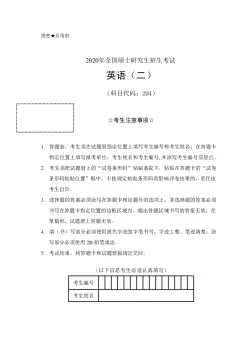
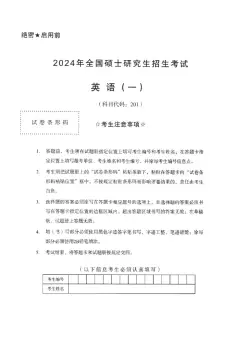
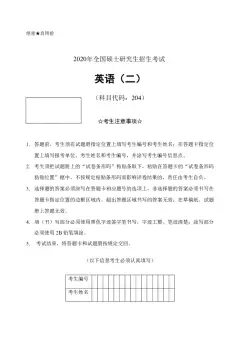
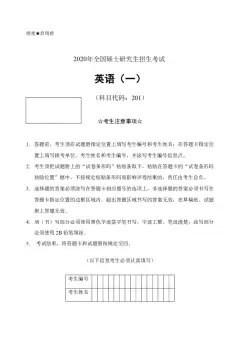
2020 年全国硕士研究生招生考试
英语(一)
(科目代码:201)
☆考生注意事项☆
1. 答题前,考生须在试题册指定位置上填写考生编号和考生姓名;在答题卡
指定位置上填写报考单位、考生姓名和考生编号,并涂写考生编号信息点。
2. 考生须把试题册上的“试卷条形码”粘贴条取下,粘贴在答题卡的“试卷
条形码粘贴位置”框中。不按规定粘贴条形码而影响评卷结果的,责任由
考生自负。
3. 选择题的答案必须涂写在答题卡相应题号的选项上,非选择题的答案必须
书写在答题卡指定位置的边框区域内。超出答题区域书写的答案无效;在
草稿纸、试题册上答题无效。
4. 填(书)写部分必须使用黑色字迹签字笔书写,字迹工整、笔迹清楚;涂
写部分必须使用 2B铅笔填涂。
5. 考试结束,将答题卡和试题册按规定交回。
(以下信息考生必须认真填写)
考生编号
考生姓名2020年全国硕士研究生招生考试英语(一)试题
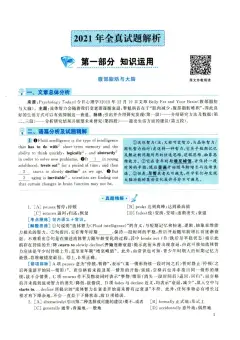
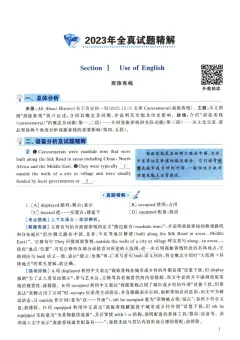
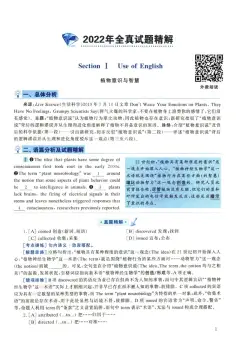
Section I Use of English
Directions:
Read the following text. Choose the best word(s) for each numbered blank and mark A,
B, CorD on the ANSWER SHEET. (10 points)
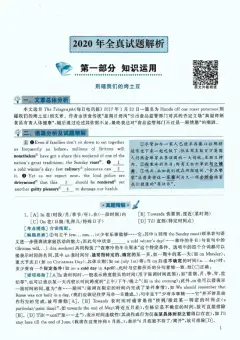
Even if families don't sit down to eat together as frequently as before, millions of
Britons will nonetheless have got a share this weekend of one of the nation's great
traditions: the Sunday roast. ] a cold winter's day, few culinary pleasures can 2
it. Yet as we report now, the food police are determined that this 3 should be rendered
yet another guilty pleasure 4 to damage our health.
The Food Standards Authority (FSA) has 5 a public warning about the risks of
a compound called acrylamide that forms in some foods cooked 6 high temperatures.
This means that people should 7 crisping their roast potatoes, reject thin-crust pizzas
and only 8 toast their bread. But where is the evidence to support such alarmist
advice? 9 studies have shown that acrylamide can cause neurological damage in
mice, there is no 10 evidence that it causes cancer in humans.
Scientists say the compound is 11 to cause cancer but have no hard scientific
proof. 12 the precautionary principle, it could be argued that it is 13 to follow
the FSA advice. 14 it was rumoured that smoking caused cancer for years before
the evidence was found to prove a 15 .
Doubtless a piece of boiled beef can always be 16 up on Sunday alongside
some steamed vegetables, without the Yorkshire pudding and no wine. But would life be
worth living? 17 the FSA says it is not telling people to cut out roast foods 18 ,
but to reduce their lifetime intake. However, its 19 risks coming a cross as being
pushy and overprotective. Constant health scares just 20 with no one listening.
2020年英语(一)试题第1页共14页1. [A] In On [C] Till [D] Towards
2. [A] match [B] express [C] satisfy [D] influence
3. [A] patience [B] concern [C] surprise [D] enjoyment
4. [A] intensified [B] guaranteed [C] compelled [D] privileged
5. [A] ignored [B] received [C] issued [D] cancelled
6. [A] under [B] by [C] for [D] at
7. [A] forget [B] avoid [C] finish [D] regret
8. [A] easily [B] regularly [C] partially [D] initially
9. [A] If [B] Since [C] While [D] Unless
10. [A] conclusive [B] external [C] secondary [D] negative
11. [A] likely [B] bound [C] insufficient [D] slow
12. [A] In addition to [B] At the cost of [C] On the basis of [D] In contrast to
13. [A] interesting [B] fortunate [C] urgent [D] advisable
14. [A] As usual :B] After all EC] By definition [D] In particular
15. [A] connection [B] combination [C] resemblance [D] pattern
16. [A] made [B] used [C] saved [D] served
17. [A] To be brief :B] For instance [C] To be fair [D] In general
18. [A] entirely [B] gradually [C] reluctantly [D] carefully
19. [A] promise [B] competition [C] experience [D] campaign
20. [A] follow up end up [C] open up [D] pick up
Section II Reading Comprehension
Part A
Directions:
Read the following four texts. Answer the questions after each text by choosing A, B, C
or D. Mark your answers on the ANSWER SHEET. (40 points)
2020年英语(一)试题第2 页共14页Text 1
A group of Labour MPs, among them Yvette Cooper, are bringing in the new year
with a call to institute a UK "town of culture^^ award. The proposal is that it should sit
alongside the existing city of culture title, which was held by Hull in 2017, and has been
awarded to Coventry for 2021. Cooper and her colleagues argue that the success of the
crown for Hull, where it brought in £220m of investment and an avalanche of arts, ought
not to be confined to cities. Britain's towns, it is true, are not prevented from applying,
but they generally lack the resources to put together a bid to beat their bigger competitors.
A town of culture award could, it is argued, become an annual event, attracting funding
and creating jobs.
Some might see the proposal as a booby prize for the fact that Britain is no longer
able to apply for the much more prestigious title of European capital of culture, a sought-
after award bagged by Glasgow in 1990 and Liverpool in 2008. A cynic might speculate
that the UK is on the verge of disappearing into an endless fever of self^celebration in its
desperation to reinvent itself for the post-Brexit world: after town of culture, who knows
what will follow- village of culture? Suburb of culture? Hamlet of culture?
It is also wise to recall that such titles are not a cure-all. A badly run "year of
culture^^ washes in and out of a place like the tide, bringing prominence for a spell but
leaving no lasting benefits to the community. The really successful holders of such titles
are those that do a great deal more than fill hotel bedrooms and bring in high-profile arts
events and good press for a year. They transform the aspirations of the people who live
there; they nudge the self-image of the city into a bolder and more optimistic light. It is
hard to get right, and requires a remarkable degree of vision, as well as cooperation
between city authorities, the private sector, community groups and cultural organisations.
But it can be done: Glasgow's year as European capital of culture can certainly be seen
as one of a complex series of factors that have turned the city into the powerhouse of
art, music and theatre that it remains today.
A "town of culture“ could be not just about the arts but about honouring a town's
peculiarities- helping sustain its high street, supporting local facilities and above all
celebrating its people. Jeremy Wright, the culture secretary, should welcome this positive,
hope-filled proposal, and turn it into action.
2020年英语(一)试题第3 页共14页21. Cooper and her colleagues argue that a “town of culture“ award could
[A] consolidate the town-city ties in Britain.
[B] promote cooperation among Britain's towns.
[C] increase the economic strength of Britain's towns.
[D] focus Britain's limited resources on cultural events.
22. According to Paragraph 2, the proposal might be regarded by some as
[A] a sensible compromise.
[B] a self^deceiving attempt.
[C] an eye-catching bonus.
[D] an inaccessible target.
23. The author suggests that a title holder is successful only if it
[A] endeavours to maintain its image.
[B] meets the aspirations of its people.
[C] brings its local arts to prominence.
[D] commits to its long-term growth.
24. Glasgow is mentioned in Paragraph 3 to present
[A] a contrasting case.
[B] a supporting example.
[C] a background story.
[D] a related topic.
25. What is the author's attitude towards the proposal?
[A] Skeptical.
[B] Objective.
[C] Favourable.
[D] Critical.
2020年英语(一)试题第4 页共14页Text 2
Scientific publishing has long been a licence to print money. Scientists need
journals in which to publish their research, so they will supply the articles without
monetary reward. Other scientists perform the specialised work of peer review also for
free, because it is a central element in the acquisition of status and the production of
scientific knowledge.
With the content of papers secured for free, the publisher needs only to find a
market for its journal. Until this century, university libraries were not very price sensitive.
Scientific publishers routinely report profit margins approaching 40% on their operations,
at a time when the rest of the publishing industry is in an existential crisis.
The Dutch giant Elsevier, which claims to publish 25% of the scientific papers
produced in the world, made profits of more than £900m last year, while UK
universities alone spent more than £210m in 2016 to enable researchers to access their
own publicly funded research; both figures seem to rise unstoppably despite increasingly
desperate efforts to change them.
The most drastic, and thoroughly illegal, reaction has been the emergence of Sci-
Hub, a kind of global photocopier for scientific papers, set up in 2012, which now
claims to offer access to every paywalled article published since 2015. The success of
Sci-Hub, which relies on researchers passing on copies they have themselves legally
accessed, shows the legal ecosystem has lost legitimacy among its users and must be
transformed so that it works for all participants.
In Britain the move towards open access publishing has been driven by funding
bodies. In some ways it has been very successful. More than half of all British
scientific research is now published under open access terms: either freely available from
the moment of publication, or paywalled for a year or more so that the publishers can
make a profit before being placed on general release.
Yet the new system has not worked out any cheaper for the universities. Publishers
have responded to the demand that they make their product free to readers by charging
their writers fees to cover the costs of preparing an article. These range from around
£500 to $5,000. A report last year pointed out that the costs both of subscriptions and
of these “article preparation costs“ had been steadily rising at a rate above inflation. In
some ways the scientific publishing model resembles the economy of the social internet:
labour is provided free in exchange for the hope of status, while huge profits are made by
a few big firms who run the market places. In both cases, we need a rebalancing of
power.
2020年英语(一)试题第5 页共14页26. Scientific publishing is seen as “a licence to print money,, partly because
[A] its funding has enjoyed a steady increase.
[B] its marketing strategy has been successful.
[C] its payment for peer review is reduced.
[D] its content acquisition costs nothing.
27. According to Paragraphs 2 and 3, scientific publishers like Elsevier have
[A] thrived mainly on university libraries.
[B] gone through an existential crisis.
[C] revived the publishing industry.
[D] financed researchers generously.
28. How does the author feel about the success of Sci-Hub?
[A] Relieved.
[B] Puzzled.
[C] Concerned.
[D] Encouraged.
29. It can be learned from Paragraphs 5 and 6 that open access terms
[A] allow publishers some room to make money.
[B] render publishing much easier for scientists.
[C] reduce the cost of publication substantially.
[D] free universities from financial burdens.
30. Which of the following characterises the scientific publishing model?
[A] Trial subscription is offered.
[B ] Labour triumphs over status.
[C] Costs are well controlled.
[D] The few feed on the many.
2020年英语(一)试题第6 页共14页Text 3
Progressives often support diversity mandates as a path to equality and a way to
level the playing field. But all too often such policies are an insincere form of virtue
signaling that benefits only the most privileged and does little to help average people.
A pair of bills sponsored by Massachusetts state Senator Jason Lewis and House
Speaker Pro Tempore Patricia Haddad, to ensure "gender parity“ on boards and
commissions, provide a case in point.
Haddad and Lewis are concerned that more than half the state-government boards
are less than 40 percent female. In order to ensure that elite women have more such
opportunities, they have proposed imposing government quotas. If the bills become law,
state boards and commissions will be required to set aside 50 percent of board seats for
women by 2022.
The bills are similar to a measure recently adopted in California, which last year
became the first state to require gender quotas for private companies. In signing the
measure, California Governor Jerry Brown admitted that the law, which expressly
classifies people on the basis of sex, is probably unconstitutional.
The US Supreme Court frowns on sex-based classifications unless they are
designed to address an "important“ policy interest, Because the California law applies to
all boards, even where there is no history of prior discrimination, courts are likely to rule
that the law violates the constitutional guarantee of "equal protection.”
But are such government mandates even necessary? Female participation on
corporate boards may not currently mirror the percentage of women in the general
population, but so what?
The number of women on corporate boards has been steadily increasing without
government interference. According to a study by Catalyst, between 2010 and 2015 the
share of women on the boards of global corporations increased by 54 percent.
Requiring companies to make gender the primary qualification for board
membership will inevitably lead to less experienced private sector boards. That is
exactly what happened when Norway adopted a nationwide corporate gender quota.
Writing in The New Republic. Alice Lee notes that increasing the number of
opportunities for board membership without increasing the pool of qualified women to
serve on such boards has led to a "golden skirt“ phenomenon, where the same elite
women scoop up multiple seats on a variety of boards.
Next time somebody pushes corporate quotas as a way to promote gender equity,
remember that such policies are largely self-serving measures that make their sponsors
feelgood but do little to help average women.
2020年英语(一)试题第7 页共14页31. The author believes that the bills sponsored by Lewis and Haddad will
[A] help little to reduce gender bias.
[B] pose a threat to the state government.
[C] raise women's position in politics.
[D] greatly broaden career options.
32. Which of the following is true of the California measure?
[A] It has irritated private business owners.
[B] It is welcomed by the Supreme Court.
[C] It may go against the Constitution.
[D] It will settle the prior controversies.
33. The author mentions the study by Catalyst to illustrate
[A] the harm from arbitrary board decisions.
[B] the importance of constitutional guarantees.
[C] the pressure on women in global corporations.
[D] the needlessness of government interventions.
34. Norway9 s adoption of a nationwide corporate gender quota has led to
[A] the underestimation of elite women's role.
[B] the objection to female participation on boards.
[C] the entry of unqualified candidates into the board.
[D] the growing tension between labor and management.
35. Which of the following can be inferred from the text?
[A] Women5s needs in employment should be considered.
[B] Feasibility should be a prime concern in policymaking.
[C] Everyone should try hard to promote social justice.
[D] Major social issues should be the focus of legislation.
2020年英语(一)试题第8 页共14页Text 4
Last Thursday, the French Senate passed a digital services tax, which would impose
an entirely new tax on large multinationals that provide digital services to consumers or
users in France. Digital services include everything from providing a platform for selling
goods and services online to targeting advertising based on user data, and the tax applies
to gross revenue from such services. Many French politicians and media outlets have
referred to this as a "GAFA tax,“ meaning that it is designed to apply primarily to
companies such as Google, Apple, Facebook and Amazon- in other words, multinational
tech companies based in the United States.
The digital services tax now awaits the signature of President Emmanuel Macron,
who has expressed support for the measure, and it could go into effect within the next
few weeks. But it has already sparked significant controversy, with the United States
trade representative opening an investigation into whether the tax discriminates against
American companies, which in turn could lead to trade sanctions against France.
The French tax is not just a unilateral move by one country in need of revenue.
Instead, the digital services tax is part of a much larger trend, with countries over the
past few years proposing or putting in place an alphabet soup of new international tax
provisions. These have included Britain's DPT (diverted profits tax), Australia's MAAL
(multinational antiavoidance law), and India's SEP (significant economic presence) test,
to name but a few. At the same time, the European Union, Spain, Britain and several
other countries have all seriously contemplated digital services taxes.
These unilateral developments differ in their specifics, but they are all designed to tax
multinationals on income and revenue that countries believe they should have a right to tax,
even if international tax rules do not grant them that right. In other words, they all share a
view that the international tax system has failed to keep up with the current economy.
In response to these many unilateral measures, the Organization for Economic
Cooperation and Development (OECD) is currently working with 131 countries to reach
a consensus by the end of 2020 on an international solution. Both France and the United
States are involved in the organization's work, but France's digital services tax and the
American response raise questions about what the future holds for the international tax
system.
France's planned tax is a clear warning: Unless a broad consensus can be reached
on reforming the international tax system, other nations are likely to follow suit, and
American companies will face a cascade of different taxes from dozens of nations that
will prove burdensome and costly.
2020年英语(一)试题第9 页共14页36. The French Senate has passed a bill to
[A] regulate digital services platforms.
[B] impose a levy on tech multinationals.
[C] protect French companies9 interests.
[D] curb the influence of advertising.
37. It can be learned from Paragraph 2 that the digital services tax
[A] will prompt the tech giants to quit France.
[B] aims to ease international trade tensions.
[C] is apt to arouse criticism at home and abroad.
[D] may trigger countermeasures against France.
38. The countries adopting the unilateral measures share the opinion that
[A] the current international tax system needs upgrading.
[B] redistribution of tech giants' revenue must be ensured.
[C] tech multinationals9 monopoly should be prevented.
[D] all countries ought to enjoy equal taxing rights.
39. It can be learned from Paragraph 5 that the OECD's current work
[A] is being resisted by US companies.
[B] is faced with uncertain prospects.
[C] needs to be readjusted immediately.
[D] needs to involve more countries.
40. Which of the following might be the best title for this text?
[A] France leads the charge on Digital Tax
[B] France Is Confronted with Trade Sanctions
[C] France Demands a Role in the Digital Economy
[D] France Says "NO" to Tech Multinationals
2020年英语(一)试题第10页共14页Part B
Directions:
Read the following text and answer the questions by choosing the most suitable subheading
from the list A-G for each of the numbered paragraphs (41-45). There are two extra
subheadings which you do not need to use. Mark your answers on the ANSWER SHEET.
(10 points)
[A] Eye fixations are brief.
[B] TOO much eye contact is instinctively felt to be rude.
[C] Eye contact can be a friendly social signal.
[D] Personality can affect how a person reacts to eye contact.
[E] Biological factors behind eye contact are being investigated.
[F] Most people are not comfortable holding eye contact with strangers.
[G] Eye contact can be aggressive.
In a social situation, eye contact with another person can show that you are paying
attention in a friendly way. But it can also be antagonistic, such as when a political
candidate turns toward their competitor during a debate and makes eye contact that
signals hostility. Here9s what hard science reveals about eye contact:
41.
We know that a typical infant will instinctively gaze into its mother's eyes, and she
will look back. This mutual gaze is a major part of the attachment between mother and
child. In adulthood, looking at someone else in a pleasant way can be a complimentary
sign of paying attention. It can catch someone's attention in a crowded room, “Eye
contact and smiles^^ can signal availability and confidence, a common-sense notion
supported in studies by psychologist Monica Moore.
42.
Neuroscientist Bonnie Auyeung found that the hormone oxytocin increased the
amount of eye contact from men toward the interviewer during a brief interview when
the direction of their gaze was recorded. This was also found in high-functioning men
2020年英语(一)试题第n 页共14页with some autistic spectrum symptoms, who may tend to avoid eye contact. Specific
brain regions that respond during direct gaze are being explored by other researchers,
using advanced methods of brain scanning.
43.
With the use of eye-tracking technology, Julia Minson of the Harvard Kennedy
School of Government concluded that eye contact can signal very different kinds of
messages, depending on the situation. While eye contact may be a sign of connection or
trust in friendly situations, it's more likely to be associated with dominance or
intimidation in adversarial situations. "Whether you9re a politician or a parent, it might
be helpful to keep in mind that trying to maintain eye contact may backfire if you9re
trying to convince someone who has a different set of beliefs than you,“said Minson.
44.
When we look at a face or a picture, our eyes pause on one spot at a time, often on
the eyes or mouth. These pauses typically occur at about three per second, and the eyes
then jump to another spot, until several important points in the image are registered like
a series of snapshots. How the whole image is then assembled and perceived is still a
mystery although it is the subject of current research.
45.
In people who score high in a test of neuroticism, a personality dimension
associated with self-consciousness and anxiety, eye contact triggered more activity
associated with avoidance,according to the Finnish researcher Jari Hietanen and
colleagues. ctOur findings indicate that people do not only feel different when they are
the centre of attention but that their brain reactions also differ." A more direct finding is
that people who scored high for negative emotions like anxiety looked at others for
shorter periods of time and reported more comfortable feelings when others did not look
directly at them.
2020年英语(一)试题第12页共14页Part C
Directions:
Read the following text carefully and then translate the underlined segments into
Chinese. Write your answers on the ANSWER SHEET. (10 points)
Following the explosion of creativity in Florence during the 14th century known as
the Renaissance, the modem world saw a departure from what it had once known. It
turned from God and the authority of the Roman Catholic Church and instead favoured
a more humanistic approach to being. Renaissance ideas had spread throughout Europe
well into the 17th century,with the arts and sciences flourishing extraordinarily among
those with a more logical disposition. (46) with the Church's teachings and ways of
thinking being eclipsed by the Renaissance, the gap between the Medieval and modem
periods had been bridged、leading to new and unexplored intellectual territories.
During the Renaissance, the great minds of Nicolaus Copernicus, Johannes Kepler
and Galileo Galilei demonstrated the power of scientific study and discovery. (47)
Before each of their revelations, many thinkers at the time had sustained more ancient
ways of thinking, including the geocentric view that the Earth was at the centre of our
universe. Copernicus theorized in 1543 that all of the planets that we knew of revolved
not around the Earth, but the Sun, a system that was later upheld by Galileo at his own
expense. Offering up such a theory during a time of high tension between scientific and
religious minds was branded as heresy, and any such heretics that continued to spread
these lies were to be punished by imprisonment or even death.
(48) Despite attempts by the Church to suppress this new generation of logicians
and rationalists, more explanations for how the universe fiinctioned were being made
at a rate that the people could no longer ignore. It was with these great revelations that a
new kind of philosophy founded in reason was bom.
The Church5s long-standing dogma was losing the great battle for truth to
rationalists and scientists. This very fact embodied the new ways of thinking that swept
through Europe during most of the 17th century. (49) As many took on the duty of
trying to integrate reasoning and scientific philosophies into the world, the Renaissance
was over and it was time for a new era - the Age of Reason.
The 17th and 18th centuries were times of radical change and curiosity, Scientific
method, reductionism and the questioning of Church ideals was to be encouraged, as
were ideas of liberty, tolerance and progress. (50) Such actions to seek knowledge and
to understand what information we already knew were captured by the Latin phrase
'sapere aude' or 'dare to know: after Immanuel Kant used it in his essay "An Answer to
the Question: What is Enlightenment? It was the purpose and responsibility of great
minds to go forth and seek out the truth, which they believed to be founded in knowledge.
2020年英语(一)试题第13页共14页Section III Writing
Part A
51. Directions:
The student Union of your university has assigned you to inform the international
students about an upcoming singing contest. Write a notice in about 100 words.
Write your answer on the ANSWER SHEET.
Do not use your own name in the notice. (10 points)
Part B
52. Directions:
Write an essay of 160-200 words based on the pictures below. In your essay,
you should
1) describe the pictures briefly,
2) interpret the implied meaning, and
3) give your comments.
Write your answer on the ANSWER SHEET. (20 points)
习惯
2020年英语(一)试题第14页共14页
![《2020年考研英语一真题可复制搜索查词_考研真题_x_英语一真题+解析[80-25]_英语一2010-2024真题及解析_2010-2024考研英语一真题(PDF)》第1页预览](https://static.diaifu.net/ssd/ssd5/wenku/2026-04-17/17e1bbfe2b0c790c1bd3c866e68f7567/17e1bbfe2b0c790c1bd3c866e68f7567_1.webp)
![《2020年考研英语一真题可复制搜索查词_考研真题_x_英语一真题+解析[80-25]_英语一2010-2024真题及解析_2010-2024考研英语一真题(PDF)》第2页预览](https://static.diaifu.net/ssd/ssd5/wenku/2026-04-17/17e1bbfe2b0c790c1bd3c866e68f7567/17e1bbfe2b0c790c1bd3c866e68f7567_2.webp)
![《2020年考研英语一真题可复制搜索查词_考研真题_x_英语一真题+解析[80-25]_英语一2010-2024真题及解析_2010-2024考研英语一真题(PDF)》第3页预览](https://static.diaifu.net/ssd/ssd5/wenku/2026-04-17/17e1bbfe2b0c790c1bd3c866e68f7567/17e1bbfe2b0c790c1bd3c866e68f7567_3.webp)
![《2020年考研英语一真题可复制搜索查词_考研真题_x_英语一真题+解析[80-25]_英语一2010-2024真题及解析_2010-2024考研英语一真题(PDF)》第4页预览](https://static.diaifu.net/ssd/ssd5/wenku/2026-04-17/17e1bbfe2b0c790c1bd3c866e68f7567/17e1bbfe2b0c790c1bd3c866e68f7567_4.webp)
![《2020年考研英语一真题可复制搜索查词_考研真题_x_英语一真题+解析[80-25]_英语一2010-2024真题及解析_2010-2024考研英语一真题(PDF)》第5页预览](https://static.diaifu.net/ssd/ssd5/wenku/2026-04-17/17e1bbfe2b0c790c1bd3c866e68f7567/17e1bbfe2b0c790c1bd3c866e68f7567_5.webp)
![《2020年考研英语一真题可复制搜索查词_考研真题_x_英语一真题+解析[80-25]_英语一2010-2024真题及解析_2010-2024考研英语一真题(PDF)》第6页预览](https://static.diaifu.net/ssd/ssd5/wenku/2026-04-17/17e1bbfe2b0c790c1bd3c866e68f7567/17e1bbfe2b0c790c1bd3c866e68f7567_6.webp)
![《2020年考研英语一真题可复制搜索查词_考研真题_x_英语一真题+解析[80-25]_英语一2010-2024真题及解析_2010-2024考研英语一真题(PDF)》第7页预览](https://static.diaifu.net/ssd/ssd5/wenku/2026-04-17/17e1bbfe2b0c790c1bd3c866e68f7567/17e1bbfe2b0c790c1bd3c866e68f7567_7.webp)
![《2020年考研英语一真题可复制搜索查词_考研真题_x_英语一真题+解析[80-25]_英语一2010-2024真题及解析_2010-2024考研英语一真题(PDF)》第8页预览](https://static.diaifu.net/ssd/ssd5/wenku/2026-04-17/17e1bbfe2b0c790c1bd3c866e68f7567/17e1bbfe2b0c790c1bd3c866e68f7567_8.webp)