




文档内容
选择性必修第四册 Unit 5 Launching Your Career
Ⅰ.阅读理解
A
British sculptor Jason Taylor has made it his mission to use his talent to conserve our
ecosystems by creating underwater museums.Over the years,the environmentalist has put over
850 massive artworks underwater worldwide.On February 1,2021,Taylor launched his latest work
—The Underwater Museum of Cannes.
“The main goal was to bring attention to the fact that our oceans need our help,” Taylor
told Dezeen.“Ocean ecology has been destroyed by human activity in the Mediterranean over the
past few decades,and it is not obvious what is taking place when observing the sea from afar.”
The Underwater Museum of Cannes contains 6 sculptures featuring local residents of various
ages.They range from Maurice,an 80yearold fisherman,to Anouk,a 9yearold student.Towering
over 6feettall and weighing 10 tons,the faces are sectioned into two parts,with the outer part
like a mask.The mask indicates that the world’s oceans appear powerful and unbeatable from the
surface but house an ecosystem that is extremely fragile to careless human activities.
Though the waters surrounding the sculptures now appear a pristine blue,the seabed was
filled with old boat engines,pipes,and other humanmade trash when the project began about
four years ago.Besides removing the trash,Taylor also restored the area’s seagrass.Just one
square meter of the seagrass can generate up to 10 liters of oxygen daily.The seagrass also helps
prevent coastal erosion and provides habitats for many ocean creatures.
“The idea of creating an underwater museum was to draw more people underwater and
develop a sense of care and protection,” Taylor told Dezeen.“If we threw unwanted waste near
a forest,there would be a public outcry.But this is happening every day in our surrounding waters
and it largely goes unnoticed.”
1.Why does Jason Taylor create underwater museums?
A.To protect the artworks underwater.
B.To draw attention to endangered sea animals.
C.To show his sculpture talent.
D.To raise awareness of protecting the ocean.
2.Why does the outer part of the sculptures look like a mask?
A.To popularize the features of the locals.
B.To remind people to protect themselves.
C.To reflect people’s protection of the ocean.
D.To stress the sensitiveness of the ecosystem.3.What’s paragraph 4 mainly about?
A.How the project was started.
B.How the seagrass was restored.
C.What recovery effort the project made.
D.Why the surroundings were improved.
4.What can we infer from what Jason Taylor said in the last paragraph?
A.The situation of the ocean is easily ignored.
B.The destruction caused to the ocean is noticeable.
C.Forests play a more important role in ecosystems.
D.People have zero tolerance to damage done to nature.
B
There are some 7,000 languages spoken worldwide,each unique,using different sounds,
vocabularies and structures.Charles the Great said,“To have a second language is to have a
second soul.” This begs the question:Does the language we speak shape who we are? As it turns
out,yes.
In societies such as the United States or Western Europe ,selfexpression and language
precision are valued.Asian cultures , on the other hand , prefer an indirect form of
communication.Words like “perhaps” and “maybe” are used more than “yes” or
“no”.Americanism takes an informal approach to communication.Therefore it’s OK to refer
to a stranger or the boss as “you”.However,the Thai language has 12 forms of the same
pronoun,choosing one depends on status.In this way,languages are essential in navigating(导航)
any culture,be that our own or otherwise.
People who speak different languages notice different things,depending on the constructs of
their mother tongue.Take an accident.In English,it’s OK to say:“She broke the glass.” But
in a language like Spanish,you’d probably go with:“The glass broke.” The same incident
produces two different responses.English speakers will remember who’s at fault,because their
language asks them to , while Spanish speakers are more likely to remember it was an
accident.This has real consequences,especially when it comes to crime and punishment.
Professor Jim Cummins has written extensively on mother tongues.For Cummins , the
stronger our home language,the easier it is for us to learn others.Of course,research also shows
that being bilingual(会说两种语言的) gives people many advantages in life.Linguist Julien Leyre
writes that learning another language develops our ability to “understand the mental world of
another person,based on the language they use,and how that world is different from our own.”
Our mother tongue is central to how we think,what we know and who we are.Like us,
languages are living things that change over time and must be cared for to survive.By doing so,
we protect not just the linguistic structures or vocabularies we use,but the culture,knowledge
and power behind them.5.Why does the author mention “Americanism” and “the Thai language” in paragraph 2?
A.To tell the cultural differences between them.
B.To indicate a language is a guide to a culture.
C.To stress American expressions are informal.
D.To reveal a language is associated with status.
6.What is English speakers’ response to an accident?
A.They will seek blame.
B.They will punish others.
C.They will avoid responsibility.
D.They will draw a lesson from it.
7.What does Julien Leyre think about bilinguals?
A.They enjoy a more colorful life.
B.They can remain mentally healthy.
C.They find it easier to learn a language.
D.They can gain insight into others’ minds.
8.What can be the best title for the text?
A.How Do Languages Differ?
B.Will Your Language Be Extinct?
C.Why Does Our Mother Tongue Matter?
D.Should We Speak a Second Language?
Ⅱ.完形填空
Literature was something I was interested in.At school I was that kid who stuck his hand up to
1 aloud from the Shakespeare play.Over the holidays I would visit the 2 and read
literatures.While my generation was playing after school,I was in a ghetto(贫民区) learning to
3 .
I lived then in Lagos.The ghetto landlords had unlimited 4 .They could throw families
with all their possessions out into the street.Annoyed,I wrote about 5 .Those pieces were not
published.Then it occurred to me to write a story about them.This began my long 6 in the
rigorous craft(严谨构思) of the short story.
However,after finishing my Alevels,I had a job working for a paint company. 7 in
Lagos was so terrible that it took three hours to get to work.I would wake up at 4 a.m.and write
for an hour before 8 work.When I 9 I would sleep and then write till one o’clock.
The first 10 took a year.I got myself 11 from work and bought a typewriter with
the severance pay(解雇金).I then worked as a reporter for a news magazine.In the autumn of
1978 I came to London to study.I came really to write.I began 12 and sent the manuscript to
many 13 ,who all turned it down.
Then,one morning,a letter came from Longmans’ African Writers’ Series.I remembergiving a cry of 14 .That moment changed everything.I was 19.With the publication of
Flowers and Shadows,the life I was meant to live 15 .
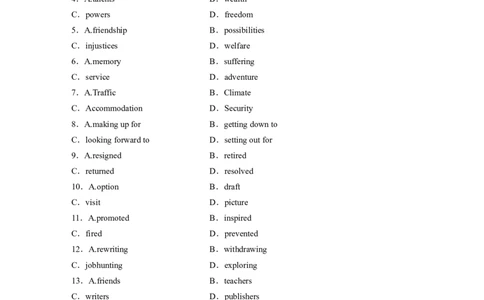
1.A.think B.read
C.cry D.speak
2.A.libraries B.charities
C.exhibitions D.attractions
3.A.act B.write
C.cook D.paint
4.A.talents B.wealth
C.powers D.freedom
5.A.friendship B.possibilities
C.injustices D.welfare
6.A.memory B.suffering
C.service D.adventure
7.A.Traffic B.Climate
C.Accommodation D.Security
8.A.making up for B.getting down to
C.looking forward to D.setting out for
9.A.resigned B.retired
C.returned D.resolved
10.A.option B.draft
C.visit D.picture
11.A.promoted B.inspired
C.fired D.prevented
12.A.rewriting B.withdrawing
C.jobhunting D.exploring
13.A.friends B.teachers
C.writers D.publishers
14.A.fear B.joy
C.pain D.sorrow
15.A.ended B.changed
C.began D.improved
Ⅲ.语法填空
First Chinese lanterns were invented in the Eastern Han Dynasty and used as lamps and for the
worship of the Buddha.With 1. (them) rich colors and nice shapes,lanterns add to
the atmosphere of festivals.In the Tang Dynasty , lanterns were made 2.(show)people’s peaceful life and present China as a powerful country.The materials 3.
are used for making a lantern are very simple.Historically,bamboo,wood or wire was used for
the frame.The shade was crafted from delicate paper or silk.Chinese calligraphy,painting and
paper cutting were often used for 4. (decorate) the lanterns.
While first 5. (create) for practical use in the house,the Chinese lanterns
eventually became 6. (high) decorative,and a status symbol.Although there is no
longer a practical need for Chinese lanterns,they are still made,used,and enjoyed by the
Chinese people during festivals.The streets both in big cities 7. small towns are
decorated with red lanterns during festivals.
The Lantern Festival is one of the best 8. (day) to view Chinese lanterns in action.It is
always held on the 15th day of the first Chinese lunar month.The festival is viewed 9. the
end to the Chinese New Year celebrations and it 10. (celebrate) with the release of
floating and flying lanterns.