2025 年第一次广东省普通高中学业水平合格性考试
英语仿真模拟试卷 02
(考试时间:90 分钟 满分 150 分)
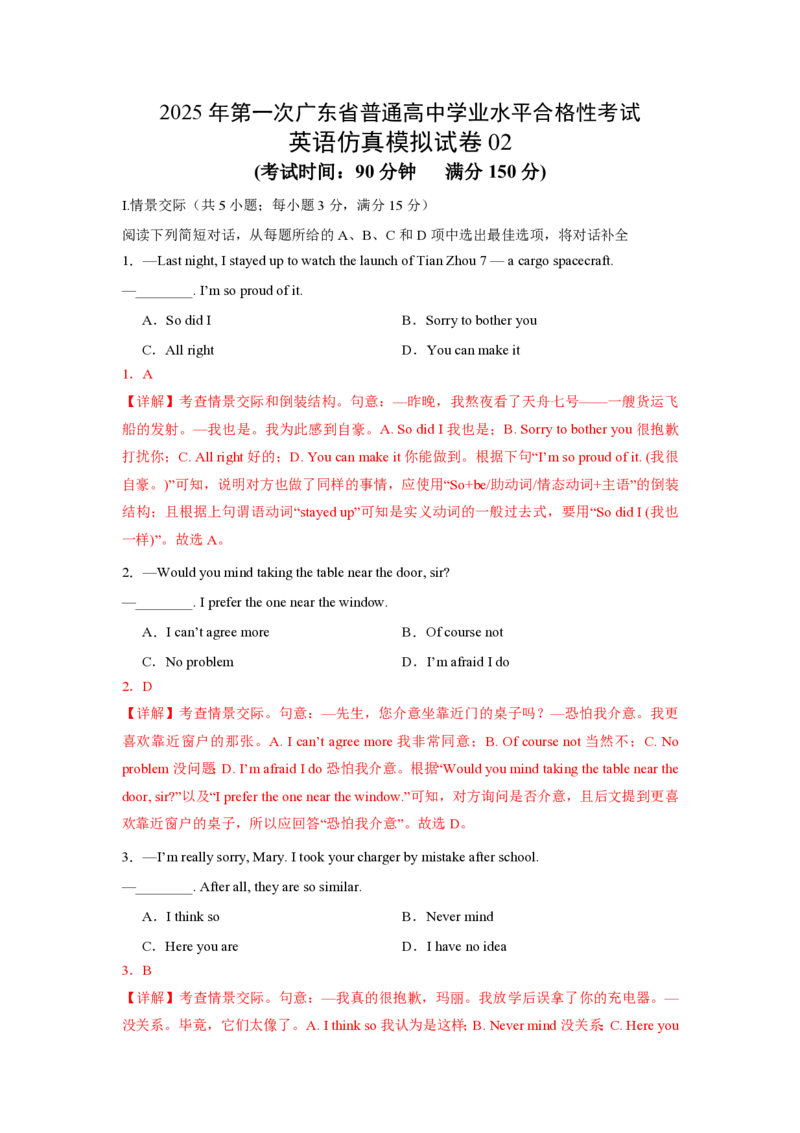
I.情景交际(共5小题;每小题3分,满分15分)
阅读下列简短对话,从每题所给的A、B、C和D项中选出最佳选项,将对话补全
1.—Last night, I stayed up to watch the launch of Tian Zhou 7 — a cargo spacecraft.
—________. I’m so proud of it.
A.So did I B.Sorry to bother you
C.All right D.You can make it
1.A
【详解】考查情景交际和倒装结构。句意:—昨晚,我熬夜看了天舟七号——一艘货运飞
船的发射。—我也是。我为此感到自豪。A. So did I我也是;B. Sorry to bother you很抱歉
打扰你;C. All right好的;D. You can make it你能做到。根据下句“I’m so proud of it. (我很
自豪。)”可知,说明对方也做了同样的事情,应使用“So+be/助动词/情态动词+主语”的倒装
结构;且根据上句谓语动词“stayed up”可知是实义动词的一般过去式,要用“So did I (我也
一样)”。故选A。
2.—Would you mind taking the table near the door, sir?
—________. I prefer the one near the window.
A.I can’t agree more B.Of course not
C.No problem D.I’m afraid I do
2.D
【详解】考查情景交际。句意:—先生,您介意坐靠近门的桌子吗?—恐怕我介意。我更
喜欢靠近窗户的那张。A. I can’t agree more 我非常同意;B. Of course not 当然不;C. No
problem没问题;D. I’m afraid I do恐怕我介意。根据“Would you mind taking the table near the
door, sir?”以及“I prefer the one near the window.”可知,对方询问是否介意,且后文提到更喜
欢靠近窗户的桌子,所以应回答“恐怕我介意”。故选D。
3.—I’m really sorry, Mary. I took your charger by mistake after school.
—________. After all, they are so similar.
A.I think so B.Never mind
C.Here you are D.I have no idea
3.B
【详解】考查情景交际。句意:—我真的很抱歉,玛丽。我放学后误拿了你的充电器。—
没关系。毕竟,它们太像了。A. I think so我认为是这样;B. Never mind没关系;C. Here youare给你;D. I have no idea我不知道。根据句意,对方表示歉意,应回答“没关系”以表安慰。
故选B。
4.—Zhang Dawei did not pass the driving test yesterday.
—________!
A.Good luck B.Good idea C.My pleasure D.What a pity
4.D
【详解】考查情景交际。句意:—张大伟昨天没有通过驾驶考试。—真可惜!A. Good luck
祝好运;B. Good idea好主意;C. My pleasure我的荣幸;D. What a pity真可惜。根据“Zhang
Dawei did not pass the driving test yesterday.”可知,对方提到不好的消息,回答时应该表达对
此事的遗憾或同情,选项D符合语境。故选D。
5.—Excuse me, could you tell me the way to the National Museum?
—________. I’m new here.
A.I hope so B.No problem C.Never mind D.I’m sorry
5.D
【详解】考查情景交际。句意:—打扰一下,您能告诉我去国家博物馆怎么走吗?—不好
意思,我也是刚来这儿。A. I hope so希望如此;B. No problem没问题;C. Never mind没关
系;D. I’m sorry对不起。根据句意可知,此处对问路作出应答,礼貌地表示不知道,应用
I’m sorry。故选D。
II.阅读(共15小题;每小题3分,满分45分)
第一节 阅读下列短文,掌握其大意,然后从每题所给的A、B、C和D项中选出最佳选项。
A
The FIFA World Cup came to an end in December 2022. But the love for soccer is still
very much alive and well in Zibo, Shandong Province. Zibo is called “the home of soccer ball”.
It’s the birthplace of the ancient Chinese sport of cuju. In 2004, cuju won the recognition of FIFA
— soccer’s governing body — as the earliest form of soccer.
The Chinese character cu means to kick. Ju means an ancient type of leather ball. It has
feathers (羽毛) or grain chaff (谷糠) inside. The ancient Chinese historical text Zhan Guo Ce says
cuju was a form of amusement among common people. But during the Han Dynasty, soldiers
played cuju for army training. During the Tang Dynasty, women played cuju at the royal court
(朝廷) for the amusement of the emperors. It entered the golden age in the Song Dynasty when it
became popular among every class. Yet, the 2,000-year-old game slowly got out of people’s lives
during the Ming Dynasty.Li Weipeng, 34, from Linzi district of Zibo city, is a seventh-generation inheritor (传承人)
of cuju. He has been practicing cuju skills for 18 years. Mastering different cuju skills is not easy.
“At the beginning, I spent eight hours a day practicing juggling (颠球) a ball. It was tiring,” Li
told China Daily. He now can juggle a ball with his foot over 10,000 times in a row.
Teaching students cuju moves is a part of Li’s job. The traditional Chinese sport cuju is
now popular at primary and middle schools in Linzi. “Students show great interest in playing
cuju. It encourages me to promote the ancient sport,” Li said.
6.Why is Zibo called “the home of soccer ball”?
A.Because cuju was born there. B.Because people there love soccer.
C.Because there is a branch of FIFA. D.Because modern soccer began there.
7.What is the main idea of Paragraph 2?
A.The way of making cuju. B.The development of cuju.
C.The value of cuju to the world. D.The popularity of cuju among the Chinese.
8.In the Ming Dynasty, cuju _______.
A.was used to train soldiers B.was enjoyed by the emperors
C.became popular among women D.slowly disappeared in people’s lives
9.Which of the following is true about Li Weipeng?
A.He is the only inheritor of cuju.
B.He thinks it easy to learn cuju skills.
C.He now practises cuju eight hours a day.
D.He passes down cuju skills to the younger generation.
10.What the best title for the passage?
A.Zibo — a city of soccer fans B.Cuju — its yesterday and today
C.Soccer — a popular sport in China D.Li Weipeng — a devoted instructor of cuju
6.A 7.B 8.D 9.D 10.B
【导语】本文是一篇说明文。主要介绍了山东淄博被称为“足球之乡”,是古代运动蹴鞠的
发源地。讲述了蹴鞠的历史发展,包括其在不同朝代的用途和流行程度,还介绍了淄博临
淄的蹴鞠第七代传承人李为鹏,他练习蹴鞠技艺多年,并致力于在学校推广蹴鞠,如今蹴
鞠在当地中小学颇受欢迎。
6.细节理解题。根据第一段“Zibo is called the home of soccer ball. It’s the birthplace of the
ancient Chinese sport of cuju. (淄博被称为“足球之乡”。它是中国古代蹴鞠运动的发源地。)”可知,淄博被称为“足球之乡”是因为它是古代中国足球运动蹴鞠的发源地。故选
A。
7.主旨大意题。第二段主要讲述了蹴鞠的发展历程,从古代作为民间娱乐活动,到汉代士
兵用于军事训练,再到唐代女性在宫廷中玩蹴鞠供皇帝娱乐,最后在宋代进入黄金时期,
但在明代逐渐淡出人们的生活。因此,第二段的主要意思是蹴鞠的发展过程。故选B。
8.细节理解题。根据第二段“Yet, the 2,000-year-old game slowly got out of people’s lives
during the Ming Dynasty. (然而,这项有着2000多年历史的游戏在明代逐渐淡出了人们的生
活。)”可知,在明代,这项拥有2000多年历史的运动逐渐淡出了人们的生活。故选D。
9.细节理解题。根据第四段“Teaching students cuju moves is a part of Li’s job. (教学生蹴
鞠动作是李的工作之一。)”可知,李伟鹏的工作之一是教学生蹴鞠的动作,即他将蹴鞠技
能传授给了年轻一代。故选D。
10.主旨大意题。通读全文可知,文章主要介绍了蹴鞠这一古代中国足球运动的历史、发
展以及现代传承情况,特别是通过李伟鹏这一现代传承人的故事来展现。故选B。
B
Chinese New Year is right around the corner! This is the time of year when we “sweep
away the dust". We give our homes a good, thorough cleaning. We do this in order to make a
clean, first start in the new year.
Another great way to start fresh is to get rid of all the clutter. Over a year ago, I did just
that. In preparation for a move, I found a lot of things were not used. So l gave away around 75
percent of my clothes. I got rid of 60 percent of my furnishings. A first, I was afraid I would miss
those things. However, I soon realized what a burden on my life that excess had become. I found
that caring for fewer things means more time to spend with friends and family.
Here are some benefits simply:
More free time. The more things you own, the more time you’ spend cleaning and
organizing them. Keep only the items you need, use or enjoy. You’ll be surprised at how much
time you’ll have to do what you actually want to do.
More money. As you stop buying things you don’t need, your finances will improve. You
can save the extra money and take a special trip or an interesting class instead. Learn to reward
yourself with rich experiences, not things.
Changed values. Once you break the accumulation (累积) habit, your values shift. You
come to realize that things don’t bring lasting happiness. True joy comes from making memories
with loved ones.Living simply lowers your stress level, improves your health and allows you to focus on
what’s important. The good news is that you don’t have to wait for a holiday to start living
simply. Start living with less today and discover the peace and happiness this lifestyle can bring.
11.We clean our homes when Chinese New Year is coming because __________.
A.we will have a lot of visitors B.we want to have a good new beginning
C.we don’t like some old clothes any moreD.we are making preparations for a move
12.The underlined word “clutter” in Paragraph 2 probably means “something ________”.
A.ugly B.strange C.old-fashioned D.unnecessary
13.After the writer got rid of some of her clothes, she ________.
A.got a feeling of joy B.missed those things
C.regretted her decisions D.began to buy new clothes
14.Living simply can bring us the following benefits EXCEPT _________.
A.more free time to enjoy life B.less stress and better health
C.more chances to get promoted D.more money for rich experiences
15.Which of the following might be the best title for the passage?
A.Living with less B.Buying things you need
C.Having a thorough cleaning D.Discovering lasting happiness
11.B 12.D 13.A 14.C 15.A
【导语】本文是一篇议论文。文章由中国春节前的扫尘迎接新年写到简单生活。过多的东
西会给我们生活带来负担,而简单生活可以让我们能有更多时间做更重要的事情或者陪伴
家人。文章从三个方面说明简单生活的好处:有更多时间,省钱及价值观的改变。
11.细节理解题。根据第一段“We give our homes a good, thorough cleaning. We do this in order
to make a clean, first start in the new year. (我们会彻底打扫房屋。这样做是为了在新的一年里
有一个干净的开始。)”可知,我们在春节来临之际打扫房屋是因为我们想要有一个良好的新
开端。故选B。
12.词句猜测题。根据第二段“Another great way to start fresh is to get rid of all the clutter. Over
a year ago, I did just that. In preparation for a move, I found a lot of things were not used. (另一
个重新开始的好方法是摆脱所有的杂乱。一年多前,我就是这么做的。为了搬家做准备,
我发现很多东西都没用。)”可知,文中的“clutter”指的是不必要的东西。故选D。
13.细节理解题。根据第二段“So l gave away around 75 percent of my clothes. I got rid of 60
percent of my furnishings. At first, I was afraid I would miss those things. However, I soon
realized what a burden on my life that excess had become. (所以我送出了大约 75%的衣服。我处理掉了 60%的家具。起初,我担心我会想念那些东西。然而,我很快意识到多余的东西
给我的生活带来了多大的负担。)”可知,作者处理掉一些衣服后,获得了一种轻松的感觉,
而非后悔或想念。故选 A。
14.细节理解题。根据第四段“More free time. (有更多的空闲时间。)”、第五段“More
money. (更多钱。)”以及第七段“Living simply lowers your stress level, improves your health and
allows you to focus on what’s important. (简单的生活可以降低您的压力,改善您的健康,并
让您专注于重要的事情。)”可知,简单生活不能给我们带来更多晋升的机会。故选C。
15.主旨大意题。通读全文可知,文章主要讲述了简单生活的好处以及倡导人们过简单的
生活。故选A。
第二节阅读下面短文,从短文后的选项中选出可以填入空白处的最佳选项。
Being grateful has positive effects on both physical and mental health. Studies have found
that giving thanks can help people sleep better, reduce stress and improve interpersonal
relationships. 16 Here are some tips for you.
Start a thank-you journal. Make it a habit to write down the things that you’re grateful for.
17 Make it as easy as possible.
Write a letter. Some people many helped you on some occasions, but you didn’t have a
chance to thank them in time. Think of them and send them a letter. 18
Think small. The smaller you start, the more you will be able to see things you’re grateful
for. For example, a bus driver picks you up. 19 You may think, I’m going to write
about this later in my journal, I’m so grateful for this.
20 Take notice of everything that makes up your environment. Thank of the sky,
the cool air, and the warmth of your sweater. The act of simply nothing and warming things is a
great way to express gratefulness. Being grateful reminds your connection with the world around
you.
A.Pay attention to the world around you.
B.He is really nice or waits an extra minute for you.
C.How do you express gratefulness in your daily life?
D.Even better, deliver it in person and read it to them.
E.You can write in your notebook or do it on your phone.
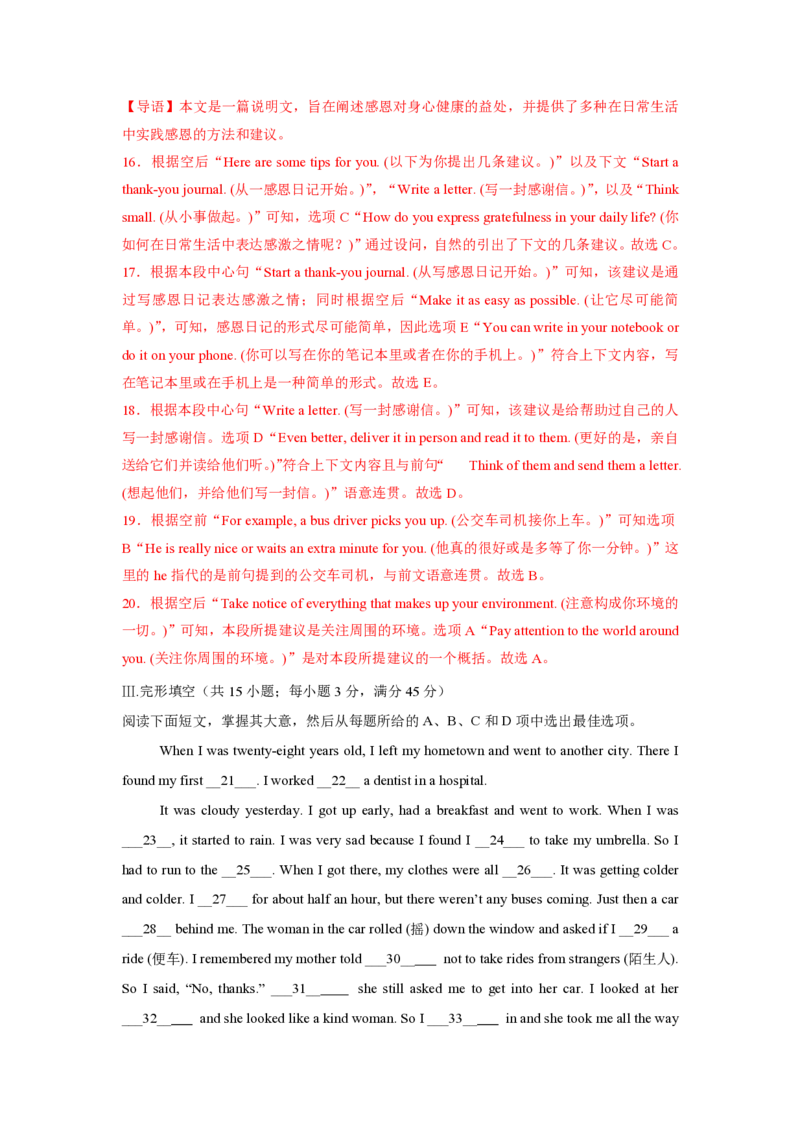
16.C 17.E 18.D 19.B 20.A【导语】本文是一篇说明文,旨在阐述感恩对身心健康的益处,并提供了多种在日常生活
中实践感恩的方法和建议。
16.根据空后“Here are some tips for you. (以下为你提出几条建议。)”以及下文“Start a
thank-you journal. (从一感恩日记开始。)”,“Write a letter. (写一封感谢信。)”,以及“Think
small. (从小事做起。)”可知,选项C“How do you express gratefulness in your daily life? (你
如何在日常生活中表达感激之情呢?)”通过设问,自然的引出了下文的几条建议。故选C。
17.根据本段中心句“Start a thank-you journal. (从写感恩日记开始。)”可知,该建议是通
过写感恩日记表达感激之情;同时根据空后“Make it as easy as possible. (让它尽可能简
单。)”,可知,感恩日记的形式尽可能简单,因此选项E“You can write in your notebook or
do it on your phone. (你可以写在你的笔记本里或者在你的手机上。)”符合上下文内容,写
在笔记本里或在手机上是一种简单的形式。故选E。
18.根据本段中心句“Write a letter. (写一封感谢信。)”可知,该建议是给帮助过自己的人
写一封感谢信。选项D“Even better, deliver it in person and read it to them. (更好的是,亲自
送给它们并读给他们听。)”符合上下文内容且与前句“ Think of them and send them a letter.
(想起他们,并给他们写一封信。)”语意连贯。故选D。
19.根据空前“For example, a bus driver picks you up. (公交车司机接你上车。)”可知选项
B“He is really nice or waits an extra minute for you. (他真的很好或是多等了你一分钟。)”这
里的he指代的是前句提到的公交车司机,与前文语意连贯。故选B。
20.根据空后“Take notice of everything that makes up your environment. (注意构成你环境的
一切。)”可知,本段所提建议是关注周围的环境。选项A“Pay attention to the world around
you. (关注你周围的环境。)”是对本段所提建议的一个概括。故选A。
Ⅲ.完形填空(共15小题;每小题3分,满分45分)
阅读下面短文,掌握其大意,然后从每题所给的A、B、C和D项中选出最佳选项。
When I was twenty-eight years old, I left my hometown and went to another city. There I
found my first __21___. I worked __22__ a dentist in a hospital.
It was cloudy yesterday. I got up early, had a breakfast and went to work. When I was
___23__, it started to rain. I was very sad because I found I __24___ to take my umbrella. So I
had to run to the __25___. When I got there, my clothes were all __26___. It was getting colder
and colder. I __27___ for about half an hour, but there weren’t any buses coming. Just then a car
___28__ behind me. The woman in the car rolled (摇) down the window and asked if I __29___ a
ride (便车). I remembered my mother told ___30__ not to take rides from strangers (陌生人).
So I said, “No, thanks.” ___31__ she still asked me to get into her car. I looked at her
___32__ and she looked like a kind woman. So I ___33__ in and she took me all the wayto my house. I thanked her and wanted to ___34__ her some money. She refused (拒绝) and
left __35___ I could ask for her name.
I was really lucky to meet such a kind woman in the strange city.
21.A.woman B.job C.dentist
22.A.like B.of C.as
23.A.at the station B.at home C.in the hospital
24.A.remembered B.wanted C.forgot
25.A.hospital B.bus stop C.home
26.A.dry B.over C.wet
27.A.cried B.looked C.waited
28.A.stopped B.drove C.went
29.A.came B.bought C.needed
30.A.me B.him C.her
31.A.If B.So C.But
32.A.happily B.carefully C.sadly
33.A.walked B.got C.climbed
34.A.give B.have C.share
35.A.before B.after C.when
21.B 22.C 23.C 24.C 25.B 26.C 27.C 28.A
29.C 30.A 31.C 32.B 33.B 34.A 35.A
【导语】本文是一篇记叙文。本文讲述了作者在陌生的城市工作,在一个下雨天接受了一
位陌生女士的善意的帮助,她感到非常幸运。
31.考查名词词词义辨析。句意:在那里我找到了我的第一份工作。A. woman女人;B. job
工作;C. dentist牙医。根据“I worked … a dentist in a hospital. (我在一家医院当牙医)”可
知,此处应该是工作。故选B。
32.考查介词词义辨析。句意:我在一家医院当牙医。A. like像;B. of……的;C. as 作为。
“work as”是固定短语,表示“担任……;以……身份工作”,这里是说“以牙医的身份工
作”。故选C。
33.考查介词短语辨析。句意:当我在医院的时候,天开始下雨了。A. at the station 在车
站;B. at home 在家;C. in the hospital 在医院。根据前文“I got up early, had a breakfast and
went to work. (我起得很早,吃了早餐,然后去上班。)”以及后文提到的“she took me all the
way to my house. (她一路把我带到我家。)”可知,她之前是在医院的。故选C。34.考查动词词义辨析。句意:我很伤心,因为我发现我忘记带伞了。A. remembered 记得;
B. wanted 想要;C. forgot 忘记。根据“sad (悲伤的)”和“didn’t take my umbrella (没带
伞)”可知,是忘记带伞了。故选 C。
35.考查名词词义辨析。句意:所以我不得不跑到公交站。A. hospital 医院;B. bus stop
公交站;C. home 家。根据后文“I … for about half an hour, but there weren’t any buses
coming. (我等了大约半个小时,但是没有公交车来。)”可知,此处是公交车站。故选 B。
36.考查形容词词义辨析。句意:当我到那里时,我的衣服都湿了。A. dry 干的;B. over
结束的;C. wet 湿的。由前文下雨了,作者忘记带雨伞了可知,她是全身淋湿了。故选C。
37.考查动词词义辨析。句意:我等了大约半个小时,但是没有公交车来。A. cried 哭;
B. looked 看;C. waited 等待。根据“I … for about half an hour, but there weren’t any buses
coming. (我等了大约半个小时,但是没有公交车来。)”可知,作者是等了半个小时。故选
C。
38.考查动词词义辨析。句意:就在那时,一辆车在我身后停了下来。A. stopped 停止;
B. drove 驾驶;C. went 去。根据后文“The woman in the car rolled (摇) down the window and
asked if I … a ride (便车). (车里的女士摇下车窗问我是否需要搭便车。)”可知,车应该是停
下来。故选A。
39.考查动词词义辨析。句意:车里的女士摇下车窗问我是否需要搭便车。A. came 来;
B. bought 买;C. needed 需要。根据“I thanked her and wanted to … her some money. She
refused (拒绝) and left … I could ask for her name. (我感谢了她,并想给她一些钱。她拒绝了,
并在我问她名字之前离开了。)”可知,女士是询问作者是否需要便车。故选 C。
30.考查代词词义辨析。句意:我记得我妈妈告诉我不要搭乘陌生人的车。A. me 我;B. him
他;C. her 她。根据“my mother told ...”可知,“我的”妈妈自然是对“我”的告诫。故
选 A。
31.考查连词词义辨析。句意:但是她仍然让我上车。A. If 如果;B. So 所以;C. But 但
是。作者拒绝了女士,但女士仍然邀请,是转折关系。故选 C。
32.考查副词词义辨析。句意:我仔细地看了看她,她看起来像个善良的女人。A. happily
开心地;B. carefully 仔细地;C. sadly 悲伤地。此处由于女士的坚持,作者不得不仔细观
察这位女士以判断其可信度。故选 B。
33.考查动词词义辨析。句意:所以我上了车,她一路把我送回了家。A. walked 走;B. got
得到;C. climbed 爬。根据“So I … in and she took me all the way to my house. (所以我上了
车,她一路把我送回了家。)”可知,她把我送回了家,所以我是“上车了”,“get in”意
为“上车”,固定短语。故选 B。
34.考查动词词义辨析。句意:我感谢她,并想给她一些钱。A. give 给;B. have 有;C. share
分享。此处是作者想给女士钱表达谢意,“give sb. sth.”意为“给某人某物”,固定搭配。故选A。
35.考查连词词义辨析。句意:她拒绝了,并在我问她名字之前离开了。A. before 在……
之前;B. after 在……之后;C. when 当……时候。根据全文,作者并不知道女士的名字,
所以她没有问出女士的名字,所以女士是在作者问名字之前离开的。故选A。
IV.语法填空(共10小题;每小题2分,满分20分)
阅读下面短文,在空格处填入1个适当的单词或括号内单词的正确形式。
Last January, I visited France with my parents and my younger sister who was born two
years later than me. It’s my 36 (two) time to travel there. In a small town, we visited
37 Chinese restaurant and we 38 (be) so surprised to find delicious Sichuan
food abroad. The owner of the restaurant is a sixty-year-old man from Sichuan. He moved to the
town thirteen years ago and opened 39 (he) restaurant. He 40 (have)
ingredients (原料) shipped directly from Sichuan so that he can offer delicious food to people. I
praised him for his behavior in my heart. 41 he had to deal with language problems
and sometimes there weren’t enough ingredients, he still tried to make Chinese food. “I just want
42 (guest) to have more chances to eat food from my homeland.” The man said.
This man has helped to spread Chinese culture by bringing Sichuan food 43
France. It’s the 44 (good) food I have eaten. Culture shouldn’t be separated. I think
Sichuan food is very important in Chinese culture. I 45 (real) enjoyed it.
36.second 37.a 38.were 39.his 40.has 41.Though/Although
42.guests 43.to 44.best 45.really
【导语】本文是一篇记叙文。文章主要通过叙述作者在法国的旅行经历,以及遇到的一家
四川餐馆和餐馆老板的故事,展现了作者对于中华文化的热爱和对于海外华人传承中华文
化的敬意。
36.句意:这是我第二次去那里。根据“my… time”可知,此处是指作者的第二次;应用
基数词two的序数词second“第二”表顺序。故填second。
37.句意:在一个小镇上,我们参观了一家中餐馆,惊讶地发现国外竟然也能吃到美味的
四川菜。根据“Chinese restaurant”可知,此处是指一家中餐馆,应用不定冠词表泛指,且
“Chinese”是以辅音音素开头的单词,应用a修饰。故填a。
38.句意:在一个小镇上,我们参观了一家中餐馆,惊讶地发现国外竟然也能吃到美味的
四川菜。根据“visited”可知,句子时态为一般过去时,且主语“we”为第一人称复数,be
动词应用were。故填were。39.句意:他十三年前搬到这个小镇并开了这家餐馆。根据空后名词“restaurant”可知,
此处应用人称代词 he 的形容词性物主代词 his“他的”,在句中作定语,修饰名词
“restaurant”。故填his。
40.句意:他直接从四川进货食材,以便为人们提供美味的菜肴。根据“can offer”可知,
此处描述现在的情况,句子时态应用一般现在时,且主语“He”为第三人称单数,动词have
应用三单形式has。故填has。
41.句意:尽管他必须面对语言问题,有时食材也不够充足,但他仍然努力制作中餐。分
析句子结构可知,前后两句之间为让步关系,应用although/though引导状语从句,位于句
首,首字母要大写。故填Although/Though。
42.句意:我只是想让客人们有更多机会品尝到我家乡的美食。由语境可知,此处应用名
词guest“客人”的复数形式guests表泛指。故填guests。
43.句意:这位老人通过将四川美食带到法国,帮助传播了中国文化。根据“bringing Sichuan
food … France”可知,此处考查bring…to…“把……带到……”,动词短语。故填to。
44.句意:这是我吃过的最美味的食物。根据空前定冠词“the”可知,此处应用形容词
good“好的”最高级形式best“最好的”,在句中作定语,修饰名词“food”。故填best。
45.句意:我真的很喜欢它。分析句子结构可知,此处应用形容词real的副词形式really“的
确,真的”,在句中作状语,修饰动词“enjoyed”。故填really。
V. 书面表达(共1题,满分25分)
46. 你的英国朋友Bill对中国传统节日感兴趣,想让你推荐一个,内容要点包括:
1.推荐的原因;
2.节日的习俗/活动。
注意:
1.写作词数应为90个左右;
2.请按如下格式在答题卡的相应位置作答。
Dear Bill,
____________________________________________________________________
____________________________________________________________________
____________________________________________________________________
____________________________________________________________________
____________________________________________________________________
________________________________________________________________________________________________________________________________________
____________________________________________________________________
____________________________________________________________________
____________________________________________________________________
____________________________________________________________________
______________________________________________________________
Yours,
Li Hua
46.【答案】
Dear Bill,
Learning that you are interested in Chinese traditional festivals, I’m more than pleased to
recommend the Mid-Autumn Festival to you.
The reason why I recommend the festival is that we Chinese think it very significant to celebrate
the Mid-Autumn Festival. No matter how busy we are, it is typical of us to admire the full moon
and enjoy mooncakes together. It is because mooncakes are as round as the full moon,
representing family reunion. Meanwhile. we will cook a wide range of delicious foods, ranging
from fish, pork to vegetables.
By celebrating the festival, we are also to show that we are grateful for the year’s good harvests.
If you need more information about the festival, I’m pleased to inform you of it.
Yours,
Li Hua
【导语】本篇是应用文写作。你的英国朋友Bill对中国传统节日感兴趣,要求考生写邮件
给他推荐一个节日。
【详解】1. 词汇积累
高兴的:pleased→delighted
认为:think→consider
重要的:significant→important
表达:show→express
2. 句式拓展
简单句变复合句
原句:Meanwhile, we will cook a wide range of delicious foods, ranging from fish, pork to
vegetables.
拓展句:Meanwhile, we will prepare a variety of delicious foods, which range from fish, pork to
vegetables.【点睛】[高分句型1]The reason why I recommend the festival is that we Chinese think it very
significant to celebrate the Mid-Autumn Festival.(运用了why引导的定语从句和that引导的表
语从句)
[高分句型 2]It is because mooncakes are as round as the full moon, representing family
reunion.(运用了because引导的表语从句)