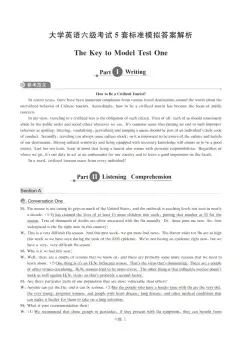
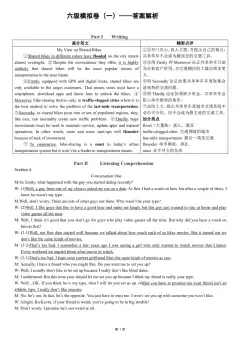
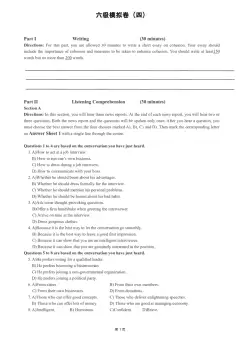
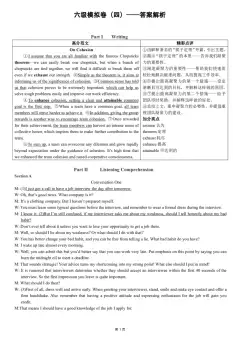
Model Test Three
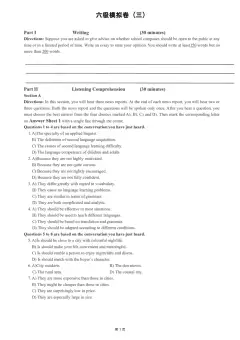
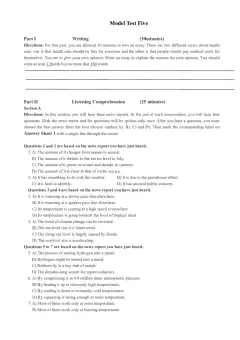
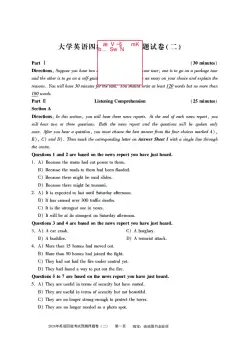
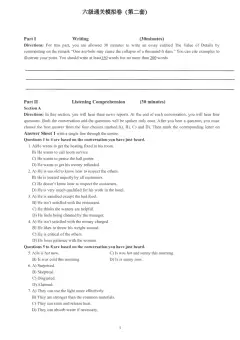
PartI Writing (30minutes)
Directions: For this part, you are allowed 30 minutes to write an essay. Suppose you have two options on how to
go on your tour: one is to go on a package tour and the other is to go on a self-guided tour. You are to make a
choice.Writeanessaytoexplainthereasonsforyourchoice.Youshouldwrite atleast120wordsbutnomorethan
180words.
PartII ListeningComprehension (25minutes)
SectionA
Directions: In this section, you will hear three news reports.At the end of each conversation, you will hear four
questions. Both the news report and the questions will be spoken only once.After you hear a question, you must
choose the best answer from the four choices marked A), B), C) and D). Then mark the corresponding letter on
AnswerSheet 1withasinglelinethroughthecentre.
Questions1and2arebasedonthenewsreportyouhavejustheard.
1.A)Waitforthehurricanetostop. B)Call911forhelp.
C)Leavetheirhomesimmediately. D)Turntosocialmediawebsitesforhelp.
2.A)Theircolleagues. B)Theirneighbors.
C)Localfiredepartment. D)Arestaurantwheretheyoftenhaddinner.
Questions3and4arebasedonthenewsreportyouhavejustheard.
3.A)Apieceofmulti-usefurnitureforkids.
B)Acameraforwatchingchildreninanotherroom.
C)Ayoungboy’sdailylifewithhistwinbrother.
D)Ayoungboyrescuinghisbrothertrappedunderthefurniture.
4.A)Playingwithanewcamera. B)Tryingtomoveadresser.
C)Tryingtoclimbtothetopofadresser. D)Climbingthewallintheirbedroom.
Questions5to7arebasedonthenewsreportyouhavejustheard.
5.A)IcebergsfloatthroughthesewatersbetweenMayandJuly.
B)Itsfreshwatercomesfrommeltingicebergs.
C)Peoplecanseeicebergsfromthecoast.
D)Thereisahugeicebergsittingonthecoast.
6.A)Ithasapopulationof5,000people. B)Itspillarindustryistourism.
C)Itsresidentsaregoodatfishing. D)Ithasonlyonesmallinn.
7.A)Itwillmeltwithin10days.
B)Itwillbepushedintotheseabyoceancurrents.
C)Itwillbeusedasthebackgroundoffilms.
D)Itwillbepushedintotheseabylocalresidents.
SectionB
Directions:In this section, you will hear two long conversations.At the end of each conversation, you will hearfour questions. Both the conversation and the questions will be spoken only once.After you hear a question, you
must choosethe bestanswer fromthe four choices markedA), B), C), andD).Then mark thecorresponding letter
onAnswerSheet 1withasinglelinethroughthecentre.
Questions8to11arebasedontheconversationyouhavejustheard.
8.A)Asingleroom. B)Adoubleroom.
C)Afamilyroom. D)Asuite.
9.A)Heishereonaresearchmission. B)Heishereformeetingfriends.
C)Heishereforsightseeing. D)Heishereonabusinesstravel.
10.A)Freeairportshuttleservice.
B)Afullcontinentalbuffeteveryevening.
C)Useofthemini-barintheroom.
D)Roomserviceprovidedbythehotel.
11.A)Inthemorning. B)Intheafternoon.
C)Atnoon. D)Beforemidnight.
Questions12to15arebasedontheconversationyouhavejustheard.
12.A)Alightingcameraman. B)Amoviemaker.
C)Afilmandvideoeditor. D)Afilmdirector.
13.A)Wonderful. B)Challenging.
C)Frustrating. D)Difficult.
14.A)Therearenoofficehourlimits.
B)Employeesarereluctanttoworkovertime.
C)Employeesworkmorethan16hoursaday.
D)Workingovertimeisverycommon.
15.A)Theyaremuchmoreeffective. B)Theyaresociallygreat.
C)Theyaresometimesannoying. D)Theyarenotsocommon.
SectionC
Directions:Inthissection,youwillhearthreepassages.Attheendofeachpassage,youwillhearsomequestions.
Both the passage and the questions will be spoken only once.After you hear a question,you must choose the best
answer from the fourchoices markedA), B), C)and D).Then mark the corresponding letter on Answer Sheet 1
withasinglelinethroughthecentre.
Questions16to18arebasedonthepassageyouhavejustheard.
16.A)Carsandironore. B)Ironoreandpeople.
C)Animalsandironore. D)Peopleandanimals.
17.A)Itincludesthreeinfrastructurecompanies.
B)Ithas24operatorstoruntheservices.
C)Ithasnostate-ownedcompanies.
D)Itisahighlycomplexsystem.
18.A)HethinksBritishtrainsarethemostpunctualintheworld.
B)HenevercomplainstotheRailPassengerCouncil.
C)Heconstantlyencountersthepoortrainservice.
D)Heoftencomplainsaboutthepoortrainservice.
Questions19to21arebasedonthepassageyouhavejustheard.
19.A)Thetriflesofdailylife.
B)Thebasicsofrelationships.
C)Thestandardsofrelationships.
D)Thefeelingsofromanticgestures.20.A)Itneedssomethingspecial. C)Itisthesourceofhappiness.
B)Itishighlydemanding. D)Itdoesn’texistinreallife.
21.A)Therearemanyupsanddownsinlife. C)Peopletendtothinkhighlyofthemselves.
B)Itishardtofindahealthyrelationship. D)Peoplehaveeasyaccesstomeetingstrangers.
Questions22to25arebasedonthepassageyouhavejustheard.
22.A)Theyareliabletoattack. C)Theyareassmartascats.
B)Theyliketosmellpeople. D)Theyareindependent.
23.A)Strong. B)Quiet. C)Neat. D)Loyal.
24.A)Theycanbetrainedtodeliverthings. C)Theycanbeusedtoworkaspolicedogs.
B)Theycanbeputtouseguidedogs. D)Theycanbetrainedtohelpthedisabled.
25.A)Evaluatingdogs’reactiontodifferentcancers.
B)Usingdogstodiscoverearlystagecancer.
C)Examiningdogs’highlysophisticatedsensor.
D)Investigatingthefunctionsofdogs;noses.
PartⅢ Reading Comprehension (40minutes )
SectionA
Directions: In this section, there is a passage with ten blanks.You are required to select one word for each blank
from a list of choices given in a word bank following the passage. Read the passage through carefully before
making your choices. Each choice in the bank is identified by a letter. Please mark the corresponding letter for
each item on Answer Sheet 2 with a single line through the centre. You may not use any of the words in the
bankmorethanonce.
Questions26to35arebasedonthefollowingpassage.
There’s something rotten in the state of women’s health.As this article is being written in July, Republicans
in Congress are__26__in a frenzied effort to repeal and replace theAffordable CareAct(ACA)put in place by the
Obama administration. At least 22 million Americans would lose medical insurance by 2026 under the
latest__27__ofthis plan—which includeslarge cuts to Medicaid—andlackof insurancemeans moresickness and
death for thousands, data show. These cuts__28__to affect women more than men—whether by removing basic
healthcoverage,cuttingmaternitycareor__29__limitingreproductiverights.
It’s time to take a stand against this war on women’s health.Currentevents are just thelatest__30__in along
history of male-centric medicine, often driven not by politicians but by scientists and physicians. Before the
National Institutes of Health Revitalization Act of 1993, which__31__the inclusion of women and minorities in
final-stage medication and therapy trials, women were actively__32__from such tests because scientists worried
that female hormonal cycles would interfere with the results. The__33__,meant women did not know how drugs
wouldaffectthem.
Whether or not the repeal-and-replace legislation passes this year, these__34__are part of a larger war on
women’s health that is not likely to abate anytime soon. We must resist this assault. Never mind “America First”
–it’s__35__toputwomenfirst.A)absolutely I)omission
B)attacks J)required
C)common K)sharply
D)critical L)shifted
E)engaged M)threaten
F)excluded N)value
G)influence O)version
H)insult
SectionB
Directions: In this section, you are going to read a passage with ten statements attached to it. Each statement
containsinformationgiveninoneoftheparagraphs.Identifytheparagraphfromwhichtheinformationisderived.
You may choose a paragraph more than once. Each paragraph is marked with a letter. Answer the questions by
markingthecorrespondingletteronAnswerSheet2.
MotherhoodIsn’tSacrifice;It’sSelfishness
[A]Iwastakingafewweeks’breakfromworkoverthesummer.MyfamilyandI—myhusbandandmysons,
then 9 and 7—planned to spend the time at our house on the New Jersey shore.When my mother asked what we
would be doing on our vacation, I told her we would be together—going to the beach and the nearby amusement
park,cooking,playingintheyard.Inresponse,mymothersaid:“Oh,that’snotmuchofavacationforyou.I’llbet
you can’twait to get backto work. Motherhood, it’s the hardestjob in the world.All sacrifice!” “Really?” was all
Icouldsayinresponse.
[B]I was looking forward to uninterrupted time with my boys. We would spend days by the ocean and take
trips to the boardwalk, where they would scream with delight whole riding the roller coaster—the same one I’d
riddenwhenI wastheirage,thenriddenalongsidethemuntilHurricaneSandydepositeditintotheAtlantic.We’d
ram one another with bumper cars; we’d ride the old-fashioned merry-go-round, waiting until my youngest son’s
favorite horse, bright-blue Freddy, became available. Some days were sure to end in tears of exhaustion, but the
tearsdidn’toutweighthejoy.Evenonthebaddays.
[C]My mother was only trying to be sympathetic to my life as a working mother, but the self-satisfied way
she proclaimed the sacrificial nature of motherhood grated(使人烦恼). I don’t believe for one second that
motherhood is the hardest job in the world nor that it is all sacrifice. Still, it wasn’t fair to blame her; she was
merely parroting a common refrain. Oncemy annoyance lifted,in its placespread akind of clarity thathelpedme
tounderstandhowtheselinguistictropes(比喻)reinforcethedisempowermentofmothersandwomen.
[D]The assertion of motherhood as sacrifice comes with a perceived glorification. A woman is expected to
sacrifice her time, ambition and sense of self to a higher purpose, one more worthy than her own individual
identity.Thisleavesavacuumintheplaceofhervalue,onethatothersrushtofill.
[E]When a woman becomes pregnant, she seems to become public property. Perhaps because bearing
children ensures the continuation of the species, it is often prioritized as part of a larger social contract. Not only
does this logic lead to an attempt to legislate women’s bodies, but also in smaller, everyday gestures, boundaries
get crossed. Many friends tell stories about being touched by strangers during pregnancy, as if a woman’s
maternal(母亲的)statusturnsherintoavesseltohandle.
[F]Written more than 30 years ago, Margaret Atwood’s The Handmaid’s Tale offers a cautionary tale of
womanhoodassacrifice.Inthisdystopicnovel,womenaregroupedaccordingtotheusesmendetermineforthem:
namely, sterile wives married for appearance or fertile “handmaids,” who are raped routinely for procreation(生
育). One male character declares that the woman must “learn in silence with all subjection” and that“she shall be
savedbychildbearing.”Inthisscenario,theactoftheconceptofmotherhoodassacrifice.
[G]Whenwe cling to theidea ofmotherhoodas sacrifice, whatwe really sacrifice is oursense ofself, as if itisthepricewepayforhavingchildren.
[H]Motherhood is not a sacrifice, but a privilege—one that many of us choose selfishly. At its most
atavistic(原始的), procreating ensures that our genes survive into the next generation. You could call this
selfishness as biological imperative. On a personal level, when we bring into the world a being that is of us,
someonewewillprotectandloveandforwhomwewilldoeverythingwecantohelpthriveandflourish,itbegets
thequestion,Howisthisselfless?Selflessnessimpliesthatwehavenoskinthegame.Inmotherhood,we’reallin.
[I] By reframing motherhood as a privilege, we redirect agency back to the mother, empowering her,
celebrating her autonomy(自主权)instead of her sacrifice. Granted, some of us have more autonomy than others.
There are many mothers who would not have chosen motherhood, for financial or personal reasons. Still, by
owningourrolesasmothersandrefusingthefalseaccolades(赞扬)ofmartyrdom(殉难),wedomoretoempower
allwomen.
[J]In my experience, when women talk among women, our ambivalence or frustration is rarely about our
roles as mothers. (That doesn’t mean our kids don’t drive us crazy sometimes.)Rather, conversations turn to
questions of how to manage the best part of our lives(those very kids who are driving us crazy)with our partners,
careers and other responsibilities. And while many women derive their deepest fulfillment as mothers, it doesn’t
preclude(阻止)theirambitionorflyinthefaceofleaninginoroutorsideways.
[K]Callingmotherhood“thehardestjobintheworld”missesthepointcompletelybecausehavingandraising
children is not a “job.” No one will deny thatthere is exhaustion, fear and tedium(枯燥). Raising a family is hard
work,butsoiseveryothermeaningfulaspectofourlives.
[L]The language surrounding child rearing as a job surely derived from caregivers’and homemakers’efforts
tobeacknowledgedasfulfillinganimportantrole.Andclearlyraisingchildrenisoneofthemostimportantthings
we do—for both women and men—but that does not make it a job. In a job, an employer pays for services an
employee agrees to perform. And there is a boss to whom the employee reports. In the case of parenting, who
wouldthatbe?
[M]That doesn’t mean we don’t want support—paid parental leave, more flexible working hours, publicly
funded day care. But the cultural shift has to happen for the policies to follow. Martyrs, after all, don’t need or
expectpublicservices.
[N]Fathers are rarely, if ever, spoken about in the same way that mothers are. It’s culturally acceptable for
mentohavechildrenandprofessionalidentitieswithouthavingtochoosebetweenthetwo.Theseunspokenbiases
run deep. It reminds me of a friend whose husband complained about having to “babysit” the children while she
went to dinner with friends. Has a woman ever “babysat” her own children? Things are changing, but the
insidious(潜在的)inferencespersist.
[O]Further,with“women”and“family”asgo-to culturalcorollaries(必然的结果),studiesshow,terrifyingly,
thatthesebiasesarebeingadoptedbyartificialintelligence,too.Callingmotherhoodawoman’s“job” onlyserves
tokeepawoman inher place.Thepriorities ofmothers whoworkoutsidethehomeare oftenquestioned.It’sasif
womenareforcedtochoosebetweenambition(orsimplyearningalivingwage)andfamily.
[P]If we start referring to motherhood as the beautiful, messy privilege that it is, and to tending to our
children as the most loving yet selfish thing we do, perhaps we can change the biased language my mother used.
Only when we stop talking about motherhood as sacrifice can we start talking about mothers the way that we
deserve.
36. In Margaret Atwood’s novel, women are divided into two groups based on whether or not they can give
birthtoachild.
37.The way to alter the biased view held by people like the author’s mother is to talk about being a mother as
privilegeandselfishness.
38.Rearing children couldn’t become a job because parents, unlike employees, neither get paid to fulfill their
responsibilitiesnorhaveasuperior.39.The author knows from her experience that conversations between women usually centre on disciplining
theirchildren,jobsandotherresponsibilitiesinsteadoftheirmotheringroles.
40.Motherhoodisaselfishbehavior,frombothabiologicalandapersonalperspective.
41.The author expressed her disagreement when her mother made comments on her holiday plan and
motherhood.
42. The cultural acceptance of men’s dual identities as father and jobholder reflects deep-rooted prejudice
againstwomen.
43.The reason why pregnant women appear to become public assets may be that bringing children into the
worldmakessurethehumanrace’scontinuedexistence.
44.Despite their unwillingness to bear a child due to economic or personal reasons, many women still became
mothers.
45.Theauthorexpectedtospendherholidaywith sonswithoutdistractionandbelievedtheywouldhaveagood
time.
SectionC
Directions: There are 2 passages in this section. Each passage is followed by some questions or unfinished
statements. For each of them there are four choices marked A), B), C) and D). You should decide on the best
choiceandmarkthecorrespondingletteronAnswerSheet 2withasinglelinethroughthecentre.
PassageOne
Questions46to50arebasedonthefollowingpassage.
Worried about Internet companies spying on your online browsing? You might turn to something called a
virtualprivatenetworktoprotectyourprivacy.Butresearcherssaythesenetworkscanthemselvesbeinsecure.
Earlier this year, the federal government rolled back rules that would have prevented Internet service
providers from tracking your activity online. Comcast, AT&T and other providers are now allowed to track and
sellyourpersonaldatetoo—withmuchlessfearofregulatoryaction.
One solution is a VPN, which is like a dark, secret tunnel you use to go from your computer to a website.
While you’re inside the tunnel—clicking on Instagram photos or checking your bank account—third parties can’t
see what you’re doing. There are lots of reasons people around the world use VPNs: to hide location, to access
worknetworks,eventoavoidgovernmentcensorship(审查).
Internet providers handle customer privacy in different ways. Some say you have to opt in for them to sell
yourdata.BecauseofInternet-connecteddevices,providerscanseemorethanthewebsitesyoubrowse.
So,whocareswhetherTimeWarnerCableorVerizon knowswhenIturnoffmylights orwhetherIstockmy
fridgewithSwissorcheddar?
For one thing, those data points can be used to target advertising.And the government or private companies
couldusetheinformationtodenyservices,likehealthinsurance—orevenwater.
Some VPNs promise anonymous(匿名的)browsing for free or just a few dollars a month; they claim not to
share your data. But these services don’t always deliver on their promises. Sometimes the medicine might be
worse than the illness. In the first major review of VPN providers, what researchers found was alarming. Nearly
40percentinjectedmalware(恶意软件).
Experts suggest researching a VPN before using it and to think of it as a supplementary tool, not a privacy
solution. They advise reading the VPN service provider’s privacy policy to see whether it collects or retains any
userinformationthatcouldbetracedbacktoyou.
46.WhatdoestheauthorsayaboutInternetserviceproviders?
A)Theyarepushedtoformulateandimplementprivacy-relatedregulations.
B)Theyareunderlessstresswithregardtothegovernment’ssupervision.
C)Thefederalgovernmentforbidsthemtocomeintocontactwithusers.
D)Thefederalgovernmenturgesthemtotracktheirusers’personaldata.47.Accordingtotheauthor,whatisthemainpurposeofusingaVPN?
A)TodefendtheInternetusers’privacy.
B)Tocoveruptheusers’residence.
C)Tovisitthewebsitestheuserslike.
D)Torelievethegovernment’sburden.
48.Whatdoestheauthorimplyabouttheusers’data?
A)Theymaybeinterpretedtothreatentheuser’ssafety.
B)Theymaybesoldtoprivatecompaniestomakeprofits.
C)Theycanbeusedforthebenefitofthegovernment.
D)Theycanbetargetedforpublicserviceadvertising.
49.WhatdoestheauthorthinkofVPNserviceproviders?
A)Mostofthemtempttheuserswithlowprice.
B)Theythemselvesmightbetheprivacyintruder.
C)Researcherswarnthemofthevirusinfection.
D)Theytendtostealtheusers’dataforsurvival.
50.Whatistheauthor’ssuggestionforchoosingaVPN?
A)Toaskforothercustomers’advice.
B)Tosignanagreementonprivacypolicy.
C)ToavoidthefrequentuseofaVPN.
D)TocarefullyselectaVPNserviceprovider.
PassageTwo
Questions51to55arebasedonthefollowingpassage.
For much of the history of American higher education, dorms and other student amenities(设施)—from
dininghalls to recreationalcenters—were thoughtafter the primary business of campus planning: grand academic
buildings.
By the turn of this century,colleges had an increasing appetite for campus luxuries.Asurge of students from
the millennial(千禧年的)generation were graduating from high schools nationwide, and many colleges found the
simplest way to compete for attention in a crowded market was to build fancier facilities. Construction cranes
were everywhere on campuses, and often the most high-profile projects involved student amenities usually
financedbyborrowing.
Now, after a building boom that lasted more than a decade, the pace of spending on luxurious campus
decorations is slowing. The reason behindthis shift is a combination of growing concerns aboutrising tuition and
studentdebt,decliningnumbersofhigh-schoolgraduates,andtheever-fluctuatingtastesofstudentsandparents.
Anotherreasonforcolleges withdrawingfromtheamenitiesarmsraceisthathighereducationisnolongerin
a growth mode, so there are fewer dollars available to build student luxuries. Enrollment numbers in higher
education have fallen for five continuous years. It’s also unclear if the “build it and they will come” approach
actuallyworkedinattractingstudentsorkeepingthemthroughgraduation.
Some higher-education experts argue that ever-fancier amenities for students distract them from their
studies—college students spend only a quarter of their week on academic pursuits—and encourage them to spend
time alone in private kitchens and bedrooms rather than with other students in dining halls or lounges(休息
室).Researchshowsthatwithoutthesenseofcommunity thatoftencomes fromlivingtogether inclosecommunal
quarters, students may have fewer opportunities to learn how to get along with different people and manage
conflicts,ordevelopthefriendshipsandnetworksthatkeeptheminschool.
As colleges increasingly worry aboutboosting their retention andgraduation rates, campuses are returning to
their old-school ways. Dorms and other student amenities are going back to more modest times with the
conveniencesofthemodernage.51.WhatdoestheauthorsayaboutAmericanhighereducation?
A)DormsanddininghallswerealwaysthefocusofAmericanhighereducation.
B)Moreattentionwaspaidtoacademicbuildingsthanstudents’conveniences.
C)Americancampusplanningusedtoincludealargenumberoffacilities.
D)Recreationalcenterswereappealingtostudentsofdifferentnationalities.
52.Whywerecollegesinthepursuitofcampusluxuries?
A)Becausethenewgenerationhadmoredemandonthem.
B)Becausecollegesbelievedtheycouldattractmorestudents.
C)Becausecollegescouldbefinancedbybuildingfacilities.
D)Becausethebuildingmarketwashighlycompetitive.
53.Whatisoneofthereasonsbehindtheshiftofthebuildingboom?
A)Thebuildingboomhasbeenquestionedbystudentsandparents.
B)Therisingtuitionmakesithardforstudentstoaffordluxuries.
C)Manyofhigh-schoolgraduatesrefusetoenjoycampusluxuries.
D)Therevenueofcollegesdropswiththeadmissionratedecreasing.
54.Whatdohigher-educationexpertsworryabout?
A)Studentstendtostayaloneplayingcomputergames.
B)Studentsspendlesstimeonstudythanonrecreations.
C)Studentsmaynotknowhowtohangoutwithothers.
D)Studentsmaylackthecouragetosolveconflicts.
55.Itcanbeinferredfromthepassagethat_____.
A)collegescaremoreaboutstudents’qualityratherthanthequantity
B)itisdifficultforcollegestokeepstudentsthroughgraduation
C)collegeshaveadoptedapracticalattitudetograduationrates
D)theconveniencesofthemodernagearewelcomedbystudents
PartⅣ Translation (30 minutes)
Directions:Forthispart,youareallowed30minutestotranslateapassagefromChineseinto
English.YoushouldwriteyouransweronAnswerSheet2.
十二生肖(thetwelveChineseZodiacs)是中国传统文化的重要组成部分。根据中国的十二生肖,每一
年都与十二种动物中的一种有联系。你也许听说过中国人用十二生肖动物作为纪年的周期系统。在西方,
中国十二生肖的十二种动物已经越来越为人们所熟悉。十二生肖代表的动物的性格特点各不相同,每一种
动物都代表着与该生肖相关的信仰、寓意和传统智慧。龙是十二生肖中唯一的神话兽,在龙年出生的人被
认为是吉祥的。