厦外2025—2026 学年第二学期高一年级期中考试
英语试题
本试卷分选择题和非选择题两部分,共12 页,满分为150 分。考试用时120 分钟。
注意事项:1.答卷前,考生务必用黑色字迹的钢笔或签字笔将自己的姓名和准考证号填写在
答题卡相应的位置上,用2B 铅笔将自己的准考证号填涂在答题卡上。
2.选择题每小题选出答案后,用2B 铅笔把答题卡上对应题目的答案标号涂黑;如需改动,
用橡皮擦干净后,再选涂其他答案;在试卷上做答无效。
3.非选择题必须用黑色字迹的钢笔或签字笔在答题卡上作答,答案必须写在答题卡上各题目
指定区域内的相应位置上,超出指定区域的答案无效;如需改动,先划掉原来的答案,然后
再写上新的答案;不准使用涂改液。不按以上要求作答的答案无效。
4.考生必须保持答题卡的整洁和平整。
第一部分 听力(共两节,满分20 分)
第一节(共5 小题;每小题1 分,满分5 分)
听下面5 段录音。每段录音后有一个小题,从题中所给的A、B、C 三个选项中选出最佳选项。
听完每段录音后,你都有10 秒钟的时间来回答有关小题和阅读下一小题。每段录音播放两遍。
1. When does the city library close during the weekends?
A. At 6 pm.
B. At 8 pm.
C. At 10 pm.
2. What does the woman probably want to do?
A. Fetch some fruit.
B. Work out for a while.
C. Buy sports facilities.
3. What are the speakers mainly talking about?
A. The group project.
B. The weekend plan.
C. The class schedule.
4. How does the woman feel about the trade show?
A. Curious.
B. Disappointed.
C. Impressed.
5. What happened to the man?
A. He found his bike broken.
B. He failed to play the movie.
C. He walked a friend to a show.
第二节(共15 小题;每小题1 分,满分15 分)
听下面5 段录音。每段录音后有几个小题,从题中所给的A、B、C 三个选项中选出最佳选项。
听每段录音前,你将有时间阅读各个小题,每小题5 秒钟;听完后,每小题都有5 秒钟的作
答时间。每段录音播放两遍。
听下面一段对话,回答以下小题。
6. What is Lily’s first plan for the afternoon?
A. To attend a celebration.
B. To enter a speech contest.
C. To finish math homework.
7. Why does the man talk to Lily?
A. To turn to her for help.
B. To extend an invitation.
C. To deal with schoolwork.
听下面一段对话,回答以下小题。
8. What is the man doing?
A. Adjusting his plan.
B. Collecting payment.
C. Confirming a repair.
9. When should the woman pay for the repair?
A. On the repairman’s arrival.
B. After completing the repair.
C. Before the repairman’s visit.
10. What is the woman required to do?
A. Stay at home.
B. Call the company.
C. Prepare materials.
听下面一段对话,回答以下小题。
11. What does the man ask the woman to do?
A. Pay by phone.
B. Check the items.
C. Keep the receipt.
12. How will the woman pay for the items?
A. By credit card.
B. By e-wallet.
C. In cash.
13. What does the man do?
A. A shopkeeper.
B. A customer.
C. A deliveryman.
听下面一段对话,回答以下小题。
14. What is the students’ problem regarding morning reading?
A. Few of them know its right way.
B. Many of them avoid it very often.
C. Some of them choose to review words.
15. What does the woman suggest?
A. Reading all the content.
B. Marking key words first.
C. Conducting a brief warm-up.
16. How long does a morning reading usually last?
A. 10 minutes.
B. 20 minutes.
C. 30 minutes.
听下面一段独白,回答以下小题。
17. Whom is the speaker talking to?
A. College students.
B. Teenagers.
C. Software developers.
18. What did Lin do in Chengdu?
A. He studied app development.
B. He formed a technology team.
C. He acquired managing skills.
19. What is the new app designed to do?
A. Assist with homework.
B. Better study efficiency.
C. Plan after-school activities.
20. What is the purpose of the talk?
A. To advocate a study app.
B. To share a learning process.
C. To present a student inventor.
第二部分 阅读(共两节,满分50 分)
第一节(共15 小题;每小题2.5 分,满分37.5 分)
阅读下列短文,从每题所给的A、B、C、D 四个选项中选出最佳选项。
A
Immersive Van Gogh Exhibition Opens in Singapore
What is the exhibition about?
Van Gogh: The Immersive Experience is a large-scale digital art exhibition that brings the Post-Impressionist
master’s works to life through projections, sound and interactive technology. It returns to Singapore with a notable
new feature.
What is the key new feature?
A dedicated AI Studio has been added. Visitors can type a text prompt (指令), such as “sunflowers under a starry
sky,” and an artificial intelligence algorithm will instantly generate a unique digital image in Van Gogh’s distinctive
style of brushstrokes and colors. This image can then be projected alongside the artist’s classic works. “It’s about
participation, not just observation,” notes a curator (策展人).
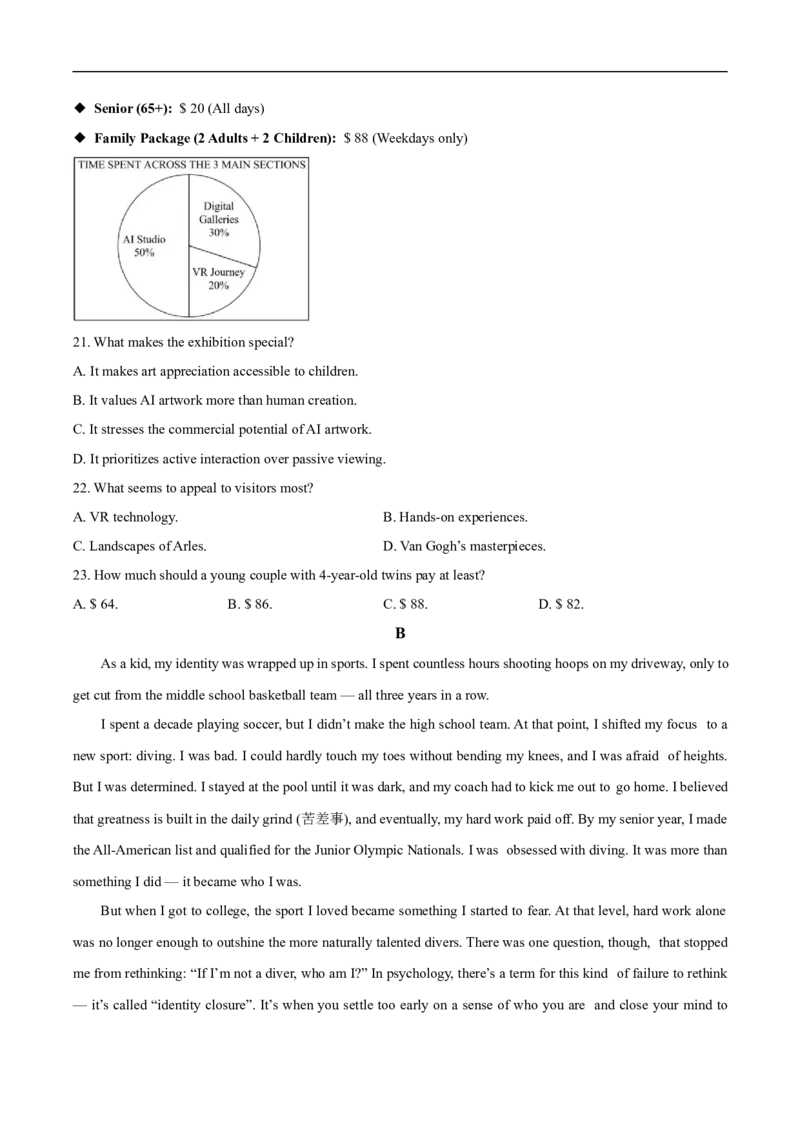
What are the main sections of the experience?
• Digital Galleries: Walk through rooms surrounded by animated projections of paintings like The Starry Night
and Sunflowers.
• AI Studio: Create and display your own AI-generated Van Gogh-style artwork.
• VR Journey: Use virtual reality headsets to explore the landscapes of Arles, France that inspired Van Gogh.
Please note: The VR section has a separate queue and may require additional waiting time.
What are the dates and prices?
• Dates & Venue: 15 November 2025 — 15 May 2026, Marina Bay Sands Expo and Convention Centre.
• Ticket Price:
◆ Adult (18-64): $ 32 (Weekdays) /$ 38 (Weekends)
◆ Child (5-12): $ 18 (All days) Children under 5 enter free.
◆ Student (13-17 or with valid ID): $ 22 (All days)
◆ Senior (65+): $ 20 (All days)
◆ Family Package (2 Adults + 2 Children): $ 88 (Weekdays only)
21. What makes the exhibition special?
A. It makes art appreciation accessible to children.
B. It values AI artwork more than human creation.
C. It stresses the commercial potential of AI artwork.
D. It prioritizes active interaction over passive viewing.
22. What seems to appeal to visitors most?
A. VR technology.
B. Hands-on experiences.
C. Landscapes of Arles.
D. Van Gogh’s masterpieces.
23. How much should a young couple with 4-year-old twins pay at least?
A. $ 64.
B. $ 86.
C. $ 88.
D. $ 82.
B
As a kid, my identity was wrapped up in sports. I spent countless hours shooting hoops on my driveway, only to
get cut from the middle school basketball team — all three years in a row.
I spent a decade playing soccer, but I didn’t make the high school team. At that point, I shifted my focus to a
new sport: diving. I was bad. I could hardly touch my toes without bending my knees, and I was afraid of heights.
But I was determined. I stayed at the pool until it was dark, and my coach had to kick me out to go home. I believed
that greatness is built in the daily grind (苦差事), and eventually, my hard work paid off. By my senior year, I made
the All-American list and qualified for the Junior Olympic Nationals. I was obsessed with diving. It was more than
something I did — it became who I was.
But when I got to college, the sport I loved became something I started to fear. At that level, hard work alone
was no longer enough to outshine the more naturally talented divers. There was one question, though, that stopped
me from rethinking: “If I’m not a diver, who am I?” In psychology, there’s a term for this kind of failure to rethink
— it’s called “identity closure”. It’s when you settle too early on a sense of who you are and close your mind to
alternative selves.
After my freshman year of college, I rethought my identity. I realized that diving was a passion, not a purpose.
My values were to grow and excel. I didn’t have to be a diver to grow, excel, and contribute. Instead of foreclosing
on one identity, we’re better off trying on a range of possible selves. Retiring from diving freed up my summer for
psychology research and coaching young divers. It also gave me time to concentrate on my silliest hobby: performing
as a magician.
Ever since then, I’ve put an annual reminder in my calendar to rethink. It’s a checkup. Just as I go to the doctor
for an annual checkup when nothing seems wrong, I now do the same for the important parts of my life: a career
checkup to consider how my goals are shifting, and a relationship checkup to re-examine my habits. Just as I’d never
skip a physical, I no longer skip these.
24. What primarily motivated the author to persist through his early struggles in diving?
A. His natural talent for the sport.
B. His sense of identity tied to diving.
C. His pure enjoyment of diving itself.
D. His coach’s pressure to work harder.
25. After the freshman year of college, what did the author decide to do?
A. Embrace more possible selves.
B. Outwork more talented divers.
C. Give up diving-related things.
D. Shift his focus to a new sport.
26. What did the author think about retiring from diving?
A. Thrilling.
B. Distracting.
C. Regrettable.
D. Worthwhile.
27. What can you learn from the passage?
A. Failure is the mother of success.
B. Where there is a will, there is a way.
C. Regular self-reflection enables personal growth.
D. Our value doesn’t lie in what we do, but who we are.
C
Have you ever obeyed the suggestions of a digital writing assistant to replace a word or restructure a sentence?
Before the appearance of digital tools, you’d probably have turned to a dictionary for the same assistance.
Dictionaries enable us to write not with fail-safe convenience but with originality and a point of view. While AI
assistants produce phrases and statements so writers don’t have to think them up, dictionaries provide us with the
knowledge to use language ourselves in expressive and potentially infinite (无穷的) ways. They place choice and
authority truly in human hands, forcing us to discover how we want to explain ourselves and our ideas to the
world.
The abundance of digital writing assistants gives greater urgency to debates about what a dictionary should be.
In 1946, George Orwell described good writing as “picking out words for the sake of their meaning,” a practice that
dictionaries facilitate while digital writing programs stifle. Writers consulting a dictionary make a choice, while
writers guided by an app have their choices made for them. The digital-native approach delivers hands-off,
derivative (衍生的) communication. The other requires leafing through pages without knowing exactly where you’ll
end up. Without dictionaries to provide us with a guide to English’s potential, writing that way is nearly
impossible.
Our ability to express ourselves is critical — it helps us define who we are. Dictionaries aid us in achieving this:
They categorize our unique ways of thinking through language. I’m a Canadian; my feeling of pride in my native
land is enhanced by small verbal Canadianisms like “eaves trough” or “serviette”, which are well-documented in
dictionaries but rarely used by AI chatbots, for the most part.
As digital writing extends deeper into our lives and minds, we need dictionaries more than ever. Abandoning
dictionaries and embracing mechanized (机械化的) writing would weaken our capacity for collective identity quite
as much as the ability to express ourselves.
28. What might be a distinct feature of dictionaries according to the author?
A. They promise fail-safe phrases.
B. They possess academic authority.
C. They facilitate creative writing.
D. They provide ready-made expressions.
29. What does the underlined word “stifle” in paragraph 3 probably mean?
A. Favor.
B. Revise.
C. Observe.
D. Discourage.
30. Why does the author mention “eaves trough” and “serviette” in paragraph 4?
A. To show how AI aids us in expressing.
B. To indicate the weakness of dictionaries.
C. To celebrate the diversity of Canadian English.
D. To illustrate how language use affects identity.
31. What can be a suitable title for the text?
A. Who Uses Writing Assistant?
B. Why Keep Your Dictionary?
C. How to Deal with Digital Writing?
D. What to Expect from Dictionaries?
D
Have you ever found someone copying your gestures or facial expressions during a conversation? This is the
Chameleon (变色龙) Effect, the nonconscious (无意识的) mimicry (模仿) of others’ behaviors. Just like a chameleon
integrates into its environment, people unconsciously mimic others’ gestures, mannerisms or accents to build
connections and smooth interactions, which is a common yet easily overlooked human trait.
Psychologists John Bargh and Tanya Chartrand proved the Chameleon Effect in a 1999 experiment. They asked
78 participants to talk with experimenters during a personality test. To avoid conscious mimicry, researchers used
photos as a distraction during conversations. The results showed participants unconsciously increased face touching
by 20% and foot movement by 50% to match the experimenters. Another part found people who were mimicked
rated the experimenters more positively, showing mimicry boosts likability. The Chameleon Effect comes from two
main reasons. It is rooted in human empathy — people mimic others to share feelings and build emotional bonds. It
also evolved as a survival trait: fitting in with a group helps people gain support and avoid danger. In daily life, this
explains why couples or close friends gradually adopt similar speech habits or gestures.
This effect also appears in speech and social settings. People may unconsciously pick up others’ accents or
phrases after long interactions. For example, a football player once accidentally used a French accent during an
interview after living in France for months, a typical display of the effect. However, too much mimicry may make
people lose their sense of self. Such over-mimicry can lead to confusion about one’s true personality.
Overall, the Chameleon Effect is a positive social tool that promotes connection and empathy. It helps reduce
social tension and build trust between people. While it helps people integrate into groups, balancing mimicry with
self-identity is important to avoid losing oneself in social interactions. With this awareness, people can use the effect
wisely while preserving their own uniqueness.
32. Which of the following is an example of the “Chameleon Effect”?
A. A girl copies her deskmate’s movements.
B. A driver follows a policeman’s directions.
C. An applicant learns the judge’s expressions by heart.
D. An assistant practices a foreigner’s tones on purpose.
33. What can be inferred about the “Chameleon Effect” from paragraph 2?
A. Personality changes with conscious mimicry.
B. Likability increases mimicry in conversations.
C. People mimic others to gain group acceptance.
D. Mimicry arouses shared feelings between couples.
34. What is the downside of too much mimicry?
A. The loss of self-identity.
B. An end to true connection.
C. The failure of mutual trust.
D. A decrease in social tension.
35. What is the author’s attitude towards the “Chameleon Effect”?
A. Doubtful.
B. Critical.
C. Cautious.
D. Indifferent.
第二节(共5 小题;每小题2.5 分,满分12.5 分)
阅读下面短文,从短文后的选项中选出可以填入空白处的最佳选项。选项中有两项为多余选
项。
As part of my research for my book, I’m doing an experiment — a “daily visit.” I wanted to visit the same place
every day, for an entire year, to see how that experience would affect my perceptions.
   36    A large place, a beautiful place, and an inexhaustible place. And so I decided on the Metropolitan
Museum of Art, a treasure house within walking distance of my apartment — seven minutes, I timed it.
But here’s the thing: I’ve lived within walking distance of the Met for years.    37    The museum had
always been there, waiting, but I’d mostly ignored it.
For me, the Met was an untapped (未开发的) possibility that I was eager to explore, and I wondered if other
people felt the same way. I asked on social media.    38    I’d assumed that my desire to visit the same place
every day was fairly unusual, so I was surprised by how enthusiastically people embraced this idea. I heard from
many people who already made daily visits, or who liked the idea of making daily visits, to places such as: the beach,
public library, hiking trails, and even a castle!
When I started this experiment of making a daily visit, I had no idea what to expect. Spoiler alert (剧透): I love
this visit.    39    I may visit the Met every day for the rest of my life. I’m reminded of one of my favorite
quotations by Alberto Giacometti:
“Everything gains in grandeur ( 宏伟) every day, becomes more and more unknown, more and more
beautiful.”    40
A. It’s a highlight of my daily schedule.
B. I was astonished by the flood of answers I received.
C. Visiting the same place every day was not easy for me.
D. The closer I come, the grander it is, the more remote it is.
E. The fact that I could visit was no guarantee that I would visit.
F. People who try new things and go to new places tend to be happier.
G. For this challenge, I needed a place I could easily visit, day after day.
第三部分 语言运用(共两节,满分25 分)
第一节(共15 小题;每小题1 分,满分15 分)
阅读下面短文,从每题所给的A、B、C、D 四个选项中选出最佳选项。
When the art competition poster went up on the school bulletin board, Clara, a left-handed girl with a badly
injured wrist, clutched her favorite paintbrush    41   . She had been looking forward to this event for years, for
it was her last chance to win a valuable scholarship to her dream art school. The doctor had warned her to    42
her wrist completely for a whole month, but she just couldn’t bear to give up the opportunity.
Her first attempt ended in total frustration — her brush    43    suddenly due to the sharp pain, leaving a
messy streak right across the center of the canvas. Tears blurred her vision as she stared at the totally    44    painting,
her heart sinking with disappointment. Just as she was about to crumple (揉皱) it up and throw it away in anger,
she    45    her mentor’s inspiring words: “Resilience is not avoiding falls, but    46    with more courage
each time you stumble.”
With her    47    hand, a hand she’d never used for painting before, Clara started over from scratch. Every
stroke felt stiff and awkward, every line was    48    and uneven, but she refused to let frustration
  49

  her.
Days slowly turned into nights; her palm blistered and ached, but her resolve (决心)
  50

  brighter with every
passing hour. She kept working through the pain,    51    the constant pain in her injured wrist.
On the    52    day, her rough yet heartfelt landscape stood out among all the polished works — not for
perfection, but for its raw, unyielding spirit. Although she didn’t win the scholarship she’d    53   , a well-known
gallery owner noticed her work and provided    54    support.
True perseverance isn’t about never failing. It’s about crafting light from the ashes of despair,
  55

  when the
whole world expects you to surrender.
41. A. tightly
B. loosely
C. gently
D. casually
42. A. stretch
B. recover
C. hold
D. rest
43. A. moved
B. slipped
C. skipped
D. froze
44. A. completed
B. ruined
C. abandoned
D. occupied
45. A. forgot
B. guessed
C. recalled
D. reminded
46. A. rising
B. falling
C. crying
D. complaining
47. A. wrong
B. right
C. injured
D. strong
48. A. rough
B. flat
C. sharp
D. slim
49. A. catch sight of
B. take care of
C. make the best of
D. get the better of
50. A. burned
B. faded
C. improved
D. weakened
51. A. minding
B. ignoring
C. avoiding
D. stopping
52. A. rehearsal
B. exhibition
C. celebration
D. submission
53. A. accounted for
B. stood for
C. searched for
D. longed for
54. A. moral
B. technical
C. financial
D. academic
55. A. still
B. just
C. even
D. only
第二节 短文填词(共10 小题;每小题1 分,满分10 分)
阅读下面短文,在空白处填入1 个适当的单词或括号内单词的正确形式。
As a child, Huang Rongbing would watch his mother, Wen Xiuzhen, comb her long and thick hair. After forming
a bun (圆发髻) at the back of her head, she    56    (decorate) it with colorful flowers, the 34-year-old recalled.
All the women in the small fishing village of Xunpu in Quanzhou, Fujian province, have long hair like Wen.
The colorful and distinctive floral (用花制作的) headdress she often wears is known as zanhua or zanhuawei, a kind
of head ornament (装饰) listed    57    a national intangible cultural heritage in 2008. As an old saying in Xunpu
goes, “Put flowers in your hair in this life    58    you’ll also be pretty in the afterlife.”
The head ornament    59    (ultimate) inspired Huang’s career path. In 2016, he and his older sister opened
a salon    60    tourists could get their hair styled in the Xunpu tradition and have their photos
  61

  (take). Yin
Siqi was one of Huang’s customers. Wen put flowers on Yin’s bun, which formed a circular shape that symbolized
unity, perfection and completion. Yin took photos of    62    (her) in traditional Xunpu dress and    63    (wear) a
zanhua. One of her social media posts received over 40000 “likes”. The increase in tourist visits pleased Huang not
just from a business standpoint but also because it led to greater    64    (aware) of the history and culture behind
zanhua headwear.
“Earning    65    reputation for their hard work, resilience and compassion, the women of Xunpu are famous
for harvesting the best seafood,” said Huang. “When they put a zanhua on their heads, they express their wish to
pursue happiness. The flowers are seen as a symbol of hope,” he added.
第四部分 课内知识检测(共三节,满分40 分)
第一节 单句语填(共14 小题;每小题1 分,共14 分)
66. He is generous _________________ his money and his time.
67. _________________ makes it striking is that it shows a thin figure with an expression of fear.
68. So far, a number of difficult diseases _________________ (cure) with the help of modern medicine.
69. A pair of big sunglasses, a hat, maybe even a mask — these are necessary items for a superstar who doesn’t want
_________________(recognize) on the street.
70. The discovery of artemisinin showed that there is no limit _________________ Chinese wisdom.
71. _________________ he could get the job depends on this face-to-face interview with the boss.
72. Tu Youyou’s discovery of artemisinin was proved to be a highly _________________ (promise) breakthrough
in medical history.
73. She agreed without the slightest _________________ (hesitate).
74. Everyone was shocked by _________________ quickly he finished the complicated task.
75. I am deeply impressed by the _________________ (mass) circles of white and yellow in The Starry Night
racing across the sky.
76. After getting lost in the unfamiliar city, I finally found a kind local who showed me ________________ the
nearest subway station was.
77. In his last speech, he _________________ (refer) to a recent trip to Canada.
78. The performance on Drama Night was so _________________ (impress) that all the students talked about it for
weeks.
79. The customer asked to see whoever is in charge _________________ the sales department.
第二节 默写(共8 小题;每小题2 分,共16 分)
80. He _______________________________________ in the history of music.
81. In his twenties, he __________________________________ his piano skills, but then he began to lose his
hearing.
82. _______________________________________, the composer produced some amazing pieces, including nine
symphonies, five piano pieces, and an opera!
83. He _____________________________________ until his death in 1827, writing more than 130 musical
works.
84. ___________________________________, he told her that the dress was sold.
85. She returned to the shop the following morning ______________________________________, with a handbag
in one hand and a long umbrella in the other.
86. _______________________________________, the assistant was eager to serve her this time.
87. She _____________________________________ almost everything in the window before finally buying the
dress she had first asked for.
第三节 应用文句型翻译(共5 小题;每小题2 分,共10 分)
88.在中国科学领域的杰出人物中,我最钦佩的是屠呦呦,她因在寻找致命疾病疟疾的治疗方法上做出巨
大贡献而闻名。
Among the outstanding figures in Chinese scientific field, the person I admire most is Tu Youyou, who is noted for
______________________________________________________ the deadly disease malaria.
89.正是由于他坚持不懈的追求和科学精神,袁隆平最终在杂交水稻研究上取得了突破。
__________________________________________________________ Yuan Longping eventually made a
breakthrough in the research of hybrid rice.
90.本次展览展出了来自全国知名艺术家和新锐人才创作的各种精彩作品。
__________________________________________________________ created by renowned artists and emerging
talents across the country.
91.所有画作构图巧妙,描绘了迷人的景色或生动的形象,展现了中国自然风光的魅力。
All paintings were cleverly constructed with fascinating scenes or vivid creatures,
_______________________________________________________________________.
92.此活动不仅让人们领略到传统艺术的魅力,也点燃了他们对艺术的热情,提升了审美品位。
The event not only offered them a glimpse into the charm of traditional art,
____________________________________________________________________ and enhanced their aesthetic
taste.
第五部分 读后续写(满分15 分)
阅读下面材料,根据其内容和所给段落开头语续写两段,使之构成一篇完整的短文。
“Oh no!” I shouted as I searched through my dance bag. My dance shoes were nowhere to be found. For a
moment, I could hardly hide a smile — finally, an excuse not to go to the tiring practice! However, Mom drove
straight to the studio (练功房). “Ms. Linda keeps some spare dance shoes,” she reminded gently. I took a deep breath,
walked in unwillingly and fished out a pair.
“Only four weeks remain before the holiday performance,” Ms. Linda told the class. “We must focus and work
hard.” My heart dropped, and the memory of last year’s stage failure flashed back — I was unable to move and
breathe properly under bright lights. That night, I begged Mom to let me quit. Surprisingly, she didn’t force me to
keep going. Instead, she said quietly, “It’s your decision, Kami. But have you thought about your partner? Can she
make it without you?”
“She won’t mind,” I said, “She probably doesn’t even know my name.”
The next Friday, Mom picked me up from school. As we drove away, she asked if I wanted to attend the dance
class. “No,” I whispered, “Not today.” “Okay,” Mom nodded understandingly. I breathed easy, sure that I had made
the right choice, thinking no one would notice one absent dancer in the crowded studio.
On Saturday, during a shopping trip, I unexpectedly ran into my dance partner at checkout. “Hi, Kami!” she
called cheerfully. I stood still, my face red, and realized I didn’t even know her name until she introduced herself as
Sylvia. Then her smile disappeared. “I missed you yesterday. Honestly, I’m frightened about the show. My grandma is
flying in just to watch, and I fear that I’ll mess up our paired moves.”
What she said struck me. I knew I was not the only one who was afraid all the time. Dance was not only my
hard thing; it was our common fight.
注意:
1.续写词数应为150 个左右;
2.请按如下格式在答题卡的相应位置作答。
Looking at her worried face, I felt a sudden increase of determination inside me.
The day of the holiday performance finally came.
2025 级高一下英语期中考 答案
第一部分 听力
1-5 CBABA  6-10 CBCBA  11-15 BCAAC  16-20 CBABC
第二部分 阅读理解
21-23 DBA
24-27 BADC
28-31 CDDB
32-35 ACAC
36-40 GEBAD
第三部分 语言运用
第一节 完形填空
41-45 ADBBC
46-50 ABADA
51-55 BDDCC
第二节 语法填空
56. would decorate/decorated
57. as
58. and
59. ultimately
60. where
61. taken
62. herself
63. wearing
64. awareness
65. a
第四部分 课内知识检测
第一节 单句语填
66. with
67. What
68. have been cured
69. to be recognized
70. to
71. Whether
72. promising
73. hesitation
74. how
75. massive
76. where
77. referred
78. impressive
79. of
第二节 默写
80. is regarded as one of the greatest composers
81. had been very famous for
82. Inspired by his struggles with deafness
83. proceeded with the composition
84. Glancing at her scornfully
85. dressed in a fur coat
86. Not realizing who she was
87. enjoyed herself making the assistant bring
第三节 应用文句型翻译
88. her great contributions to (1’) finding a cure for (1’)
89. It was due to his relentless pursuit and scientific spirit (1’) that (1’)
90. This exhibition featured (1’) a wide variety of amazing works (1’)
91. which (1’) conveyed the glamour of Chinese natural scenery (1’)
92. but also (1’) ignited their passion for art (1’)
第五部分 读后续写
续写参考范文:
Looking at her worried face, I felt a sudden increase of determination inside me. “You are not alone,” I promised,
gripping her trembling hand. “We’ll conquer the stage together.” Hearing my words, her face lit up as she grabbed
my hand back firmly.(要点1:我向Sylvia 承诺将与她一起攻克难关,以及Sylvia 的反应) Realizing that
Sylvia depended on me, I found the courage to face my fear. We spent the remaining weeks glued to the studio floor,
repeating every step until our movements flowed smoothly. We corrected each other’s errors and celebrated small
victories. (要点2:在接下来的几周,我们互相帮助、共同努力排练)The anxiety that once held me back was
replaced by a sense of responsibility. We were no longer two strangers; we were a team, drawing strength from one
another to perfect our routine before the big moment. (要点3:排练取得了效果,我们进步了(可针对上文
提到问题来写效果:恐惧、逃避、互相不熟、配合不好))
The day of the holiday performance finally came. Stepping onto the stage, I felt the familiar heat of the bright
lights, but this time, I didn’t freeze. I took a deep breath, looking at Sylvia. She offered a determined and brave nod.
Then the music began. We moved as one body, our feet gliding across the wooden floor with grace. Every turn was
correct and every jump was high. (要点1:我们勇敢登台,配合默契,出色完成表演。)When we finished
our final move, loud cheers rose from the audience. “We made it!” whispered Slyvia in a choking voice as we
embraced each other. Through my tearful eyes, I spotted Mom sitting with Sylvia’s grandmother in the front row
giving us a proud and affirming smile. (要点2:观众以及前文提到的重要人物的反应(专程来看表演的Sylvia
的奶奶和见证我的成长过程的我的妈妈))It was at that moment that I suddenly realized that true success wasn’t
about avoiding fear, but sharing the challenge with a friend and conquer it together. (要点3:我的感悟(人与
自我类作文必须回归到“我”的视角及想法,才能完成“我”害怕逃避--勇敢面对--战胜困难--提升意识这
个心态成长的闭环))

续写评分补充说明:
1. 涂改液、非黑色的水笔、记号卷0 分
2. 只写一段,得分不超过12 分。
3. 第一段或第二段空行3 行以上(含3 行),每段扣2 分。(如两段都空3 行以上,则扣4 分。)
4. 主题明显错误(即完全不擦边),得分不超过15 分。
5. 每漏一个要点扣5 分。
6. 卷面书写实在太差,降一档(即扣5 分)。
听力原文
1.
W: Does the city library extend its opening hours during weekends?
M: Yes, it does. It stays open till 10 pm though normally it closes at 8 pm. By the way, it wraps up at 6 pm during
holidays.
2.
W: Excuse me, can you tell me where the gym is around here?
M: Yeah, sure. See the sports hall over there? The place is right next to it, by the fruit stand.
W: Thank you so much.
3.
W: Hi, how’s our biology group project going?
M: Not very well. We still need more information, but we’re running out of time.
W: Yeah, the deadline is coming soon. We need to work faster.
4.
M: What did you think of the new trade show downtown?
W: All the constant noise there totally ruined it. You could barely talk to the staff.
M: Really? I heard it had plenty of great exhibitions.
5.
W: Hi, you’re finally here! We almost started the movie without you. What kept you?
M: Sorry! My bike broke down halfway, I had to walk the rest of the way.
W: It’s okay, you just made it. Hurry in, the best part’s coming up.
6-7.
M: Hi Lily, what are you going to do this afternoon?
W: Not much. I’ll finish my math homework at home. Why ask?
M: Well, I won the second prize in the school English speech contest. Our teacher said there will be a small celebration
for winners after class. I was wondering if you’d like to come.
W: I’d love to, but I need to help my mom make dinner later.
M: Don’t worry. It’ll only last half an hour and end before dinner.
W: That sounds good. I’ll go with you then.
8-10.
M: Hi, this is Tom from City Repair. I’m just ringing to confirm that your pipe repair in your house is booked for 10
a. m. tomorrow. Does that still work for you?
W: Oh! Would it be possible to reschedule it to the afternoon? I’ve got something urgent to deal with tomorrow
morning.
M: No problem at all. How does 2 o’clock sound?
W: That’s great. By the way, when do I need to pay the full cost for the repair?
M: Actually, you can settle up the full amount once the repair’s all done and dusted.
W: Perfect! One last thing. Do I have to be on the scene while the repair is going on?
M: Yes, please. And we’ll give you a call 10 minutes prior to our arrival.
11-13.
W: Excuse me. I’d like to buy some school supplies. A thick notebook, a pen set and that storybook on the shelf,
please.
M: Sure. Let me remind you first. Please check each item carefully before you pay. We can’t accept returns of used
items without quality issues.
W: Okay, got it. By the way, could you tell me their prices?
M: Certainly. The notebook is 15 yuan, the pen set 30 yuan, and the storybook 45 yuan.
W: Alright. I’ll take all of them.
M: No problem. I’ll pack these chosen items for you right now. Would you prefer to pay in cash or by credit card?
W: Can I pay by e-wallet?
M: Sorry, cash or chip only.
W: OK, here is the cash.
14-16
W: Many students do morning reading every day, but few know how to do it properly.
M: What proper way? I always feel my morning reading is a waste of time and gain nothing from it.
W: Let me ask you first. Do you dive into new texts as soon as you start your morning reading every day?
M: Yeah, I do. It’s not that I don’t want to focus on reading, but I just want to finish more content quickly every
morning.
W: I see, but that’s where the problem lies. According to our English teacher, we should do a short warm-up before
formal reading to get our minds focused first.
M: Sounds reasonable. Do we need to spend a long time on this warm-up every morning? How about 20 minutes?
W: Well, just about 10 minutes is enough for it since our morning reading usually lasts 30 minutes in total.
17-20.
M: Good afternoon, everyone. Thank you for joining us for today’s Teenagers’ Creator Talk. Today, we are privileged
to invite Lin Wei, a college student who invented a popular study app for teenagers. Lin Wei used to be a middle
school student who was poor at arranging his study time. In 2021, he went to Chengdu to learn how apps are
successfully developed in a training program, where he met many like-minded friends. After two years of hard work,
he developed the first version of his app, Study Smart, in 2025. Earlier in 2026, he improved the app and launched it
online. In daily study, students pay much attention to finishing homework, but they often ignore the importance of
learning efficiency. His app is meant to help students make reasonable study plans and improve their learning
efficiency. So let’s give a warm welcome to Lin Wei!