2025~2026 学年度高三(下)限时训练(四)
英 语
注意事项:
1. 答题前,考生务必将自己的姓名、准考证号填写在答题卡上。
2. 回答选择题时,选出每小题答案后,用铅笔把答题卡上对应题目的答案标号涂黑。如需改
动,用橡皮擦干净后,再选涂其它答案标号。回答非选择题时,将答案写在答题卡上,写在本试卷
上无效。
3. 考试结束后,只将答题卡交回。
第一部分 听力(共两节,满分30分)
做题时,先将答案标在试卷上。录音内容结束后,你将有两分钟的时间将试卷上的答案转涂
到答题卡上。
第一节(共5小题;每小题1.5分,满分7.5分)
听下面5段对话。每段对话后有一个小题,从题中所给的A、B、C三个选项中选出最佳选项,
并标在试卷的相应位置。听完每段对话后,你都有10秒钟的时间来回答有关小题和阅读下一小题。
每段对话读两遍。
1.What will the man do next?
A.Do some printing. B.Continue with the speech. C.Attend an opening ceremony.
2.What is Jenkins doing now?
A.Taking a holiday. B.Searching for new information. C. Working on a report.
3.What does the man mean?
A.The wind is dying down.
B.The car ride is more comfortable.
C.The woman should wrap up warm.
4.Where are the speakers?
A.At a restaurant. B.At home. C.At a supermarket.
5.What are the speakers talking about?
A.What activities Tim likes to do.
B.Whether Tim often plays soccer.
C.How to help Tim quit online games.
第二节(共15小题;每小题1.5分,满分22.5分)
听下面5段对话或独白。每段对话或独白后有几个小题,从题中所给的A、B、C三个选项中
选出最佳选项,并标在试卷的相应位置。听每段对话或独白前,你将有时间阅读各个小题,每小题
5秒钟;听完后,各小题将给出5秒钟的作答时间。每段对话或独白读两遍。
听第6段录音,回答第6、7题。
6.What is the probable relationship between the speakers?
A.Neighbours. B.Workmates. C.Friends.
英语试题 第1页(共10页)第二部分 阅读理解(共两节,满分50分)
第一节(共15小题;每小题2.5分,满分37.5分)
阅读下列短文,从每题所给的A、B、C和D四个选项中选出最佳选项。
A
Getting Along with Grizzlies (灰熊)
Almost three-quarters of all young females that grow up in the Elk Valley die young. In fact, after
tracking 70 bears between 2016 and 2022, experts found survival rates for young grizzlies in the Elk Valley
are the lowest recorded in North America.
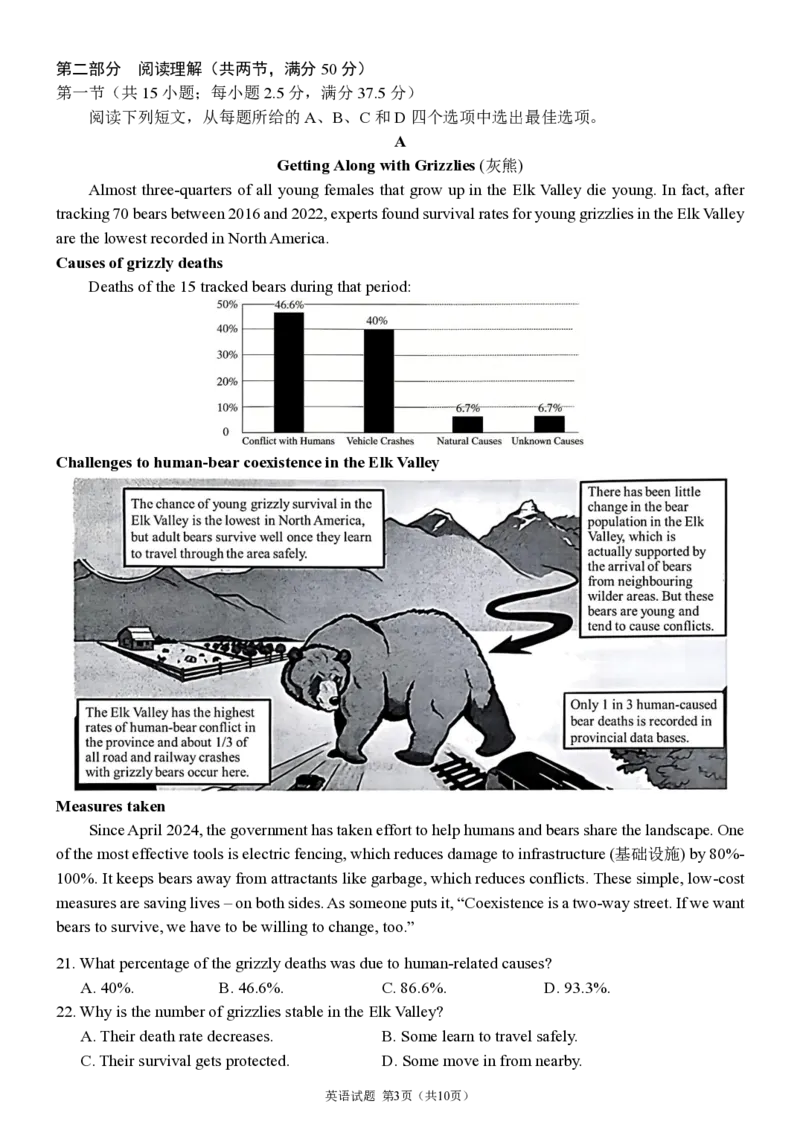
Causes of grizzly deaths
Deaths of the 15 tracked bears during that period:
Challenges to human-bear coexistence in the Elk Valley
Measures taken
Since April 2024, the government has taken effort to help humans and bears share the landscape. One
of the most effective tools is electric fencing, which reduces damage to infrastructure (基础设施) by 80%-
100%. It keeps bears away from attractants like garbage, which reduces conflicts. These simple, low-cost
measures are saving lives – on both sides. As someone puts it, “Coexistence is a two-way street. If we want
bears to survive, we have to be willing to change, too.”
21. What percentage of the grizzly deaths was due to human-related causes?
A. 40%. B. 46.6%. C. 86.6%. D. 93.3%.
22. Why is the number of grizzlies stable in the Elk Valley?
A. Their death rate decreases. B. Some learn to travel safely.
C. Their survival gets protected. D. Some move in from nearby.
英语试题 第3页(共10页)23. What is the main function of electric fencing?
A. Saving humans from bears. B. Preventing conflict and loss.
C. Letting bears trust humans. D. Cutting the bear control cost.
B
For proof that topiary (林木造型艺术) can be high art, look no further than the work of Pearl Fryar.
The self-taught artist used bushes and trees as his medium, and he was known as the “Picasso of Plants”
during his decades-long career. Fryar died in his home on April 4, 2026 at age 86, leaving behind a legacy
in the world of ornamental gardening and acres of living art.
When Fryar began to work in a factory in South Carolina in the late 1970s, he and his wife planned
to buy a house in Bishopville, but they soon ran into trouble. Fryar said that a white resident had told his
real estate agent that he didn’t want a Black couple living in the neighbourhood, citing a racist stereotype
that they wouldn’t take care of their yard.
The couple settled on a property farther away, but Fryar didn’t forget the comment. With three acres
of land at his disposal, he got to work transforming his double lot into his own personal Eden, complete
with decorative trees and flowerbeds. With no formal education besides a three-minute lesson from the
owner of his local nursery plus a knowledge of plants gained from his childhood spent helping out on the
family farm, he began sculpting more elaborate topiaries, eventually receiving the Yard of the Month award
from his local garden club in 1986. Even after becoming a celebrity in the horticultural world, Fryar kept
his home the primary site of his art, and over the years it grew into a local attraction.
“I fall under the category of what they call a self-taught artist,” Fryar once said. “Horticulturalists (园
艺家) are constantly saying I shouldn’t be able to do this. I’m doing it because I don’t know the rules. I do
what I want to do according to the way I feel.”
Fryar’s yard remained free and open to the public throughout his lifetime. It’s now managed by Pearl
Fryar Topiary Garden, a nonprofit that plans to maintain it as a living memorial to the horticultural legend.
24. What motivated Fryar to learn topiary?
A. His strong interest in horticulture. B. His past experience on the family farm.
C. A remark rooted in racial prejudice. D. A desire to win a local gardening award.
25. What do we know about Fryar’s garden?
A. It was located in Bishopville. B. It drew visitors from around the area.
C. A nursery owner helped build it. D. The trees and flowers were decorated.
26. What message did Fryar convey in Paragraph 4?
A. Following the instincts matters in artistic creation.
B. Success requires proceeding despite others’ doubt.
C. Artistic rules may be challenged in creative practice.
D. Self-taught artists are limited by lack of formal training.
27. Which of the following can best describe Fryar?
A. Caring and responsible. B. Ambitious and perseverant.
C. Determined and creative. D. Enthusiastic and optimistic.
英语试题 第4页(共10页)C
Six months before she died, my grandmother moved into an old people’s home and I visited her there.
She was sitting in the living room with about fifteen other residents, half of them asleep. People only moved
when they needed to be helped to the bathroom. It was so depressing.
So, I was really thrilled when I read a newspaper article about a new concept in old people’s homes.
The idea is simple, but revolutionary: combining a residential home for the elderly with a nursery school
in the same building. The children and the residents share activities such as music, painting, gardening,
and caring for the pets. The residents enjoy reading or telling stories to the children and, if a child is feeling
sad or tired, there is always a kind lap to sit on and a cuddle. The children are happy because they get a lot
more individual attention and someone has time for them. The residents are happy because they feel useful
and needed.
Nowadays there is less and less contact between the old and the young. There are many reasons for
this, but the result is the same: more old people who are lonely and feel useless, along with more and more
families with young children who desperately need more support.
That’s why inter-generational programmes supported by UNESCO and other organisations, designed
to bring the old and the young together, are growing in popularity. There are successful initiatives all over
the world. One of the successful schemes pairs young volunteers with old people who are losing their sight.
The young people help with practical things such as online shopping and book reading. The older people
can pass on their knowledge and experience to their young visitors. For instance, a retired judge may be
paired with a teenager who wants to study law. Lasting friendships often develop.
But it isn’t only the individuals concerned who gain from inter-generational activities. The advantages
to society are enormous too. If older people can understand and accept the youth of today, and vice versa,
there will be less conflict in a community. In a world where the number of old people is increasing, we
need as much understanding and tolerance as possible. And we can use the strengths of one generation to
help another. Then perhaps getting old won’t be such a depressing prospect after all.
28. What is the purpose of the first paragraph?
A. To explain the author’s visit. B. To show life in care homes.
C. To describe resident interactions. D. To show limits of elderly care.
29. Which of the following is an advantage of inter-generational activities?
A. Generation tension is eased. B. Staff workload is greatly reduced.
C. Activities fit more age groups. D. Children get more emotional support.
30. What can be inferred about the author’s attitude towards inter-generational activities?
A. They should be promoted more widely. B. They boost young people’s confidence.
C. They reshape the meaning of community. D. They should be regulated at a societal level.
31. What can be a suitable title for the text?
A. What Care Services Do B. How Isolation is Tackled
C. When Generations Meet D. Why Society Needs Connection
英语试题 第5页(共10页)D
You leave an hour of online surfing with the sense that the world is falling apart. In the real world,
however, a neighbour you disagree with politically helps you start your car. The dissonance is no accident.
It is how today’s Internet works.
To better understand this gap, researchers surveyed 1,090 adults and found that people dramatically
overestimate how common harmful behaviour on the Internet is. On Reddit, participants thought harmful
commenters were 13 times more common, estimating 43% of users post harmful content, while the actual
figure is just 3%. Most offensive posts come from a small group of highly active users, whose outsized
posts shape public beliefs, creating the “majority illusion” that makes this minority seem like the norm,
drowning out the silent majority.
Our brains are wired to notice threats and moral breaks – negative content sticks in our minds.
Additionally, social media algorithms (算法) prioritise content that causes strong reactions to keep users
engaged, with falsehoods spreading faster than truth. Bot networks add to the noise: it has been reported
that bad bots make up roughly a third of global web traffic, misleading what trends and who appears popular.
Measuring online harmful content is tricky, as automated tools often miss unobvious aggressive
remarks. But what matters more is not “how harmful is the Internet”, but what ordinary users perceive as
normal. Social psychologists call this dynamic “pluralistic ignorance”: people privately reject harmful
norms but go along with them publicly. This misconception formed online creates a dangerous gap, fuelling
public distrust, preventing public participation, and lowering moral standards – if we think “everyone is
awful,” we’re less likely to be kind.
While there is no silver bullet, practical steps – rooted in policy and personal awareness – can narrow
the gap. The key lies in recognising online engagement doesn’t equal approval: skip “most engaging” feeds
and ground our views in actual world connections. Imagine a public square where the loudest few don’t
seize the microphone – disagreement remains, but the air resounds with daily life: neighbours helping start
cars, strangers holding doors. Online, we can make that reality visible again.
32. What does the underlined word “dissonance” in Paragraph 1 probably mean?
A. Disorder. B. Prejudice. C. Contrast. D. Debate.
33. What does the “majority illusion” refer to in the text?
A. A false impression. B. A personal belief.
C. An overestimated post. D. A harmful behaviour.
34. What is Paragraph 3 mainly about?
A. Why global web traffic misleads people. B. Why the minority feels like the majority.
C. How we identify online harmful content. D. What harm online misconception causes.
35. What is the author’s suggestion in dealing with “pluralistic ignorance”?
A. Acting like the loudest few. B. Improving moral standards.
C. Avoiding online engagement. D. Evaluating through real life.
英语试题 第6页(共10页)第二节(共5小题;每小题2.5分,满分12.5分)
阅读下面短文,从短文后的选项中选出可以填入空白处的最佳选项。选项中有两项多余选项。
There’s just something about Labubu. You hear the sound of opening a blind box, see that cheeky
smile and suddenly you’re attracted. But once the excitement fades, you can’t help but wonder, why do we
keep chasing more, even when we already have enough?
Evolutionary psychology gives us a fascinating answer. A lot of what we do comes from what once
helped our ancestors survive. 36 That could mean the difference between thriving and going without.
Over generations, we’ve been wired to find joy in having more than we require.
Labubu represents a modern form of this instinct. The blind-box model mirrors ancestral uncertainty:
investing effort toward an uncertain payoff with the possibility of a rare, high-status “secret” find. The
uncertainty of the reward activates dopamine pathways in the brain. 37 This explains why collectors
sometimes keep buying long after they’ve achieved their goal.
38 When collecting remains a source of joy and social connection, it can be adaptive. Many
Labubu collectors share mini furniture, and fan-made content. 39 But when over-marketing and
rocketing resale prices step in, the whole environment changes. Suddenly, it’s less about the joy of owning
something you love and more about showing off or reselling it for a profit.
In questioning whether hoarding is simply collecting gone mad, it becomes clear that human psychology
hasn’t fundamentally changed. Social media, over-marketing, and resale culture supercharge ancient drives.
The challenge is to keep those drives in balance. 40 Ask yourself: Does it truly spark joy? In the end,
Labubu is more than a toy. It’s a little mirror, reflecting both our ancient instincts and modern anxieties,
and showing just how easily a fun hobby can tip into full-blown craze.
A. Collect what brings genuine pleasure.
B. But how does collecting slip into disorder?
C. Buyers don’t know which figure they will get.
D. Back then, collecting was about saving tools or food for later use.
E. Collecting becomes a problem when possessions damage our daily life.
F. It makes us “want” the experience even when we already “have” enough.
G. Such are forms of self-expression that enrich rather than mess up our life.
英语试题 第7页(共10页)第三部分 英语知识运用(共两节,满分 30 分)
第一节(共15 小题;每小题 1 分,满分15 分)
阅读下面短文,从每题所给的A、B、C、D四个选项中选出可以填入空白处的最佳选项。
Here’s a remarkable account of a Nepalese family. About a century ago, a boy named Bishnu was not
allowed to go to school, while decades later his son helped thousands of Nepalis learn to 41 .
When Bishnu was a child, he was forced to work on a farm. He was so 42 to receive an education
that he ran away to Kathmandu, where the only school was located, walking for three entire days. As his
children grew up, with the 43 of being imprisoned, Bishnu 44 brought in a teacher to educate
them. Fortunately, education was finally permitted in 1951. Dinesh, Bishnu’s third son, not only attended
elementary school but also went on to graduate from college. With a teaching position came the 45 to
travel throughout Nepal.
Dinesh soon became aware of how few poor Nepalis were able to read. This 46 inspired him to
follow in his father’s footsteps as a 47 of education. He and his wife, a lively young woman who was
also 48 to supporting the poor, 49 an organisation called the Non-Formal Education Services
Centre to provide education for disadvantaged Nepalis.
When they 50 to teach reading and writing, they quickly realised that they also needed to
address the 51 they encountered. After consulting with villagers, they made sustained efforts to promote
agricultural development and goat farming in order to reduce poverty. The villagers were encouraged to
52 one quarter of their income. With their savings and some other financial 53 , they were able
to send their children to schools.
Since then, the campaign has guaranteed 20,000 adults and 5,000 children 54 to education,
while also helping to 55 them out of poverty. They have constructed 15 schools, along with 56 drinking
water systems, and planted thousands of trees.
41.A. grow B.farm C.read D.teach
42.A. bound B.determined C.grateful D.modest
43.A. help B.fear C.exception D.risk
44.A. deliberately B.illegally C.delightedly D.unwillingly
45.A. opportunity B.measure C.basis D.law
46.A. response B.action C.ability D.realisation
47.A. leader B.trainer C.champion D.researcher
48.A. opposed B.addicted C.committed D.accustomed
49.A. proposed B.found C.launched D.visited
50.A. held on B.set out C.took off D.turned out
51.A. ignorance B.injustice C.poverty D.conflict
52.A. charge B.lend C.spend D.donate
53.A. assistance B.need C.guidance D.well-being
54.A. adaptation B.devotion C.benefit D.access
55.A. lift B.persuade C.drive D.force
英语试题 第8页(共10页)第二节(共10小题;每小题1.5分,满分15分)
阅读下面短文,在空白处填入1个适当的单词或括号内单词的正确形式。
When content creator Sherry XiiRuii started uploading humorous tutorials (辅导材料) about everyday
Chinese habits under the hashtag #BecomingChinese on social media in 2025, she probably did not expect
that her videos 56 (spark) a global trend.
In these videos, the Chinese American influencer 57 (playful) explains Chinese approaches to
wellness and household customs. Her success has inspired a wave of imitators across TikTok, Instagram
and Facebook, 58 creators backing the virtues of soaking one’s feet in warm water before bed, sipping
hot water, wearing slippers at home, 59 experimenting with acupuncture (针灸).
60 (drive) by growing interest in recent weeks, the #BecomingChinese has evolved beyond daily
activities, triggering related trends like #ChinaMaxxing – a hashtag that 61 (fill) with growing online
appreciation for China’s infrastructure, public 62 (safe) and modern conveniences.
More importantly, the trend signals 63 broader expansion of China’s cultural influence, which
now reaches global audiences through animated characters, designer toys and innovations in artificial
intelligence and robotics.
In a recent interview with CGTN, XiiRuii noted that while mainstream exposure to Chinese culture
remains superficial in the US, 64 (introduce) simple, easily adopted habits has created an accessible
entry point for global audiences. “ 65 matters the most is that people are willing to learn about Chinese
culture,” she said.
第四部分 写作(共两节,满分40分)
第一节(满分15分)
你校New Babel英语杂志社正在举办主题为“乡村振兴中的青春力量”的征文活动。请你写
一篇短文投稿,内容包括:
1. 乡村振兴的意义;
2. 发出倡议。
注意:
1. 写作词数为80个左右;
2. 请按照如下格式在答题卡的相应位置作答。
Youth Power in Rural Revitalisation
英语试题 第9页(共10页)第二节(满分25分)
阅读下面材料,根据其内容和所给段落开头语续写两段,使之构成一篇完整的短文。
My name is Mae. I’ve always been passionate about exploring and solving problems – whether fixing
a broken toy or figuring out how a phone app works. This led me to join our school’s Coding (编程) Club.
In our first lesson, Ms. Davis told us that coding is more than writing lines of code. It is about using
technology to make life easier for others.
“Your project,” she announced in class one day, “is to create a simple app that solves a real-life problem.”
“You have one week to prepare,” She added gently, hoping this would give us enough time to find inspiration
and finish the project.
The challenge stayed with me as I walked to my neighbour Mrs. Thompson’s apartment after school.
She had invited me for tea, as she often did on Tuesdays. Mrs. Thompson was kind and cheerful, but lately
she had been a little forgetful, often misplacing her keys or repeating the same story twice without realising
it. When I arrived, she was in the kitchen.
“Mae! Good timing,” she greeted me warmly, and then stopped, glancing at the kettle. “Did I already
boil water for tea?”
I checked the kettle – it was still warm. We laughed about it as I poured water, and soon we were
chatting. Our conversation turned to her weekly book club with friends. Mrs. Thompson smiled, talking
about her two old friends. Mr. Brown arrived late for the game, and Mrs. Smith failed to bring her glasses
twice. “We’re quite a group,” she said.
Then her expression grew thoughtful. “We manage, of course. But sometimes I think wouldn’t it be
nice if something simply reminds us? Take medicine. Water the plants. Friday for book club.” She tapped
her head with a soft laugh.
Her words sank in. At that moment, an idea formed in my mind. As I stood up to leave, I smiled
mysteriously, “Give me a few days, and I’ll bring you a little surprise.”
“Oh? I’ll try not to forget that,” she laughed.
注意:
1. 续写词数应为150左右;
2. 请按如下格式在答题卡的相应位置作答。
That night, I sat at my desk, notebook open and mind racing with details.
A week later, I presented my project to Ms. Davis.
英语试题 第10页(共10页)