UNIT
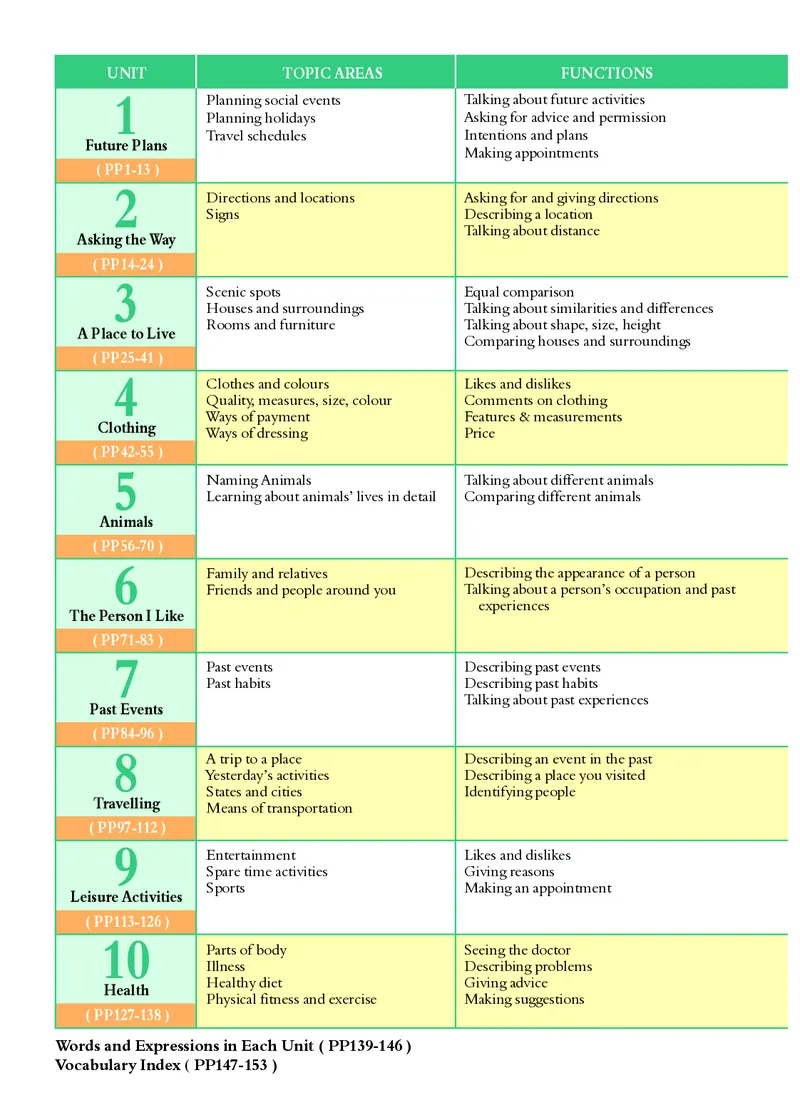
TOPIC AREAS
FUNCTIONS
A Place to Live
Animals
The Person I Like
Past Events
Travelling
Leisure Activities
Health
( PP1-13 )
( PP14-24 )
( PP25-41 )
( PP42-55 )
( PP56-70 )
( PP71-83 )
( PP84-96 )
( PP97-112 )
( PP113-126 )
( PP127-138 )
Planning social events
Planning holidays
Travel schedules
Directions and locations
Signs
Scenic spots
Houses and surroundings
Rooms and furniture
Clothes and colours
Quality, measures, size, colour
Ways of payment
Ways of dressing
Naming Animals
Learning about animals’ lives in detail
Family and relatives
Friends and people around you
Past events
Past habits
A trip to a place
Yesterday’s activities
States and cities
Means of transportation
Entertainment
Spare time activities
Sports
Parts of body
Illness
Healthy diet
Physical fitness and exercise
Talking about future activities
Asking for advice and permission
Intentions and plans
Making appointments
Asking for and giving directions
Describing a location
Talking about distance
Equal comparison
Talking about similarities and differences
Talking about shape, size, height
Comparing houses and surroundings
Likes and dislikes
Comments on clothing
Features & measurements
Price
Talking about different animals
Comparing different animals
Describing the appearance of a person
Talking about a person’s occupation and past
experiences
Describing past events
Describing past habits
Talking about past experiences
Describing an event in the past
Describing a place you visited
Identifying people
Likes and dislikes
Giving reasons
Making an appointment
Seeing the doctor
Describing problems
Giving advice
Making suggestions
1
2
3
4
5
6
7
8
9
10
Clothing
Future Plans
Asking the Way
Words and Expressions in Each Unit ( PP139-146 )
Vocabulary Index ��PP147-153 )
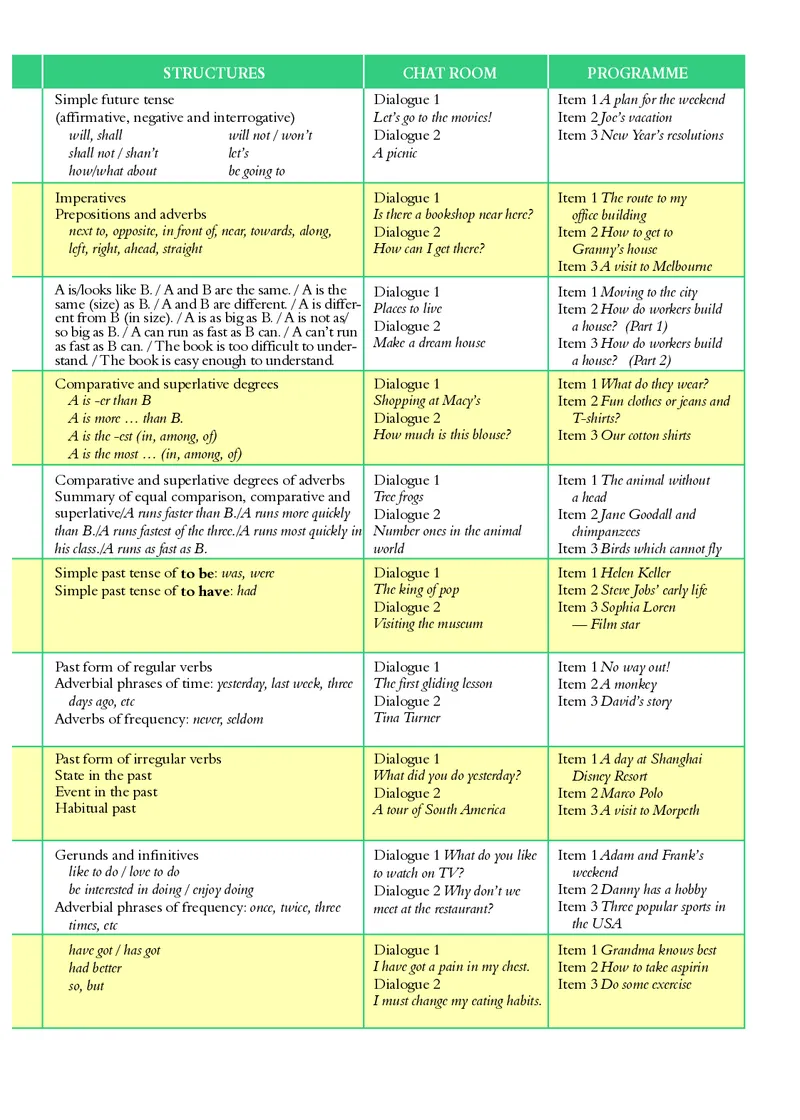
STRUCTURES
CHAT ROOM
PROGRAMME
Simple future tense
(affirmative, negative and interrogative)
will, shall
will not / won’t
shall not / shan’t
let’s
how/what about
be going to
Imperatives
Prepositions and adverbs
next to, opposite, in front of, near, towards, along,
left, right, ahead, straight
A is/looks like B. / A and B are the same. / A is the
same (size) as B. / A and B are different. / A is differ-
ent from B (in size). / A is as big as B. / A is not as/
so big as B. / A can run as fast as B can. / A can’t run
as fast as B can. / The book is too difficult to under-
stand. / The book is easy enough to understand.
Comparative and superlative degrees
A is -er than B
A is more … than B.
A is the -est (in, among, of)
A is the most … (in, among, of)
Comparative and superlative degrees of adverbs
Summary of equal comparison, comparative and
superlative/A runs faster than B./A runs more quickly
than B./A runs fastest of the three./A runs most quickly in
his class./A runs as fast as B.
Simple past tense of to be: was, were
Simple past tense of to have: had
Past form of regular verbs
Adverbial phrases of time: yesterday, last week, three
days ago, etc
Adverbs of frequency: never, seldom
Past form of irregular verbs
State in the past
Event in the past
Habitual past
Gerunds and infinitives
like to do / love to do
be interested in doing / enjoy doing
Adverbial phrases of frequency: once, twice, three
times, etc
have got / has got
had better
so, but
Dialogue 1
Let’s go to the movies!
Dialogue 2
A picnic
Dialogue 1
Is there a bookshop near here?
Dialogue 2
How can I get there?
Dialogue 1
Places to live
Dialogue 2
Make a dream house
Dialogue 1
Shopping at Macy’s
Dialogue 2
How much is this blouse?
Dialogue 1
Tree frogs
Dialogue 2
Number ones in the animal
world
Dialogue 1
The king of pop
Dialogue 2
Visiting the museum
Dialogue 1
The first gliding lesson
Dialogue 2
Tina Turner
Dialogue 1
What did you do yesterday?
Dialogue 2
A tour of South America
Dialogue 1 What do you like
to watch on TV?
Dialogue 2 Why don’t we
meet at the restaurant?
Dialogue 1
I have got a pain in my chest.
Dialogue 2
I must change my eating habits.
Item 1 A plan for the weekend
Item 2 Joe’s vacation
Item 3 New Year’s resolutions
Item 1 The route to my
office building
Item 2 How to get to
Granny’s house
Item 3 A visit to Melbourne
Item 1 Moving to the city
Item 2 How do workers build
a house? (Part 1)
Item 3 How do workers build
a house? (Part 2)
Item 1 What do they wear?
Item 2 Fun clothes or jeans and
T-shirts?
Item 3 Our cotton shirts
Item 1 The animal without
a head
Item 2 Jane Goodall and
chimpanzees
Item 3 Birds which cannot fly
Item 1 Helen Keller
Item 2 Steve Jobs’ early life
Item 3 Sophia Loren
— Film star
Item 1 No way out!
Item 2 A monkey
Item 3 David’s story
Item 1 A day at Shanghai
Disney Resort
Item 2 Marco Polo
Item 3 A visit to Morpeth
Item 1 Adam and Frank’s
weekend
Item 2 Danny has a hobby
Item 3 Three popular sports in
the USA
Item 1 Grandma knows best
Item 2 How to take aspirin
Item 3 Do some exercise
1
1
. 1 .
Unit
Unit
Future Plans
Future Plans
1
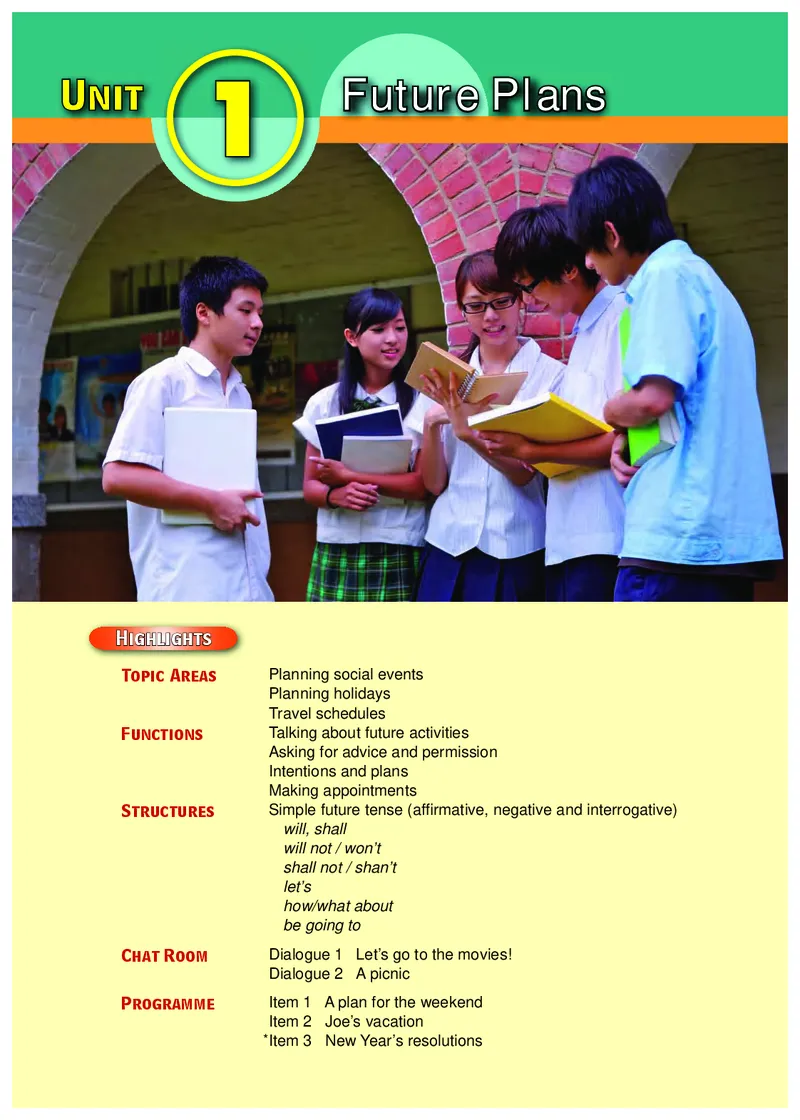
Topic Areas
Planning social events
Planning holidays
Travel schedules
Functions
Talking about future activities
Asking for advice and permission
Intentions and plans
Making appointments
Structures
Simple future tense (affi rmative, negative and interrogative)
will, shall
will not / won’t
shall not / shan’t
let’s
how/what about
be going to
Chat Room
Dialogue 1 Let’s go to the movies!
Dialogue 2 A picnic
Programme
Item 1 A plan for the weekend
Item 2 Joe’s vacation
Item 3 New Year’s resolutions
*
Highlights
Highlights
2
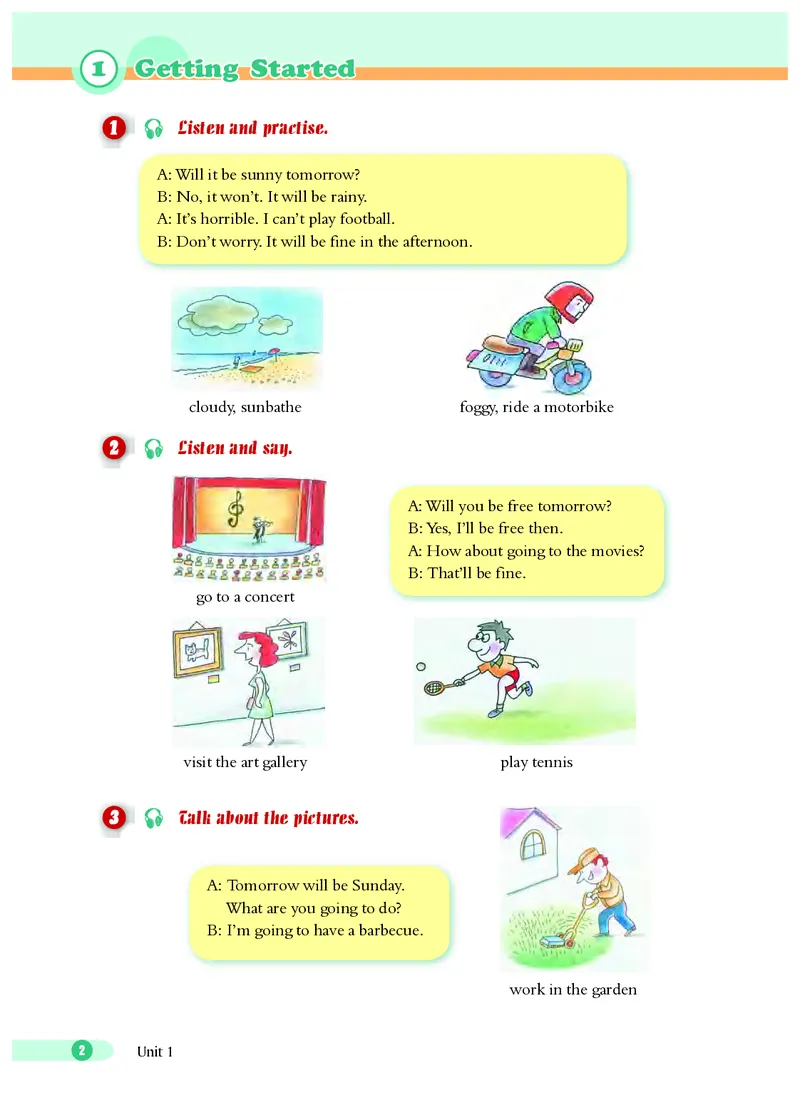
Getting Started
Getting Started
1
Listen and practise.
Listen and say.
Talk about the pictures.
1
2
3
A: Will it be sunny tomorrow?
B: No, it won’t. It will be rainy.
A: It’s horrible. I can’t play football.
B: Don’t worry. It will be fine in the afternoon.
A: Will you be free tomorrow?
B: Yes, I’ll be free then.
A: How about going to the movies?
B: That’ll be fine.
A: Tomorrow will be Sunday.
What are you going to do?
B: I’m going to have a barbecue.
cloudy, sunbathe
visit the art gallery
go to a concert
foggy, ride a motorbike
play tennis
work in the garden
Unit 1
3
Time to get up
What to do before breakfast
What to have for breakfast
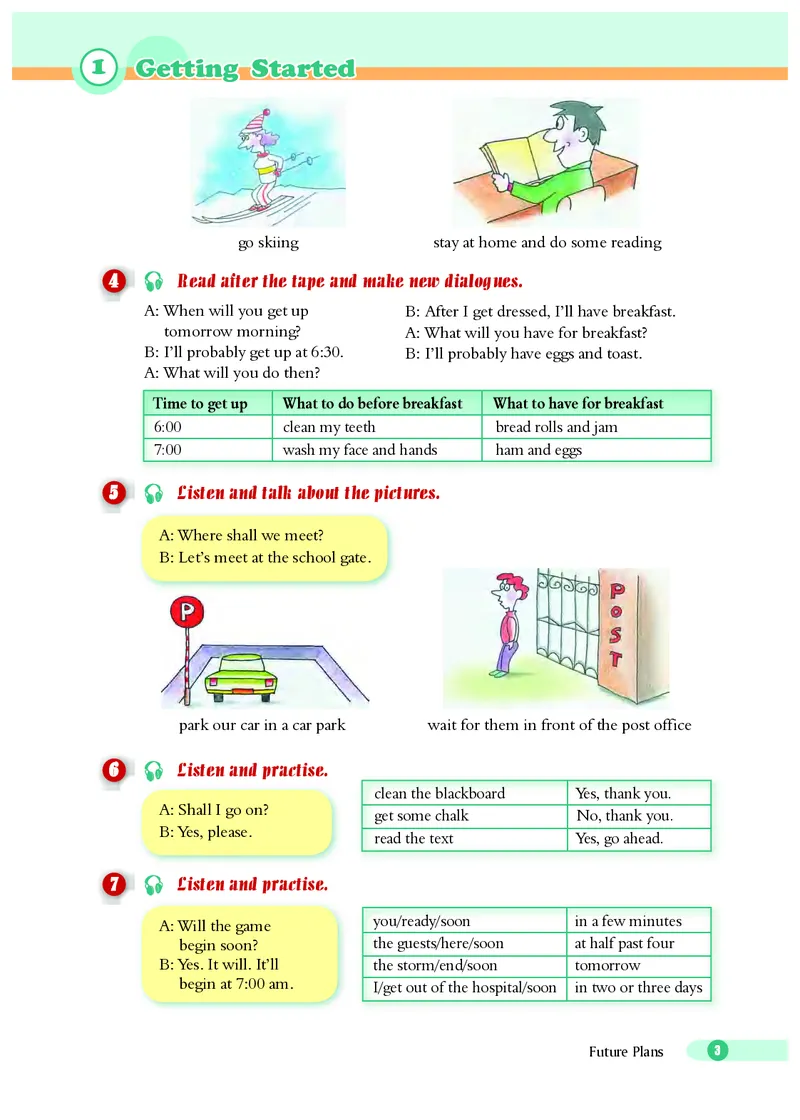
Read after the tape and make new dialogues.
Listen and talk about the pictures.
Listen and practise.
Listen and practise.
4
5
6
7
A: Where shall we meet?
B: Let’s meet at the school gate.
A: Shall I go on?
B: Yes, please.
A: Will the game
begin soon?
B: Yes. It will. It’ll
begin at 7:00 am.
go skiing
park our car in a car park
A: When will you get up
tomorrow morning?
B: I’ll probably get up at 6:30.
A: What will you do then?
1
Getting Started
Getting Started
stay at home and do some reading
wait for them in front of the post office
6:00
clean my teeth
bread rolls and jam
7:00
wash my face and hands
ham and eggs
clean the blackboard
Yes, thank you.
get some chalk
No, thank you.
read the text
Yes, go ahead.
you/ready/soon
in a few minutes
the guests/here/soon
at half past four
the storm/end/soon
tomorrow
I/get out of the hospital/soon
in two or three days
B: After I get dressed, I’ll have breakfast.
A: What will you have for breakfast?
B: I’ll probably have eggs and toast.
Future Plans
4
Chat Room
Chat Room
2
Dialogue 1
Dialogue 2
David: So, Mike, what are you going to do tomorrow?
Mike: I’m going to go for a ride on my new bike. How about you?
David: I’m going to the beach with my cousin if it doesn’t rain.
Mike: And if it rains?
David: Oh, well, maybe we’ll go to the movies.
Would you like to join us?
Mike: I’d love to. I won’t ride my bike if it rains.
When and where shall we meet?
David: Let’s meet at the theatre, around 7:30 pm.
Leon: We shall have a picnic tomorrow. Can you come, Jacky?
Jacky: Yes, I can. Where shall we have the picnic?
Leon: We shall have the picnic in Fairy-Lake Park.
Jacky: How shall we go there?
Leon: We shall go there by bus.
Jacky: Will your sister come, too?
Leon: No, she won’t come. She will go to a birthday party.
Jacky: Oh, that’s too bad. What will the weather be like tomorrow?
Leon: It’ll be fine. I think we’ll have a good time.
Jacky: That’s for sure. See you tomorrow.
Leon: See you.
Let’s go to the movies
A picnic
Unit 1
5
3
Programme
Programme
Item 1
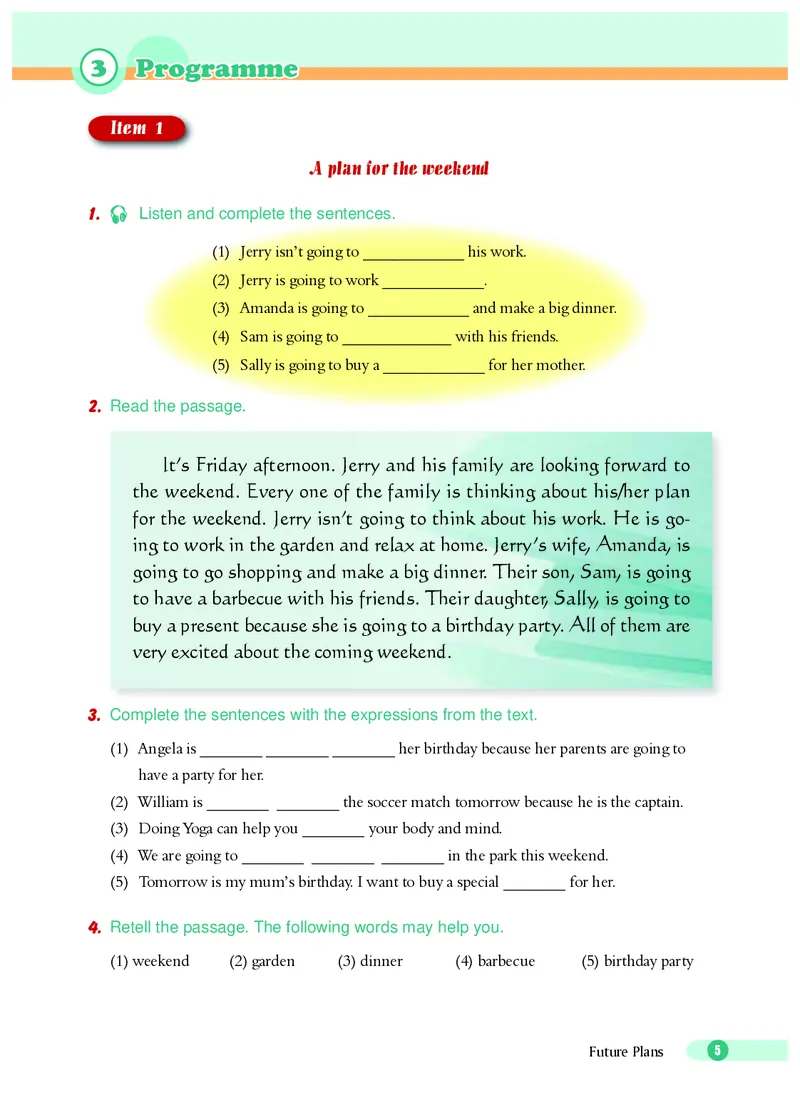
1. Listen and complete the sentences.
2. Read the passage.
3. Complete the sentences with the expressions from the text.
4. Retell the passage. The following words may help you.
(1) Jerry isn’t going to _____________ his work.
(2) Jerry is going to work _____________.
(3) Amanda is going to _____________ and make a big dinner.
(4) Sam is going to ______________ with his friends.
(5) Sally is going to buy a _____________ for her mother.
(1) Angela is ________ ________ ________ her birthday because her parents are going to
have a party for her.
(2) William is ________ ________ the soccer match tomorrow because he is the captain.
(3) Doing Yoga can help you ________ your body and mind.
(4) We are going to ________ ________ ________ in the park this weekend.
(5) Tomorrow is my mum’s birthday. I want to buy a special ________ for her.
(1) weekend
(2) garden
(3) dinner
(4) barbecue
(5) birthday party
It’s Friday afternoon. Jerry and his family are looking forward to
the weekend. Every one of the family is thinking about his/her plan
for the weekend. Jerry isn’t going to think about his work. He is go-
ing to work in the garden and relax at home. Jerry’s wife, Amanda, is
going to go shopping and make a big dinner. Their son, Sam, is going
to have a barbecue with his friends. Their daughter, Sally, is going to
buy a present because she is going to a birthday party. All of them are
very excited about the coming weekend.
A plan for the weekend
Future Plans
6
Item 2
1. What will the boy and his family do in spring?
Listen to the passage and tick [√]
the right pictures.
2. Listen and say whether the statements are true(T) or false(F).
3. Listen again and answer the questions.
a. make a snowman b. ride a bike
c. play baseball
d. work in the garden
e. paint the fence
f. fly a kite
g. go swimming h. stay indoors
i. go skiing
______ (1) It’ll be winter soon.
______ (2) It’s spring now.
______ (3) The boy hopes to play outside with his friends.
______ (4) The boy and his friends often ride bicycles and play baseball in winter.
______ (5) The boy is tired of winter.
(1) Is the boy tired of the snow?
_______________________________________________________________________
(2) Is he going to play with his friends?
_______________________________________________________________________
(3) Can he go out and play with his friends now?
_______________________________________________________________________
(4) Will spring come soon?
_______________________________________________________________________
(5) Will they ride bicycles and play baseball with their friends again in spring?
_______________________________________________________________________
3
1
6
7
8
9
2
3
5
4
Joe’s vacation
Programme
Programme
Unit 1
7
4. Read and understand.
5. Complete the sentences with the expressions in the text.
6. Group discussion.
(1) We always have eggs, rolls and milk for breakfast. I’m ________ ________ them. I want
to change my breakfast.
(2) Jack is always late for class. Today he is late again. Mr Black is very angry and asks him
not to be late ________ ________.
(3) The weatherman says tomorrow will be cloudy and ________. We won’t see sunshine.
(1) What will be the next season?
(2) What will the weather be like in your city?
(3) What will you and your friends do then?
I’m tired of winter. I’m tired of the snow, I’m tired of cold weather,
and I’m tired of heavy coats and boots! Just think…in a few more
weeks it won’t be winter any more. It’ll be spring. The weather won’t
be cold. It’ll be warm. It won’t snow any more. It’ll be sunny. I won’t
play alone at home. I’ll go outside and play with my friends. We’ll ride
bicycles and play baseball again. We’ll go boating on the lake. We’ll
swim in the river and catch fish in the river, too. Every day will be fun.
* Item 3
1. Listen and match
the words with the
pictures.
3
Programme
Programme
(4) What will your family do?
(5) What suggestions will you make to visitors?
the
he
es.
hotdogs
Queen
Arts and Crafts Exhibition
fair chips
candyfloss roller coaster
New Year’s resolutions
Future Plans
8
3
Programme
Programme
2. Listen again and put the following events in the right order.
a. We shall go to the fair on Woodhouse Moor.
b. I shall get up early and meet my friends.
c. We shall eat all sorts of things.
d. We shall catch the early train.
e. We shall spend all our money at the fair.
(1) Mrs Smith often _____________ her friends for tea on Saturdays.
(2) Sam will go to the airport to _____________ his cousin from London.
(3) There are many _____________ of modern arts in that art gallery.
(4) Mr Black goes to a _____________ once a month to sell flowers and buy what they need. His
children will enjoy themselves at the _____________, too. They can buy sweets, lollipops and toys.
(5) Many children like to have a ride on the _____________. It’s really exciting.
(1) When will the next public holiday come and what is it?
(2) What will people do that day?
(3) Will people go to work that day?
(4) Will you give anyone presents that day?
(5) Will you do anything special to prepare for it?
(6) Will you have special food that day?
( ) — ( ) — ( ) — ( ) — ( ) — ( ) — ( ) — ( ) — ( ) — ( )
f. We shall have a ride on the roller coaster.
g. We shall probably meet friends at the fair.
h. We shall go to the Arts and Crafts Exhibition.
i. We shall get home very late.
j. We shall get the last train.
3. Read and understand.
4. Retell the story by starting with “Susan will get up early and meet her friends, Judy
and Sammy. They ...”
5. Complete the sentences with the words in the text.
6. Discuss with your partners.
The next public holiday will be Easter. This year it will be on the 12th of
April. I shall get up early and meet my friends, Judy and Sammy. We shall catch
the early train into the centre of the city. Then we shall go to the Arts and
Crafts Exhibition in the Queen’s Hall. After that we shall go to the fair on Wood-
house Moor. We shall spend all our money at the fair. We shall eat all sorts of
things — things such as chips, hotdogs and candyfloss. We shall probably meet
friends there. We shall have a ride on the roller coaster. In the evening we shall
get the last train and get home very late.
Unit 1
9
Data Bank
Data Bank
5
Message Box
Message Box
4
3
7. Pair Work Use your imagination and give your answers to these questions.
I
are
very
afternoon
tomorrow
morning
work
letter
university
temperature
blackboard
night
(1) What will they enjoy in the Arts and Crafts Exhibition?
(2) How will they spend all their money?
(3) What else may people do at the fair?
(4) How will they feel on their way home?
1. Read the following words and divide them into three groups according to
the number of syllables.
Programme
Programme
I,
very,
afternoon,
Box 1
Box 2
Box 3
Affirmative (full forms and contractions)
Negative (full forms and contractions)
I / We shall ...
I’ll / We’ll ...
I / We shall not ...
I / We shan’t ...
You / They will ...
You’ll / They’ll ...
You / They will not ...
You / They won’t ...
He / She / It will ...
He’ll / She’ll / It’ll ...
He / She / It will not ...
He / She / It won’t ...
Shall I / we…?
Shall we meet at the school gate?
Will you / they…?
Will you meet us at the airport?
Will he / she / it…?
Will he drive us to the hotel?
What / When / How will…?
How will they spend the holiday here?
Let’s…
Let’s go for a picnic this Sunday.
You’d better do / not do…
You’d better come to our beach party.
You’d better not stay at home all day.
How / What about…?
How about a dinner party?
I’d like to…
I’d like to watch the baseball game.
Future Plans
10
Data Bank
Data Bank
5
DIY Lab
DIY Lab
6
office building
classrooms
library and reading rooms
laboratories
IT centre
gym
sports ground
2. Read the following words, paying attention to word stress.
3. Could you fi nd the rules?
very /�veri/
doctor /�dɒktə/
American /ə�merikən/
any /�eni/
recorder /ri�kɔ�də/
university /�ju�ni�v �siti/
/ i� / he
she
we
Peter
evening
see
street
keep
need
peep
meet
piece
belief
chief
achieve
field
receive
receipt
perceive
/ i /
it
is
his
this
city
study
sorry
carry
between recorder excuse
/ e /
get
tell
very
bed
desk
lesson
red
pleasure head
peasant
pleasant
/
/ man
that
bag
glad
land
hand
have
1. Presentation In your school re-
ception room you act as the host
and are telling a group of American
guests what they will see in your
school. The following words may
help you.
2. Questionnaire Read the following possible events in the future, and put a circle
around the number which coincides with your opinion. Before starting, look at the
Notes and understand what each number stands for. Compare your answers with
your partner’s.
Water will replace oil.
1 2 3 4 5 6 7
I will study abroad.
1 2 3 4 5 6 7
Cities will appear in Antarctica.
1 2 3 4 5 6 7
A UFO will land near a large city.
1 2 3 4 5 6 7
I will travel around the world.
1 2 3 4 5 6 7
Pandas will become extinct.
1 2 3 4 5 6 7
Australia will have a president instead of a king or queen. 1 2 3 4 5 6 7
I will be able to speak English fluently.
1 2 3 4 5 6 7
I will be able to speak French, too.
1 2 3 4 5 6 7
One of my classmates will be a principal.
1 2 3 4 5 6 7
Unit 1
11
DIY Lab
DIY Lab
6
1—Yes, definitely.
2—Yes, probably.
3— It’s possible.
4—It’s hard to say.
5— It’s doubtful.
6— No, probably not.
7— No, definitely not.
You and your friend are talking to a travel agent about your travel plans. You are living
in the city of Los Angeles. Choose your destination and ask about the cost and the time.
Complete the dialogue.
Tourists: I wonder if you could help us. We’d like to go to _____________. We shall
go by plane / bus / train / car. How long will it take?
Agent:
It’ll take you _____________.
Tourists: I see. And by _____________?
Agent:
That’ll be _____________.
Tourists: And how long will it take by _____________?
Agent:
It’ll take _____________.
Tourists: Well, I think we’ll go by _____________.
Agent:
Very good, sir / ma’am.
Tourists: Thank you very much.
Agent:
You’re welcome.
3. Pair Work.
4. Internet Surfi ng.
From Los Angeles to
Bus
Plane
Train
Car
New
Cost
$100
$250
$220
$15/day
York
Time
4 days
6 hours
3 1/2 days
6 days
Chicago
Cost
$80
$210
$195
$15/day
Time
3 days
4 1/2 hours
2 1/2 days
4 days
New
Cost
$90
$220
$200
$15/day
Orleans
Time
3 1/2 days
5 hours
3 days
5 days
San
Cost
$30
$60
$45
$15/day
Francisco
Time
10 hours
45 min.
8 hours
12 hours
A traveller has a budget of 8,000 yuan and wants a 4-day tour abroad. You
act as a travel agent. Make arrangements for him with the help of the Internet
and discuss it with your partner. Try to convince the traveller that the places of
the tour are the most attractive and the itinerary is the best one.
Notes
Future Plans
12
Culture Corner
Culture Corner
7
1. People often send invitations for large
events such as weddings, engagement
parties, and for celebrations like 18th
and 21st birthdays.
2. People in the West often send a “Thank
You” note the day after a special occasion
that has been enjoyed. It should be
personally written, short and to the
point, expressing your thanks.
Damian Curtis and Carol Jacobs
request the company of
Ellen Smith and friend
on the occasion of their marriage
in the Heatherdown Chapel
at Greystanes Road, Carlingford
at 2 pm on Friday 18 November 2011
and afterwards for the reception
at Lucinda House, Epping
RSVP. 28 October 2011
134 Noble Avenue,
Carlingford NSW 2134
Tel: 9866 3588
An invitation
Dear Louise and John,
Thank you so much for a wonderful evening last night.
I enjoyed myself immensely and met some lovely people. The food
was excellent and I enjoyed the wine very much (perhaps too much).
It was thoughtful of you to invite me to your home so close to Christ-
mas. I felt very comfortable and happy and I know that I will re-
member the occasion for many years to come.
Once again, thank you both. Best wishes for Christmas and the
New Year.
Yours sincerely,
Lin
A thank-you note
16 Brunswick Street
Carven
23 December 2011
Unit 1
13
Magic Square
Write your answers in the magic square. Here are
clues to help you. If you’ve done it correctly, you’ll see
that your answers will read the same across and down.
1) Across
(1) This animal catches rats.
(2) Had a meal
(3) An afternoon drink
2) Across
(1) This animal has horns and a beard.
(2) Only one time
(3) Performs
(4) Exam
Game Zone
Game Zone
8
1. Game.
2. Rhyme.
3. Song.
My kite is white,
My kite is light,
My kite is in the sky!
Now left, now right,
Now low, now high,
You see the kite,
We see it, you and I.
How are you
My kite
Hello, hello, hello
and how are you?
I’m fine. I’m fine,
and I hope that you are, too.
1
2
3
1
2
3
4
Future Plans
14
Unit
Unit
Asking the Way
Asking the Way
2
Topic Areas
Directions and locations
Signs
Functions
Asking for and giving directions
Describing a location
Talking about distance
Structures
Imperatives
Prepositions and adverbs
next to, opposite, in front of, near, towards, along,
left, right, ahead, straight
Chat Room
Dialogue 1 Is there a bookshop near here?
Dialogue 2 How can I get there?
Programme
Item 1 The route to my offi ce building
Item 2 How to get to Granny’s house
Item 3 A visit to Melbourne
*
Highlights
Highlights
15
1
Getting Started
Match the signs with the phrases.
Listen to the tape and number the following drawings.
Then read after the tape.
Listen and repeat.
1
2
3
( 1 ) Don’t turn left.
____________________
( 2 ) Turn left.
____________________
( 3 ) Walk across the road.
____________________
( 4 ) Don’t overtake another vehicle
when getting near a crosswalk. ____________________
( 5 ) Stop your car.
____________________
( 6 ) Don’t turn right.
____________________
( 7 ) Turn right.
____________________
( 8 ) Don’t drive into this street. ____________________
a
b
c
d
e
f
(1) Linda: Excuse me. Can you tell me how to get to the hospital?
Tom: Yes, certainly. Go down Lucky Street and turn left at Happy Avenue.
The hospital is on your right.
(2) Linda: Excuse me. Is this bus going to the library?
Tom: No, it’s going downtown.
Linda: Which bus goes to the library?
Tom: No. 24.
c) Take the
second
street on
the left.
f) Turn left at
the cross-
roads.
a) Go straight
ahead.
b) Take the
first street
on the
right.
d) Turn right
at the traf-
fic lights.
e) Go straight
ahead and
turn left at
the bank.
16
P I Z Z A
HUT
H E A LT H
CENTRES
CINEMA
CENTRAL
PARK
P O L I C E
STATION
RESTAURANT
Getting Started
Getting Started
1
Work in pairs and find these places in the map. The first one has
been done for you.
Listen and do questions and answers.
4
5
How far is the Petrol Station from here?
It’s about 200 yards away.
_____________________________________
_____________________________________
_____________________________________
_____________________________________
_____________________________________
_____________________________________
_____________________________________
_____________________________________
200 yds
1.5 hours
2.5 miles ahead
45 minutes
30 minutes
10 minutes’ walk
3,000 metres
1/2 mile
(3) Linda: Excuse me. Where’s the church?
Tom: Sorry. I don’t know. I’m a stranger here.
Woman: Excuse me. Where is the swimming pool, please?
Man:
Go straight ahead and turn left at the roundabout.
The swimming pool is on your left.
Petrol Station
Town Centre
Safari Park
Hampton Court
(1)
(2)
(3)
(4)
(5)
Bus services
Kennedy Airport
Railway station
Unit 2
17
2
Chat Room
Chat Room
Dialogue 1
Dialogue 2
Ken: Excuse me?
Ann: Yes?
Ken: We’re going to buy some books. Is there a bookshop near here?
Ann: No. But there’s a big one about two kilometres away.
Ken: How can I get there?
Ann: You can take a bus.
Ken: Which bus?
Ann: You can take No. 12 or No. 25. Go along this road and you’ll find
the bus stop on the right.
Ken: Thank you very much.
Ann: You are welcome.
(the telephone rings)
Peter: Hello, Peter speaking.
Diana: Hi, Peter. This is Diana. I’m near the Grand Theatre.
Can you tell me how I can get to the railway station from here?
Peter: The Grand Theatre? You are quite near the station.
Diana: Oh. That’s good. How far away is it?
Peter: It’s about eight minutes’ walk from the theatre. You should walk
across the road at the theatre. Then go straight ahead. Turn right at
the first traffic lights. The railway station is right around the corner.
You can’t miss it.
Diana: Thank you, Peter.
Peter: My pleasure.
Is there a bookshop near here?
How can I get there?
Asking the Way
18
3
Item 1
1. Listen to the e-mail and draw the right route on the map.
2. Study the above e-mail message and write down the main directions.
3. Your cousin Rebecca is visiting you in a few days. Give her directions to your house
by e-mail. You may draw a map to show the way.
Dear Jacky,
Here are the directions to my office building. I think the sta-
tion on Warren Street is the most convenient tube station for you.
When you come out of the station, turn right and walk along Hus-
ton Road to the big crossroads at the end. Turn left down Great
Portland Street. Take the second turn on the right and then the
first on the left.
I work in the big building on the right towards the end of the
road. I’ll see you in the entrance hall at about 6:00 pm.
Yours,
Barbara Smith
Programme
Programme
The route to my office building
Great Portland Street
Warren Street
Huston Road
Unit 2
19
3
Programme
Programme
Item 2
1. Listen to the passage and mark Granny’s house.
2. Role play.
3. Draw a map to show the way to get to the nearest bookstore from your school.
Tell your classmates how to get there.
Tell Mary how to get to her Granny’s house.
It’s spring again. Mary wants to visit her grandparents in the
countryside. They live in a quiet and beautiful village. Mary’s father is
telling her how to get to their house.
“It’s easy to get to Granny’s house. Just walk along this path and
you’ll see a small wood with many trees after you pass a signpost. Take
the path through the trees. As you come to a stream, take the path to
the right. Walk along the
stream until you come
to a bridge. Cross the
bridge to get to the other
side. Walk away from the
bridge and take the path
straight ahead. Pass the
green lawns, and you will
see Granny ’s house at
the end of the path. You
need to go up a long flight
of steps to get to her
place.”
How to get to Granny’s house
Asking the Way
20
(1) Bridge Road
a. A beachside holiday resort.
(2) Royal Botanic Gardens
b. A street of fashion, food and furniture.
(3) Williamstown
c. There are excellent landscapes of plants.
A. Bridge Road is Melbourne’s most popular
street for fashion, food and furniture. There
are many discount stores and factory outlets.
It’s in Richmond.
Christine’s friend Teresa is coming to visit Melbourne. Christine collects some
information about the three places that Teresa should go to.
* Item 3
1. Read and match.
3
B. Royal Botanic Gardens are world famous
gardens. There are excellent landscapes of plants
from around the world. Walks of the gardens may
bring you impressive experiences. Take the tram
to South Yarra, then walk along Punt Road, and
they’re right across the road.
C. Williamstown is just a stone’s throw away from the
city. The streets of Williamstown were first built by
Europeans in 1837. It used to be an old seaport. Now
it is a nice beachside holiday resort. Take the West
Gate Freeway and turn off at Melbourne Road. Fol-
low Melbourne Road through to Williamstown, and
from here follow signs to various attractions.
A visit to Melbourne
Programme
Programme
Unit 2
21
3
Programme
Programme
Message Box
Message Box
4
2. Read and mark the three places.
Box 1
Box 2
Box 3
V
Jump.
V+O
Open the door.
V+P
Be reasonable.
V+A
Get inside.
V+O+O
Tell me the truth.
V+O+C
Wash the sheets clean.
V+O+A
Put the flowers on the table.
Don’t
open the door.
be afraid.
Describing the position with “prepositions”
Where’s the painting?
Where’s the post office?
It’s on / at / above / in / under / beside / near / behind the desk.
It’s next to / opposite / in front of / near the police station.
Asking the Way
22
5
DIY Lab
DIY Lab
6
Data Bank
Data Bank
happy
sorry
record
begin
many
decide
refuse
always
party
excuse
(1) family
hospital
activity
several
exercise
necessity
(2) dictation
education
revision
discussion
conversation
television
(3) university
altogether
the nearest post office / cinema / library / convenience store / stationer’s.
1. Read the following words and divide them into two groups according to where
syllable stress occurs.
2. Read the following words, paying attention to word stress.
3. Could you fi nd the rules?
happy ,
begin ,
/ f /
fine
fly
fifth
wife
fall
off
photograph
physics
philosophy
/ v / very
five
evening
even
have
/ θ /
thank
think
thin
thick
three
through
/ ð / this
that
they
with
though
although
/ m / me
my
time
come
some
/ b / bomb
comb
tomb
limb
lamb
1. Presentation Describe how to get to the following places from your school.
2. Listen. People are asking the way to each of the following places. Where are
they? Tick (✓) the correct circle a, b, or c.
Lake Sta-
tionery
The Coffee
Shop
Minute Print
Parking Lot
a
c
b
T h e
Deli
Candy
Land
Mr Tie
First Bank
Long Life
Drugstore
Video City
Computer
Books
a
b
c
(1) Where is the Four Seasons Restaurant?
(2) Where is the Century Hotel?
Unit 2
23
Culture Corner
Culture Corner
7
6
DIY Lab
DIY Lab
3. Pair Work Look at the map.
You will see that the names
of the buildings are not given.
Name six buildings on the
map. Then work with a
partner, and try to fi nd each
building from the point
marked.
Sunshine Su-
permarket
Holiday
Travel
Department
Store
Park
Music
City
The
Lamp
Shop
c
a
b
Burger
Boy
Payright
Shoes
Sports
Store
Castle
Books
Marie’s
Fashion
Star Soft-
ware
The Gift
Horse
Flowers
By Ivy
a
c
b
(3) Where is the drugstore?
(4) Where is the video store?
PITT ST
WEST ST
SMITH ST
BROWN ST
EAST ST
JONES ST
SOUTH ST
WELL ST
JOHN ST
OWEN ST
MAIN ST
BACK ST
HOPE ST
In China, signs show distances in kilometres, but in Britain or America
road signs show the distances to towns and cities in miles. Short distances
are given in yards. One mile is about 1.6 kilometres. And one yard is about
0.91 metre.
Asking the Way
24
Game Zone
Game Zone
8
Across
(1) The colour of the sky on a fine day.
(2) Not difficult.
(3) Stevenson saw the wind – the kites on high.
Down
(1) Good, better, –
(2) Hob – a knife and fork when he eats.
(3) We see with them.
1. Crossword.
2. Rhyme.
3. Song.
Flying man, Flying man,
Up in the sky,
Where are you going to
Flying so high?
Over the mountains
And over the sea,
Flying man, Flying man
Won’t you take me?
Oh! Where has my little dog gone?
Flying man
Oh where, oh where has my little dog gone?
Oh, where, oh where can he be?
With his ears cut short and his tail cut long
Oh where, oh where can he be?
(Repeat once)
1
1
2
3
2
3
Unit 2
25
25
. 25 .
Unit
Unit
A Place to Live
A Place to Live
3
Topic Areas
Scenic spots
Houses and surroundings
Rooms and furniture
Functions
Equal comparison
Talking about similarities and differences
Talking about shape, size, height
Comparing houses and surroundings
Structures
A is / looks like B.
A and B are the same.
A is the same (size) as B.
A and B are different.
A is different from B (in size).
A is as big as B.
Chat Room
Dialogue 1 Places to live
Dialogue 2 Make a dream house
Programme
Item 1 Moving to the city
Item 2 How do workers build a house? (Part 1)
Item 3 How do workers build a house? (Part 2)
*
Highlights
Highlights
A is not as / so big as B.
A can run as fast as B can.
A can’t run as fast as B can.
The book is too diffi cult to understand.
The book is easy enough to understand.
26
Getting Started
Getting Started
1
Listen and talk about the scenic spots.
Listen and talk about more scenic spots.
Barbara and Chris are twins. Listen and talk about their rooms.
1
2
3
The Eiffel Tower is like the letter A.
But Beijing National Stadium is not a bit like the letter A.
It looks like a bird’s nest.
A: Are the two beds the same?
B: Yes, they are. Barbara’s bed is the same as Chris’s.
A: What about other things in their rooms?
B: Look at their desks. They are different in colour.
A: Are their chairs the same?
B: No, they aren’t. They are different.
Washington Monument, a pencil
Sydney Opera House, shells
the Great Wall, a dragon
Arabian Star Hotel, a sail
Unit 3
27
Listen and say.
Listen and say.
4
5
A: Is this pipe long?
B: Yes, it is.
A: How about that pipe?
B: That pipe is as long as this one.
A: Look at the two flats. Are they the same?
B: No, they aren’t. They are different in size.
✰ size
✰ length
✰ width
✰ plans
1
Getting Started
Getting Started
bookcase
dressing table
wardrobe
computer
TV
lamp
shape
colour
size
A Place to Live
28
Getting Started
Getting Started
1
clean, window
big, armchair
beautiful, picture
heavy, box
new, rug
Listen and compare.
Talk about Joe and Bob.
6
7
A: Is this wire long?
B: Yes, it is.
A: Is that wire long, too?
B: No, it isn’t. That wire is not so long as this one.
Joe and Bob are neighbours. They have the same habits and hobbies. They
both get up late. They both play the piano well. They both draw pictures beautifully.
However, sometimes they are different from each other. Joe does his home-
work carefully, but Bob doesn’t. Joe eats slowly, but Bob eats very fast. Joe helps his
mother happily, but Bob hates housework.
Unit 3
29
1
Getting Started
Getting Started
You will hear “The box is heavy. You can’t lift it.” You should say “The
box is too heavy to lift.”
Listen and make dialogues.
8
9
The box is too heavy to lift.
A: He is tall. He can reach the light.
B: Right. He is tall enough to reach the light.
Complete the following sentences according to the above passage.
Joe gets up as late as Bob.
Joe _______________________________________________________.
Joe _______________________________________________________.
Bob doesn’t do his homework so carefully as Joe.
Bob ______________________________________________________.
Bob ______________________________________________________.
John
The room
Lucy
He
is strong
is big
is well
runs fast
lift the box
hold our class
work again
catch the thief
bag
water
book
dictionary
big
hot
difficult
expensive
carry
drink
read
buy
A Place to Live
30
Chat Room
Chat Room
2
Dialogue 1
Dialogue 2
John: Where do you live, Kim?
Kim: I live in an apartment downtown.
John: Oh, that’s convenient, but is there much crime?
Kim: Not much. But there is a lot of traffic. I can’t stand
the noise sometimes!
John: I have a house in the suburbs.
Kim: Oh, I bet it’s really quiet. But is there much to do there?
John: No, not much. In fact, nothing ever really happens.
That’s the trouble.
Kim: Hey. Let’s trade places one weekend!
John: OK. Great idea!
Monster House is a programme. It’s about changing people’s houses into
their dream ones. Listen to the conversation carefully and take down notes.
Host: Hello. Monster House. Who’s that calling?
Jim:
Hello. My name’s Jim Lee. I am a big racing fan. My house is safe and
sweet, but it’s a bit plain for a racing fan like me.
Host: We can help to change. What’s your house like?
Jim:
Well, it’s a two-bedroom bungalow with a kitchen and a dining room.
Host: How big is the kitchen?
Jim:
It’s sixteen square metres.
Host: It’s big, I think. We can make it look like
a garage. What about the dining room?
Jim:
It is next to the kitchen. There is a large
table, some chairs and a sofa in it.
Host: I see. We will make some new chairs
with used tires. And your sofa will be like a trunk.
Jim:
That’s cool! How much should I pay?
Host: It’s all free. Just leave us the key. Come home a week later,
and you will get a big surprise.
Places to live
Make a dream house
Unit 3
31
3
Programme
Programme
Item 1
1. Listen and do the comprehension.
2. Listen and read.
(1) People in the dialogue are ________.
A. classmates
B. a couple
C. mother and son
D. father and daughter
(2) They are talking about ________.
A. whether to go to the theatre
B. whether to grow vegetables
C. whether to live in the city
D. whether to have a barbecue
(3) Who is for living in the suburbs?
A. Mr Lee.
B. Mrs Lee.
C. Mr Lee’s father.
D. Mrs Lee’s father.
Mr Lee will work in the city. The Lees are discussing the possibilities
of moving to the city.
Mr Lee: I will work in the city and we had better live in the city as well.
Mrs Lee: I really don’t want to. A flat in the city is as expensive
as a house here.
Mr Lee: It is good for you and our daughter. The local shops have
convenient opening hours. The flat is near a very good school.
Mrs Lee: You are wrong. The air in the city is not so fresh as the air here.
The water there is not so clean as it is here.
Mr Lee: I don’t care about these. The city offers restaurants, theatres
and cinemas. There is also a barbecue and picnic area in the
housing estate. Life here can’t be as exciting as life there.
Mrs Lee: But at night the city is not as quiet as the country here. I like
watching TV or reading a novel at home.
Mr Lee: Let’s leave the matter for your father to decide.
(4) Who is for moving to the city?
A. Mr Lee.
B. Mrs Lee.
C. Mr Lee’s father.
D. Mrs Lee’s father.
(5) They decide to leave the matter
to ________.
A. Mr Lee’s father
B. Mrs Lee’s mother
C. Mr Lee’s mother
D. Mrs Lee’s father
Moving to the city
A Place to Live
32
1
2
3
5
7
6
4
9
8
10
Item 2
Is it good to live in the suburbs?
Play the roles of Mr and Mrs Lee and Mrs Lee’s father. The three are dis-
cussing whether to move to the city.
Mr Lee is for moving and he lists his reasons.
Mrs Lee is against moving and she also lists her reasons.
Mrs Lee’s father tries to be on good terms with both Mr Lee and his
daughter.
3
3. List the advantages and disadvantages of living in the city.
You may add your opinions.
4. Suppose you are Mrs Lee’s father. What’s your opinion? Will they move to the city?
5. Role play
6. Topic Discussion
Advantages
Disadvantages
air
traffic
environment
education
shopping
leisure
air
traffic
environment
education
shopping
leisure
For
Factors
Against
Programme
Programme
How do workers build a house? (Part 1)
Unit 3
33
3. Someone is going to tell us how workers build new houses. Check (✓) what he
has mentioned.
4. Listen again and complete the statements.
1. Look at the picture. Match the numbers with the following words.
2. Answer the questions.
5. Pair Work
6. Group Work
driveway
lawn
chimney
side door
shutter
roof
window
garage
light
garage door
(1) Do you live in a flat or a house? _______________________________________________
__________________________________________________________________________
(2) Before workers build a house, what do they have to do? ____________________________
__________________________________________________________________________
(3) Can you see any pipes in your house? What are they used for? _______________________
__________________________________________________________________________
(1) A ________ ________ works as hard as a bee.
(2) Workers dig a hole in the ground and build the ________ of the house.
(3) The bottom is called the ________.
(4) A frame ________ ________ the floors, the walls and the roofs.
(5) Behind the walls ________ carry water, gas and steam.
walls, roofs
ceilings
electricity
pipes
a house design
families
floors
water, gas, steam
foundation
time
What protects the people and things inside a house when it rains or the wind blows?
Read the passage below before closing your books. Take turns acting as a worker. The
others ask “the worker” questions on the text.
Do you work hard?
3
Programme
Programme
A Place to Live
34
3
Programme
Programme
(1) the base on which something is built ________
(2) the lowest part of anything ________
(3) a large enclosed fire used for producing hot water or steam ________
(4) a hard main structure round which something is built or made ________
(5) a plan produced for something that is to be made ________
(6) an apparatus using coal, gas, electricity, etc, used for cooking ________
(7) warm and comfortable ________
(1) What makes a house comfortable? _______________________________________________
(2) Why are armchairs wider than people’s bodies? _____________________________________
(3) How high are the seats? Why? ___________________________________________________
(4) Does electricity travel through pipes behind the walls? _______________________________
(5) Do people like big houses or small houses? ________________________________________
(1) What do people buy for their new houses?
(2) Do people need tables, chairs, desks and bookcases?
(3) Why can lamps, radios, refrigerators and televisions work?
7. Look back at the text. Find words that mean:
1. Group Work Discuss the following questions.
A house builder works as hard as a bee.
To start, he draws a picture of the new house. It is a house design.
Then workers dig a hole in the ground and build the bottom of the house.
The bottom is called the foundation.
What is on top of the foundation? A frame holds up the walls and the roofs.
Behind the walls of a house there are many pipes. Some pipes carry clean
and dirty water. Other pipes carry gas for the furnace or the stove. More pipes
carry steam to the heater.
The roof and the windows on the outside of a house protect the people and
the things on the inside. When it rains or the wind blows, people can sit inside a
cozy house like a snail inside a shell.
* Item 3
2. Listen and answer the questions below.
How do workers build a house? (Part 2)
Unit 3
35
3
The seats are half as high as people’s legs so they can get up easily.
The word in italics means
a. because
b. with the purpose that
c. and
3. Read the text and check your answers to the questions above.
4. Which of the following is correct?
5. Armchairs are wider than people’s bodies so they can sit down.
6. Write a paragraph describing your home. Then show it to your partner for comment.
Some houses have a lot of furniture. Some have only a little. People need
tables and chairs and rugs. Furniture makes a house comfortable. Armchairs are
wider than people’s bodies so they can sit down. The seats are half as high as
people’s legs so they can get up easily.
Lamps, radios and refrigerators all work by electricity. Electricity travels
through wires behind the walls. Other wires carry voices to the telephone and
clear pictures to the television set.
Some people like to have big houses. Other people like to have small
houses. But people everywhere are happy with good homes. The world is big. A
house is like a little part of the world of your own.
Programme
Programme
a piece of furniture
a furniture
Message Box
Message Box
4
Box 1
Box 2
A and B are the
same (size, colour,
shape, ...)
A is the same (size,
colour, shape... ) as
B.
This pencil and that pencil are the same length.
This bag and that bag are the same colour.
This pencil box and that pencil box are the same shape.
This pencil is the same length as that one.
This bag is the same colour as that one.
This pencil box is the same shape as that one.
A Place to Live
36
4
Box 3
Box 4
Box 5
Box 6
Box 7
Box 8
Box 9
A and B are differ-
ent in (size, colour,
shape, ...)
A is different from
B in (size, colour,
shape, ...)
A is as [adj.] as B (is).
A is not as / so [adj.]
as B (is).
… too (adj.) to do
…
… (adj.) enough to
do …
… not (adj.) enough
to do …
My shoes and his shoes are different in size.
My shoes and his shoes are different in colour.
This swimming pool and that swimming pool are different in shape.
This building is different from that building in height.
This swimming pool is different from that one in width.
This swimming pool is different from that one in depth.
I am as tall as my brother (is).
The red pencil is as long as the blue one (is).
These books are as interesting as those books (are).
Tim is not as / so tall as Jim (is).
The red pencil is not as / so long as the yellow one (is).
These books are not as / so thick as those books (are).
The boy is too young to go to school.
The girl is too short to reach the shelf.
The man is too old to look after himself.
The boy is old enough to go to school.
The girl is tall enough to reach the shelf.
The man is strong enough to carry the box.
The boy is not old enough to go to school.
The girl is not tall enough to reach the shelf.
The man is not strong enough to carry the box.
Message Box
Message Box
Unit 3
37
5
Data Bank
Data Bank
DIY Lab
DIY Lab
6
maps great desks street flags
1. Read the following words, paying attention to the underlined parts.
2. Could you fi nd the rules?
/ ɑ� / car
far
park
dark
start
harm
party
class
grass
task
flask
grasp
last
pass
past
palm
calm
half
calf
branch
plant
France
laugh
laughter
laughable
heart
hearty
hearth
clerk
Derby
sergeant
father
rather
master
/ � / cut
but
cup
much
lucky
up
sun
sum
some
other
son
love
wonder
worry
does
flood
blood
rough
tough
enough couple
/ ɔ� / pork
port
sort
short
lord
forty
more
store
score
core
shore
caught
daughter
taught
naughty
thought
sought
fought
brought bought
law
draw
saw
claw
paw
wall
walk
talk
call
ball
tall
hall
warm
warn
warp
haul
author
autumn august
door
floor
four
pour
fourteen fourth
/ ɒ / pot
box
not
top
lost
clock
hot
want
wander
wash
what
(1) Do you have a dream house? Would you add a home theatre in your house? Would
you be happier with a spa, an indoor pool, or a pool table? Draw it down and com-
pare yours with your partner’s.
(2) Design a scenic spot in your hometown. What does it look like? A pencil? A book?
Anything else?
1. Presentation Find a picture of a house or a room where a famous person once
lived. Describe the house or the room.
2. Pair Work
3. Topic Discussion Do you like living in the city or in the suburbs? Why?
4. Problem Solving Why do people in different areas live in different kinds of hous-
es? Does it have anything to do with weather?
5. Interview Interview your classmates or your parents. Ask them if they like the
place they live in now. Why or why not? What are their ideal housing estates?
A Place to Live
38
Culture Corner
Culture Corner
7
There are many things we call a house
Like small dark holes in the walls for the noisy mouse.
Tall windy nests in the trees are what flying birds like the most,
But dirty deep holes in the ground are cosy for rabbits and moles.
Dogs and kittens sleep in soft pillows,
And little spiders make webs in the corners of some windows.
Crocodiles and snakes enjoy muddy swamps,
But beavers prefer to build their own dams.
Fish and whales live in the wet blue sea,
And wood or brick buildings are houses for you and me.
But what really matters is:
To have a home where you can feel safe and free.
1. Do you know different types of house?
2. Learn homes for different animals.
This is a very tall
tower block of
apartments called
a skyscraper.
This is a house made of
wood. It stands on legs
above the ground and is
called a stilt house.
This house is
made of mud or
“adobe” so It is a
mud house. It
looks very square
and has very small
windows.
This house is
made of blocks of
ice. It has a round
top and is called
an igloo.
This house is usually in the
country. It has a lot of land
which is used as a farm for
animals. It is called a ranch.
Some people do not live in
houses but on boats. Their
homes fl oat on the water
and they live in
houseboats.
This is a long house with only
one storey. It dose not have
rooms upstairs. It is called a
bungalow.
This is a very small, cosy house
which is usually in a village. It is
called a cottage. Cottages can be
very old houses.
In the United Kingdom many
houses are built in pairs (two
houses joined together). These
houses are called semi-
detached.
This is a small house
in the forest made of
pieces of wood called
logs, so it is called a
log cabin.
Unit 3
39
Culture Corner
Culture Corner
7
Game Zone
Game Zone
8
Most people in Western countries live in houses. A typical British house
has a front garden and a back one. On the ground floor there is a sitting
room, a dining room and a kitchen. On the first floor, there’s a bathroom
and one or more bedrooms. Sometimes there is an attic.
In Western countries, neighbours usually send cards to the family that
will move in or move out. Some families will give a farewell party. The new
comers will give a house-warming party in the new place in order to know
the new neighbours.
In China, people in different areas have different customs. In some ar-
eas, people like playing firecrackers before they move into their new place;
in other areas friends or relatives will give bamboos to those who will
move. What other customs do you know? Why do people do so?
3. Moving customs in different countries
Can you guess the meaning of the following expressions? Complete the sentences
with the help of the pictures.
1. Game.
(1) The nurse is as busy as a ____________________.
(2) He is as poor as a church ____________________.
A Place to Live
40
(3) The girl is as happy as a ____________________.
(4) The man is as proud as a ____________________.
(5) The boy is as hungry as a ____________________.
(6) The scenery is as beautiful as a ____________________.
(7) The boy is as bright as a ____________________.
(8) The sound is as clear as a ____________________.
(9) The problem is as easy as ____________________.
(10) I want to be as free as a ____________________.
Game Zone
Game Zone
8
Unit 3
41
Game Zone
Game Zone
8
3. Song.
Morning comes early
Morning comes early and bright with dew.
Under your window I sing to you. Up then
my comrades, up then my comrades, Let us be
greeting the morn so blue. Up then my com-
rades, up then my comrades, Let us be greeting
the morn so blue.
2. Children’s Rhyme.
My sweet home! My sweet home!
I love my home! I love my home!
If wind comes who will protect me?
If winter comes who will protect me?
My home, my home nice for me.
My home, my home a temple for me.
If summer comes who will protect me?
If rain comes who will protect me?
My home, my home best for me.
My home, my home a mosque for me.
If night comes who will shelter me?
If storm comes who will shelter me?
My home, my home is good for me.
A majestic creation of Thee.
A Place to Live
42
Unit
Unit
Clothing
Clothing
4
Topic Areas
Clothes and colours
Quality, measures, size, colour
Ways of payment
Ways of dressing
Functions
Likes and dislikes
Comments on clothing
Features and measurements
Price
Structures
Comparative and superlative degrees
A is -er than B
A is more … than B
A is the -est (in,among, of)
A is the most … (in,among, of)
Chat Room
Dialogue 1 Shopping at Macy’s
Dialogue 2 How much is this blouse?
Programme
Item 1 What do they wear?
Item 2 Fun clothes or jeans and T-shirts?
Item 3 Our cotton shirts
*
Highlights
Highlights
43
1
Getting Started
Getting Started
Read the dialogue, ask and answer questions about the pictures
in a similar way.
Learn these sentences. Ask and answer questions about the pictures
in a similar way.
Talk about the clothes.
1
2
3
A: Do you like this jacket?
B: Yes, I like it very much.
A: Do you like this hat?
B: No, I don’t like it at all.
A: How do you like this blue shirt?
B: It’s nice.
A: How do you like this brown coat?
B: I don’t like it very much.
A: What about these two jackets? Which one do you like better?
B: The yellow one.
A: What size are these shoes?
B: They are size 7.
A: What’s the size of this T-shirt?
B: Its size is S.
coat
vest
shoes
sneakers
pants
rain-jacket
dress
tie
sweater
belt
blouse
scarf
Clothing
44
Getting Started
Getting Started
1
Do you know…
Learn these sentences.
Listen and say.
5
6
4
A: Here are two pencils. Is this pencil as long as that one?
B: No. It’s shorter.
A: Which one is longer, the Yangtze River or the Yellow River?
B: The Yangtze River is longer than the Yellow River.
A: Which one is higher, the Himalaya or Mount Tai?
B: The Himalaya is much higher than Mount Tai.
A: Which one is larger, China or Japan?
B: China is far larger than Japan.
The grey skirt is beautiful.
The blue skirt is more beautiful.
The blue skirt is more beautiful than the grey one.
skirt
size: 8
jeans
size: 7
leather shoes
size: 6
pyjamas
size: M
hat
size: L
T-shirt
size: XL
desk
large
envelope
small
ruler
long
book
thin
box
heavy
b
h
Rivers
Mountains
Countries
The Amazon, the Mississippi
The Nile, the Suez
The Danube, the Volga
The Fujiyama, the Vesuvius
The Himalayas, the Alps
The Andes, the Urals
Australia, New Zealand
Brazil, Portugal
India, Pakistan
Unit 4
45
Talk about the clothes.
Learn the sentences.
7
8
The grey skirt is expensive.
The blue skirt is more expensive.
The blue skirt is more expensive than the grey one.
A: How do you like this jacket? Is it good?
B: Oh, yes. It’s the best jacket in the shop.
The grey pants are long.
The blue pants are longer than the grey ones.
The black pants are the longest among the three.
The black pants are the longest pants in my closet.
The Wolf sneakers are expensive.
The Nike sneakers are more
expensive than the Wolf.
The Adidas sneakers are the most
expensive sneakers of the three.
The black sweater is fashionable.
The red sweater is more fashionable.
The red sweater is even more fashionable
than the black one.
shoes
strong
¥199
¥299
¥499
sweater
thick
coat
expensive
pants
beautiful
dress
fashionable
1
Getting Started
Getting Started
Clothing
46
Dialogue 1
Dialogue 2
Shop assistant: May I help you, madam?
Customer:
Yes, please. How much is this blouse? I can’t find
a price tag on it.
Shop assistant: Let me see. 41 dollars, madam.
Customer:
May I try it on?
Shop assistant: Yes, of course…
(a few minutes later)
How do you like it?
Customer:
Er…it’s too large. I’d like
to try a smaller one.
(a few more minutes later)
Good. This blouse is just
right for me.
Do you accept credit cards, please?
Shop assistant: Yes, you can pay either by
credit card or in cash.
What card do you have?
Customer:
I have a Visa card.
Shop assistant: OK …
Please sign your name here.
And here’s your receipt.
Customer:
Thanks.
2
Chat Room
Chat Room
It’s a nice Sunday morning. Nancy and Linda are at the
fashion department of Macy’s...
Nancy: What do you think of this grey skirt, Linda?
Linda: It’s pretty. But I think the blue one is better. It’s even prettier.
Nancy: Let me have a look. Yes, it feels much softer. How much is it?
Linda: It’s 80 dollars.
Nancy: Oh, it’s more expensive than the grey one.
That grey skirt is only 45 dollars.
Linda: But it’s worth the money and it’s more beautiful.
I think this is the most beautiful skirt here.
Nancy: Are they the same size?
Linda: Yes. But look, this blue one is longer. I like long skirts.
Shopping at Macy’s
How much is this blouse?
Unit 4
47
3
Programme
Programme
Item 1
1. Before listening, learn the following words with the help of pictures.
4. Read the passage and answer the questions.
2. Listen to the tape and match the clothing with the country or area.
3. Listen to the tape and write your answers.
a piece of cloth
hanbok
Scotland
sari
Hawaii
kilt
India
skirt and lei
Korea
the waist
a wreath
bare feet
Name of the dress
Who wears it?
hanbok
sari
kilt
skirt and lei
The traditional dress in Korea is called hanbok. The top part is a long
shirt like a blouse. Women wear skirts and men wear baggy pants. Now
people still wear them on some special days, such as weddings.
Women in India wear saris. This is a very long piece of cloth. Very often,
women wear them like skirts with a top part over their shoulders or heads.
Silk saris are only for important days.
Men and boys in Scotland wear a kind of skirt called kilt. Kilts don’t
have pockets, so people always hang a small heavy bag at the waist in the
front. This heavy bag can stop the kilt from blowing up in the wind because
traditionally Scotsmen don’t wear anything under the kilts.
Hawaii is famous for its hula dancers. They wear grass skirts and
wreaths of flowers called lei around their necks and heads. Sometimes danc-
ers give their performances with bare feet.
What do they wear?
Clothing
48
3
Programme
Programme
Item 2
1. Different people have different ideas on clothing. Listen to the conversation
and complete the sentences.
2. Learn the text and fi ll in the diagram.
3. Talk about Whitney’s and David’s
clothing in the picture.
Whitney: I like fun clothes and mini skirts in many colours. My mother
wears classic clothing. She likes dark colours. This is good for old women.
But young girls should have more vivid colours. I think metallic silver is the
most exciting colour.
David: I always wear jeans and T-shirts. I’m not interested in fashion. A
person cannot only be interested in fashion. We must use our brains. I think
smart girls are usually more interested in music, sports or movies. In general,
I wear informal clothes.
(1) Do Korean people wear the hanbok every day now? ___________________________
(2) How do women in India usually wear saris? _________________________________
(3) Do kilts have pockets? What do people hang at the waist then? ___________________
(4) How do hula dancers sometimes give their performances? ______________________
(1) Whitney likes ________ clothes.
(2) Whitney’s mother wears more ________ clothes.
(3) Whitney thinks ________ ________ should have more vivid colours.
(4) David wears informal clothes like ________ and ________.
(5) David thinks smart girls are usually more interested in ________, ________ or ________.
Whitney
Whitney’s mother
David
colour
style
Fun clothes or jeans and T-shirts?
Unit 4
49
3
Programme
Programme
2. Read the text again and complete each sentence with a phrase from the list given.
4. What’s your opinion on clothing? Talk about this with your partner.
5. Write about your own ideas on clothing or those of someone you know
in about 50 words.
3. Act the monologue. You may dress
yourself up and have shirts as props.
The following may help you.
We think we should be proud of ourselves. Our cotton shirts are so com-
fortable that you’ll want to wear one every day. Our cotton yarn is the best
quality. Our shirts feel far smoother than the shirts of other materials and are
even stronger than you expect. Every size is designed for the best comfort, and
each shirt gives you enough room to move. Moreover, cotton shirts are a bit
cheaper than many others on the market. We hope you’ll enjoy our best-quality
cotton shirts every day.
(1) Our cotton shirts are so comfortable that you’ll want to wear one every day.
(2) Our shirts feel far smoother than usual and are even stronger than you expect.
(3) Every size is designed for the best comfort, and each shirt gives you
enough room to move.
(4) We think we should be proud of ourselves.
(5) We hope you’ll enjoy our best-quality cotton shirts every day.
(6) Our cotton yarn is the best quality.
(7) Moreover, they’re a bit cheaper than some others on the market.
enough ... to move
the best yarn
cheaper than
as expensive as
far smoother than
* Item 3
1. Read the monologue. Put the sentences into the right order according
to the text.
(1) We use _____________ to weave our cotton shirts.
(2) Our cotton shirts give you _____________ room ______________.
(3) Our cotton shirts are _____________ the shirts of other materials.
(4) Our cotton shirts are not _____________ many others on the market.
They are _____________ the others.
(1) be proud
(2) material
(3) design
(4) price
Our cotton shirts
Clothing
50
3
Message Box
Message Box
4
Box 1
Look at some adjectives in the following box and find out how we put them into their
comparative and superlative degrees. Can you find some rules?
tall
short
cold
big
thin
hot
large
late
wide
heavy
happy
busy
good
bad
far
expensive
comfortable
formal
taller
shorter
colder
bigger
thinner
hotter
larger
later
wider
heavier
happier
busier
better
worse
farther / further
more expensive
more comfortable
more formal
tallest
shortest
coldest
biggest
thinnest
hottest
largest
latest
widest
heaviest
happiest
busiest
best
worst
farthest / furthest
most expensive
most comfortable
most formal
4. Discuss with your partner. Advertise one of the following clothes with
the information given.
5. Write a short paragraph with the help of the text you have learned.
silk suit
smooth, silky
cotton dress
comfortable, breathable
cotton shirt
formal, comfortable
cotton jeans
slim tight, fit well
Programme
Programme
Unit 4
51
4
Message Box
Message Box
Box 3
Box 4
Box 2
A is (even, much,
far, a lot, a bit, etc)
–er than B
A is the -est
(… in, among, of ...)
A is (even, much,
far, a lot, a bit, etc)
more ... than B
A is the most …
(in, among, of ...)
Please learn Box 2 to find out how we use comparative and superlative degrees in sentences.
He is
The suits are
tall.
taller
the tallest
expensive.
more expensive
the most expensive
The grey skirt is longer than the green one.
This box is far bigger than I want.
The blue skirt is much softer than the grey one.
The white shirt is more comfortable than the black one.
Tom’s bag is even more expensive than mine.
This book is far more interesting than any other books.
The cotton yarn we use is the best.
Tony is the tallest student among this group of boys.
They are the most expensive shoes in the store.
This is the most comfortable shirt in my closet.
than
among
than
in
I (am).
us.
the shoes (are).
the shop.
Data Bank
Data Bank
5
(1) a notebook
a blackboard
a red pen
a flag pole
a good time
a ballpoint pen
textbook
sit down
(2) good students
a big factory
a bookshelf
a picture
a slide show
(3) Good morning.
Good night.
Comrade Li
Head light
1. Read the words, paying attention to the underlined parts.
Clothing
52
5
DIY Lab
DIY Lab
6
Data Bank
Data Bank
1. Presentation Look at the people
in different clothes in the following pictures.
Describe what they are wearing and give
your own opinion about their clothing.
2. Pair Work Please bring a photo of a famous
person and comment on his or her clothing
with your partner.
This is an egg.
That is an apple.
This is a pen.
Those are English books.
2. Read the sentences, paying attention to liaison.
3. Could you fi nd the rules?
/ u� / too
food
fool
school
choose
boot
do
move
movement
grew
flew
chew
blew
drew
clue
glue
blue
flue
rue
rule
flu
crude
rude
grume
rumour
/ υ / book
good
foot
took
look
put
pull
full
push
bull
bush
should
would
could
/ �� / bird
girl
firm
first
dirty
stir
term
serve
verb
perk
nerve
alert
fur
nurse
purse
curse
further
curb
cur
world
worm
worse
work
word
learn
pearl
earn
early
search
/ ə /
sister
brother
worker
teacher
leader
actor
rotor
stator
monitor
visitor
centre
cadre
metre
litre
meagre
again
above
asleep
China
America
obey
tomorrow
oppose
command
concise
suppose
support
success
suspect
suspense
surprise
surround
survive
surrender
pursue
Unit 4
53
Culture Corner
Culture Corner
7
6
DIY Lab
DIY Lab
4. Problem Solving Choose some clothes for a member in your group. Sketch your
design and explain why you think these clothes suit him/her well.
Compare the measurements.
3. Group Work
A bride usually wears a pure white
wedding gown. Sometimes a pink
wedding gown means that it isn’t the
first time the bride gets married.
At a funeral, people often
wear some dark colours, such as
black or dark blue. White is not a
colour for funerals in the West.
Scene: It’ll be your mother’s birthday very soon. You decide to buy something for your mother
with your pocket money. But you have only a small amount of money. You go to a fash-
ion store with your friend and try to decide what to buy. A shop assistant is coming to
help you.
Act:
Please work with your partners to act out the scene.
1. People in Britain or America sometimes measure fabric materials themselves, too.
They have different measurements from ours.
2. People in Western countries have different dressing customs on wedding and funeral
ceremonies from Chinese people.
A bridegroom often wears a suit or sometimes his traditional costume. Bride maids often
wear gowns of different colours except pure black.
1 inch (in)
= 2.54 cm
1 foot (ft) = 12 in
= 30.48 cm
1 yard (yd) = 3 ft
= 0.914 m
Elect in your class the best fashion designer.
Clothing
54
Game Zone
Game Zone
8
1. Each of the following pictures tells a word
that you can use to complete the puzzle.
You’ll be able to complete the puzzle as
soon as you fi nd the right word for
each picture.
6
5
1,4
2
3
1
2
3
4
5
6
Unit 4
55
2. Rhyme.
3. Song.
Colours here. Colours there.
Many colours here and there.
Colours everywhere.
Blue. The big blue sky.
Grey. Grey elephants.
White. Pretty white flowers.
Yellow. Yellow bananas.
Brown. Funny brown monkeys.
Black. Happy black seals.
Colour
Colours
Red, Yellow, Blue and Green, stand up,
Red, Yellow, Blue and Green, turn around,
and stretch up high above your heads,
ah, Red, yellow, Blue and Green, sit down.
Pink, Purple, Brown and Tan, stand up.
Pink, Purple, Brown and Tan, turn around,
and stretch up high above your heads,
ah, Pink, Purple, Brown and Tan, sit down.
Gold, Silver, Black and White, stand up.
Gold, Silver, Black and White, turn around,
and stretch up high above your heads,
ah, Gold, Silver, Black and White, sit down.
8
Game Zone
Game Zone
Clothing
56
Unit
Unit
Animals
Animals
5
Topic Areas
Naming animals
Learning about animals’ lives in detail
Functions
Talking about different animals
Comparing different animals
Structures
Comparative and superlative degrees of adverbs
Summary of equal comparison, comparative and superlative
A runs faster than B.
A runs more quickly than B.
A runs fastest of the three.
A runs most quickly in his class.
A runs as fast as B.
Chat Room
Dialogue 1 Tree frogs
Dialogue 2 Number ones in the animal world
Programme
Item 1 The animal without a head
Item 2 Jane Goodall and chimpanzees
Item 3 Birds which cannot fl y
*
Highlights
Highlights
57
1
Getting Started
Getting Started
Do you know the names of these animals?
Listen and say.
Who makes the sound? Do you know?
1
2
3
panda
wolf
cow
(endangered) animals
( wild ) animals
(farm) animals
dolphin
leopard
horse
tiger
lion
sheep
gorilla
deer
pig
The lion roars fiercely.
The tiger roars fiercely.
The tiger roars as fiercely as the lion.
horse
leopard
zebra
cat
run fast
climb high
Animals
58
The lion roars even more fiercely.
The lion roars even more fiercely than the wolf.
The wolf roars fiercely.
Getting Started
Getting Started
1
Listen and compare the animals.
Learn the sentences.
4
5
The zebra runs faster.
The zebra runs faster than the giraffe.
The hound barks more fiercely.
The hound barks more fiercely than the dog.
The kangaroo hops farther.
The kangaroo hops farther than the rabbit.
The giraffe runs fast.
The dog barks fiercely.
The rabbit hops far.
giraffe
bird
zebra
cock
deer
pig
giraffe
duck
reach high
get up early
run quickly
sing loudly
Unit 5
59
Listen, repeat and compare the animals yourself.
Listen to the following model and make your own dialogues.
6
7
Linda: Which animal runs faster, zebra or giraffe?
Tom: The zebra runs faster than the giraffe, I think.
Linda: Yes, you’re right. But what about kangaroo?
Tom: The kangaroo runs fastest of the three.
Linda: You’re right again. The kangaroo runs most quickly of the three.
1
Getting Started
Getting Started
The giraffe runs fast.
The zebra runs faster than the giraffe.
The kangaroo runs fastest among the three.
The dog roars fiercely.
The wolf roars more fiercely than the dog.
The lion roars (the) most fiercely of the three.
• cat / mouse, run, quickly
• snail / snake, creep, slowly
• kangaroo / dog, jump, high
Animals
60
Dialogue 1
Dialogue 2
Teacher:
Good morning, class. Today let’s talk about number ones in
the animal world. First, which animal is the tallest, do you know?
Student A: It’s the giraffe. The giraffe reaches the highest.
Teacher:
That’s right. Then which animal is the heaviest?
Student B: It’s the elephant. It is as big as a high wall.
Teacher:
You are right. The elephant is much bigger than any other
animal. Is the elephant the heaviest animal in the world?
Student C: I’m afraid not, sir. I read in The Hundred-Thousand Whys
that the elephant is the heaviest animal on the land.
But there is another heavier animal in the sea. It is far heavier
than the elephant. It is the whale, a huge fish.
Teacher:
Good boy. You are right. But the whale is not a fish.
It’s a mammal.
2
Chat Room
Chat Room
Dad:
Linda, do you know the tree frogs?
Linda: Tree frogs? I’ve never heard of them. What are they like?
Dad:
Tree frogs live on trees. They jump higher than the cats.
Linda: Really?
Dad:
Yes. Tree frogs have long legs and wide feet.
Linda: Will they fall off the trees?
Dad:
No, they won’t. They have sticky pads at the end of their toes.
These sticky toe pads keep tree frogs from falling.
Linda
Oh, I see.
Dad:
Tree frogs can even change colour.
Linda: That’s cool!
Dad:
They stay green on green leaves. But when they are on brown
branches, they turn brown.
Linda: That’s interesting. There is so much fun in the animal world.
Tree frogs
Number ones in the animal world
Unit 5
61
3
Programme
Programme
Item 1
2. Listen and fi nd the answers.
3. Read the following passage.
1. Listen and answer the questions.
(1) What is the sponge? ___________________________________________________
(2) Where do sponges live? ________________________________________________
(3) What are animal sponges for? ___________________________________________
(4) Are the sponges we use today the same as animal sponges?
____________________________________________________________________
(5) What is the similarity between them? _____________________________________
(1) The sponge is an animal that has ________.
A. a tail B. many holes C. a head
(2) Which of the following does this story lead you to believe?
A. The sponge lives where there are ancient people.
B. The sponge eats whatever the water may bring.
C. Sponges bite the divers.
(3) Where does the sponge live?
A. It lives where men dive.
B. It lives in the air.
C. It lives under water.
(4) The main idea of the whole story is that ________.
A. the sponge is very different from most animals
B. people in ancient times were clean
C. we do not use sponges from the sea any more
The animal without a head
Animals
62
3
Programme
Programme
Item 2
4. Retell what a sponge is like with the help of the chart.
5. Discuss with your classmates the difference between water sponges and the
sponges we use in our daily life.
6. Develop the passage with your partner.
2
1
3
4
head
tail
legs
bodies
move
live
breathe
feed
in deep water
on the floor of the sea
sizes
shapes
colours
Have you ever seen an animal without a head? There is such an ani-
mal! It has no tail or legs. Its body is full of holes. It eats and breathes but
never moves. It lives under water. The water brings the animal air. The
water brings the animal little plants and animals to feed on. What animal
is it? It is the sponge!
The sponge is a water animal. Some sponges are found where the wa-
ter is not very deep. Other sponges live on the floor of the sea. Sponges
grow in many sizes, shapes, and colours.
Men dive for sponges. Animal sponges are needed for many things.
But most sponges sold in the stores are not animals. They are made by
man.
Jane Goodall and chimpanzees
Unit 5
63
3
Programme
Programme
1. Listen and answer the questions.
2. Read and confi rm your answers.
3. Retell the story with the help of the questions.
5. Watch an animal (e.g., a pet) or a group of animals. Tell your classmates
something about the animal.
4. Topic Discussion What animal would you most likely make friends with?
Jane Goodall is one of the most well-known scientists in the world. She
spends most of her time studying wild chimpanzees in Africa.
It’s not easy to watch chimpanzees. They are very shy and often run
away. At first, Jane watches them from far away. Later she comes nearer to
these animals, and learns more about their lives.
Chimps eat vegetables and fruit. They also feed on insects. They can
even make tools to help them hunt insects. Mother chimpanzees give milk
to their babies and give them lessons about life.
Jane Goodall becomes friends with many chimpanzees. She wants all of
us to make a better world for chimpanzees and some other endangered ani-
mals.
Chimpanzees are shy animals.
(1) What do they do if you are near them?
(2) What do they eat?
(3) Can they make tools?
(4) Do mother chimps feed her babies?
(5) Do they teach their babies something?
(1) Who is Jane Goodall? __________________________________________________
(2) What animals does she watch? ___________________________________________
(3) Is it easy to watch chimpanzees? Why? ____________________________________
(4) What do chimpanzees eat? ______________________________________________
(5) What does Jane want all of us to do? ______________________________________
Animals
64
3
3. True or false: Decide whether the following statements are true(T) or false(F)
after you have listened to the tape.
(1) Where do ostriches live now? __________________________________________
(2) How big are some of the ostriches? _____________________________________
(3) Do the cock ostriches and the hen ostriches have the same kind of feathers?
_________________________________________________________________
(4) How many toes do ostriches have on each foot? ___________________________
(5) Do ostriches live separately or live in groups? _____________________________
(6) What do they feed on? _______________________________________________
(7) When do ostriches separate into pairs? ___________________________________
(8) How do cock ostriches court hen ones? _________________________________
(1) Ostriches are often ________ ________ tall and as heavy as ________ ________.
(2) The cock ostrich’s body has beautiful ________ ________, and his wings and tail have
________ ________ feathers.
(3) The hen ostrich has ________ feathers.
(4) Ostriches can run ________ ________ ________ 30 miles an hour.
(5) When they are in danger, ostriches will kick with their ________ ________ and slash
the enemy with the ________ ________.
(6) Ostriches often move about with a herd of ________ or ________.
(7) The ostrich’s eggs usually take about 40 days ________ ________.
(8) The baby ostriches grow ________ ________ taller each month and can soon run
almost ________ ________ ________ their parents.
______ (1) The cock ostrich has beautiful black feathers on his body, his wings and his tail.
______ (2) The ostriches run very fast on their two toes of each foot.
______ (3) They kick with their powerful legs and slash with their claws only for protection.
______ (4) The cock ostrich attracts the hen only by fluffing out his feathers and fanning her.
______ (5) The cock and the hen ostriches take turns in hatching their eggs.
* Item 3
1. Listen and answer the questions.
2. Listen again and complete the sentences.
Birds which cannot fly
Programme
Programme
Unit 5
65
3
Programme
Programme
4. Read the passage and check your answers to the exercises above.
Some birds cannot fly; these birds run instead. Ostrich-
es of Africa are an example.
Ostriches are the largest birds; they are often
8 feet tall, and weigh 300 pounds. Their long,
strong legs have no feathers, and their necks
and heads are covered with a fine down. The
cock ostrich’s body has beautiful black feath-
ers, and his wings and tail are covered with
handsome white feathers. The hens, which are
slightly smaller, have grey-brown feathers.
Although they cannot fly, ostriches can run as fast as 30 miles an
hour. They have only two toes on each foot— a large one on which they
run, and a very small one that is almost useless. On each foot there is a
strong claw as well. Ostriches usually run away from danger, but if one
is cornered, it will kick with its powerful legs and slash its enemy with
the sharp claws.
Ostriches now live only in Central Africa or on farms in South Af-
rica. They are raised for their feathers. They live in groups of a dozen
or more, and often move about with a herd of zebras or antelopes. They
feed on insects, small lizards and mice, and leaves and seeds. In fact,
they will swallow almost anything.
During the breeding season they separate into pairs, and the cock
courts the hen by fluffing out his feathers, fanning her and making loud
noises. Each pair makes a large bowl in the sand, and in this the hen lays
a dozen or more white eggs. Each egg is nearly 8 inches long and weighs
3 pounds. The hen sits on the eggs during the day. Her brown feathers
make her look much like a dried bush. So she is not at all easy to see in
the brown grassland, especially when she lowers her head to the ground.
This habit may have given people the idea that ostriches hide their heads
in the sand where there is danger. At night the cock sits, for his black
and white feathers look like shadows of the night.
The eggs take about 40 days to hatch, and the chicks, which are a
foot high at first, grow a foot taller each month. They can soon run as
fast as their parents.
Animals
66
3
Programme
Programme
5. Describe a cock ostrich’s outlook with the help of the prompts.
6. Say something about an ostrich’s habits and characters.
7. Describe how an ostrich’s egg is hatched.
8. Are there any other kinds of birds that cannot fl y but can run fast?
(1) how large
(2) strong long legs
(3) necks and heads
(4) feathers (cock, hen)
(1) run fast
(2) have two toes on a foot
(3) kick and slash
(4) move about with zebras or antelopes
(5) feed on
(6) swallow anything
Message Box
Message Box
4
Box 1
fast
high
deep
late
early
cleverly
heavily
quickly
bad
far
well
faster
higher
deeper
later
earlier
more cleverly
more heavily
more quickly
worse
farther
better
fastest
highest
deepest
latest
earliest
most cleverly
most heavily
most quickly
worst
farthest
best
Unit 5
67
4
Message Box
Message Box
Box 2
Box 4
Box 3
fast + er / est
as…as
Australians like kangaroos and koalas
Australians like kangaroos and koalas
more / most + ly
A squirrel runs fast.
A rabbit runs faster.
A rabbit runs faster than a squirrel.
A leopard runs fastest of the three animals.
Liz usually finishes her homework quickly.
Julia usually finishes her homework more quickly.
Julia usually finishes her homework more quickly than Liz.
Lily usually finishes her homework most quickly in her class.
The lion roars fiercely.
The tiger roars fiercely, too.
The tiger roars as fiercely as the lion.
better
the best
than
of
any other animal.
all the animals.
Data Bank
Data Bank
5
It is a ’desk.
’Give me your ’book.
I have ’three ’red ’pencils.
1. Read the sentences, paying attention to sentence stress.
2. Could you fi nd the rules?
/ ai / I
time
white
bike
nine
fine
my
sky
fly
fry
by
shy
high
light
bright
might
sight
right
neither
either
buy
guy
lie
tie
pie
die
/ ɔi / oil
boil
spoil
noise
voice
join
boy
toy
joy
enjoy
employ
Animals
68
5
DIY Lab
DIY Lab
6
Data Bank
Data Bank
1. Classroom Presentation Dress yourself up as an animal and introduce yourself to
the class.
2. Pair Work Interview your deskmate. Ask him or her what his/her favourite animal is
and why.
3. Topic Discussion
4. Problem Solving
5. Internet Surfi ng Go online and get some pictures of an animal you like. Then
introduce to your classmates what you have found about the animal.
6. Go and visit the zoo in your city at the weekend and try to name the animals there.
Then share your story with others in class.
(1) You may find meat of wild animals or birds on tables in some restaurants. Should we eat
wild animals in restaurants? Why or why not?
(2) Some people stop eating animals and become vegetarian. Will you become a vegetarian, too?
Why or why not?
(3) Will you ask people to stop wearing a fur coat or buying a fur bag? How?
(1) Dogs are useful pets and man’s friends. What would you do if you see a homeless and sick
dog in the street? Talk about your decisions.
(2) Some people have complaints about pet dogs. They think dogs leave a mess on the street
and bark at night. What advice can you give to dog owners?
/ ei / case
late
make
same
cake
take
lake
game
pay
say
lay
stay
play
clay
spray
train
gain
rain
nail
mail
hail
tail
eight
freight
heigh
neighbour
great
break
breaker
breakable
steak
/ əυ / go
so
both
hole
spoke
note
close
told
sold
bold
hold
fold
gold
cold
show
snow
low
glow
flow
know
sow
road
load
roam
boat
coat
soap
boast
soul
Unit 5
69
Game Zone
Game Zone
8
7
Culture Corner
Culture Corner
In Western countries, people love animals very much. They think animals are
just like human beings. Children have little animals as their friends, and old people
keep pets as their companions. Almost everybody has a pet. They never eat animals
like dogs and snakes. People in the West also like birds very much. They often feed
them. People there leave some food in their yards for wild birds to get. Generally
speaking, they have far more sense of environmental protection and animal rights.
In the West, there is an association called SPCA. It means the Society for the
Prevention of Cruelty to Animals. The SPCA tries to keep animals from danger. They
protect animals from some people and from accidents. The SPCA has special clinics
for sick animals.
1. Draw and guess.
1) My friend
I have a friend.
She is little and white.
She has two red eyes
and two long ears.
I like my friend.
Who is she?
Wild animals can be dangerous.
If you see one, be careful, run away.
The panther is running in the jungle.
The snake climbs in the tree.
The crocodiles are hungry.
But they can’t eat me!
The bear is swimming in the water.
The monkeys like to play.
The tiger is roaring in the jungle.
Be careful, run away!
2) Are these animals?
(1) a hot dog
(2) a copycat
(3) a clotheshorse
(4) a paper tiger
(5) a cowboy
2. Children’s Rhyme.
Wild animals
Animals
70
Game Zone
Game Zone
8
3. Find the animals in the picture and complete the chart.
Two tigers
Little tiger, little tiger, little tiger
Run so fast, run so fast
Tell me where are you going (Repeat 2 times)
Let me know, let me know
Little tiger, little tiger
Pass me by (Repeat 2 times)
Have you lost your Mama?
Have you lost your Papa?
Tell me why. Tell me why.
(Repeat once)
4. Song.
Number one in one aspect
Name of the animal
closest to human beings
fastest
slowest
strongest
fiercest
most timid
most useful
live longest
biggest
cleverest
Unit 5
71
Unit
Unit
The Person I Like
The Person I Like
6
Topic Areas
Family and relatives
Friends and people around you
Functions
Describing the appearance of a person
Talking about a person’s occupation and past experiences
Structures
Simple past tense of to be: was, were
Simple past tense of to have: had
Chat Room
Dialogue 1 The king of pop
Dialogue 2 Visiting the museum
Programme
Item 1 Helen Keller
Item 2 Steve Jobs’ early life
Item 3 Sophia Loren—Film star
*
Highlights
Highlights
72
Getting Started
Getting Started
1
Talk about the weather.
1
Bill:
What’s the weather like today?
John: It’s warm.
Bill: Was it warm yesterday?
John: No, it wasn’t. It was cold.
warm
cloudy
foggy
stormy
cold
hot
sunny
cool
Unit 6
73
Identify some popular sportsmen and talk about them.
Ask questions to get information and then complete the form.
2
3
This is Bailey.
He was a footballer when he was young.
Lu Xun
Shakespeare
Einstein
Darwin
1
Getting Started
Getting Started
Li Furong
table tennis player
Lang Ping
volleyball player
Ali
boxer
When was he born?
Where was he from?
What was he?
Name
Birth place
Birth year
Nationality
Profession
Lu Xun
Shakespeare
1564
Dramatist
Einstein
Germany
1879
American
Darwin
1809
Biologist
The Person I Like
74
Getting Started
Getting Started
1
Study and say.
Learn the following sentences.
Compare “there is”, “there are” and “there was”, “there were”.
4
6
5
(1) There is a book on the desk.
(2) There are some students in our classroom.
She had black eyes. (blue / brown)
Her hair wasn’t brown. She had long black hair.
Had she a small nose / a big mouth / a round face?
Yes, she had. (No, she hadn’t.)
Her nose was small and her mouth wasn’t big.
But it is not there now.
But they are not there now.
A: There was
There was
There were some
B: Yes, there was.
No, there wasn’t.
wasn’t there?
yesterday.
last week.
a film
last night,
a meeting
yesterday evening,
a party
yesterday afternoon,
a tennis match
last Saturday,
a book on the desk
a pencil box in my bag
a green coat in the wardrobe
foreign friends in our school
oranges in the fridge
newspapers on the desk
Unit 6
75
2
Chat Room
Chat Room
Dialogue 1
Dialogue 2
A: Do you know Michael Jackson?
B: Sure I do. He was a great artist. People call him MJ. And people
call him the “King of Pop”. Do you like him?
A: Of course. He was good at music, dance and fashion.
Which of his songs do you like best?
B: Thriller. It is the best-selling album of all time. What about you?
A: I like his dance techniques, such as robot and the moonwalk.
His stage performances were really great.
B: By the way, have you heard the news?
A: What’s it?
B: His personal physician was found guilty.
A: I visited the museum yesterday.
B: Oh, did you? What was the most interesting thing in the museum?
A: Terracotta warriors. They are really magnificent.
B: Yes. They were warriors over 2,000 years ago. What did they look like?
A: They were a little taller than people today.
They had large black eyes and small mouths.
B: What did they wear to war?
A: They wore armour but they didn’t wear helmets.
B: What weapons did they have?
A: They had spears, axes, swords and so on.
B: I hope I can visit the museum some day.
The king of pop
Visiting the museum
The Person I Like
76
3
Item 1
1. Listen to the passage and decide if these statements are true (T) or false (F).
______ (1) Helen Keller was seriously ill when she was 19 years old.
______ (2) She became blind and deaf.
______ (3) She was deaf but she could talk to other people for the next five years.
______ (4) Miss Sullivan taught Helen to “speak” by using her hands.
______ (5) Helen took Miss Sullivan out into woods.
______ (6) Helen learned to live like other people.
Model
Was Helen Keller ill when she was 19 months old?
Was she blind and deaf?
Programme
Programme
2. Read the text and ask your partner questions about the passage. Each one of you
must ask at least fi ve questions.
When Helen Keller was 19 months old, she
was seriously ill. She was blind and deaf. For the
next five years she could hardly talk to other people.
Then a teacher, Anne Sullivan, arrived from Boston
and helped her. She taught Helen to live like other
people. She taught her to use her hands as a way of
speaking. Miss Sullivan took Helen out into the woods. They also went
to the circus, the theatre and factories. Miss Sullivan explained every-
thing in the language of touch, of fingers and of hands. Helen learned
many things. She swam in rivers, rode a horse, rowed a boat and even
climbed trees. Helen loved Miss Sullivan.
Helen Keller
Unit 6
77
3
Programme
Programme
1. Skim the passage and put the events in order.
(1) Helen – ill – young
(2) blind – deaf
(3) five years – hardly talk to other people
(4) teacher – arrived – helped her
(5) taught – use hands – speaking
(6) Sullivan – into the woods
What can we learn from Helen Keller?
3. Retell the story with the given words.
4. Discuss in groups.
Item 2
Steve Jobs was born on February 24, 1955, in San
Francisco, California, and was adopted by Paul and
Clara Jobs. He grew up with one sister, Patty. Paul
Jobs was a machinist and he fixed cars as a hobby.
In 1961 the family moved to Mountain View, Cal-
ifornia. This area was becoming a centre for electron-
ics. At that time people started to refer to the area as
“Silicon Valley.”
As a child, Jobs preferred to do things by himself. He liked swimming,
but was not interested in team sports or other group activities. He showed
an early interest in electronics and gadgetry. He spent a lot of time work-
ing in a neighbour’s garage workshop.
Jobs also enrolled in the Hewlett-Packard Explorer Club. There he
saw engineers demonstrate new products, and he saw his first computer
at the age of twelve. He was very impressed, and knew right away that he
wanted to work with computers.
While in high school Jobs attended lectures at the Hewlett-Packard
plant. On one occasion he boldly asked William Hewlett (1931–2001), the
president, for some parts he needed to complete a class project. Hewlett
was so impressed that he gave Jobs the parts, and offered him a summer
internship at Hewlett-Packard.
Steve Jobs’ early life
(7) went to – circus – theatre – factories
(8) Sullivan – explained – touch –
fingers – hands
(9) Helen – learned – swam – rode –
rowed – climbed
(10) Helen – loved
The Person I Like
78
2. Match the words with their defi nitions.
3. Read the passage and answer the questions.
(1) Hewlett offered him an internship at HP.
(2) Steve Jobs enrolled in the HP Explorer Club.
(3) Paul and Clara adopted Steve Jobs.
(4) Steve Jobs asked Hewlett to give him some parts.
(5) Steve Jobs grew up with his sister.
(6) He spent much time working in a garage workshop.
(7) The family moved to California.
(1) When and where was Steve Jobs born?
___________________________________________________________________________
(2) Where did he grow up?
___________________________________________________________________________
(3) Was he interested in team sports?
___________________________________________________________________________
(4) What did he like to do?
___________________________________________________________________________
(5) What did he see in the HP Explorer Club?
___________________________________________________________________________
(6) Who gave him some parts for a class project?
___________________________________________________________________________
adopt
put sb’s name on a list
machinist
a grey element
silicon
a person who explores
gadgetry
a person who operates a machine
enroll
show clearly
explorer
without fear
demonstrate
permission to reside in a hospital or plant
boldly
small machines or devices
project
a study of a particular subject
internship
take into one’s family
3
4. Topic Discussion Why do we say Steve Jobs was bold when he asked William
Hewlett for some parts?
Programme
Programme
( ) — ( ) — ( ) — ( ) — ( ) — ( ) — ( )
Unit 6
79
3. Read the passage and check your answers above.
3
Programme
Programme
______ (1)
Sophia was born in Rome.
______ (2)
She was born in a rich family.
______ (3)
When she was a child, she was very beautiful.
______ (4)
One of her prizes was a train ticket.
______ (5)
Her first book was Boy on a Dolphin.
Sophia Loren was born ________ September ________ , 1934 in Rome, Italy. Her father
________ an engineer. She lived with her mother and ________ in a seaport ________ near
Naples. Her family was very ________ .
* Item 3
1. Listen to the passage and decide if these statements are true (T) or false (F).
2. Listen to the passage and fi ll in the missing words.
Sophia Loren was born on September 20, 1934 in Rome, Italy. Her fa-
ther was an engineer. Her sister was three years younger. They lived with
their mother and grandmother in a seaport town near Naples. Her family
was very poor.
Through her childhood, Sophia was shy, awkward and thin. Her nick-
name at that time was “toothpick”. By her early teens she became very
beautiful. At the age of 14, she entered several beauty contests in Naples.
She had many prizes and one of them was a train ticket to Rome. Her first
English film was Boy on a Dolphin in 1957. In 1958 she was in Hollywood.
She had 11 Best Actress Honours in 1961. She had three favourite films.
Her first book was her autobiography Sophia: Living and Loving, Her Own
Story published in 1979.
She has two sons. One was born in 1968, and the other in 1973. In May
1982, she was in jail for 17 days because she underpaid taxes from 1963
to 1964. “The two big advantages I had at birth,” she says, “were to have
been born wise and to have been born in poverty.”
Sophia Loren – Film star
The Person I Like
80
3
Programme
Programme
(1) What nationality is Sophia Loren? _______________________________________________
(2) Where was she born? _________________________________________________________
(3) Why was her nickname “toothpick”? _____________________________________________
(4) Why was she in jail in 1982? ____________________________________________________
(5) How many Best Actress Honours did she win in 1961? ______________________________
(6) What was her first book? ______________________________________________________
awkward
nickname
beautiful teenager
prizes
train ticket
first English film
honours
3 favourite films
first book
4. Read the passage again and answer the questions.
5. Retell the 2nd paragraph with the help of the key words.
Message Box
Message Box
4
Box 1
Box 3
Box 2
I
am
was
You
are
were
He (She, It)
is
was
We
You
are
were
They
yesterday / the day before yesterday / yesterday afternoon
last Monday / week / month / summer / year
two hours / three days / four months / five years ago
in 1990 / March
He, She, It
has
had
I, You, We, They
have
had
Unit 6
81
5
Data Bank
Data Bank
We are very busy / at weekdays /, and we always have a good time / at weekends.
1. Read the sentence, with pauses between the sense groups.
3. Could you fi nd the rules?
2. Read the following in rhythm.
/ � / good
give
get
big
egg
guide
guess
league
plague
vague
ghost
ghastly
Ghana
/ k / keep
kick
keen
sky
kid
can
could
cook
cut
come
coat
neck
sick
pick
peck
unique
communiqué
picturesque
ache
headache
stomach
character
/ s /
see
same
send
son
sun
since
city
centre
cycle
cylinder
scene
science
scent
scissors
class
mass
boss
loss
psychology
pseudo
pseudonym
‘one
‘one and
‘one and a
‘one and then a
‘two
‘two and
‘two and a
‘two and then a
‘three
‘three and
‘three and a
‘three and then a
‘four
‘four
‘four
‘four
DIY Lab
DIY Lab
6
1. Presentation Who is your favourite star? Describe his / her personal fi le to
your partner.
2. Survey Do your classmates like watching sports? Whose favourite stars are bas-
ketball players? Whose are baseball players? Fill in the chart with the numbers you
have got.
The Person I Like
82
DIY Lab
DIY Lab
6
3. Problem Solving Play a game with a group of classmates. You have someone in
your mind. (He or she must be the one the others know.) Ask the others to ask you
Yes/No questions. For example:
4. Internet Surfi ng Find on the Net four famous people and fi ll in the form.
Is he a foreigner?
(Yes.)
Was he born in the 1950s?
(No.)
Is he handsome?
(Yes.)
Is he a singer?
(No.)
Is he in England?
(Yes.)
Has he blue eyes?
(Yes.)...
Stars
Boys
Girls
Total
basketball player
football player
tennis player
boxer
film star
singer
dancer
writer
Person
Sex Birth date
Hometown
Outstanding attribute Eyes Hair Height
Beckham male 2nd May,
1975
London
dark
blue
light
brown
180cm
Your classmates have three chances to guess who he or she is. Those who ask fewest
questions and guess right will win. Then he’ll have a person in his mind and ask the others to
do the same.
Unit 6
83
Culture Corner
Culture Corner
7
Game Zone
Game Zone
8
Americans often have large social gatherings. They may be called “potlucks” or
“coffee hours” or “open house”. You may be asked to bring a dish of food. It is com-
mon to arrive ten minutes to fifteen minutes late and leave half an hour before it is
scheduled to end. You should stay at least half an hour. On these occasions you should
talk for a few minutes to one person, and then move on to talk to another one. It is a
good idea to have several questions in mind to ask people you meet. It is polite to talk
about your work, your country, your trip to America and what you like about America,
but not in detail. Do not ask Americans how old they are, how much money their
house or other possessions cost or whether they are married. Questions about adults’
age and money are considered rude.
If someone brings you to the party or introduces you to people at the beginning
or if there is a host, you should return to that person just before you leave and thank
him or her.
2. Rhyme.
Rhym
ym
ym
ym
yme.
e.
Old mother Twitchet had but one eye,
And a long tail that she let fly;
And every time she went through a gap,
She left a bit of her tail in a trap.
Ding, Dong, Bell
Ding, dong, bell,
Pussy’s in the well!
Who put her in?
Little Tommy Green.
Who pulled her out?
Little Johnny Stout.
What a naughty boy was that,
To try to drown poor pussy cat,
Who never did him any harm,
But killed the mice in his father’s barn.
Twinkle, twinkle, little star,
how I wonder what you are!
Up above the world so high,
like a diamond in the sky.
Twinkle, twinkle, little star,
how I wonder what you are!
When the blazing sun is gone,
when nothing shines up on,
Then you show your little light,
Twinkle twinkle all the night.
Twinkle, twinkle, little star,
how I wonder what you are!
Twinkle, twinkle, little star
1. Guess what.
3. Song.
n.
The Person I Like
84
Unit
Unit
Past Events
Past Events
7
Highlights
Highlights
Topic Areas
Past events
Past habits
Functions
Describing past events
Describing past habits
Talking about past experiences
Structures
Past form of regular verbs
Adverbial phrases of time: yesterday, last week, three days ago, etc
Adverbs of frequency: never, seldom
Chat Room
Dialogue 1 The fi rst gliding lesson
Dialogue 2 Tina Turner
Programme
Item 1 No way out!
Item 2 A monkey
Item 3 David´s story
*
85
1
Getting Started
Getting Started
Listen and practise.
1
Peter: Did you watch television yesterday evening?
Tom: Yes, I did. I watched the news programme.
Lily: Did you study yesterday evening?
Linda: Yes, I did. I studied English.
Sandy: Did you play yesterday evening?
Jim: Yes, I did. I played a computer game.
Ben: Did you chat on the
Internet yesterday evening?
Billy: Yes, I did. I chatted with
my friend.
Ask and answer.
2
Fred: Did the boys play
basketball last Monday?
Jim: No, they didn’t.
They played soccer.
Past Events
86
Getting Started
Getting Started
1
Jill:
Did you listen to music
yesterday morning?
Daisy: No, I didn’t. I cleaned
the floor.
Liz: Did your aunt stay with you
during the summer holidays, Jane?
Jane: No, she didn’t. She stayed with
my grandma.
visited a friend
worked in the sound lab
did my homework
listened to the radio
played basketball
did some washing
called him
last night
played tennis
just now
walked to the bus stop
after class yesterday
(1) What did you do last Sunday?
I watched the TV programme.
What else did you do?
I did some shopping.
(2) When did you post the letter?
I posted the letter yesterday.
Make questions and answers with the words provided.
3
Unit 7
87
1
typed the letter
Richard
allowed you to enter
my teacher
carried the box
Xiao Hong
listened to the tape
10 minutes
reviewed the lessons
an hour
studied in a primary school
five years
watch the TV news
had an appointment
attend the meeting
didn’t want to
talk to Mr Stephenson
didn’t know him
Bill:
Did you always watch TV in the morning last week, Sue?
Sue:
No, I never watched TV in the morning.
I sometimes watched TV in the evening.
Paul:
Did you finish school at 5:30pm last week?
Henry: No, I seldom finished school at 5:30pm.
I usually finished school at 6:00pm.
talked to the teacher
in the office
discussed with your classmates
in the classroom
planted the trees
in the garden
(4) Who translated the novel?
Mr Xu Yuandu (did).
(5) How long did you stay in Shanghai?
I stayed in Shanghai for four years.
(6) Why didn’t you finish your homework?
Because I had a cold.
(3) Where did you review your lesson?
I reviewed it in the reading room.
Ask and answer questions in pairs.
4
Getting Started
Getting Started
Past Events
88
Chat Room
Chat Room
2
Dialogue 1
Dialogue 2
Woman: What was your first gliding lesson like?
Man:
It was very interesting.
Woman: How did you start?
Man:
Well, the instructor showed me the controls.
Woman: What happened next?
Man:
The instructor showed me how to use them.
Then we went for a short flight.
Woman: Were you nervous when you took over the controls for the first time?
Man:
Yes, very. My hands were shaking.
Woman: Did you have any moments of panic?
Man:
Yes, when the glider was rushing towards the ground and
I suddenly forgot what to do.
Woman: That must have been frightening.
Sue:
Do you like Tina Turner?
Karen: Yes, I do. She’s a great singer.
Sue:
I read her biography. It is interesting.
Karen: When was she born?
Sue:
She was born in 1939.
Karen: Where did her family live?
Sue:
Her family lived in Nutbush, Tennessee.
Karen: When did she leave Nutbush?
Sue:
She left the city in 1942.
Karen: Where did she go then?
Sue:
To St. Louis.
Karen: What did she do in St. Louis?
Sue:
She started singing and met her husband, Ike, in a night club there.
Karen: Why did she become a singer?
Sue:
Because she loved singing.
The first gliding lesson
Tina Turner
Unit 7
89
3
Item 1
1. Listen to the passage and put the events in the right order.
2. Listen to the passage and decide whether the statements are true(T) or false(F).
( ) My wallet fell out of my pocket and into the water.
( ) I waited for money.
( ) I was fishing on a beautiful lake.
( ) I couldn’t leave the hotel.
( ) I caught nothing.
______ (1) The writer was lucky because he caught some fish.
______ (2) He was going to go swimming because he was hot.
______ (3) His wallet contained plane tickets, his passport and money.
______ (4) He didn’t find his wallet.
______ (5) He asked his mother for some money.
I have always wanted to go fishing. Last summer, I went on a trip
abroad. On the last day of my vacation, I went fishing on a beautiful
lake. Unfortunately, I didn’t catch any fish, and I got bored. I decided
to go swimming. When I stood up, my wallet fell out of my pocket
and into the water. It had all my money, my passport, my plane tick-
ets — everything. I jumped into the lake to look for it, but I didn’t find
anything.
The next morning, I wasn’t able to leave the hotel. I had no money
to pay the bill and no plane ticket to go home. So what did I do? I
called my father and asked for some money. I have never had such a
terrible experience.
3. Read the text and check your answers.
4. Topic Discussion Did you ever have a terrible day? What happened? What went
wrong?
No way out!
Programme
Programme
Past Events
90
3
Programme
Programme
Item 2
1. Listen to the passage and put the pictures in the right order.
(1) (2) (3)
(4) (5) (6)
(7) (8) (9)
(10) (11)
A monkey
Unit 7
91
3
Programme
Programme
2. Listen to the passage again and answer the questions.
3. Read the passage and answer the questions.
(1)
Did a monkey look through the window of a classroom? _______________________
(2)
Did it look in a cupboard? ________________________________________________
(3)
Did Miss Smith come in? ________________________________________________
(4)
Did the teacher see the monkey? __________________________________________
(5)
Did the monkey find a banana? ___________________________________________
(6)
Did the monkey jump on to a TV? ________________________________________
(7)
Did it look at Peter’s book? _______________________________________________
(8)
Did the teacher ask a question? ____________________________________________
(9)
Was the teacher surprised? ________________________________________________
(10) Did the children laugh? _________________________________________________
(1) What did a monkey do one day? ___________________________________________
(2) Where did it look first? __________________________________________________
(3) Then who came in? _____________________________________________________
(4) What did Miss Smith do on the board? _____________________________________
(5) Who opened Miss Smith’s desk? __________________________________________
(6) Where did the monkey jump on to? ________________________________________
(7) What did the monkey look at? ____________________________________________
(8) When Miss Smith asked a question, what did the monkey do? __________________
(9) Who was surprised? _____________________________________________________
(10) Who laughed? _________________________________________________________
One day a monkey looked through the window of our classroom
and then jumped in. It was looking for something to eat. First it looked
in the cupboard but there was nothing there. Then Miss Smith, our
teacher, came in. She did not see the monkey and she began to write on
the board.
The monkey opened Miss Smith’s desk and found an apple. It be-
gan to eat it. Then the monkey jumped on to the fan.
Then it jumped on to John’s desk and opened it, but there was
nothing inside. It sat on John’s knee and looked at John’s book.
When Miss Smith asked a question, the monkey put its hand up!
Miss Smith was very surprised and the children laughed.
The monkey jumped out of the window.
Past Events
92
* Item 3
1. Read David’s story and then put ticks(√) in the chart below.
3
2. Match the words to the proper defi nitions.
My name’s David. I started school when I was five years old. I enjoyed
my time at primary school. I made lots of new friends and learnt to read and
write and do arithmetic.
But when I was eleven my family moved to another part of the city and
I had to leave all my friends who went to a different secondary school. It
was scary being in a new school with hundreds of older and bigger children
I didn’t know. But my new class teacher, Mrs Green, was wonderful — She
really helped me feel more secure in my new environment. And she made us
all work really hard too!
After working hard for the first year with Mrs Green’s encouragement,
I felt I didn’t need to do so much work, so I didn’t make much effort in any
classes, because I found everything quite easy. I know this was stupid but
none of the teachers pushed me to do better so I just did the minimum
amount of work necessary.
When I took my GCSEs at the age of sixteen my grades were really poor.
That taught me a good lesson and since then I haven’t been so lazy!
Now I’m studying history at university.
David
Yes
No
didn’t work hard all the time
found it hard to make new friends
was not encouraged by the teachers
got bad test or exam grades
got into trouble
now works harder
scary
safe from harm
secure
the smallest or least
minimum
frightening
David’s story
Programme
Programme
Unit 7
93
3
Programme
Programme
Message Box
Message Box
4
3. Complete the sentences with proper words from the text.
4. Read the story and answer the questions.
Box 1
/ t /
work → worked
look
→ looked
talk
→ talked
cook → cooked
fish
→ fished
wash → washed
jump → jumped
help
→ helped
laugh → laughed
/ d /
close → closed
clean → cleaned
open → opened
show → showed
sail
→ sailed
climb → climbed
try
→ tried
reply → replied
/ id /
paint → painted
wait
→ waited
shout → shouted
want → wanted
study → studied
empty → emptied
(1) Young children often feel happier in the home ____________ .
(2) Children need lots of ______________ when they’re learning new things.
(3) I know you don’t like her, but please make a(n) ________________ to be polite.
(1) When did David start school? __________________________________________________
(2) What did he do at primary school? ______________________________________________
(3) When did his family move to another part of the city? _______________________________
(4) What did his friends do? ______________________________________________________
(5) What was scary? _____________________________________________________________
(6) What did he think of his class teacher? ___________________________________________
(7) When didn’t he make much effort in classes? Why? ________________________________
(8) Why did he do the minimum amount of work? ____________________________________
5. Group Work Does David’s experience teach us a lesson?
Past Events
94
5
DIY Lab
DIY Lab
6
Data Bank
Data Bank
1. Read the sentences, paying attention to sentence stress and falling intonation.
2. Could you fi nd the rules?
/ eə / hair
air
fair
pair
repair
stairs
care
dare
bare
hare
ware
square
stare
glare
flare
wear
bear
tear
pear
where
there
their
/ υə / poor
moor
tour
contour
sure
cure
pure
/ iə / near
hear
ear
gear
year
fear
appear
cheer
sheer
deer
peer
beer
sneer
here
mere
tier
/ aυ / how
now
town
cow
row
allow
howl
count
out
about
ground
pound
round
found shout
1. Speaking What did you do last week? Fill in the plan and tell your partner.
�John is a �student.
We’re �learning �English.
There’re a �lot of �books �there.
.
Monday
__________________________________
__________________________________
__________________________________
__________________________________
Tuesday
__________________________________
__________________________________
__________________________________
__________________________________
Thursday
__________________________________
__________________________________
__________________________________
__________________________________
Friday
__________________________________
__________________________________
__________________________________
__________________________________
Unit 7
95
Culture Corner
Culture Corner
7
6
DIY Lab
DIY Lab
2. Pair Work Ask your partner questions about what he / she did during the weekend.
3. Presentation Suppose you attend a weekly boarding school and go home during
the weekend. Your parents want to know what you and your classmates did during
your school days. Now tell your parents what happened.
4. Topic Discussion An exciting event in my childhood.
(Describe the event and explain why this event was exciting.)
When Americans go to work
Most Americans commute to work. They can take a bus or drive them-
selves. For many Americans the commute is no more than half an hour. Some
Americans, however, have to drive for two or three hours every morning and
every night! People generally decide where to live because the schools are
good, because the air is clean, or just because they can afford to live there.
In San Francisco, people can commute by car, by bus, by bicycle, by
streetcar, by train, or even by boat!
Wednesday
__________________________________
__________________________________
__________________________________
__________________________________
Saturday / Sunday
__________________________________
__________________________________
__________________________________
__________________________________
Past Events
96
Game Zone
Game Zone
8
(1) There were ten people in the room an hour ago. Two left five
minutes ago. Four people are leaving now. How many people will
there be in the room in a moment?
(2) There were twelve customers in the restaurant ten minutes ago.
Three of them left five minutes ago, but three new customers have just
entered. How many customers are there in the restaurant now?
(3) Mr Hunt had eight black pigs and ten white ones last week. He bought five black
ones yesterday. He is going to sell four white ones tomorrow. How many pigs will
Mr Hunt have after that?
(4) Last week John bought a pen, a pencil, and a ruler. They cost 40 cents all together.
The pencil cost half as much as the ruler, and the pen cost five times as much as the
pencil. How much did each of the three things cost?
1. Riddles.
2. Rhyme.
3. Song.
When I was a soldier,
A soldier, a soldier,
When I was a soldier,
This was how I went.
When I was a policeman,
A policeman, a policeman,
When I was a policeman,
This was how I went.
When I was a grocer,
A grocer, a grocer,
When I was a grocer,
This was how I went.
The bear went over the mountain
When I was a soldier
The bear went over the mountain (3 times)
To see what he could see and all that he could see
And all that he could see was
The other side of the mountain (3 times)
Was all that he could see
Was all that he could see
The bear went over the river (3 times)
To see what he could see and all that he could see
And all that he could see was
The other side of the river (3 times)
Was all that he could see
When I was a farmer,
A farmer, a farmer,
When I was a farmer,
This was how I went.
When I was a carpenter,
A carpenter, a carpenter,
When I was a carpenter,
This was how I went.
When I was a fisherman,
A fisherman, a fisherman,
When I was a fisherman,
This was how I went.
For he’s a jolly good fellow (3 times)
Which nobody can deny (3 times)
For he’s a jolly good fellow (3 times)
Which nobody can deny.
jus
ust t
Unit 7
97
97
. 97 .
Unit
Travelling
Topic Areas
A trip to a place
Yesterday’s activities
States and cities
Means of transportation
Functions
Describing an event in the past
Describing a place you visited
Identifying people
Structures
Past form of irregular verbs
State in the past
Event in the past
Habitual past
Chat Room
Dialogue 1 What did you do yesterday?
Dialogue 2 A tour of South America
Highlights
Programme
Item 1 A day at Shanghai Disney Resort
Item 2 Marco Polo
Item 3 A visit to Morpeth
*
8
98
Getting Started
1
Listen and practise.
Follow John and Bill.
1
Ask and answer questions.
2
3
A: What did you do last Sunday?
B: I saw a film.
A: What else did you do?
B: I went over my lesson.
Los Angeles?
Houston?
Seattle?
Pittsburgh?
Bill:
There was an English party
yesterday evening, wasn’t there?
John: Yes, there was.
Bill:
When did it begin?
John: It began at 7:15pm.
Bill:
When did it end?
John: It ended at 9:30pm.
Bill:
How long did it last?
John: It lasted about two hours.
Bill:
How did you like it?
John: It was very good.
wrote a letter
took pictures
spoke at a meeting
swam in the lake
bought a radio
met a friend
(1)
(2)
(3)
film
football match
talk on England
7:20 pm
4:30 pm
3:30 pm
8:40 pm
5:30 pm
4:50 pm
Did you go to
San Francisco.
New York.
Boston.
Detroit.
No, we didn’t.
We went to
English party 7:15pm 9:30pm
Unit 8
99
Bring to mind a trip you made and follow the example.
4
Learn these sentences.
5
Listen and repeat.
7
Change used to into did and make a new sentence.
6
1
Getting Started
Getting Started
Question: When did you take this trip?
Answer:
Last year.
Question: Where did you go?
Answer:
Beijing.
Question: How did you get there?
Answer: By train.
Summary: Last year, my classmate went to Beijing...
had a cold.
went to see my friend.
was not well enough.
smoked.
drank beer.
got up early.
stayed up.
never
always
He
by train
by plane
by bus
by bike
on foot
Why didn’t you go and
see the film yesterday?
(1) In those days we used to live in the country.
(2) We used to get up at 5am every morning all through the summer.
(3) We used to work in the same workshop.
(4) He used to bring me flowers on Fridays.
(5) Every evening he used to go for a walk.
He used to carry an umbrella. (always)
He always carried an umbrella.
Because I
by ship
Travelling
100
Chat Room
Chat Room
2
Dialogue 1
Dialogue 2
B: When did you get up yesterday morning?
J: I got up at 6 o’clock.
B: Did you have a big breakfast?
J: No, I didn’t. I had a light breakfast.
B: When did you get to work yesterday?
J: I got to work at 8 o’clock.
B: Did you go out for lunch yesterday, John?
J: Yes, I did. I went out for lunch at about 12 o’clock.
B: Who had lunch with you?
J: Paul did.
B: When did you go home?
J: I went home at 6 o’clock.
B: What did you do after dinner?
J: I read a book.
Greg: Hi! Kristi!
Kristi: Greg! When did you get back from South America?
Greg: I got back last month. I had a great time.
Kristi: Glad to hear it. Which place did you like best?
Greg: I liked Brazil best. The forests there are full of beautiful birds.
Kristi: I’d like to go to Brazil some day. I hear the beaches are beautiful.
Greg: There are too many people on the beaches.
I like places with few tourists.
Kristi: Where else did you go?
Greg: Well, I went to Chile and Venezuela, too.
Kristi: Were there many tourists in Venezuela?
Greg: No. Venezuela is very nice. It has many mountains and waterfalls.
But I still like Brazil best.
Kristi: Where are you going next?
Greg: I am not sure. The United States, perhaps.
What did you do yesterday?
A tour of South America
Unit 8
101
3
Programme
Item 1
1. Listen to the passage and answer the questions.
2. Listen to the passage again and answer the questions.
(1) Are you in Shanghai? ____________________________
(2) Were you at Shanghai Disney Resort yesterday?
______________________________________________
(3) Was it sunny and hot? ____________________________
(4) Were the people friendly there? _____________________
(5) Were the fireworks at night beautiful? _______________
(6) Was Dad tired? __________________________________
(1) Where were you yesterday? ________________________________________
(2) What was the weather like? _________________________________________
(3) Were there long lines of people outside Shanghai Disney Resort?
_________________________________________________________________
(4) What was your favourite place? _____________________________________
(5) What about the fireworks at night? __________________________________
(6) What do you think of the trip? ______________________________________
3. Read the passage and find the past form of be.
Here we are in Shanghai. What a place! Yesterday we were at
Shanghai Disney Resort all day. The sun was fierce and it was very
hot. There were long lines of people outside the resort, but the rides
and the shows were fun. Everywhere it was crowded, but all the
people were friendly and polite. Our favourite place was Cinderella’s
Palace. The fireworks at night were beautiful. I was excited. It was
great for us, but Dad was really tired at the end of the day.
A day at Shanghai Disney Resort
Travelling
102
4. Rewrite the passage in the form of a letter to your grandma. The beginning and the
ending have already been done for you.
I
you
he
she
it
you
we
they
am
are
is
is
is
are
are
are
was
were
was
was
was
were
were
were
I was excited.
We were at Shanghai Disney Resort all day.
The sun was fierce.
There were long lines of people outside.
It was very hot.
The rides and the shows were fun.
Everywhere it was crowded.
All the people were friendly and polite.
Unit 8
103
5. Pair Work Tell each other about your visit to Shanghai Disney Resort yesterday.
The following things should be included.
✰ Time
✰ Place
✰ People
✰ Weather
✰ The rides and the shows
✰ The fireworks
✰ The end of the day
Dad
Jet Packs
Dumbo the Flying Elephant
TRON Lightcycle Power Run
Dear Grandma,
Here we are in Shanghai.
____________________________
____________________________
____________________________
Stamp
____________________________
____________________________
We miss you. See you soon.
Love
Melanie and Michele.
Grandpa Grant
Homestead Lane
Harvard
Travelling
104
3
Programme
Programme
Item 2
1. Read the passage and fi ll in the numbers.
Marco Polo is a famous explorer. With his father and uncle, he left
the city of Venice in 1271 and went to China. Marco was 17 years old
when he started his journey. When he returned, he was 41!
The Polos’ journey was very difficult. They crossed the Gobi Des-
ert. After a journey of more than three and a half years they arrived at
the Palace of Kublai Khan, near Beijing.
Marco Polo worked for the Khan for seventeen years. At last it was
time to go home.
This time the Polos did not cross the Gobi Desert; they went by
ship. This journey was worse than the first. They left China with four-
teen ships and six hundred men but only eighteen men reached Persia.
From there, they travelled north. They didn’t reach Venice until three
years later, in the winter of 1295.
(1) Marco Polo left Venice in _____________.
(2) He started his journey at the age of _____________.
(3) When he returned to Italy, he was _____________.
(4) It took the Polos _____________ years to get to China.
(5) Marco Polo worked for Kublai Khan for _____________ years.
(6) _____________ ships and _____________ men left China but only _____________ men
reached Persia.
(7) They arrived in Venice in _____________.
2. Retell the passage with the help of the gist.
(1) Marco Polo stayed in the East for a very long time.
(2) The Polos’ journey to China was very difficult.
(3) The journey home was worse than the first.
Marco Polo
Unit 8
105
3
Programme
3. Do you know any stories about Marco Polo? If so, tell one to your class. Here are
some examples:
4. Discuss the Silk Road with the help of a map of the world.
(1) The Polos passed places where oil came out of the ground.
Marco Polo sensed that the oil could be used for lighting lamps.
(2) Marco Polo saw a kind of black stone that burned.
(3) Marco Polo made journeys to Burma and India.
* Item 3
1. Read the description of the town of Morpeth and follow the author’s route.
Yesterday we went to see Morpeth. We took the Morpeth Heritage Walk. It
covers about three kilometres. We passed many beautiful historical buildings.
We started at Fig Tree Hill. The hill has picnic facilities. We walked past the
Surgeon’s Cottage. It is now shops. From there we came to Morpeth Bridge. It
was erected in 1870 to replace a ferry boat. Opposite the bridge on the right
is the Courthouse. It is still in use today. We continued our walk past the his-
toric Railway Station and turned into George Street. Then we came to a church
on the right. It was built of bricks. We continued up George Street and came
to the shopping district. We stopped for refreshment. Our tour finished at the
magnificent Closebourne House. Lieutenant Edward Close built it in 1826.
A visit to Morpeth
7
6
5
4
2
3
1
8
Travelling
106
3
Programme
2. Using information from the text, fill in the names of the numbered tourist attractions
on the map. Write your answers in the boxes. The first one has been done for you
as an example. Note: there are more names than you will need.
3. Pair Work (You can exchange your roles.)
Student A keeps only upper part of the map and student B has the lower part.
Ask each other questions about the author’s route.
Tourist attractions
A Fig Tree Hill
B ferry boat
C George Street
D Gosford
E church
F Closebourne House
G Morpeth Bridge
H shopping district
I Surgeon’s Cottage
J Railway Station
K Courthouse
Model 1
Student A: Where did you start?
Student B: We started at Fig Tree Hill.
Student A: Tell me something about it.
Student B: It has picnic facilities.
(1)
2
=
_________
(2)
3
=
_________
(3)
4
=
_________
(4)
5
=
_________
(5)
6
=
_________
(6)
7
=
_________
(7)
8
=
_________
Example 1 = A
Unit 8
107
3
Model 2
Student B: You turned into George Street. What place did you come to?
Student A: We came to a church.
Student B: Tell me something about it.
Student A: It was built of bricks.
Tourist attractions
A Fig Tree Hill
B ferry boat
C George Street
D Gosford
E church
F Closebourne House
G Morpeth Bridge
H shopping district
I Surgeon’s Cottage
J Railway Station
K Courthouse
Tourist attractions
A Fig Tree Hill
B ferry boat
C George Street
D Gosford
E church
F Closebourne House G Morpeth Bridge H shopping district
I Surgeon’s Cottage
J Railway Station
K Courthouse
4. We started at Closebourne House and fi nished at Fig Tree Hill.
Try to complete the route.
1
2
3
4
5
6
7
8
Closebourne House
Fig Tree Hill
Programme
Programme
7
8
6
1
2
4
3
5
Travelling
108
3
5. Writing Describe the following tourist attractions.
(1) Morpeth Heritage Walk
It covers about three kilometres,
and takes visitors past many
beautiful historical buildings.
(2) Fig Tree Hill
(3) Surgeon’s Cottage
(4) Morpeth Bridge
(5) Courthouse
(6) church
(7) Closebourne House
Box 2
I (You, He, She, They) worked.
I (You, He, She, They) did not work.
Did you (he, she, they) work?
Message Box
Message Box
4
Programme
Programme
Box 1
begin → began
go
→ went
come → came
have → had
do
→ did
sit
→ sat
drink → drank
read → read
drive → drove
ride → rode
eat
→ ate
say → said
find
→ found
see → saw
get
→ got
take → took
Box 3
It was warm yesterday.
Yesterday we were at Disneyworld all day.
The fireworks were beautiful.
I worked in the lab.
We went to San Francisco.
I didn’t see Mr Jones, but I saw John.
When did the party end?
We never got up late.
Unit 8
109
Data Bank
Data Bank
5
DIY Lab
DIY Lab
6
1. Read the following sentences, paying attention to the marked rising intonation.
2. Could you fi nd the rules?
/ tʃ /
chair
cheer
cheep
which
beach
rich
March
fetch
match
watch
catch
/ tʃə / picture
culture
literature future
agriculture
/ d� /
January
June
July
just
justice
join
joy
enjoy
village
college
page
gem
bridge
judge
budge
porridge
sandwich
soldier
/ w /
well
welcome wet
wear
western
wave
when
why
what
which
where
whip
quick
quite
quiet
question quota
quality
quantity
They �often �go to �factories and �farms to learn from the �workers and �farmers.
There’s a �lot of �traffic in �London and it �moves �slowly in the���centre of the city in rush hours.
1. Presentation Tell the class a tour you made recently.
2. Pair Work Ask your partner the following questions and fi ll in the chart.
(1) Have you ever been to…?
(2) When did you go there?
(3) How did you go there?
(4) Whom did you go there with?
Where
When
How
Whom
Travelling
110
DIY Lab
DIY Lab
6
3. Topic Discussion Which do you prefer when you travel, by plane, by ship, by train
or driving yourself?
4. Problem Solving
Waldhaus
An extraordinary hotel
with turn-of-the-century charms and modern day comforts
— All winter sports
— Orchestra
— Indoor pool and tennis
— Children’s nursery
— Tower suites
The Diamond on the Square
POLISHED ACCOMMODATIONS
AT A REASONABLE PRICE
HANDLERY UNION SQUARE HOTEL
Family run for over 4 years
351 Geary Street San Francisco, CA 9102
Beijing Guotai Apartment
Golden area, convenient transportation
and ideal place for both
domestic and foreign guests
Unit 8
111
Culture Corner
Culture Corner
7
DIY Lab
DIY Lab
6
5. Internet Surfi ng Browse an American city on the Internet and make a travel plan.
Your plan should include:
(1) Location
(2) Ways of travelling
(3) Length to stay
(4) What to see there
(5) Cost of the trip
English-speaking people often ask questions about holidays.
Before the holiday, they talk about their holiday plans. They may ask:
Are you going to any place this year?
How are you going? Are you going by boat?
What’s the quickest way to get there?
Where’s your brother planning to go tomorrow?
Would you consider going north this summer?
When the holiday is over they often ask:
Where did you go?
Did you enjoy it?
Is the place worth visiting? Why?
Where are you going next?
(1) An engineer is going to work in Beijing for two months.
Where should he stay?
(2) This winter Mr Smith and his wife are going to San
Francisco for Christmas with their one-year-old son. Do
you know where they can stay?
(3) Thomas is over sixty. He lives in the US with his wife.
Travelling
112
Game Zone
Game Zone
8
What are little boys made of, made of ?
What are little boys made of ?
Frogs and snails, and puppy-dogs’ tails;
And that’s what little boys are made of.
What are little girls made of, made of ?
What are little girls made of ?
Sugar and spice, and all that’s nice;
And that’s what little girls are made of.
2. Rhyme.
3. Song.
Fly birdie fly
What are little boys made of
Fly little birdie fly
Fly little birdie fly up to the sky
La La La La La La La La La La La La
Happy ‘cause I’m free
Run little pony run
Run little pony run up to the hill
La La La La La La La La La La La La
Happy ‘cause I’m free.
Here are 9 squares made up
of 24 matches. Can you take
away four matches so that
you’re left with 5 squares?
1. Matchmakers.
Unit 8
113
113
. 113 .
Unit
Unit
Leisure Activities
Leisure Activities
Topic Areas
Entertainment
Spare time activities
Sports
Functions
Likes and dislikes
Giving reasons
Making an appointment
Structures
Gerunds and infi nitives
like to do / love to do
be interested in doing / enjoy doing
Adverbial phrases of frequency: once, twice, three times, etc
Chat Room
Dialogue 1 What do you like to watch on TV?
Dialogue 2 Why don´t we meet at the restaurant?
Highlights
Highlights
Programme
Item 1 Adam and Frank´s weekend
Item 2 Danny has a hobby
Item 3 Three popular sports in the USA
*
9
114
Getting Started
Getting Started
1
Listen and repeat.
Listen and say.
Look at the illustrations and make dialogues.
1
2
3
A: Will you be free this evening?
B: Yes, I’ll be free then.
A: Will you be free tomorrow?
B: Sorry, I won’t be free then. But I’ll be free the day after tomorrow.
A: Where shall we meet?
B: Let’s meet at the school gate.
A: Could we meet at 4:30 pm?
B: All right. See you then.
A: What do you like to do in your spare time?
B: I like to read a magazine.
A: What does your father like to do?
B: He likes to…
read a magazine
go swimming
listen to music
play tennis
go on line
design clothes
wait for them
at the lobby
have lunch
at the restaurant
have a meeting
in the classroom
Unit 9
115
Read and practise.
Look at Nick’s plan and answer the questions.
Listen and say.
4
5
6
1
Getting Started
meeting people.
seeing new places.
eating different foods.
going shopping.
make models?
design a car?
make pottery?
read English novels?
A: Why do you want to travel?
B: I want to travel because I enjoy
A: Why do you like to
How
What
A: Me too. about coming to my house this evening?
model planes.
science.
art.
literature.
B: Because I’m interested in
model planes.
science fictions.
paintings.
books.
I’ll show you my
B: That’s a good idea.
A: Let’s make it 6:30.
A: How often does Nick
play the violin?
B: He plays the violin once a day.
A: How often does Nick...?
B: He...
Nick’s plan
play the violin
once a day
listen to pop music
three times a week
visit grandma
twice a year
do some revision
once a week
116
Chat Room
Chat Room
2
Dialogue 1
Dialogue 2
What do you like to watch on TV?
Rita:
What do you like to watch on TV, James?
James: I love to watch quiz shows and talk shows. What about you, Rita?
Rita:
I like nature movies and I like cartoons.
James: So do I. Do your mum and dad watch much TV?
Rita:
Not much. They’re too busy. And they are interested in the
news and documentaries. You know, finance, politics…
James: Everybody has different tastes and interests.
Rita:
So, you should have more than one TV set then.
James: We do. We have one for each in the family!
Why don’t we meet at the restaurant?
Andrew: Hi, Jane. So what’s the plan?
Jane:
How about playing tennis tonight?
Andrew: That’s a good idea.
Jane:
Great. Is 7:00 all right?
Andrew: Can we make it a little later? I have to work until 6:30.
Jane:
No problem. What time do you want to meet?
Andrew: I’m sure I can make it to the tennis court by 7:30,
but how about having dinner first?
It’s really busy around here today, and I didn’t have time for lunch.
Jane:
OK, I know a fantastic Mexican restaurant.
Andrew: I don’t really like Mexican food.
Can we go to a Chinese restaurant instead?
Jane:
Yeah. The Taste of Hong Kong is really close to the tennis courts.
Andrew: OK, I like it.
Jane:
Then why don’t we meet at the restaurant?
Andrew: Sure, I’ll see you there around 7:30. I’ll try not to be late.
Unit 9
117
3
Programme
Programme
Item 1
______ (1) Adam and Frank are very busy at weekends.
______ (2) They go to a party with their friends every Friday night.
______ (3) On Saturday mornings during the winter, they usually go to the beach.
______ (4) They usually study on Friday afternoons and Sunday evenings.
______ (5) They know how to have a good time at weekends.
Adam and Frank’s weekend
1. Listen to the passage and say whether the statements are true (T) or false (F).
2. Read the text and choose the right sentence.
Adam and Frank have a lot to do at weekends. Every Friday after-
noon they do their homework. Every Friday night they go to a party.
They dance all evening and come home very tired.
On Saturday mornings during the winter, Adam has band prac-
tice, and Frank plays on the basketball team. In the summer they go
to the park and play soccer. Sometimes they go to the beach. There
they swim and lie in the sun. On Saturday nights they go to a movie
or a disco with their friends.
On Sundays they go to museums, or go skating. In the summer
they also spend Sundays in the park or at the beach. They like fresh
air. Sometimes they visit their relatives in other parts of the city. On
Sunday evenings they do their homework and they get things ready
for school the next day. Adam and Frank like the city, and they al-
ways enjoy themselves at weekends.
Leisure Activities
118
3
(1) Adam and Frank have a lot to do at weekends.
A. They know what to do at weekends.
B. They have a lot of homework to do at the weekend.
(2) They always come home very tired.
A. They are very tired when they come home.
B. They are too tired to come home.
(3) Frank plays on the basketball team.
A. Frank likes playing basketball.
B. Frank is a member of the basketball team.
(4) Sometimes they visit their relatives in other parts of the city.
A. Sometimes they go with their relatives to the other parts of the city.
B. Sometimes they go to the other parts of the city to visit their relatives.
(5) On Sunday evenings they get things ready for school the next day.
A. They get ready to go to school on time.
B. They prepare what they need for school.
(1) Friday afternoon
(2) Friday night
(3) Saturday mornings
(4) Saturday nights
(5) Sunday
(6) Sunday evenings
3. Retell what Adam and Frank do at weekends. The following time may help you.
4. Tell each other in your group what you do at weekends.
Item 2
Danny has a hobby
1. Listen to the passage and answer the questions.
(1) What’s Danny’s hobby? ___________________________________________________
(2) What’s he doing at the moment? ____________________________________________
(3) Why does he like playing games online? ______________________________________
(4) Why don’t some players welcome new players? ________________________________
(5) How do you understand the last sentence in the passage? ________________________
Programme
Programme
Unit 9
119
2. Read the passage and check your answers.
3. Match the words in Column A with the defi nitions in Column B.
3
Programme
Programme
Danny has a hobby — playing games online. He likes to visit alien
worlds. He is interested in solving puzzles. He particularly enjoys chat-
ting to other gamers.
Danny is sitting quietly in front of his computer. His mother thinks
he is doing his homework but she is wrong. Danny is actually visiting
alien worlds, solving puzzles and “chatting” to other gamers around the
world. Danny’s hobby is playing games on the Internet.
Why are games online so interesting? “Because I can pretend to be a
different person. There are also many different kinds of games for me to
play,” says Danny. “Other people love to play these games because they
can play at any time. They do not need to organize a group. Someone in
the world always wants to play.”
Starting a game online is not easy. Some gamers do not welcome new
gamers. They become annoyed when new gamers ask them questions.
Other gamers are helpful. They want to make new friends. When Danny
has a problem, he always says, “Excuse me, are you busy? I am new at
this game and I have a question.” Sometimes this works. At other times,
however, the gamer at the other end makes you feel like an idiot.
A B
(1) hobby
a. the worldwide network of computer links
(2) alien
b. something that is difficult to understand or explain
(3) chat
c. something that you enjoy doing in your spare time
(4) Internet
d. very different from what you are used to
(5) solve
e. to make the necessary arrangements
(6) puzzle
f. to do as if something were true, in fact you know it’s not
(7) quietly
g. slightly angry
(8) pretend
h. without making much noise
(9) organize
i. to talk in an informal and friendly way
(10) annoyed
j. to find the correct answer to a problem or the explanation for
something that is difficult to understand
4. Have a discussion in groups. A representative of each group gives a presentation.
(1) Which is more interesting, playing games or playing games online? Why?
(2) You are a new gamer and want to start a game on the Internet. What should you do?
(3) What will you do with a new gamer?
Leisure Activities
120
3
Programme
Programme
* Item 3
Three popular sports in the USA
1. Listen to the tape and tick off the ball games which appear in the passage.
baseball
hockey
basketball
rugby
soccer
cricket
American football
tennis
golf
volleyball
Unit 9
121
3
Programme
Programme
2. Listen again and make notes.
4. Find the words in the text which mean:
Seasonal sports:
Indoor sports:
Another name for football:
(1) a very eager follower of a sport or a famous person ________
(2) working in one of the professions ________
(3) to throw with force ________
(4) a covering to protect the head ________
(5) favoured by many people ________
3. Read the passage and answer the questions.
There are three popular sports in the USA. They are basketball, football
and baseball.
Basketball is mainly an indoor game. There are many professional teams
and school teams. Almost every high school or college in the country has its
team and a lot of fans. Students can play nearly all the year round.
Baseball is popular in spring and summer. In the warm weather you can
see young men and boys playing the game in any part of the country. There
are also professional teams in the sport.
In autumn, the most popular sport is football. As you know, this game is
not so popular in other parts of the world. It is typically American. The players
wear helmets and hurl themselves at each other. They catch the ball in their
hands and run fast to score.
In the US the usual kind of football is called soccer. Many Americans now
become interested in soccer. More and more people enjoy playing and watch-
ing the game.
(1) Is basketball popular at high schools or colleges? Is it a seasonal sport?
__________________________________________________________________________
(2) In which seasons is baseball popular? What can you see during the warm weather?
__________________________________________________________________________
(3) Is American football popular all over the world? Tell each other its rules and the
equipment used.
__________________________________________________________________________
Leisure Activities
122
3
5. Surf the Internet and fi nd information about a game you like.
6. Compare the popular games in the US with those in China. What are the similari-
ties and differences? Have a discussion.
(1) the number of players in each game and their roles or positions
(2) equipment and time needed
(3) scoring and rules
Message Box
Message Box
4
Box 1
I
We
You
They
She
He
It
likes/loves to do…
likes/enjoys doing...
doesn’t like/enjoy…
like/love to do…
like/enjoy doing...
don’t like/enjoy doing…
Box 2
you
they
we
she
he
it
Do
Does
like/love to do…?
like/enjoy doing...?
like/love to do…?
like/enjoy doing…?
Box 3
How often do/(does)
you/they/ (she/he/
it)…?
I … once a day.
They … twice a week.
She/He/It … three times a month.
Box 4
Why do you like … ?
Because I…
Programme
Programme
Unit 9
123
/ ŋ / thing
sing
staying
doing
bang
tong
wrong
think
ink
tank
bank
monk
plunk
pink
English England mingle
tingle
/ r /
red
read
right
radio
rude
write
wrong
wrack
wrap
wrench
wretched
wreck
rhyme
rhythm
Data Bank
Data Bank
5
1. Read the sentences, minding the sentence stress.
3. Can you fi nd the rules?
2. Read the sentences in falling intonation.
I’m a student.
He’s learning English.
�What’s your �job?
Pass me the salt, please.
There’re some books on the desk.
Get out of here!
Let’s go together, then.
�Who are you �looking �for?
�Where are you �living �now?
�Which �book is �yours?
They work very hard.
But I’ve got a brother-in-law with us.
1. Presentation These three charts
show what three different people
choose as their favourite things
in life. Read the charts and give
a presentation about them.
DIY Lab
DIY Lab
6
A
holidays
motorbike
music
football
friends
B
food
study
parents
going out
partner
clothes
C
knitting
radio and TV
gardening
family
cat
friends
Leisure Activities
124
DIY Lab
DIY Lab
6
2. Pair Work Look at the chart above.
3. Survey Answer the questions in the survey fi rst and then note your
partner’s answers.
What kind of person do you think each of A-C is? Talk about the person’s
— age
— sex
— character
I think A is probably a young
man, because his motorbike is
his favourite thing in life.
Which person do you think you would get on with best? Why?
Unit 9
125
DIY Lab
DIY Lab
6
4. Problem Solving A group of six foreign students are coming to your city on an
exchange programme. You will plan their schedule for three days.
With a partner, decide where you want to take them, and when. Remember to think about
when restaurants, stores, clubs, and the tourist sights open and close. Also, think about
locations. Only public transportation is available.
Here is some information to help you plan.
There are three male and three female students.
They are all between 12 and 15 years of age.
They are all staying in a school’s dormitory.
They get breakfast at the dorm, but not lunch or dinner.
They need some free time.
Start like this: “Let’s think of as many places as we can. Then we can choose some and ar-
range a schedule.”
Day one
Day two
Day three
CULTURE CORNER
CULTURE CORNER
7
Western students believe in the “work hard and play hard” philoso-
phy, so they work very hard during weekdays, Monday through Friday, but
at weekends most of them have a wild time enjoying themselves.
There is a great variety of entertainment and recreation: birthday par-
ties, informal dances, formal dances, movies, theatres, concerts and sports
events, etc. Students also join all kinds of clubs, associations and teams
according to their individual hobbies. Clubs are groups of people with the
same interests. There are many clubs for sports and music.
What kind of club do people in your country join? Are you a member
of any club?
Leisure Activities
126
GAME ZONE
GAME ZONE
8
What is the end of everything?
What’s the hardest thing about learning to ride a bike?
What is the longest word in the English language?
What is the same size as a man but weighs nothing?
What kind of dog would a person bite?
What kind of ship never sinks?
1. Quick wits.
2. Rhyme.
3. Song.
Happy birthday to you
Happy birthday to you!
Happy birthday to you!
Happy birthday, dear Mary!
Happy birthday to you!
How old are you?
How old are you?
Oh tell us, please, Mary,
How old are you?
He likes singing,
Go! Go! Go!
She likes dancing.
We love playing,
We love music,
We really love playing.
We really love music.
We won’t forget working,
Fun! Fun! Fun!
We really enjoy working.
He enjoys running,
Play and work,
She enjoys swimming.
Work and play.
We love sports,
We love both,
We really love sports.
We love both!
Unit 9
127
127
. 127 .
Unit
Unit
Health
Health
10
10
Topic Areas
Parts of body
Illness
Healthy diet
Physical fi tness and exercise
Functions
Seeing the doctor
Describing problems
Giving advice
Making suggestions
Structures
have got / has got
had better
so, but
Chat Room
Dialogue 1 I have got a pain in my chest
Dialogue 2 I must change my eating habits
Highlights
Highlights
Programme
Item 1 Grandma knows best
Item 2 How to take aspirin
Item 3 Do some exercise
*
128
Getting Started
Getting Started
1
Listen and say.
Listen and practise.
Identify the parts of the body.
1
2
3
A: What’s the matter with you?
A: Would you like to play tennis?
B: I’m afraid I can’t.
A: Oh, what’s the matter with you?
B: I’ve got
a stomachache.
a fever.
a cold.
a cough.
B: I feel
bad.
terrible.
horrible.
awful.
Unit 10
129
Listen and say.
Listen and say.
4
5
1
Getting Started
Getting Started
A: I don’t feel well. I’ve got a pain here.
B: Take this medicine three times a day. You’ll be all right soon.
(1)
A: I don’t feel like eating. It hurts here.
B: Take this medicine three times a day. You’ll soon be well again.
(2)
A: I can’t sleep well.
B: It’s nothing serious. Take more exercise. You’ll sleep like a log.
(3)
A: I am late for the train. What should I do?
B: You had better start at once.
(1)
A: I can’t go to his party. What should I do?
B: You had better give him a ring in advance.
(2)
A: I can’t finish my work on time. What should I do?
B: You had better ask someone for help.
(3)
A: I couldn’t understand these new words. What should I do?
B: You had better look them up in a dictionary.
(4)
A: It is cold today. What should I do?
B: You had better not go out today.
(5)
Health
130
Chat Room
Chat Room
2
Dialogue 1
Dialogue 2
I have got a bad pain in my chest
D: Good morning, Mr Harris. What’s the problem?
P: Well, I’ve got a very bad pain in my chest, doctor.
D: I see. When did it start?
P: About a week ago.
D: Do you have the pain all the time?
P: Yes, it’s there the whole time. Sometimes it’s bad.
It’s worse when I get up in the morning.
D: Is it bad now?
P: Yes, it really hurts.
D: Where exactly is the pain?
P: Just here.
D: All right. Now breathe in and out slowly,
and I’ll listen to your chest. Er... You’ve got a very bad cold.
You’d better stay in bed for a day or two.
P: Oh, I don’t have to go to school. I’m so happy.
I must change my eating habits
Linda: How’ve you been, Alan?
Alan: Great! Except that I have gained some weight. I eat a lot, you know.
L:
What do you like to eat?
A:
I like to eat pizza, French fries, sausages, hamburgers and fried chicken.
L:
Do you eat vegetables and fruit?
A:
I hardly eat any fruit and I don’t like vegetables.
L:
Do you like to eat sweet food?
A:
Yes, I eat a lot of chocolate and ice cream every day.
L:
Oh, your eating habits are not good. We must eat healthy food.
We don’t need much fat and sugar, but we need plenty of fresh
fruit and vegetables.
A:
Oh, I see. I must change my eating habits.
Unit 10
131
3
Programme
Programme
Item 1
1. Read the passage and match the words
with the proper defi nitions.
2. Cover the passage. Circle true (T) or false (F).
When people have a cold, they usually see a doctor or they get
some medicine from a drugstore. But many people also use home rem-
edies.
Lots of people eat hot chicken soup when they have a cold. They
find it clears the head and the nose. Some people rub oil on the chest
for a cold. Other people drink a mixture of red pepper, hot water, sugar,
lemon juice, and milk or vinegar. Here are some simple home remedies.
Coughs: Drink some water with a teaspoon of baking soda in it.
Insomnia: Drink a large glass of warm milk.
Burns: Put the burn under cold water or put a cold handkerchief on
it. But don’t put ice on the burn.
drugstore
the condition of being unable to sleep
medicine
something used to treat disease
remedy
something made by mixing
mixture
a cure for a disease
insomnia
pharmacy
(a) Hot fish soup is good for a cold.
T
F
(b) Ice is good for a burn.
T
F
(c) Honey helps a cough.
T
F
(d) Warm milk helps you go to sleep.
T
F
Grandma knows best
Health
132
Item 2
1. Read the passage and choose the correct answer to each question.
3. Read the fi rst paragraph. What are the three ways of getting medical care?
4. Read the second paragraph. How does grandma cure a cold? Find out three ways.
5. Group Work What home remedies do you use? Do your parents use the same
remedies? Have a discussion in your group. A representative gives a presentation
to the class.
3
(1) ______________________________________________________________
(2) ______________________________________________________________
(3) ______________________________________________________________
(1) ______________________________________________________________
(2) ______________________________________________________________
(3) ______________________________________________________________
(1) How much medicine should adults and
children over 12 years take each time?
A. 8 tablets.
B. 1 or 2 tablets.
C. 3 tablets.
(2) How many times can you
take the medicine in 24 hours?
A. 8 times.
B. 6 times.
C. 3 times.
(3) What kind of patient can
take this medicine?
A. Adults.
B. Only children over 12 years old.
C. Adults and children.
How to take aspirin
Dosage: Adults and children over 12 years, 1 or 2 tablets each
time, 3 times in 24 hours.
Caution: Children under 3, use only as directed by physician.
Warning: Keep this out of children‛s reach. In case of
accidental overdose, contact a physician immediately.
Programme
Programme
How to take aspirin
Unit 10
133
1. Read the passage and do the exercise.
2. Look up the following words in a dictionary and give each of them a defi nition.
3. Use these words to complete the sentences below.
4. Role Play Suppose student A is a doctor, and student B is a patient. The doctor
tells the patient how to take the medicine.
* Item 3
3
Programme
Programme
(1) dosage
(2) caution
(3) warning
(4) physician
(5) accidental
(6) overdose
(1) If you take too many aspirin tablets, you have taken an _____________.
(2) Another word for doctor is _____________.
(3) The _____________ is the amount of medicine to take.
(4) When you do something right away, you do it _____________.
(5) Words that tell you to be careful are _____________ and _____________.
dosage caution warning physician accidental overdose contact immediately
Do some exercise
Health
134
3
Programme
Programme
Everyone needs to do a certain amount of exercise in order to keep fit. A
little exercise regularly is better than a lot now and then. You needn’t and in
fact, mustn’t, “overdo” it.
When you get up in the morning, stretch and breathe deeply. Then bend
down and touch your toes (legs straight) twenty times. Try to get used to walk-
ing upstairs instead of using a lift. Climbing a flight of stairs every day is bet-
ter for you, in the long run, than running round the block three times a week.
So you needn’t feel breathless and exhausted when you exercise — and you
shouldn’t.
Find the words that mean:
at equal intervals ________
do too much ________
very tired ________
push your arms or legs stiffly away ________
unable to breathe easily _______
(1) You will soon __________ it.
(2) No one believed it, but __________, Mary got an A on her book report.
(3) We go to school __________ learn.
(4) You may make good grades by studying only before examinations,
but you will succeed __________ only by studying hard every day.
(5) I will go __________ you.
(6) __________ we go to the cinema.
2. Read the passage again and complete the sentences with one of the following phrases.
3. Give your partner some advice on keeping fi t.
4. Say something about walking upstairs instead of using a lift.
now and then in order to get used to in fact in the long run instead of
(1) do some exercise
(2) do not overdo it
Unit 10
135
4
Message Box
Message Box
Box 1
I
We
You
They
She
He
It
I
We
You
They
She
He
It
have ...
have ...
has ...
has ...
I’ve got ...
We’ve got ...
You’ve got ...
They’ve got ...
She’s got ...
He’s got ...
It’s got ...
or
Box 2
Box 3
I
We
You
They
She
He
It
I
we
you
they
she
he
it
have not
( haven’t )
Have
has not
( hasn’t )
Has
got ...
got ...?
got ...
Box 4
I
We
You
They
She
He
It
had better
go to the doctor’s.
drink plenty of hot water.
stay in bed.
Box 5
I bought some medicine, but I didn’t take it.
I telephoned the doctor, but he wasn’t in his office.
I usually get up early, but I overslept this morning.
Health
136
Data Bank
Data Bank
5
1. Read the sentences in rising intonation.
2. Read the sentences, paying attention to intonation.
3. Could you fi nd the rules?
�Are you �John �Smith?
�Are you a �student?
�Have you got a �book?
�Is he �learning �English?
�Can you �speak �English?
�Do you have �classes in the �morning?
�Are you �learning �English from him?
(1)
(2)
Are you a student or a teacher?
Is she learning English or French?
Does he work in Beijing or in Shanghai?
/ h / how
here
he
her
horse
house
who
whom
/ ʃ /
she
shake
shop
ship
fish
shoes
cushion
sure
sugar
assure
motion
mention function
patience
partial
mission discussion
percussion
pension Asian
Asia
conscience
conscious
social
socialist
socialism
machine crèche
/ � /
vision
revision provision usual
usually
visual
casual
pleasure measure
garage
massage
seizure
/ j /
yes
yet
yesterday yield
year
/ n / now
snow
own
no
not
town
ground
know
knife
knowledge
knock
pneumonia
pneumonic
gnaw
gnarl
Unit 10
137
DIY Lab
DIY Lab
6
1. Presentation Ask the students to bring the directions for use of medicine and tell
the class how to take the medicine.
2. Pair Work You are a patient. Tell your partner who acts as a doctor how you are
feeling and ask him/her questions about the dosage of the medicine.
3. Survey Answer the questions below and compare them with your partner’s.
(1) How many colds do you have each year?
____________________________________________________________
(2) How much money do you spend on medicine?
____________________________________________________________
(3) How many days do you miss from school each term because of colds?
____________________________________________________________
(4) What medicine for colds do you usually take?
____________________________________________________________
CULTURE CORNER
CULTURE CORNER
7
Clowns are often hired to work in children’s hospitals in America.
Many children are afraid of going to the doctor, so these clowns make
the environment of the hospital more fun. Some hospital clowns are paid
professionals. Others are volunteers. They simply enjoy making children
smile.
Health
138
GAME ZONE
GAME ZONE
8
Brush brush brush brush
Every tooth, no need to rush
Brush them every night until they’re bright
Rub scrub rub scrub
At the sink or in the tub
Now it’s time to wash our face
Soap and water is all it takes you’ll see
And soon you’ll be so clean
That you will sparkle like me
And that’s clean!
And that’s it!
And then you spit!
1. Rhyme.
2. Song.
Do you like
Teacher: Do you like grapes?
Pupil: Yes, I like grapes.
Teacher: Do you like pears?
Pupil: Yes, I like pears.
Teacher: Do you like apples?
Pupil: Yes, I like apples.
Teacher: You can have them to eat today.
Unit 10
139
Words and Expressions in Each Unit
stranger /�streind�ə/ n.�ଛ഻ಮļၻཛྷಮ
�swimming pool�ႻႫԅ
roundabout /�raυndəbaυt/ n. ߔྡҵ੦
petrol station�ࡎႺᅧ
Chat Room
Dialogue 1
�bookshop /�bυkʃɒp/ n.�ඈד
�kilometre /�kilə mi
tə/ n.�܌ৢ
Dialogue 2
�theatre /�θiətə/ n.�ञᄅ
�straight /streit/ adv. лᆸׁ
�ahead /ə�hed/ adj. & adv. ཧవļᄥవ
Programme
Item 1
�direction /di�rekʃən/ n. ᆿ൝ļ
�tube /tju
b/ n. ׁ๕
�crossroad /�krɒsrəυd/ n. ്ሻ੦९
Item 2
path /pɑ
θ/ n. ੦࣭ĭུ੦
�wood /wυd/ n. ඖਧ
�pass /pɑ
s/ v.�ࣤݞ
signpost /�sainpəυst/ n. ੦ћ
stream /stri
m/ n.�ུޒĭུ༟
lawn /lɔ
n/ n. Ҭ
�at the end of ᄥrrࣘ
fl ight /flait/ n. ၊ؕࢰุ
�step /step/ n.�ĩุĪุ࠱ĭฃࢰ
* Item 3
�collect /kə�lekt/ v. ൴ࠪ
��discount store ᆄ॰ד
� factory outlet ܅Ӕᆸד
� botanic garden ᆹ༆჻
�landscape /�l�ndskeip/ n. ڌࣧĭܼࣧ
impressive /im�presiv/ adj. ۻಮയॡႎཨ
֭ļਿಮౚம֭
�tram /tr�m/ n. ႽݍאӢ
Unit 1
Getting Started
gallery /���ləri/ n. ߊĭ્ඔܾ�
Chat Room
Dialogue 1
�ride /raid/ n. & v. ఖĩሹྣӢgજֱ�ļչӸ
ĩӢĪ
Programme
Item 1
�look forward to ఁֈĭິ
�think about�འĭඹ॑
�barbecue /�bɑ
bikju
/ n. ഖ॓
�excited /ik�saitid/�adj.�֭ࠟ
coming /�k�miŋ/�adj.�ࢄধ֭ĭ༷၊۹֭�
Item 2
�heavy /�hevi/ adj. ްൔ֭
�boot /bu
t/ n. ӑ࿖ĩӐቜIVV[ZĪ
�outside /aυt�said/ adv.�ᄥປĭཧປ
�baseball /�beisbɔ
l/ n. Ї౷
�catch /k�tʃ/ v. ሊĭ҅ሢ
* Item 3
�catch /k�tʃ/ v.�ࠫےഐ
�centre /�sentə/ n.�ᇗྗ
�art /ɑ
t/ n.�ၤඔ
�craft /krɑ
ft/ n.�܅ၤļ൵ၤ
�fair /feə/ n.�ᅢ߾
hotdog /hɒtdɒ�/ n.�ಫܘ
candyfl oss /�k�ndiflɒs/ n.�૫߅ย
roller coaster /�rəυlə �kəυstə/ n.�ߔ߉Ӣ
Unit 2
Getting Started
�certainly /�s�
tnli/ adv.�।ׯׁļ֚ಞ
avenue /��vinju
/ n. ࢯ֩ĭվ֩
�downtown / daυn�taυn/ adv. & n. ĩາĪୁ൯౽
Words and Expressions in Each Unit
Words and Expressions in Each Unit
ŜሇĻћΔ֎Օແ{ၴ༈ࢥცႏნॣӹћሡ|ĩ����୕ϹĪu࠱Օࠀўvᇗ֭֎ՕŞ
140
Words and Expressions in Each Unit
a stone’s throw ၊ࡸᆵဲĭ၊ൎᆵग
seaport /�si
pɔ
t/ n. ݢ۞
beachside /bi
tʃsaid/ n. ݢญѐ
resort /ri�zɔ
t/ n. ĩႻĪൃׁ
attraction /ə�tr�kʃən/ n. ࣧ
Unit 3
Getting Started
�scenic spot ڌࣧൃׁ
Great Wall ӑӴ
dragon /�dr��ən/ n. ੋ
Sydney /�sidni/ n. ༙ୌ
opera /�ɒpərə/ n. ۫ञ
opera house /�ɒpərə haυs/ n. ۫ञᄅ
shell /ʃel/ n. Хड़
sail /seil/ n. ِ
�twin /twin/ n. ඨЎĩᆵ၊Ī
dressing table /�dresiŋ �teibəl/ n. ሖฃ
wardrobe /�wɔ
drəυb/ n. ၑݒ
�length /leŋθ/ n. ӑ؏
�width /widθ/ n. ং؏
�habit /�h�bit/ n. ༥݀
�carefully /�keəfəli/ adv. ስ༭ׁ
�happily /�h�pili/ adv. ۢྞׁ
�hate /heit/ v. ޝ
�lift /lift/ v. & n. ขgऐ
�carry /�k�ri/ v. ྂփĭᄖ්
�enough /i�n�f/ adv. ቈܜׁ
Chat Room
Dialogue 1
suburb /�s�b�
b/ n. ࣕሆᅕ౽
�the suburbs ౽
�trade /treid/ v. ߘ
Dialogue 2
plain /plein/ adj.�֖֭
bungalow /�b�ŋ�ələυ/ n. ٤
�garage /���rɑ
d�/ n. Ӣॷ
trunk /tr�ŋk/ n. ఢӢҎྣৡཙ
Programme
Item 1
�couple /�k�pəl/ n. ၊؛ڗہ
�decide /di�said/ v. भׯ
�had better ቓނ
�care /keə/ v. ܹྗļࡁࢨ
�offer /ɒfə/ v. ܊
housing estate /�haυziŋ i�steit/ n. ሆᅕ౽
�advantage /əd�vɑ
ntid�/ n. ႲĭӑԱ
disadvantage / disəd�vɑ
ntid�/ n. Ҋ৮ĩ๐
ࡹĪļ
opinion /ə�pinjən/ n. ၱࡶ
�reason /�ri
zən/ n. ჸႁļৠႶ
�environment /in�vairənmənt/ n. ߔ࣪
�education / edjυ�keiʃən/ n. ࢥც
leisure /�le�ə/ n. ४ཅĭཅ༳
Item 2
driveway /�draivwei/ n. Ӣྣ֩ļයಮӢ֩
chimney /�tʃimni/ n. ՜
shutter /�ʃ�tə/ n. Ϭ၅Ի
roof /ru
f/ n.
pipe /paip/ n. ܽሸ
ceiling /�si
liŋ/ n. ็߅ϸ
electricity /i lek�trisiti/ n. א
�builder /�bildə/ n. ࢁᄷᆈļࢁህ܅ಮ
design /di�zain/ n. ϋļഩࡁ
�on top of… ᄥrrഐ
foundation /faυn�deiʃən/ n. ׁࠖ
frame /freim/ n. ইࡗ
gas /��s/ n. టเ
furnace /�f�
nis/ n. ࠍਫ਼
stove /stəυv/ n. ਫ਼ሸ
steam /sti
m/ n. ᆝఢ
heater /�hi
tə/ n. టഩЩ
�protect /prə�tekt/ v. Д߁ļ٥ᇀ
cozy /�kəυzi/ adj. ໙ؿඅ൩֭
snail /sneil/ n. ୬�
enclose /in�kləυz/ v. గধ
�produce /prə�dju
s/ v. ഻ӉļӉ഻
structure /�str�ktʃə/ n. ࢺܚ
* Item 3
�refrigerator /ri�frid�əreitə/ n. Ѫཙ
furniture /�f�
nitʃə/ n. ࡍख
141
Words and Expressions in Each Unit
�easily /�i
zili/ adv. ೀၦׁ
wire /waiə/ n. אཔ
�correct /kə�rekt/ adj. ᆦಚ֭
�purpose /�p�
pəs/ n. ପ֭
paragraph /�p�rə�rɑ
f/ n. ؕઓ
Unit 4
Getting Started
�jacket /�d��kit/ n. ࡋॠഁĭؓഐၑ
pants /p�nts/ n. [ڷ] ӑॸ
�sweater /�swetə/ n. સၑ
�blouse /blaυz/ n. ୷൜ӱഁ
vest /vest/ n. Фྗ
sneaker /�sni
kə/ n. ᄖཿ
�tie /tai/ n. փ
�scarf /skɑ
f/ n. ࣆ
�size /saiz/ n. Ԍղ
�T-shirt /�ti
ʃ�
t/ n. T࿇ഁ
�skirt /sk�
t/ n. ୷ಜ
jeans /d�i
nz/ n. ୬ስॸ
leather /�leðə/ n. ோ۲
pyjamas /pə�d�ɑ
məz/ n. [ڷ]�ඬၑ
fashionable /�f�ʃənəbəl/ adj. ֭᷶
Chat Room
Dialogue 1
�pretty /�priti/ adj. ֭
�feel /fi
l/ v. ଋഐಈۻಮۓब
�soft /sɒft/ adj. ೄ֭
Dialogue 2
�madam /�m�dəm/ n. ୷൞
�price /prais/ n. ࡖ۴
tag /t��/ n. ћమ
�right /rait/ adj. దނ֭
credit /�kredit/ n. Ⴐ
�cash /k�ʃ/ n. ཋࣉ
�sign /sain/ v. మĩଈĪ
receipt /ri�si
t/ n. ൴औ
Programme
Item 1
�cloth /klɒθ/ n. ҋ
waist /weist/ n. ိҎ
wreath /ri
θ/ n. ߅ߔ
performance /pə�fɔ
məns/ n. ўဎ
Item 2
miniskirt /�minisk�
t/ n. ૡؓಜ
classic /�kl�sik/ adj. ܦ֭
�clothing /�kləυðiŋ/ n. ၑሪļၑڣĩቁӳĪ
vivid /�vivid/ adj. ࠋ௪֭ļ഻֭
metallic /mi�t�lik/ adj. ࣉඓ֭
�silver /�silvə/ n. ႇ
�exciting /ik�saitiŋ/ adj. ਿಮྞځ֭�
�movie /�mu
vi/ n. אႝ
�in general ቁ֭ধ
informal /in�fɔ
məl/ adj. ٬ᆦ൜֭
* Item 3
�cotton /�kɒtn/ n. ૫
�comfortable /�k�mftəbəl/ adj. අ൩֭
yarn /jɑ
n/ n. ૫པ
quality /�kwɒliti/ n. ᇑਐ
�smooth /smu
ð/ adj. ݃߉֭
material /mə�tiəriəl/ n. ჸਠ
�comfort /�k�mfət/ n. අ൩ĩ؏Ī
�room /ru
m/ n. ४
�market /�mɑ
kit/ n. ൯ӎ
Unit 5
Getting Started
endangered /in�deind�əd/ adj. ѥਪ૽य֭ļ
ᄭ຺֦ཊ֭
dolphin /�dɒlfin/ n. ݢᦘ
gorilla /�ə�rilə/ n. վྜྜ
leopard /�lepəd/ n. ਥЛ
roar /rɔ
/ v. ޯࢩ
fi ercely /fiəsli/ adv. ྪׁ
giraffe /d�i�rɑ
f/ n. ӑࣨ੨
bark /bɑ
k/ v. & n. ܘٲ
hound /haυnd/ n. ࣦ
kangaroo / k�ŋ�ə�ru
/ n. ևඒ
hop /hɒp/ v. ๓ᄉ
�creep /kri
p/ v. உ
142
Words and Expressions in Each Unit
Chat Room
Dialogue 1
frog /frɒ�/ n. ຕ
sticky /�stiki/ adj. ᅜ֭
pad /p�d/ n. ሸ
�toe /təυ/ n. ࢞ᇁ
Dialogue 2
whale /weil/ n. ࣟა
mammal /�m�məl/ n. ҇ೌ༆
Programme
Item 1
sponge /sp�nd�/ n. ݢ૭
�breathe /bri
ð/ v. ༓
feed /fi
d/ v. ໐
Item 2
chimpanzee / tʃimp�n�zi
/ n. ޙྜྜ
�well-known /wel nəυn/ adj. Ⴝଈ֭ĭᇡᇣ
ᆱ֭
�scientist /�saiəntist/ n. ज़࿘ࡍ
�feed on ၣrrແ༆
�insect /�insekt/ n. ঘԓ
�tool /tu
l/ n. ܅ख
hunt /h�nt/ v. ਥ಄ĭਥ
�lesson /�lesən/ n. ൹ॣļࢥ
* Item 3
ostrich /�ɒstritʃ/ n. ଡ଼
feather /�feðə/ n. ოસ
down /daυn/ n. ುસ
�cock /kɒk/ n. ྮĩ֚ྡೀՕĪļ܌ࠡļྮଡ଼
�wing /wiŋ/ n. ԎЅ
�tail /teil/ n. ້Ϡ
�handsome /�h�nsəm/ adj. ႏश֭
slightly /�slaitli/ adv. ၊ļູོ
�foot /fυt/ n. ࢞ļႏԌ�
�useless /�ju
sləs/ adj. Ⴐ֭
claw /klɔ
/ n. ላሸ
�danger /�deind�ə/ n. ຺ཊ
�corner /�kɔ
nə/ v.�চļࢄrrзচ࣪
�kick /kik/ v. ฺ
powerful /�paυəfəl/ adj. Ⴝ৷֭ĭౄվ֭
slash /sl�ʃ/ v. ै
�enemy /�enəmi/ n. ֹಮ
�sharp /ʃɑ
p/ adj. ֭
�raise /reiz/ v. හဩļᇝᆹļऐగ
�dozen /�d�zən/ n. ĩ၊Īս
herd /h�
d/ n. ൽಝ
swallow /�swɒləυ/ v.
breed /bri
d/ v. ĩ༆Ī഻ცĭٖᆺ
�separate /�sepərit/ v. ൘ٻि
�lay /lei/ v. ༷ĩ֙Ī
�shadow /�ʃ�dəυ/ n. ႝሸ�
hatch /h�tʃ/ v. ښߌ
Unit 6
Getting Started
footballer /�fυtbɔ
lə/ n. ቈ౷ᄖჼ
dramatist /�dr�mətist/ n. ञቜࡍ
biologist /bai�ɒləd�ist/ n. ഻༆࿘ࡍ
Chat Room
Dialogue 1
�pop /pɒp/ n. ཋօੈྣႃ
�artist /�ɑ
tist/ n. ၤඔࡍ
best-selling /�best �seliŋ/ adj. Ӗ֭
technique /tek�ni
k/ n. ࠷
�robot /�rəυbɒt/ n. ࠗఞಮ
moonwalk /�mu
n wɔ
k/ n. ᄍ౷ྣቄ
physician /fi�ziʃən/ n. ज़၌഻
guilty /��ilti/ adj. Ⴝቔ֭
Dialogue 2
terracotta / terə�kɒtə/ a & n. ԍะĩ֭Ī
warrior /�wɒriə/ Ⴏ൞ĭ൞
magnifi cent /m���nifisənt/ adj. ߇৩֭
armour /�ɑ
mə/ n. ࡒ
weapon /�wepən/ n. ఞ
spear /spiə/ n. હĭా
�ax /�ks/ n. ڮ
sword /sɔ
d/ n. ࡼ
Programme
Item 1
�seriously /�siəriəsli/ adv. ကᇟׁļကෝׁ
�blind /blaind/ adj. ༮֭ĭପ֭
143
Words and Expressions in Each Unit
�deaf /def/ adj. ੌ֭
circus /�s�
kəs/ n. જ༬
�factory /�f�ktəri/ n. ܅Ӕ
�explain /ik�splein/ v. ࢻ൬�
�touch /t�tʃ/ n. & v. ࢬ
�fi nger /�fiŋ�ə/ n. ൵ᆿ
�row /rəυ/ v. ߋĩԷĪ
�boat /bəυt/ n. ུԷĭ
Item 2
adopt /ə�dɒpt/ v. ൴ဩĭဩ
machinist /mə�ʃi
nist/ n. ࠗྈ܅ļࠗྈ
�fi x /fiks/ v. ྱৠ
electronics /i lek�trɒniks/ n. אሸ࿘
�refer /ri�f�
/ v. ֦ĭณࠫ
enroll /in�rəυl/ v. ĩ൘ĪሇҰļĩ൘Ī࿘
demonstrate /�demənstreit/ v. ဎ൝ļཉ൝
impress /im�pres/ v. ۻrrയॡႎཨ
�right away /rait ə�wei / adv. ৳ॡĭજഐ
�lecture /�lektʃə/ n. ࢋ
�plant /plɑ
nt/ n. ܅Ӕ
boldly /bəυldli/ adv. Ⴏەׁ
�president /�prezidənt/ n. ቁҒļቁ
�complete /kəm�pli
t/ v. ຣӶ
�project /�prɒd�ekt/ n. ལପ
internship /�int�
nʃip/ n. ൔ༥ఁļൔ༥഻
* Item 3
shy /ʃai/ adj. ᦧ๎֭
awkward /�ɔ
kwəd/ adj. аሣ֭
nickname /�nikneim/ n. Սބ
toothpick /�tu
θ pik/ n. మ
�teens /�ti
nz/ n. ച୕ఁĩ്ೠᇈ്ࣼ෧Ī
�contest /�kɒntest/ n. ઊᆢĭࣱ
�prize /praiz/ n. ࢊ
Hollywood /�hɒliwυd/ n. ނদ༂ļ્ݛႝฎ
ĩࠏאႝ၄Ī
honour /�ɒnə/ n. ಼ძļቕ࣫
autobiography / ɔ
təbai�ɒ�rəfi/ n. ሹԶ
jail /d�eil/ n. ࡛ჩ
underpay / �ndə�pei/ v. ݞചᆮڹļڹ֬й
ĩ႓֬ගصĪച
Unit 7
Getting Started
�watch /wɒtʃ/ v. ܼॉļሇ൲
�Internet /�intənet/ n. ߂৻ັ
�soccer /�sɒkə/ n. ႏ൜ቈ౷
�sound lab ნႃ൱
�post /pəυst/ v. Ⴗ
�call /kɔ
l/ v. ࢩ
�review /ri�vju
/ v. ߵܬļڷ༥
�type /taip/ v. սሻ
�allow /ə�laυ/ v. ᄕ࿀ĭӽಲ
�appointment /ə�pɔintmənt/ n. ᄇ߾
�seldom /�seldəm/ adv. ޛച
Chat Room
Dialogue 1
gliding /��laidiŋ/ adj. ߉ཝ֭
instructor /in�str�ktə/ n. ࢥਈ
�control /kən�trəυl/ n. Ҩቂఞļ७ᇍ
�happen /�h�pən/ v. ه഻
�nervous /�n�
vəs/ adj. Ҋυ֭
shake /ʃeik/ v. ĩ൘ĪӋĭĩ൘Ī
�moment /�məυmənt/ n. ද
panic /�p�nik/ n. ࣡ߢ
�rush /r�ʃ/ v. Ԓ
frightening /�fraitniŋ/ adj. ਿಮ५ज֭
Dialogue 2
�biography /bai�ɒ�rəfi/ n. Զࡂ
Tennessee / tenə�si
/ n. ๊༎ᇤ
St. Louis ൄ੦ၦ
�meet /mi
t/ v. უࡶ
Programme
Item 1
�abroad /ə�brɔ
d/ adv. າݛປ
unfortunately /�n�fɔ
tʃənətli/ adv. Ҋྥׁ
�bore /bɔ
/ v. ൘ဒ٘
�wallet /�wɒlit/ n. ళࡋ
�passport /�pɑ
spɔ
t/ n. ߁ᅾ
Item 2
cupboard /�k�bəd/ n. Ԥ
�fan /f�n/ n. ഉሸ
144
Words and Expressions in Each Unit
�knee /ni
/ n. ༚ۊ
�surprised /sə�praizd/ adj. ֭࣡ĭۓ֦ၱປ֭
�laugh /lɑ
f/ v. վཹĭهཹ
* Item 3
�enjoy /in�d�ɔi/ v. རൻ
�primary /�praiməri/ adj. ུ࿘֭
arithmetic /ə�riθmətik/ n. ඔ
�another /ə�n�ðə/ adj. ਾ၊۹
secondary /�sekəndəri/ adj. ᇗֱ֭
scary /�skeəri/ adj.�ႌగ࣡ߢ֭
�wonderful /�w�ndəfəl/ adj. ਿಮ֭࣡ļ
ਜҊగ֭
secure /si�kjυə/ adj. υಎ֭
�encouragement /in�k�rid�mənt/ n. ܥ৫
�effort /�efət/ n. ୵৷
�quite /kwait/ adv. ཕ֚
�push /pυʃ/ v. ժդļ
minimum /�miniməm/ adj. ቓུ֭
�amount /ə�maυnt/ n. ගਐ
�necessary /�nesisəri/ adj. щ္֭ĭщྻ֭
GCSE / d�i
si
es�i
/ n. ᇗ࿘р၄ᆫඈ
�poor /pɔ
/ adj. ᇑਐҽ֭ĭҽ֭
�lazy /�leizi/ adj. د֭
Unit 8
Getting Started
�go over ໙༥
Los Angeles /lɒs ��nd�ələs/ n. ઔᨪĩ્ݛ
ࡎ৮ڦୌᇤ༎Ҏ۞൯Ī
Houston /�hju
stən/ n. ྰබ؟ĩ્ݛ֬ॠ
බᇤײҎ۞൯Ī
Seattle /si��tl/ n. ༎ĩ્ݛ߇ുؠᇤ༎
Ҏ۞൯Ī
Pittsburgh /�pitsb�
�/ n. ௌርЕĩ્ݛѧ༛
ٍୌᇤ༎ҎӴ൯Ī
Detroit /di�trɔit/ n. ׀ำĩ્ݛ૩ཽۼᇤ
ײҎ۞൯Ī
�pm / pi
�em/ n. ༷
�match /m�tʃ/ n. йļࠍӀ
�am /əm/ n. ഐ
�stay up Ҋඬब
Chat Room
Dialogue 2
�forest /�fɒrist/ n. ೮ਧĭਧ
�few /fju
/ adj. ޛച֭ĭചග֭
Chile /�tʃili/ n. ᇎ৮ĩ્ᇥ༎ҎݛࡍĪ
Venezuela / venə�zweilə/ n. ໆঠĩ્
ᇥТҎݛࡍĪ
waterfall /�wɔ
təfɔ
l/ n. ఀҋ
Programme
Item 1
Florida /�flɒridə/ n. ڕઍৢպᇤĩ્ݛᇤଈĪ
crowded /�kraυdid/ adj. Ь࠲ಮಝ
ĩࠏײ༎Ī֭
�friendly /�frendli/ adj. Ⴞނ֭
�polite /pə�lait/ adj. Ⴝિ֭ĭॢట֭
Cinderella / sində�relə/ n. ߯ܤ
fi reworks /�faiəw�
ks/ n. [ڷ] ဗࠍ
Item 2
�famous /�feiməs/ adj. ᇿଈ֭
Venice /�venis/ n. ືୌබĩၱվ৮ײТҎ۞
൯Ī
�journey /�d��
ni/ n. ੲྣĭੲӹ
�cross /krɒs/ v. ޠݞ
gobi / �əυbi/ n. ۭыĭۭыญ
�desert /�dezət/ n. ଙ
Kublai Khan / ku
blə �kɑ
n / щਣ
Persia /�p�
ʃə/ n. ѷබĩၐঽܦӳĭ༎
ݛࡍĪ
* Item 3
�cover /�k�və/ v. ڵۊ
facility /fə�siləti/ n. ŜӐቜfacilitiesŞഩЩĭ
ഩൈ
surgeon /�s�
d�ən/ n. ປज़၌഻
cottage /�kɒtid�/ n. ֎Լུļհഢļ
ུѡක
�bridge /brid�/ n. ొ
erect /i�rekt/ v. ۊļࢁᄷ
replace /ri�pleis/ v. ಄օĭแߘ
�ferry /�feri/ n. ϭؐļؐԷļؐ९
courthouse /�kɔ
thaυs/ n. ٍᄅ
145
Words and Expressions in Each Unit
�railway /�reilwei/ n. ๕੦
�station /�steiʃən/ n. rrᅧ
district /�distrikt/ n. ౽ჟĭׁ٢
refreshment /ri�freʃmənt/ n. ྗĭႊਠ
lieutenant /lef�tenənt/ n. ੬ळᇗ໕ļ
ݢळഐ໕
Unit 9
Getting Started
�then /ðen/ adv. ଲ
�lobby /�lɒbi/ n. ĩੲܾĪվพ
�spare /speə/ adj. اჍ֭ļ४ཅ֭
�model /�mɒdl/ n. ྠ
pottery /�pɒtəri/ n. ะၤļะఞ
�science /�saiəns/ n. ज़࿘ļৠ࿘
literature /�litərətʃə/ n. ࿘
�violin / vaiə�lin/ n. ུ
revision /ri�vi�ən/ n. ڷ༥
Chat Room
Dialogue 1
quiz /kwiz/ n. ུұ൳
quiz show ᇎ৷ࣱࢳପ
talk show ຊ९ྶ
�nature /�neitʃə/ n. վሹಞ
�cartoon /kɑ
�tu
n/ n. ߊ
documentary / dɒkjυ�mentəri/ n. ࡈ੫
Dialogue 2
court /kɔ
t/ n. ӎ
�fantastic /f�n�t�stik/ adj. ࠦނ֭
Programme
Item 1
�beach /bi
tʃ/ n. ݢญ
disco /�diskəυ/ n. ָබज़
�relative /�relətiv/ n. ඓ
Item 2
alien /�eiliən/ n. ၻ֭ĩൟࣀĪļປݛ֭
puzzle /�p�zəl/ n. ૢļұယĩᇎ৷g࠷g
ସྗֱĪ֭ĩࠏႻ༬Īļ଼
particularly /pə�tikjυləli/ adv. Ⴕఋĭำѡׁ
actually /��ktʃuəli/ adv. ൔࡅഐ�
organize /�ɔ
�ənaiz/ v. ᆶ
annoyed /ə�nɔid/ adj. ٘ୀ֭
�helpful /helpfəl/ adj. ჇЂળ֭ļႽႰ֭
�feel like (doing)�འ္
* Item 3
hocky /�hɒki/ n. ౿ݘ౷
rugby /�r��bi/ n. ᣋᢩ౷
seasonal /�si
zənəl/ adj. ࠹ࢳĩྦྷĪ֭
indoor /�indɔ
/ adj. ൱֭
mainly /�meinli/ adv. ᇾ္ׁ
typically /�tipikli/ adv. ྠׁ
hurl /h�
l/ v. Ⴐ৷ᇇ
�score /skɔ
/ v. ֬ĩٻĪļ࣑ĩ౷Ī
equipment /i�kwipmənt/ n. ഩЩ
Unit 10
Getting Started
�stomachache /�st�məkeik/ n.
�fever /�fi
və/ n. هഖĭهಫ
horrible /�hɒribəl/ adj. फ़֭ĭ५ҏ֭
�awful /�ɔ
fəl/ adj. फ़֭ĭᄮۥ֭
�pain /pein/ n. ึ
�medicine /�medisən/ n. း
�hurt /h�
t/ v. ႌగึ
�sleep like a log ඬ֬ޛඋ
log /lɒ�/ n.
�at once ৳ॡĭજഐ
�give sb a ring ۻଞಮսאߍ
advance /əd�vɑ
ns/ n. వ࣑ļవ
in advance /in əd�vɑ
ns/ adv. వ
Chat Room
Dialogue 1
�problem /�prɒbləm/ n. ĭ଼
chest /tʃest/ n. ྫ
�all the time ၊ᆸ
Dialogue 2
�pizza /�pi
tsə/ n. ௌ
French fries ඌ๐
Programme
Item 1
146
Words and Expressions in Each Unit
�drugstore /�dr��stɔ
/ n. း٤
remedy /�remidi/ n. းļᇕਗٍ
rub /r�b/ v. Ґ
vinegar /�vini�ə/ n. բ
teaspoon /�ti
spu
n/ n. ҷԄ
insomnia /in�sɒmniə/ n. െ૬ĭെ૬ᆩ
burn /b�
n/ v. & n. วഌĩԱĪ�
handkerchief /�h�ŋkətʃif/ n. ൵थ
pharmacy /�fɑ
məsi/ n. းד
cough /kɒf/ n. ढ़ෑ
Item 2
dosage /�dəυsid�/ n. ࠼ਐļးļႰਐ
caution /�kɔ
ʃən/ n. ࣦ۩ļུྗĭ࣐സ
overdose /�əυvədəυs/ n. ݞਐႰး�
�contact /�kɒnt�kt/ v. ৻ખ
�immediately /i�mi
diətli/ adv. ৳ॡ
* Item 3
�certain /�s�
tn/ adj. ଞོĭଞᇝ
�in order (to) ແਜ
regularly /�re�jυləli/ adv. ׁ݇ĭׯఁׁ
�now and then ࠏĭஅق
�overdo / əυvə�du
/ v. ϤĩଞൡĪቛ֬ݞٻ
bend /bend/ v. ຝိĭ౨മ
�lift /lift/ n. אุ
in the long run ӑᄁধॉĭᇜࣶ
breathless /�breθləs/ adj. టԸტტ֭
exhausted /i��zɔ
stid/ adj. ொ৷ࢸ֭
147
Vocabulary Index
Vocabulary Index
Vocabulary Index
bend /bend/ v. ຝိĭ౨മ��10
best-selling /�best �seliŋ/ adj. Ӗ֭��6
�biography /bai�ɒ�rəfi/ n. Զࡂ��7
biologist /bai�ɒləd�ist/ n. ഻༆࿘ࡍ��6
�blind /blaind/ adj. ༮֭ĭପ֭��6
�blouse /blaυz/ n. ୷൜ӱഁ��4
�boat /bəυt/ n. ུԷĭ��6
boldly /bəυldli/ adv. Ⴏەׁ��6
�bookshop /�bυkʃɒp/ n.�ඈד��2
�boot /bu�t/ n. ӑ࿖ĩӐቜIVV[ZĪ��1
�bore /bɔ�/ v. ൘ဒ٘��7
� botanic garden ᆹ༆჻��2
�breathe /bri�ð/ v. ༓��5
breathless /�breθləs/ adj. టԸტტ֭��10
breed /bri�d/ v. ĩ༆Ī഻ცĭٖᆺ��5
�bridge /brid�/ n. ొ��8
�builder /�bildə/ n. ࢁᄷᆈļࢁህ܅ಮ��3
bungalow /�b�ŋ�ələυ/ n. ٤��3
burn /b��n/ v. & n. วഌĩԱĪ��10�
C
�call /kɔ�l/ v. ࢩ��7
candyfl oss /�k�ndiflɒs/ n.�૫߅ย��1
�care /keə/ v. ܹྗļࡁࢨ��3
�carefully /�keəfəli/ adv. ስ༭ׁ��3
�carry /�k�ri/ v. ྂփĭᄖ්��3
�cartoon /kɑ��tu�n/ n. ߊ��9
�cash /k�ʃ/ n. ཋࣉ��4
�catch /k�tʃ/ v. ሊĭ҅ሢ��1
�catch /k�tʃ/ v.�ࠫےഐ��1
caution /�kɔ�ʃən/ n. ࣦ۩ļུྗĭ࣐സ��10
ceiling /�si�liŋ/ n. ็߅ϸ��3
�centre /�sentə/ n.�ᇗྗ��1
�certain /�s��tn/ adj. ଞོĭଞᇝ��10
�certainly /�s��tnli/ adv.�।ׯׁļ֚ಞ��2
chest /tʃest/ n. ྫ��10
A
a stone’s throw ၊ࡸᆵဲĭ၊ൎᆵग��2
�abroad /ə�brɔ�d/ adv. າݛປ��7
actually /��ktʃuəli/ adv. ൔࡅഐ��9�
adopt /ə�dɒpt/ v. ൴ဩĭဩ��6
advance /əd�vɑ�ns/ n. వ࣑ļవ��10
�advantage /əd�vɑ�ntid�/ n. ႲĭӑԱ��3
�ahead /ə�hed/ adj. & adv. ཧవļᄥవ��2
alien /�eiliən/ n. ၻ֭ĩൟࣀĪļປݛ֭��9
�all the time ၊ᆸ��10
�allow /ə�laυ/ v. ᄕ࿀ĭӽಲ��7
�am /əm/ n. ഐ��8
�amount /ə�maυnt/ n. ගਐ��7
annoyed /ə�nɔid/ adj. ٘ୀ֭��9
�another /ə�n�ðə/ adj. ਾ၊۹��7
�appointment /ə�pɔintmənt/ n. ᄇ߾��7
arithmetic /ə�riθmətik/ n. ඔ��7
armour /�ɑ�mə/ n. ࡒ��6
�art /ɑ�t/ n.�ၤඔ��1
�artist /�ɑ�tist/ n. ၤඔࡍ��6
�at once ৳ॡĭજഐ��10
�at the end of ᄥrrࣘ��2
attraction /ə�tr�kʃən/ n. ࣧ��2
autobiography /�ɔ�təbai�ɒ�rəfi/ n. ሹԶ��6
avenue /��vinju�/ n. ࢯ֩ĭվ֩��2
�awful /�ɔ�fəl/ adj. फ़֭ĭᄮۥ֭��10
awkward /�ɔ�kwəd/ adj. аሣ֭��6
�ax /�ks/ n. ڮ��6
B
�barbecue /�bɑ�bikju�/ n. ഖ॓��1
bark /bɑ�k/ v. & n. ܘٲ��5
�baseball /�beisbɔ�l/ n. Ї౷��1
�beach /bi�tʃ/ n. ݢญ��9
beachside /bi�tʃsaid/ n. ݢญѐ��2
ŜሇĻћΔ֎Օແ{ၴ༈ࢥცႏნॣӹћሡ|ĩ����୕ϹĪu࠱Օࠀўvᇗ֭֎ՕļՕ๐ଔ້
ගሻў൝ۆՕ๐ᄥ֭֎ჵගŞ
148
Vocabulary Index
Chile /�tʃili/ n. ᇎ৮ĩ્ᇥ༎ҎݛࡍĪ��8
chimney /�tʃimni/ n. ՜��3
chimpanzee /�tʃimp�n�zi�/ n. ޙྜྜ��5
Cinderella /�sində�relə/ n. ߯ܤ��8
circus /�s��kəs/ n. જ༬��6
classic /�kl�sik/ adj. ܦ֭��4
claw /klɔ�/ n. ላሸ��5
�cloth /klɒθ/ n. ҋ��4
�clothing /�kləυðiŋ/ n. ၑሪļၑڣĩቁӳĪ��4
�cock /kɒk/ n. ྮĩ֚ྡೀՕĪļ܌ࠡļྮଡ଼��5
�collect /kə�lekt/ v. ൴ࠪ��2
�comfort /�k�mfət/ n. අ൩ĩ؏Ī��4
�comfortable /�k�mftəbəl/ adj. අ൩֭��4
coming /�k�miŋ/�adj.�ࢄধ֭ĭ༷၊۹֭��1
�complete /kəm�pli�t/ v. ຣӶ��6
�contact /�kɒnt�kt/ v. ৻ખ��10
�contest /�kɒntest/ n. ઊᆢĭࣱ��6
�control /kən�trəυl/ n. Ҩቂఞļ७ᇍ��7
�corner /�kɔ�nə/ v.�চļࢄrrзচ࣪��5
�correct /kə�rekt/ adj. ᆦಚ֭��3
cottage /�kɒtid�/ n. ֎Լུļհഢļུѡක��8
�cotton /�kɒtn/ n. ૫��4
�cough /kɒf/ n. ढ़ෑ��10
�couple /�k�pəl/ n. ၊؛ڗہ��3
court /kɔ�t/ n. ӎ��9
courthouse /�kɔ�thaυs/ n. ٍᄅ��8
�cover /�k�və/ v. ڵۊ��8
cozy /�kəυzi/ adj. ໙ؿඅ൩֭��3
�craft /krɑ�ft/ n.�܅ၤļ൵ၤ��1
�creep /kri�p/ v. உ��5
credit /�kredit/ n. Ⴐ��4
�cross /krɒs/ v. ޠݞ��8
�crossroad /�krɒsrəυd/ n. ്ሻ੦९��2
crowded /�kraυdid/ adj. Ь࠲ಮಝĩࠏײ
༎Ī֭��8
cupboard /�k�bəd/ n. Ԥ��7
D
�danger /�deind�ə/ n. ຺ཊ��5
�deaf /def/ adj. ੌ֭��6
�decide /di�said/ v. भׯ��3
demonstrate /�demənstreit/ v. ဎ൝ļཉ൝��6
�desert /�dezət/ n. ଙ��8
design /di�zain/ n. ϋļഩࡁ��3
Detroit /di�trɔit/ n. ׀ำĩ્ݛ૩ཽۼᇤ
ײҎ۞൯Ī��8
�direction /di�rekʃən/ n. ᆿ൝ļ��2
disadvantage /�disəd�vɑ�ntid�/ n. Ҋ৮ĩ๐
ࡹĪļ��3
disco /�diskəυ/ n. ָබज़��9
��discount store ᆄ॰ד��2
district /�distrikt/ n. ౽ჟĭׁ٢��8
documentary /�dɒkjυ�mentəri/ n. ࡈ੫��9
dolphin /�dɒlfin/ n. ݢᦘ��5
dosage /�dəυsid�/ n. ࠼ਐļးļႰਐ��10
down /daυn/ n. ುસ��5
�downtown /�daυn�taυn/ adv. & n. ĩາĪୁ൯౽��2
�dozen /�d�zən/ n. ĩ၊Īս��5
dragon /�dr��ən/ n. ੋ��3
dramatist /�dr�mətist/ n. ञቜࡍ��6
dressing table /�dresiŋ �teibəl/ n. ሖฃ��3
driveway /�draivwei/ n. Ӣྣ֩ļයಮӢ֩��3
�drugstore /�dr��stɔ�/ n. း٤��10
E
�easily /�i�zili/ adv. ೀၦׁ��3
�education /�edjυ�keiʃən/ n. ࢥც��3
�effort /�efət/ n. ୵৷��7
electricity /i�lek�trisiti/ n. א��3
electronics /i�lek�trɒniks/ n. אሸ࿘��6
enclose /in�kləυz/ v. గধ��3
�encouragement /in�k�rid�mənt/ n. ܥ৫��7
endangered /in�deind�əd/ adj. ѥਪ૽य֭ļ
ᄭ຺֦ཊ֭��5
�enemy /�enəmi/ n. ֹಮ��5
�enjoy /in�d�ɔi/ v. རൻ��7
�enough /i�n�f/ adv. ቈܜׁ��3
enroll /in�rəυl/ v. ĩ൘ĪሇҰļĩ൘Ī࿘��6
�environment /in�vairənmənt/ n. ߔ࣪��3
equipment /i�kwipmənt/ n. ഩЩ��9
erect /i�rekt/ v. ۊļࢁᄷ��8
�excited /ik�saitid/�adj.�֭ࠟ��1
149
Vocabulary Index
�exciting /ik�saitiŋ/ adj. ਿಮྞځ֭��4�
exhausted /i��zɔ�stid/ adj. ொ৷ࢸ֭��10
�explain /ik�splein/ v. ࢻ൬��6�
F
facility /fə�siləti/ n. ŜӐቜfacilitiesŞഩЩĭ
ഩൈ��8
�factory /�f�ktəri/ n. ܅Ӕ��6
� factory outlet ܅Ӕᆸד��2
�fair /feə/ n.�ᅢ߾��1
�famous /�feiməs/ adj. ᇿଈ֭��8
�fan /f�n/ n. ഉሸ��7
�fantastic /f�n�t�stik/ adj. ࠦނ֭��9
fashionable /�f�ʃənəbəl/ adj. ֭᷶��4
feather /�feðə/ n. ოસ��5
feed /fi�d/ v. ໐��5
�feed on ၣrrແ༆��5
�feel /fi�l/ v. ଋഐಈۻಮۓब��4
�feel like (doing)�འ္��9
�ferry /�feri/ n. ϭؐļؐԷļؐ९��8
�fever /�fi�və/ n. هഖĭهಫ��10
�few /fju�/ adj. ޛച֭ĭചග֭��8
fi ercely /fiəsli/ adv. ྪׁ��5
�fi nger /�fiŋ�ə/ n. ൵ᆿ��6
fi reworks /�faiəw��ks/ n. [ڷ] ဗࠍ��8
�fi x /fiks/ v. ྱৠ��6
fl ight /flait/ n. ၊ؕࢰุ��2
Florida /�flɒridə/ n. ڕઍৢպᇤĩ્ݛᇤଈĪ��8
�foot /fυt/ n. ࢞ļႏԌ��5�
footballer /�fυtbɔ�lə/ n. ቈ౷ᄖჼ��6
�forest /�fɒrist/ n. ೮ਧĭਧ��8
foundation /faυn�deiʃən/ n. ׁࠖ��3
frame /freim/ n. ইࡗ��3
French fries ඌ๐��10
�friendly /�frendli/ adj. Ⴞނ֭��8
frightening /�fraitniŋ/ adj. ਿಮ५ज֭��7
frog /frɒ�/ n. ຕ��5
furnace /�f��nis/ n. ࠍਫ਼��3
furniture /�f��nitʃə/ n. ࡍख��3
G
gallery /���ləri/ n. ߊĭ્ඔܾ��1�
�garage /���rɑ�d�/ n. Ӣॷ��3
gas /��s/ n. టเ��3
GCSE /�d�i�si�es�i�/ n. ᇗ࿘р၄ᆫඈ��7
giraffe /d�i�rɑ�f/ n. ӑࣨ੨��5
�give sb a ring ۻଞಮսאߍ��10
gliding /��laidiŋ/ adj. ߉ཝ֭��7
�go over ໙༥��8
gobi /��əυbi/ n. ۭыĭۭыญ��8
gorilla /�ə�rilə/ n. վྜྜ��5
Great Wall ӑӴ��3
guilty /��ilti/ adj. Ⴝቔ֭��6
H
�habit /�h�bit/ n. ༥݀��3
�had better ቓނ��3
handkerchief /�h�ŋkətʃif/ n. ൵थ��10
�handsome /�h�nsəm/ adj. ႏश֭��5
�happen /�h�pən/ v. ه഻��7
�happily /�h�pili/ adv. ۢྞׁ��3
�hate /heit/ v. ޝ��3
hatch /h�tʃ/ v. ښߌ��5
heater /�hi�tə/ n. టഩЩ��3
�heavy /�hevi/ adj. ްൔ֭��1
�helpful /helpfəl/ adj. ჇЂળ֭ļႽႰ֭��9
herd /h��d/ n. ൽಝ��5
hocky /�hɒki/ n. ౿ݘ౷��9
Hollywood /�hɒliwυd/ n. ނদ༂ļ્ݛႝฎ
ĩࠏאႝ၄Ī��6
honour /�ɒnə/ n. ಼ძļቕ࣫��6
hop /hɒp/ v. ๓ᄉ��5
horrible /�hɒribəl/ adj. फ़֭ĭ५ҏ֭��10
hotdog /hɒtdɒ�/ n.�ಫܘ��1
hound /haυnd/ n. ࣦ��5
housing estate /�haυziŋ i�steit/ n. ሆᅕ౽��3
Houston /�hju�stən/ n. ྰබ؟ĩ્ݛ֬ॠ
බᇤײҎ۞൯Ī��8
�hurt /h��t/ v. ႌగึ��10
hunt /h�nt/ v. ਥ಄ĭਥ��5
150
Vocabulary Index
hurl /h��l/ v. Ⴐ৷ᇇ��9
I
�immediately /i�mi�diətli/ adv. ৳ॡ��10
impress /im�pres/ v. ۻrrയॡႎཨ��6
impressive /im�presiv/ adj. ۻಮയॡႎཨ
֭ļਿಮౚம֭��2
in advance /in əd�vɑ�ns/ adv. వ��10
�in general ቁ֭ধ��4
�in order (to) ແਜ��10
in the long run ӑᄁধॉĭᇜࣶ��10
indoor /�indɔ�/ adj. ൱֭��9
informal /in�fɔ�məl/ adj. ٬ᆦ൜֭��4
�insect /�insekt/ n. ঘԓ��5
insomnia /in�sɒmniə/ n. െ૬ĭെ૬ᆩ��10
instructor /in�str�ktə/ n. ࢥਈ��7
�Internet /�intənet/ n. ߂৻ັ��7
internship /�int��nʃip/ n. ൔ༥ఁļൔ༥഻��6
J
�jacket /�d��kit/ n. ࡋॠഁĭؓഐၑ��4
jail /d�eil/ n. ࡛ჩ��6
jeans /d�i�nz/ n. ୬ስॸ��4
�journey /�d���ni/ n. ੲྣĭੲӹ��8
K
kangaroo /�k�ŋ�ə�ru�/ n. ևඒ��5
�kick /kik/ v. ฺ��5
�kilometre /�kilə�mi�tə/ n.�܌ৢ��2
�knee /ni�/ n. ༚ۊ��7
Kublai Khan /�ku�blə �kɑ�n / щਣ��8
L
�landscape /�l�ndskeip/ n. ڌࣧĭܼࣧ��2
�laugh /lɑ�f/ v. վཹĭهཹ��7
lawn /lɔ�n/ n. Ҭ��2
�lay /lei/ v. ༷ĩ֙Ī��5
�lazy /�leizi/ adj. د֭��7
leather /�leðə/ n. ோ۲��4
�lecture /�lektʃə/ n. ࢋ��6
leisure /�le�ə/ n. ४ཅĭཅ༳��3
�length /leŋθ/ n. ӑ؏��3
leopard /�lepəd/ n. ਥЛ��5
�lesson /�lesən/ n. ൹ॣļࢥ��5
lieutenant /lef�tenənt/ n. ੬ळᇗ໕ļݢळഐ
໕��8
�lift /lift/ n. אุ��10
�lift /lift/ v. & n. ขgऐ��3
literature /�litərətʃə/ n. ࿘��9
�lobby /�lɒbi/ n. ĩੲܾĪվพ��9
log /lɒ�/ n. ��10
�look forward to ఁֈĭິ��1
Los Angeles /lɒs ��nd�ələs/ n. ઔᨪĩ્ݛ
ࡎ৮ڦୌᇤ༎Ҏ۞൯Ī��8
M
machinist /mə�ʃi�nist/ n. ࠗྈ܅ļࠗྈ��6
�madam /�m�dəm/ n. ୷൞��4
magnifi cent /m���nifisənt/ adj. ߇৩֭��6
mainly /�meinli/ adv. ᇾ္ׁ��9
mammal /�m�məl/ n. ҇ೌ༆��5
�market /�mɑ�kit/ n. ൯ӎ��4
�match /m�tʃ/ n. йļࠍӀ��8
material /mə�tiəriəl/ n. ჸਠ��4
�medicine /�medisən/ n. း��10
�meet /mi�t/ v. უࡶ��7
metallic /mi�t�lik/ adj. ࣉඓ֭��4
minimum /�miniməm/ adj. ቓུ֭��7
miniskirt /�minisk��t/ n. ૡؓಜ��4
�model /�mɒdl/ n. ྠ��9
�moment /�məυmənt/ n. ද��7
moonwalk /�mu�n�wɔ�k/ n. ᄍ౷ྣቄ��6
�movie /�mu�vi/ n. אႝ��4
N
�nature /�neitʃə/ n. վሹಞ��9
�necessary /�nesisəri/ adj. щ္֭ĭщྻ֭��7
�nervous /�n��vəs/ adj. Ҋυ֭��7
151
Vocabulary Index
nickname /�nikneim/ n. Սބ��6
�now and then ࠏĭஅق��10
O
�offer /ɒfə/ v. ܊��3
�on top of… ᄥrrഐ��3
opera /�ɒpərə/ n. ۫ञ��3
opera house /�ɒpərə haυs/ n. ۫ञᄅ��3
opinion /ə�pinjən/ n. ၱࡶ��3
organize /�ɔ��ənaiz/ v. ᆶ��9
ostrich /�ɒstritʃ/ n. ଡ଼��5
�outside /aυt�said/ adv.�ᄥປĭཧປ��1
�overdo /�əυvə�du�/ v. ϤĩଞൡĪቛ֬ݞٻ��10
overdose /�əυvədəυs/ n. ݞਐႰး��10�
P
pad /p�d/ n. ሸ��5
�pain /pein/ n. ึ��10
panic /�p�nik/ n. ࣡ߢ��7
pants /p�nts/ n. [ڷ] ӑॸ��4
paragraph /�p�rə�rɑ�f/ n. ؕઓ��3
particularly /pə�tikjυləli/ adv. Ⴕఋĭำѡׁ��9
�pass /pɑ�s/ v.�ࣤݞ��2
�passport /�pɑ�spɔ�t/ n. ߁ᅾ��7
path /pɑ�θ/ n. ੦࣭ĭུ੦��2
performance /pə�fɔ�məns/ n. ўဎ��4
Persia /�p��ʃə/ n. ѷබĩၐঽܦӳĭ༎
ݛࡍĪ��8
petrol station�ࡎႺᅧ��2
pharmacy /�fɑ�məsi/ n. းד��10
physician /fi�ziʃən/ n. ज़၌഻��6
pipe /paip/ n. ܽሸ��3
Pittsburgh /�pitsb���/ n. ௌርЕĩ્ݛѧ༛
ٍୌᇤ༎ҎӴ൯Ī��8
�pizza /�pi�tsə/ n. ௌ��10
plain /plein/ adj.�֖֭��3
�plant /plɑ�nt/ n. ܅Ӕ��6
�pm /�pi��em/ n. ༷��8
�polite /pə�lait/ adj. Ⴝિ֭ĭॢట֭��8
�poor /pɔ�/ adj. ᇑਐҽ֭ĭҽ֭��7
�pop /pɒp/ n. ཋօੈྣႃ��6
�post /pəυst/ v. Ⴗ��7
pottery /�pɒtəri/ n. ะၤļะఞ��9
powerful /�paυəfəl/ adj. Ⴝ৷֭ĭౄվ֭��5
�president /�prezidənt/ n. ቁҒļቁ��6
�pretty /�priti/ adj. ֭��4
�price /prais/ n. ࡖ۴��4
�primary /�praiməri/ adj. ུ࿘֭��7
�prize /praiz/ n. ࢊ��6
�problem /�prɒbləm/ n. ĭ଼��10
�produce /prə�dju�s/ v. ഻ӉļӉ഻��3
�project /�prɒd�ekt/ n. ལପ��6
�protect /prə�tekt/ v. Д߁ļ٥ᇀ��3
�purpose /�p��pəs/ n. ପ֭��3
�push /pυʃ/ v. ժդļ��7
puzzle /�p�zəl/ n. ૢļұယĩᇎ৷g࠷g
ସྗֱĪ֭ĩࠏႻ༬Īļ଼��9
pyjamas /pə�d�ɑ�məz/ n. [ڷ]�ඬၑ��4
Q
quality /�kwɒliti/ n. ᇑਐ��4
�quite /kwait/ adv. ཕ֚��7
quiz /kwiz/ n. ུұ൳��9
quiz show ᇎ৷ࣱࢳପ��9
R
�railway /�reilwei/ n. ๕੦��8
�raise /reiz/ v. හဩļᇝᆹļऐగ��5
�reason /�ri�zən/ n. ჸႁļৠႶ��3
receipt /ri�si�t/ n. ൴औ��4
�refer /ri�f��/ v. ֦ĭณࠫ��6
refreshment /ri�freʃmənt/ n. ྗĭႊਠ��8
�refrigerator /ri�frid�əreitə/ n. Ѫཙ��3
regularly /�re�jυləli/ adv. ׁ݇ĭׯఁׁ��10
�relative /�relətiv/ n. ඓ��9
remedy /�remidi/ n. းļᇕਗٍ��10
replace /ri�pleis/ v. ಄օĭแߘ��8
resort /ri�zɔ�t/ n. ĩႻĪൃׁ��2
�review /ri�vju�/ v. ߵܬļڷ༥��7
revision /ri�vi�ən/ n. ڷ༥��9
152
Vocabulary Index
�ride /raid/ n. & v. ఖĩሹྣӢgજֱ�ļչӸ
ĩӢĪ��1
�right /rait/ adj. దނ֭��4
�right away /rait ə�wei / adv. ৳ॡĭજഐ��6
roar /rɔ�/ v. ޯࢩ��5
�robot /�rəυbɒt/ n. ࠗఞಮ��6
roller coaster /�rəυlə �kəυstə/ n.�ߔ߉Ӣ��1
roof /ru�f/ n. ��3
�room /ru�m/ n. ४��4
roundabout /�raυndəbaυt/ n. ߔྡҵ੦��2
�row /rəυ/ v. ߋĩԷĪ��6
rub /r�b/ v. Ґ��10
rugby /�r��bi/ n. ᣋᢩ౷��9
�rush /r�ʃ/ v. Ԓ��7
S
sail /seil/ n. ِ��3
�scarf /skɑ�f/ n. ࣆ��4
scary /�skeəri/ adj.�ႌగ࣡ߢ֭��7
�scenic spot ڌࣧൃׁ��3
�science /�saiəns/ n. ज़࿘ļৠ࿘��9
�scientist /�saiəntist/ n. ज़࿘ࡍ��5
�score /skɔ�/ v. ֬ĩٻĪļ࣑ĩ౷Ī��9
seaport /�si�pɔ�t/ n. ݢ۞��2
seasonal /�si�zənəl/ adj. ࠹ࢳĩྦྷĪ֭��9
Seattle /si��tl/ n. ༎ĩ્ݛ߇ുؠᇤ༎
Ҏ۞൯Ī��8
secondary /�sekəndəri/ adj. ᇗֱ֭��7
secure /si�kjυə/ adj. υಎ֭��7
�seldom /�seldəm/ adv. ޛച��7
�separate /�sepərit/ v. ൘ٻि��5
�seriously /�siəriəsli/ adv. ကᇟׁļကෝׁ��6
�shadow /�ʃ�dəυ/ n. ႝሸ��5�
shake /ʃeik/ v. ĩ൘ĪӋĭĩ൘Ī��7
�sharp /ʃɑ�p/ adj. ֭��5
shell /ʃel/ n. Хड़��3
shutter /�ʃ�tə/ n. Ϭ၅Ի��3
shy /ʃai/ adj. ᦧ๎֭��6
�sign /sain/ v. మĩଈĪ��4
signpost /�sainpəυst/ n. ੦ћ��2
�silver /�silvə/ n. ႇ��4
�size /saiz/ n. Ԍղ��4
�skirt /sk��t/ n. ୷ಜ��4
slash /sl�ʃ/ v. ै��5
�sleep like a log ඬ֬ޛඋ��10
slightly /�slaitli/ adv. ၊ļູོ��5
�smooth /smu�ð/ adj. ݃߉֭��4
snail /sneil/ n. ୬��3�
sneaker /�sni�kə/ n. ᄖཿ��4
�soccer /�sɒkə/ n. ႏ൜ቈ౷��7
�soft /sɒft/ adj. ೄ֭��4
�sound lab ნႃ൱��7
�spare /speə/ adj. اჍ֭ļ४ཅ֭��9
spear /spiə/ n. હĭా��6
sponge /sp�nd�/ n. ݢ૭��5
St. Louis ൄ੦ၦ��7
�station /�steiʃən/ n. rrᅧ��8
�stay up Ҋඬब��8
steam /sti�m/ n. ᆝఢ��3
�step /step/ n.�ĩุĪุ࠱ĭฃࢰ��2
sticky /�stiki/ adj. ᅜ֭��5
�stomachache /�st�məkeik/ n. ��10
stove /stəυv/ n. ਫ਼ሸ��3
�straight /streit/ adv. лᆸׁ��2
stranger /�streind�ə/ n.�ଛ഻ಮļၻཛྷಮ��2
stream /stri�m/ n.�ུޒĭུ༟��2
structure /�str�ktʃə/ n. ࢺܚ��3
suburb /�s�b��b/ n. ࣕሆᅕ౽��3
surgeon /�s��d�ən/ n. ປज़၌഻��8
�surprised /sə�praizd/ adj. ֭࣡ĭۓ֦ၱປ֭��7
swallow /�swɒləυ/ v. ��5
�sweater /�swetə/ n. સၑ��4
�swimming pool�ႻႫԅ��2
sword /sɔ�d/ n. ࡼ��6
Sydney /�sidni/ n. ༙ୌ��3
T
�T-shirt /�ti�ʃ��t/ n. T࿇ഁ��4
tag /t��/ n. ћమ��4
�tail /teil/ n. ້Ϡ��5
talk show ຊ९ྶ��9
teaspoon /�ti�spu�n/ n. ҷԄ��10
153
Vocabulary Index
�teens /�ti�nz/ n. ച୕ఁĩ്ೠᇈ്ࣼ෧Ī��6
technique /tek�ni�k/ n. ࠷��6
Tennessee /�tenə�si�/ n. ๊༎ᇤ��7
terracotta /�terə�kɒtə/ a & n. ԍะĩ֭Ī��6
�the suburbs ౽��3
�theatre /�θiətə/ n.�ञᄅ��2
�then /ðen/ adv. ଲ��9
�think about�འĭඹ॑��1
�tie /tai/ n. փ��4
�toe /təυ/ n. ࢞ᇁ��5
�tool /tu�l/ n. ܅ख��5
toothpick /�tu�θ�pik/ n. మ��6
�touch /t�tʃ/ n. & v. ࢬ��6
�trade /treid/ v. ߘ��3
�tram /tr�m/ n. ႽݍאӢ��2
trunk /tr�ŋk/ n. ఢӢҎྣৡཙ��3
�tube /tju�b/ n. ׁ๕��2
�twin /twin/ n. ඨЎĩᆵ၊Ī��3
�type /taip/ v. սሻ��7
typically /�tipikli/ adv. ྠׁ��9
U
underpay /��ndə�pei/ v. ݞചᆮڹļڹ֬й
ĩ႓֬ගصĪച��6
unfortunately /�n�fɔ�tʃənətli/ adv. Ҋྥׁ��7
�useless /�ju�sləs/ adj. Ⴐ֭��5
V
Venezuela /�venə�zweilə/ n. ໆঠĩ્
ᇥТҎݛࡍĪ��8
Venice /�venis/ n. ືୌබĩၱվ৮ײТҎ۞
൯Ī��8
vest /vest/ n. Фྗ��4
vinegar /�vini�ə/ n. բ��10
�violin /�vaiə�lin/ n. ུ��9
vivid /�vivid/ adj. ࠋ௪֭ļ഻֭��4
W
waist /weist/ n. ိҎ��4
�wallet /�wɒlit/ n. ళࡋ��7
wardrobe /�wɔ�drəυb/ n. ၑݒ��6
warrior /�wɒriə/ Ⴏ൞ĭ൞��6
�watch /wɒtʃ/ v. ܼॉļሇ൲��7
waterfall /�wɔ�təfɔ�l/ n. ఀҋ��8
weapon /�wepən/ n. ఞ��6
�well-known /wel nəυn/ adj. Ⴝଈ֭ĭᇡᇣ
ᆱ֭��5
whale /weil/ n. ࣟა��5
�width /widθ/ n. ং؏��3
�wing /wiŋ/ n. ԎЅ��5
wire /waiə/ n. אཔ��3
�wonderful /�w�ndəfəl/ adj. ਿಮ֭࣡ļ
ਜҊగ֭��7
�wood /wυd/ n. ඖਧ��2
wreath /ri�θ/ n. ߅ߔ��4
Y
yarn /jɑ�n/ n. ૫པ��4
���ࡂ
ഐݢປნࢥცԣϹന{ၴ༈ࢥცࢥज़ඈ�ႏნ|ĩఆ୕࠱ഐҰeࣼ୕࠱༷ҰĪ൦ЯനԣϹ֭{ႏნĩಎ
ݛປݛნ࿘ྲྀ༪ਡࢥғĪቀގࢥӹ|ĩ�p�Ī֭ྱװЯĭۼऔࢥცҎቓྕϷҋ֭{ၴ༈ࢥცႏნॣӹћ
ሡ|ĩ����୕ϹĪྱװؿӶh
ЯࢥғႶಎݛປݛნ࿘ྲྀ܅ቜခࣶ߾gഐݢປݛნվ࿘ᆶё྇ĭࣤࢥცҎࠖԬࢥცॣӹࢥғልࡍ܅
ቜໆჼ߾ഴҸݞሡვ൘Ⴐh
ЯҰࢥғ܊ࣼ୕ၴ༈ࢥცఆ୕࠱׃م࿘ఁ൘Ⴐh
ЯҰࢥғ֭ё྇ಮჼႽĻ
ቁᇾёĻႾھ
ᇾ����ёĻထ߇ྞ
ڴᇾёĻᅽर୩����ආड
ё����ᆈĻĩχྨ൮лߊஎਡĪ
� �
၅����ۍ����্��������႞����ආड����ᅮՅ����ᅮ����ᄈ
� �
ৡឥឥ����ܽ��������ထ߇ྞ
ЯҰඈ׃၊Ϲё྇ಮჼແĻ
ቁᇾёĻւ᧕����Ⴞھ
ᇾ����ёĻထ߇ྞ
ڴᇾёĻ಼ྕ૾
ё����ᆈĻ״ቖཞ����ᅽर୩����ളࢁ����ܽ��������಼ྕ૾����٢ྕި
� �
ආड��������႞����ᅮ����ᄈ����ಠഝॊ����፳ཱི����ߣുᆓ
� �
ᅮՅ����ထ߇ྞ
ߓႚ݄վ഻ধאধݮᆿԣࢥғ֭ҽոތҊቈĭԣЗݔၱࡶh
ഐݢປნࢥცԣϹനࠖԬࢥცൡ၄Ҏ
ׁᆾĻഐݢ൯վ৽༎੦���ބഐݢປნࢥცԣϹന���൱
ႷᆧёચĻ������
৻༪אߍĻ��������ሏ����
ഺ��χᅾᇗ߇ಮ૾ܓތݛuᇿቜಋٍv׃م്ೠ๐ᇗܹჇuແൔൈࣼ୕ᇍၴ༈ࢥცތݛࡍࢥც݇ߋؿ
ё྇ԣϹࢥज़ඈĭԪቜᆈൡ༽ഺҊ࿀൘Ⴐ֭ປĭफ़ၣҊࣤᇿቜಋಮ࿀फ़ĭᄥࢥज़ඈᇗࠀёၠࣤهў֭ቜ
ؕࠏᆈུ֭ؓሻቜgႃቜࠏ֎ڞ્֭ඔቜgതႝቜĭ֔႓֚χᅾ݇ׯᆮڹЙԗĭᆿቜ
ᆈྨଈgቜଈӳv֭Ⴝܹ݇ׯĭၠࣘਐᅻჸቜᆈᆮڹЙԗhჸቜᆈೊႽܹჇᆮڹЙԗൡၚफ़ࠫ
იԣϹന৻༪h
ൈ��茵
ഃ༎ീԣϹႎඟ܌ර
7871092 1/16 ႎᅮ�10 ሻග�249 బሻ
2016 ୕�1 ᄍ׃�1 Ϲ 2016 ୕�1 ᄍ׃�1 ՙႎඟ
9.36 ჵ
ISBN 978-7-5446-4187-6 / G • 1324
ዘ!!! ᆇ! ൟࣀඈԣϹ༎υႽན܌ර
݀!!! ႜ! ഃ༎ྕ߇هྣࠪႽནᄻಱ܌ර
ЯϹඈೊႽႎሕᇑਐĭიഃ༎ྕ߇هྣࠪႽནᄻಱ܌රࢥғهྣׁࠖ৻༪נߘh
ЯϹඈೊႽႎሕᇑਐĭიഃ༎ྕ߇هྣࠪႽནᄻಱ܌රࢥғهྣׁࠖ৻༪נߘh
ׁᆾĻ༎υ൯໊��ࢯ��ބ���אߍĻĩ�� Ī��������
ׁᆾĻ༎υ൯໊��ࢯ��ބ���אߍĻĩ�� Ī��������
ກሞӲՊణ!(CIP)!ຕ
ᅭခঞᇣঞກ!ᆈᇕ/ ბิᆩກ/ पူ֩Njᄊࣀ႗ڪՊ/
Ċฉ࡛ǖฉ࡛ྔᇕঞᇣӲมLj2016
ISBN 978-7-5446-4187-6
I. Ɨᅭč II. Ɨᄊč III. ƗᆈᇕੜĊ؛ዐĊঞ
IV. ƗG634.411
ዐࡔӲԨກ࠷CIPຕࢃጴDŽ2015Džڼ288725ࡽ