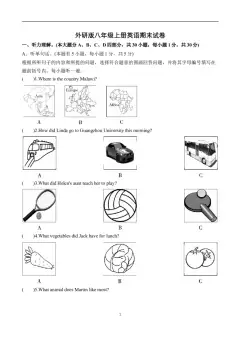
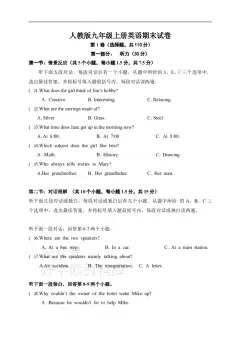
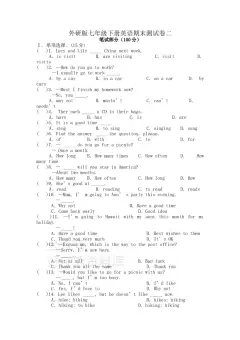
外研版九年级上册英语期末试卷
第I 卷(90 分)
第一部分  听力
Ⅰ.情景反应。(每小题1 分,共10 分)
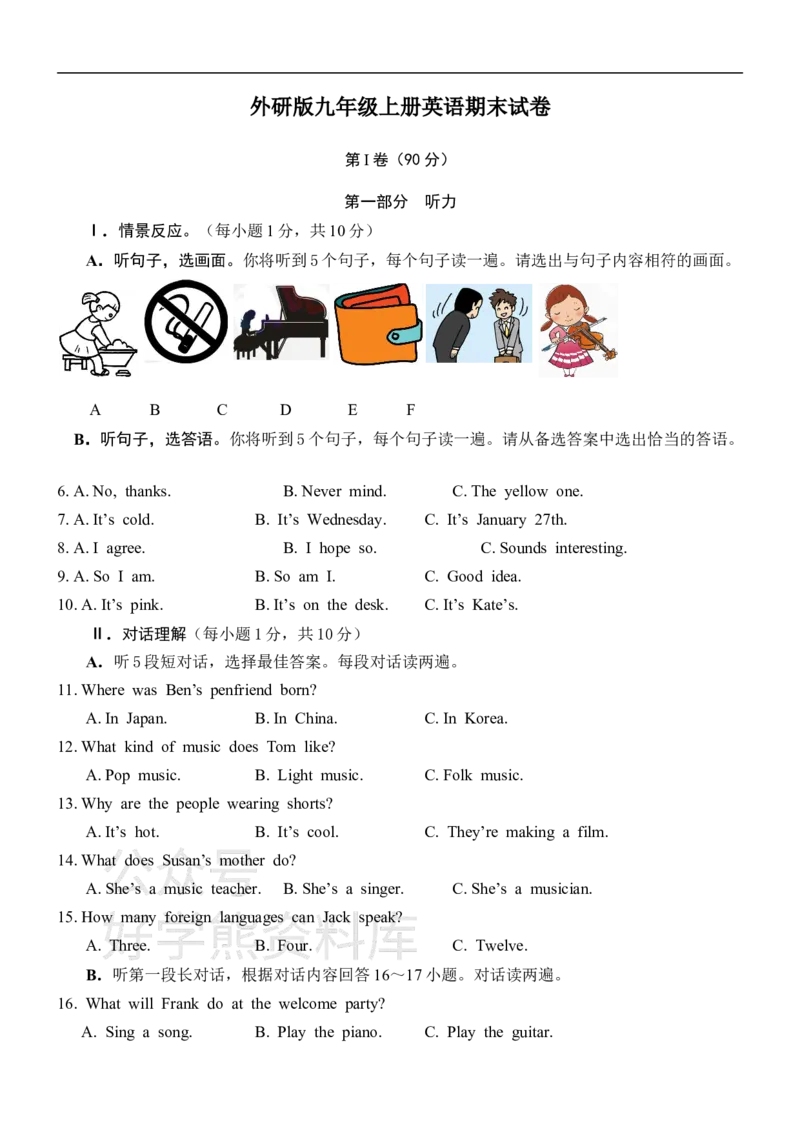
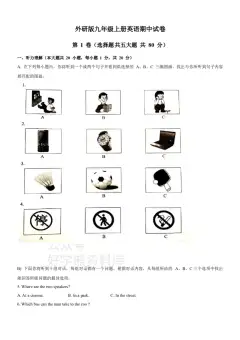
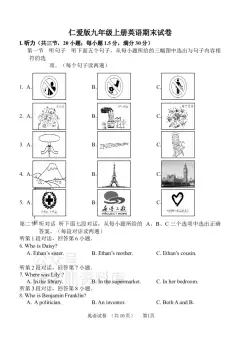
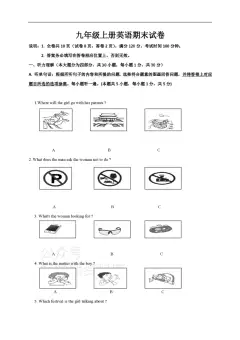
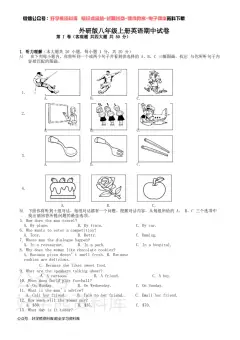
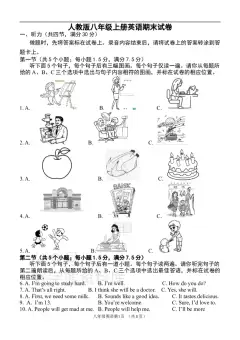
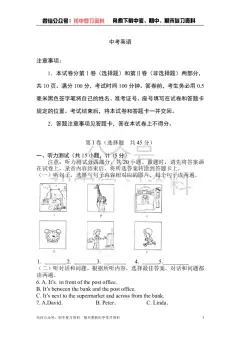
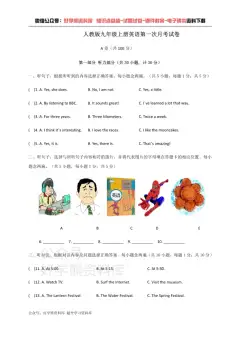
A.听句子,选画面。你将听到5 个句子,每个句子读一遍。请选出与句子内容相符的画面。
    A          B           C           D           E          F
    B.听句子,选答语。你将听到5 个句子,每个句子读一遍。请从备选答案中选出恰当的答语。
6. A. No, thanks.
B. Never mind.
C. The yellow one.
7. A. It’s cold.
B. It’s Wednesday.
C. It’s January 27th.
8. A. I agree.
B. I hope so.
C. Sounds interesting.
9. A. So I am.
B. So am I.
C. Good idea.
10. A. It’s pink.
B. It’s on the desk.
C. It’s Kate’s.
    Ⅱ.对话理解(每小题1 分,共10 分)
A.听5 段短对话,选择最佳答案。每段对话读两遍。
11. Where was Ben’s penfriend born?
A. In Japan.
B. In China.
C. In Korea.
12. What kind of music does Tom like?
A. Pop music.
B. Light music.
C. Folk music.
13. Why are the people wearing shorts?
A. It’s hot.
B. It’s cool.
C. They’re making a film.
14. What does Susan’s mother do?
A. She’s a music teacher.
B. She’s a singer.
C. She’s a musician.
15. How many foreign languages can Jack speak?
A. Three.
B. Four.
C. Twelve.
B.听第一段长对话,根据对话内容回答16~17 小题。对话读两遍。
16. What will Frank do at the welcome party?
   A. Sing a song.
B. Play the piano.
C. Play the guitar.
17. When is the welcome party?
   A. On Friday morning.
B. On Friday afternoon. C. On Friday evening.
C.听第二段长对话,根据对话内容回答18~20 小题。对话读两遍。
18. How long has Jean played volleyball?
A. For 8 years.
B. For 15 years.
C. For 23 years.
19. Who taught Jean to play volleyball?
A. Her father.
B. Her sister.
C. Her mother.
20. How often does Jean play volleyball?
A. Every day.
B. Once a week.
C. Three times a week.
    Ⅲ.短文理解。你将听到一篇短文,短文读三遍。请根据短文内容,选择正确答案。(每小题
2 分,共10 分)
21. Tina’s mom has been away          for two weeks.
   A. for study
B. for vacation
C. on business
22. Every evening Tina and her Dad          by the lake.
   A. go for a run
B. go for a walk
C. go for a picnic
23. Last week Tina and her dad went to         .
   A. the children’s park
B. the children’s hospital
C. the children’s palace
24. On Sundays Tina and her dad go to visit her         .
   A. cousins
B. friends
C. grandparents
25. Tina’s mom is now in         .
   A. Canada
B. Russia
C. Australia
第二部分  笔 试
    Ⅳ. 单项选择(每小题1 分,共15 分)
从各小题所给的四个备选项中选出最佳答案。
26. Lin Yu is          exchange student at a university in France.
   A. /
B. a
C. an
D. the
27. Sometimes hobbies can get          the way of our schoolwork.
  A. in
B. at
C. to
D. for
28. —Is there          in today’s newspaper?
—Yes. Lots of volunteers went to Wuhan to help fight with COVID-19.
A. touching anything
B. anything touching
   C. touching something
D. everything touching
29. —What kind of movies do you like, Sam?
   —I like the movies

  are about Chinese history.
   A. who
B. whom
C. whose
D. that
30. Mr. Black can’t walk because he has a          in the knee.
   A. pain
B. place
C. chance
D. choice
31. The doll is a          gift for me from my aunt. I’ve kept it for 10 years.
   A. general
B. awful
C. common
D. valuable
32. —The doctor told me not to eat too much, but I find it is difficult.
   —The doctor is right.          you eat,          you will be.
A. The less; the healthier
B. The more; the healthier
C. The less; the more healthy
D. The more; the more healthier
33. Sleeping is a good thing, but some people sleep         .
   A. lately
B. badly
C. nearly
D. widely
34. The event was          because of COVID-19.
  A. pushed
B. allowed
C. canceled
D. announced
35. No one knows when the temple         , because there is no record about it.
   A. built
B. builds
C. is built
D. was built
36. When summer comes, a lot of people feel like          for fun.
   A. swim
B. swum
C. swimming
D. to swim
37. —Excuse me, could you please tell me if the sports meeting will be held on time?
   —It depends on the weather. If it rains this evening, we’ll have to         .
   A. turn it on
B. put it off
C. give it up
D. take it away
38. —Susan, I wonder         .
   —Next Saturday evening.
A. when we will have the New Year’s Party
   B. when will we have the New Year’s Party
   C. where we will have the New Year’s Party
   D. where will we have the New Year’s Party
39. —The English speech was really wonderful.
   —        ! I had a cold and missed it.
   A. Lucky you
B. Good idea
C. What a pity D. Take your time
40. The fans were waiting for the singer to show

   up
   in the hall.
   A. remain
B. appear
C. reflect
D. perform
Ⅴ. 完形填空。阅读下面短文,掌握其大意,然后从短文后各题所给的A、B、C、D 四个选
项中,选出最佳选项。(10 分)
There was a group of poor painters living in a small house in Washington. One was named
Johnsy, and
  41

   was named Sue. There was also an old painter named Beherman. He always
looked after them.

  42

   was coming. Johnsy got very sick. She became thinner and thinner. A doctor came
to look at her. But he said there was
  43

   he could do. Johnsy needed to depend on
  44


instead of others. As long as she had hope, things would work out well in the end.
One day, Sue came back home. She heard Johnsy counting, “Twelve, eleven ...” Sue asked,
“
  45

   are you counting, Johnsy?”
Johnsy answered, “I am counting the
  46

   of leaves outside. The cold wind blows them
out. After the last leaf falls, I will go too.”
Sue was so
  47

  . She told Beherman this.
Beherman comforted Sue, “Don’t worry. Everything will be OK.”
At night, the wind blew
  48

  . Sue didn’t sleep all night. The next morning, she found
there was a leaf still on.
Days went by quickly. The leaf was
  49

   there. Luckily, Johnsy became better and better.
    Why did the leaf stay on the tree all the time? Because Beherman
  50

   the leaf. He
made Johnsy have hope.
41. A. other
B. others
C. another
D. the other
42. A. Spring
B. Summer
C. Autumn
D. Winter
43. A. nothing
B. anything
C. something
D. everything
44. A. she
B. her
C. hers
D. herself
45. A. Why
B. What
C. When
D. Where
46. A. name
B. color
C. shape
D. number
47. A. sad
B. happy
C. excited
D. surprised
48. A. quietly
B. strongly
C. suddenly
D. carefully
49. A. often
B. usually
C. always
D. already
50. A. washed
B. painted
C. cleaned
D. stuck
Ⅵ.阅读理解。(51~60 小题每小题1 分,其余每小题2 分,共30 分)
A
阅读短文,判断短文后句子的意思是否与短文内容相符。用“T”表示相符,
“F”表示不相符。(每小题1 分)
April Fool’s Day is a celebration that takes place in different countries around the world.
One April Fool’s Day, a reporter in England announced that there would be no more
spaghetti because the spaghetti farmers in Italy had stopped growing spaghetti. Many people ran
to their local supermarkets to buy as much spaghetti as they could. By the time people realized
that the story was a hoax, all of the spaghetti across the country had been sold out. In another
famous trick a TV show in England reported the discovery of special water. They said this
water would help people lose weight and that one customer had already lost a lot of weight in
just four months. By the end of the day, more than 10,000 people had phoned the TV station to
find out how to get this water.
One of the world’s most famous tricks, however, happened in October rather than in April.
In that month in 1938, actor Orson Welles announced on his radio program that aliens from
Mars had landed on the earth. He described where they had landed and told how they were
moving across the United States. Welles made it sound so real that hundreds of people believed
the story, and fear spread across the whole country. By the time police officers announced that
the story was a hoax, thousands of people had left their homes.
51. One April Fool’s Day, a reporter in England announced that there would be no
   more spaghetti because the spaghetti farmers around his country had stopped
   growing spaghetti.
52. After watching the TV show, lots of people went to the TV station to get the special water.
53. The famous trick mentioned in Paragraph 3 didn’t happen on April Fool’s Day.
54. According to Welles the aliens were moving across the United States.
55. Hundreds of people believed the story and ran away from their homes.
B
阅读短文,根据短文内容,从下面各小题所给的四个备选项中,选出最佳选项。(每小题1
分)
Wu Guichun is a migrant worker (农民工) in Dongguan, Guangdong Province. The 54-year-
old man used to work in a shoe factory there. He always went to the Dongguan Library to read
or borrow books. However, the shoe factory was shut down this year. Without a job, he planned
to leave the city and return to his hometown. When he gave back the library card, he wrote a
Chinese good-bye note to the library. In English it is as follow.
Since 12 years ago, I have been reading in Dongguan Library. Reading can make
me wise. It is of great benefit to me. However, during the special time, it’s difficult for me to
find a job. Though I’m unwilling to leave the city, I have to. Looking back at the past years,
the library is the best place for me. It is a palace of knowledge and enriches my life. I will
never forget the days when I read in the library.
A librarian (图书管理员) was moved by his love for reading and posted the note on the
Internet. Soon, it touched the hearts of tens of millions of people. After the local government
learned about this, they helped Wu find a new job so that he could continue staying in the city.
Now he works on gardening and greening in a community near the library. He needn’t leave
and it’s more convenient for him to go on with his reading. He is very happy and thankful for
the offer. He believes that his 12 years of reading in the library is only a start.
Reading is a gateway to a better, happier and more meaningful life. Do you think so?
56. Wu Guichun used to work in          in Dongguan.
   A. a library
B. a community
C. a shoe factory
D. a local government
57. Wu Guichun wrote a(n)          to the library.
   A. e-mail
B. letter
C. thank-you note
D. good-bye note
58. Which of the following is TRUE?
   A. Wu Guichun thought reading could make him clever.
   B. Wu Guichun had to go back to his hometown because he got sick.
   C. Wu Guichun had been reading in Dongguan Library for 12 years.
   D.
Wu Guichun had to go back to his hometown because he was too old to work.
59. At last          helped Wu Guichun find a new job.
   A. a librarian
B. the local government
C. a shoe factory worker
D. a community worker
60. From the passage we know          can make our life better, happier and more
   meaningful.
A. reading
B. money
C. city life
D. friendship
C
阅读短文,根据短文内容,从下面各小题所给的四个备选项中,选出最佳选项。(每小题2
分)
Many people know that robots do hard and dangerous things in factories. But did you know
that there are many other kinds of robots and they do much more than that?
Social robots are very popular. Wakamaru, a Japanese robot, is helpful to elderly and
disabled people. It can be programmed to remind people to take their medicine, and it can also
call for help in an emergency (情急情况). Robovie Ⅱ is a social robot that helps people go
shopping.
Domestic robots are very popular today. They will help you clean your house. With their
help, you’ll have more time to enjoy life.
Medical robots are very important in modern medicine. With the da Vinci Surgical System,
the doctor sits several feet away from the patient and controls the robot’s every move. The
HeartlLander can do heart surgery (外科手术). Thanks to robotics (机器人的) engineers, disabled
people can have robotic hands that work like human hands.
Service robots help in emergencies. The VGTV is a small robot that is used to
help search for people who are trapped (受困的) under fallen buildings. It can change its shape
to go into small spaces.
Explorer robots are very useful, too. The Groundwater Voyager makes maps of underwater
environments. Some robots can work in space easily. They have successfully explored planets
like Mars, Venus, and Jupiter, where they were controlled by humans on the earth through
remote control (遥控).
Amazing, right? What will future robots do?
61. What can’t Social robots do?
   A. Help people go shopping.
B. Help clean your house.
   C. Call for help in an emergency.
D. Remind people to take their medicine.
62. What does the underlined word “domestic” in Paragraph 3 mean in Chinese?
   A. 现代的
B. 时尚的
C. 昂贵的
D. 家务的
63. The HeartLander is         .
A. a medical robot
B. a social robot
C. a service robot
D. an explorer robot
64. Which robot can be used in searching for people in an earthquake?
   A. A social robot
B. A domestic robot
C. A service robot
D. An explorer robot
65. How many kinds of robots are mentioned in the passage?
   A. Four
B. Five
C. Six
D. Seven
D
阅读短文,根据短文内容,从下面各小题所给的四个备选项中,选出最佳选项。(每小题2
分)
Certain things you do at one place are totally OK and understood. When you do the same
thing in another place, it might be misunderstood. Here are some rules you should know when
you are in Finland (芬兰).
To start with, Finns pay much attention to personal space. When waiting in line, they keep
one meter or more from each other. If you are standing too close to someone, you will notice
that the other person is trying to get a bit further from you.
Second, do not make eye contact (接触) with Finns. For them, eye contact is not very
common, even when talking to friends and family. It might be a sign of rudeness (粗鲁) in
other cultures not to look each other in the eyes when talking. In Finland it’s just the opposite.
Also, touching strangers in Finland is not allowed. They might feel uncomfortable. For most
Finns, physical contact while talking even among friends is not common. They do not give
kisses on the cheek (脸颊) when greeting each other. Mostly the greeting is saying hi or shaking
hands.
Finns do not talk about their salaries (薪水). It is impolite to ask even friends about how
much they earn. It is simply considered part of their personal space. What’s more, nobody talks
about each other’s appearance (外貌) or clothes unless someone asks for an opinion.
Because of all these, Finns are often considered unfriendly. Anyway, as the saying goes,
“When in Rome, do as the Romans do.”
66. In Finland you’re not supposed to         .
   A. wait in a line
B. say hi to someone
   C. shake hands with someone
D. stand too close to someone
67. In Finland it’s          to look each other in the eyes when talking.
   A. polite
B. impolite
C. friendly
D. unfair
68. In Finland when friends meet, they greet each other by
   A. bowing
B. hugging
C. shaking hands
D. kissing the cheek
69. In Finland it might be polite to talk about         .
   A. weather
B. clothes
C. salaries
D. appearance
70. The best title for the passage is         .
   A. Things to Do in Finland
B. Places to Visit in Finland
   C. Making Friends in Finland
D. Rules to Know about Finland
Ⅶ. 情景交际A(每小题1 分,共5 分)
根据上下文意思,从方框中选择5 个句子补全对话,使其意思完整。
A: The mobile phone is useful in our daily lives. 71
B: Yes, I think so too. I can’t imagine life without it.
A: 72
B: Of course. This is my second mobile phone.
A: Do you often use it?
B: No. Sometimes I don’t use it for 4 or 5 days.
A: 73
B: 13 years old. My parents gave it to me on my 13th birthday. I remember it was white. I
loved it very much. 74
A: I got my first mobile phone when I was 10. I remember my best friend got one and
   I wanted to chat with her on WeChat, so I asked my mother to buy one for me.
B: It’s lucky that we’re allowed to have mobile phones. 75
A: I agree. As students, study always comes first.
第Ⅱ卷 (30 分)
Ⅷ. 综合填空(共10 小题,每小题l 分,共10 分)
A.单词拼写  根据中文或首字母提示完成下列单词的拼写,使句意完整与
正确。每空一词。
76. Though the          (王后;女王) is old, she is loved by her people.
77. My cousin said learning          (基本的;基础的) table manners is her
   biggest challenge in America.
78. I          (更喜欢) music that has great lyrics.
79. If you don’t have a driver’s l        , you can’t drive the car.
80. Neither Jim n         Tom likes soap operas.
B.选词填空  阅读下面短文,从方框中选择单词,根据实际情况用其适当形式填空,使短文
意思完整、通顺。每空一词,每词只能用一次。
Tea is one of the three most popular drinks in the world. It has a 81.


  of about
5,000 years. It’s reported that tea is drunk in more than 60 countries and regions (地区) and
enjoyed by over 2 million people. On November 27, 2019, the United Nations (UN) designated
(指定) May 21 as International Tea Day. The UN’s 82.


  showed the importance of tea
in people’s daily lives.
one  history  large  grow  decision
A. What about you?
B. Have you got a mobile
phone?
C. Who bought it for you?
D. I think it’s a great invention.
E. How many mobile phones have you got?
F. So we should use them
i
l
As the birthplace of tea and the 83.


  tea-producing country in the world, China has
always paid a lot of attention to the development of the tea industry (行业). This was the 84.

year that China has celebrated International Tea Day. To celebrate the day, many events took
place in different places in China.
International Tea Day not only encouraged farmers to 85.


  more nice tea plants, but
it also helps to spread tea culture and the popularity of tea.
Ⅸ. 情景交际B(每小题1 分,共5 分)

根据对话内容,在下面的空白处填入适当的词,使对话的意思完整与正确。每空一词(含缩
略词)。
A: Excuse me, sir. Could you tell me the way 86.


  the train station?
B: Well, let me see. Go down this road and 8  7  .


  the third turning on the
   right to Zhongshan Road. Walk on 8  8  .


  you see the Bank of China. The
   train station is on its left.
A: How 89.


  is it from here?
B: It is about 30 minutes’ walk.
A: 30 minutes’ walk isn’t a short way. Is there a bus going there?
B: Yes. The No. 9 bus will take you right there. The bus stop is just over there.
A: Thanks a lot.
B: You’re 90.


  .
Ⅹ. 书面表达。(共15 分)
假如你叫李华,请你根据以下要点,以“My lucky day”为题,写一篇英语短文,记叙你经
历过的幸运的一天,讲讲那天都发生了什么事情。
提示:1.早上醒来时,正下着雨;2.正要去公交车站坐车去上学时,我叔叔打来了电话,
说他可以捎我一程;3.当天晚些时候,我意识到我把钱包忘在家里了,无法买午饭,我最好的朋
友说她可以和我分享她的午饭;4.下午我因为数学考试得了最高分而得到老师的表扬;5.晚上
父母很高兴,承诺将给我买一辆自行车作为奖励。
要求:1.不少于80 词。2.须包括所有的提示内容,可以根据需要作适当的发挥,以使行文
连贯。短文的开头和结尾已给出,不计入总词数。
    I   will

   always

   remember

   the
    date

   November

   12,
    2020.

   This

   was

   the
    luckiest

   day

   of
    my
    life.


 I  think

  that
   was
   the
   best
   day
   I ’ d  had
   in   a  long
   time.

  What

  a  lucky

  day!

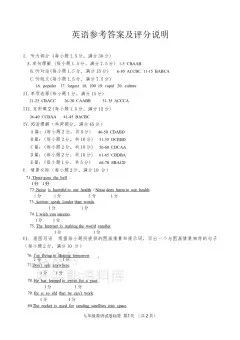
参考答案
第Ⅰ卷
第一部分 听力
Ⅰ.1~5
FBDEA
6~10
BCABC
Ⅱ.11~15 CBCAB
16~20
ABBCC
Ⅲ.21~25 CABCB
第二部分 笔试
Ⅳ.26~30 CABDA
31~35
DABCD
36~40
CBACB
Ⅴ.41~45 CDADB
46~50
DABCB
Ⅵ.51~55 FFTTF
56~60
CDCBA
61~65
BDACB
66~70
DBCAD
Ⅶ.71~75 DBGAF
第Ⅱ卷
Ⅷ.76. queen
77. basic
78. prefer
79. license/licence
80. nor
81. history
82. decision
83. largest
84. first
85. grow
Ⅸ.86. to
87. take
88. until
89. far
90. welcome
Ⅹ.One possible version
Dear

   Henry,


    I   will

   always

   remember

   the
    date

   November

   12,
    2020.

   This

   was

   the
    luckiest

   day

   of
    my
    life.


When I woke up that morning, (1 分) it was raining. (1 分) I was about to go to the bus
station (1 分) to take the bus to school (1 分) when my uncle called me up. (1 分) He said he
could give me a lift in his car. (1 分) Later that day, I realized I had left my wallet at home (1
分) and couldn’t buy lunch. (1 分) My best friend Lisa said she could share her lunch with me,
(2 分) so I had a free lunch. In the afternoon, I was praised by my math teacher (1 分) because
I got the highest score in the math exam. (1 分) I couldn’t believe that I did so well, and
neither could my parents. That night they were so happy (1 分) that they promised me that they
would buy a bike for me as a prize. (2 分)
I   think

   that

   was

   the
    best

   day

   I ’ d    had

   in    a    long

   time.

   What

   a    lucky

   day!


书面表达评分说明:
1.本大题满分为15 分,可按七个档次评分。
2.评分时,先根据所写的句子的内容及语言知识的运用情况初步确定其所属档次,然后以该档次
的要求进行微调,最后给分。
书面表达评分标准
第一档(13~15 分): 能把所有内容要点完整表达,时态、人称正确;逻辑性强,层次清晰,紧
扣主题,语言流畅,卷面清洁。
第二档(10~12 分): 基本包含所有内容要求,句子表达基本完整,时态基本正确,逻辑性一般,
语言表达一般,卷面基本清洁,根据《评分细则》扣分后评分。
第三档(8~9 分):   包含大部分内容要点,有少数句子表达不完整,个别时态、人称出现错误,
根据《评分细则》扣分后评分。
第四档(6~7 分):   缺漏部分内容要点,标点符号不明确,句子有错,语言表达不清,卷面
涂改痕迹多,根据《评分细则》扣分后评分。
第五档(4~5 分):   仅有少数句子反映内容要点,多数句子出现错误,卷面较差,根据《评
分细则》扣分后评分。
第六档(2~3 分):   仅有1-2 个句子能表达内容要点,大多数句子语言表达错误,卷面极差,
根据《评分细则》扣分后评分。
第七档(0~1 分):   没有按要求表达,只能写出与所要求内容有关的一些单词。
附:评分细则
   1.卷面清洁得,语言流畅得,能按要求表述完整内容,按信息点给分。
  2.句子结构(含语态、时态、主谓一致等):每错两处,扣0.5 分。一处可忽略
    不计,如果同一篇文章6 处出现错误只扣2 分。全错扣5。
  3.单词拼写错两处扣0.5 分。一处可忽略不计,如果同一个单词多处出现错误
只扣0.5 分。
4.如果一个句子可以表达两个内容,按两个句子计算得分。
5.涂改及大小写如果有2~5 处错误扣0.5 分,5 处以上扣1 分,最多只扣1 分。