五年级上册英语语法重难点突破
(一)be动词的用法和常见句型
be动词是英语中使用频率最高的词类之一,意为“是”。be是原形,
在一般现在时中,根据人称和数的变化,它有am,is,are三种形式。
一、be动词的变化
1. 人称变化:第一人称单数(I ,我)用am,
第三人称单数(he,他;she,她;it,它)用is,
第二人称和复数人称(you,你,你们we,我们;they,他/她/
它们 )用are。
2. 数的变化:单数名词和不可数名词用is, 复数名词用are。
二、含有be动词的常见句型
1.含be动词的肯定句:结构为“主语+be(am,is,are)+其他.”。be动词后可
以是形容词,用来描述特征;也可以是名词或名词短语,用来描述某
个身份、对象等;还可以是介词短语等。
如:He is kind. 他很和蔼。I am a girl. 我是一个女孩。
2.含be动词的否定句:在be动词后面加not。其中,is not可缩写成isn't,are
not可以缩写成aren't。
如:Your books are not/aren't on the table. 你的书不在餐桌上。
3.含be动词的一般疑问句:将be动词提前到句首(并大写首字母),标点改
为问号。回答需要用yes或no。
如:—Are you in the park now? 你现在在公园吗?
— No,I'm not. 不,我不在。
4.含be动词的特殊疑问句:结构为“疑问词+be(am,is,are)+主语+其他?”。
如:—What's she like? 她什么样?
—She's friendly. 她很友好。
第 1 页 共 15 页专项练习
一、用be动词的适当形式填空。
1.I a student.I have a friend.She an English girl.
2.Zoom and Zip in the house.
3.—What that? —It a plant.
4.— your mother strict? —Yes,she .
5.This a bathroom.Those bedrooms.
6.Miss Wang will our new Chinese teacher.She
kind.
7.The tea hot.The vegetables fresh.
8.It a sunny day.There not many clouds
in the sky.
二、看图,补全对话。
1. 2. 3. 4.
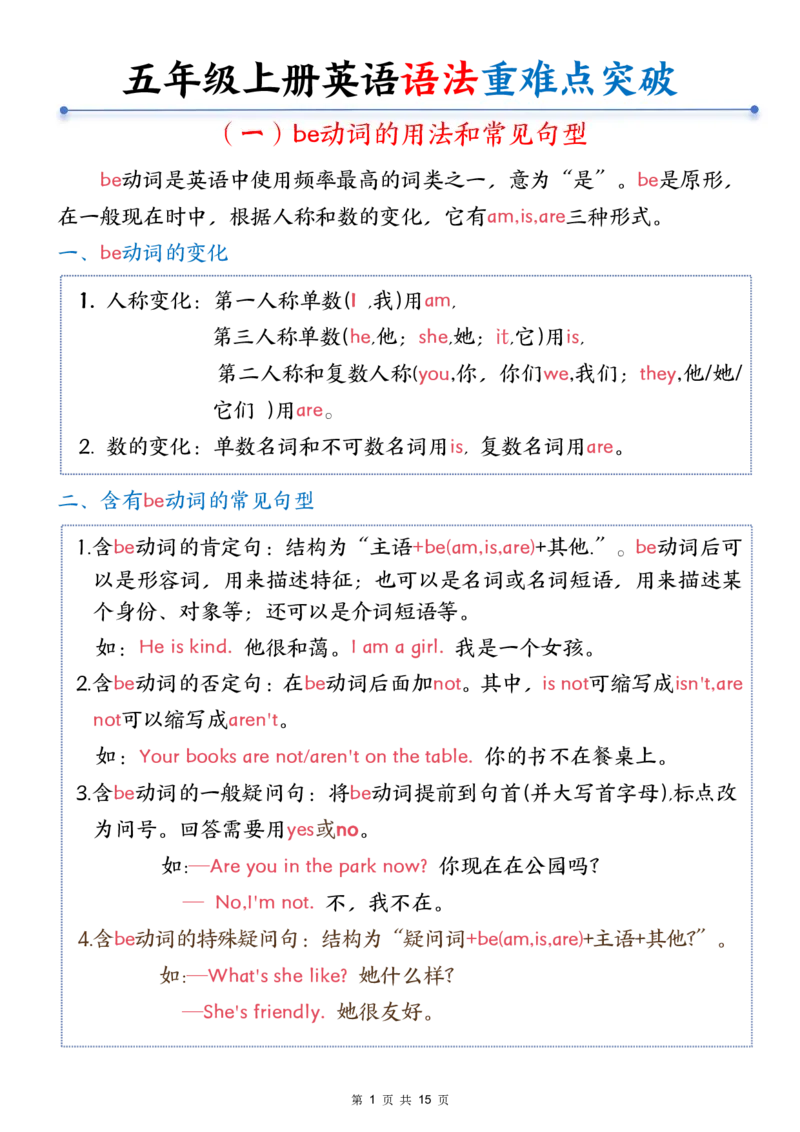
1.— he ? —He's funny.
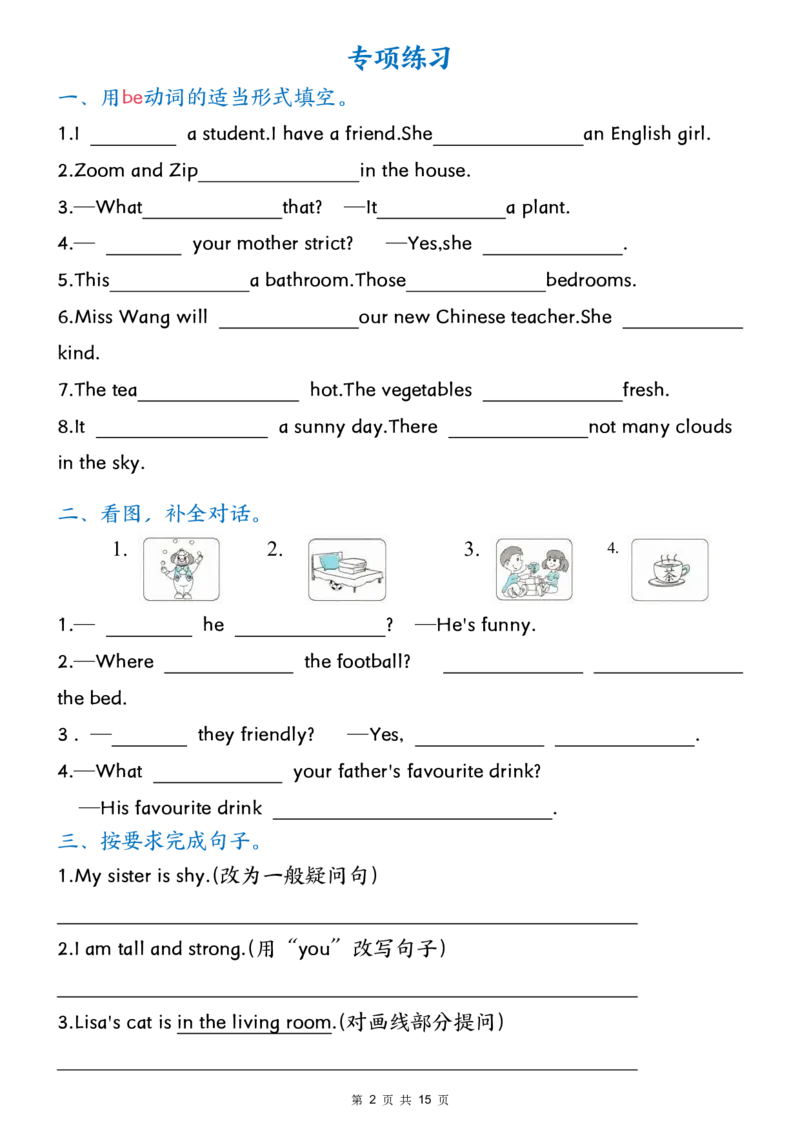
2.—Where the football?
the bed.
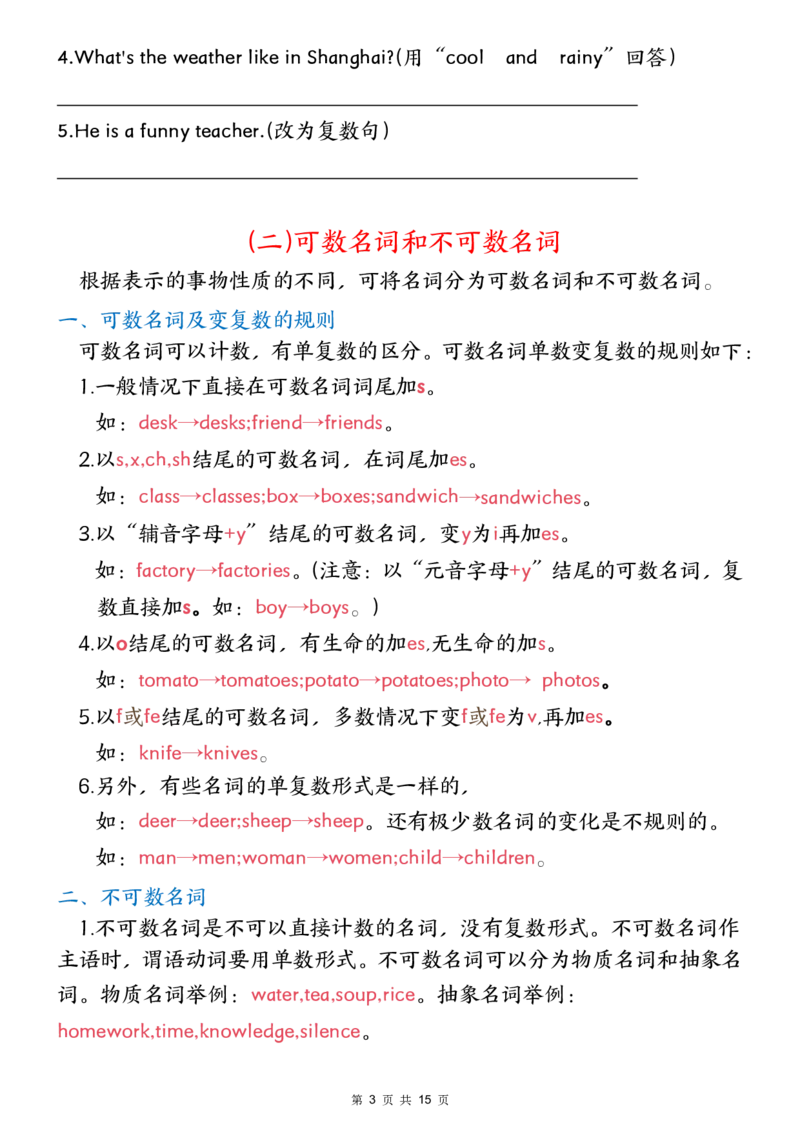
3 . — they friendly? —Yes, .
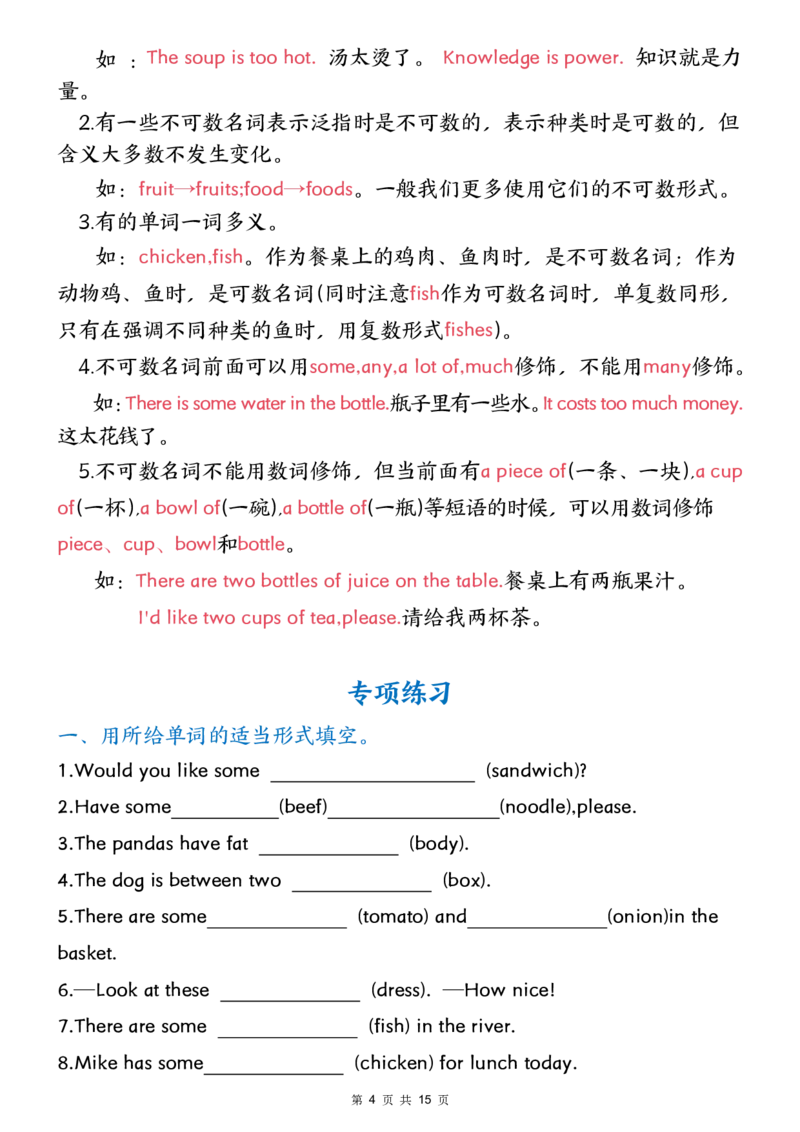
4.—What your father's favourite drink?
—His favourite drink .
三、按要求完成句子。
1.My sister is shy.(改为一般疑问句)
2.I am tall and strong.(用“you”改写句子)
3.Lisa's cat is in the living room.(对画线部分提问)
第 2 页 共 15 页4.What's the weather like in Shanghai?(用“cool and rainy”回答)
5.He is a funny teacher.(改为复数句)
(二)可数名词和不可数名词
根据表示的事物性质的不同,可将名词分为可数名词和不可数名词。
一、可数名词及变复数的规则
可数名词可以计数,有单复数的区分。可数名词单数变复数的规则如下:
1.一般情况下直接在可数名词词尾加s。
如:desk→desks;friend→friends。
2.以s,x,ch,sh结尾的可数名词,在词尾加es。
如:class→classes;box→boxes;sandwich→sandwiches。
3.以“辅音字母+y”结尾的可数名词,变y为i再加es。
如:factory→factories。(注意:以“元音字母+y”结尾的可数名词,复
数直接加s。如:boy→boys。)
4.以o结尾的可数名词,有生命的加es,无生命的加s。
如:tomato→tomatoes;potato→potatoes;photo→ photos。
5.以f或fe结尾的可数名词,多数情况下变f或fe为v,再加es。
如:knife→knives。
6.另外,有些名词的单复数形式是一样的,
如:deer→deer;sheep→sheep。还有极少数名词的变化是不规则的。
如:man→men;woman→women;child→children。
二、不可数名词
1.不可数名词是不可以直接计数的名词,没有复数形式。不可数名词作
主语时,谓语动词要用单数形式。不可数名词可以分为物质名词和抽象名
词。物质名词举例:water,tea,soup,rice。抽象名词举例:
homework,time,knowledge,silence。
第 3 页 共 15 页如 :The soup is too hot. 汤太烫了。 Knowledge is power. 知识就是力
量。
2.有一些不可数名词表示泛指时是不可数的,表示种类时是可数的,但
含义大多数不发生变化。
如:fruit→fruits;food→foods。一般我们更多使用它们的不可数形式。
3.有的单词一词多义。
如:chicken,fish。作为餐桌上的鸡肉、鱼肉时,是不可数名词;作为
动物鸡、鱼时,是可数名词(同时注意fish作为可数名词时,单复数同形,
只有在强调不同种类的鱼时,用复数形式fishes)。
4.不可数名词前面可以用some,any,a lot of,much修饰,不能用many修饰。
如:Thereissomewaterinthe bottle.瓶子里有一些水。Itcosts too much money.
这太花钱了。
5.不可数名词不能用数词修饰,但当前面有a piece of(一条、一块),a cup
of(一杯),a bowl of(一碗),a bottle of(一瓶)等短语的时候,可以用数词修饰
piece、cup、bowl和bottle。
如:There are two bottles of juice on the table.餐桌上有两瓶果汁。
I'd like two cups of tea,please.请给我两杯茶。
专项练习
一、用所给单词的适当形式填空。
1.Would you like some (sandwich)?
2.Have some (beef) (noodle),please.
3.The pandas have fat (body).
4.The dog is between two (box).
5.There are some (tomato) and (onion)in the
basket.
6.—Look at these (dress). —How nice!
7.There are some (fish) in the river.
8.Mike has some (chicken) for lunch today.
第 4 页 共 15 页9.There (be not) any milk in the glass.
10.—Can I have some (bread) or (hamburger)? —
OK.
11.That girl is too hungry.She would like two (bowl) of
(rice).
12.—How many (library) are there in your school? —There
(be)one.
二、圈出句中错误的部分,并在横线上改正。
1.We need three potatos.
2.Lisa drinks eight bottle of water every day.
3.I still have some homeworks left.
4.We would like to eat some vegetable.They are healthy.
5.There are many photoes and pictures on the wall.
(三)would like和like的用法
一、would like及相关句型
1. would like中的would是情态动词,没有人称和数的变化。当把would
like作为一个整体看时,它的用法与want相同,意为“想要”。would like
后面接名词,或者接“to do sth”。
如:She would like some water.她想要一些水。
I would like to ask you some questions.我想要问你一些问题。
2.“Would you like..?”句型用于征求别人的意见,与“Do you want..?”同义
,但语气更加委婉。在征求意见的一般疑问句中应该用some而不用any, 表
示希望得到对方的肯定回答。
如:—Would you like some juice? 你想要一些果汁吗? — Yes,please.
好的。
3.“What would you like?”是用来询问对方想要什么的特殊疑问句,回答
时用“I'd like..”或者直接说出想要的东西。
第 5 页 共 15 页如:—What would you like to eat?你想要吃什么? — I'd like some beef.
我想要一些牛肉。
二、like的用法
1.like意为“喜欢”,是实义动词,有人称和数的变化(第三人称单数形式
为likes)。like后面接名词或代词。近义词是love。
如:He likes ice cream. 他喜欢冰激凌。We all like her. 我们都喜欢她。
2.泛指喜欢某种事物时,like后面如果是可数名词,名词要用复数形式,
不用不定冠词a/an,some, 或者数词等修饰;表示喜欢具体的事物时,可
以特指。
如:We like apples. 我们喜欢苹果。(泛指) I like this cat. 我喜欢这只
猫。(特指)
专项练习
一、用like或would like填空。
1.My pen is lost.I a new one.
2.I a fish hamburger,please.
3.—What's your favourite food? —I
noodles best.
4.—Can I help you?—Yes.I some storybooks.
5.I vegetables.They're healthy.
6.I'm thirsty.I some water.
7.—Do you this toy? —Yes,I do.
8.They the village.They often play there all
day.
二、按要求完成句子。
I'd like to eat some bread.
第 6 页 共 15 页1.对画线部分提问: you to
?
2.改为一般疑问句: like to eat bread?
3.改为同义句: to eat some
bread.
(四)情态动词can的用法
一、情态动词can的含义
情态动词can后面接动词原形,没有人称和数的变化。表示能力,意
为“可以,能,会(做某事)”。
二、含有情态动词can的句型
1.含有can的肯定句结构为“主语+can+动词原形+其他.”。
如:John can play football. 约翰会踢足球。
2.含有can的否定句,在can后加not,写为cannot,也可以缩写为can't。否
定句中用any代替some。
如:Oliver can't do any kung ku. 奥利弗不会练功夫。
3.含有can的一般疑问句,将can提到句首并大写首字母,句号改为问
号。一般疑问句中通常用any代替some。肯定回答为“Yes,主语+can.”;否
定回答为“No,主语+can't.”
如:—Can Mike do any kung fu? 迈克会练功夫吗? —No,he can't. 不
,他不会。
4.含有can的特殊疑问句结构为“疑问词+can+主语十动词原形+其他?”
。
如:—What can you do? 你会做什么? — I can sing English songs. 我
会唱英文歌
【拓展】我们学过一些关于特长活动的英文表达,固定搭配规律要
记牢。“play+the+ 乐器名词(原形)”表示弹奏乐器,“play+球类名词(原形)
第 7 页 共 15 页”表示球类运动。乐器前加the,球类运动前不加the。do的搭配有:do(some)
kung fu;do homework。表示说某种语言用 speak,如:speak English。
专项练习
一、选词填空。
1.My friend (can/like)draw pictures.
2.My sister can swim,but I (can/can't).
3.Can you play (pipa/the pipa)?
4.Li Ming can't sing (some/any)English songs.
5.Can you (are/be)my friend?
6.—I can't make a puppet.—Don't be sad.I (can/can't)help
you.
二、按要求完成句子。
1.Danny's sister can dance.(对画线部分提问)
2.Robin can do some kung fu.(改为一般疑问句,并作肯定回答)
3.What can he do?(看图回答问题)
4.Can he swim?(看图回答问题)
5.She can make some puppets.(改为否定句)
(五) there be句型的陈述句
一、there be句型的含义
there be的意思是“有”,与have的区别在于:there be指客观存在的“有
”,表示某地存在某人或某物,是一种存在关系;have指主观上“拥有”,
第 8 页 共 15 页表示某人拥有某物,是一种从属关系。there be中的there是引导词,本身无
实际意义,be后面接的名词是句子的主语。
二、there be句型的肯定句
1.主语为可数名词单数或不可数名词:There is(+ a/a n)+可数名词单数/
不可数名词(十地点状语).
如:There is a boy behind the door.门后有一个男孩。There is some milk
in the bottle。
瓶子里有一些牛奶。
2.主语为可数名词复数:There are+可数名词复数(十地点状语).
如:There are some pens in the bag.包里有一些钢笔。
3.there be句型的就近原则:当有两个或两个以上的并列主语时,be动词
的形式要遵循“就近原则”,即和离它最近的名词在数上保持一致。如果想
表达某地有多种物品,每种物品后需用逗号隔开,在最后一种物品前加and。
如:There is a book and some pencils in the bag.包里有一本书和一些铅
笔。
There are three pens,five crayons and an eraser in the pencil box.文具
盒里有三支钢笔、五支蜡笔和一块橡皮。
三、there be句型的否定句
1.there be句型由肯定句变成否定句,需要在be动词后加not。如肯定句中
有some,要用any代替。
如:There is not a bird in the tree. 树上没有鸟。
There aren't any people in the park. 公园里没有人。
2. there be否定句还可以用“There be no+名词+其他.”的结构,no后面紧
跟名词,不再加冠词或者any等。如果be动词是is, no后面跟可数名词单数
或者不可数名词;如果be 动词是are,no后面跟可数名词复数。
如:There is no juice on the table.餐桌上没有果汁。
There are no apples on the tree. 树上没有苹果。
专项练习
第 9 页 共 15 页一、用be或be not的适当形式填空。
1.There a river in the park.
2.There some bears in the forest.
3.There any fish in the river.
4.There no students in the library.
5.There some apple juice on the table.
6.There a panda and five monkeys in the zoo.
二、用a,an,some或any填空。
1.There isn't milk in the fridge.
2.There are toy dogs on the desk.
3.There is umbrella under the sofa.
4.There is water for you.
5.There is pencil and three erasers in the pencil box.
三、按要求改写句子。
1.There are no plants on the desk.(改为同义句)There on
the desk.
2.There isn't any tea in the cup.(改为肯定句) There in
the cup.
3.There are some eggs in the kitchen.(改为单数句) in
the kitchen.
四、用be动词的适当形式补全短文。
My bedroom is small but nice.You can see a small bed.There
two toy boxes under the bed.There a brown desk near the
bed.On the desk, there some comic books and a
computer.I like drawing cartoons on the computer.Beside the computer,there
some water in the water bottle.There a family photo and
some pictures on the wall.There any plants in my
bedroom.But I have a pet dog.Look! It is sitting beside my desk.
第 10 页 共 15 页There so many things in my bedroom.Do you like my
bedroom?
(六)there be句型的疑问句
一、there be句型的一般疑问句
1.基本结构:Is/Are+there+a/an /any...+名词+其他?
肯定回答:Yes,there is/are.是的,有。否定回答:No,there isn't/aren't. 不
,没有。
2.将there be句型的陈述句改为一般疑问句时,首先找出句中的be动词,
将其提前到句首且大写首字母;句中有some时,把some改为any ;另外人称
要做相应的变化,数的变化还是遵循“就近原则”。
如:There are some keys in my schoolbag. 我的书包里有一些钥匙。
→Are there any keys in your schoolbag?你的书包里有钥匙吗?
二、there be句型的特殊疑问句
1.询问物品的数量:How many+可数名词复数+are there+地点状语?
如:—How many eggs are there in the kitchen? 厨房里有多少个鸡蛋?
—There are three./Three.有三个。
2.询问某处有什么:What's+地点状语?(注意:不管实际有多少东西,问句
都用What's提问。)
如:—What's in the box?盒子里有什么? — There are some candies.有
一些糖果。
专项练习
一、用be动词的适当形式填空。
1. there a robot on the bed?
2. there a lot of tigers in the forest?
3. there any cola in the fridge?
4. there a boy and two girls in the classroom?
第 11 页 共 15 页5. there any computer rooms on the first floor?
二、按要求完成句子。
1.There is some milk on the table.(改为一般疑问句,并作肯定回答)
2.There are forty students in the room.(对画线部分提问)
3.There isn't any bread on the plate.(改为肯定句)
4.What's in your bedroom?(根据实际情况回答问题)
(七)方位介词
一、常见的方位介词
in 在……里面 on 在……上面 under在……下面
behind在……后面 in front of 在……前面 between在……中间
beside 在……旁边 near 在……附近 above 在(或向)……上面
二、易混方位介词的辨析
1.above、over和on: 三者都表示“在……上方 ”, above表示两者表面不
接触,不一定在正上方。over是指在正上方。on指两者表面接触,在某物
的上面。
如:Thereisa clockabovethedesk.课桌上方有一个钟。(通常指挂在课桌上
方的墙上)
There is a lamp over the table.桌子上方有一盏灯。
There is a book on the desk.课桌上有一本书。
2.between指在两者之间,表示在两个同类物品之间时,between后面用
名词的复数形式。表示在两个不同的物品之间时,用“between..and.”结构
among表示“在三者或三者以上之间”。后面的名词是复数形式。
如:There is a ball between the chairs.在椅子之间有一个球。
第 12 页 共 15 页Uncle Jack lives in a house among the trees.杰克叔叔住在树林中的一座
房子里。
3.beside和near都有“在旁边”的意思,near表示的距离范围比beside更
远一些。next to意为“紧挨着”,靠近的程度比beside更近。
4.in front of意为“在……前面”,对应词是behind “在……后面”。in the
front of意为“在……(内部的)前面”,指在某物本身范围内的靠前部分。
如:The blackboard is in the front of the classroom.黑板在教室前方。
5.in the tree指外界事物(如小鸟、猫、风筝)在树上,侧重内在性;on the
tree指树本身的事物(如树叶、枝条、果实)在树上,侧重表面性。
三 、介词后面如果接代词,须用代词宾格形式。如:behind me在我后面
人称代词主宾格对应如下
主格 I we you she he it they
宾格 me us you her him it them
专项练习
一、用in或on填空。
1.—What is the wall? —A clock.
2.My kite is the tree.Can you help me?
3.—Is the pen the floor Mike's? —Yes,it is.
4.There are some oranges the tree.
5.—What's the box? —Let's open it and see.
6.I can see some ducks the lake.
二、根据首字母提示填空。
1.This is my family photo.Look! I'm b my father and
mother.
2.Jack is short.I'm tall.So I sit b Jack.
3.There are some new lights a the desks in our
classroom.
第 13 页 共 15 页4.She is Helen.And the boy beside h is Oliver.
5.—I can't find my pen.—Look!It's u your chair.
三、按要求完成句子。
1.There is a village behind the mountain.(改为同义句)
There is a the village.
2.There are some flowers near the house.(改为同义句)
There are some the
3.The zoo0 is beside the city library.(对画线部分提问)
the zoo?
4.河上有一座桥。(汉译英) .
(八) 时间介词
1.表示具体的某一天。如:on Sunday在周日;on New Year's Day在元
旦;on my birthday在我生日这天;on a sunny day在晴朗的一天
on
2.表示具体的、特定的某一天的上午、下午或晚上。
如:on Friday morning在周五早上
1.表示一般意义上的上午、下午或傍晚的一段时间。如:in the afternoon
在下午 2.表示在某段较长的时间(月、季节、年等)内。
in 如:in spring 在春天;in December在十二月;in 2023在2023年 3.表
示从现在起一段时间以后。
如:They will be back in a week.他们一周之后就会回来。
1.表示具体某一时间点,某一刻。
at 如:at five在五点;at seven thirty在七点半
2.固定搭配:at noon在中午;at night在夜里
【拓展】表示“在周末”一般用on/at the weekend,或者on/at weekends;前者
可指“ 多个周末”,也可指“某个特定周末”,后者指“每逢周末”。next
、last、this、that和every与时间名词连用时,前面通常不再加介词,如:
We're going to work on a farm next Sunday.下周日,我们要去农场劳动。
第 14 页 共 15 页专项练习
一、用at,in或on填空。
1.I often play football Tuesdays.
2.—When do you get up the morning?
six.
3.Helen has a singing class Thursday evenings.
4.He doesn't sleep well night.
5.Sometimes,I watch TV the evening,and then I go to bed
eleven.
6.My sister gets a lot of presents her birthday.
7.My birthday is October (十月).
8.Betty will be 23 years old 2026.
二、根据汉语提示补全句子。
1.Is it hot (在夏天)?
2.We usually have lunch (在中午).
3.What do you often do (在儿童节)?
4.Can you be back (在周三早上)?
5.I often draw pictures (在周末).
6.Miss Li goes home (在五点钟)every
afternoon.
第 15 页 共 15 页