2026 年高考第二次模拟考试(广东卷)
英语
(考试时间:120 分钟  试卷满分:120 分)
注意事项:
1.本试卷分第Ⅰ卷(选择题)和第Ⅱ卷(非选择题)两部分。答卷前,考生务必将自己的姓名、准
考证号填写在答题卡上。
2.回答第Ⅰ卷时,选出每小题答案后,用2B 铅笔把答题卡上对应题目的答案标号涂黑。如需改动,
用橡皮擦干净后,再选涂其他答案标号。写在本试卷上无效。
3.回答第Ⅱ卷时,将答案写在答题卡上。写在本试卷上无效。
4.考试结束后,将本试卷和答题卡一并交回。
第一部分  阅读(共两节,满分50 分)
第一节(共15 小题;每小题2.5 分,满分37.5 分)
阅读下列短文,从每题所给的A、B、C、D 四个选项中选出最佳选项。
A
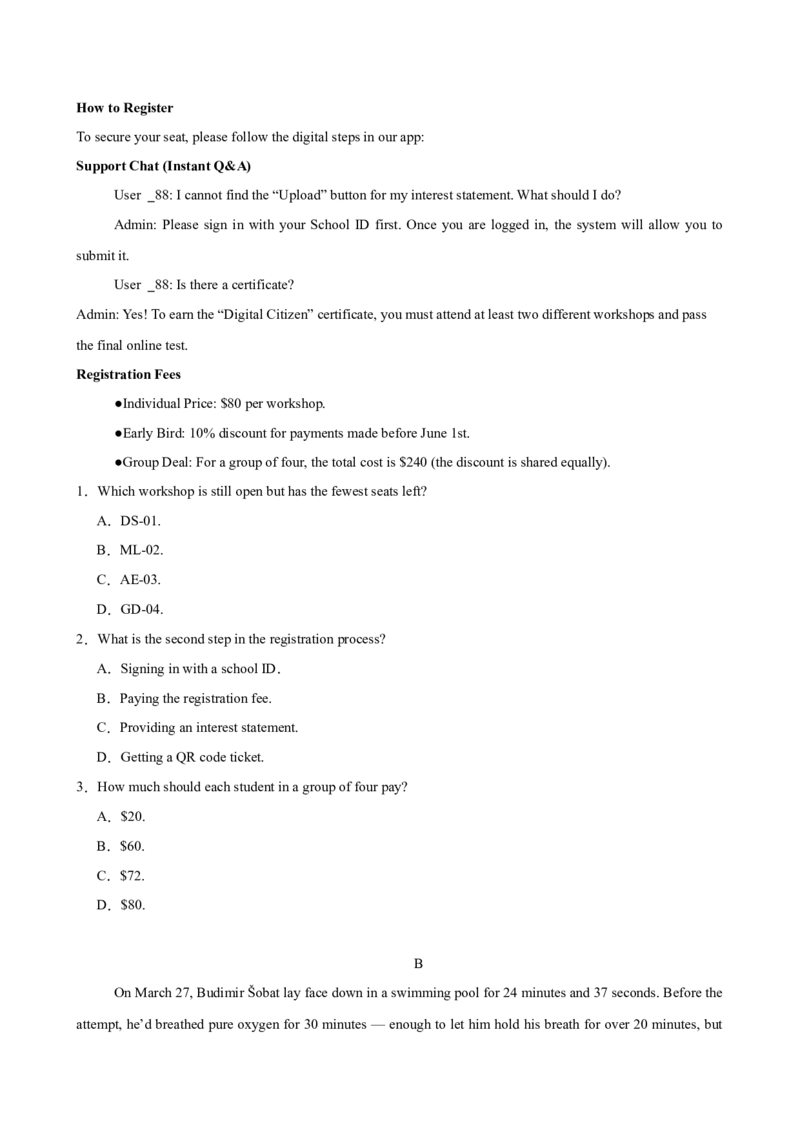
Welcome to the 2025 Digital Skills Week! To prepare for a tech-driven future, we offer three specialized
workshops. Use our app to track availability and complete your registration.
Workshop Availability & Focus
Before you apply, please check the current enrollment status. Note: A workshop closes once the “Progress”
reaches 100%.
Module Code
Skill Focus
Enrollment Progress
Current Status
DS-01
Data Science: Big
data and algorithm
design.
95%
Almost Full
ML-02
Media Literacy: Fake
news and online
safety.
60%
Seats Available
AE-03
AI Ethics: Social
impact of artificial
intelligence.
20
%
Open
GD-04
Graphic Design:
UI/UX and poster
creation.
100%
Closed
How to Register
To secure your seat, please follow the digital steps in our app:
Support Chat (Instant Q&A)
User  88: I cannot find the “Upload” button for my interest statement. What should I do?
Admin: Please sign in with your School ID first. Once you are logged in, the system will allow you to
submit it.
User  88: Is there a certificate?
Admin: Yes! To earn the “Digital Citizen” certificate, you must attend at least two different workshops and pass
the final online test.
Registration Fees
●Individual Price: $80 per workshop.
●Early Bird: 10% discount for payments made before June 1st.
●Group Deal: For a group of four, the total cost is $240 (the discount is shared equally).
1.Which workshop is still open but has the fewest seats left?
A.DS-01.
B.ML-02.
C.AE-03.
D.GD-04.
2.What is the second step in the registration process?
A.Signing in with a school ID.
B.Paying the registration fee.
C.Providing an interest statement.
D.Getting a QR code ticket.
3.How much should each student in a group of four pay?
A.$20.
B.$60.
C.$72.
D.$80.
B
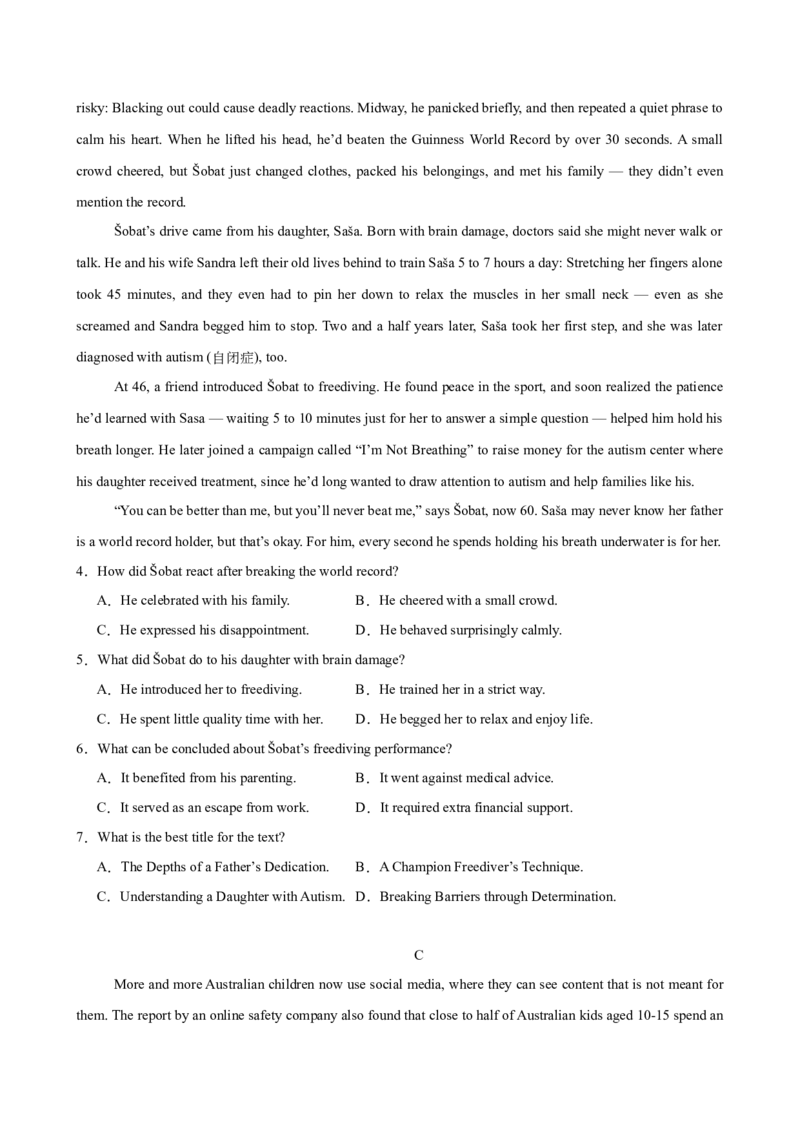
On March 27, Budimir Šobat lay face down in a swimming pool for 24 minutes and 37 seconds. Before the
attempt, he’d breathed pure oxygen for 30 minutes — enough to let him hold his breath for over 20 minutes, but
risky: Blacking out could cause deadly reactions. Midway, he panicked briefly, and then repeated a quiet phrase to
calm his heart. When he lifted his head, he’d beaten the Guinness World Record by over 30 seconds. A small
crowd cheered, but Šobat just changed clothes, packed his belongings, and met his family — they didn’t even
mention the record.
Šobat’s drive came from his daughter, Saša. Born with brain damage, doctors said she might never walk or
talk. He and his wife Sandra left their old lives behind to train Saša 5 to 7 hours a day: Stretching her fingers alone
took 45 minutes, and they even had to pin her down to relax the muscles in her small neck — even as she
screamed and Sandra begged him to stop. Two and a half years later, Saša took her first step, and she was later
diagnosed with autism (自闭症), too.
At 46, a friend introduced Šobat to freediving. He found peace in the sport, and soon realized the patience
he’d learned with Sasa — waiting 5 to 10 minutes just for her to answer a simple question — helped him hold his
breath longer. He later joined a campaign called “I’m Not Breathing” to raise money for the autism center where
his daughter received treatment, since he’d long wanted to draw attention to autism and help families like his.
“You can be better than me, but you’ll never beat me,” says Šobat, now 60. Saša may never know her father
is a world record holder, but that’s okay. For him, every second he spends holding his breath underwater is for her.
4.How did Šobat react after breaking the world record?
A.He celebrated with his family.
B.He cheered with a small crowd.
C.He expressed his disappointment.
D.He behaved surprisingly calmly.
5.What did Šobat do to his daughter with brain damage?
A.He introduced her to freediving.
B.He trained her in a strict way.
C.He spent little quality time with her.
D.He begged her to relax and enjoy life.
6.What can be concluded about Šobat’s freediving performance?
A.It benefited from his parenting.
B.It went against medical advice.
C.It served as an escape from work.
D.It required extra financial support.
7.What is the best title for the text?
A.The Depths of a Father’s Dedication.
B.A Champion Freediver’s Technique.
C.Understanding a Daughter with Autism. D.Breaking Barriers through Determination.
C
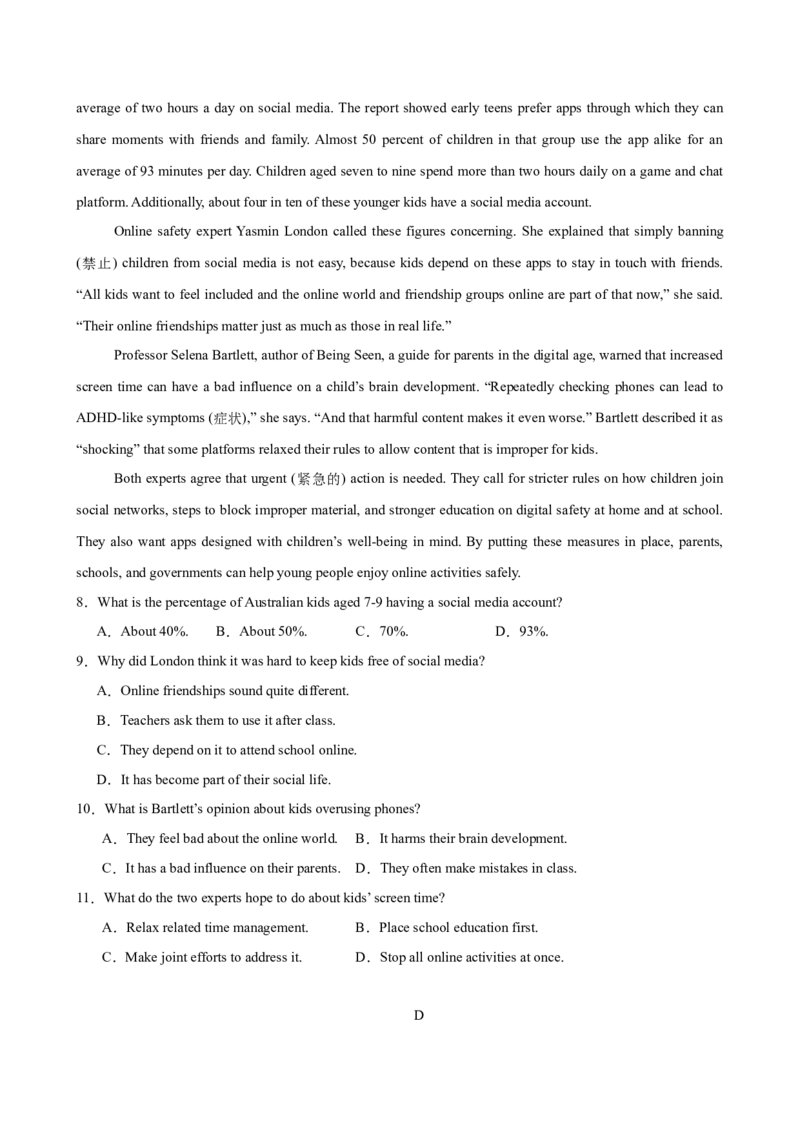
More and more Australian children now use social media, where they can see content that is not meant for
them. The report by an online safety company also found that close to half of Australian kids aged 10-15 spend an
average of two hours a day on social media. The report showed early teens prefer apps through which they can
share moments with friends and family. Almost 50 percent of children in that group use the app alike for an
average of 93 minutes per day. Children aged seven to nine spend more than two hours daily on a game and chat
platform. Additionally, about four in ten of these younger kids have a social media account.
Online safety expert Yasmin London called these figures concerning. She explained that simply banning
(禁止) children from social media is not easy, because kids depend on these apps to stay in touch with friends.
“All kids want to feel included and the online world and friendship groups online are part of that now,” she said.
“Their online friendships matter just as much as those in real life.”
Professor Selena Bartlett, author of Being Seen, a guide for parents in the digital age, warned that increased
screen time can have a bad influence on a child’s brain development. “Repeatedly checking phones can lead to
ADHD-like symptoms (症状),” she says. “And that harmful content makes it even worse.” Bartlett described it as
“shocking” that some platforms relaxed their rules to allow content that is improper for kids.
Both experts agree that urgent (紧急的) action is needed. They call for stricter rules on how children join
social networks, steps to block improper material, and stronger education on digital safety at home and at school.
They also want apps designed with children’s well-being in mind. By putting these measures in place, parents,
schools, and governments can help young people enjoy online activities safely.
8.What is the percentage of Australian kids aged 7-9 having a social media account?
A.About 40%.
B.About 50%.
C.70%.
D.93%.
9.Why did London think it was hard to keep kids free of social media?
A.Online friendships sound quite different.
B.Teachers ask them to use it after class.
C.They depend on it to attend school online.
D.It has become part of their social life.
10.What is Bartlett’s opinion about kids overusing phones?
A.They feel bad about the online world.
B.It harms their brain development.
C.It has a bad influence on their parents.
D.They often make mistakes in class.
11.What do the two experts hope to do about kids’ screen time?
A.Relax related time management.
B.Place school education first.
C.Make joint efforts to address it.
D.Stop all online activities at once.
D
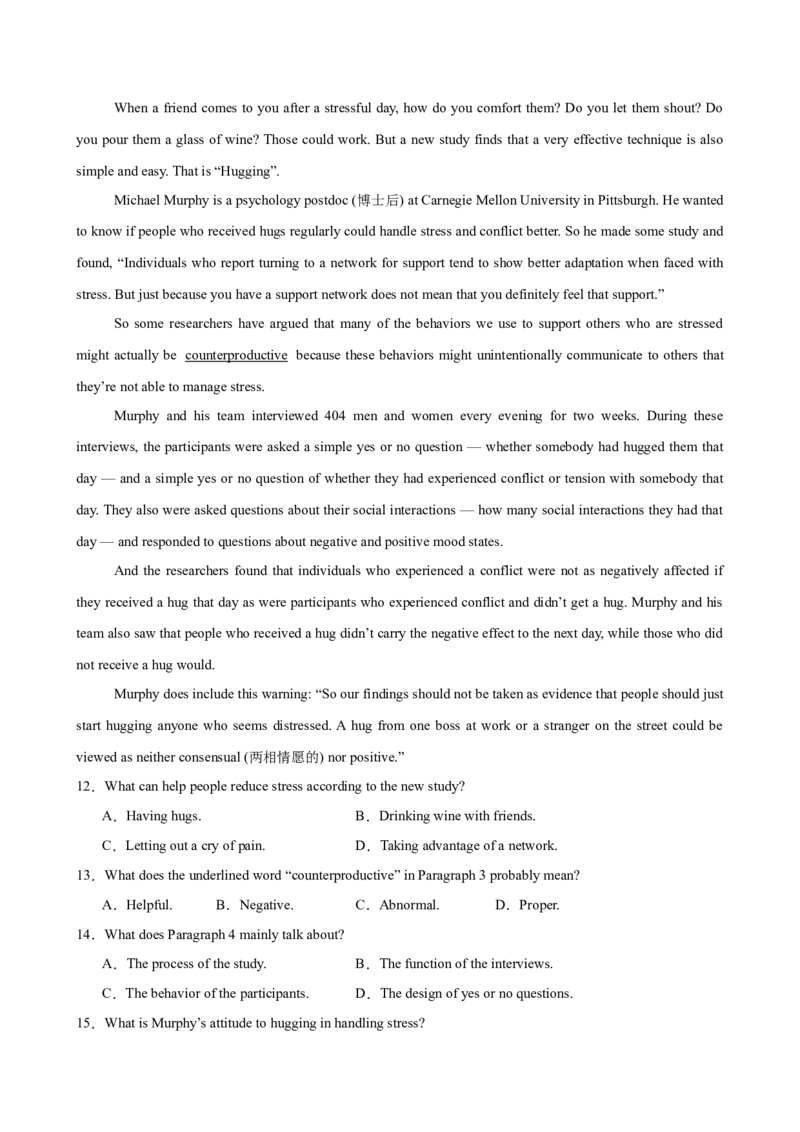
When a friend comes to you after a stressful day, how do you comfort them? Do you let them shout? Do
you pour them a glass of wine? Those could work. But a new study finds that a very effective technique is also
simple and easy. That is “Hugging”.
Michael Murphy is a psychology postdoc (博士后) at Carnegie Mellon University in Pittsburgh. He wanted
to know if people who received hugs regularly could handle stress and conflict better. So he made some study and
found, “Individuals who report turning to a network for support tend to show better adaptation when faced with
stress. But just because you have a support network does not mean that you definitely feel that support.”
So some researchers have argued that many of the behaviors we use to support others who are stressed
might actually be counterproductive because these behaviors might unintentionally communicate to others that
they’re not able to manage stress.
Murphy and his team interviewed 404 men and women every evening for two weeks. During these
interviews, the participants were asked a simple yes or no question — whether somebody had hugged them that
day — and a simple yes or no question of whether they had experienced conflict or tension with somebody that
day. They also were asked questions about their social interactions — how many social interactions they had that
day — and responded to questions about negative and positive mood states.
And the researchers found that individuals who experienced a conflict were not as negatively affected if
they received a hug that day as were participants who experienced conflict and didn’t get a hug. Murphy and his
team also saw that people who received a hug didn’t carry the negative effect to the next day, while those who did
not receive a hug would.
Murphy does include this warning: “So our findings should not be taken as evidence that people should just
start hugging anyone who seems distressed. A hug from one boss at work or a stranger on the street could be
viewed as neither consensual (两相情愿的) nor positive.”
12.What can help people reduce stress according to the new study?
A.Having hugs.
B.Drinking wine with friends.
C.Letting out a cry of pain.
D.Taking advantage of a network.
13.What does the underlined word “counterproductive” in Paragraph 3 probably mean?
A.Helpful.
B.Negative.
C.Abnormal.
D.Proper.
14.What does Paragraph 4 mainly talk about?
A.The process of the study.
B.The function of the interviews.
C.The behavior of the participants.
D.The design of yes or no questions.
15.What is Murphy’s attitude to hugging in handling stress?
A.Subjective.
B.Doubtful.
C.Objective.
D.Indifferent.
第二节(共5 小题;每小题2.5 分,满分12.5 分)
阅读下面短文,从短文后的选项中选出可以填入空白处的最佳选项。选项中有两项为多余选项。
What comes to mind when you think about chocolate? A candy bar at Halloween? Ice cream on a hot day?
For Ibrahim, a 12-year-old boy from the West African country of Ghana, chocolate is not about sweet
treats; it is about bitter work.     16     But if they did, we would learn that Ibrahim spends his days growing
and harvesting cocoa beans, from which chocolate is made. We would also learn that he is just one of more than
two million children who perform this difficult labour instead of attending school.
To change the harmful practices like this, some farms use an approach called Fairtrade.     17     It
aims to create a different relationship between buyers (chocolate companies) and sellers (cocoa farmers) by
encouraging farmers to join together to form a shared business called a cooperative. Because farmers work
together instead of competing with each other, they can demand a higher price from the buyers.     18
Consumers like you can play a role as well. You can buy Fairtrade chocolate if possible, pressure candy
companies to change their labour practices, or ask local stores to sell Fairtrade products.     19     It is a
programme recognizing schools that provide Fairtrade products in cafeterias or include related lessons in
curriculum (课程).
Chocolate has a hidden story that affects children like Ibrahim—children who want a happy future just like
you do.     20     By enjoying Fairtrade products or simply spreading the word, you can make chocolate as
sweet for all children as it is for you.
A.You have the power to change the story.
B.The labels on chocolate do not tell his story.
C.Fairtrade is a way of doing business that prohibits child labour.
D.You can also take action through the Fairtrade Schools network.
E.On many farms, children like Ibrahim perform difficult farming tasks.
F.Cocoa trees grow in the tropical climates of Africa, Latin America and South-East Asia.
G.With more income, farmers can pay adult workers and can send their children to school.
第二部分  语言运用(共两节,满分30 分)
第一节  (共15 小题;每小题1 分,满分15 分)
阅读下面短文,从每题所给的A、B、C、D 四个选项中选出可以填入空白处的最佳选项。
Johnmarshall Reeve, a professor at an Australian university, has spent two decades studying what happens
when kids are given some agency ( 自主权) in school. He and other researchers found that when students are
allowed some     21     to take their own initiative (倡议), they are more     22     in class and better able
to master new skills, they have better grades and     23     problems with peers and they are happier, too.
Importantly, teachers do not need to change the curriculum they teach or change their disciplinary (学科的)
24    . They just need apply a few new teaching practices in the course of their     25     lesson.
Mr. Reeve suggested teachers use a    26     tone rather than controlling. Controlling language shuts
students down. “They’ll put up a shield (屏障) and block you out,” Mr. Reeve told us. Reasoning language     27
the shield. Kids open up.
So, instead of “Here is an example of a good essay. Please go write one,” the teacher might say: “What is
your     28     for this first draft?” Rather than simply being told, students     29     what they need to
accomplish and develop a plan to make it happen. Teachers monitor and     30     them along the way.
This is how agency is built. No adult can     31     a student to be self-driven. Children develop the
skill the way they learn anything else: with     32    . The act of setting the goal makes it more     33    .
Just as the developmental psychologist Aliza Pressman says: “Let kids do for themselves what they can
already do. And     34     and encourage them to do things they can almost do. And then teach and model for
them the things that they can’t do.” This is how adults can help children build     35    .
21.A.opportunity
B.challenge
C.discussion
D.pressure
22.A.confused
B.engaged
C.relaxed
D.disappointed
23.A.more
B.newer
C.fewer
D.easier
24.A.result
B.approach
C.influence
D.attitude
25.A.special
B.interesting
C.normal
D.difficult
26.A.reasoning
B.imagining
C.praising
D.explaining
27.A.raises
B.protects
C.ignores
D.lowers
28.A.achievement
B.score
C.grade
D.goal
29.A.figure out
B.turn down
C.look for
D.care about
30.A.allow
B.coach
C.replace
D.remind
31.A.force
B.expect
C.warn
D.forbid
32.A.curiosity
B.patience
C.practice
D.confidence
33.A.difficult
B.popular
C.complex
D.meaningful
34.A.scold
B.refuse
C.guide
D.promise
35.A.confidence
B.agency
C.wisdom
D.trust
第二节(共10 小题;每小题1. 5 分, 满分15 分)
阅读下面材料,在空白处填入适当的内容(1 个单词)或所给单词的正确形式。
In Beijing, an exhibition at the National Library brings ancient academies back to life and shows how they
still shape Chinese education today. It is in these quiet halls,     36     the smell of old books hangs in the air,
that visitors seem to hear the voices of scholars reading the classics and searching for     37     (wise).
From the Tang Dynasty to the Qing Dynasty, shuyuan — traditional academies — served as centers for
learning, book collecting     38     moral training. More than 110 rare books, selected     39

(demonstrate) how these schools helped pass on knowledge from one generation to another, are on display.
Among them is a 17th-century edition of the Book of Han,     40     (contain) the famous words “be diligent
in learning and seek truth from facts”, a motto that guided     41     great many students.
So important were these academies that over 7,500 of them once spread across China. Some, such as Yuelu
Academy in Hunan, later     42     (grow) into modern universities. Scrolls from Dunhuang and stone
carvings of Confucian texts     43     (far) show how education survived wars and the passing of time.
In the early 20th century, the transformation of many academies into modern schools     44     (effect)
in response to educational reform. Today, their spirit remains.      45      they teach us is that respect for
knowledge, moral growth and the search for truth are values that never grow old.
第四部分 写作(共两节, 满分40 分)
第一节(满分15 分)
46.现在来中国学习中文的留学生越来越多,其中不少人对线上支付的安全性有疑虑。假定你是李华,
请以“安全使用线上支付”为主题,向校英语报刊投稿。内容包括:
1. 你的看法;
2. 使用建议。
注意:
1. 写作词数应为80 左右;
2. 可适当增加细节,以使行文连贯。
Use Online Payment Safely in China
___________________________________________________________________________________________
___________________________________________________________________________________________
___________________________________________________________________________________________
___________________________________________________________________________________________
___________________________________________________________________________________________
___________________________________________________________________________________________
___________________________________________________________________________________________
___________________________________________________________________________________________
___________________________________________________________________________________________
___________________________________________________________________________________________
______________________________________________________________________________________
第二节(满分25 分)
47.阅读下面材料,根据其内容和所给段落开头语续写两段,使之构成一篇完整的短文。
Recently, I had an unforgettable experience in downtown Austin. I’d travelled all the way from Texas just
to spend some time exploring the lively city. One sunny day, I found myself in Zilker Park, sitting on a bench (长
椅) and watching the people go by. It was a peaceful moment, and I felt completely at ease in this new
environment.
After a few hours of this delightful people-watching, I decided it was time to head back to my car. As I
reached into my bag for my keys, a cold wave of fear washed over me. My purse was gone! Panic set in
immediately. My purse wasn’t just any ordinary bag; it held my ID, credit cards, all my necessary medicines, and
a significant amount of cash — hundreds of dollars.
The anxiety started in my legs, making them feel weak and shaky. My mind went blank, and I couldn’t
think straight. I knew I had to act fast.
I began to retrace (重走) my steps, walking back through the park, trying to remember every single place
I’d been. I searched high and low, looking under benches and in every corner. After about an hour of this crazy
search, I found myself standing in front of a Zilker Park gift shop. I didn’t really know why I stopped there, but
something inside me told me to give it a try. Maybe, just maybe, someone had turned in my purse.
I took a deep breath and walked into the shop. My heart was pounding in my chest as I approached the
cashier. “Excuse me,” I said, my voice trembling. “Has anyone brought in a black purse?”
The woman’s eyes widened in surprise, and she said, “Actually, someone has!” At that very moment, all the
negative emotions came pouring out. Tears streamed down my face, and I couldn’t stop sobbing ( 啜泣). All the
anxiety that had been building up inside me was finally released. The cashier then told me the whole story. About
half an hour earlier, two women had come into the gift shop with a black purse.
注意:
1.续写词数应为150 个左右;
2.请按如下格式在答题卡的相应位置作答。
The two women said they’d found it under a bench.
___________________________________________________________________________________________
___________________________________________________________________________________________
___________________________________________________________________________________________
___________________________________________________________________________________________
___________________________________________________________________________________________
_____
I immediately called the number left by the two kind women.
___________________________________________________________________________________________
___________________________________________________________________________________________
___________________________________________________________________________________________
___________________________________________________________________________________________
___________________________________________________________________________________________
_____