2026 年高考第二次模拟考试(广东卷)
英语
(考试时间:120 分钟  试卷满分:120 分)
注意事项:
1.本试卷分第Ⅰ卷(选择题)和第Ⅱ卷(非选择题)两部分。答卷前,考生务必将自己的姓名、准
考证号填写在答题卡上。
2.回答第Ⅰ卷时,选出每小题答案后,用2B 铅笔把答题卡上对应题目的答案标号涂黑。如需改动,
用橡皮擦干净后,再选涂其他答案标号。写在本试卷上无效。
3.回答第Ⅱ卷时,将答案写在答题卡上。写在本试卷上无效。
4.考试结束后,将本试卷和答题卡一并交回。
第一部分  阅读(共两节,满分50 分)
第一节(共15 小题;每小题2.5 分,满分37.5 分)
阅读下列短文,从每题所给的A、B、C、D 四个选项中选出最佳选项。
A
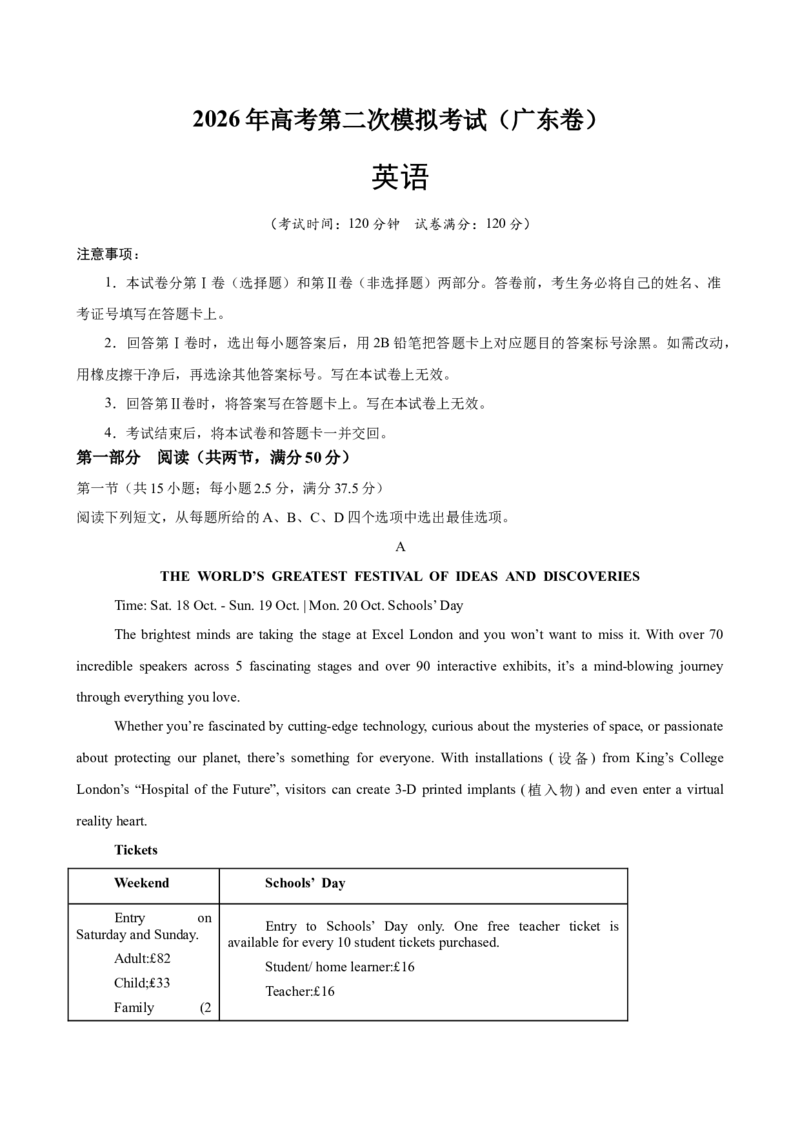
THE WORLD’S GREATEST FESTIVAL OF IDEAS AND DISCOVERIES
Time: Sat. 18 Oct. - Sun. 19 Oct. | Mon. 20 Oct. Schools’ Day
The brightest minds are taking the stage at Excel London and you won’t want to miss it. With over 70
incredible speakers across 5 fascinating stages and over 90 interactive exhibits, it’s a mind-blowing journey
through everything you love.
Whether you’re fascinated by cutting-edge technology, curious about the mysteries of space, or passionate
about protecting our planet, there’s something for everyone. With installations ( 设备) from King’s College
London’s “Hospital of the Future”, visitors can create 3-D printed implants ( 植入物) and even enter a virtual
reality heart.
Tickets
Weekend
Schools’ Day
Entry

on
Saturday and Sunday.
Adult:£82
Child;₤33
Family
(2
Entry to Schools’ Day only. One free teacher ticket is
available for every 10 student tickets purchased.
Student/ home learner:£16
Teacher:£16
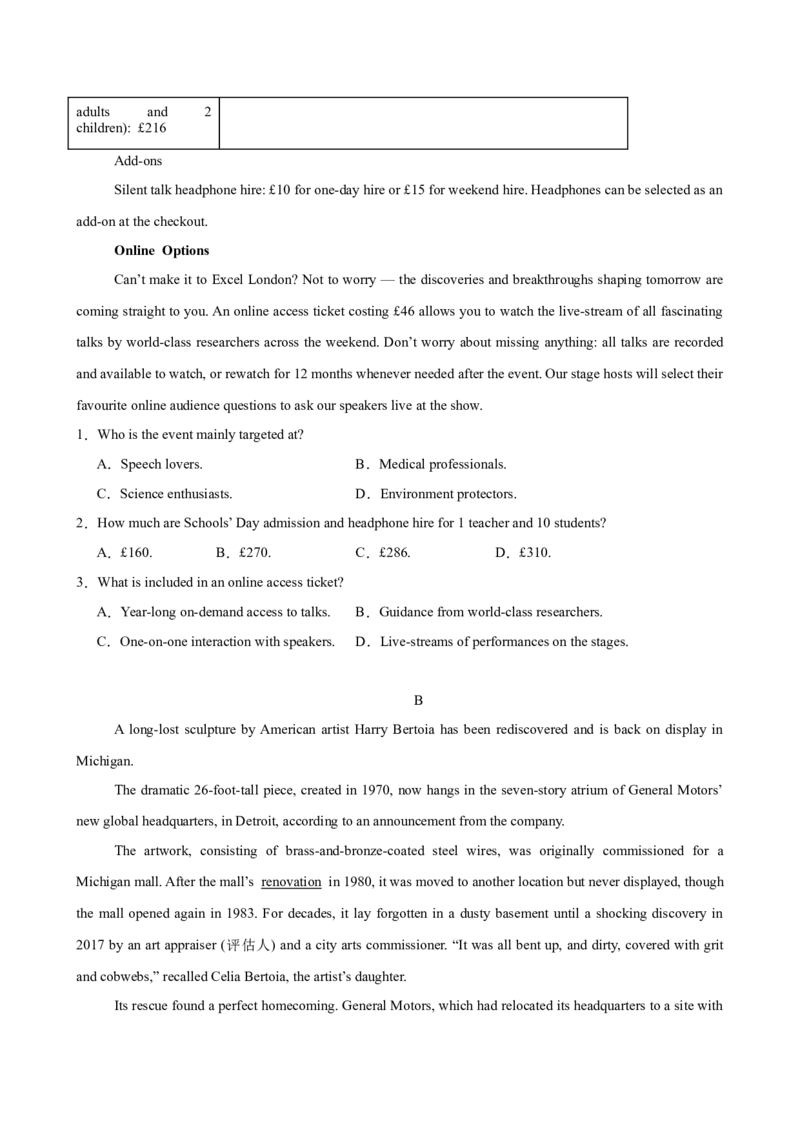
adults
and
2
children): £216
Add-ons
Silent talk headphone hire: £10 for one-day hire or £15 for weekend hire. Headphones can be selected as an
add-on at the checkout.
Online Options
Can’t make it to Excel London? Not to worry — the discoveries and breakthroughs shaping tomorrow are
coming straight to you. An online access ticket costing £46 allows you to watch the live-stream of all fascinating
talks by world-class researchers across the weekend. Don’t worry about missing anything: all talks are recorded
and available to watch, or rewatch for 12 months whenever needed after the event. Our stage hosts will select their
favourite online audience questions to ask our speakers live at the show.
1.Who is the event mainly targeted at?
A.Speech lovers.
B.Medical professionals.
C.Science enthusiasts.
D.Environment protectors.
2.How much are Schools’ Day admission and headphone hire for 1 teacher and 10 students?
A.£160.
B.£270.
C.£286.
D.£310.
3.What is included in an online access ticket?
A.Year-long on-demand access to talks.
B.Guidance from world-class researchers.
C.One-on-one interaction with speakers.
D.Live-streams of performances on the stages.
B
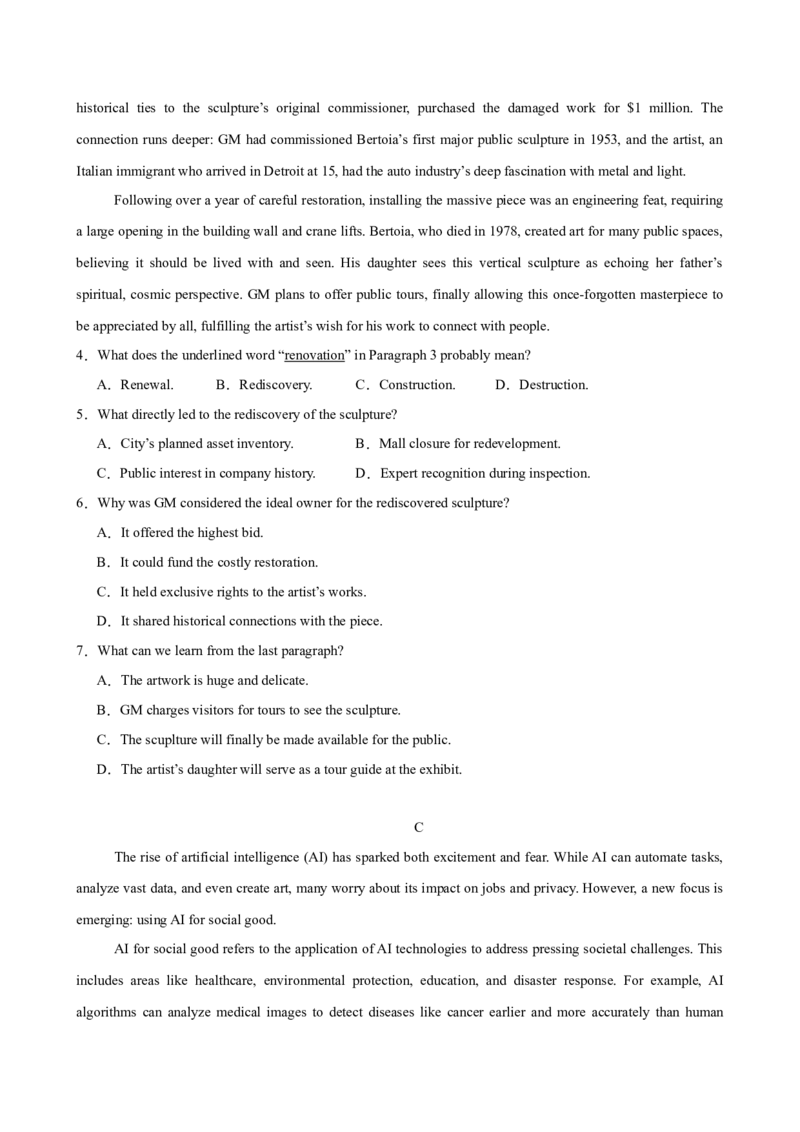
A long-lost sculpture by American artist Harry Bertoia has been rediscovered and is back on display in
Michigan.
The dramatic 26-foot-tall piece, created in 1970, now hangs in the seven-story atrium of General Motors’
new global headquarters, in Detroit, according to an announcement from the company.
The artwork, consisting of brass-and-bronze-coated steel wires, was originally commissioned for a
Michigan mall. After the mall’s renovation in 1980, it was moved to another location but never displayed, though
the mall opened again in 1983. For decades, it lay forgotten in a dusty basement until a shocking discovery in
2017 by an art appraiser (评估人) and a city arts commissioner. “It was all bent up, and dirty, covered with grit
and cobwebs,” recalled Celia Bertoia, the artist’s daughter.
Its rescue found a perfect homecoming. General Motors, which had relocated its headquarters to a site with
historical ties to the sculpture’s original commissioner, purchased the damaged work for $1 million. The
connection runs deeper: GM had commissioned Bertoia’s first major public sculpture in 1953, and the artist, an
Italian immigrant who arrived in Detroit at 15, had the auto industry’s deep fascination with metal and light.
Following over a year of careful restoration, installing the massive piece was an engineering feat, requiring
a large opening in the building wall and crane lifts. Bertoia, who died in 1978, created art for many public spaces,
believing it should be lived with and seen. His daughter sees this vertical sculpture as echoing her father’s
spiritual, cosmic perspective. GM plans to offer public tours, finally allowing this once-forgotten masterpiece to
be appreciated by all, fulfilling the artist’s wish for his work to connect with people.
4.What does the underlined word “renovation” in Paragraph 3 probably mean?
A.Renewal.
B.Rediscovery.
C.Construction.
D.Destruction.
5.What directly led to the rediscovery of the sculpture?
A.City’s planned asset inventory.
B.Mall closure for redevelopment.
C.Public interest in company history.
D.Expert recognition during inspection.
6.Why was GM considered the ideal owner for the rediscovered sculpture?
A.It offered the highest bid.
B.It could fund the costly restoration.
C.It held exclusive rights to the artist’s works.
D.It shared historical connections with the piece.
7.What can we learn from the last paragraph?
A.The artwork is huge and delicate.
B.GM charges visitors for tours to see the sculpture.
C.The scuplture will finally be made available for the public.
D.The artist’s daughter will serve as a tour guide at the exhibit.
C
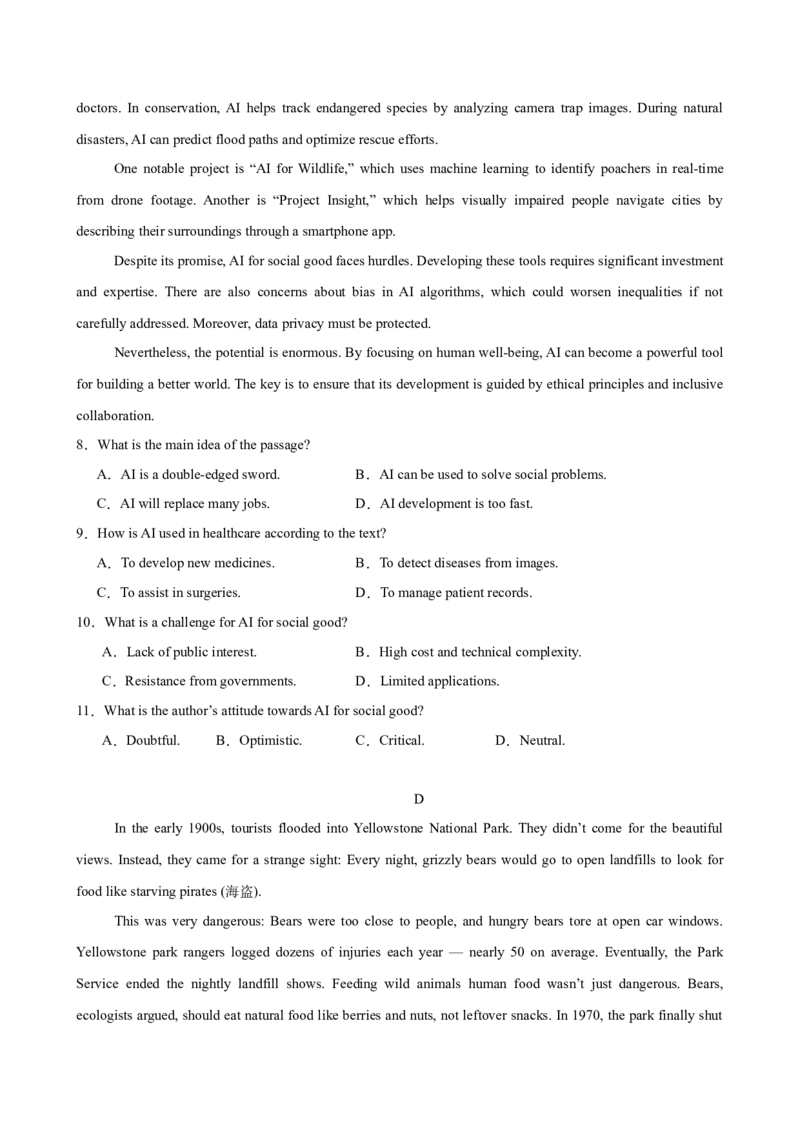
The rise of artificial intelligence (AI) has sparked both excitement and fear. While AI can automate tasks,
analyze vast data, and even create art, many worry about its impact on jobs and privacy. However, a new focus is
emerging: using AI for social good.
AI for social good refers to the application of AI technologies to address pressing societal challenges. This
includes areas like healthcare, environmental protection, education, and disaster response. For example, AI
algorithms can analyze medical images to detect diseases like cancer earlier and more accurately than human
doctors. In conservation, AI helps track endangered species by analyzing camera trap images. During natural
disasters, AI can predict flood paths and optimize rescue efforts.
One notable project is “AI for Wildlife,” which uses machine learning to identify poachers in real-time
from drone footage. Another is “Project Insight,” which helps visually impaired people navigate cities by
describing their surroundings through a smartphone app.
Despite its promise, AI for social good faces hurdles. Developing these tools requires significant investment
and expertise. There are also concerns about bias in AI algorithms, which could worsen inequalities if not
carefully addressed. Moreover, data privacy must be protected.
Nevertheless, the potential is enormous. By focusing on human well-being, AI can become a powerful tool
for building a better world. The key is to ensure that its development is guided by ethical principles and inclusive
collaboration.
8.What is the main idea of the passage?
A.AI is a double-edged sword.
B.AI can be used to solve social problems.
C.AI will replace many jobs.
D.AI development is too fast.
9.How is AI used in healthcare according to the text?
A.To develop new medicines.
B.To detect diseases from images.
C.To assist in surgeries.
D.To manage patient records.
10.What is a challenge for AI for social good?
A.Lack of public interest.
B.High cost and technical complexity.
C.Resistance from governments.
D.Limited applications.
11.What is the author’s attitude towards AI for social good?
A.Doubtful.
B.Optimistic.
C.Critical.
D.Neutral.
D
In the early 1900s, tourists flooded into Yellowstone National Park. They didn’t come for the beautiful
views. Instead, they came for a strange sight: Every night, grizzly bears would go to open landfills to look for
food like starving pirates (海盗).
This was very dangerous: Bears were too close to people, and hungry bears tore at open car windows.
Yellowstone park rangers logged dozens of injuries each year — nearly 50 on average. Eventually, the Park
Service ended the nightly landfill shows. Feeding wild animals human food wasn’t just dangerous. Bears,
ecologists argued, should eat natural food like berries and nuts, not leftover snacks. In 1970, the park finally shut
down the landfills for good.
By then, though, the grizzly were in deep trouble. As few as 700 remained in the lower 48 states, down
from the estimated 50,000 that once lived in the 18 western states. Decades of trapping, shooting, and poisoning
had driven them to the edge of extinction. The bears that survived had gotten used to eating human food, so when
the landfills closed, many of them couldn’t find enough food and died.
Their already fragile (脆弱的) population in the Yellowstone region decreased to fewer than 250. So in
1975, the US Fish and Wildlife Service placed grizzly bears on the endangered species list. Today, there are over
1,000 bears around Yellowstone.
The recovery effort was a major success, but it’s led to new problems. As the bear population grows,
they’re moving into areas where people live. This can lead to conflicts. In 2024 alone, over 60 grizzly were killed
in Wyoming after causing problems like killing cattle or breaking into homes.
Now, there’s a debate about whether to remove grizzlies from the endangered species list. Some say their
numbers have recovered enough. But to remove legal protection would mean grizzly bears would face increasing
threats to their survival at a time when some biologists argue the species’ recovery is shaky at best.
12.Why did tourists rush to Yellowstone National Park in the early 1900s according to the text?
A.To explore the winding paths.
B.To admire the splendid scenery.
C.To watch grizzly search for food.
D.To take photos with family member
13.What was a consequence of closing the landfills in Yellowstone National Park?
A.A bear hunt across the conservation area.B.A sharp decline in grizzly’s population.
C.A dramatic increase in tourist numbers. D.A fragile natural environment in the park.
14.What can we infer from the last paragraph?
A.De-listing grizzly remains uncertain.
B.The protection by law is ineffective.
C.The Park Service’s duty is overstated.
D.All biologists express concern over bears.
15.Which is the most suitable title for the text?
A.Grizzly’s’ Recovery: Success and New Challenges
B.A Fundamental Shift in Public Views on Landfills
C.The Yellowstone: Its Unique Ecosystem and Value
D.A Threat to Grizzly Posed by Overcrowded Sites
第二节(共5 小题;每小题2.5 分,满分12.5 分)
阅读下面短文,从短文后的选项中选出可以填入空白处的最佳选项。选项中有两项为多余选项。
Are you truly happy? What does it mean to be happy? What does it take to achieve happiness?     16

The following are a few tips that I follow to create happiness in my life.
Make a plan for achieving goals that you believe will make you happy. Your moods (心情) will very likely
increase if you are going after something you value.
   17    It is easy to begin to think negatively when you are surrounded by people who think that way. On
the contrary, if you are around people who are happy, their emotional state will be infectious.
When something goes wrong, try to figure out a solution (解决办法) instead of being absorbed in self-pity.
Truly happy people don’t allow setbacks to affect their mood because they know that with a little thought they
can.
Spend a few minutes each day thinking about the things that make you happy.     18     And this will
lead you to continuous happiness.
   19    Whether you treat yourself to lunch, take a long, relaxing bath or simply spend a few extra minutes
on your appearance, you will be subconsciously putting yourself in a better mood.
Finding the humor in situations can also lead to happiness. Find a way to make light of a situation that would
otherwise make you happy.
Keeping healthy is another way to achieve happiness.    20
A.Surround yourself with happy people.
B.There are some tips in life that lead to happiness.
C.Eating healthy foods or being fit can have a great effect on your mood.
D.These few minutes will help you focus on the positive things in your life.
E.What makes you happy may be different from what makes someone else happy.
F.It is also important to take some time each day to do something nice for yourself.
G.These are important questions for anyone who is seeking happiness to ask themselves.
第二部分  语言运用(共两节,满分30 分)
第一节  (共15 小题;每小题1 分,满分15 分)
阅读下面短文,从每题所给的A、B、C、D 四个选项中选出可以填入空白处的最佳选项。
Once upon a time, much of the world was populated by wolves. They    21    all over the United States
and Canada, Siberia and much of mainland Europe, as well as Great Britain, and if humans hadn’t come along,
they would still be there in great numbers. But man did come along, farmed the land,    22    the wolves
killing their livestock (家畜) and so gradually drove them out of the homes that had once been theirs.
Wolves are not    23    in our language and literature, however. In fairy stories, they are seen as evil and
dangerous, always    24    to eat people. Remember the time when Little Red Riding Hood thinks that a wolf
is her grandmother? If you really want to see how English-speaking humans think of the wolf, just look at the
25   ! “A wolf in sheep’s clothing” is not a pleasant person and a “wolf-whistle” is not a pleasant sound!
Yet wolves are totally unlike the image we have of them from legend and language. For a start, they don’t
26    humans; indeed, they do their best to keep out of our way. They are very sociable animals, living in packs
and looking after their young, which should make some humans    27    themselves. Instead of being   28  ,
the howl of the wolf — the cry of the whole pack — as the full moon rises in a star-bright sky, is one of the most
beautiful sounds in nature. They are beautiful creatures which can run at speeds of up to 65 kph if they have to.
And when they do   29   , their 42 large teeth are fearlessly effective.
But the    30    remains that we love the lion, the king of the jungle, while we demonize (妖魔化) the
wolf, one of the most beautiful animals in the world. Only     31   do writers treat them nicely; for example, a
she-wolf is supposed to have fed the twins Remus and Romulus, who went on to    32    the city of Rome.
And so, while man kills animals in their millions, often just for the fun of it, the wolf represents a state of
natural    33    that we do not know and can never obtain, even though we    34    it in our hearts. Perhaps
that’s why, in the end, we    35    the wolf so much — for having something we can never get our hands on.
21.A.ruled
B.migrated
C.concentrated
D.ranged
22.A.set aside
B.approved of
C.objected to
D.worked out
23.A.killers
B.victims
C.characters
D.criminals
24.A.reluctant
B.ready
C.unlikely
D.sure
25.A.look
B.sound
C.language
D.behaviour
26.A.avoid
B.frighten
C.attack
D.protest
27.A.surprised at
B.pleased with
C.ashamed of
D.interested in
28.A.loud
B.peaceful
C.musical
D.soft
29.A.run
B.jump
C.kill
D.cry
30.A.possibility
B.mystery
C.evidence
D.fact
31.A.occasionally
B.recently
C.instantly
D.ultimately
32.A.found
B.ruin
C.pollute
D.mess
33.A.duty
B.grace
C.competition
D.skill
34.A.criticize
B.desire
C.neglect
D.learn
35.A.cage
B.keep
C.notice
D.hate
第二节(共10 小题;每小题1. 5 分, 满分15 分)
阅读下面材料,在空白处填入适当的内容(1 个单词)或所给单词的正确形式。
The Tujia people in Youyang have a rich cultural tradition centered around the “Baishou Dance,” a group
dance listed as a national intangible cultural heritage.     36     (perform) during festivals like the Spring
Festival and Harvest Day, it involves hundreds of dancers waving red silk ribbons     37     (create) patterns
symbolizing unity and prosperity.
The dance dates back over 1,000 years, originating from ancient rituals to pray     38     good harvests.
Dancers, dressed in traditional black and blue costumes with silver ornaments, move in synchronized steps,     39
(follow) the rhythm of drums and lusheng (a reed pipe instrument). The leader, known as the “Dance Head,”
directs the group,     40     (ensure) everyone stays in harmony.
In recent years, local schools     41     (introduce) Baishou Dance into physical education classes,
allowing young people     42     (learn) the steps. The government has also organized annual competitions,
43     (attract) teams from neighboring counties. These efforts aim     44     (preserve) the tradition and
pass it on to future generations.
To experience the Baishou Dance is to witness the vitality of Tujia culture. The vibrant colors, energetic
movements, and collective spirit     45     (make) it a highlight of Youyang’s ethnic festivals, drawing tourists
from across the country.
第四部分 写作(共两节, 满分40 分)
第一节(满分15 分)
46.假定你是李华,你校本学期对大课间活动进行了改革,推出了以趣味体育为主的“阳光大课间”活
动。请你以Changes in Our Extended Morning Recess 为题,向校英文报写一篇报道。要点如下:
1.说明改革前后的变化;
2.阐述改革的意义。
注意:
1.写作词数应为80 词左右;
2.请按如下格式在答题卡的相应位置作答。
Changes in Our Extended Morning Recess
___________________________________________________________________________________________
___________________________________________________________________________________________
___________________________________________________________________________________________
___________________________________________________________________________________________
___________________________________________________________________________________________
_____
第二节(满分25 分)
47.阅读下面材料,根据其内容和所给段落开头语续写两段,使之构成一篇完整的短文。
Illness had ruined my body, leaving me tired and weak. For weeks, I barely left my bed, letting the sunlight
fade unnoticed through the window. Messages and calls from friends came almost every day, but I couldn’t bring
myself to respond. Every time my phone buzzed (发出嗡嗡声), a sense of guilt and helplessness washed over me
— I felt I had nothing worth sharing in the sorry state I was in.
Time passed slowly in the quiet room, and everything seemed indistinct. I found comfort only in small,
ordinary things: the gentle sound of the heater, the smell of the tea, and the pages of the book I could barely focus
on. Yet even these small comforts felt hollow. They made me realize the energy and laughter I had lost.
Occasionally, I would find myself staring blankly at the photo of my friends on the table, a strong sense of longing
welling up inside me. I missed them — missed the sound of their voices and the warmth they brought — but
shame and weakness kept me from seeking help.
Then, one morning, the doorbell rang. I slowly raised my head, feeling heavy-hearted, and dragged my feet
to the door. There it was: a flower delivery. I brought the flowers inside and set them on the table. Looking at the
bright colors, I couldn’t help but feel curious. Instead of returning to bed, I felt a pull on my heart, a desire to
uncover the story behind these flowers. My fingers trembled as I dialed the flower shop, and a gentle voice
answered the phone, telling me that some of my friends had sent this surprise. “They wanted to send you a
message,” he said, “through the language of flowers.”
The flowers were unlike anything I had expected. Each flower seemed to carry a piece of emotion from my
friends’ hearts — concern, admiration, hope and care. For the first time in weeks, a glimmer (一丝) of warmth ran
through me, as if the flowers had spoken before I even understood their words.
注意:
1.续写词数应为150 个左右;
2.请按如下格式作答。
I decided to call my friends one by one, starting with Lina who had always been the most caring.
___________________________________________________________________________________________
___________________________________________________________________________________________
___________________________________________________________________________________________
___________________________________________________________________________________________
____
I placed the beautiful flowers in a visible spot in my room.
___________________________________________________________________________________________
___________________________________________________________________________________________
___________________________________________________________________________________________
___________________________________________________________________________________________
____