【灿烂六月 · 高考金8 卷】
备战2026 年高考英语模拟卷(上海卷01)
(考试时间:120 分钟 试卷满分:140 分)
注意事项:
1.答卷前,考生务必将自己的姓名、考生号等填写在答题卡和试卷指定位置上。
2.回答选择题时,选出每小题答案后,用铅笔把答题卡对应题目的答案标号涂黑。如需改动,用橡
皮擦干净后,再选涂其他答案标号。回答非选择题时,将答案写在答题卡上。写在本试卷上无效。
3.考试结束后,将本试卷和答题卡一并交回。
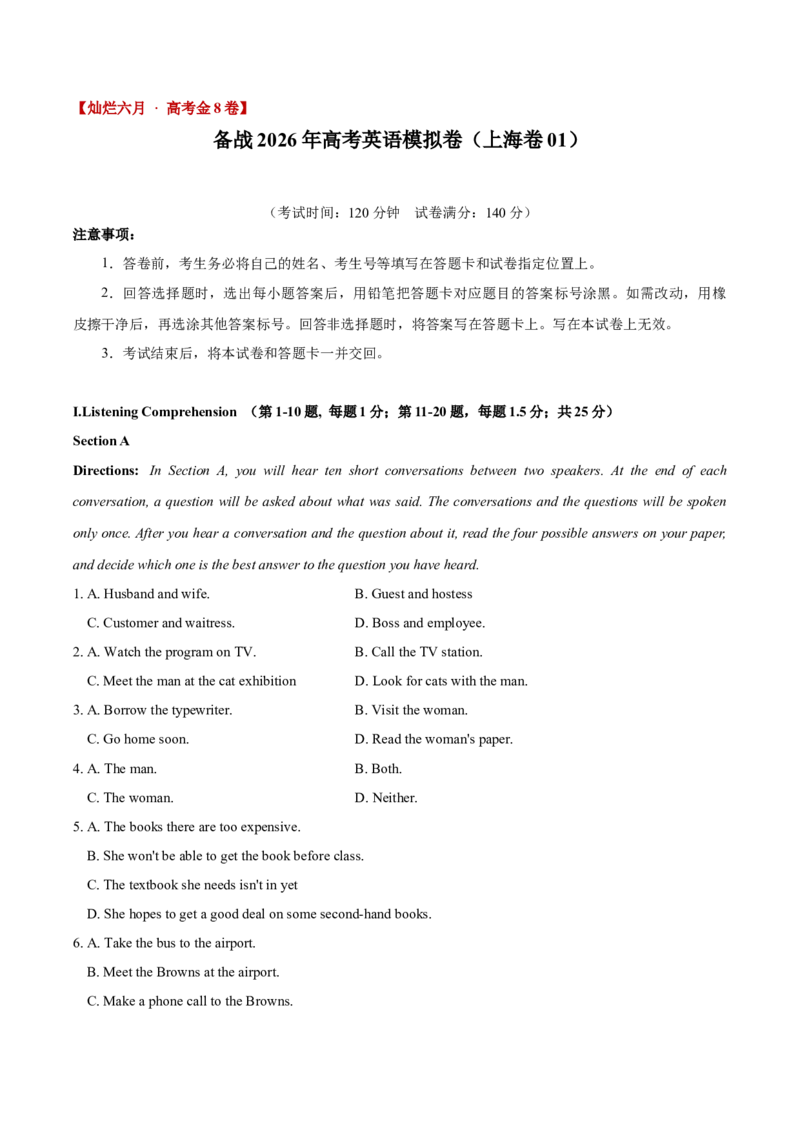
I.Listening Comprehension (第1-10 题, 每题1 分;第11-20 题,每题1.5 分;共25 分)
Section A
Directions: In Section A, you will hear ten short conversations between two speakers. At the end of each
conversation, a question will be asked about what was said. The conversations and the questions will be spoken
only once. After you hear a conversation and the question about it, read the four possible answers on your paper,
and decide which one is the best answer to the question you have heard.
1. A. Husband and wife.
B. Guest and hostess
C. Customer and waitress.
D. Boss and employee.
2. A. Watch the program on TV.
B. Call the TV station.
C. Meet the man at the cat exhibition D. Look for cats with the man.
3. A. Borrow the typewriter.
B. Visit the woman.
C. Go home soon. D. Read the woman's paper.
4. A. The man.
B. Both.
C. The woman. D. Neither.
5. A. The books there are too expensive.
B. She won't be able to get the book before class.
C. The textbook she needs isn't in yet
D. She hopes to get a good deal on some second-hand books.
6. A. Take the bus to the airport.
B. Meet the Browns at the airport.
C. Make a phone call to the Browns.
D. Accompany the Browns to the airport
7. A. The woman will have a test
B. The man will probably go to the movie.
C. The man will have to sit for an exam.
D. The woman wishes she could go to class with the man.
8. A. The results haven't come yet.
B. The results were checked again last night.
C. The woman needs another test tomorrow.
D. The doctor hasn't come back from the lab.
9. A. Most neighbors are as noisy as the woman.
B. Talking to the neighbors politely might be the best way
C. He'd like to know why the woman is angry
D. The woman is too polite for her neighbors.
10. A. He needs to buy another umbrella.
B. It will rain much later in the week.
C. It will probably rain tomorrow.
D. The weather forecasters almost never agree.
Section B
Directions: In Section B. you will hear two short passages several and one longer conversation, and you will be
asked several questions on each of them. The passages and the conversation will be read twice, but the questions
will be spoken only once. When you hear a question, read the four possible answers on your paper and decide
which one is the best answer to the question you have heard.
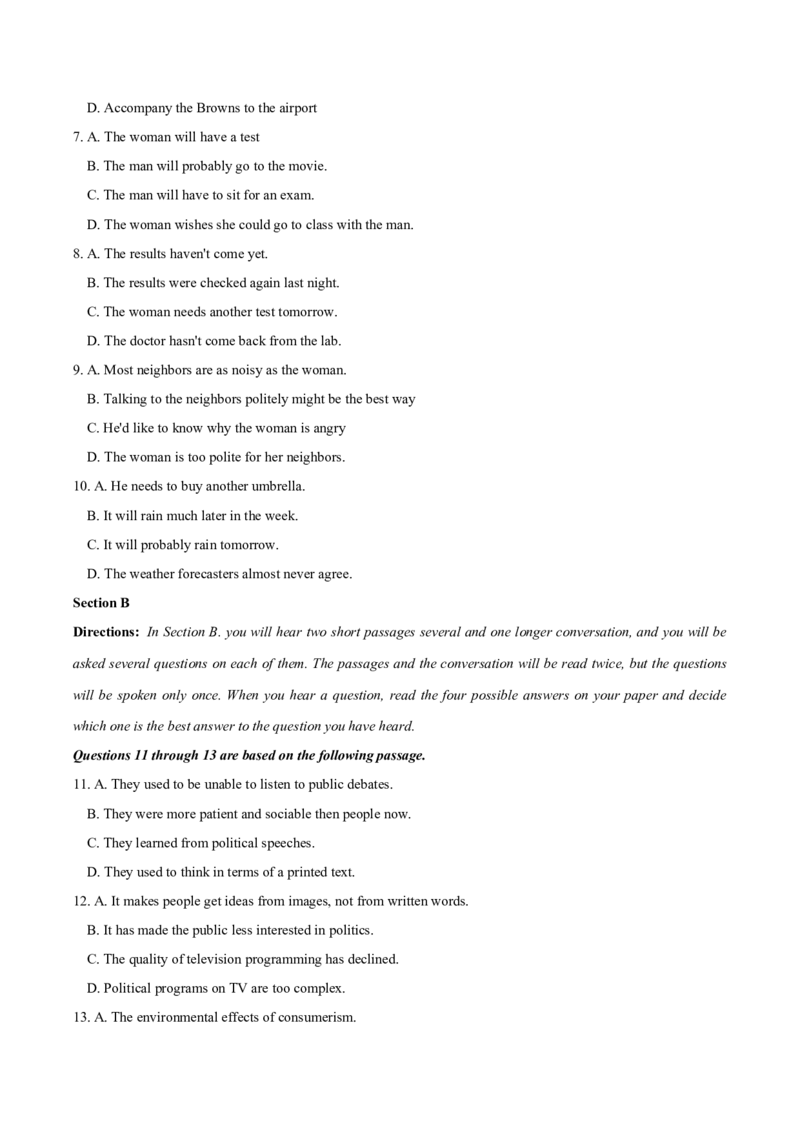
Questions 11 through 13 are based on the following passage.
11. A. They used to be unable to listen to public debates.
B. They were more patient and sociable then people now.
C. They learned from political speeches.
D. They used to think in terms of a printed text.
12. A. It makes people get ideas from images, not from written words.
B. It has made the public less interested in politics.
C. The quality of television programming has declined.
D. Political programs on TV are too complex.
13. A. The environmental effects of consumerism.
B. How consumer culture has made people unreasonable.
C. How television has affected people's thinking ability.
D. Television's damage to the environment
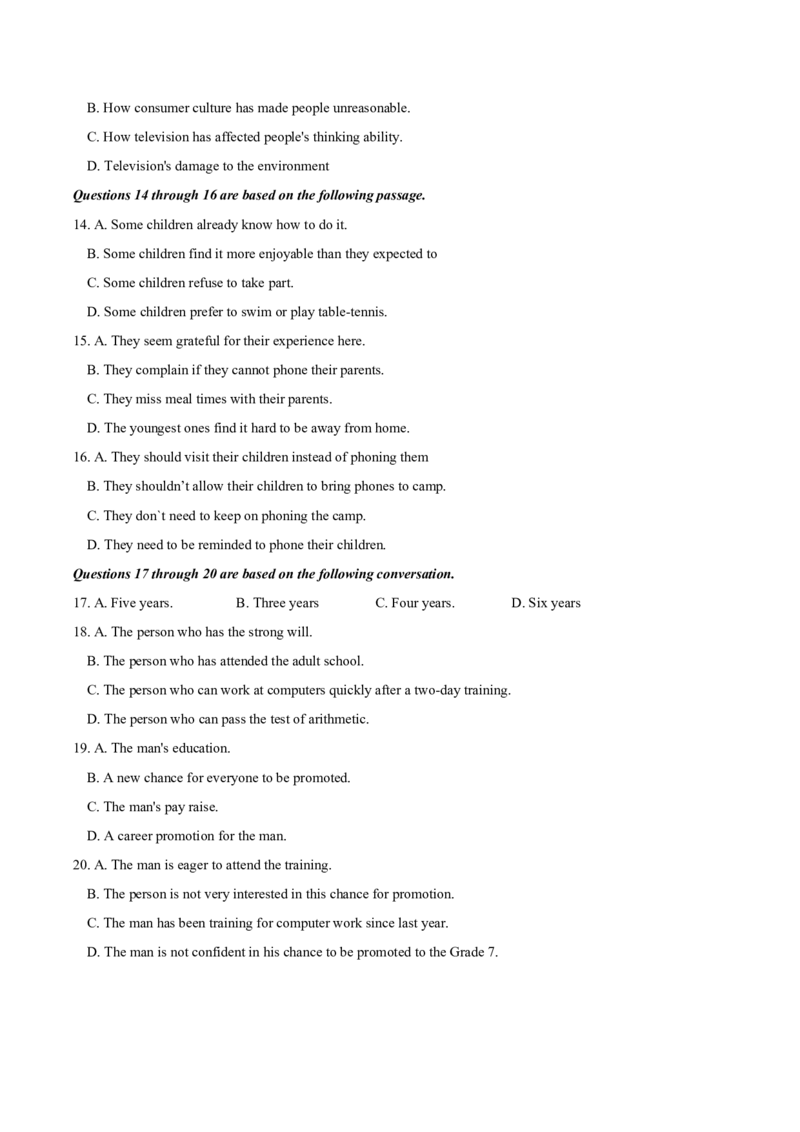
Questions 14 through 16 are based on the following passage.
14. A. Some children already know how to do it.
B. Some children find it more enjoyable than they expected to
C. Some children refuse to take part.
D. Some children prefer to swim or play table-tennis.
15. A. They seem grateful for their experience here.
B. They complain if they cannot phone their parents.
C. They miss meal times with their parents.
D. The youngest ones find it hard to be away from home.
16. A. They should visit their children instead of phoning them
B. They shouldn’t allow their children to bring phones to camp.
C. They don`t need to keep on phoning the camp.
D. They need to be reminded to phone their children.
Questions 17 through 20 are based on the following conversation.
17. A. Five years. B. Three years C. Four years. D. Six years
18. A. The person who has the strong will.
B. The person who has attended the adult school.
C. The person who can work at computers quickly after a two-day training.
D. The person who can pass the test of arithmetic.
19. A. The man's education.
B. A new chance for everyone to be promoted.
C. The man's pay raise.
D. A career promotion for the man.
20. A. The man is eager to attend the training.
B. The person is not very interested in this chance for promotion.
C. The man has been training for computer work since last year.
D. The man is not confident in his chance to be promoted to the Grade 7.
II.
Grammar and Vocabulary (每题1 分;共20 分)
Section A
Directions: After reading the passage below, fill in the blanks to make the passage coherent and grammatically
correct. For the blanks with a given word, fill in each blank with the proper form of the given word; for the other
blanks, use one word that best fits each blank.
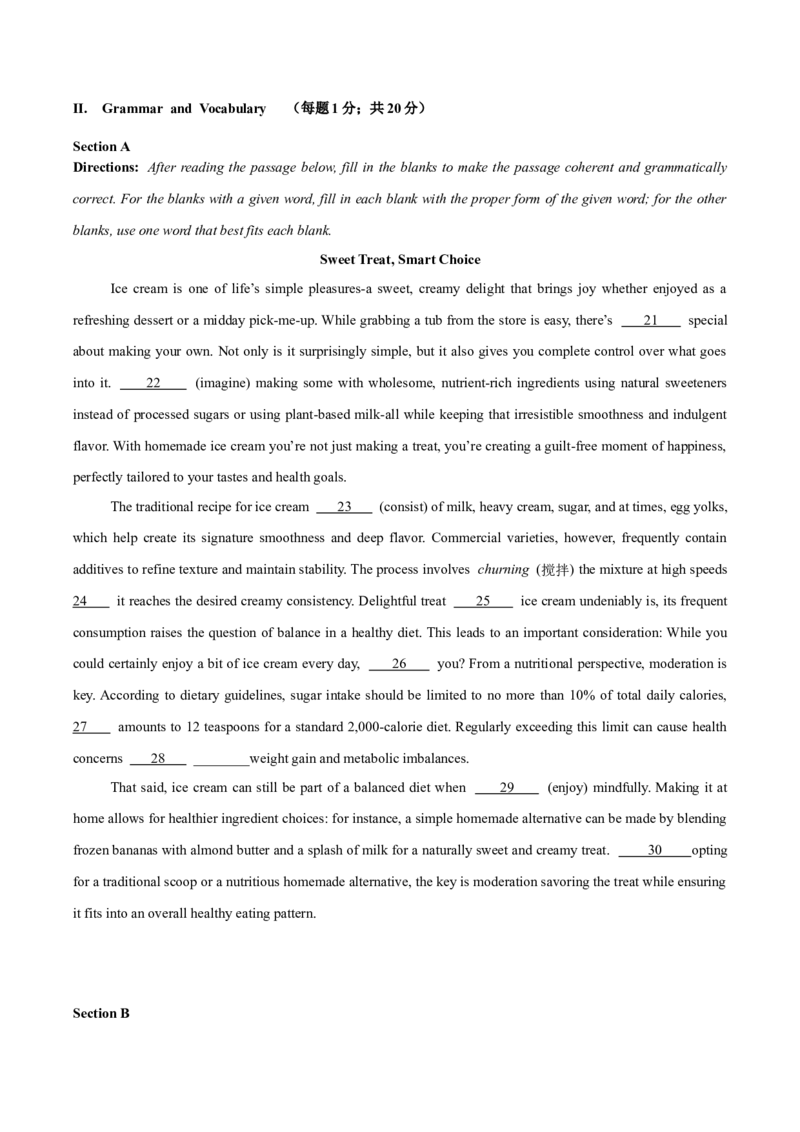
Sweet Treat, Smart Choice
Ice cream is one of life’s simple pleasures-a sweet, creamy delight that brings joy whether enjoyed as a
refreshing dessert or a midday pick-me-up. While grabbing a tub from the store is easy, there’s 21 special
about making your own. Not only is it surprisingly simple, but it also gives you complete control over what goes
into it. 22 (imagine) making some with wholesome, nutrient-rich ingredients using natural sweeteners
instead of processed sugars or using plant-based milk-all while keeping that irresistible smoothness and indulgent
flavor. With homemade ice cream you’re not just making a treat, you’re creating a guilt-free moment of happiness,
perfectly tailored to your tastes and health goals.
The traditional recipe for ice cream 23 (consist) of milk, heavy cream, sugar, and at times, egg yolks,
which help create its signature smoothness and deep flavor. Commercial varieties, however, frequently contain
additives to refine texture and maintain stability. The process involves churning (搅拌) the mixture at high speeds
24 it reaches the desired creamy consistency. Delightful treat 25 ice cream undeniably is, its frequent
consumption raises the question of balance in a healthy diet. This leads to an important consideration: While you
could certainly enjoy a bit of ice cream every day, 26 you? From a nutritional perspective, moderation is
key. According to dietary guidelines, sugar intake should be limited to no more than 10% of total daily calories,
27 amounts to 12 teaspoons for a standard 2,000-calorie diet. Regularly exceeding this limit can cause health
concerns 28 ________weight gain and metabolic imbalances.
That said, ice cream can still be part of a balanced diet when 29 (enjoy) mindfully. Making it at
home allows for healthier ingredient choices: for instance, a simple homemade alternative can be made by blending
frozen bananas with almond butter and a splash of milk for a naturally sweet and creamy treat. 30 opting
for a traditional scoop or a nutritious homemade alternative, the key is moderation savoring the treat while ensuring
it fits into an overall healthy eating pattern.
Section B
Directions: Fill in each blank with a proper word chosen from the box. Each word can be used only once. Note
that there is one word more than you need.
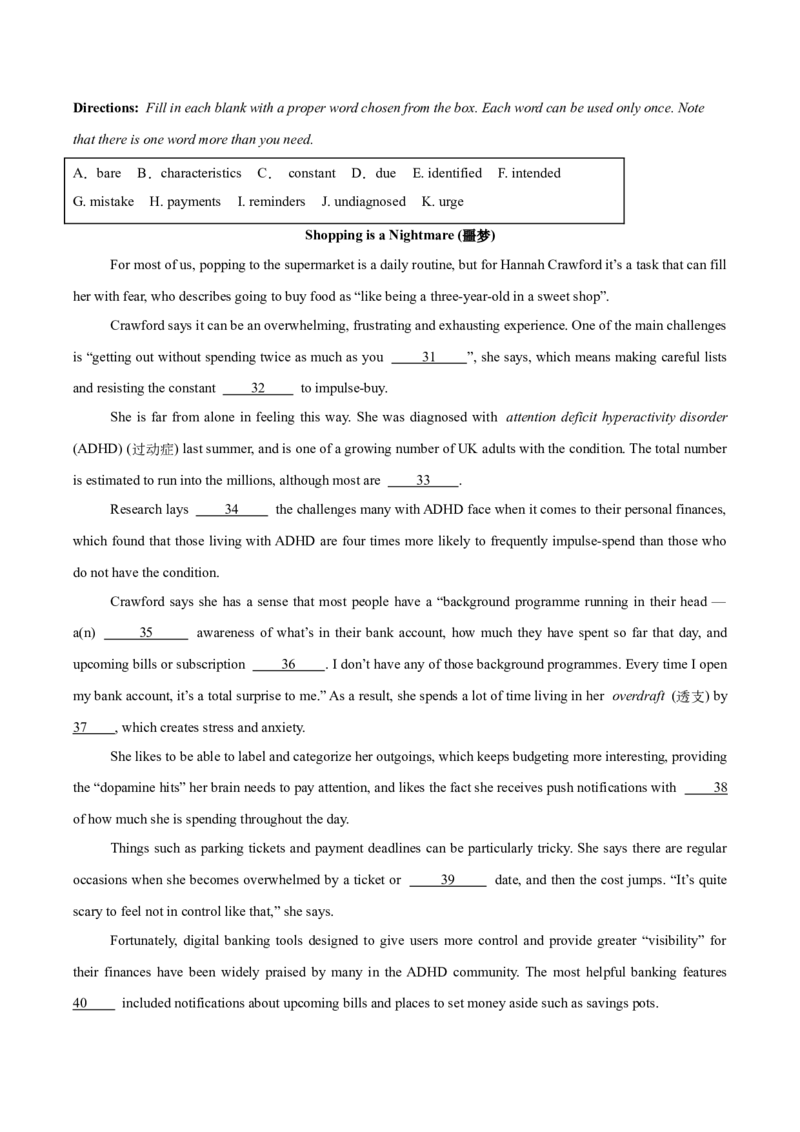
A.bare B.characteristics C. constant D.due E. identified F. intended
G. mistake H. payments I. reminders J. undiagnosed K. urge
Shopping is a Nightmare (噩梦)
For most of us, popping to the supermarket is a daily routine, but for Hannah Crawford it’s a task that can fill
her with fear, who describes going to buy food as “like being a three-year-old in a sweet shop”.
Crawford says it can be an overwhelming, frustrating and exhausting experience. One of the main challenges
is “getting out without spending twice as much as you 31 ”, she says, which means making careful lists
and resisting the constant 32 to impulse-buy.
She is far from alone in feeling this way. She was diagnosed with attention deficit hyperactivity disorder
(ADHD) (过动症) last summer, and is one of a growing number of UK adults with the condition. The total number
is estimated to run into the millions, although most are 33 .
Research lays 34 the challenges many with ADHD face when it comes to their personal finances,
which found that those living with ADHD are four times more likely to frequently impulse-spend than those who
do not have the condition.
Crawford says she has a sense that most people have a “background programme running in their head —
a(n) 35 awareness of what’s in their bank account, how much they have spent so far that day, and
upcoming bills or subscription 36 . I don’t have any of those background programmes. Every time I open
my bank account, it’s a total surprise to me.” As a result, she spends a lot of time living in her overdraft (透支) by
37 , which creates stress and anxiety.
She likes to be able to label and categorize her outgoings, which keeps budgeting more interesting, providing
the “dopamine hits” her brain needs to pay attention, and likes the fact she receives push notifications with 38
of how much she is spending throughout the day.
Things such as parking tickets and payment deadlines can be particularly tricky. She says there are regular
occasions when she becomes overwhelmed by a ticket or 39 date, and then the cost jumps. “It’s quite
scary to feel not in control like that,” she says.
Fortunately, digital banking tools designed to give users more control and provide greater “visibility” for
their finances have been widely praised by many in the ADHD community. The most helpful banking features
40 included notifications about upcoming bills and places to set money aside such as savings pots.
III.
Reading Comprehension (41 – 55 题,每题1 分;56 – 70 题,每题2 分;共45 分)
Section A
Directions: For each blank in the following passage there are four words or phrases marked A, B, C and D.
Fill in each blank with the word or phrase that best fits the context.
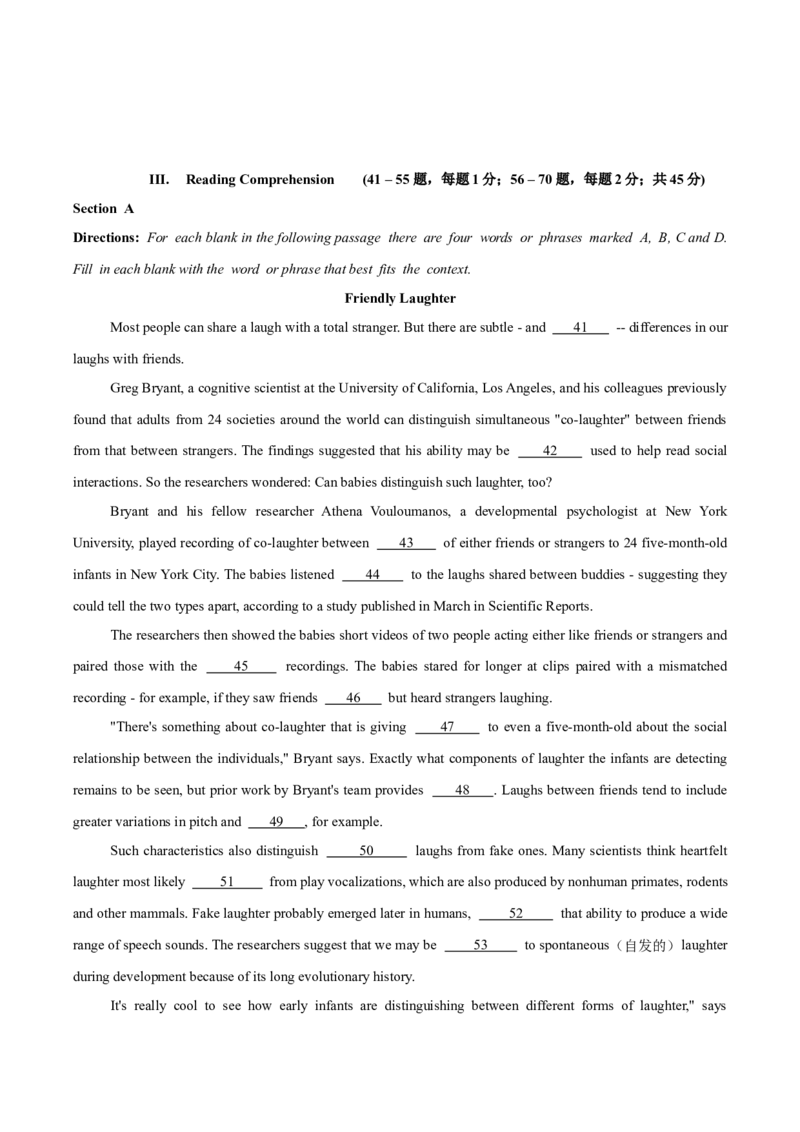
Friendly Laughter
Most people can share a laugh with a total stranger. But there are subtle - and 41 -- differences in our
laughs with friends.
Greg Bryant, a cognitive scientist at the University of California, Los Angeles, and his colleagues previously
found that adults from 24 societies around the world can distinguish simultaneous "co-laughter" between friends
from that between strangers. The findings suggested that his ability may be 42 used to help read social
interactions. So the researchers wondered: Can babies distinguish such laughter, too?
Bryant and his fellow researcher Athena Vouloumanos, a developmental psychologist at New York
University, played recording of co-laughter between 43 of either friends or strangers to 24 five-month-old
infants in New York City. The babies listened 44 to the laughs shared between buddies - suggesting they
could tell the two types apart, according to a study published in March in Scientific Reports.
The researchers then showed the babies short videos of two people acting either like friends or strangers and
paired those with the 45 recordings. The babies stared for longer at clips paired with a mismatched
recording - for example, if they saw friends 46 but heard strangers laughing.
"There's something about co-laughter that is giving 47 to even a five-month-old about the social
relationship between the individuals," Bryant says. Exactly what components of laughter the infants are detecting
remains to be seen, but prior work by Bryant's team provides 48 . Laughs between friends tend to include
greater variations in pitch and 49 , for example.
Such characteristics also distinguish 50 laughs from fake ones. Many scientists think heartfelt
laughter most likely 51 from play vocalizations, which are also produced by nonhuman primates, rodents
and other mammals. Fake laughter probably emerged later in humans, 52 that ability to produce a wide
range of speech sounds. The researchers suggest that we may be 53 to spontaneous(自发的)laughter
during development because of its long evolutionary history.
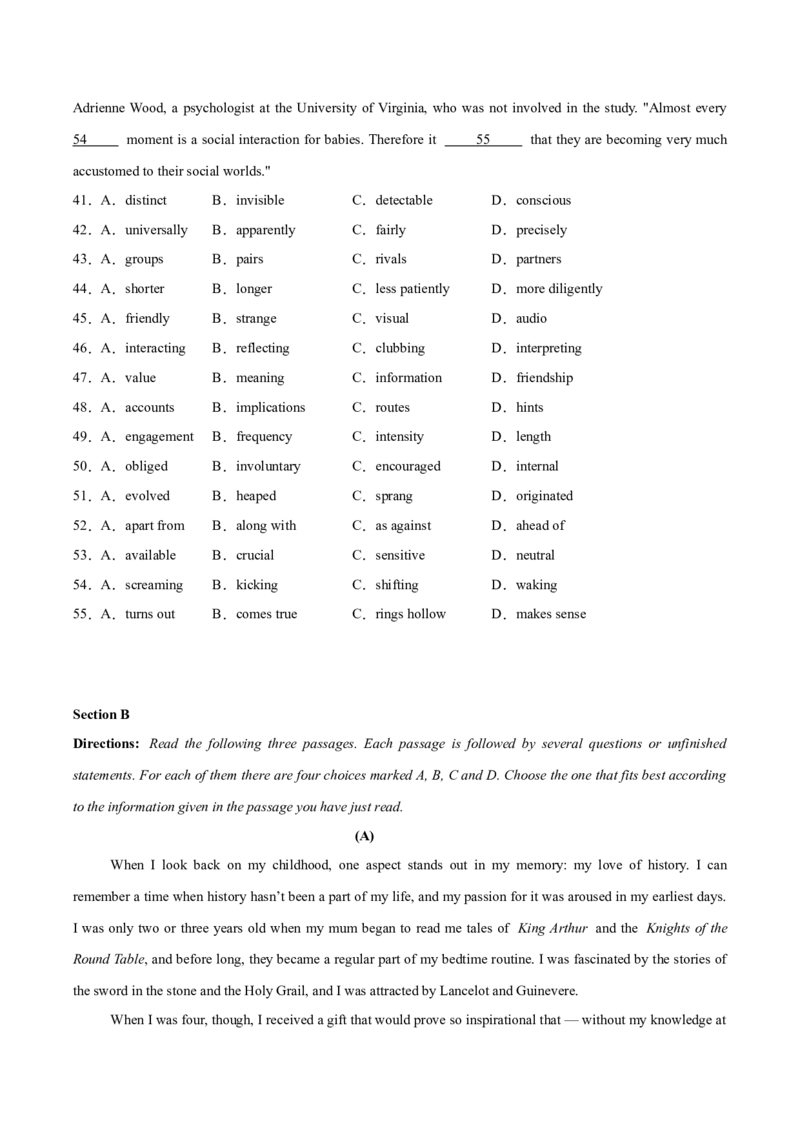
It's really cool to see how early infants are distinguishing between different forms of laughter," says
Adrienne Wood, a psychologist at the University of Virginia, who was not involved in the study. "Almost every
54 moment is a social interaction for babies. Therefore it 55 that they are becoming very much
accustomed to their social worlds."
41.A.distinct
B.invisible
C.detectable
D.conscious
42.A.universally
B.apparently
C.fairly
D.precisely
43.A.groups
B.pairs
C.rivals
D.partners
44.A.shorter
B.longer
C.less patiently
D.more diligently
45.A.friendly
B.strange
C.visual
D.audio
46.A.interacting
B.reflecting
C.clubbing
D.interpreting
47.A.value
B.meaning
C.information
D.friendship
48.A.accounts
B.implications
C.routes
D.hints
49.A.engagement
B.frequency
C.intensity
D.length
50.A.obliged
B.involuntary
C.encouraged
D.internal
51.A.evolved
B.heaped
C.sprang
D.originated
52.A.apart from
B.along with
C.as against
D.ahead of
53.A.available
B.crucial
C.sensitive
D.neutral
54.A.screaming
B.kicking
C.shifting
D.waking
55.A.turns out
B.comes true
C.rings hollow
D.makes sense
Section B
Directions: Read the following three passages. Each passage is followed by several questions or unfinished
statements. For each of them there are four choices marked A, B, C and D. Choose the one that fits best according
to the information given in the passage you have just read.
(A)
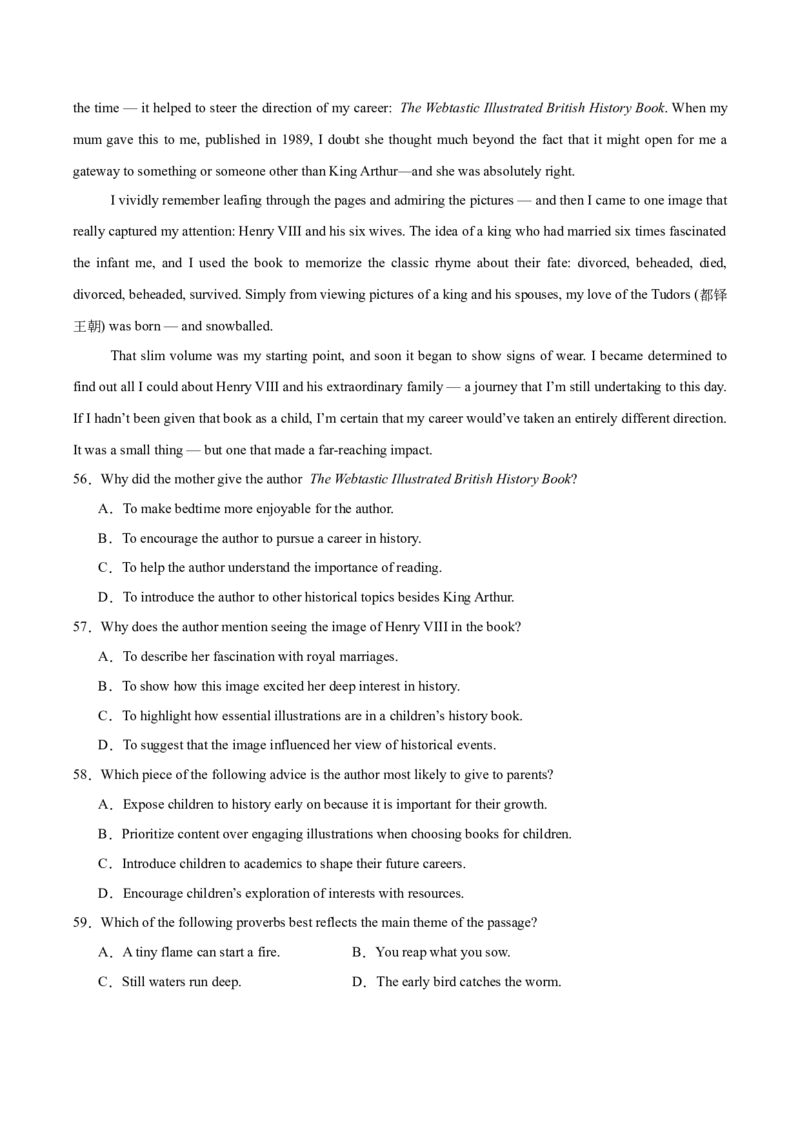
When I look back on my childhood, one aspect stands out in my memory: my love of history. I can
remember a time when history hasn’t been a part of my life, and my passion for it was aroused in my earliest days.
I was only two or three years old when my mum began to read me tales of King Arthur and the Knights of the
Round Table, and before long, they became a regular part of my bedtime routine. I was fascinated by the stories of
the sword in the stone and the Holy Grail, and I was attracted by Lancelot and Guinevere.
When I was four, though, I received a gift that would prove so inspirational that — without my knowledge at
the time — it helped to steer the direction of my career: The Webtastic Illustrated British History Book. When my
mum gave this to me, published in 1989, I doubt she thought much beyond the fact that it might open for me a
gateway to something or someone other than King Arthur—and she was absolutely right.
I vividly remember leafing through the pages and admiring the pictures — and then I came to one image that
really captured my attention: Henry VIII and his six wives. The idea of a king who had married six times fascinated
the infant me, and I used the book to memorize the classic rhyme about their fate: divorced, beheaded, died,
divorced, beheaded, survived. Simply from viewing pictures of a king and his spouses, my love of the Tudors (都铎
王朝) was born — and snowballed.
That slim volume was my starting point, and soon it began to show signs of wear. I became determined to
find out all I could about Henry VIII and his extraordinary family — a journey that I’m still undertaking to this day.
If I hadn’t been given that book as a child, I’m certain that my career would’ve taken an entirely different direction.
It was a small thing — but one that made a far-reaching impact.
56.Why did the mother give the author The Webtastic Illustrated British History Book?
A.To make bedtime more enjoyable for the author.
B.To encourage the author to pursue a career in history.
C.To help the author understand the importance of reading.
D.To introduce the author to other historical topics besides King Arthur.
57.Why does the author mention seeing the image of Henry VIII in the book?
A.To describe her fascination with royal marriages.
B.To show how this image excited her deep interest in history.
C.To highlight how essential illustrations are in a children’s history book.
D.To suggest that the image influenced her view of historical events.
58.Which piece of the following advice is the author most likely to give to parents?
A.Expose children to history early on because it is important for their growth.
B.Prioritize content over engaging illustrations when choosing books for children.
C.Introduce children to academics to shape their future careers.
D.Encourage children’s exploration of interests with resources.
59.Which of the following proverbs best reflects the main theme of the passage?
A.A tiny flame can start a fire.
B.You reap what you sow.
C.Still waters run deep.
D.The early bird catches the worm.
(B)
If you have no difficulty in understanding what native English speakers say in daily life, there is a whole
new world of brilliant podcast (播客) series to explore. If you aren’t sure where to start, have a look at these:
The Joc Rogan Experience ★★★★★
The Joc Rogan Experience is a great learning device
because of its interesting English conversations between Rogan
and his guests. At the time of writing there have been over 1,660
episodes with subjects ranging from comedy and science to politics
and sports. Rogan is also a famous stand-up comedian, so the show
is full of cultural references and idioms.
This American Life ★★★★★
This American Life is a great choice for English learners
who want an insight into the culture of the USA.It is a mixture of
journalism and storytelling, focusing on real-life tales from citizens
of all regions of the country. The stories are new and varied. One
episode was taped for 24 hours in an all-night restaurant; another
interviewed workers on strike.
The Writer's Voice ★★★★☆
The New Yorker is a famous American magazine, and every
week it prints a new short story. In this podcast, the week's story is
read aloud by its writer. The published work covers a wide range of
life experiences across the United States and beyond. It's a great
way to enjoy some of the best new fiction in the country.
Overheard at National Geographic ★★★★★
National Geographic is a much-loved American magazine
(and TV channel) famous for incredible stories and photography
related to science and the environment. Overheard is about the
discussions Nat Geo employees have had while taking breaks.
Expect crazy stories from explorers, photographers, and scientists
from around the world.
60.In order to fully enjoy these podcasts, you should________.
A.have interaction with hosts
B.have good English competence
C.be interested in being a podcaster
D.be familiar with American social life
61.Which podcast gives you more stories behind the scene?
A.The Writer's Voice.
B.This American Life.
C.The Joe Rogan Experience.
D.Overheard at National Geographic.
62.What do these podcasts have in common?
A.They enjoy great popularity.
B.Their stories are set in America.
C.They are attached to magazines.
D.Their works are updated weekly.
(C
Scientists know little about how sharks came to exist because of the way their skeletons are made. Sharks
have skeletons (骨骼) mostly made of cartilage, a soft and flexible material that doesn’t fossilize (成为化石) well.
As a result, sharks don’t leave clear remains like animals with hard bones. This means that shark skeletons don’t
leave behind the same clear, lasting remains as animals with bony skeletons. “Cartilage is a tricky material,”
explains John Maisey, a scientist at the American Museum of Natural History in New York. For centuries, scientists
have tried to piece together the history of sharks but could only make educated guesses that sharks might have
come from fish with actual bones.
However, a recent breakthrough has opened up new possibilities for understanding where sharks came from.
Using advanced CT scanning technology, Maisey and his team examined the only known fossil of an ancient fish
called Doliodus problematicus. This fossil is 400 million years old and was first discovered in the mid-1990s in
Canada. For years, researchers could only study it from the outside, but in 2014, new CT scanning technology
allowed them to look deeper into its structure without damaging it. What they found could be a missing link in the
shark evolution puzzle.
The scan revealed surprising details. Unlike modern sharks, which are smooth and lack external spines (棘
刺), the Doliodus fossil had spines along its back and near its lower body. These spines were similar to those found
in an older type of fish with both bony and shark-like characteristics. It also had jaws and teeth like those of
modern sharks, showing a mix of features from early bony fish and today’s sharks. This makes Doliodus an
important connection between two groups of fish, offering new clues about shark evolution.
“This is a major discovery,” says Michael Coates, an evolutionary biologist at the University of Chicago.
Coates believes that these findings support the idea that acanthodians, the ancient group with both bony and shark-
like characteristics, could represent an important step in the early development of sharks. Maisey’s research
encourages scientists to revisit acanthodians, an extinct group of fish with both bony and shark-like features. These
ancient creatures are thought to represent a transitional stage in fish evolution, potentially reshaping what we know
about the origins of sharks.
63.Main Idea: What is the passage primarily about?
A.Finding a new shark species with advanced technology.
B.The role of sharks in the extinction of ancient fish species.
C.An important discovery in understanding how sharks evolved.
D.Efforts to uncover the origins of sharks through fossil research.
64.Why is it tricky to study the evolution of sharks?
A.Their skeletons rarely endure over time.
B.Their remains are hard to find in ancient rock layers.
C.Their evolutionary history is too recent to be understood.
D.Their bones have been confused with those of other fish species.
65.What is the significance of the Doliodus problematicus fossil?
A.It confirms that sharks evolved mainly from acanthodians.
B.It suggests that ancient sharks lacked both jaws and spines.
C.It proves that sharks are directly related to modern bony fish.
D.It shows a connection between early bony fish and modern sharks.
66.How is the passage organized?
A.By describing several fossils before focusing on Doliodus.
B.By comparing features of sharks and acanthodians in detail.
C.By explaining the difficulties in studying sharks and sharing new findings.
D.By summarizing past research on ancient fish without introducing new insights.
Section C
Directions: Read the following passages. Fill in each blank with a proper sentence given in the box. Each
sentence can be used only once. Note that there are two more sentences than you need.
Why California is burning
For decades, environmentalists have warned that the world is going to burn. Mostly, they meant it
figuratively. But footage (影像片段) of fires sweeping through the Amazon forest, parts of Australia and now, once
again, California, makes it easy to believe the planet is, literally, on fire. So far this year, California has seen more
than 2.5m acres burned and more than 3,700 structures destroyed. With over three months remaining of this year's
fire season, few doubt the state is facing its worst yet.
The fires themselves cannot be stopped; they are fueled by climate change layered on top of an ecosystem
that burns regularly as part of its natural cycle. Hotter temperatures and drier landscapes mean more fires. 6
7
. It has made itself more vulnerable with out-of-date regulations and self-defeating policies.
California does deserve credit for being the only American state to have adopted fire-safe building codes for
what is known as the “wildland-urban interface”, where houses are sparsely dotted through tall, flammable ( 易燃
的) trees and vegetation, often on steep slopes that flames can race up. Evidence suggests the codes do help limit
damage. However, they apply only to new structures. 6
8
. Nor are there subsidies or other motivations to
nudge people and firms to take on the heavy, complicated and expensive task of making buildings safe.
Furthermore, the codes date back to 2008 and have not yet been updated to include the latest science on why
buildings burn. 6
9
. Today, landscapers can still draw up designs where bark mulch — an almost perfect
fuel — is laid down around a home, office, or even hospital.
Fire-risk maps and zoning, which determine who must follow building codes, are in desperate need of a
rethink. Among other things, they consider urbanized areas “unburnable”, which ignores science showing that the
majority of buildings catch fire when flying embers ( 余烬) are blown a mile or more away from the flaming
vegetation.
70
. When Coffey Park in Santa Rosa was destroyed by wildfire in 2017, the city vowed to
rebuild better, but it hesitated because of unfounded fears that being fire-safe would be a lot more costly. Strict fire
codes were not enforced, and the community once more had to evacuate during a fire in 2019 rather than shelter-in-
place.
No wonder California is caught in a burn-rebuild-burn-again cycle. The fires are not going away. But if state
leaders rethought their misguided policies, they would at least wreak less havoc.
A.However, much of California’s mess nowadays is of its-own-making.
B.They also do nothing about the need to improve most of the existing houses and other properties.
C.California has failed to encourage homeowners to move out of the most dangerous areas.
D.As a result, communities that are at risk from wildfires are not held to fire-safety rules — sometimes with very
serious consequences.
E.On September 7th, a utility serving northern California shut off the power supply to tens of thousands of
homes.
F.That includes strong evidence that the first five feet around a structure are key to its defense but all too often
consist of flammable materials.
IV. Summary Writing (10 分)
Directions: Read the following passage. Summarize the main idea and the main point(s) of the passage in no more
than 60 words. Use your own words as far as possible.
How Ants May Save You from Traffic Jams
The free flow of traffic becomes unstable as the density of cars increases on a highway. At 15 vehicles per
mile per lane, one driver tapping their brakes can trigger a persistent wave of congestion “It’s a kind of phase
transition,” like water turning from a liquid to a solid form, says Katsuhiro Nishinari, a physicist at the University
of Tokyo, who studies these jamming transitions.
Nishinari’s previous research had shown that foraging (觅食的) ants can maintain their flow even at high
densities. In a recent study, researchers recorded Ochetellus ants on foraging trails and used traffic-engineering
models to analyze their movement. They found that the ants don’t jam because they travel in groups of three to 20
that move at nearly constant rates while keeping good distances between one another — and they don’t speed up to
pass others. Self-driving cars, if they one day become common, could have more cooperative programming. In one
vision of this future, autonomous vehicles would share information with nearby cars to optimize traffic flow
perhaps, the researchers suggests, by prioritizing constant speeds or by not passing others on the road. “There is no
leader,” but this organization emerges anyway. And in both ant and vehicle traffic this type of distributed system
can be “very, very strong” and resilient, Nishinari says.
“Still, ants can forge trails as wide as they like, unlike drivers stuck on highways. The insects do sometimes
jam up when confined in tunnels, but to keep things moving, they’ll find a way to walk on the ceiling” she says.
Today’s drivers can learn at least one thing from ants to avoid causing a traffic jam, Nishinari says: don’t
drive too closely behind another vehicle. By leaving room between their car and the one ahead of them, drivers can
absorb a wave of braking in dense traffic conditions that would otherwise be amplified ( 放大) into a full-blown
“phantom” traffic jam with no obvious cause. “Just keeping away,” he says, can help traffic flow smoothly.
71.__________________________________________________________________________________________
____________________________________________________________________________________________
____________________________________________________________________________________________
____________________________________________________________________________________________
____________________________________________________________________________________________
__
V. Translation (第1-2 句,每句3 分;第3 句,4 分;第4 句5 分;共15 分)
Directions: Translate the following sentences into English, using the words given in the brackets.
72 数字化工具在建筑行业的应用越来越广泛。(there be)
73.在这张导览图上,十几种便民服务用不同颜色标注了出来。(mark)
74 来自全国各地的选手在空中放飞风筝,争相展示他们的风筝技艺和创新风格。(display)
75 既要让森林与城市融合,更要让市民充分参与并享受绿色城市的氛围,与自然和谐共生。(It)
VI. Guided Writing (25 分)
Directions: Write an English composition in 120-150 words according to the instructions given below in Chinese.
76.Directions: Write an English composition in 120-150 words according to the instructions given below in
Chinese.
学校科技节将举办“青少年数字素养”主题论坛(Forum on Teenage Digital Literacy),请作为高三年级的
张明写一篇演讲稿:
1.结合一次个人经历,谈谈数字技术带来的便利;
2.分享一条你认为重要的网络信息辨别方法。
____________________________________________________________________________________________
____________________________________________________________________________________________
____________________________________________________________________________________________
____________________________________________________________________________________________
___________________________