【灿烂六月·高考金8 卷】
备战2026 年高考英语模拟卷(上海卷04)
(笔试部分:115 分)
II.
Grammar and Vocabulary   (每题1 分;共20 分)
Section A
Directions: After reading the passage below, fill in the blanks to make the passage coherent and
grammatically correct. For the blanks with a given word, fill in each blank with the proper form of
the given word; for the other blanks, use one word that best fits each blank.
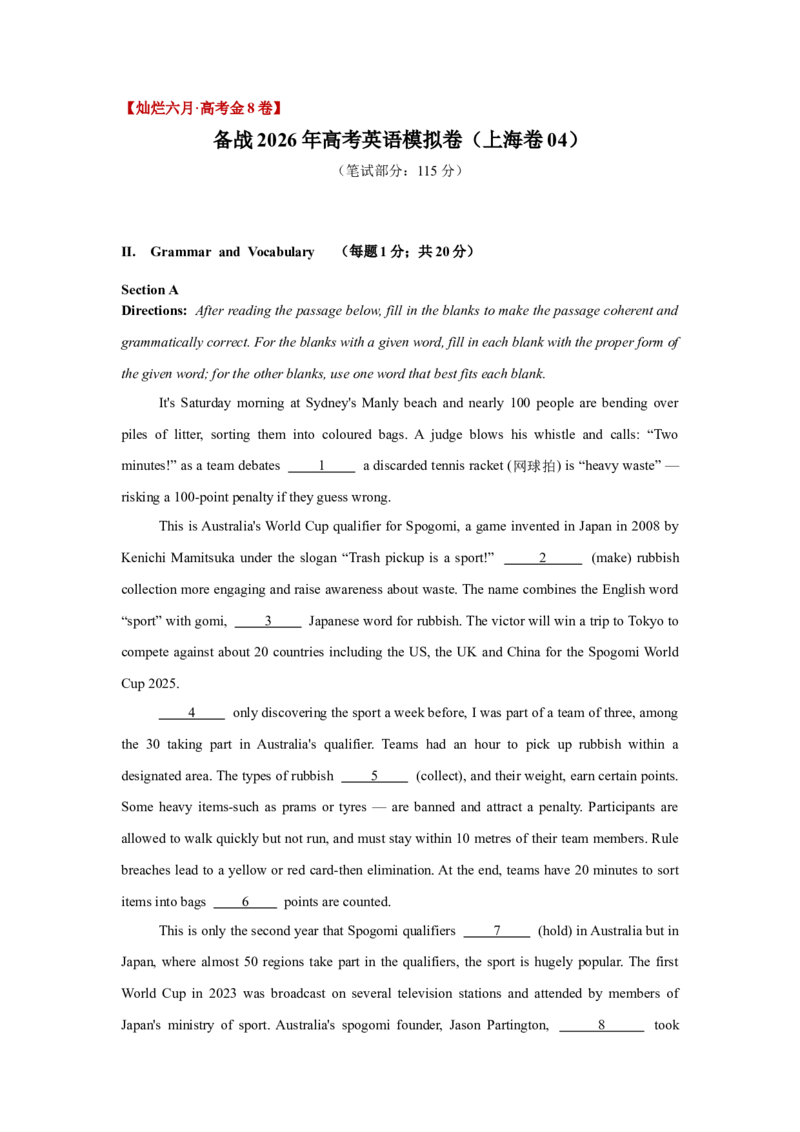
It's Saturday morning at Sydney's Manly beach and nearly 100 people are bending over
piles of litter, sorting them into coloured bags. A judge blows his whistle and calls: “Two
minutes!” as a team debates     1     a discarded tennis racket (网球拍) is “heavy waste” —
risking a 100-point penalty if they guess wrong.
This is Australia's World Cup qualifier for Spogomi, a game invented in Japan in 2008 by
Kenichi Mamitsuka under the slogan “Trash pickup is a sport!”     2     (make) rubbish
collection more engaging and raise awareness about waste. The name combines the English word
“sport” with gomi,     3     Japanese word for rubbish. The victor will win a trip to Tokyo to
compete against about 20 countries including the US, the UK and China for the Spogomi World
Cup 2025.
    4     only discovering the sport a week before, I was part of a team of three, among
the 30 taking part in Australia's qualifier. Teams had an hour to pick up rubbish within a
designated area. The types of rubbish     5     (collect), and their weight, earn certain points.
Some heavy items-such as prams or tyres — are banned and attract a penalty. Participants are
allowed to walk quickly but not run, and must stay within 10 metres of their team members. Rule
breaches lead to a yellow or red card-then elimination. At the end, teams have 20 minutes to sort
items into bags     6     points are counted.
This is only the second year that Spogomi qualifiers     7     (hold) in Australia but in
Japan, where almost 50 regions take part in the qualifiers, the sport is hugely popular. The first
World Cup in 2023 was broadcast on several television stations and attended by members of
Japan's ministry of sport. Australia's spogomi founder, Jason Partington,     8     took
Australia's winners to Tokyo, says the sport is “only going to get bigger” here. “It was crazy,” he
says of the 2023 event. “It was like being in the Olympics . . . it was incredible.”
To Partington,     9     is dressed up as a fun event is about raising environmental
awareness. “We know 80% of litter that ends up in the ocean comes from the land, so the more we
can get people aware     10     instead of walking past rubbish, you should pick it up, the
better,” he said. “There will be hundreds of kilograms of stuff that we've collected today.”
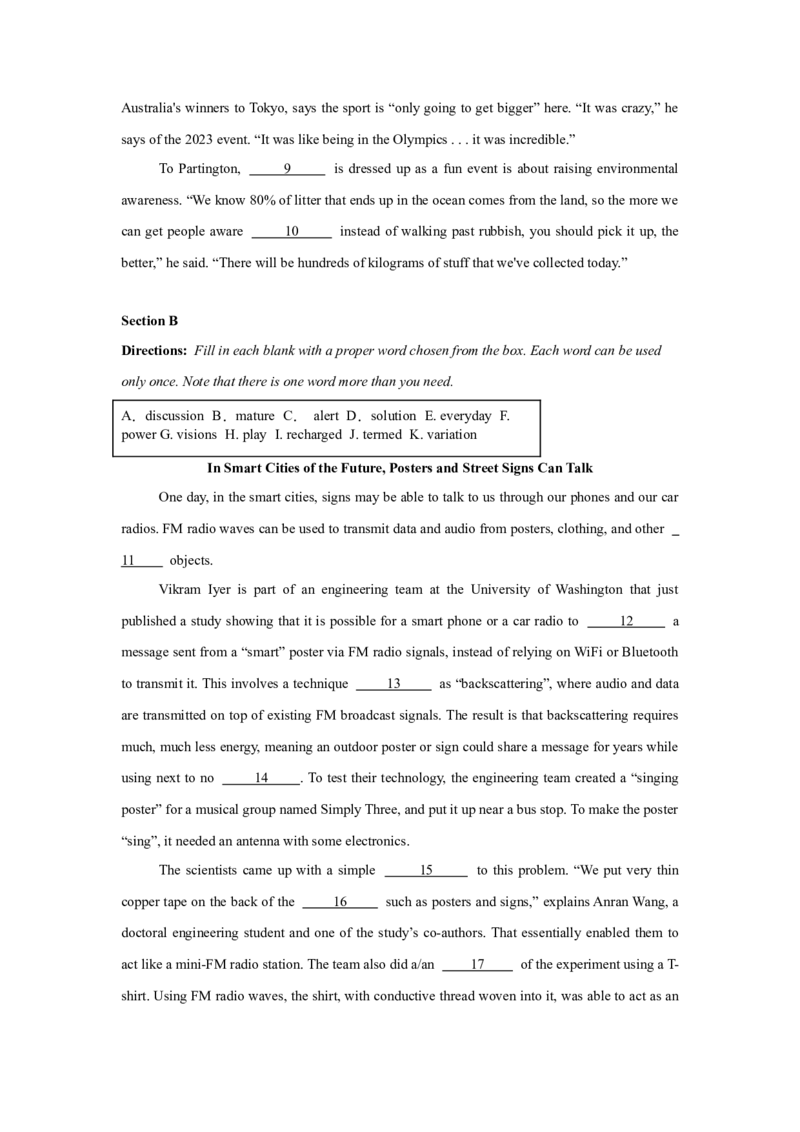
Section B
Directions: Fill in each blank with a proper word chosen from the box. Each word can be used
only once. Note that there is one word more than you need.
A.discussion  B.mature  C. alert  D.solution  E. everyday  F.
power G. visions  H. play  I. recharged  J. termed  K. variation
In Smart Cities of the Future, Posters and Street Signs Can Talk
One day, in the smart cities, signs may be able to talk to us through our phones and our car
radios. FM radio waves can be used to transmit data and audio from posters, clothing, and other
11     objects.
Vikram Iyer is part of an engineering team at the University of Washington that just
published a study showing that it is possible for a smart phone or a car radio to     12     a
message sent from a “smart” poster via FM radio signals, instead of relying on WiFi or Bluetooth
to transmit it. This involves a technique     13     as “backscattering”, where audio and data
are transmitted on top of existing FM broadcast signals. The result is that backscattering requires
much, much less energy, meaning an outdoor poster or sign could share a message for years while
using next to no     14    . To test their technology, the engineering team created a “singing
poster” for a musical group named Simply Three, and put it up near a bus stop. To make the poster
“sing”, it needed an antenna with some electronics.
The scientists came up with a simple     15     to this problem. “We put very thin
copper tape on the back of the     16     such as posters and signs,” explains Anran Wang, a
doctoral engineering student and one of the study’s co-authors. That essentially enabled them to
act like a mini-FM radio station. The team also did a/an     17     of the experiment using a T-
shirt. Using FM radio waves, the shirt, with conductive thread woven into it, was able to act as an
antenna and transmit data to a smartphone. That showed that clothing could be used with sensors
to monitor a person’s vital signs and didn’t need to be constantly     18    .
The scientists were primarily focused on proof of concept, and they appear to be the first
research team to prove this method of tapping into existing radio signals can work. Iyer thinks the
technology is still not     19    . How it might ultimately be used is open to      20     ,
but he believes there are plenty of possibilities beyond promoting music groups.
III.
Reading Comprehension    (41 – 55 题,每题1 分;56 – 70 题,每题2
分;共45 分)
Section A
Directions: For each blank in the following passage there are four words or phrases marked
A, B, C and D. Fill in each blank with the word or phrase that best fits the context.
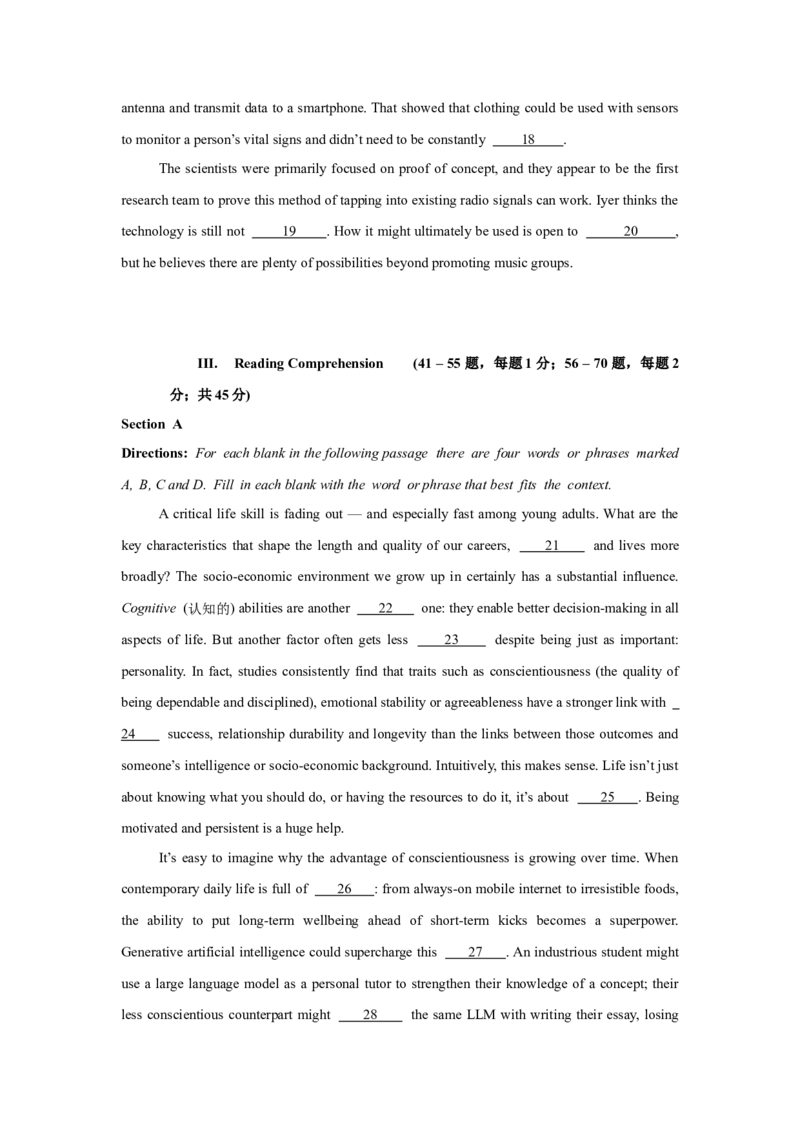
A critical life skill is fading out — and especially fast among young adults. What are the
key characteristics that shape the length and quality of our careers,    21    and lives more
broadly? The socio-economic environment we grow up in certainly has a substantial influence.
Cognitive (认知的) abilities are another    22    one: they enable better decision-making in all
aspects of life. But another factor often gets less    23    despite being just as important:
personality. In fact, studies consistently find that traits such as conscientiousness (the quality of
being dependable and disciplined), emotional stability or agreeableness have a stronger link with
24    success, relationship durability and longevity than the links between those outcomes and
someone’s intelligence or socio-economic background. Intuitively, this makes sense. Life isn’t just
about knowing what you should do, or having the resources to do it, it’s about    25   . Being
motivated and persistent is a huge help.
It’s easy to imagine why the advantage of conscientiousness is growing over time. When
contemporary daily life is full of    26   : from always-on mobile internet to irresistible foods,
the ability to put long-term wellbeing ahead of short-term kicks becomes a superpower.
Generative artificial intelligence could supercharge this    27   . An industrious student might
use a large language model as a personal tutor to strengthen their knowledge of a concept; their
less conscientious counterpart might    28    the same LLM with writing their essay, losing
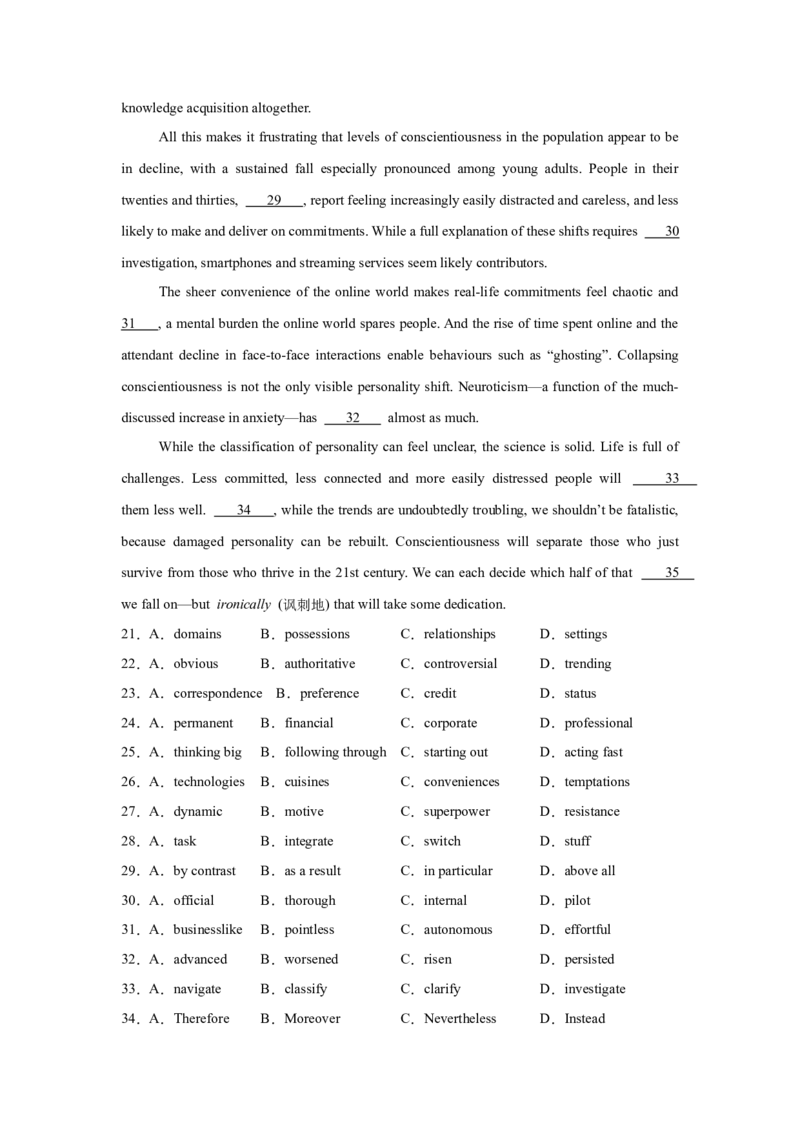
knowledge acquisition altogether.
All this makes it frustrating that levels of conscientiousness in the population appear to be
in decline, with a sustained fall especially pronounced among young adults. People in their
twenties and thirties,    29   , report feeling increasingly easily distracted and careless, and less
likely to make and deliver on commitments. While a full explanation of these shifts requires    30
investigation, smartphones and streaming services seem likely contributors.
The sheer convenience of the online world makes real-life commitments feel chaotic and
31   , a mental burden the online world spares people. And the rise of time spent online and the
attendant decline in face-to-face interactions enable behaviours such as “ghosting”. Collapsing
conscientiousness is not the only visible personality shift. Neuroticism—a function of the much-
discussed increase in anxiety—has    32    almost as much.
While the classification of personality can feel unclear, the science is solid. Life is full of
challenges. Less committed, less connected and more easily distressed people will    33
them less well.    34   , while the trends are undoubtedly troubling, we shouldn’t be fatalistic,
because damaged personality can be rebuilt. Conscientiousness will separate those who just
survive from those who thrive in the 21st century. We can each decide which half of that    35
we fall on—but ironically (讽刺地) that will take some dedication.
21.A.domains
B.possessions
C.relationships
D.settings
22.A.obvious
B.authoritative
C.controversial
D.trending
23.A.correspondence  B.preference
C.credit
D.status
24.A.permanent
B.financial
C.corporate
D.professional
25.A.thinking big
B.following through
C.starting out
D.acting fast
26.A.technologies
B.cuisines
C.conveniences
D.temptations
27.A.dynamic
B.motive
C.superpower
D.resistance
28.A.task
B.integrate
C.switch
D.stuff
29.A.by contrast
B.as a result
C.in particular
D.above all
30.A.official
B.thorough
C.internal
D.pilot
31.A.businesslike
B.pointless
C.autonomous
D.effortful
32.A.advanced
B.worsened
C.risen
D.persisted
33.A.navigate
B.classify
C.clarify
D.investigate
34.A.Therefore
B.Moreover
C.Nevertheless
D.Instead
35.A.divide
B.survival
C.personality
D.trend
Section B
Directions: Read the following three passages. Each passage is followed by several questions or
unfinished statements. For each of them there are four choices marked A, B, C and D. Choose the
one that fits best according to the information given in the passage you have just read.
(A)
At age 11, Zlata Filipovic saw things that most people pray they never see. Growing up in
the middle of a war zone, this little girl experienced firsthand the horrors of war.
Filipovic turned 11 in December of 1991. Five months later Serbian soldiers attacked
Filipovic’s hometown of Sarajevo, Bosnia. While many people fled the city, Filipovic’s family
stayed. Some of the worst moments of the Bosnian conflict would take place right under her nose.
How did Filipovic deal with her harrowing experience? By writing a diary.
Zlata’s Diary was first published in the summer of 1993 by UNICEF (United Nations
International Children’s Emergency Fund). It attracted enormous interest. Her writings on the
Bosnian conflict were not as sophisticated ( 老练的) as the daily news reports. Filipovic’s
observations were, however, more moving and intimate.
Zlata’s Diary gave readers a sense of sympathy for the ordinary people stuck in the Balkan
region. Filipovic’s writings raised world awareness of the senseless conflict in Sarajevo. “I see that
things aren’t good here,” Filipovic writes. “An ugly war is taking away my childhood.”
After two years of enduring the war in Sarajevo, Filipovic’s family escaped to Paris in
December of 1993. Zlata’s Diary was then printed by an international publisher. It became an
instant bestseller. It has since been translated into 35 languages.
Outside Bosnia, Filipovic continued to show deep concern for her torn homeland. In the
following years, she gave many talks on the impact of war on children. She spoke often about the
need for a stable, lasting peace in the Balkan region.
Filipovic eventually attended a British University and received a degree in human sciences.
Today, the well-being of the Balkan region remains on her mind. Now Filipovic wants to use her
experience to promote peace in a rapidly changing Europe. She hopes that her stories of war will
make people listen to her message of peace.
36.The underlined word “harrowing” in Paragraph 2 can best be replaced by “_______.”
A.memorable
B.disturbing
C.embarrassing
D.enriching
37.What was special about Zlata’s Diary?
A.It wrote about war in different languages.
B.It was as attractive as the daily news report.
C.It helped the world see war through the eyes of a child.
D.It made the world know better about the Bosnian conflict.
38.It can be learned from the passage that ______.
A.Zlata was promoting peace with her stories of war
B.Zlata’s nose was seriously wounded in the conflict
C.Zlata kept her diary a secret until the winter of 1993
D.Zlata felt relieved after escaping from the war in Sarajevo
39.Which of the following might be the best title for the passage?
A.Zlata Filipovic: growing up in war
B.Zlata Filipovic: writing against war
C.Zlata Filipovic: changing the world
D.Zlata Filipovic: loving peace in heart
 (B)
Advanced Rechargeable Digital Hearing Aid Technology Only $229!
The new Advanced HearClear HCR3 rechargeable hearing aid combines advanced
technology with a low price to provide you with outstanding value.
5 star Reviews!☆☆☆☆☆
Outstanding Product! “This product is outstanding. Dad loves it, my mom loves it, and I am
grateful! Don’t believe that you have to spend a lot of money to get a quality hearing aid” —
Gilmore B.
HCR3 Features!
New Advanced Third Generation American Technology
Easy ON/OFF Button
Automatic Noise Reduction and Feedback Cancellation
100% Money Back Guarantee
Even Better In Pairs!
Your brain is designed to use both ears working together. In fact, studies show that you may
be able to hear up to 3 times better in noisy situations when using two hearing aids. Buy a pair for
the best results and maximum savings!
Simple. Affordable. Rechargeable Digital Hearing Aid-For Only $229!
The new HearClear HCR3 Rechargeable Digital Hearing Aids features advanced third
generation digital technology at an unbelievably affordable Price! The HCR3 is packed with the
same key technologies that all high end digital hearing aids share while leaving out the extra bells
and whistles that increase cost and require expensive adjustments. This helps you hear better,
while saving you lot of money.
Your new HearClear HCR3 hearing aids work at a fraction of the cost of name-brand
hearing aids, and you won’t have to keep changing the batteries! You will love the comfortable
and lightweight Open-fit design. The HCR3 is pre-programmed for most moderate to significant
hearing losses, so you won’t need professional appointments to make costly adjustments. It is
shipped directly to you and will help you hear better right out of the box!
You can spend thousands for an expensive hearing aid, or you can spend just $249 for
hearing aid that is great for most hearing losses (only S229 each when you buy a pair). We are so
sure you will love your hearing aids that we offer a 100% Money Back Guarantee--Risk Free if
you are not satisfied for any reason.
40.One reason why buying a pair of hearing aids is recommended is that
A.the HCR3 guarantees 100% refund if bought in pairs
B.it will save consumers up to $20 for a pair of hearing aids
C.humans are pre-programmed to better hear with two ears
D.people can hear triple better in various situation with two hearing aids
41.How much will you pay if you want to buy a pair of HCR3 hearing aids?
A.$229.
B.$249.
C.$ 458.
D.$498.
42.Which of the following features can be added to the section “HCR3 Features”?
① Built-in programs for different listening situations.
②Easy access to changing batteries
③Digital sound processing chip.
④ Simple adjustments without professional help.
A.①③
B.①③④
C.②③④
D.①②③
 (C)
Chemists at Cornell University have found a way to use light and oxygen to recycle
polystyrene — a kind of plastic used in many everyday items — into benzoic acid, a chemical
often kept in school laboratories and used in perfumes, food preservatives, and other common
products.
Styrofoam egg boxes, hard plastic disc cases, red cups, and many other products are made
of polystyrene, which forms about one third of landfill waste around the world. Because this
plastic is light and breaks into small pieces, it often escapes recycling systems and pollutes rivers
and oceans, remaining for hundreds of years before it breaks down completely.
A team led by Erin Stache, a chemistry professor at Cornell, discovered that the reaction
can even take place in a sunny window. The process uses a special catalyst (催化剂) that allows
light and oxygen to react with the plastic’s surface. When light shines on the catalyst, it activates
oxygen, which then helps break the long plastic chains into smaller chemical parts that turn into
benzoic acid. Because the reaction works under normal temperature and sunlight, it uses far less
energy than heating or melting plastic in traditional systems and avoids the need for fossil fuels.
In line with her lab’s goal of solving environmental problems through chemistry, Stache
said the new method is simple, climate-friendly, and could handle large amounts of waste
collected from daily life. The team hopes their discovery will encourage industries to find cleaner
and more sustainable ways to reuse plastic materials and reduce long-term pollution.
The method also works when the waste includes dirt, dyes ( 染料), or other kinds of
plastic. Unlike many recycling systems that need careful sorting, it can deal with mixed or slightly
dirty materials, which makes it more practical for everyday use and easier to apply in different
regions.
“The good thing about using light is that it gives us great control over the chemical
process,” Stache explained. “If we can use sunlight to drive the reaction, that’s a real advantage,”
she added, noting that most current recycling systems depend on high heat from fuels.
Tests with white coffee cup lids, Styrofoam, and clear lids showed that all broke down well,
while black lids worked less effectively, possibly because dark dyes blocked the light. The team’s
next step is to improve the speed of the reaction under natural sunlight and to test it on larger
amounts of waste to see how well it performs outside the laboratory.
43.Which of the following best describes the Cornell team’s new process?
A.Oxygen and heat act directly and efficiently on the plastic surface.
B.Light and oxygen react through a catalyst to break down the plastic.
C.The catalyst stops oxygen from reaching the plastic and changing it.
D.Sunlight and the catalyst work together to melt the plastic into pieces.
44.What is the main significance of the team’s discovery?
A.It proves that laboratory-made plastic products can be recycled safely.
B.It introduces a faster and cheaper way to produce new types of plastic.
C.It shows that sunlight can be used more effectively in upcycling waste.
D.It offers a cleaner and more energy-saving way to recycle plastic waste.
45.In the sentence “The good thing about using light is that it gives us great control over the
chemical process” (paragraph 6), what does “control” most likely refer to?
A.Limiting how much plastic is produced.
B.Sorting different materials in a precise way.
C.Directing and managing how the reaction happens.
D.Measuring what color works best with their method.
46.What can be inferred from the researchers’ next goal in developing the recycling method?
A.Speed and efficiency are important for commercial success.
B.Partnership across research teams is essential for innovation.
C.Scientific progress often depends on improving existing methods.
D.Environmental projects need long-term public support to succeed.
Section C
Directions: Read the following passages. Fill in each blank with a proper sentence given in
the box. Each sentence can be used only once. Note that there are two more sentences than
you need.
Crop-growing skyscrapers
By the year 2050, nearly 80% of the Earth’s population will live in urban centres. Applying
the most conservative estimates to current demographic trends, the human population will increase
by about three billion people by then. At present, throughout the world, over 80% of the land that
is suitable for raising crops is in use. Historically, some 15% of that has been laid waste by poor
management practices.     47
The concept of indoor farming is not new, since hothouse production of tomatoes has been
in vogue for some time. What is new is the urgent need to scale up this technology to
accommodate another three billion people. Many believe an entirely new approach to indoor
farming is required. One such proposal is for the ‘Vertical ( 垂直的) Farm’. The concept is of
multi-storey buildings in which food crops are grown in environmentally controlled conditions.
48
It took humans 10,000 years to learn how to grow most of the crops we now take for
granted.     49     This means that, for the majority, we humans have shelter from the
elements, yet we subject our food-bearing plants to the rigours of the great outdoors and can do no
more than hope for a good weather year. However, due to a rapidly changing climate, that is not
what happens. Massive floods, long droughts, hurricanes take their toll each year, destroying
millions of tons of valuable crops.
The supporters of vertical farming claim many potential advantages. For instance, crops
would be produced all year round, as they would be kept in artificially controlled conditions.
There would be no weather-related crop failures and all the food could be grown organically.
50     Without it, those plants nearest the windows would be exposed to more sunlight and grow
more quickly, reducing the efficiency of the system.
Vertical farming is an attempt to address the undoubted problems of a growing population.
At the moment, though, more needs to be done to reduce the detrimental impact it would have on
the environment.
A.Within that same time frame, we evolved into an urban species, in which 60% of the human
population now lives vertically in cities.
B.One variation on vertical farming that has been developed is to grow plants in stacked trays
(托) that move on rails.
C.A major drawback of vertical farming, however, is that the plants would require artificial light.
D.It would also dramatically reduce fossil fuel use, by cutting out the need for tractors, ploughs
and shipping.
E.What can be done to ensure enough food for the world’s population to live on?
F.If successfully implemented, vertical farms offer the promise of urban renewal, sustainable
production of a safe and varied food supply.
IV. Summary Writing   (10 分)
Directions: Read the following passage. Summarize the main idea and the main point(s) of the
passage in no more than 60 words. Use your own words as far as possible.
Should you blame yourself for your bad habits?
In the 1960s, Stanford psychologist Walter Mischel tested self-control by leaving children
alone with a sweet: they could eat one at once, or wait and get two. Those who waited later did
better at school, were happier, and earned more, leading him to see self-control as key to success.
Later research, however, questioned this. His study was small and narrow. Larger studies
show wealthier children resist temptation more easily, often because they trust the reward will
come. Environment strongly shapes self-control, so we are not entirely in charge of it.
Luck also plays a role. You did not choose where you were born, how supportive your
parents were, or what talents you received. What people usually take responsibility for is how they
use those circumstances—whether they waste their advantages or manage to overcome
difficulties. Yet even perseverance and willpower are influenced by genes, as shown in recent twin
studies.
The modern world adds further challenges. Technology and marketing target our reward
systems: phones are designed to hold our attention, advertisements follow us online, and shopping
platforms encourage unplanned purchases. If resisting temptation feels harder now, that is not only
a personal weakness but also the result of a system built to exploit it.
What, then, is the right conclusion? We should not imagine that self-control is simply a
matter of inner strength, nor that we are powerless victims of circumstance. A more realistic view
is that habits are formed at the intersection of personal choices and external conditions. People
who seem especially self-disciplined often succeed not because they resist temptation better, but
because they arrange their environment, routines, and goals in ways that reduce the need for
constant willpower. Recognising both the limits of personal control and the power of context
allows us to take smarter, fairer steps toward change.
51.____________________________________________________________________________
_______________________________________________________________________________
_______________________________________________________________________________
_______________________________________________________________________________
_______________________________________________________________________________
_______________________________________________________________________________
_______________________________________________________________________________
_______________________________________________________________________________
_______________________________________________________________________________
_______________________________________
V. Translation  (第1-2 句,每句3 分;第3 句,4 分;第4 句5 分;共15 分)
Directions: Translate the following sentences into English, using the words given in the brackets.
52.别让孩子们在游泳池边没人看管,好吗?(leave)

53.人生如行舟。唯有张弛有度,方能行稳致远。(balance)


54.出于安全起见,当局坚持要求游客在游览观光时不要偏离标记的路径。(sake)


55.外面天气真冷,要是现在能喝到一碗老妈煮的热汤,一定能立即提升我的心情。
(sure)


VI. Guided Writing  (25 分)
假设你是明启中学学生李华。你常阅读一个英文学习类网站,上面一位博主最近发文,邀
请读者分享他们在课堂外学到的重要一课。写一篇短文投稿到该网站,介绍你的一次经历。
内容须包括:
 (1) 简要描述这次经历 (如一次志愿活动、团队合作、旅行或比赛等) ;
 (2) 说明你从中学到的东西;
 (3) 谈谈这次经历对你的影响。
_______________________________________________________________________________
_______________________________________________________________________________
_______________________________________________________________________________
_______________________________________________________________________________
_______________________________________________________________________________
_______________________________________________________________________________
_______________________________________________________________________________
_______________________________________________________________________________
_______________________________________________________________________________
_______________________________________________________________________________
_______________________________________________________________________________
_______________________________________________________________________________
_______________________________________________________________________________
_______________________________________________________________________________
_______________________________________________________________________________
_________________________________________________________________