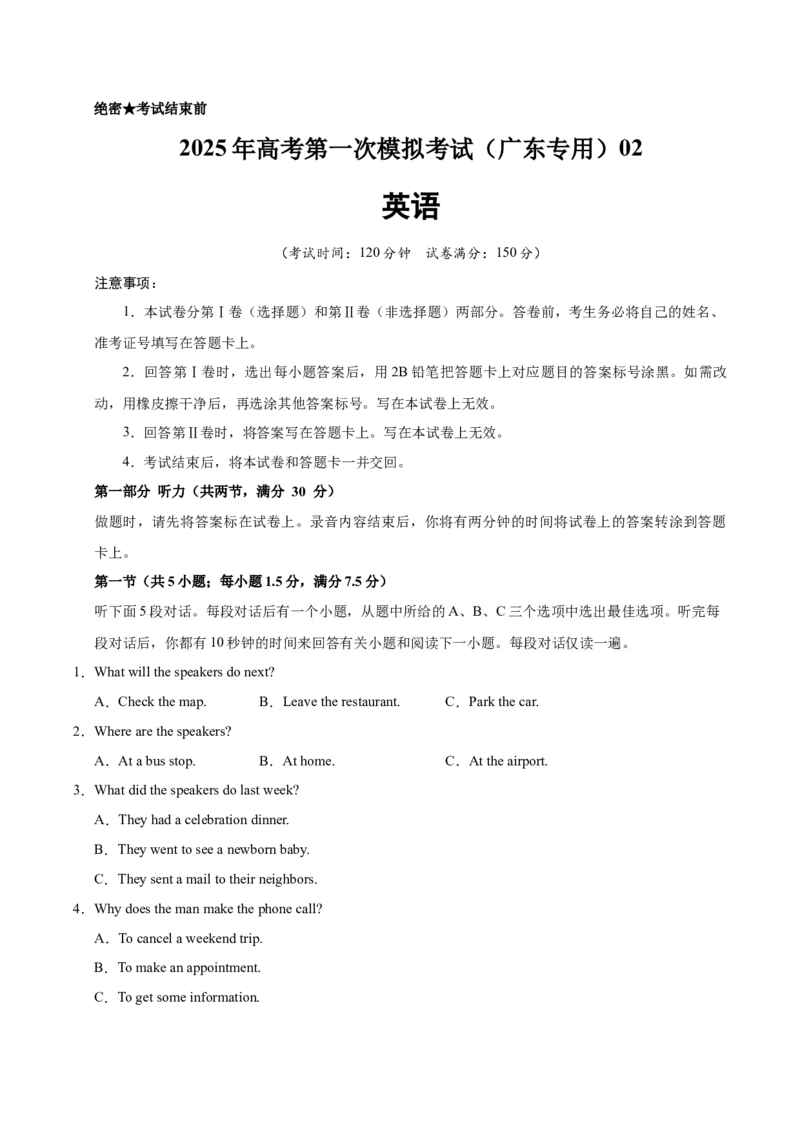
绝密★考试结束前
2025 年高考第一次模拟考试(广东专用)02
英语
(考试时间:120 分钟  试卷满分:150 分)
注意事项:
1.本试卷分第Ⅰ卷(选择题)和第Ⅱ卷(非选择题)两部分。答卷前,考生务必将自己的姓名、
准考证号填写在答题卡上。
2.回答第Ⅰ卷时,选出每小题答案后,用2B 铅笔把答题卡上对应题目的答案标号涂黑。如需改
动,用橡皮擦干净后,再选涂其他答案标号。写在本试卷上无效。
3.回答第Ⅱ卷时,将答案写在答题卡上。写在本试卷上无效。
4.考试结束后,将本试卷和答题卡一并交回。
第一部分 听力(共两节,满分 30 分)
做题时,请先将答案标在试卷上。录音内容结束后,你将有两分钟的时间将试卷上的答案转涂到答题
卡上。
第一节(共5 小题;每小题1.5 分,满分7.5 分)
听下面5 段对话。每段对话后有一个小题,从题中所给的A、B、C 三个选项中选出最佳选项。听完每
段对话后,你都有10 秒钟的时间来回答有关小题和阅读下一小题。每段对话仅读一遍。
1.What will the speakers do next?
A.Check the map.
B.Leave the restaurant.
C.Park the car.
2.Where are the speakers?
A.At a bus stop.
B.At home.
C.At the airport.
3.What did the speakers do last week?
A.They had a celebration dinner.
B.They went to see a newborn baby.
C.They sent a mail to their neighbors.
4.Why does the man make the phone call?
A.To cancel a weekend trip.
B.To make an appointment.
C.To get some information.
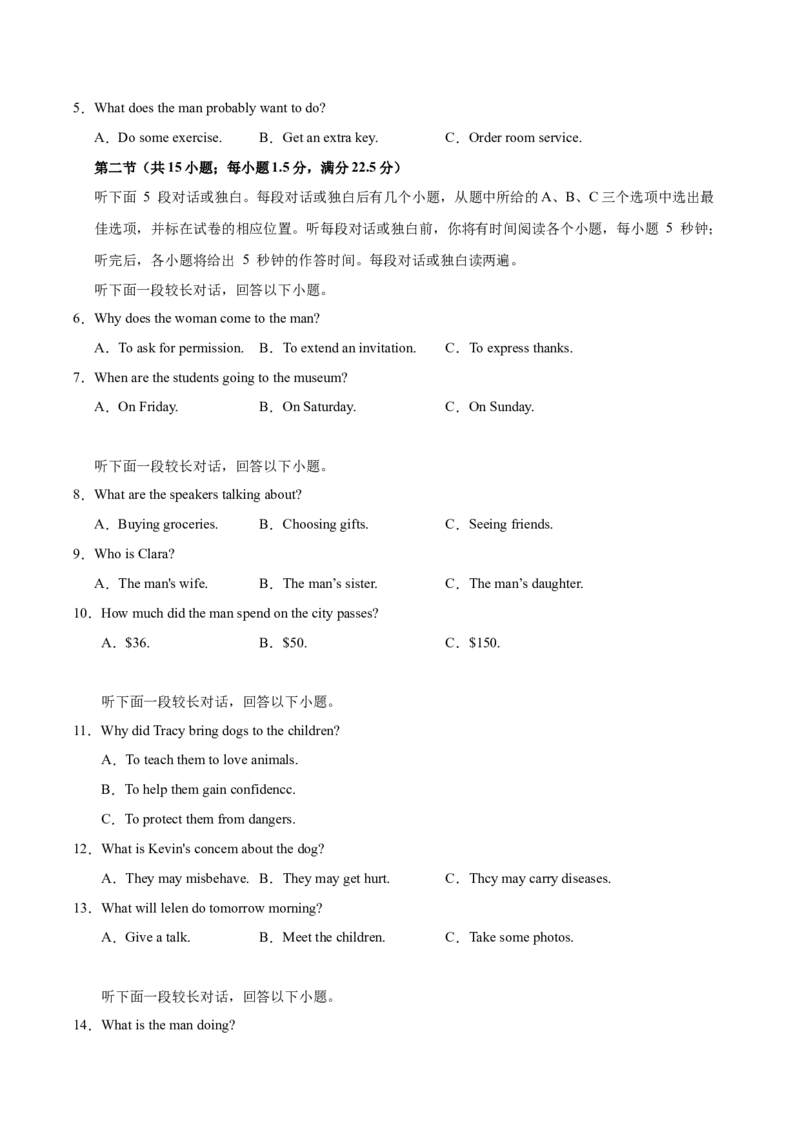
5.What does the man probably want to do?
A.Do some exercise.
B.Get an extra key.
C.Order room service.
第二节(共15 小题;每小题1.5 分,满分22.5 分)
听下面 5 段对话或独白。每段对话或独白后有几个小题,从题中所给的A、B、C 三个选项中选出最
佳选项,并标在试卷的相应位置。听每段对话或独白前,你将有时间阅读各个小题,每小题 5 秒钟;
听完后,各小题将给出 5 秒钟的作答时间。每段对话或独白读两遍。
听下面一段较长对话,回答以下小题。
6.Why does the woman come to the man?
A.To ask for permission.
B.To extend an invitation.
C.To express thanks.
7.When are the students going to the museum?
A.On Friday.
B.On Saturday.
C.On Sunday.
听下面一段较长对话,回答以下小题。
8.What are the speakers talking about?
A.Buying groceries.
B.Choosing gifts.
C.Seeing friends.
9.Who is Clara?
A.The man's wife.
B.The man’s sister.
C.The man’s daughter.
10.How much did the man spend on the city passes?
A.$36.
B.$50.
C.$150.
听下面一段较长对话,回答以下小题。
11.Why did Tracy bring dogs to the children?
A.To teach them to love animals.
B.To help them gain confidencc.
C.To protect them from dangers.
12.What is Kevin's concem about the dog?
A.They may misbehave. B.They may get hurt.
C.Thcy may carry diseases.
13.What will lelen do tomorrow morning?
A.Give a talk.
B.Meet the children.
C.Take some photos.
听下面一段较长对话,回答以下小题。
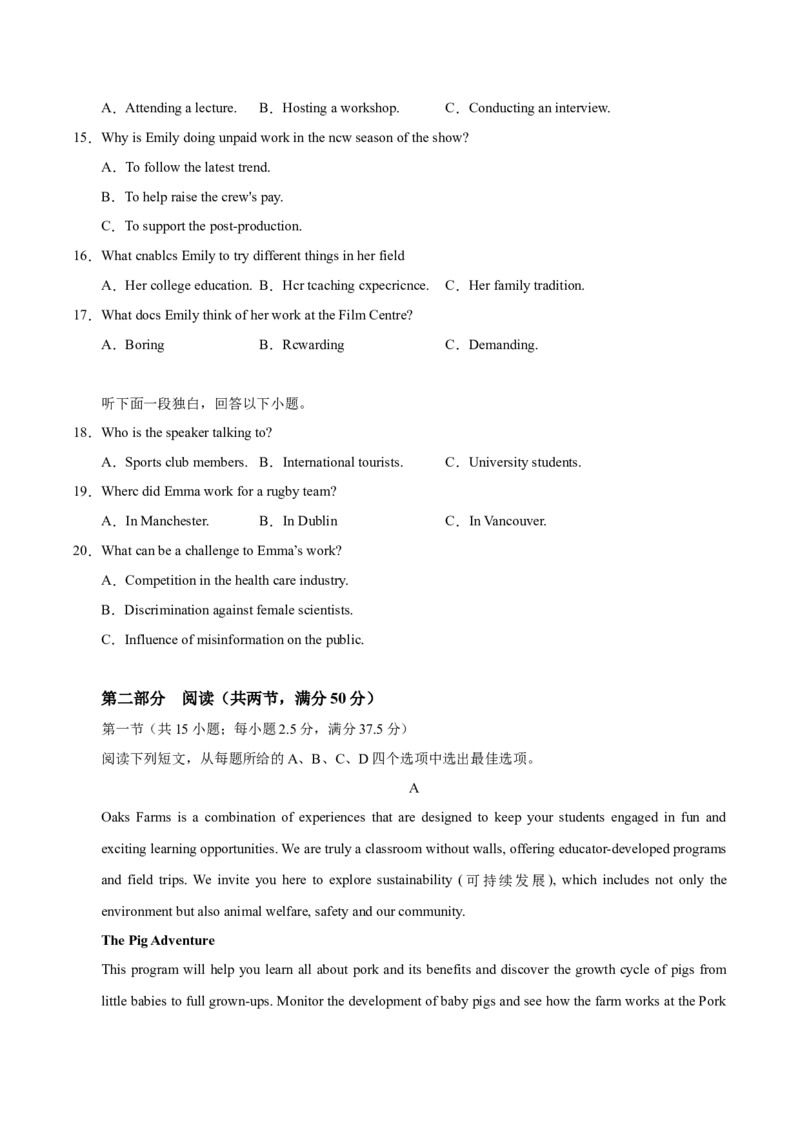
14.What is the man doing?
A.Attending a lecture.
B.Hosting a workshop.
C.Conducting an interview.
15.Why is Emily doing unpaid work in the ncw season of the show?
A.To follow the latest trend.
B.To help raise the crew's pay.
C.To support the post-production.
16.What cnablcs Emily to try different things in her field
A.Her college education. B.Hcr tcaching cxpecricnce.
C.Her family tradition.
17.What docs Emily think of her work at the Film Centre?
A.Boring
B.Rcwarding
C.Demanding.
听下面一段独白,回答以下小题。
18.Who is the speaker talking to?
A.Sports club members. B.International tourists.
C.University students.
19.Wherc did Emma work for a rugby team?
A.In Manchester.
B.In Dublin
C.In Vancouver.
20.What can be a challenge to Emma’s work?
A.Competition in the health care industry.
B.Discrimination against female scientists.
C.Influence of misinformation on the public.
第二部分  阅读(共两节,满分50 分)
第一节(共15 小题;每小题2.5 分,满分37.5 分)
阅读下列短文,从每题所给的A、B、C、D 四个选项中选出最佳选项。
A
Oaks Farms is a combination of experiences that are designed to keep your students engaged in fun and
exciting learning opportunities. We are truly a classroom without walls, offering educator-developed programs
and field trips. We invite you here to explore sustainability ( 可持续发展), which includes not only the
environment but also animal welfare, safety and our community.
The Pig Adventure
This program will help you learn all about pork and its benefits and discover the growth cycle of pigs from
little babies to full grown-ups. Monitor the development of baby pigs and see how the farm works at the Pork
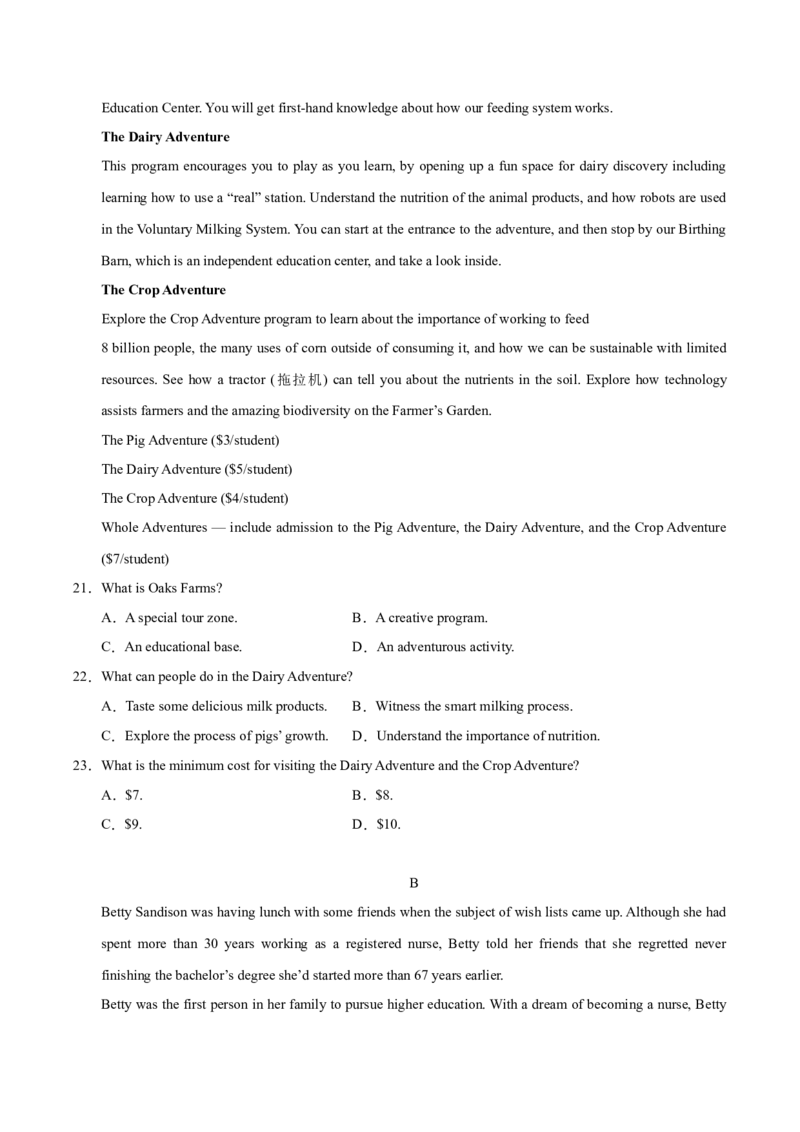
Education Center. You will get first-hand knowledge about how our feeding system works.
The Dairy Adventure
This program encourages you to play as you learn, by opening up a fun space for dairy discovery including
learning how to use a “real” station. Understand the nutrition of the animal products, and how robots are used
in the Voluntary Milking System. You can start at the entrance to the adventure, and then stop by our Birthing
Barn, which is an independent education center, and take a look inside.
The Crop Adventure
Explore the Crop Adventure program to learn about the importance of working to feed
8 billion people, the many uses of corn outside of consuming it, and how we can be sustainable with limited
resources. See how a tractor (拖拉机) can tell you about the nutrients in the soil. Explore how technology
assists farmers and the amazing biodiversity on the Farmer’s Garden.
The Pig Adventure ($3/student)
The Dairy Adventure ($5/student)
The Crop Adventure ($4/student)
Whole Adventures — include admission to the Pig Adventure, the Dairy Adventure, and the Crop Adventure
($7/student)
21.What is Oaks Farms?
A.A special tour zone.
B.A creative program.
C.An educational base.
D.An adventurous activity.
22.What can people do in the Dairy Adventure?
A.Taste some delicious milk products.
B.Witness the smart milking process.
C.Explore the process of pigs’ growth.
D.Understand the importance of nutrition.
23.What is the minimum cost for visiting the Dairy Adventure and the Crop Adventure?
A.$7.
B.$8.
C.$9.
D.$10.
B
Betty Sandison was having lunch with some friends when the subject of wish lists came up. Although she had
spent more than 30 years working as a registered nurse, Betty told her friends that she regretted never
finishing the bachelor’s degree she’d started more than 67 years earlier.
Betty was the first person in her family to pursue higher education. With a dream of becoming a nurse, Betty
enrolled at the University of Minnesota. But when she was just 25 credits short of getting her degree, for some
reason, Betty dropped out of school and soon got married. Her career was put on hold as the couple moved
around for her husband’s job, spending time living in different places.
Many years later, Betty returned to community college to become a registered nurse. She worked as a nurse
for more than 30 years before retiring in 2013.
But in 2018, she still felt regretful over her unfinished degree. Encouraged by her friends, Betty decided to
return to university to complete her bachelor’s degree. She chose to live in the dormitory and got on well with
her roommates. She enrolled in classes and started working on those last 25 credits. However, she was
discouraged by the new technology used when taking online courses during the coronavirus pandemic. Even
so, Betty persevered.
At age 84, Betty got her bachelor’s degree in Multidisciplinary Studies from the College of Continuing and
Professional Studies. She described the accomplishment as “pure joy, pure satisfaction”. Betty may even audit
(旁听) college classes now that her degree is complete. She is not sure what’s next, but there’s one thing she
does know: Life’s too short to live with regrets!
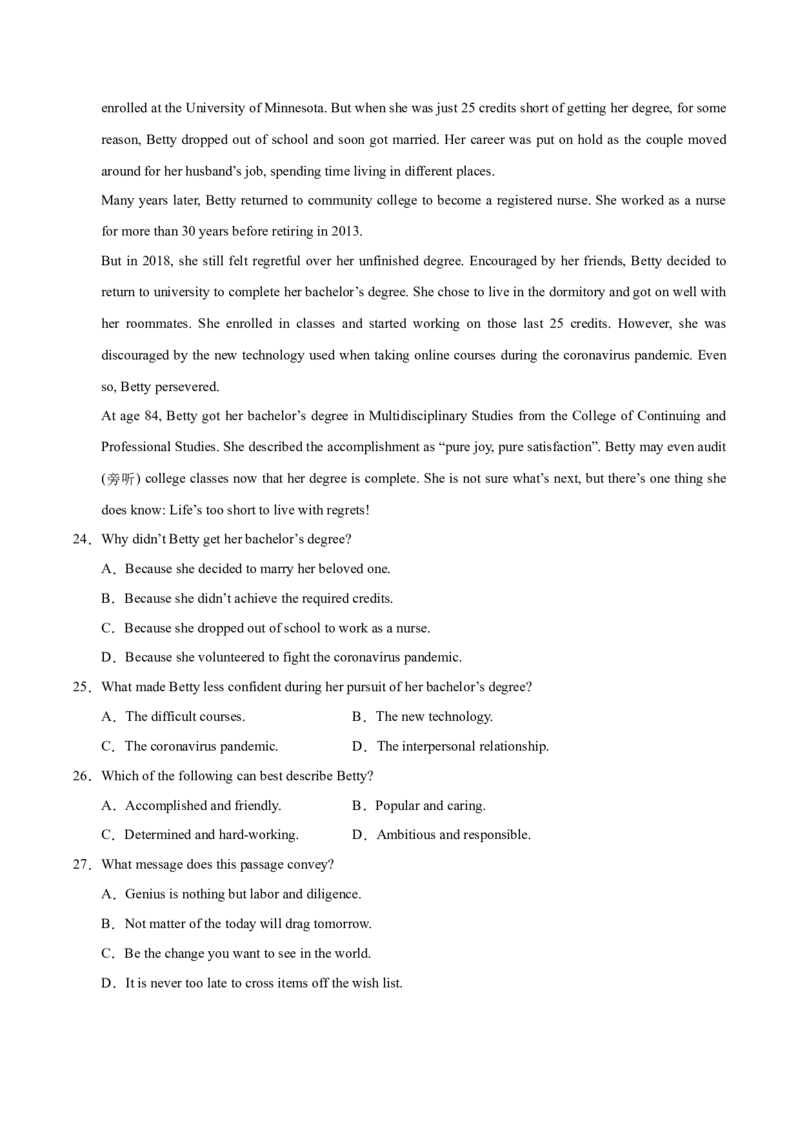
24.Why didn’t Betty get her bachelor’s degree?
A.Because she decided to marry her beloved one.
B.Because she didn’t achieve the required credits.
C.Because she dropped out of school to work as a nurse.
D.Because she volunteered to fight the coronavirus pandemic.
25.What made Betty less confident during her pursuit of her bachelor’s degree?
A.The difficult courses.
B.The new technology.
C.The coronavirus pandemic.
D.The interpersonal relationship.
26.Which of the following can best describe Betty?
A.Accomplished and friendly.
B.Popular and caring.
C.Determined and hard-working.
D.Ambitious and responsible.
27.What message does this passage convey?
A.Genius is nothing but labor and diligence.
B.Not matter of the today will drag tomorrow.
C.Be the change you want to see in the world.
D.It is never too late to cross items off the wish list.
C
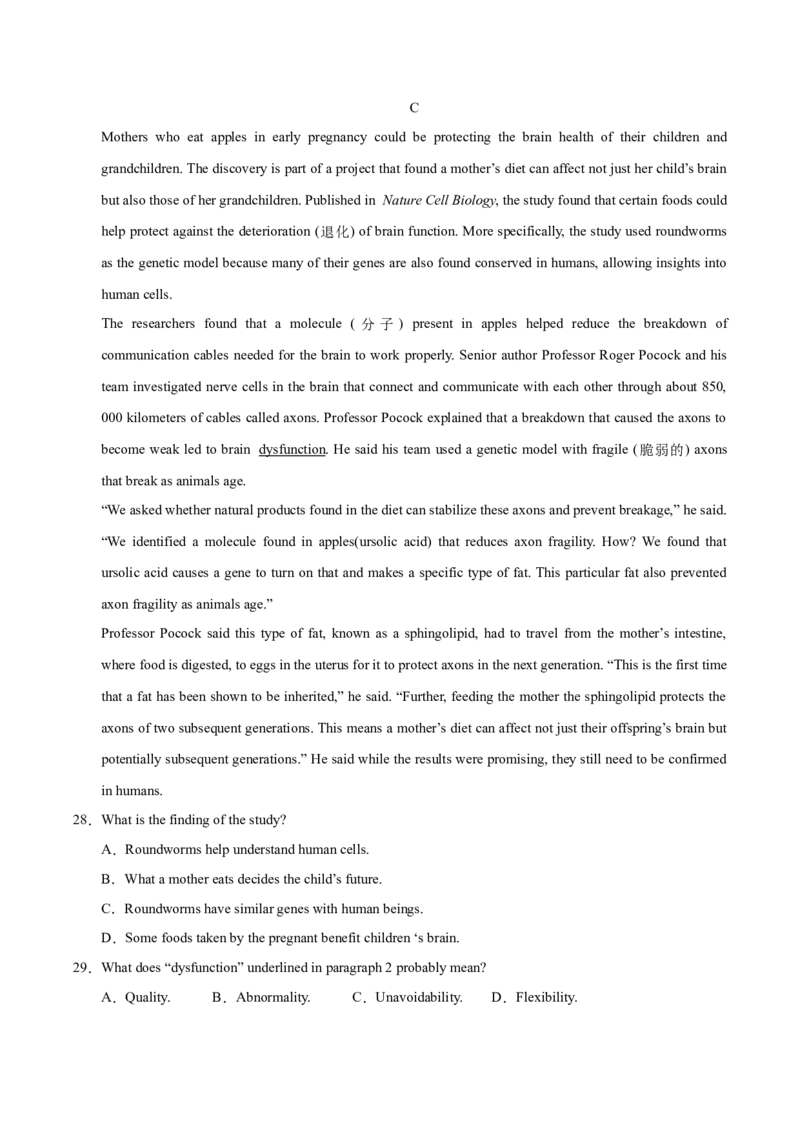
Mothers who eat apples in early pregnancy could be protecting the brain health of their children and
grandchildren. The discovery is part of a project that found a mother’s diet can affect not just her child’s brain
but also those of her grandchildren. Published in Nature Cell Biology, the study found that certain foods could
help protect against the deterioration (退化) of brain function. More specifically, the study used roundworms
as the genetic model because many of their genes are also found conserved in humans, allowing insights into
human cells.
The researchers found that a molecule ( 分子) present in apples helped reduce the breakdown of
communication cables needed for the brain to work properly. Senior author Professor Roger Pocock and his
team investigated nerve cells in the brain that connect and communicate with each other through about 850,
000 kilometers of cables called axons. Professor Pocock explained that a breakdown that caused the axons to
become weak led to brain dysfunction. He said his team used a genetic model with fragile (脆弱的) axons
that break as animals age.
“We asked whether natural products found in the diet can stabilize these axons and prevent breakage,” he said.
“We identified a molecule found in apples(ursolic acid) that reduces axon fragility. How? We found that
ursolic acid causes a gene to turn on that and makes a specific type of fat. This particular fat also prevented
axon fragility as animals age.”
Professor Pocock said this type of fat, known as a sphingolipid, had to travel from the mother’s intestine,
where food is digested, to eggs in the uterus for it to protect axons in the next generation. “This is the first time
that a fat has been shown to be inherited,” he said. “Further, feeding the mother the sphingolipid protects the
axons of two subsequent generations. This means a mother’s diet can affect not just their offspring’s brain but
potentially subsequent generations.” He said while the results were promising, they still need to be confirmed
in humans.
28.What is the finding of the study?
A.Roundworms help understand human cells.
B.What a mother eats decides the child’s future.
C.Roundworms have similar genes with human beings.
D.Some foods taken by the pregnant benefit children ‘s brain.
29.What does “dysfunction” underlined in paragraph 2 probably mean?
A.Quality.
B.Abnormality.
C.Unavoidability.
D.Flexibility.
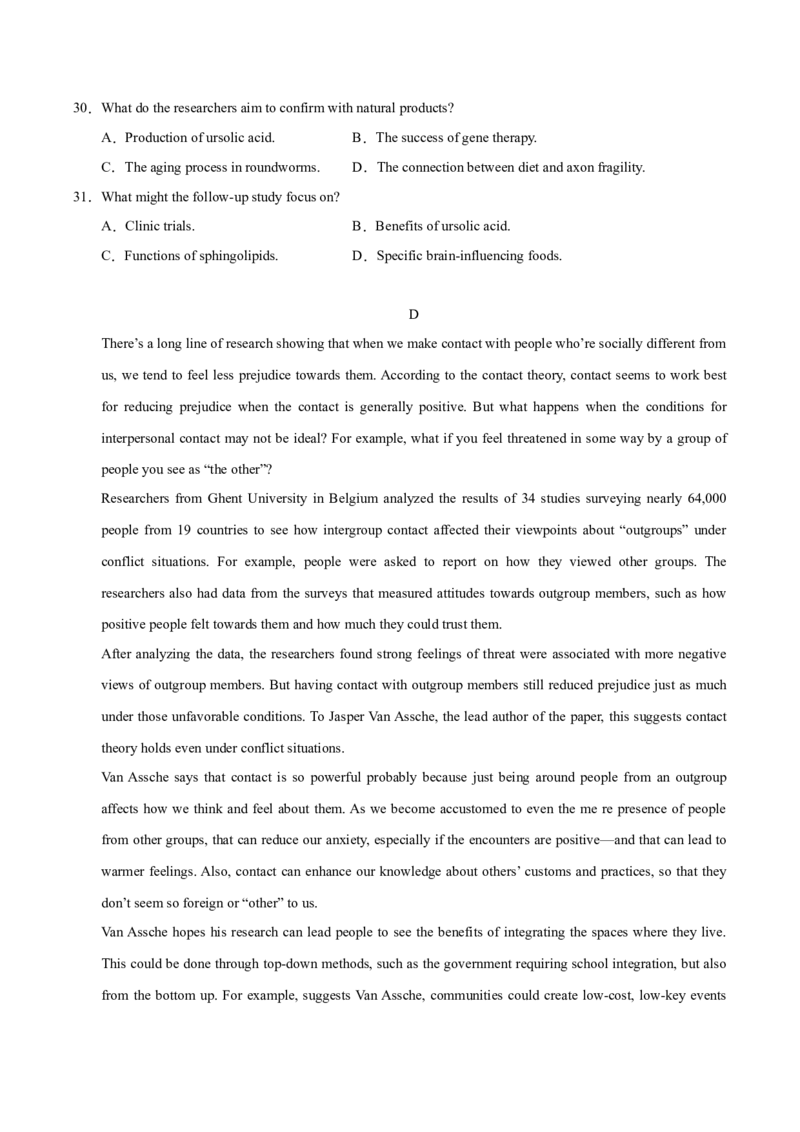
30.What do the researchers aim to confirm with natural products?
A.Production of ursolic acid.
B.The success of gene therapy.
C.The aging process in roundworms.
D.The connection between diet and axon fragility.
31.What might the follow-up study focus on?
A.Clinic trials.
B.Benefits of ursolic acid.
C.Functions of sphingolipids.
D.Specific brain-influencing foods.
D
There’s a long line of research showing that when we make contact with people who’re socially different from
us, we tend to feel less prejudice towards them. According to the contact theory, contact seems to work best
for reducing prejudice when the contact is generally positive. But what happens when the conditions for
interpersonal contact may not be ideal? For example, what if you feel threatened in some way by a group of
people you see as “the other”?
Researchers from Ghent University in Belgium analyzed the results of 34 studies surveying nearly 64,000
people from 19 countries to see how intergroup contact affected their viewpoints about “outgroups” under
conflict situations. For example, people were asked to report on how they viewed other groups. The
researchers also had data from the surveys that measured attitudes towards outgroup members, such as how
positive people felt towards them and how much they could trust them.
After analyzing the data, the researchers found strong feelings of threat were associated with more negative
views of outgroup members. But having contact with outgroup members still reduced prejudice just as much
under those unfavorable conditions. To Jasper Van Assche, the lead author of the paper, this suggests contact
theory holds even under conflict situations.
Van Assche says that contact is so powerful probably because just being around people from an outgroup
affects how we think and feel about them. As we become accustomed to even the me re presence of people
from other groups, that can reduce our anxiety, especially if the encounters are positive—and that can lead to
warmer feelings. Also, contact can enhance our knowledge about others’ customs and practices, so that they
don’t seem so foreign or “other” to us.
Van Assche hopes his research can lead people to see the benefits of integrating the spaces where they live.
This could be done through top-down methods, such as the government requiring school integration, but also
from the bottom up. For example, suggests Van Assche, communities could create low-cost, low-key events
that bring people together, helping to promote tolerance.
32.Why are the questions raised in paragraph 1?
A.To inspire readers’ imagination.
B.To argue against the contact theory.
C.To show the author’s curiosity.
D.To offer the purpose of the study.
33.Why can interpersonal contact reduce prejudice?
A.It improves people’s adaptive capacity. B.It increases people’s desire to socialize.
C.It promotes each other’s understanding. D.It makes people emotionally stable.
34.What might be Van Assche’s advice according to the text?
A.Expanding communities on the whole.
B.Increasing chances of positive contact.
C.Strengthening interactions between schools.
D.Offering equal education opportunities to diverse groups.
35.What can be the best title of the text?
A.People involved in equal contact are generally positive
B.Opportunities for intergroup contact are on the rise
C.The interventions based on contact are unhealthy
D.Interpersonal contact can help people connect
第二节(共5 小题;每小题2.5 分,满分12.5 分)
阅读下面短文,从短文后的选项中选出可以填入空白处的最佳选项。选项中有两项为多余选项。
Most of us have a map of the world in our mind that we use any time we think about places.    36    In fact,
many of the maps in our heads share the same errors, some of which are quite large and surprisingly resistant
to correction.
For example, we all believe that South America is just south of North America, of course. But you may be
surprised by the fact that virtually the entire South American continent is east of Florida. There are lots of
possible reasons for geographical misconceptions like this one, says cartographer (地图绘制员) John Nelson.
37    After all it’s not called Southeast America.
Europe is also often placed much farther south on mental maps than it really is. But it actually lines up better
with Canada.    38    Western Europe is relatively warm for its latitude (纬度) thanks to the Gulf Stream
which brings warmer water from the Gulf of Mexico across the Atlantic. The warmer temperatures are more
similar to the climate of the lower 48 states than Canada’s.
   39    We also have misconceptions about the relative size of things. This may be due in part to the nature
of 2D maps. Flattening a 3D globe onto a flat surface isn’t possible without some distortion (变形). This is
especially obvious for maps that use certain projections.
Mercator maps distort the shape and relative size of continents, particularly near the poles. This is why
Greenland appears to be similar in size to all of South America on Mercator maps.    40
A.Locations aren’t the only way our mental maps can be wrong.
B.But these mental maps aren’t necessarily dependable.
C.Nelson says that climate might play a role in this misunderstanding.
D.In fact, South America is more than eight times larger than Greenland.
E.He believes the misplaced Americas may be partly a result of their names.
F.However, our physical experience of the world may come into play as well.
G.None of these geographic misconceptions would be surprising for a student.
第三部分  语言运用(共两节,满分30 分)
第一节  (共15 小题;每小题1 分,满分15 分)
阅读下面短文,从每题所给的A、B、C、D 四个选项中选出可以填入空白处的最佳选项。
That day I walked in the post office with a huge smile. My story had been accepted for     41     in a
Chicken Soup. After months of stressful life events, I had (a)     42     in my step and a lightness in my
heart.
Grasped     43     in my hand was the form giving permission to print my story. As the clerk stuck the
form to my envelope, she said, “Ten dollars,     44     only. Our system is dead today.” I fished through
my     45    . But without luck. Tears clouded my vision.
Then a deep voice behind me said, “I’ll take care of it.” I turned and met a man’s     46     gaze as he held
out a ten-dollar bill. “Just pay it forward,” he said.
That often-overused phrase sent     47     down through my toes.     48     his kindness, I was
walking back to my car when I noticed something glowing in the sun. It was a credit card.
    49     to find the owner, I played detective for several blocks. Then I      50      a young mother
with three children. She was      51      through some bags in the back. I approached and asked, “Are
you Jessica Slate?” Her eyes got round. “Yes!” “I believe this is yours,” I handed her the card. “You      52
my day,” she wiped away tears, “Truly.”
While driving home, I mused that being kind on both the receiving and the giving end felt      53

good. First with cash, then with credit, I had      54      a literal interpretation of paying it forward. When
it comes to acts of kindness, all forms of      55      are acceptable.
41.A.education
B.application
C.communication
D.publication
42.A.faith
B.lead
C.spring
D.doubt
43.A.firmly
B.casually
C.blindly
D.effortlessly
44.A.signature
B.check
C.cash
D.credit
45.A.form
B.purse
C.envelope
D.car
46.A.sympathetic
B.curious
C.hopeful
D.appreciative
47.A.desire
B.joy
C.panic
D.despair
48.A.Reflecting on B.Counting on
C.Hunting for
D.Allowing for
49.A.Hesitant
B.Content
C.Inspired
D.Determined
50.A.anticipated
B.spotted
C.recognized
D.contacted
51.A.digging
B.seeing
C.cutting
D.tearing
52.A.fueled
B.enriched
C.marked
D.saved
53.A.partly
B.equally
C.seemingly
D.naturally
54.A.stamped
B.imagined
C.experienced
D.accepted
55.A.generosity
B.donation
C.payment
D.submission
第二节(共10 小题;每小题1. 5 分, 满分15 分)
阅读下面材料,在空白处填入适当的内容(1 个单词)或所给单词的正确形式。
In September, UNESCO Director-General Audrey visited Zhoukoudian in Beijing. She was full of praise    56
a special structure which    57    (successful) protected Yuanrendong Cave from an unusual rainstorm in
July. The karst cave    58    (reveal) the fossilized remains of 40 individuals so far.
The structure protects the site from the extreme weather, secretary-general Qin Changwei said at the 2nd
World Cultural and Natural Heritage Forum. “   59    provides a reference for the protection of cultural
relics, and suggests    60    (measure) for helping heritage sites respond to the influence of climate
change.”
Organized by various organizations,    61    forum brought together some 50 professionals to discuss the
protection and    62    (sustain) development of heritage sites.
“Climate change has been the subject of in-depth discussion by the UNESCO World Heritage Committee.
Questions like how to balance humans and nature, how to respond to natural disasters    63    what new
challenges this brings to World Heritage Sites are worth    64    (consider),” says Qin.
“Addressing the issue requires multi-sectoral and interdisciplinary cooperation, making full use of cutting-
edge technology and jointly    65    (develop) risk prevention and response plans,” he adds.
第四部分 写作(共两节, 满分40 分)
第一节(满分15 分)
66.假定你是学生会主席李华, 本周五下午,校学生会将邀请吴教授在校报告厅做“航天强国”专题讲座。
请你写一则活动通知,发布在校英文网站上,内容包括:
1. 讲座的目的和主题;
2. 主讲人和讲座内容简介;
3. 注意事项。
注意: 写作词数应为 80 左右。
Notice
________________________________________________________________________________________
________________________________________________________________________________________
________________________________________________________________________________________
________________________________________________________________________________________
________________________________________________________________________________________
___________________________________
The Students’ Union
第二节(满分25 分)
67.阅读下面材料,根据其内容和所给段落开头语续写两段,使之构成一篇完整的短文。
In a house far from the city lived John and his mother. John’s only hobby was wandering in the nearby
picturesque forest. In its center was a shiny clear lake with schools of fish dancing in it. Lovely animals such
as deer or rabbits were playing around and cute birds were singing in trees. Fascinated by the beauty and
liveliness of nature, he desired to become a great artist and present all the breath-taking scenes to the world.
John studied in the local primary school. Life was not easy for John and his mom after his father died.
Knowing what hard work his mother did to make ends meet, John really didn’t want his mother to worry. His
mother knew the significance of education in life but she was against his dream of becoming an artist. “The
profession of artist can’t aid a person in meeting his daily expenses,” she would say. But as each day passed,
John’s dream became more passionate.
Due to the living circumstances, even buying some new colors would be a luxury. John only used the worn
drawing file and limited colors for his daily practice. Though lacking fine painting materials, he never gave up
drawing. He spent a significant amount of time staying in the forest, secretly perfecting his craft. With
continuous hard work and a distinct gift for art, he drew beautifully.
One day John read about a competition being held in the town, whose deadline was only two days away. He
got the perfect opportunity to fulfill his desire but he was in a dilemma (两难境地) as for the competition he
needed special paints and some brushes. He didn’t have the courage to ask his mother for money as he knew
her prejudice against art.
That evening his mom returned from work and handed him a few paper notes, saying, “This is for your lunch
at school next month.” The money was enough for his desired materials! John’s face lit up.
注意:
1. 续写词数应为150 左右;
2. 请按如下格式在答题卡的相应位置作答。
Early the next morning, John secretly left home with the money.
________________________________________________________________________________________
________________________________________________________________________________________
________________________________________________________________________________________
________________________________________________________________________________________
________________________________________________________________________________________
______________
A week later, a phone call came to John’s home.
________________________________________________________________________________________
________________________________________________________________________________________
________________________________________________________________________________________
________________________________________________________________________________________
________________________________________________________________________________________
______________