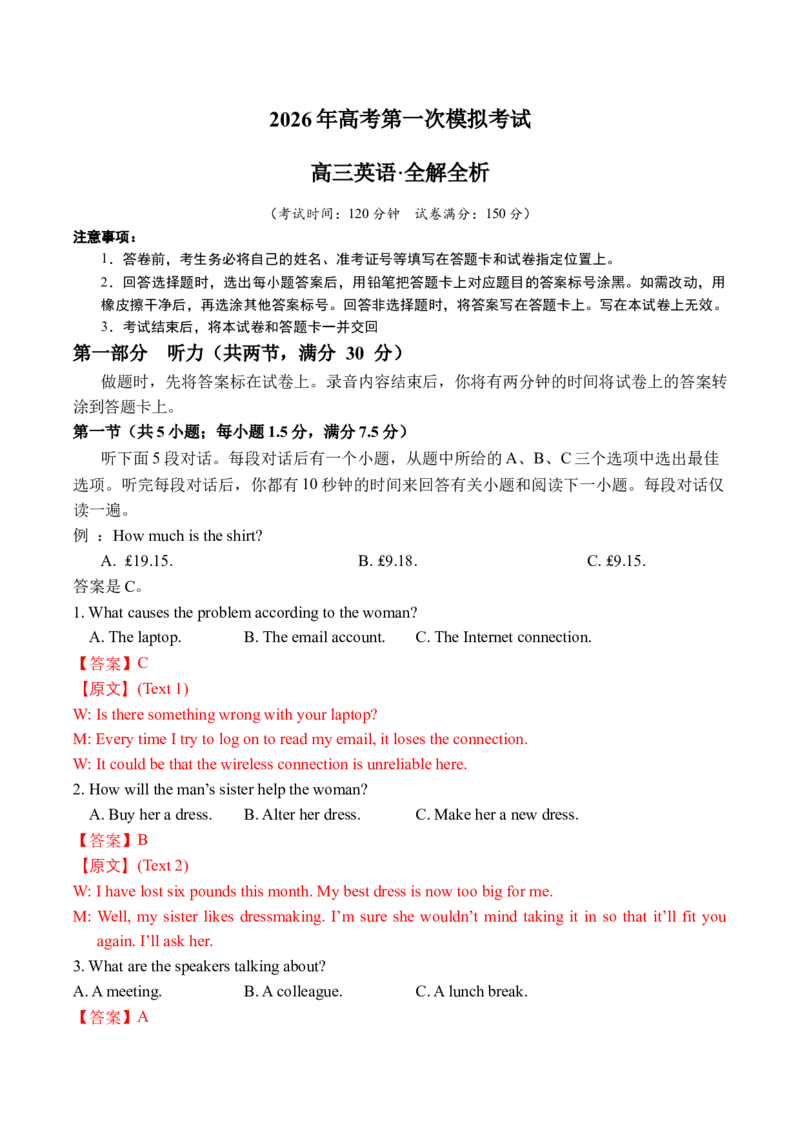
2026 年高考第一次模拟考试
高三英语·全解全析
(考试时间:120分钟 试卷满分:150分)
注意事项:
1.答卷前,考生务必将自己的姓名、准考证号等填写在答题卡和试卷指定位置上。
2.回答选择题时,选出每小题答案后,用铅笔把答题卡上对应题目的答案标号涂黑。如需改动,用
橡皮擦干净后,再选涂其他答案标号。回答非选择题时,将答案写在答题卡上。写在本试卷上无效。
3.考试结束后,将本试卷和答题卡一并交回
第一部分 听力(共两节,满分 30 分)
做题时,先将答案标在试卷上。录音内容结束后,你将有两分钟的时间将试卷上的答案转
涂到答题卡上。
第一节(共5小题;每小题1.5分,满分7.5分)
听下面5段对话。每段对话后有一个小题,从题中所给的A、B、C三个选项中选出最佳
选项。听完每段对话后,你都有10秒钟的时间来回答有关小题和阅读下一小题。每段对话仅
读一遍。
例 :How much is the shirt?
A. ₤19.15. B. ₤9.18. C. ₤9.15.
答案是C。
1. What causes the problem according to the woman?
A. The laptop. B. The email account. C. The Internet connection.
【答案】C
【原文】(Text 1)
W: Is there something wrong with your laptop?
M: Every time I try to log on to read my email, it loses the connection.
W: It could be that the wireless connection is unreliable here.
2. How will the man’s sister help the woman?
A. Buy her a dress. B. Alter her dress. C. Make her a new dress.
【答案】B
【原文】(Text 2)
W: I have lost six pounds this month. My best dress is now too big for me.
M: Well, my sister likes dressmaking. I’m sure she wouldn’t mind taking it in so that it’ll fit you
again. I’ll ask her.
3. What are the speakers talking about?
A. A meeting. B. A colleague. C. A lunch break.
【答案】A【原文】(Text 3)
M: Did Tom say that the meeting would start as usual?
W: He pushed it back so people could grab something to eat first.
M: Great. That way we can get started without rushing.
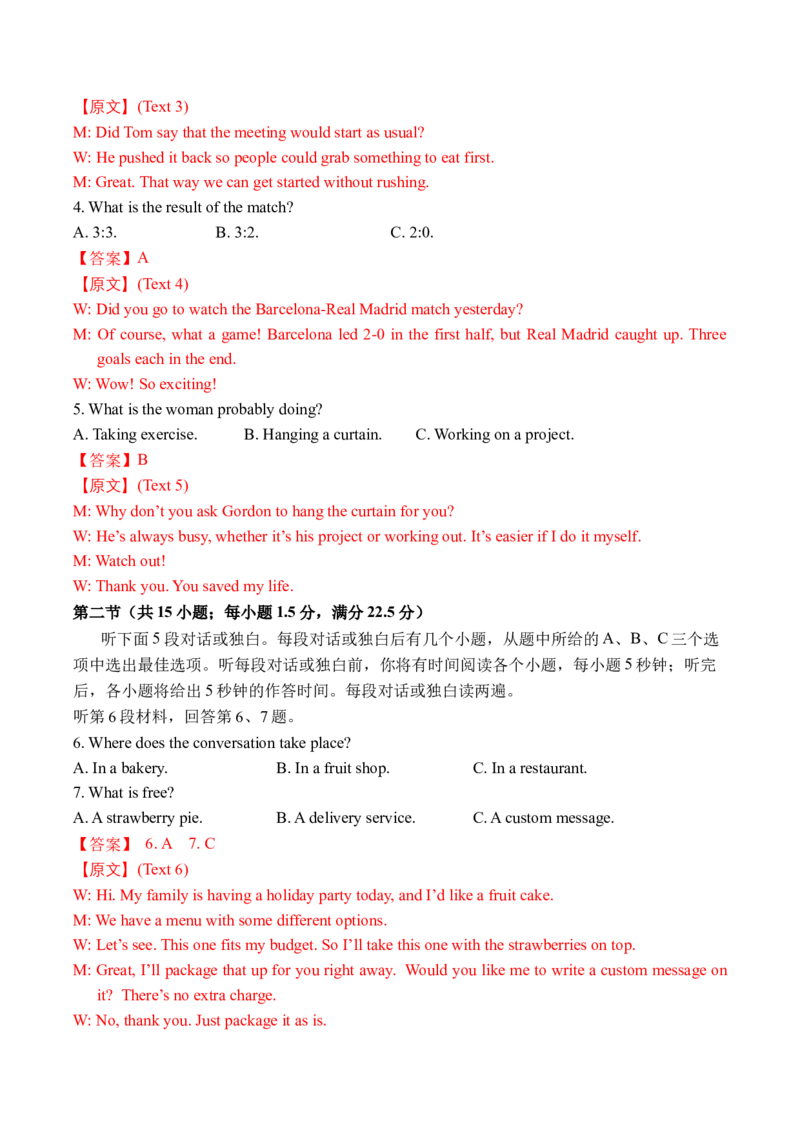
4. What is the result of the match?
A. 3:3. B. 3:2. C. 2:0.
【答案】A
【原文】(Text 4)
W: Did you go to watch the Barcelona-Real Madrid match yesterday?
M: Of course, what a game! Barcelona led 2-0 in the first half, but Real Madrid caught up. Three
goals each in the end.
W: Wow! So exciting!
5. What is the woman probably doing?
A. Taking exercise. B. Hanging a curtain. C. Working on a project.
【答案】B
【原文】(Text 5)
M: Why don’t you ask Gordon to hang the curtain for you?
W: He’s always busy, whether it’s his project or working out. It’s easier if I do it myself.
M: Watch out!
W: Thank you. You saved my life.
第二节(共15小题;每小题1.5分,满分22.5分)
听下面5段对话或独白。每段对话或独白后有几个小题,从题中所给的A、B、C三个选
项中选出最佳选项。听每段对话或独白前,你将有时间阅读各个小题,每小题5秒钟;听完
后,各小题将给出5秒钟的作答时间。每段对话或独白读两遍。
听第6段材料,回答第6、7题。
6. Where does the conversation take place?
A. In a bakery. B. In a fruit shop. C. In a restaurant.
7. What is free?
A. A strawberry pie. B. A delivery service. C. A custom message.
【答案】 6. A 7. C
【原文】(Text 6)
W: Hi. My family is having a holiday party today, and I’d like a fruit cake.
M: We have a menu with some different options.
W: Let’s see. This one fits my budget. So I’ll take this one with the strawberries on top.
M: Great, I’ll package that up for you right away. Would you like me to write a custom message on
it? There’s no extra charge.
W: No, thank you. Just package it as is.听第 7 段材料,回答第 8、9 题。
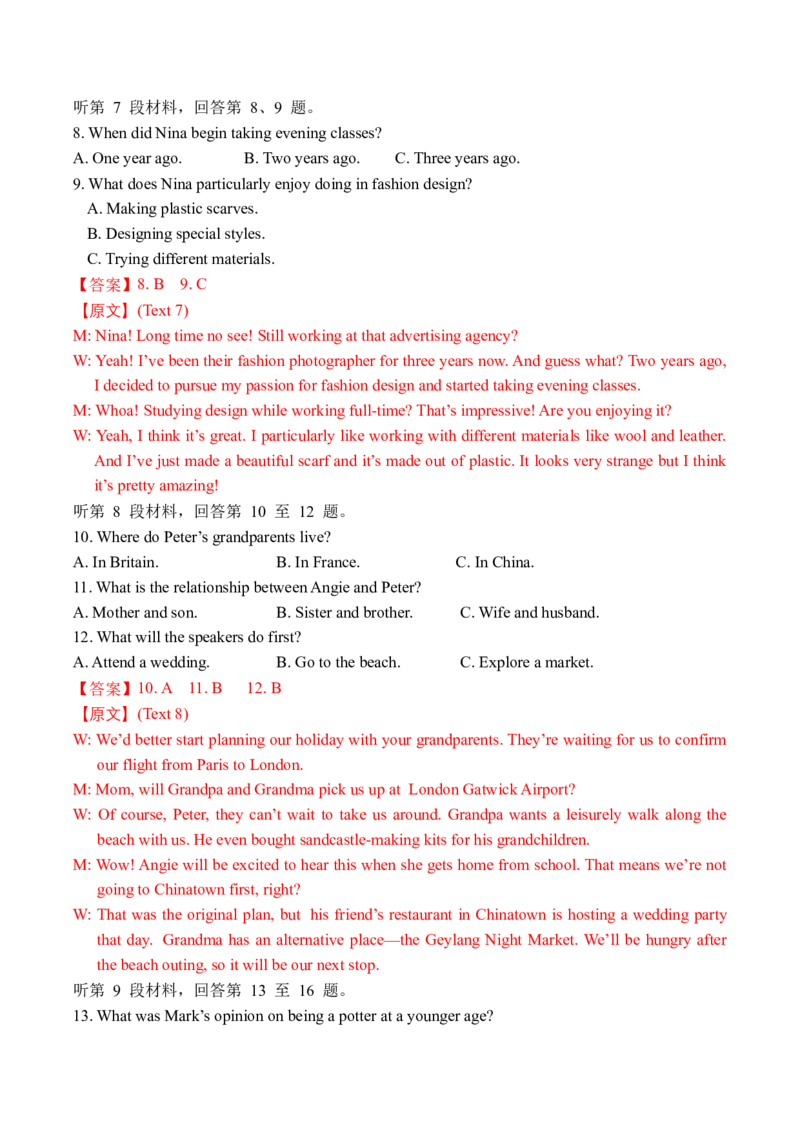
8. When did Nina begin taking evening classes?
A. One year ago. B. Two years ago. C. Three years ago.
9. What does Nina particularly enjoy doing in fashion design?
A. Making plastic scarves.
B. Designing special styles.
C. Trying different materials.
【答案】8. B 9. C
【原文】(Text 7)
M: Nina! Long time no see! Still working at that advertising agency?
W: Yeah! I’ve been their fashion photographer for three years now. And guess what? Two years ago,
I decided to pursue my passion for fashion design and started taking evening classes.
M: Whoa! Studying design while working full-time? That’s impressive! Are you enjoying it?
W: Yeah, I think it’s great. I particularly like working with different materials like wool and leather.
And I’ve just made a beautiful scarf and it’s made out of plastic. It looks very strange but I think
it’s pretty amazing!
听第 8 段材料,回答第 10 至 12 题。
10. Where do Peter’s grandparents live?
A. In Britain. B. In France. C. In China.
11. What is the relationship between Angie and Peter?
A. Mother and son. B. Sister and brother. C. Wife and husband.
12. What will the speakers do first?
A. Attend a wedding. B. Go to the beach. C. Explore a market.
【答案】10. A 11. B 12. B
【原文】(Text 8)
W: We’d better start planning our holiday with your grandparents. They’re waiting for us to confirm
our flight from Paris to London.
M: Mom, will Grandpa and Grandma pick us up at London Gatwick Airport?
W: Of course, Peter, they can’t wait to take us around. Grandpa wants a leisurely walk along the
beach with us. He even bought sandcastle-making kits for his grandchildren.
M: Wow! Angie will be excited to hear this when she gets home from school. That means we’re not
going to Chinatown first, right?
W: That was the original plan, but his friend’s restaurant in Chinatown is hosting a wedding party
that day. Grandma has an alternative place—the Geylang Night Market. We’ll be hungry after
the beach outing, so it will be our next stop.
听第 9 段材料,回答第 13 至 16 题。
13. What was Mark’s opinion on being a potter at a younger age?A. Challenging. B. Pleasing. C. Confusing.
14. Why did Mark decide to do pottery?
A. To follow the family tradition.
B. To support his company’s operations.
C. To try something different and artistic.
15. What was Mark’s problem when going back to school?
A. Lacking enthusiasm.
B. Handling physical challenges.
C. Fitting in with young students.
16. What kind of pots will Mark be working on?
A. Large ones. B. Brightly colored ones. C. Complicated ones.
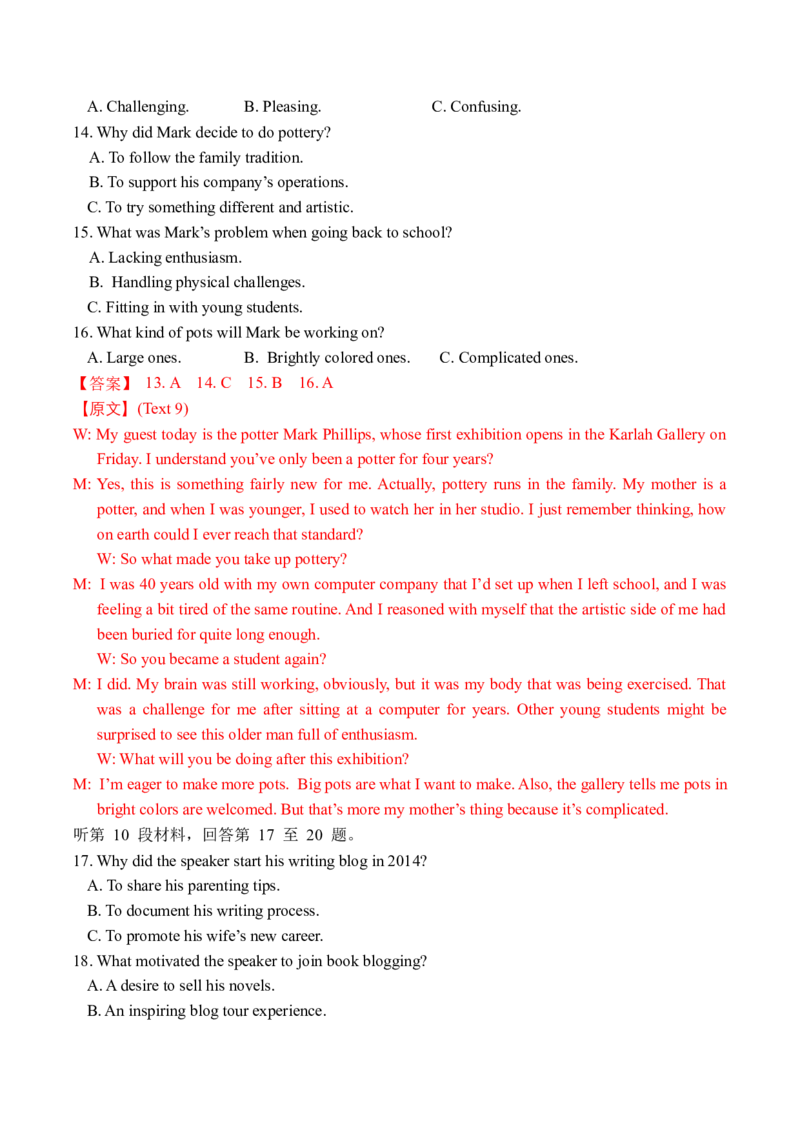
【答案】 13. A 14. C 15. B 16. A
【原文】(Text 9)
W: My guest today is the potter Mark Phillips, whose first exhibition opens in the Karlah Gallery on
Friday. I understand you’ve only been a potter for four years?
M: Yes, this is something fairly new for me. Actually, pottery runs in the family. My mother is a
potter, and when I was younger, I used to watch her in her studio. I just remember thinking, how
on earth could I ever reach that standard?
W: So what made you take up pottery?
M: I was 40 years old with my own computer company that I’d set up when I left school, and I was
feeling a bit tired of the same routine. And I reasoned with myself that the artistic side of me had
been buried for quite long enough.
W: So you became a student again?
M: I did. My brain was still working, obviously, but it was my body that was being exercised. That
was a challenge for me after sitting at a computer for years. Other young students might be
surprised to see this older man full of enthusiasm.
W: What will you be doing after this exhibition?
M: I’m eager to make more pots. Big pots are what I want to make. Also, the gallery tells me pots in
bright colors are welcomed. But that’s more my mother’s thing because it’s complicated.
听第 10 段材料,回答第 17 至 20 题。
17. Why did the speaker start his writing blog in 2014?
A. To share his parenting tips.
B. To document his writing process.
C. To promote his wife’s new career.
18. What motivated the speaker to join book blogging?
A. A desire to sell his novels.
B. An inspiring blog tour experience.C. Pressure from writing communities.
19. How does the speaker write book reviews on his blog?
A. By offering honest reviews.
B. By comparing different books.
C. By focusing on questions about the books.
20. What effect has book blogging had on the speaker?
A. It helps him write more books.
B. It allows him to meet more readers.
C. It increases his understanding of literature.
【答案】17. B 18, B 19. A 20. C
【原文】(Text 10)
M: Well, now let me tell you how I came to be a book blogger. To support my wife’s career, in 2014
I decided to leave my job and become a stay-at-home dad. That same year, I launched my writing
blog to record my journey into fiction writing.
My introduction to book blogging came through Kelly Lacey of Love Books Group, who organized a
blog tour for my first novel. This was a lovely experience where people who were passionate about
reading read and talked about my novel! It seemed like such a lovely community that I wanted to be
part of it. In early 2020, I joined Anne Cater’s book connectors group.
On my blog, I focus on two types of posts: in-depth reflections on the nature of writing and honest
book reviews. I try to be positive but will also point out some concerns or questions about the book
—no matter who the writer is—because I feel the review is more useful this way. If I really don’t like
the book, I won’t publish a review.
Ever since I started book blogging, I’ve been reading much more. Also, book blogging has helped
deepen my appreciation of literature, doubling the joy of reading while sharpening my writing skills.
第二部分 阅读(共两节, 满分50分)
第一节(共15小题;每小题2.5分, 满分37.5分)
阅读下列短文, 从每题所给的A、B、C和D四个选项中选出最佳选项。
A(原创题)
Community Youth Center Spring Programs 2026
Are you looking for meaningful activities for teenagers? The Community Youth Center is
offering the following programs for students aged 13-18:
Environmental Protection Volunteer Program
Time: Every Saturday, 9:00-11:30 AM (March 16 - May 25)
Activities: Tree planting, community cleaning, waste sorting workshops
Requirements: No experience needed; sign up in advance (limit 30 people)
Registration: Visit the center’s office or call 555-7890
Public Speaking Training CourseTime: Every Sunday, 2:00-4:30 PM (March 17 - June 2)
Activities: Speech practice, debate competitions, expert lectures
Requirements: Basic English or Chinese communication skills
Fee: $80 per person (includes materials)
Traditional Handicraft Workshop
Time: Every Friday evening, 6:30-8:30 PM (March 15 - May 10)
Activities: Learn paper-cutting, bamboo weaving, and Chinese knot making
Requirements: Interest in traditional culture; bring your own scissors (basic tools provided)
Registration deadline: March 10th
For more information, visit www.communityyouthcenter.org.
21. How long will the Environmental Protection Volunteer Program last?
A. 2 months B. 2.5 months C. 3 months D. 3.5 months
22. What do participants need to bring to the Traditional Handicraft Workshop?
A. Paper B. Bamboo C. Scissors D. Knots
23. Which program requires a fee?
A. None of the above
B. Public Speaking Training Course
C. Traditional Handicraft Workshop
D. Environmental Protection Volunteer Program
【答案】21.B 22.C 23.B
【解析】这是一篇广告类应用文,主要介绍社区青年中心2026年春季为13-18岁青少年推出
的环保志愿、公众演讲培训、传统手工艺工作坊三类项目,含时间、活动等信息。
21. B(细节理解—时间跨度计算) 解析:环保志愿者项目时间“March 16 - May 25”,3月
16日至5月25日约2.5个月,故选B。
22. C(细节理解—物品要求) 解析:传统手工艺工坊要求“bring your own scissors”,需自
带剪刀,故选C。
23. B(细节理解—费用信息) 解析:公共演讲培训课程标注“Fee: $80 per person”,为收
费项目,故选B。
B(原创题)
When 14-year-old Mia Anderson was walking her dog Max in the neighborhood park last
Saturday afternoon, she noticed a small, trembling figure hiding behind a bush. As she approached
carefully, she found it was a 3-year-old boy wearing only a thin T-shirt, crying silently. The boy
couldn’t tell Mia his name or where he lived, so she decided to stay with him and alert the authorities
right away.
Mia sat on the grass with the boy, using her jacket to keep him warm and letting Max play with
him to cheer him up. Meanwhile, she called the local police station. Ten minutes later, two officersarrived. They asked Mia for details about how she found the boy, and then used the boy’s description
to search the nearby area.
While the police were working, Mia thought of a way to help. She remembered that there was a
community noticeboard at the park entrance. She quickly made a simple poster with the boy’s
appearance—curly brown hair, blue eyes, and a red toy car in his hand—and stuck it on the board.
She also asked some passers-by if they had seen a worried parent looking for a child.
Luckily, within 20 minutes, a woman rushed to the park, shouting the boy’s name—Liam. It
turned out that Liam had wandered off while his mother was busy preparing lunch at home. The
mother was so grateful that she hugged Mia tightly and wanted to give her some money as a reward,
but Mia politely refused. “I just did what anyone would do,” she said with a smile.
The local newspaper later reported the story, praising Mia for her quick thinking and kindness.
Mia’s teacher also mentioned her in class, saying that Mia was always a responsible and caring
student. When asked about the experience, Mia said, “It feels good to help others. I hope everyone
will pay more attention to their surroundings and lend a hand when needed.”
24. How did Mia cheer the little boy up while waiting for the police?
A. By buying him a toy car
B. By singing songs for him
C. By letting her dog play with him
D. By taking him to the community noticeboard
25. Why did Liam get lost in the park?
A. Because Mia’s dog Max led him away from home
B. Because he wanted to play with passers-by in the park
C. Because he wandered off when his mother was cooking
D. Because Mia took him there without his mother’s permission
26. We can infer from the passage that ________.
A. Mia’s act of kindness was widely praised
B. Liam’s mother punished him for wandering off
C. the police found Liam’s home by using the poster
D. Mia received a reward from Liam’s mother finally
27. What is the best title for the passage?
A. How to Find a Lost ChildB. Mia’s Kindness Saves the Day
C. A Lost Boy’s Adventure in the Park
D. The Story of a Community Noticeboard
【答案】24. C 25. C 26. A 27. B
【解析】文章讲述了14岁的米娅·安德森在公园帮助走失的3岁男孩找到母亲的故事。
24. C 细节理解题。定位原文:第二段首句 “using her jacket to keep him warm and letting
Max play with him to cheer him up”。逻辑分析:题干询问“Mia 在等警察时如何安慰小男
孩”,原文明确提到“让狗Max和他玩耍”,与选项C完全对应。
25. C 细节理解题。定位原文:第四段 “It turned out that Liam had wandered off while his
mother was busy preparing lunch at home”。逻辑分析:题干询问“Liam走失的原因”,原文
“妈妈忙着准备午饭时他溜走了”,选项C中“cooking”是“preparing lunch”的同义替换,表
述一致。
26. A 推理判断题。定位原文:第五段 “The local newspaper later reported the story, praising
Mia... Mia’s teacher also mentioned her in class”。逻辑分析:题干要求“推理隐含信息”,原文
提到“报纸报道、老师表扬”,可推断“Mia的善举受到广泛赞扬”,选项 A符合逻辑推
导。
27. B 主旨大意题。主旨定位:全文围绕“Mia发现走失男孩→耐心陪伴→主动帮助寻找家人
→善举受到赞扬”展开,核心是“Mia的善意”。选项B“Mia的善意拯救局面”:既包含核
心人物Mia,又突出“善意”的主题,概括全文核心事件,符合标题“简洁、精准、涵盖主
旨”的要求;
C篇(原创)
Exams are coming, and many students are worried about remembering all the knowledge
they’ve learned. Fortunately, there are simple and effective ways to improve your memory.
First, practice active recall. Instead of just reading your notes repeatedly, try to remember and
write down what you’ve learned without looking. For example, after studying a chapter, close the
book and list the key points. This forces your brain to retrieve information, which strengthens
memory.
Second, use spaced repetition. Our brains forget information quickly, so it’s important to review
regularly. Study a topic for the first time, then review it after 1 day, 3 days, and 7 days. This method
helps move information from short-term memory to long-term memory.
Third, connect new information to what you already know. If you’re learning a new English
word, link it to a familiar word or a personal experience. For example, if you’re learning “delicious”,
think of your favorite food. This makes the new information easier to remember.Fourth, get enough sleep. Sleep is crucial for memory consolidation. When you sleep, your brain
organizes and stores the information you’ve learned during the day. Aim for 7-9 hours of sleep every
night, especially before exams.
Finally, stay relaxed. Stress and anxiety can affect your memory. Try deep breathing,
meditation, or taking short walks to reduce stress. A calm mind is better at remembering information.
By following these methods, you can improve your memory and perform better in exams.
Remember, consistency is key—start practicing these techniques early and stick to them.
28. What does the underlined word “retrieve” in Paragraph 2 probably mean?
A. Forget B. Store C. Recall D. Analyze
29. Which method involves reviewing information at different time intervals?
A. Active recall B. Spaced repetition
C. Connecting new information D. Staying relaxed
30. What is the function of the example in Paragraph 3?
A. To compare familiar words with new words
B. To show the difficulty of learning new English words
C. To prove that personal experiences are more important
D. To explain how to connect new information with existing knowledge
31. How is the passage organized?
A. By presenting methods in order.
B. By telling a story and giving advice.
C. By listing problems and solving them.
D. By comparing different memory techniques.
【答案】28. C 29. B 30. D 31. A
【解析】本文围绕考试前如何提升记忆力展开,介绍了三种简单且有效的方法。
28.. C词义猜测—动词含义。 前文“active recall”(主动回忆)和“write down what you’ve
learned without looking”表明,retrieve意为“回忆、调取”,与recall同义,故选C。
29. B 细节理解题。“spaced repetition”明确“review after 1 day, 3 days, and 7 days”,即不同
时间间隔复习,故选B。
30. D 新题型—段落功能。第三段主题是“将新信息与已知信息关联”,例子是为了解释该
方法的具体操作,故选D。31. A 新题型--语篇结构分析题。文章开篇引出“提升记忆力的方法”这一主题,随后通
过“First, Second, Third, Fourth, Finally”的逻辑顺序,依次介绍主动回忆、间隔重复等具体方
法,属于“按顺序呈现方法”的结构,因此选A。
D篇(原创)
With the development of technology, more and more smart tools are helping high school
students study more efficiently. These tools are designed to solve common study problems, such as
time management and difficult subjects.
One popular tool is the digital planner app. Unlike traditional paper planners, digital planners
allow students to set reminders for homework, exams, and deadlines. They can also track their study
time and set goals. For example, a student can set a goal to study math for 2 hours a day, and the app
will send a reminder when it’s time to start. Some apps even have a calendar function that shows
upcoming tests and assignments.
Another useful tool is the language learning app. For students struggling with English, these
apps offer interactive lessons, vocabulary practice, and pronunciation exercises. Many apps use
gamification(游戏化)—students earn points or badges when they complete tasks, which makes
learning more fun. Some apps also have a speech recognition feature that helps students improve
their speaking skills by comparing their pronunciation to native speakers.
For science and math subjects, there are problem-solving apps. These apps can solve complex
equations, explain scientific concepts, and provide step-by-step solutions. Students can take a photo
of a problem, and the app will show the answer and explain how to get there. This helps students
understand difficult topics and learn from their mistakes.
However, it’s important to use these tools wisely. They should be used as aids, not replacements
for hard work. Students should still attend classes, do homework independently, and practice
regularly. With the right balance, smart study tools can be valuable helpers for high school students.
28. What is a feature of digital planner apps?
A. They solve math problems
B. They send study reminders
C. They provide vocabulary practice
D. They offer pronunciation exercises
29. How do language learning apps make learning fun?
A. By using gamification B. By sending remindersC. By tracking study time D. By showing step-by-step solutions
34. What is the author’s attitude towards smart study tools?
A. Critical B. Supportive C. Doubtful D. Neutral
35. What does the author want to tell students in the last paragraph?
A. Smart tools can replace hard work B. Students should rely on smart tools fully
C. Balance is key when using smart tools D. Smart tools are useless for daily study
【答案】32. B 33. A 34. B 35. C
【解析】 文章主要讲述科技发展带来的各类智能学习工具能帮助高中生更高效学习,不过这
些工具需合理使用,不能取代自主学习。
32. B细节理解题。 原文“set reminders for homework, exams, and deadlines”,即发送学习提
醒,故选B。
33. A细节理解题。 “...use gamification... makes learning more fun”,通过游戏化让学习有
趣,故选A。
34. B 观点态度题。 作者强调“smart tools can be valuable helpers”,同时提醒“use wisely”,
整体态度支持,故选B。
35. C段落主旨题。最后一段核心是“平衡使用智能工具,不可替代努力”,故选C。
第二节(共5小题;每小题2. 5分, 满分12. 5分)
阅读下面短文, 从短文后的选项中选出可以填入空白处的最佳选项。选项中有两项为多余
选项。
The Campus Locker of KindnessIn the corner of our school’s cafeteria, a wooden locker painted
in warm yellow has become a beloved spot for students. 36 What started as a small
initiative has grown into a heartwarming tradition that connects the whole school.
It all began with three Grade 11 students—Luna, Jake, and Mia. They noticed that some
classmates often forgot essential items like umbrellas, stationery, or even snacks for after-school
activities. 37 They cleaned and repaired an old unused locker, then put up a sign that read:
“Take what you need, leave what you can—kindness is free.”
At first, only a few students dared to participate. Some left extra pens and notebooks, while
others took a raincoat or a pack of tissues. 38 Soon, the locker was filled with all sorts of
useful things: from textbooks and sports water bottles to handmade cookies and encouraging notes.
The three students also added small labels to help organize the items, making it easier for everyone
to find what they needed.
39 Once, a student accidentally took a borrowed novel without leaving a replacement,
which made some donors feel disappointed. Instead of giving up, Luna and her friends posted agentle reminder on the locker: “Let’s keep the cycle of kindness going—every item matters.” This
small adjustment worked, and the locker soon returned to its harmonious state.
Today, the Locker of Kindness is more than just a storage space. 40 It reminds us that even
the smallest acts of generosity can make a big difference. As Jake said, “We never expected it to
grow so much. It’s amazing to see how kindness spreads when we give it a chance.”
A. The locker is open 24 hours a day for all students.
B. Many students donated their new textbooks to the locker.
C. Like any other project, it faced a small challenge at one point.
D. Teachers soon joined the project and offered financial support.
E. They wanted to do something to help without drawing attention.
F. However, as more people heard about it, participation grew rapidly.
G. It not only provides practical help but also spreads warmth among peers.
【答案】36.A 37. E 38. F 39. C 40. G
【解析】 本文主要介绍了某学校三名学生发起“Kindness Locker(善意储物柜)”校园公益
活动的背景、过程与影响。
36. A 考查“话题一致性+细节补充”,空格需承接前文对“善意储物柜”的基本介绍,为后
文“成为校园传统”铺垫合理语境。上下文分析:前文明确核心话题是“食堂角落的黄色善
意储物柜”,且提及它是“学生喜爱的地点”;A 选项“该储物柜 24 小时向所有学生开
放”补充了储物柜的使用规则,既呼应“beloved spot”(学生可随时使用才会受欢迎),又为
后文“小倡议发展为全校传统”提供逻辑支撑——开放属性确保了参与的广泛性。
37. E考查“因果逻辑+行动动机”。空格需衔接前文“发现问题”与后文“采取行动”,形
成“问题→动机→行动”的逻辑闭环。前文指出“三名学生发现同学常忘带必需品”的问
题,后文描述“清理旧储物柜、张贴善意标语”的具体行动;E选项“他们想默默提供帮
助,不引人注目”既明确了行动动机(解决同学困境),又解释了行动方式的合理性(用旧
储物柜、低调发起),使“发现问题→发起项目”的逻辑连贯自然。
38.F考查“转折逻辑+情节推进”。空格需衔接前文“初期参与人数少”与后文“储物柜装满
物品”的对比变化,符合高考“转折关系”高频考点。前文用“At first, only a few students”强
调初期参与度低,后文用“Soon, filled with all sorts of useful things”体现参与度的显著提升;F
选项“然而,随着更多人知晓此事,参与度迅速提高”以“however”明确转折关系,精准承
接前后文的情节变化,使“初期冷清→后期火爆”的叙事节奏合理。
39. C考查“总分逻辑+段落主旨”。空格需作为段落总起句,引出后文对“项目遇到的具体
问题”的描述,后文详细叙述“学生拿走借阅书籍未归还,导致捐赠者失望”的具体事件,以及后续的解决方式;C选项“和其他任何项目一样,它曾一度面临小挑战”直接点明段落
核心——项目遭遇的困难,后文的具体事件正是对“small challenge”的例证,总分结构清
晰。
40. G 考查递进逻辑+主题升华。空格需承接前文“不只是储物空间”,体现项目的深层意
义,呼应全文“传递善意”的核心主旨。前文用“more than just a storage space”强调项目的意
义超越物理功能,后文用“reminds us that even the smallest acts of generosity can make a big
difference”升华主题——善意的影响力;G选项“它不仅提供实际帮助,还在同龄人中传播温
暖”以“not only...but also...”的递进结构,既呼应前文“储物空间”的实用功能(提供实际帮
助),又衔接后文的主题升华(传播善意、产生大影响),使段落逻辑层层递进。
第三部分 语言运用(共两节,满分30分)
第一节(共15小题,每小题1分,满分15分)
阅读下面短文, 从每题所给的A、B、C和D四个选项中选出可以填入空白处的最佳选
项。
Our school launched a "Low-Carbon Campus" initiative last year, inspired by the national call
for ecological protection. As a member of the student volunteer team, I witnessed how small changes
can 4 1 a big difference to the environment.
The project began with a 4 2 : our campus consumed too much electricity and produced
a lot of waste. We first conducted a survey to 4 3 the main sources of energy waste—old
lighting systems, improper garbage sorting, and excessive use of disposable products. Based on the
results, we 4 4 practical solutions: installing solar-powered lights, setting up classified waste
bins, and promoting reusable tableware in the cafeteria.
At first, some students were 4 5 to change their habits. They thought the new rules were
inconvenient and unnecessary. However, we didn’t give up. We created posters to explain the 4 6
of low-carbon life, held lectures with environmental experts, and shared interesting facts about
sustainability on the school website. Gradually, more and more students 4 7 the initiative.
They started bringing their own water bottles, sorting garbage carefully, and turning off lights when
leaving classrooms.
We also faced technical 4 8 . The solar lights sometimes failed to work on cloudy days,
and some waste bins were often misused. With the help of our physics teacher, we adjusted the light
sensors to improve their 4 9 . We also added clear labels and student volunteers to guide
everyone in proper waste sorting. These small 5 0 made the project run more smoothly.
After one year, the 5 1 were remarkable. Our campus electricity consumption dropped by
23%, and waste recycling rate increased to 45%. More importantly, the concept of low-carbon living
has deeply 5 2 into every student’s mind. Many families even joined our efforts, reducing
plastic use and saving energy at home.This experience taught me that environmental protection is not a solo journey but a collective
5 3 . It requires patience, creativity, and teamwork to turn ideas into reality. As young people, we
have the 5 4 to take action and contribute to a greener future. Every small step we take today
will 5 5 to a more sustainable world tomorrow.
4
A. make B. take C. have D. keep
1
4
A. problem B. plan C. dream D. goal
2
4
A. hide B. identify C. prove D. ignore
3
4
A. rejected B. borrowed C. proposed D. copied
4
4
A. ready B. reluctant C. eager D. afraid
5
4
A. importance B. difficulty C. possibility D. happiness
6
4
A. criticized B. abandoned C. joined D. doubted
7
4
A. chances B. challenges C. benefits D. rewards
8
4
A. appearance B. safety C. performance D. popularity
9
5
A. changes B. mistakes C. promises D. gifts
0
5
A. reasons B. results C. causes D. troubles
1
5
A. divided B. translated C. entered D. settled
2
5
A. duty B. task C. effort D. hobby
3
5
A. right B. responsibility C. freedom D. ability
4
5
A. lead B. stick C. turn D. object
5
【答案】 41-45 AABCB 46-50 ACBCA 51-55 BDCBA
【解析】本文讲述“我”作为志愿者参与学校“低碳校园”倡议,通过提出解决方案、克服
困难推动项目实施,最终降低校园能耗、普及低碳理念的经历,体现了青年参与环保的集体力量与责任。
41. A 考查固定搭配。“make a difference”为高考高频短语,意为“产生影响”,契合语境
“小改变能对环境产生大影响”。
干扰项排除:take与difference不搭配;get/keep不符合“产生影响”的语义逻辑。
42. A考查名词词义辨析。后文“校园能耗高、垃圾多”是明确的问题,故problem(问题)
符合逻辑,形成“发现问题→解决问题”的叙事主线。
干扰项排除:plan(计划)、goal(目标)与后文“能耗高”的负面表述矛盾;dream(梦
想)语义过于抽象,不贴合具体校园场景。
43. B考查动词词义辨析。前文提到“发现问题”,后文需“确定浪费来源”,identify(识
别、确定)符合“调查→明确原因”的逻辑。干扰项排除:hide(隐藏)、ignore(忽视)与
“解决问题”的行动相悖;prove(证明)无“查找原因”的语义。
44. C考查动词词义辨析。基于调查结果,自然会“提出解决方案”,proposed(提出)符合
“分析问题→提出对策”的逻辑链。干扰项排除:rejected(拒绝)、copied(复制)与积极
解决问题的态度矛盾;borrowed(借用)语义不当。
45. B考查形容词辨析。后文“认为新规则不便”提示学生“不愿改变习惯”,reluctant(不
情愿的)契合语境,与后文“逐渐接受”形成转折。干扰项排除:ready(愿意的)、eager
(渴望的)与后文语义相反;afraid(害怕的)无“不愿”的核心语义。
46. A考查名词词义辨析。制作海报的目的是宣传低碳生活的“重要性”,importance(重要
性)符合“说服学生参与”的语境。干扰项排除:difficulty(困难)、happiness(快乐)与
宣传目的无关;possibility(可能性)语义过弱。
47. C考查动词词义辨析。前文“少数学生不愿”,后文“开始自带水杯、分类垃圾”,提示
学生“加入”倡议,joined(加入)体现情节推进。干扰项排除:criticized(批评)、doubted
(怀疑)与后文积极行为矛盾;abandoned(放弃)语义相反。
48. B 考查名词词义辨析。后文“太阳能灯失效、垃圾桶误用”是具体“挑战”,challenges
(挑战)作为总起词。干扰项排除:chances(机会)、benefits(好处)、rewards(回报)与
后文负面问题矛盾。
49. C考查名词词义辨析。调整传感器是为了改善太阳能灯的“性能”,performance(性能)
符合“技术优化”的语境。干扰项排除:appearance(外观)、safety(安全)与“阴天失
效”的问题无关;popularity(受欢迎度)语义不当。
50. A考查名词词义辨析。前文“调整传感器、添加标签”均为“改变”,changes(改变)
指代前文措施,符合指代一致原则。干扰项排除:mistakes(错误)、promises(承诺)、
gifts(礼物)与前文“优化措施”无关。
51. B考查名词词义辨析。后文“能耗下降23%、回收率提升”是具体“成果”,results(结
果)契合“实施一年后”的时间节点。干扰项排除:reasons(原因)、causes(起因)与后文
“数据成果”逻辑颠倒;troubles(麻烦)语义相反。52. D考查动词词义辨析与固定搭配。“settle into one’s mind”为高考高频表达,意为“深入人
心”,符合“低碳理念扎根”的语境。干扰项排除:divided(分裂)、translated(翻译)与
“理念”不搭配;entered(进入)缺少“扎根”的深层语义。
53. C考查名词词义辨析。环保不是“独自旅程”,而是集体“努力”,effort(努力)体现
“集体行动”的核心主旨。干扰项排除:duty(职责)、task(任务)侧重“责任要求”,不
如effort贴合“自愿参与”的公益属性;hobby(爱好)语义不当。
54. B考查名词词义辨析。年轻人有“责任”采取行动,responsibility(责任)契合高考“强
国有我”的价值导向。干扰项排除:right(权利)、freedom(自由)侧重“权益”,与“主
动担当”的语境不符;ability(能力)未体现“责任意识”的核心。
55. A考查动词词义辨析。“今天的小步骤将通向更可持续的未来”,lead to(通向、导致)
符合“行动→结果”的逻辑。干扰项排除:stick to(坚持)、turn to(求助)、object to(反
对)均不符合“行动与未来”的递进关系。
第二节(共10小题;每小题1.5分 ,满分15分)
阅读下面短文,在空白处填入1个适当的单词或括号内单词的正确形式。
Youth Volunteer Teaching Team, a program advocating educational equity, has been connecting
urban students with rural schools for five years. Last summer, I joined the team and spent a
meaningful month in a mountain village.
The village school lacked basic teaching resources, and many students had never seen a
computer before. Our first task was 6 1 (set) up a digital classroom with donated equipment.
With the help of local teachers, we spent three days 6 2 (install) software and testing devices.
Though tired, we were motivated by the students’ eager eyes — they would gather around the
classroom window, 6 3 (attract) by our work with curiosity.
On the first day of class, I taught English to Grade 8 students. I prepared interactive games to
make the lessons lively, 6 4 proved effective in attracting their attention. One student, Li
Hua, was particularly shy at first. I encouraged him to speak up and praised his small progress.
Gradually, he became more 65 (confidence) and even volunteered to lead group
discussions.
To enrich their after-school life, we organized a reading club. We brought over 200 books,
including storybooks, science books and biographies. The students were thrilled to read these books,
which opened a window 6 6 the outside world for them. A girl told me, "I want to study hard and
visit the cities you talked about one day."
During our stay, the local 6 7 (villager) treated us warmly. They invited us to their homes
for meals and shared stories of the village’s development. We learned that a new road 6 8 (build)
the year before, making it easier for goods to be transported out of the mountains.
As our volunteer service came to an end, we promised to keep in touch with the students. So far,
we 6 9 (exchange) dozens of letters. This experience taught me that education is not just aboutknowledge, but about building 7 0 bridge between different worlds. It also made me realize that
young people can contribute to society in their own ways, no matter how small the effort.
【答案】
61. to set 62. installing 63. attracted 64. which 65. confident
66. to 67. villagers 68. was built 69. have exchanged 70. a
【解析】 文章主要讲述了作者赴山区支教,克服资源短缺问题助力学生成长的故事。支教经
历也让作者领悟到了教育的核心是彼此联结而非单纯的知识灌输。
61. to set 考查非谓语动词(不定式作表语)。核心结构“be + to do”表“具体任务、计划或
安排”,是高考高频语法结构(近 3年全国卷考查4次)。前文明确“Our first task was”,需
说明任务的具体内容(搭建数字教室),“be to do”恰好契合“具体任务”的语义逻辑,区
别于动名词作表语表“抽象概念”。
62. installing 考查非谓语动词(动名词作宾语)。核心固定搭配“spend time (in) doing
sth.”,高考必考短语(近5年考查频率TOP3),in可省略。前文“spent three days”明确提示
遵循该搭配,“安装软件”是花费时间的具体动作,与“testing devices”构成并列逻辑。
63. attracted考查非谓语动词(过去分词作伴随状语)。核心逻辑“非谓语动词与逻辑主语为
被动关系”,表“被动承受的状态”。逻辑主语是 they(学生),与 attract 构成被动关系
(学生被我们的工作吸引),伴随主句“gather around the window”的动作发生,表状态而非
主动动作。
64. which 考查定语从句。分析句子结构可知此处为which引导非限制性定语从句,which代
指前面的整个句子,在从句中做主语。。
65. confident 考查词性转换。根据句意可知become为系动词,confident作表语,变得更加自
信。
66. to 考查介词。核心固定搭配“open a window to...”(为……打开一扇窗),高考介词考
查聚焦“固定搭配+语境逻辑”。此处表“书籍为学生打开通往外部世界的窗户”,to表“指
向、通往”,符合搭配的语义逻辑,无其他介词可替代。
67. villagers 考查名词单复数。local修饰空格处名词,结合后文“They invited us...”可知,此
处指“当地村民群体”,而非单个村民,需用复数表泛指。
68. was built考查动词语态(一般过去时的被动语态)。主语a new road与build构成被动关
系(道路被修建);时间标志为“the year before”(前一年,相对于 last summer 的过去时
间),需用一般过去时。
69. have exchanged考查动词时态(现在完成时)。核心标志词“so far”(至今),高考常
考“so far/over the years等标志词+现在完成时”的固定搭配。“so far”提示动作从过去(志愿
服务结束)持续到现在(至今已交换数十封信),强调“累计结果”而非单纯过去动作
70. a 考查冠词(不定冠词a)。此处表“搭建一座连接不同世界的桥梁”,bridge为可数名
词单数,无特指含义(前文未提及该桥梁),需用不定冠词。
第四部分 写作(共两节, 满分40分)第一节(满分15分)
假设你是李华,你校将举办“校园文化节”(Campus Culture Festival),请你给外教
Smith先生写一封邮件,邀请他参加。内容包括:
1.活动时间:4月10日(星期三)下午2:00-5:00
2.活动地点:学校操场
3.活动内容:传统舞蹈、手工展示、美食分享等
4.邀请他参与美食分享环节,带来他国家的特色美食
注意:1. 词数80左右;
2. 可适当增加细节,使行文连贯;
3. 开头和结尾已给出,不计入总词数。
Dear Mr. Smith,
I hope this email finds you well.
Looking forward to your reply.
Yours sincerely,
lihua
参考范文:
Dear Mr. Smith,
I hope this email finds you well. Our school will hold the Campus Culture Festival on the
playground from 2:00 to 5:00 PM on Wednesday, April 10th. There will be various interesting
activities, such as traditional dances, handicraft shows, and food sharing.
We sincerely invite you to join us. It would be a great pleasure if you could take part in the food
sharing party and bring special food from your country. Students are eager to taste foreign food and
learn about your culture.
Looking forward to your reply.
Yours sincerely,
Li Hua
第二节(满分25分)
阅读下面材料,根据其内容和所给段落开头语续写两段,使之构成一篇完整的短文。
注意:1.续写词数应为150个左右;
2.请按如下格式在答题纸的相应位置作答。It was a rainy Saturday morning. Lily was on her way to the library to return some books. She
had promised her friend Lucy to meet at the library at 10:00 AM to study for the upcoming exam.
When Lily got to the bus stop, she realized she had forgotten her umbrella. The rain was pouring
down, and there was no shelter at the bus stop. She looked around, hoping to find a store where she
could buy an umbrella, but there was nothing nearby. Just as she was about to give up and run to the
library in the rain, a young woman walked up to her.
“Excuse me, do you need an umbrella?” the woman asked with a smile. Lily nodded shyly. “I
have an extra one. You can use it,” the woman said, handing her a pink umbrella. Lily thanked her
repeatedly. “What’s your name? I want to return it to you,” Lily said. “My name is Emma. You can
return it to the café on Main Street. I work there,” the woman replied.
Lily took the umbrella and got on the bus. When she arrived at the library, she saw Lucy waiting
for her. They studied together until noon. After that, Lily decided to return the umbrella to Emma.
However, when she got to the café on Main Street, she found that it was closed. She asked a nearby
shop owner, who told her that Emma had quit her job and moved to another city.
Lily felt disappointed. She really wanted to thank Emma properly. She looked at the pink
umbrella and had an idea.
注意:1. 所续写短文的词数应为150左右;
2. 续写部分分为两段,每段的开头语已为你写好;
Paragraph 1:
Lily took the pink umbrella and went back to the library.
Paragraph 2:
A month later, Lily received a surprise email.
参考范文:
Paragraph 1:
Lily took the pink umbrella and went back to the library. She told her friend Lucy about Emma
and the kind act of lending her the umbrella. They decided to pass on the kindness. Every time it
rained, they would take the pink umbrella to the library and lend it to people who forgot theirs. Theyalso left a note with the old café’s address, hoping someone might know Emma. They continued to
study together at the library, and the umbrella became a symbol of warmth between them.
Paragraph 2:
A month later, Lily received a surprise email. It was from Emma! She had moved to another city
but heard about Lily’s kind act from a former café customer. Emma thanked Lily for passing on the
kindness and said she was proud of her. She also invited Lily and her friend Lucy to visit her if they
had the chance. Lily was overjoyed to connect with Emma again. She realized that a small gift like
an umbrella could build a bridge between strangers, even across distances.
关键词语:rain , umbrella , Lily , Emma , café , library , friend , study