广东“六校联
盟”2026 届高三年
级第二次联考英语
试题
Fly-in programs offer a unique opportunity for prospective students to experience campus life firsthand.
These programs, typically sponsored by the institution, are designed for students from minority backgrounds
who may not be able to afford a visit to campus on their own.
Fly-in programs provide an immersive campus experience, making universities and colleges accessible
for students in advance. They remove financial barriers to visits and offer application and financial aid
workshops. Additionally, participants build valuable connections with peers, students, and staff, gaining
support throughout the admissions process and beyond.
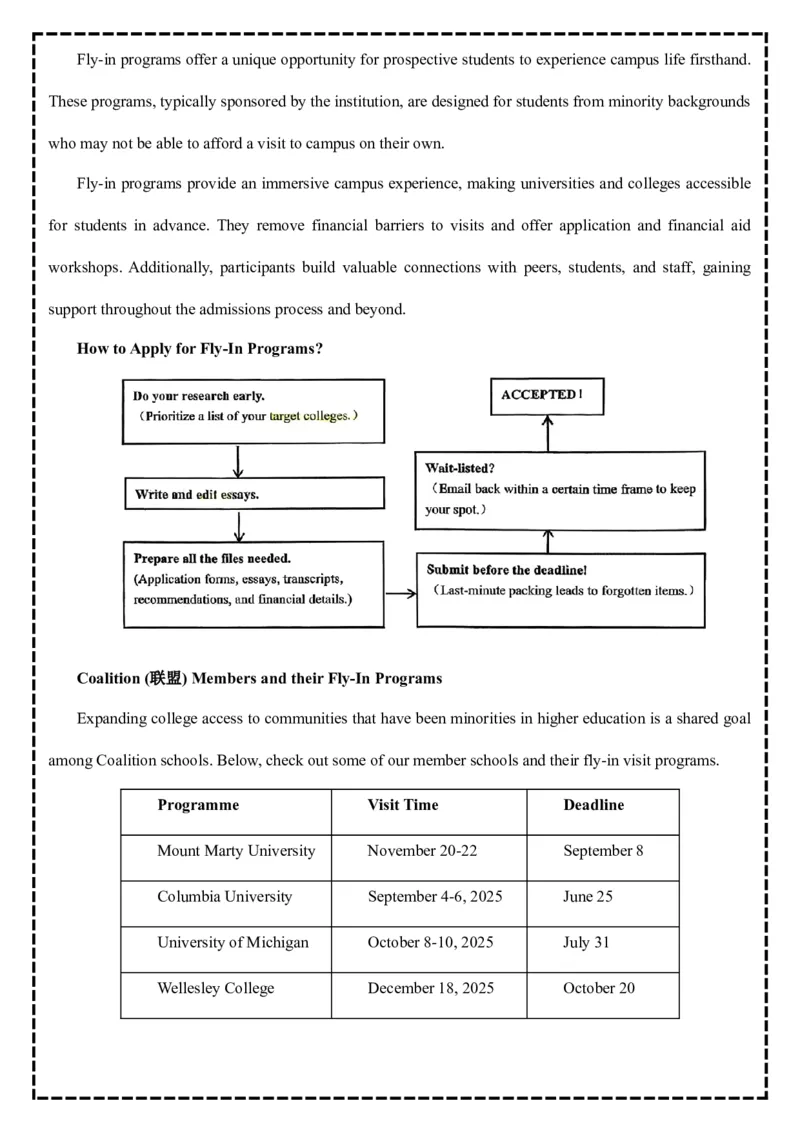
How to Apply for Fly-In Programs?
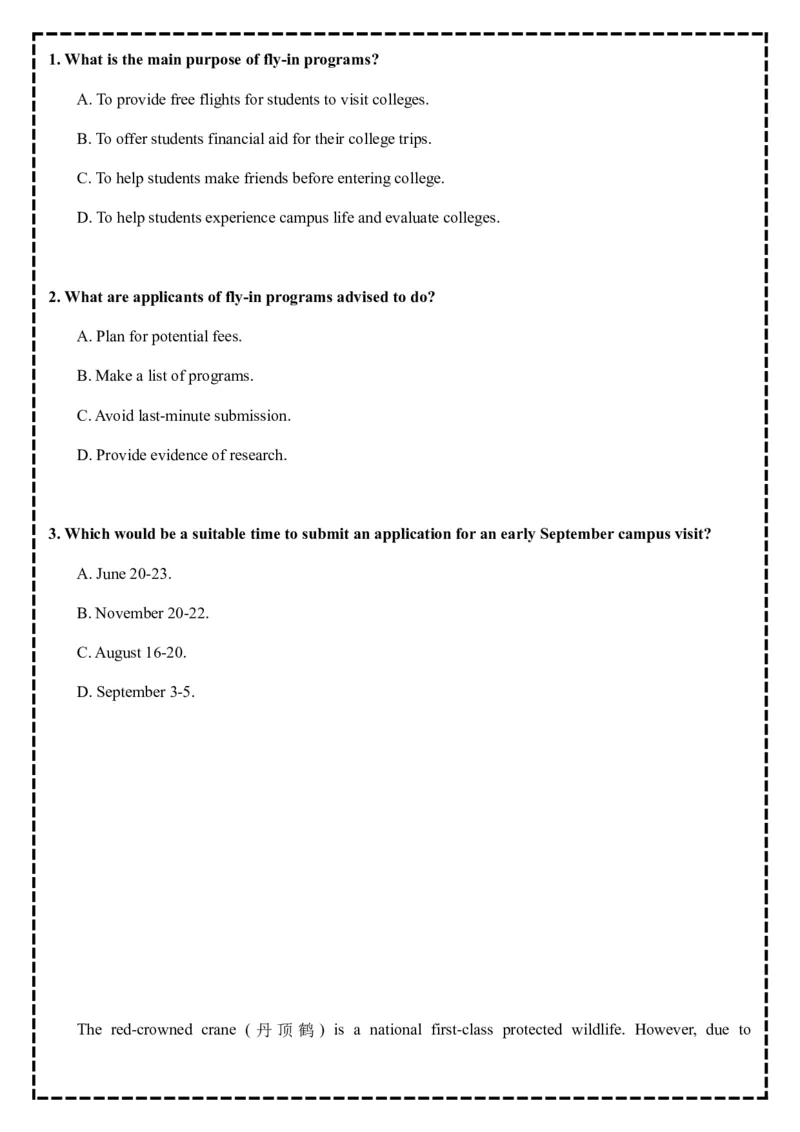
Coalition (联盟) Members and their Fly-In Programs
Expanding college access to communities that have been minorities in higher education is a shared goal
among Coalition schools. Below, check out some of our member schools and their fly-in visit programs.
Programme
Visit Time
Deadline
Mount Marty University
November 20-22
September 8
Columbia University
September 4-6, 2025
June 25
University of Michigan
October 8-10, 2025
July 31
Wellesley College
December 18, 2025
October 20
1. What is the main purpose of fly-in programs?
A. To provide free flights for students to visit colleges.
B. To offer students financial aid for their college trips.
C. To help students make friends before entering college.
D. To help students experience campus life and evaluate colleges.
2. What are applicants of fly-in programs advised to do?
A. Plan for potential fees.
B. Make a list of programs.
C. Avoid last-minute submission.
D. Provide evidence of research.
3. Which would be a suitable time to submit an application for an early September campus visit?
A. June 20-23.
B. November 20-22.
C. August 16-20.
D. September 3-5.
The red-crowned crane ( 丹顶鹤) is a national first-class protected wildlife. However, due to
environmental and ecological damage, the number of red-crowned cranes had been dangerously declining
when Zhao Shiwei joined the Zhaoquan River Management Station in 1992. Artificial breeding of red-crowned
cranes became an important part of Zhao’s work.
3 red-crowned crane birds hatched at the station through his artificial program in 1996. Despite tasting
success, Zhao and his team encountered hardships the following year. In 1997, not a single red-crowned crane
bird hatched. And in 1998, only one red-crowned crane chick hatched through artificial breeding, but it died
soon after.
In 1999, the station rescued 7 injured red-crowned cranes from the wild, which brought a crucial ray of
hope for the program. That drove Zhao and his colleagues to check temperature control devices, go through a
huge amount of data, and seek advice from experts, hoping to achieve a breakthrough in artificial breeding.
They tried every possible method, even consulting technicians from nearby chicken farms. Finally, the
artificial breeding program improved a lot. Later, a record of 85 red-crowned crane birds hatched at the station
through a combination of artificial and natural breeding methods. Over the past 30 years, Zhao has always
been personally involved in the hatching process. “This part is the most crucial; there cannot be the slightest
error,” he said.
Later, Zhao realized that with the number of artificially bred red-crowned cranes increasing, the bond
between the cranes and humans was growing stronger. “But they are the spirits of nature and hence should
return to nature.” Zhao said. Therefore, Zhao provided outdoor training to artificially bred red-crowned cranes
in the reserve in order to increase the number of wild red-crowned cranes. Up to now, Zhao and his team have
bred and released more than 200 red-crowned cranes after ensuring they will be able to survive in nature.
4. What does the author imply about the red-crowned cranes in the first two paragraphs?
A. They’re at risk of going extinct.
B. They top all other wildlife in value.
C. Their artificial breeding started in 1992.
D. Their number stopped declining in 1996.
5. What was the turning point in the artificial breeding program?
A. Raising sufficient funds.
B. Rescuing 7 wild cranes.
C. Hiring some wildlife experts.
D. Purchasing advanced devices.
6. Why did Zhao train cranes outdoors?
A. To give tourists chances to admire cranes.
B. To improve cranes’ survival skills in the wild.
C. To increase the number of artificially-bred cranes.
D. To strengthen the bond between cranes and humans.
7. What is Zhao Shiwei’s attitude towards his work of protecting red-crowned cranes over the 30
years?
A. Reluctant and doubtful.
B. Passionate and careful.
C. Pessimistic and indifferent.
D. Devoted and committed.
One of my bad habits is saying “busy” when people ask me how I’m doing. Sometimes it’s because I
actually am busy, but other times it’s because that’s what I think I’m supposed to say. That’s what important
people say. That’s what people who get promoted say. But working long hours doesn’t drive better results.
Never taking a vacation won’t lead to a promotion. So why are we so proud to talk about how busy we are all
the time?
In 2016, researchers from Columbia, Harvard, and Georgetown conducted a study to figure it out. They
found busy people are perceived to be of high status, and interestingly, these status attributions are heavily
influenced by our own beliefs about social mobility. In other words, the more we believe that one has the
opportunity for success based on hard work, the more we tend to think that people who skip leisure and work
all the time are of higher standing.
That’s why we feel like we have to appear busy, and there’s a real perception that if someone is knee-
deep in meetings, emails, and stress, then they’re probably a big deal. This culture of busyness is making it
hard for employees to find work-life balance. According to a recent study, one in five highly engaged
employees is at risk of burnout.
Personally, I’m going to stop saying “busy” when people ask me how I am. It sounds self-righteous (自
以为是的) and sets the wrong tone. Phrases like “I have limited access to email” and “I’ll respond as soon as
I get back” sound like you’re being held against your will from working as opposed to making the most of
your time off.
By rejecting the myth that business equals worth, we free ourselves and others from exhaustion. True
success isn’t about working harder; it’s about working smarter and finding balance. Let’s redefine what it
means to be productive — and start valuing rest as much as effort.
8. How does the author introduce the topic in the first paragraph?
A. By quoting famous people.
B. By presenting statistical data.
C. By comparing different opinions.
D. By introducing personal experience.
9 Why do we tend to think that busy people are of high status?
A. Our status can be attributed to our social mobility.
B. We hold the belief that hard work leads to success.
C. Our own opportunity for success never comes easily.
D. We find few people of high status have time for leisure.
10 What does the underlined phrase “knee-deep in” in Paragraph 3 probably mean?
A. Bored with.
B. Worried about.
C. Fully involved in.
D. Very interested in.
11. What is the author’s purpose in writing the passage?
A. To advise employees on how to achieve work-life balance.
B. To share his personal experience of overcoming a bad habit.
C. To introduce a study on people’s attitude towards busyness.
D. To argue against the culture of equating busyness with worth.
Scientists are advancing brain-computer interface (BCI) technology with a breakthrough system that
translates inner speech into audible words. Developed by US researchers, this “thought decoder (解码器)”
achieved 74% accuracy in converting the imagined speech of four paralyzed volunteers into sound.
Unlike earlier BCIs, which relied on brain signals from attempted speech or writing, the new device
directly interprets neural patterns linked to phonemes (speech units), aiming to restore fluent communication
for those with speech or motor disabilities.
The system works by implanting sensors in the motor cortex (运动皮层) the brain region controlling
movement, including speech. As volunteers think of words, machine learning algorithms ( 算法) analyze
neural activity to identify phoneme patterns and reconstruct sentences. Stanford neuroscientist Benyamin
Meschede-Krasa explains, “If you just have to think about speech instead of actually trying to speak, it’s
potentially easier and faster.”
Researchers discovered overlapping brain signals between attempted and imagined speech, but the system
could distinguish them through probability calculations. For example, it recognized 125,000 words by linking
frequent phoneme combinations. “These patterns are a similar but smaller version of attempted speech
activity,” notes Stanford’s Frank Willett, adding, “We decoded them well enough to prove the principle, but
not as well as attempted speech.”
There’s still a long way to go here, and the BCI often fell far short of that 74% maximum accuracy rating.
However, by utilizing upgraded implant technology and mapping more of the brain for thought cues, the
researchers are confident that the system can be quickly improved over the next few years.
Another issue to overcome is the potential for translating, logging, and speaking out inner monologues
that are intended to be kept private — not something you want in a BCI. Safeguards like thinking of a special
password start and stop decoding could be implemented here, the researchers suggest. This concept was trialed
in the experiments with 98 percent accuracy.
This follows other progress, such as a recent real-time thought-decoding study (personalized to one
individual). “The future of BCIs is bright,” Willett says. “This gives hope that speech BCIs may one day
restore communication as fluent and natural as conversational speech.”
12. How does the new BCI system differ from earlier models?
A It uses external sensors instead of implants.
B. It requires physical movement to generate speech.
C. It relies on brain signals from attempted writing only.
D. It directly decodes neural patterns associated with inner speech.
13. What can we infer from Paragraph 3?
A. Benyamin Meschede-Krasa invented the new BCI system.
B. The motor cortex is only responsible for speaking movements.
C. Machine learning plays a key role in linking brain signals to words.
D. The new BCI needs users to silently speak words to generate neural signals.
14. What privacy concern is raised about the BCI system?
A. It stores thoughts without user approval.
B. It might decode unintended private thoughts.
C. It cannot differentiate between multiple users.
D. It requires users to share mental passwords publicly
15. Which of the following is the best title for the text?
A. BCIs: The Future of Medical Implants.
B. Breakthrough in Decoding Imagined Speech.
C. The Morals of Translating Inner Monologues.
D. Overcoming Paralysis Through Brain Technology.
Earlier this month, OpenAI revealed a new version in training mode that is “good at creative writing.”
Though its release date is unclear, as a longtime freshman composition instructor, I’m already aware of the
problem of AI.-assisted cheating in writing classes. ___16___ After all, students have been unvoluntarily
exposed to an overwhelming amount of promotion around A. I., and have seen news that makes false claims
about how powerful A. I. tools are.
But a creative writing student using A. I.? In a memoir (传记) writing class? What are you saying about
your life if even you can’t be bothered to think about it.
Having written two memoirs, I know the challenges and pleasures of this work, and I want my students
to experience those challenges, too. ___17___ Rather, it is about defining who you are, in part by revisiting
particularly unpleasant experiences. This process makes the author more fully alive.
 ___18___ Using a machine that gathers information online and creates a fake version of you is not just
cheating; it degrades our memories and humanity. Yet it’s not the students who concern me most, but a culture
that undervalues writing and reading so much that some students think skipping them is a reasonable choice.
The only thing under my control as a teacher is what I do in my classroom. ___19___ Whether they write
best-sellers or just scribble in journals, doing the work with their full selves is what truly matters.
Writing can be a way to preserve ourselves and even a form of resistance. ___20___
A. I’ll teach students to write honestly.
B. I can even sympathize, to an extent.
C. This may feel like a battle already lost.
D. Outsourcing your life story to AI is disheartening.
E. The act of writing a memoir is not just about saying “Look at me”.
F. That fighting spirit is our greatest strength and exists only within us.
G. It is upsetting to see AI creating fake stories, but maybe it’s just new storytelling.
An extreme sport like BMX (Bicycle Motocross) may not be the first thing that comes to mind to help
overcome a mental health condition. However, that is ____21____ what enabled Nikita Ducarroz to fight her
fears.
As a child, Ducarroz spent every ____22____ moment on the soccer field. But at 13, the talented athlete
began to suffer from ____23____ anxiety attacks that made it hard for her to leave home. When her mother
told her she had to continue playing a sport, Ducarroz found BMX as a way to ____24____ that rule. Little
did she know that BMX would soon ____25____ every aspect of her life, and become the reason she would
push through her fears one step at a time.
The tale began when a BMX video on YouTube inspired her to try the extreme sport. She saved up for a
bike. Then she began practicing ____26____ in her driveway. Soon, her excellent skills brought her enough
____27____ to ride at the local skate park. With that confidence, Ducarroz was ____28____ to ride in the
competition in 2016, and she has not looked back since.
“The bike made me get out of the house, go to the skate park, and ____29____ get on a plane,” said
Ducarroz. “It _____30_____ me to overcome all my fears.”
The 26-year-old is now one of the world’s best female BMX freestylers. Ducarroz now has her
_____31_____ set on the 2024 Paris Olympics. She says, “My goal in Paris is another medal. I can get that
done with the training.”
Though she still suffers occasional _____32_____ attacks, Ducarroz now knows how to manage them.
To help others with mental health conditions, Ducarroz has started an Instagram page called MindTricks. It is
where people discuss their fears _____33_____.
“MindTricks started because of my own _____34_____ that I was making on Instagram about mental
health,” she explained. “And I thought, ‘Why don’t we create a place where others can do the same, a central
spot where everyone can read about these stories and also feel _____35_____ to share their own stories?’”
21. A. precisely
B. automatically
C. roughly
D. temporarily
22. A. expectant
B. boring
C. spare
D. urgent
23. A. slight
B. mild
C. occasional
D. severe
24. A. end
B. fulfill
C. measure
D. resist
25. A. put off
B. ate away
C. took over
D. slowed down
26. A. concepts
B. tricks
C. facilities
D. models
27. A. confidence
B. muscle
C. patience
D. fortune
28. A. likely
B. hesitant
C. ready
D. effortless
29. A. slowly
B. abruptly
C. swiftly
D. eventually
30. A. blocked
B. pushed
C. left
D. hooked
31. A. luck
B. sight
C. standard
D. training
32. A. panic
B. heart
C. delight
D. annoyance
33. A. carefully
B. privately
C. safely
D. humbly
34. A. appearance
B. medals
C. posts
D. choices
35. A. ashamed
B. reserved
C. collapsed
D. enlightened
China Focus: China’s upscale ice creams melting hearts of consumers
Once just a simple way to cool off, ice cream is seeing a surge of new varieties to meet the expanding
tastes and preferences of Chinese consumers since its first appearance.
On the Chinese lifestyle-sharing app known internationally as RedNote, many users have posted
appealing images of upscale ice creams ____36____ various shapes, ranging from blooming flowers to fresh
fruits, each of ____37____ is the result of delicate craftsmanship. ____38____ (comment) such as “adorable”
and “too pretty to eat” are very common in these posts.
Favored by today’s consumers, especially young people, such ice creams ____39____ (become)
commonplace in souvenir shops at tourist attractions across China since their first appearance. Handan
Museum, a well-known tourist site in Hebei in April introduced creative ice creams that drew inspiration from
two precious artifacts ____40____ (house) in the museum. “Blind boxes” containing randomly flavored ice
creams are also on sale to attract customers. The museum’s ice creams have been ____41____ hit among
visitors since their launch, with over 100 sold daily this summer. Food industry analyst Zhu Danpeng believes
the ____42____ (emerge) of these visually appealing ice creams reflects a thirst for emotional and
____43____ (spirit) well-being in consumption.
The shift to healthy eating has spurred changes in the industry. Traditional ice cream makers are adjusting
their ingredients ____44____ unveiling new products in response to evolving needs, while new brands are
winning customers by labeling themselves as producers of handcrafted and _____45_____ (fresh) made ice
creams.
英国一所友好学校的师生将到你校访问。你将作为学生代表在欢迎晚会上致辞,并赠送学生
们自制的文创礼物。请你用英语写一篇欢迎辞,包括以下内容:
1.表示欢迎;
2.介绍礼物。
注意:
1.写作词数应为80 左右;
2.请按如下格式在答题卡的相应位置作答。
     Good evening, dear friends! …

It was a cold, gray day when Frank Daily stood with his friends, waiting for the bus after school, his
breath forming pale clouds in the bitter air. Frank only pretended to listen to the chatter of his friends, hiding
the disappointment crushing his spirit. Basketball season had begun without him — his five-foot-four frame
considered “insufficient” for the team. And the coach’s harsh words echoed in his mind, “Good skills, but we
need height.”
Starting a new school wasn’t easy, especially for Frank, who had been a star athlete in elementary school.
His mom used to say, “If you put as much time into books as into basketball, you could do well in both.” Well,
maybe she was right about the books. Basketball, however, was a different story. Now he felt like a nobody.
On boarding the bus, Frank sank himself into the seat while his mind remained trapped outside the locker
room. He could still feel the pain as he scanned the team list, searching desperately for his name-and didn’t
find it. The rejection hurt more than the biting cold, making him feel completely “invisible” in his new
school.
A loud horn and a sudden stop interrupted Frank’s gloomy thoughts. The bus doors hissed
open and a very pregnant woman struggled to get on by grabbing the metal handrail (扶手) with
cold-reddened hands. As she dropped into the nearest seat with a sigh, Frank noticed she was only
wearing torn, wet socks that offered no protection and warmth.
When the driver asked about her shoes, she explained with quiet dignity, “I can’t afford them. I just got
on to warm my feet, if you don’t mind.” Hearing this, Frank was lost in thought. He knew he could always
afford shoes. She probably never could. He looked down at his new basketball shoes-once an inspiring gift
from mom, now a reminder of his broken basketball dream. Then he looked at the woman. The word
“invisible” popped into his mind again: an invisible person, but for a different reason.
 Frank glanced at the lady’s wet socks and made a decision.
  “May I know your name?” she asked  her voice was soft with emotion.