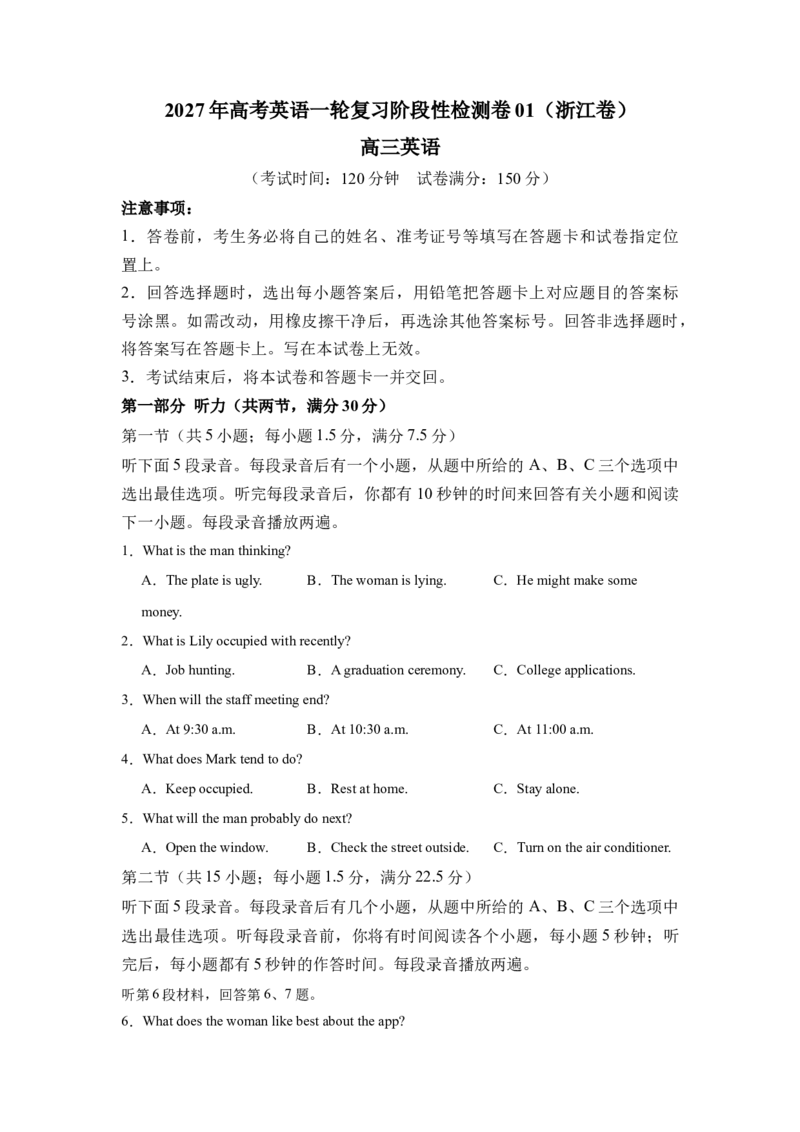
2027年高考英语一轮复习阶段性检测卷01(浙江卷)
高三英语
(考试时间:120分钟 试卷满分:150分)
注意事项:
1.答卷前,考生务必将自己的姓名、准考证号等填写在答题卡和试卷指定位
置上。
2.回答选择题时,选出每小题答案后,用铅笔把答题卡上对应题目的答案标
号涂黑。如需改动,用橡皮擦干净后,再选涂其他答案标号。回答非选择题时,
将答案写在答题卡上。写在本试卷上无效。
3.考试结束后,将本试卷和答题卡一并交回。
第一部分 听力(共两节,满分30分)
第一节(共5小题;每小题1.5分,满分7.5分)
听下面5段录音。每段录音后有一个小题,从题中所给的 A、B、C三个选项中
选出最佳选项。听完每段录音后,你都有 10秒钟的时间来回答有关小题和阅读
下一小题。每段录音播放两遍。
1.What is the man thinking?
A.The plate is ugly. B.The woman is lying. C.He might make some
money.
2.What is Lily occupied with recently?
A.Job hunting. B.A graduation ceremony. C.College applications.
3.When will the staff meeting end?
A.At 9:30 a.m. B.At 10:30 a.m. C.At 11:00 a.m.
4.What does Mark tend to do?
A.Keep occupied. B.Rest at home. C.Stay alone.
5.What will the man probably do next?
A.Open the window. B.Check the street outside. C.Turn on the air conditioner.
第二节(共15小题;每小题1.5分,满分22.5分)
听下面5段录音。每段录音后有几个小题,从题中所给的 A、B、C三个选项中
选出最佳选项。听每段录音前,你将有时间阅读各个小题,每小题 5秒钟;听
完后,每小题都有5秒钟的作答时间。每段录音播放两遍。
听第6段材料,回答第6、7题。
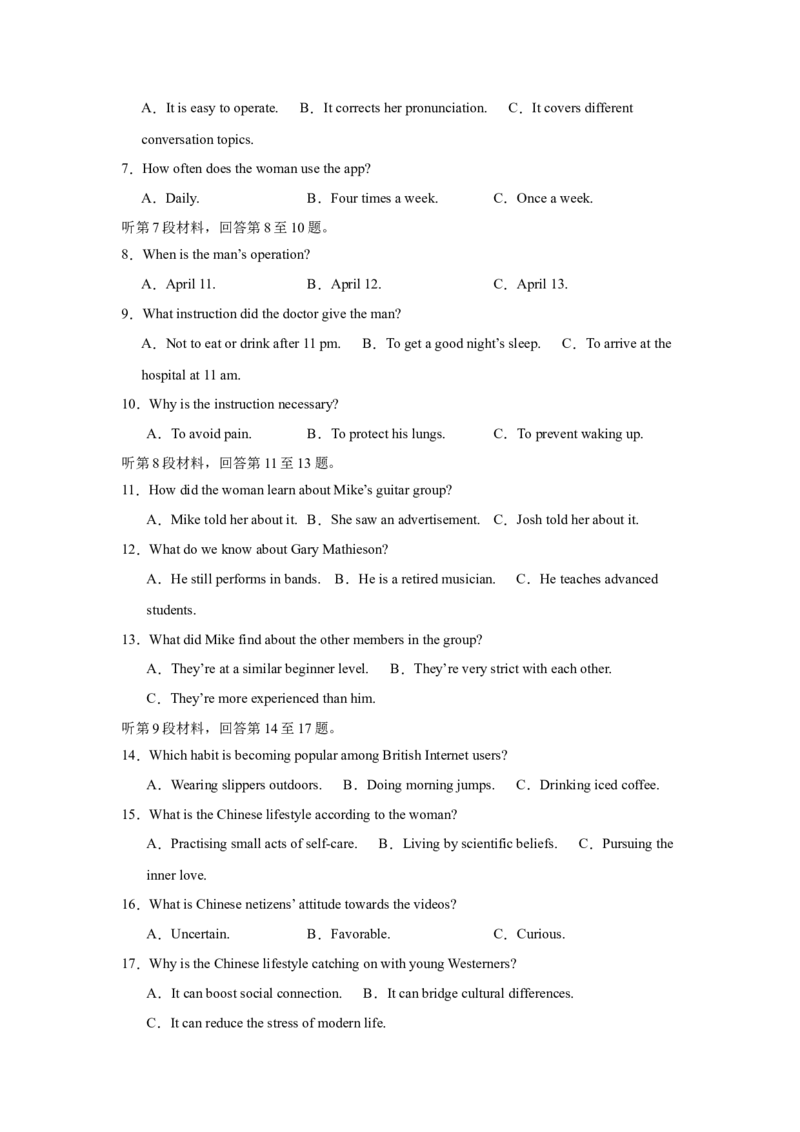
6.What does the woman like best about the app?A.It is easy to operate. B.It corrects her pronunciation. C.It covers different
conversation topics.
7.How often does the woman use the app?
A.Daily. B.Four times a week. C.Once a week.
听第7段材料,回答第8至10题。
8.When is the man’s operation?
A.April 11. B.April 12. C.April 13.
9.What instruction did the doctor give the man?
A.Not to eat or drink after 11 pm. B.To get a good night’s sleep. C.To arrive at the
hospital at 11 am.
10.Why is the instruction necessary?
A.To avoid pain. B.To protect his lungs. C.To prevent waking up.
听第8段材料,回答第11至13题。
11.How did the woman learn about Mike’s guitar group?
A.Mike told her about it. B.She saw an advertisement. C.Josh told her about it.
12.What do we know about Gary Mathieson?
A.He still performs in bands. B.He is a retired musician. C.He teaches advanced
students.
13.What did Mike find about the other members in the group?
A.They’re at a similar beginner level. B.They’re very strict with each other.
C.They’re more experienced than him.
听第9段材料,回答第14至17题。
14.Which habit is becoming popular among British Internet users?
A.Wearing slippers outdoors. B.Doing morning jumps. C.Drinking iced coffee.
15.What is the Chinese lifestyle according to the woman?
A.Practising small acts of self-care. B.Living by scientific beliefs. C.Pursuing the
inner love.
16.What is Chinese netizens’ attitude towards the videos?
A.Uncertain. B.Favorable. C.Curious.
17.Why is the Chinese lifestyle catching on with young Westerners?
A.It can boost social connection. B.It can bridge cultural differences.
C.It can reduce the stress of modern life.听第10段材料,回答第18至20题。
18.What is Bastoni’s main purpose of his trip?
A.To meet the president. B.To protect rain forests. C.To celebrate Independence
Day.
19.How does Bastoni see behind while walking?
A.With a special mirror. B.With a wide camera. C.With a large window.
20.What do we know about Bastoni’s trip?
A.It is still going on. B.It is fully finished. C.It fails completely.
第二部分 阅读(共两节, 满分50分)
第一节(共15小题;每小题2.5分, 满分37.5分)
阅读下列短文, 从每题所给的A、B、C和D四个选项中选出最佳选项。
A
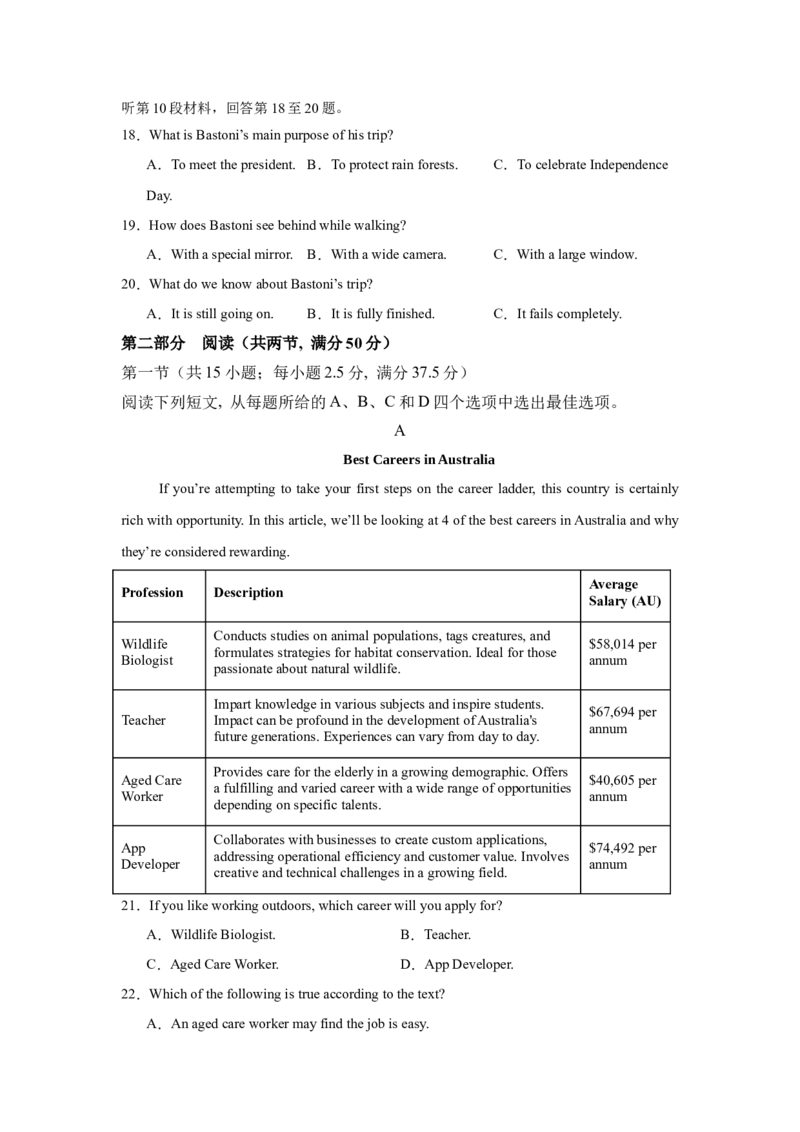
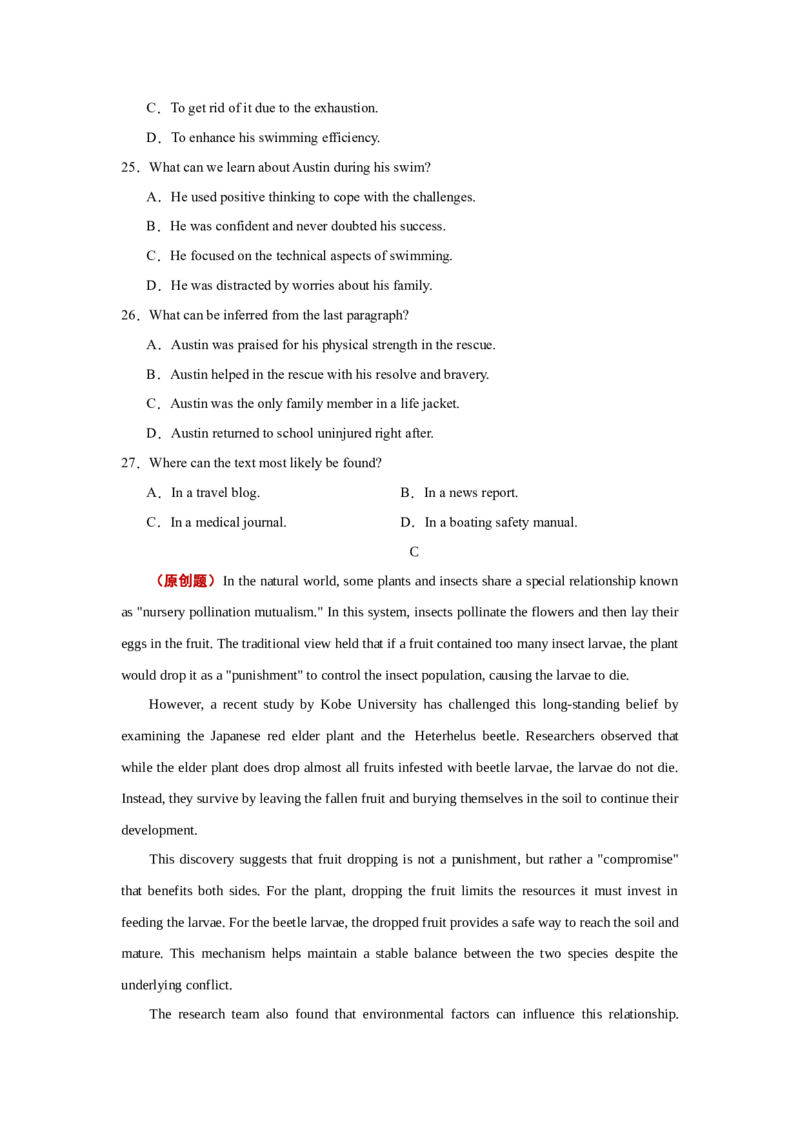
Best Careers in Australia
If you’re attempting to take your first steps on the career ladder, this country is certainly
rich with opportunity. In this article, we’ll be looking at 4 of the best careers in Australia and why
they’re considered rewarding.
Average
Profession Description
Salary (AU)
Conducts studies on animal populations, tags creatures, and
Wildlife $58,014 per
formulates strategies for habitat conservation. Ideal for those
Biologist annum
passionate about natural wildlife.
Impart knowledge in various subjects and inspire students.
$67,694 per
Teacher Impact can be profound in the development of Australia's
annum
future generations. Experiences can vary from day to day.
Provides care for the elderly in a growing demographic. Offers
Aged Care $40,605 per
a fulfilling and varied career with a wide range of opportunities
Worker annum
depending on specific talents.
Collaborates with businesses to create custom applications,
App $74,492 per
addressing operational efficiency and customer value. Involves
Developer annum
creative and technical challenges in a growing field.
21.If you like working outdoors, which career will you apply for?
A.Wildlife Biologist. B.Teacher.
C.Aged Care Worker. D.App Developer.
22.Which of the following is true according to the text?
A.An aged care worker may find the job is easy.B.A teacher needs to be knowledgeable about all subjects.
C.A wildlife biologist earns AU ﹩67,694 per year.
D.An App developer will create apps at the request of customers.
23.Who will most probably take an interest in this text?
A.A researcher. B.An educator.
C.A job hunter. D.A student volunteer.
B
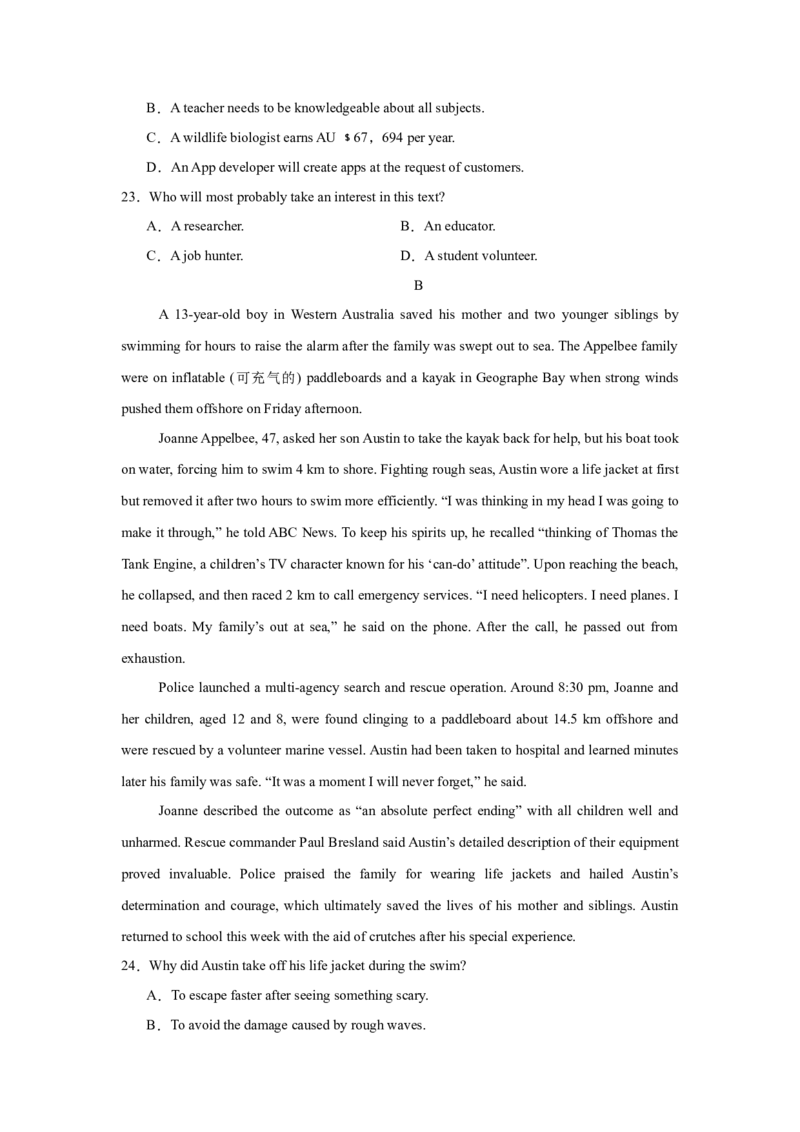
A 13-year-old boy in Western Australia saved his mother and two younger siblings by
swimming for hours to raise the alarm after the family was swept out to sea. The Appelbee family
were on inflatable (可充气的) paddleboards and a kayak in Geographe Bay when strong winds
pushed them offshore on Friday afternoon.
Joanne Appelbee, 47, asked her son Austin to take the kayak back for help, but his boat took
on water, forcing him to swim 4 km to shore. Fighting rough seas, Austin wore a life jacket at first
but removed it after two hours to swim more efficiently. “I was thinking in my head I was going to
make it through,” he told ABC News. To keep his spirits up, he recalled “thinking of Thomas the
Tank Engine, a children’s TV character known for his ‘can-do’ attitude”. Upon reaching the beach,
he collapsed, and then raced 2 km to call emergency services. “I need helicopters. I need planes. I
need boats. My family’s out at sea,” he said on the phone. After the call, he passed out from
exhaustion.
Police launched a multi-agency search and rescue operation. Around 8:30 pm, Joanne and
her children, aged 12 and 8, were found clinging to a paddleboard about 14.5 km offshore and
were rescued by a volunteer marine vessel. Austin had been taken to hospital and learned minutes
later his family was safe. “It was a moment I will never forget,” he said.
Joanne described the outcome as “an absolute perfect ending” with all children well and
unharmed. Rescue commander Paul Bresland said Austin’s detailed description of their equipment
proved invaluable. Police praised the family for wearing life jackets and hailed Austin’s
determination and courage, which ultimately saved the lives of his mother and siblings. Austin
returned to school this week with the aid of crutches after his special experience.
24.Why did Austin take off his life jacket during the swim?
A.To escape faster after seeing something scary.
B.To avoid the damage caused by rough waves.C.To get rid of it due to the exhaustion.
D.To enhance his swimming efficiency.
25.What can we learn about Austin during his swim?
A.He used positive thinking to cope with the challenges.
B.He was confident and never doubted his success.
C.He focused on the technical aspects of swimming.
D.He was distracted by worries about his family.
26.What can be inferred from the last paragraph?
A.Austin was praised for his physical strength in the rescue.
B.Austin helped in the rescue with his resolve and bravery.
C.Austin was the only family member in a life jacket.
D.Austin returned to school uninjured right after.
27.Where can the text most likely be found?
A.In a travel blog. B.In a news report.
C.In a medical journal. D.In a boating safety manual.
C
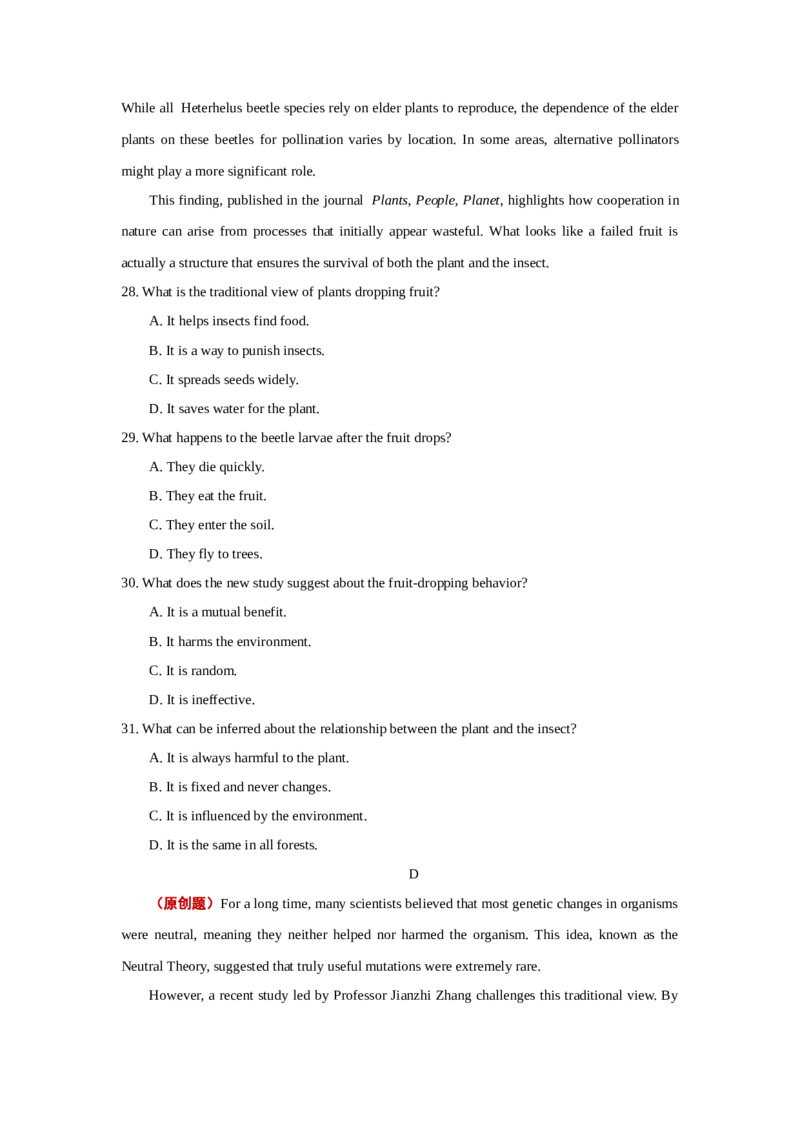
(原创题)In the natural world, some plants and insects share a special relationship known
as "nursery pollination mutualism." In this system, insects pollinate the flowers and then lay their
eggs in the fruit. The traditional view held that if a fruit contained too many insect larvae, the plant
would drop it as a "punishment" to control the insect population, causing the larvae to die.
However, a recent study by Kobe University has challenged this long-standing belief by
examining the Japanese red elder plant and the Heterhelus beetle. Researchers observed that
while the elder plant does drop almost all fruits infested with beetle larvae, the larvae do not die.
Instead, they survive by leaving the fallen fruit and burying themselves in the soil to continue their
development.
This discovery suggests that fruit dropping is not a punishment, but rather a "compromise"
that benefits both sides. For the plant, dropping the fruit limits the resources it must invest in
feeding the larvae. For the beetle larvae, the dropped fruit provides a safe way to reach the soil and
mature. This mechanism helps maintain a stable balance between the two species despite the
underlying conflict.
The research team also found that environmental factors can influence this relationship.While all Heterhelus beetle species rely on elder plants to reproduce, the dependence of the elder
plants on these beetles for pollination varies by location. In some areas, alternative pollinators
might play a more significant role.
This finding, published in the journal Plants, People, Planet, highlights how cooperation in
nature can arise from processes that initially appear wasteful. What looks like a failed fruit is
actually a structure that ensures the survival of both the plant and the insect.
28. What is the traditional view of plants dropping fruit?
A. It helps insects find food.
B. It is a way to punish insects.
C. It spreads seeds widely.
D. It saves water for the plant.
29. What happens to the beetle larvae after the fruit drops?
A. They die quickly.
B. They eat the fruit.
C. They enter the soil.
D. They fly to trees.
30. What does the new study suggest about the fruit-dropping behavior?
A. It is a mutual benefit.
B. It harms the environment.
C. It is random.
D. It is ineffective.
31. What can be inferred about the relationship between the plant and the insect?
A. It is always harmful to the plant.
B. It is fixed and never changes.
C. It is influenced by the environment.
D. It is the same in all forests.
D
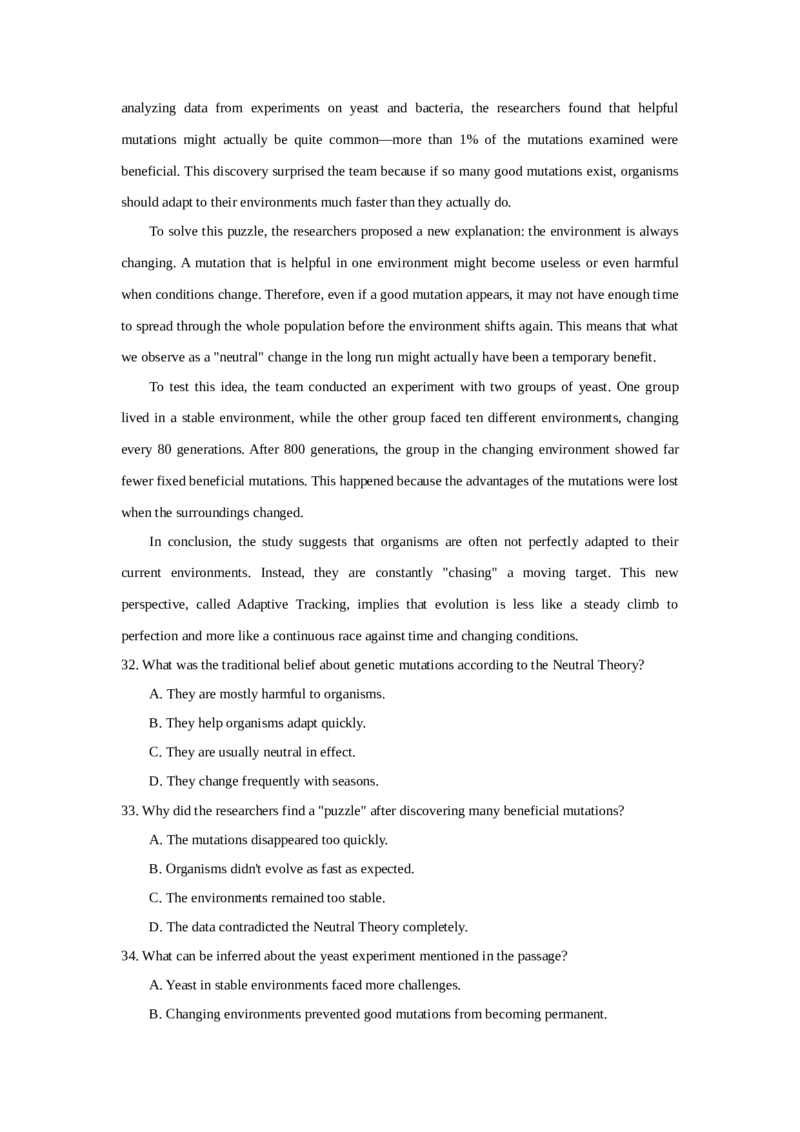
(原创题)For a long time, many scientists believed that most genetic changes in organisms
were neutral, meaning they neither helped nor harmed the organism. This idea, known as the
Neutral Theory, suggested that truly useful mutations were extremely rare.
However, a recent study led by Professor Jianzhi Zhang challenges this traditional view. Byanalyzing data from experiments on yeast and bacteria, the researchers found that helpful
mutations might actually be quite common—more than 1% of the mutations examined were
beneficial. This discovery surprised the team because if so many good mutations exist, organisms
should adapt to their environments much faster than they actually do.
To solve this puzzle, the researchers proposed a new explanation: the environment is always
changing. A mutation that is helpful in one environment might become useless or even harmful
when conditions change. Therefore, even if a good mutation appears, it may not have enough time
to spread through the whole population before the environment shifts again. This means that what
we observe as a "neutral" change in the long run might actually have been a temporary benefit.
To test this idea, the team conducted an experiment with two groups of yeast. One group
lived in a stable environment, while the other group faced ten different environments, changing
every 80 generations. After 800 generations, the group in the changing environment showed far
fewer fixed beneficial mutations. This happened because the advantages of the mutations were lost
when the surroundings changed.
In conclusion, the study suggests that organisms are often not perfectly adapted to their
current environments. Instead, they are constantly "chasing" a moving target. This new
perspective, called Adaptive Tracking, implies that evolution is less like a steady climb to
perfection and more like a continuous race against time and changing conditions.
32. What was the traditional belief about genetic mutations according to the Neutral Theory?
A. They are mostly harmful to organisms.
B. They help organisms adapt quickly.
C. They are usually neutral in effect.
D. They change frequently with seasons.
33. Why did the researchers find a "puzzle" after discovering many beneficial mutations?
A. The mutations disappeared too quickly.
B. Organisms didn't evolve as fast as expected.
C. The environments remained too stable.
D. The data contradicted the Neutral Theory completely.
34. What can be inferred about the yeast experiment mentioned in the passage?
A. Yeast in stable environments faced more challenges.
B. Changing environments prevented good mutations from becoming permanent.C. All mutations became harmful in the new environments.
D. The experiment lasted for more than 1000 generations.
35. What is the main idea of the passage?
A. Humans are not well adapted to modern environments.
B. The Neutral Theory of Evolution has been proven wrong.
C. Evolution is a constant struggle to catch up with changing environments.
D. Most genetic changes are beneficial rather than neutral.
第二节 (共5小题;每小题2.5分,满分12.5分)
阅读下面短文,从短文后的选项中选出可以填入空白处的最佳选项。选项中有
两项为多余选项。
Most students, despite age or background, truly enjoy participating in art. The attractive
aspects of art keep us focused. Using art in the classroom is no different.
Students who participate in art strengthen their focus skills. 36 For visual art, that
problem may be deciding which art tools or materials will create the picture in their minds. For
performance art, students may need precise time to remind them. Regardless of the art medium,
students must keep up with what is happening in order to successfully complete their work.
Students find art as a way of self-expression and creativity. There are no limits to art.
Students can create whatever they want with their imagination. 37 Even the shyest
students can express themselves through art.
Increased participation and motivation mean increased determination and perseverance.
When students start an art project, they are more determined to see it completed. Most primary
teachers can prove the fact that many students are not happy when their work of art is interrupted
before it has been completed. 38
The development of self-expression and creativity, free from judgement, increases students’
confidence! 39 Students develop a greater sense of self by expressing themselves
openly and in their own way. It is also quite rewarding for students to share their art with others
and develop their interpersonal skills.
40 Participation in art is highly beneficial to students’ performance in the
classroom. Art requires the use of many parts of the brain, thus, providing better overall brain
usage in students.A.Art can make students smarter.
B.Students colorfully write out the word.
C.If they can picture it, they can create it.
D.There are no right or wrong ways to create art.
E.Students must concentrate on the problem at hand.
F.Teachers should combine art with learning more carefully.
G.Students wish to realize their ideas through art without break.
第三部分 语言运用(共两节,满分30分)
第一节(共15小题;每小题1分,满分15分)
阅读下面短文,从每题所给的A、B、C、D四个选项中选出最佳选项。
I left my familiar life behind and went to a remote village in Guizhou Province. Though I
thought I had fully prepared myself to 41 in a rural school, a wave of shock and concern
washed over me at the sight of the tough conditions.
Each day, I managed to 42 my way along rough, rocky mountain paths to the
school, leaving me worn out. This was no 43 for local young children. The one-way
journey would take up to two hours without their parents’ 44 .
The major 45 lay in the shortage of teaching 46 , let alone modern
electronic devices, so I had to attach greater importance to teaching 47 at this school.
With no suitable lab supplies at hand, I once used simple daily objects to design a chemistry
experiment. The students reacted 48 , some even letting out loud cheers. Besides, I made
efforts to 49 funds for essential learning resources and teaching equipment, successfully
making them 50 to kids.
Another barrier was the local students’ strong accent, which greatly 51 our
communication. To smooth our interaction, I 52 to adapt to the local dialect and gave
53 repeatedly until they grasped the meaning.
Gradually, these hardships no longer 54 me. Instead, I gained unseen joy, which
encouraged me to 55 my voluntary work. Witnessing meaningful changes take place in
these children day by day, I knew all my efforts had truly paid off.
41.A.study B.settle C.teach D.train
42.A.find B.wind C.push D.feel
43.A.entertainment B.adventure C.difficulty D.exception44.A.company B.protection C.guidance D.permission
45.A.challenge B.crisis C.burden D.difference
46.A.methods B.facilities C.staff D.experience
47.A.quality B.process C.discipline D.innovation
48.A.wildly B.calmly C.excitedly D.quietly
49.A.deliver B.invest C.secure D.withdraw
50.A.familiar B.available C.relevant D.beneficial
51.A.blocked B.changed C.ruined D.interrupted
52.A.desired B.volunteered C.hesitated D.struggled
53.A.lessons B.comments C.explanations D.suggestions
54.A.frightened B.annoyed C.disappointed D.bothered
55.A.take up B.stick to C.focus on D.go for
第二节 语法填空(共10小题;每小题1.5分:共15分)
阅读下面短文,在空白处填入一个适当的单词或括号内单词的正确形式。
The 31st World Book and Copyright Day fell on Thursday. Coinciding with China’s first
national reading week, the People’s Daily invited two of China’s most celebrated authors, Mo Yan
and Yu Hua, 56 (discuss) reading and literary creation in the age of artificial
intelligence (AI) as well as youth development.
The conversation explored why people read, how eclectic books in one’s youth can shape a
lifetime, how young graduates can find direction amid uncertainty, and 57 close, careful
reading still matters now that AI can produce 58 (write) works.
For Nobel laureate Mo Yan, the journey to becoming a writer began with an intense love of
reading rather than writing. 59 (grow) up in a rural area with limited access to books, he
often had only a single day to borrow and finish 60 (they).
Despite reading quickly, he noted that the stories remained vivid in his memory. His
experience, he suggested, highlights the importance of reading during youth, when 61
(absorb) and imagination are at their peak.
Mo Yan explained that reading gradually 62 (awaken) his desire to write.
Alongside practical ambitions for a better life, he also developed a much 63 (deep)
aspiration: “to use my pen to express inner emotions and portray real life.”
Writer Yu Hua offered a different perspective. 64 Mo Yan, his early readingexperiences were often incomplete, 65 missing pages forced him to imagine how
stories might begin or end.
“My imagination was cultivated at that time,” he said. For him, the impulse to write did not
come from a single moment but from a series of small accumulations.
第四部分 写作(共两节, 满分40分)
第一节(满分15分)
66.假定你是李华,你所在的社区暑期将举办为期一周的“青少年志愿者夏令营”(Youth
Volunteer Summer Camp),旨在培养中学生的社会责任感和团队合作能力。请你给英国笔友
Chris写一封邮件,邀请他参加。
内容包括:
1.夏令营的基本信息;
2.活动的意义;
3.期待他的参与。
注意:
1.写作词数应为80左右;
2.请按如下格式在答题卡的相应位置作答。
Dear Chris,
_______________________________________________________________________________
_______________________________________________________________________________
_______________________________________________________________________________
_______________________________________________________________________________
_______________________________________________________________________________
_____________________________________________________________
Yours,
Li Hua
第二节(满分25分)
阅读下面材料,根据其内容和所给段落开头语续写两段,使之构成一篇完整的
短文。
Last year, I participated in a week-long volunteer program at a local animal shelter along
with several other high school students from different schools. Among them was a boy named
Oliver, who was quiet and seldom spoke. He always stayed in the corner, brushing the cats orcleaning the cages silently. I didn't pay much attention to him at first, as I was busy making friends
with more outgoing volunteers.
On the second day, after lunch, I reached into my backpack for my favorite water bottle-a
blue one with a white lid (盖子) that I had used for nearly three years. It was not there. I searched
every pocket twice,growing more anxious with each passing minute. That bottle had been with me
through every soccer practice and every exam. I couldn't believe I had lost it.
The next morning, during the break, I noticed Oliver sitting on a bench near the dog run,
drinking fromn a bottle that looked exactly like mine-the blue body with a white lid. My heart
sank. Feeling upset and betrayed, I marched over to him. “Why did you take my water bottle
without asking?" I scoded, with my voice louder than I intended.
Oliver's face turned red. He looked down at the bottle in his hands, then back at me,and
said,“This is mine. It was a gift from my grandmother before she passed away. See this small
scratch here. I made it when I was little.”He pointed to a tiny scratch near the bottom.I leaned in
and looked closely. I had never noticed a scratch on my bottle because there wasn't one.
So I checked my backpack again. This time, I reached into the very bottom of it and found my
own bottle buried deep inside, which was placed in the pocket of my coat. At that moment, I felt a
wave of shame washing over me. I had accused Oliver without knowing the truth.
注意:
(1)续写词数应为150个左右;
(2)请按如下格式在答题卡的相应位置作答。
I went to apologize to Oliver right away.
_______________________________________________________________________________
_______________________________________________________________________________
_______________________________________________________________________________
_______________________________________________________________________________
_______________________________________________________________________________
From that day on, Oliver and I became close friends.
_______________________________________________________________________________
_______________________________________________________________________________
______________________________________________________________________________________________________________________________________________________________
_______________________________________________________________________________