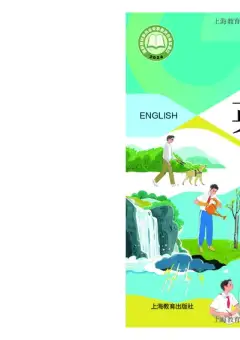
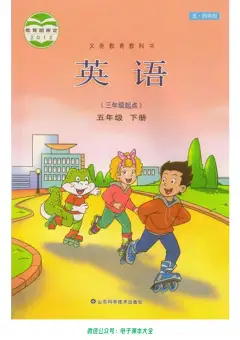
English
英语
义务教育教科书
七年级上册
七年级上册
英语
义务教育教科书
English
致 同 学
欢迎来到英语学习乐园!在这里,我们会遇到八个小伙伴,他们是王欣悦
(Millie)、罗阳(Simon)、李珊珊(Sandy)、陈丹(Daniel)、张珂(Kitty)、赵敏
(Amy)、杨青(Nora)和魏书铭(David)。他们将陪伴我们一起度过三年的英语学
习时光。在这里,我们将探究与自我、社会、自然相关的主题,学习多种类型的语篇,
欣赏地道优美的语言,用英语进行日常交流,开展多姿多彩的活动。在这里,我们将
综合运用知识、技能和策略,解决真实情境中的问题。在这里,我们将感悟中华优秀
文化,了解丰富多样的世界文明,积极思考,快乐成长。
本套教材内容的选取遵循培根铸魂、启智增慧的原则,充分体现英语课程的核心
素养培养要求。本学期我们共学习八个单元,每四个单元围绕一个大的主题。每个
单元的首页呈现单元主题、单元概览、学习情境和任务,引领我们进入单元学习。导
入(Welcome to the unit)板块利用图片、文字等多种形式激活我们的已有知识,激
发学习兴趣。在阅读(Reading)板块,本学期我们将学习向他人介绍自己和同学,
谈论彼此的兴趣爱好,描述美丽的校园和丰富多彩的学校生活;我们还将探讨日常生
活的方方面面,关注健康的饮食和生活方式,谈论衣着搭配、理财和消费习惯,了解中
外节日的庆典习俗。语法(Grammar)板块引导我们自主发现和归纳语法规则,并
在语境中运用语法知识。语音(Pronunciation)板块呈现语音知识,帮助我们准确
地拼读、记忆单词,了解语音、语调的变化,从而更好地理解别人和表达自己。综合
(Integration)板块聚焦听、说、读、看、写技能的融合,培养我们综合运用英语的能
力。评价(Assessment)板块提供多维度的评价方式,结合自评和他评,让我们体验
学习的快乐,反思和弥补自己的不足。拓展学习(Further study)板块推荐更多学
习资源,供我们自主探究主题,提升学习能力。每个模块(每四个单元)之后的课题
(Project)让我们运用跨学科知识,开展合作学习和探究学习,践行学思结合、用创
为本的英语学习活动观。本套教材内容的学习以活动为路径,我们将在体验中学习,
在实践中运用,在迁移中创新,实现语言能力、文化意识、思维品质和学习能力等方面
核心素养的协同发展。
现在,让我们一起走进这个乐园,朝着目标前进吧!祝大家学习愉快!
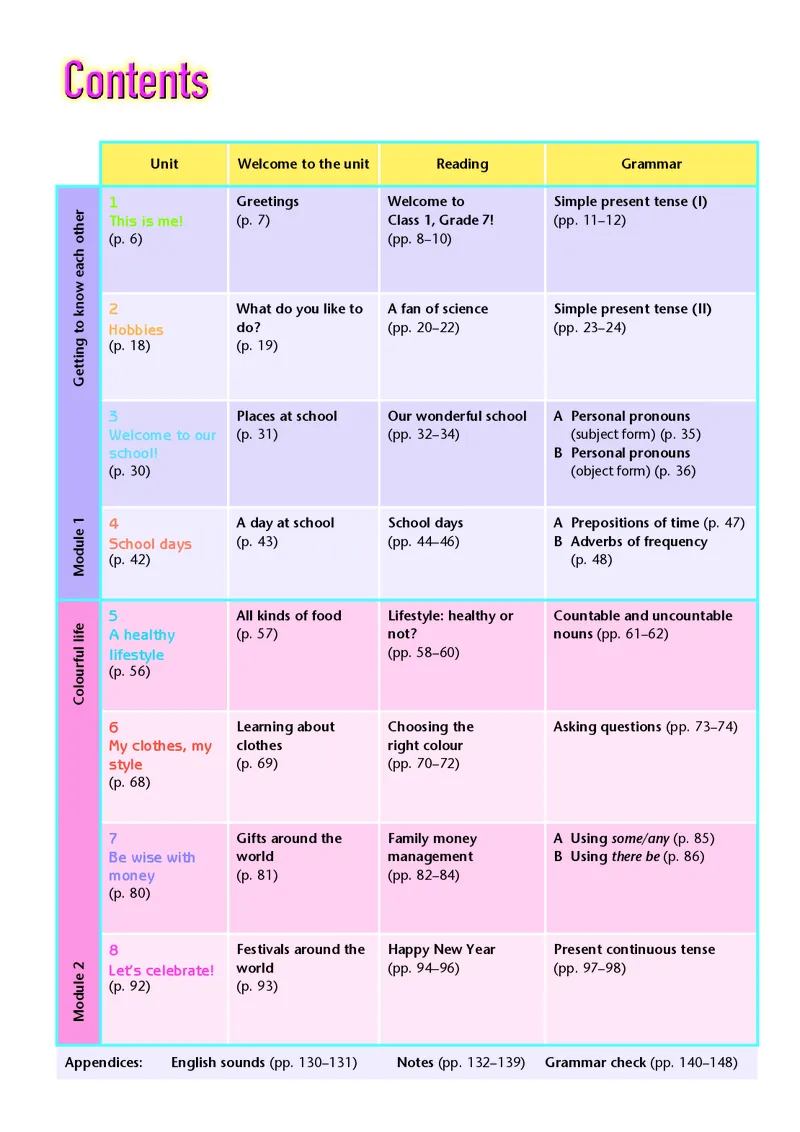
Unit
Welcome to the unit
Reading
Grammar
Module 1 �
Getting to know each other
1
This is me!
(p. 6)
Greetings
(p. 7)
Welcome to
Class 1, Grade 7!
(pp. 8–10)
Simple present tense (I)
(pp. 11–12)
2
Hobbies
(p. 18)
What do you like to
do?
(p. 19)
A fan of science
(pp. 20–22)
Simple present tense (II)
(pp. 23–24)
3
Welcome to our
school!
(p. 30)
Places at school
(p. 31)
Our wonderful school
(pp. 32–34)
A Personal pronouns
(subject form) (p. 35)
B Personal pronouns
(object form) (p. 36)
4
School days
(p. 42)
A day at school
(p. 43)
School days
(pp. 44–46)
A Prepositions of time (p. 47)
B Adverbs of frequency
(p. 48)
Module 2 �
Colourful life
5
A healthy
lifestyle
(p. 56)
All kinds of food
(p. 57)
Lifestyle: healthy or
not?
(pp. 58–60)
Countable and uncountable
nouns (pp. 61–62)
6
My clothes, my
style
(p. 68)
Learning about
clothes
(p. 69)
Choosing the
right colour
(pp. 70–72)
Asking questions (pp. 73–74)
7
Be wise with
money
(p. 80)
Gifts around the
world
(p. 81)
Family money
management
(pp. 82–84)
A Using some/any (p. 85)
B Using there be (p. 86)
8
Let’s celebrate!
(p. 92)
Festivals around the
world
(p. 93)
Happy New Year
(pp. 94–96)
Present continuous tense
(pp. 97–98)
Appendices: English sounds (pp. 130–131) Notes (pp. 132–139) Grammar check (pp. 140–148)
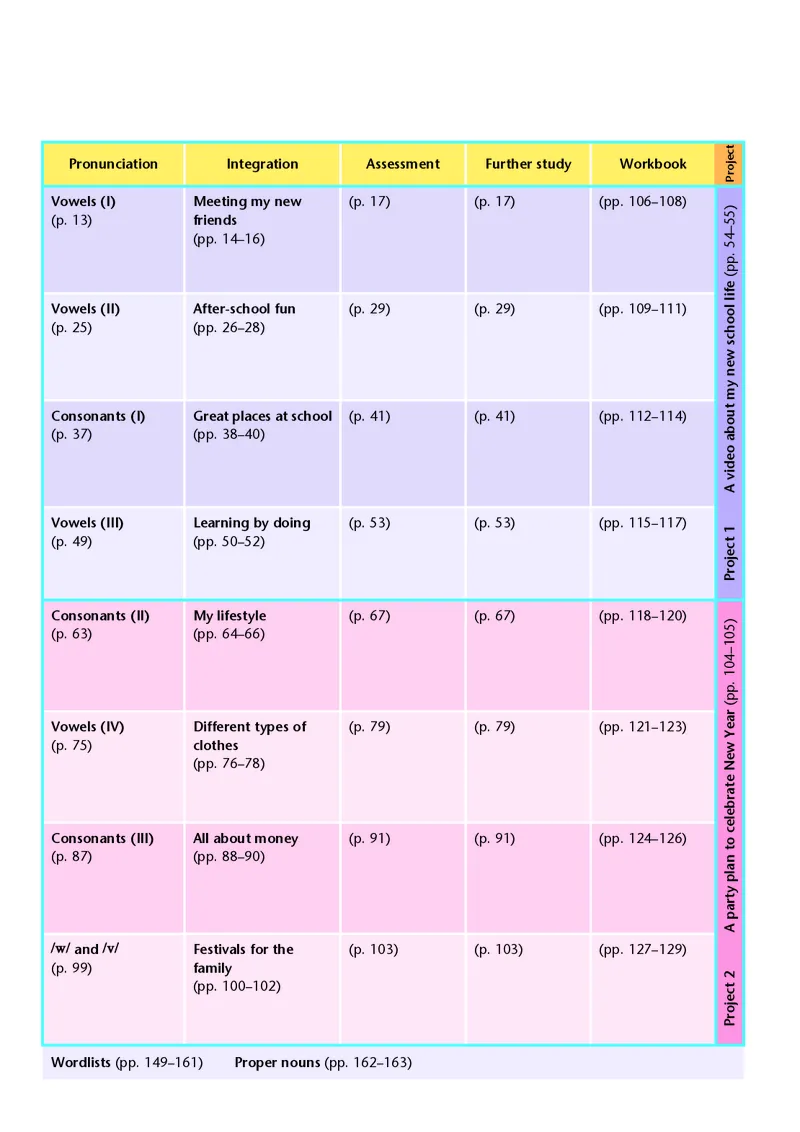
Pronunciation
Integration
Assessment
Further study
Workbook
Project
Vowels (I)
(p. 13)
Meeting my new
friends
(pp. 14–16)
(p. 17)
(p. 17)
(pp. 106–108)
Project 1�
A video about my new school life (pp. 54–55)
Vowels (II)
(p. 25)
After-school fun
(pp. 26–28)
(p. 29)
(p. 29)
(pp. 109–111)
Consonants (I)
(p. 37)
Great places at school
(pp. 38–40)
(p. 41)
(p. 41)
(pp. 112–114)
Vowels (III)
(p. 49)
Learning by doing
(pp. 50–52)
(p. 53)
(p. 53)
(pp. 115–117)
Consonants (II)
(p. 63)
My lifestyle
(pp. 64–66)
(p. 67)
(p. 67)
(pp. 118–120)
Project 2�
A party plan to celebrate New Year (pp. 104–105)
Vowels (IV)
(p. 75)
Different types of
clothes
(pp. 76–78)
(p. 79)
(p. 79)
(pp. 121–123)
Consonants (III)
(p. 87)
All about money
(pp. 88–90)
(p. 91)
(p. 91)
(pp. 124–126)
/w/ and /v/
(p. 99)
Festivals for the
family
(pp. 100–102)
(p. 103)
(p. 103)
(pp. 127–129)
Wordlists (pp. 149–161) Proper nouns (pp. 162–163)
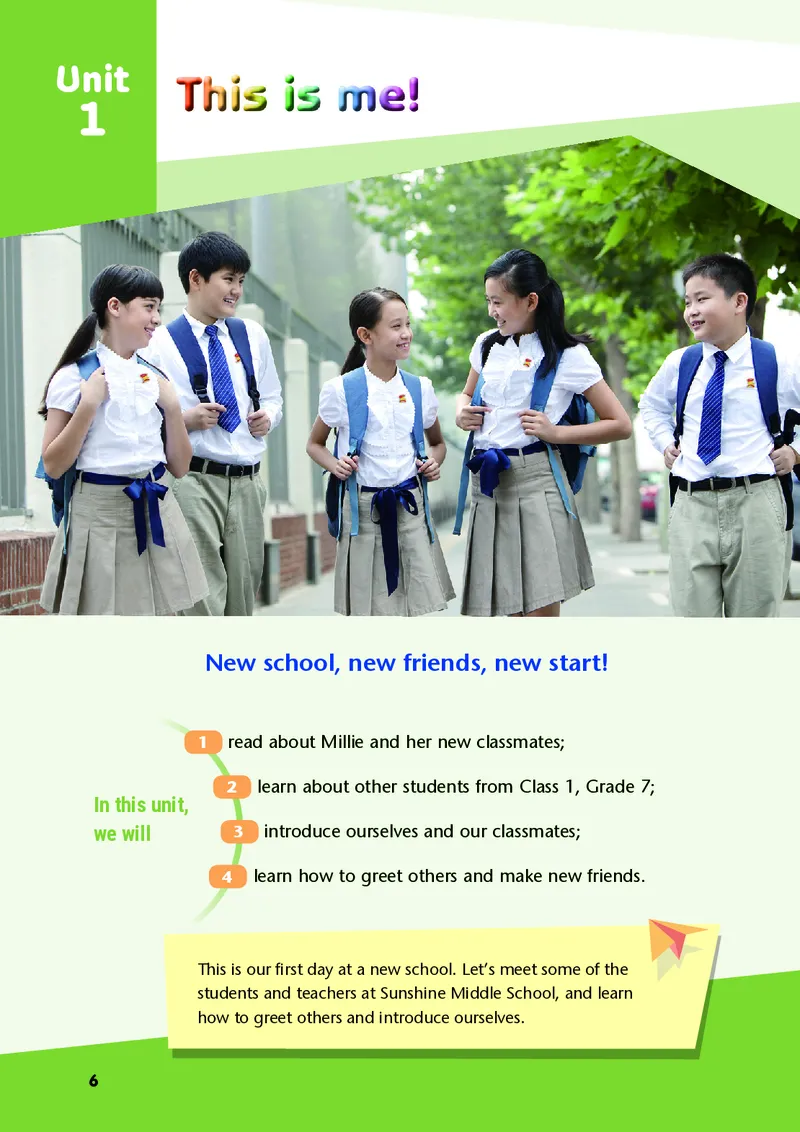
Unit
1
In this unit,
we will
1
2
3
4
learn about other students from Class 1, Grade 7;
introduce ourselves and our classmates;
learn how to greet others and make new friends.
read about Millie and her new classmates;
New school, new friends, new start!
This is our first day at a new school. Let’s meet some of the
students and teachers at Sunshine Middle School, and learn
how to greet others and introduce ourselves.
6
B Millie is greeting Sandy. Work in pairs. Greet your partner and then introduce
yourself. Use the conversation below as a model. The sentences in the box may help you.
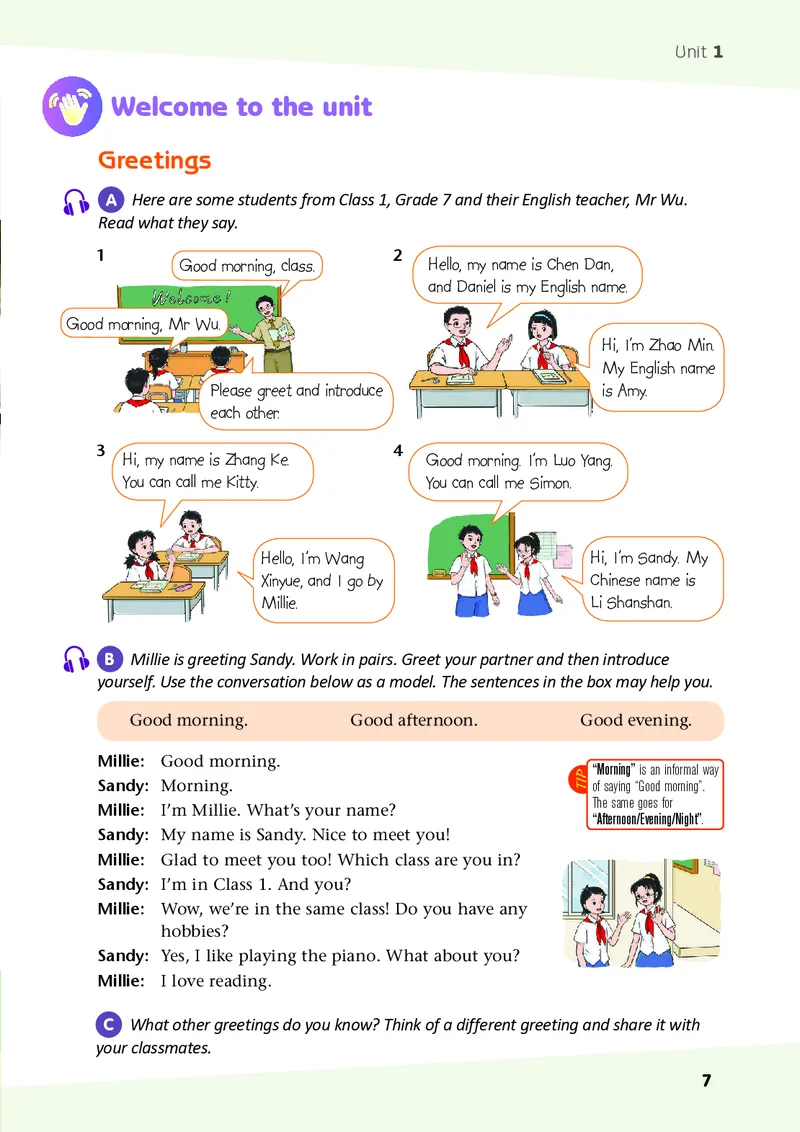
Greetings
A Here are some students from Class 1, Grade 7 and their English teacher, Mr Wu.
Read what they say.
Hi, I'm Zhao Min.
My English name
is Amy.
Millie: Good morning.
Sandy: Morning.
Millie: I’m Millie. What’s your name?
Sandy: My name is Sandy. Nice to meet you!
Millie: Glad to meet you too! Which class are you in?
Sandy: I’m in Class 1. And you?
Millie: Wow, we’re in the same class! Do you have any
hobbies?
Sandy: Yes, I like playing the piano. What about you?
Millie: I love reading.
Good morning, class.
Hello, my name is Chen Dan,
and Daniel is my English name.
Good morning. Good afternoon. Good evening.
Hi, I'm Sandy. My
Chinese name is
Li Shanshan.
Good morning. I'm Luo Yang.
You can call me Simon.
Hi, my name is Zhang Ke.
You can call me Kitty.
Hello, I'm Wang
Xinyue, and I go by
Millie.
“Morning” is an informal way
of saying “Good morning”.
The same goes for
“Afternoon/Evening/Night”.
TIP
Good morning, Mr Wu.
Please greet and introduce
each other.
C What other greetings do you know? Think of a different greeting and share it with
your classmates.
Welcome to the unit
1
2
3
4
7
Unit 1
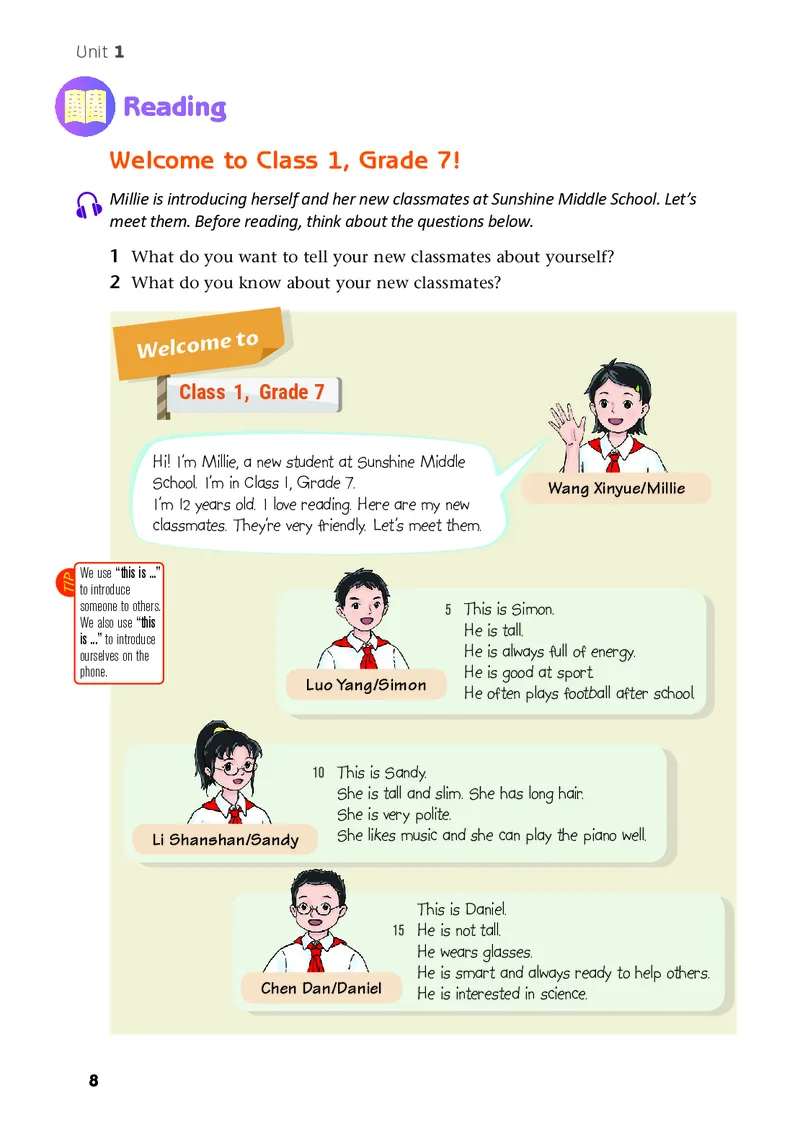
Welcome to Class 1, Grade 7!
Millie is introducing herself and her new classmates at Sunshine Middle School. Let’s
meet them. Before reading, think about the questions below.
1 What do you want to tell your new classmates about yourself?
2 What do you know about your new classmates?
This is Simon.
He is tall.
He is always full of energy.
He is good at sport.
He often plays football after school.
This is Daniel.
He is not tall.
He wears glasses.
He is smart and always ready to help others.
He is interested in science.
This is Sandy.
She is tall and slim. She has long hair.
She is very polite.
She likes music and she can play the piano well.
Class 1, Grade 7
Welcome to
Luo Yang/Simon
Chen Dan/Daniel
Li Shanshan/Sandy
Wang Xinyue/Millie
Hi! I'm Millie, a new student at Sunshine Middle
School. I'm in Class 1, Grade 7.
I'm 12 years old. I love reading. Here are my new
classmates. They're very friendly. Let's meet them.
5
10
15
Reading
We use “this is ...”
to introduce
someone to others.
We also use “this
is ...” to introduce
ourselves on the
phone.
TIP
8
Unit 1
A Match the new students in Class 1, Grade 7 with their hobbies.
B Read Millie’s introductions again. Write a T if a sentence is true or an F if it is false.
Then correct the false one(s).
a
b
c
d
Simon
Sandy
Millie
1
2
3
4
Daniel
1 Millie is interested in reading.�
______________
2 Simon is not tall. �
______________
3 Simon loves science.�
______________
4 Sandy is a tall, polite girl. �
______________
5 Sandy and Daniel wear glasses. �
______________
6 Daniel is very helpful.�
______________
9
Unit 1
C Mr Wu is making some notes about his new students. Complete his notes with the
correct forms of the words and phrases in the box below.
be good at
friendly
smart
full of energy
slim
polite
science
ready to
D Write some sentences about yourself or one of your classmates. You can write them
in the following order.
This is Millie. She has short hair. She loves reading.
Simon is a tall boy. He likes sport and (1) ______________ football. He is
always (2) ______________.
Sandy is a tall and (3) ______________ girl with long hair. She is interested
in music, and she can play the piano well. She is very (4) ______________.
She always says “please” and “thank you”.
Daniel is not tall. He wears glasses. He is (5) ______________. He likes
learning about (6) ______________. He is very nice and always
(7) ______________ help others.
My new students are all very nice. They are (8) ______________ to each
other.
Name
Age
Looks
Character
Hobbies
Millie
Simon
Sandy
Daniel
10
Unit 1
We make positive and negative sentences using the verb be in the simple
present tense like this:
Simple present tense (I)
Millie sends a message to her old friend Jenny about her new classmates. Read the
message and pay attention to the use of the verb be.
We use the simple present tense to talk about facts and states.
• We use ______________ (am, are, is) with I.
• We use ______________ (am, are, is) with you, we and they.
• We use ______________ (am, are, is) with he, she and it.
I
am not
happy.
You/We/They
are not
He/She/It
is not
Am
I
happy?
Are
you/we/they
Is
he/she/it
Yes,
I
am.
you/we/they
are.
he/she/it
is.
No,
I
am not.
you/we/they
are not.
he/she/it
is not.
I
am
happy.
You/We/They
are
He/She/It
is
We ask and answer questions using the verb be in the simple present tense like
this:
are not = aren’t
is not = isn’t
TIP
I am = I’m
You are = You’re
We are = We’re
They are = They’re
He is = He’s
She is = She’s
It is = It’s
TIP
Grammar
Hi, Jenny. I am at Sunshine Middle School now. It is a nice school.
I like my new classmates. They are all very friendly.
Sandy is a tall girl. She is interested in music. Simon is tall too. He
is good at sport. We are friends now.
How about you? Are you happy at your new school?
11
Unit 1
A Here are some pictures of Millie, her classmates and her teacher at the new school.
Complete what they are saying with the correct forms of the verb be.
B Millie is talking to her new friends. Complete their conversation with the correct
forms of the verb be.
Millie:
Hi, Simon. Hi, Sandy. (1) ______________ you happy at our new school?
Sandy & Simon: Yes, we (2) ______________.
Sandy: I like this school a lot! It (3) ______________ new and clean. Our
classmates (4) ______________ very nice.
Simon: The teachers (5) ______________ nice too. Mr Wu (6) ______________ my
favourite teacher!
Sandy:
(7) ______________ English easy for you, Simon?
Simon: No, it (8) ______________. It (9) ______________ hard for me, but I like it.
Sandy: How about you, Millie? (10) ______________ you interested in English?
Millie:
Yes, I (11) ______________. I (12) ______________ always happy in English
class.
1
3
5
2
4
6
C Talk with your partner about people and things in your new school, using the correct
forms of the verb be.
Hello! I ________ Millie.
I ________ 12 years old.
I have some new friends now.
They ________ friendly.
Hi, Daniel. ________
you good at football?
No, I ________.
The girls over there ________ Kitty
and Sandy. They both love sport.
Yes, he ________. He
________ our English teacher.
Look! ________ he our teacher?
This ________ our classroom. Our
lessons ________ not easy, but we
enjoy them.
12
Unit 1
grade she hello like make music those use white these
C Read the following sentences. Pay attention to the sounds of the letters in bold.
1 We have the same hobbies.
2 My classmates are all very nice.
3 Sandy likes listening to piano music.
4 Simon and Amy go to school by bike.
5 These students go home by bus.
Vowels (I)
Read the following words. Pay attention to the sounds of the letters a, e, i, o and u.
Pronunciation
/i:/
/aI/
/RW/
/ju:/
/eI/
‹
‹
‹
‹
‹
/eI/
/i:/
/aI/
/RW/
/ju:/
name
face
game
age
late
be
he
me
we
these
fine
hi
write
time
kite
old
home
no
nose
close
computer
cute
music
student
use
A Read the words below. Then put each one into the correct sound group.
B Look at the groups of words. Try to read the new words according to the sound of
the word in the centre in each group.
place
same
page
gate
race
nice
hide
life
rise
size
home
hope
note
joke
rose
1
2
3
13
Unit 1
Meeting my new friends
A Millie is writing about her new friends Kitty and Amy. Read her introductions. Circle
the correct words in the table.
Kitty
Amy
Looks
long hair/short hair
long hair/short hair
small/cute/lovely eyes/pretty
small/cute/lovely eyes/pretty
Character
shy/quiet/happy
shy/quiet/happy
Hobby
swimming/dancing
swimming/dancing
Integration
B Millie is showing her mum a photo of her new class. Listen to their conversation and
complete the sentences below.
This is Zhang Ke. Her English
name is Kitty. She has long
hair. She is pretty and has
lovely eyes. She is shy and
quiet. She likes dancing.
This is Zhao Min. Her English
name is Amy. Her hair is short.
She is small and cute. She is
always happy. She is good at
swimming.
Kitty and Amy are Millie’s new friends.
Kitty is only (1) ______________ years old. She is good at (2) ______________.
She has dance classes every week. She also likes (3) ______________.
Amy is (4) ______________ years old. She is small. She swims very
(5) ______________. She likes (6) ______________ new people.
Millie likes her new friends very much.
14
Unit 1
C Millie and Ms Lin, the Music teacher, meet Simon in front of the classroom building.
Work in groups of three to greet and introduce each other. Use the conversation below as
a model.
D To help students learn more about each other, Mr Wu asked every student to write a
self-introduction and post it on the school website.
D1 Daniel is making a table to help him write the self-introduction. Complete the table
with your own information.
Simon: Hi, Millie.
Millie:
Hi, Simon. Ms Lin, this is my classmate Simon.
Simon, this is Ms Lin, our Music teacher.
Simon: Glad to meet you, Ms Lin.
Ms Lin: Glad to meet you too, Simon. You like playing football, right?
Simon: Yes, I do. I often play football after school. Sport helps me stay healthy
and happy.
Ms Lin: Great!
Simon: Oh, we have a football match with Class 2 at 4:30 this afternoon. I
have to go now. Goodbye, Ms Lin. Goodbye, Millie.
Ms Lin: OK. Bye. Good luck!
Millie:
Bye.
When we introduce
two people to each
other, we usually
introduce the younger
to the elder first.
TIP
Daniel
Me
Age
12
Favourite subject(s) Maths, Computer Science
Hobbies
Chinese chess, ping-pong
15
Unit 1
D2 Here is Daniel’s self-introduction. Read it below.
D3 Write your own self-introduction based on your information in Part D1. Use Daniel’s
self-introduction as a model.
My name is …/I am …
I am … (years old).
I am in …
I like/love Maths/Computer Science/…
I like to ...
I am good at …
I am interested in …
My favourite … is …
I often play ... at the weekend.
Useful expressions
“Hi there” is
an informal
greeting.
TIP
We use a comma (,) to pause or separate things in a
sentence.
We use a full stop (.) to end a sentence.
We use a question mark (?) at the end of a question.
TIP
Hi there! I am Chen Dan from Class 1, Grade 7.
My English name is Daniel. I am 12 years old.
My favourite subjects are Maths and Computer
Science. They are interesting. I am good at
them, and I like to help my classmates with
Maths problems.
I enjoy playing Chinese chess and ping-pong. I
often play these with my dad at the weekend. They are fun.
I have many new classmates at school. They are all very nice.
I am happy to make friends with them.
Do you want to be my friend?
16
Unit 1
Luo Yang
(Simon)
William Smith
Simon has a friend called William Smith. He is from
the UK. His parents and friends often call him “Will”.
Here are some nicknames for popular English names.
Andrew
Andy
James
Jimmy
Thomas
Tom
Elizabeth
Liz
Susan
Sue
William
Will
Find out more fun facts about names and share them
with your classmates.
Don’t use a nickname
if the person does not
ask you to.
TIP
Assessment
Further study
What I can do
Me
Partner
1 I can describe Millie and her new classmates.
2 I can use the verb be in the simple present tense
correctly.
3 I can introduce myself and my classmates with
the new words in this unit.
4 I can pronounce the sounds /eI/, /i:/, /aI/, /RW/ and
/ju:/ correctly in words.
5 I know how to greet others and make new friends
at a new school.
I am good at �
.
I need to spend more time on �
.
My action plan: �
* Assess your learning of new words and grammar by doing the exercises on page 106.
Result:
Weak
Good
Wonderful
17
Unit 1
Hobbies bring joy to our life.
In this unit,
we will
1
2
3
4
learn about after-school clubs at Sunshine Middle School;
talk and write about our hobbies;
think about why hobbies are important for us.
read about some students’ hobbies;
The Class 1, Grade 7 students are talking about their
hobbies. Let’s share our favourite hobbies with classmates.
Unit
2
18
B Amy and Millie are talking about their hobbies. Work in pairs and talk about your
hobbies. Use the conversation below as a model.
What do you like to do?
A What do the Class 1, Grade 7 students like to do? Complete their answers with the
words in the box.
Amy: What’s your favourite hobby, Millie?
Millie: I love reading.
Amy:
What do you like to read?
Millie: I read all kinds of books, and I learn a lot
from them. What about you?
Amy:
I like swimming.
Millie: How often do you go swimming?
Amy:
I go swimming every week. It helps me keep fit.
jogging painting paper-cutting reading
C What hobbies do your family members or your friends have? Give an example.
I enjoy ______________.
I love ______________.
I like ______________.
I like ______________.
Welcome to the unit
3
4
1
2
19
Unit 2
A fan of science
Mr Wu asked the Class 1, Grade 7 students to write an article about a friend’s hobby.
Here is Millie’s article about Daniel. Before reading, think about the questions below.
1 Do you like science? Why or why not?
2 What do you think a fan of science often does?
Reading
Daniel: a fan of science
5
10
Daniel is one of my new friends. He is a fan of
science. He thinks science is very cool. It is all
around us. Science changes our lives!
Daniel often visits science museums. He gets
to see all kinds of things and learns a lot. It is
great fun for him.
At home, he likes to take things apart and learn
how they work. Now he can help fix things
around the house!
In his free time, Daniel reads many science
books. He also goes on the internet to find
answers to his endless questions.
He wants to be a scientist one day. I am sure
his dream can come true.
We use an
exclamation
mark (!) to
express love,
surprise, joy
or other strong
feelings.
TIP
20
Unit 2
A Complete the chart below with the information in the article.
B Read the article again and answer the questions below.
1 Why does Daniel think science is cool?
____________________________________________________________________________
2 What does Daniel do at science museums?
____________________________________________________________________________
3 What does Daniel like to do at home?
____________________________________________________________________________
4 What does Daniel look for on the internet?
____________________________________________________________________________
5 How does the article show Daniel’s love for science?
____________________________________________________________________________
A (1) __________
of science
Why he
loves science
What he
often does
His dream
Thinks science is cool and
(2) __________ our lives
• Visits (3) __________
• (4) __________ how things
work
• Reads many science books
• Finds answers to his
questions on the
(5) __________
Wants to be a (6) __________
21
Unit 2
come true
change
endless
go on the internet
fix
museum
scientist
take … apart
C Kitty is asking Millie questions about Daniel. Complete their conversation with the
correct forms of the words and phrases in the box below.
Kitty:
Daniel is a big fan of science. He can often answer our questions about
science. Why does he like it so much?
Millie: For him, science is cool. It’s all around us and it (1) ______________ our
lives.
Kitty:
So, what does he do in his free time?
Millie: He often visits science (2) ______________. He also likes to (3) ______________
things ______________. In this way, he learns how they work. Now he can
help (4) ______________ things!
Kitty:
Wow, so cool!
Millie: He’s also very good with computers. He often (5) ______________.
Kitty:
What does he use the internet to do?
Millie: He uses it to find answers to his (6) ______________ questions.
Kitty:
What does he want to be?
Millie: He wants to be a (7) ______________.
Kitty: Great! I’m sure his dream can (8) ______________!
1 How do you find answers to questions about science?
2 What other ways do you know to learn about science?
3 Why is it important for us to have hobbies?
D Think about the questions below. Share your answers with your classmates.
22
Unit 2
Simple present tense (II)
Read the sentences below and pay attention to the use of the verbs.
When we make negative sentences and ask questions,
• we use (do, does) with I, you, we and they;
• we use (do, does) with he, she and it.
Remember that we add -s to the verb after he, she or it. However, there are some
exceptions.
Most verbs
+ s
like
‹ likes
play ‹ plays
Verbs ending in a consonant + y – y + ies study ‹ studies
fly
‹ flies
Verbs ending in -ch, -sh, -ss or -x + es
watch ‹ watches wash ‹ washes
dress ‹ dresses
fix
‹ fixes
Verbs ending in a consonant + o + es
go
‹ goes
do
‹ does
do not = don’t
does not = doesn’t
TIP
2 things that are always
true
3 things that are true
now
1 things that we often do
Science changes
people’s lives.
Daniel likes to take
things apart.
Daniel often visits
science museums.
Turn to
page
141 for
changes
in
pronun-
ciation.
TIP
I/You/We/They do not
like
sport.
He/She/It
does not
I/You/We/They
like sport.
He/She/It
likes
We make positive and negative sentences using the verbs in the simple present
tense like this:
We ask and answer questions using the verbs in the simple
present tense like this:
No,
I/you/we/they
do not.
he/she/it
does not.
Do
I/you/we/they
like sport?
Does
he/she/it
Yes,
I/you/we/they
do.
he/she/it
does.
We use the simple present tense to talk about:
Grammar
23
Unit 2
A The Class 1, Grade 7 students have different hobbies. Complete the sentences below
with the correct forms of the verbs in the box.
C Amy and Sandy are talking about their hobbies. Complete their conversation with the
correct forms of the verbs in brackets.
Amy:
Hi, Sandy. What’s your hobby?
Sandy: I (1) ___________ (like) painting. I often paint at my aunt’s house. My
aunt (2) ___________ (know) so much about art. She (3) ___________ (help)
me a lot. What about you? (4) ___________ you ___________ (like) art?
Amy:
No, I don’t, but I like sport. I often (5) ___________ (go) swimming.
Sandy: Great! (6) ___________ you ___________ (go) with your parents?
Amy:
Yes. My dad (7) ___________ (love) swimming and he always (8) ___________
(go) swimming with me. My mum (9) ___________ (not like) swimming.
She (10) ___________ (watch) us swim.
D Talk with your partner about your and your friends’ hobbies, using the correct forms
of the verbs.
dance go fly love play read watch want
1 Millie ___________ reading. She ___________ every evening.
2 Simon ___________ football every week. He also ___________ football matches.
3 David ___________ for a walk on Saturdays. Sometimes, he ___________ a kite in
the park.
4 Kitty likes dancing. She ___________ for half an hour every day. She ___________
to learn all kinds of dances.
B The students are writing their names under the activities they like in the table below.
Complete the questions and then use the information in the table to answer them.
1 ___________ Sandy and Kitty enjoy listening to music?
___________
2 ___________ Millie like swimming?
___________
3 ___________ Amy enjoy reading?
___________
4 ___________ Kitty like jogging?
___________
5 ___________ Simon and Daniel love drawing?
___________
Yes, they do.
Do
Listening to music
Swimming
Reading
Jogging
Drawing
Sandy
Kitty
Simon
Amy
Daniel
Millie
Nora
Daniel
Sandy
Simon
Amy
Kitty
Millie
Sandy
Kitty
Millie
24
Unit 2
/e/
/I/
/B/
/V/
/C/
‹
A Read the words below. Then put each one under the correct sound.
B Look at the groups of words. Try to read the new words according to the sound of
the first word in each group.
clock club fun get happy listen bad often swim well
C Read the following poem. Pay attention to the sounds of the letters in bold.
Vowels (II)
Read the following words. Pay attention to the sounds of the letters a, e, i, o and
u. They are different from the sounds in Unit 1 and each sound is short.
cap
cat
dad
man
map
desk
egg
pen
red
yes
big
city
him
sit
with
box
dog
long
not
stop
but
cup
duck
run
sun
‹
‹
‹
‹
1
hand
2
help
3
film
4
hot
5
mum
habit
lend
bill
job
gun
lab
test
risk
top
just
mad
wet
silk
rock
luck
Do you like cooking a yummy dish,
Or going swimming like a fish?
Maybe you like studying maps,
Learning on the apps,
Or going for a long run?
Well, all of these hobbies are so much fun!
Pronunciation
/e/
/C/
/I/
/B/
/V/
25
Unit 2
After-school fun
A Millie is reading about after-school clubs at Sunshine Middle School. Read the table
below and then answer the questions.
B Millie is asking Mr Wu about after-school clubs. Listen to their conversation and help
Millie complete her notes.
Club
Members
Time
Book
40
4:40 p.m., Wednesday
Music
30
Painting
30
Dancing
15
Robot
20
Geography
26
Ping-pong
18
4:40 p.m., Friday
Basketball
24
Volleyball
26
Football
30
Swimming
20
1 What sports clubs are there at Sunshine Middle School?
2 How many clubs can each student join?
Our school has 11 clubs in all. Each club meets once (1) ______________.
I want to join the (2) ______________ Club. The club members meet on
Wednesday afternoons. They (3) ______________ every week and share their
ideas about it. They also introduce their (4) ______________ to each other at
the meeting.
Our school also has some (5) ______________ clubs. The members meet every
Friday afternoon. I can also join one of those clubs.
Integration
When reading
a table, we
can look at
the headings
first to get a
general idea.
TIP
26
Unit 2
C Daniel and Sandy are talking about their hobbies. Work in pairs and discuss your
hobbies. Use the conversation below as a model.
D Mr Wu asked the Class 1, Grade 7 students to write about their favourite hobbies.
D1 Read the results of Sandy’s questionnaire below and complete it with your own
information.
Daniel: Hi, Sandy. What do you like doing after school?
Sandy: I like painting. It makes me feel happy.
Daniel: Sounds nice! Do you plan to join the Painting Club?
Sandy: Yes, I do. What about you?
Daniel: I like science, so I’m interested in the
Robot Club. It’s going to be a lot of
fun.
Sandy: Sure. Both of us will have a great time
in our clubs.
It is common to use
“Sounds nice!”, “Sure.”,
etc. in a conversation
to show interest,
support or agreement.
TIP
Questions
Sandy
Me
What is your favourite
hobby?
Painting.
How often do you do it?
Every week.
When do you do it?
After school.
Why do you like it?
It makes me feel happy.
It is great fun.
Who is your role model? Xu Beihong.
How can your hobby
help you?
My dream is to design
beautiful clothes. My
painting skills can help
me a lot.
Questionnaire
27
Unit 2
D2 Here is Sandy’s article about her favourite hobby. Read it below.
D3 Write an article about your favourite hobby based on the information in Part D1. Use
Sandy’s article as a model.
I love painting. It makes me feel happy. I paint every week. I often paint
with my friends after school. We enjoy sharing our paintings and talking
about art. It is great fun.
My favourite artist is Xu Beihong. He was a master of Chinese painting.
His paintings of horses are great works of art.
I want to become a designer.
I would like to design beautiful
clothes in the future. My painting
skills can help me a lot. I hope
my dream can come true.
My favourite hobby is …
I am interested in …
I like/love/enjoy …
I often play ...
Every week/day, I …
I play/go/do … after school.
… makes me feel happy/good/great.
… can help make my dream come true.
Useful expressions
We capitalize
the first
letter of each
sentence.
TIP
28
Unit 2
Skateboarding is a fun and exciting sport. In 2021,
the sport made it to the Olympics for the first time.
It is quite popular with young people these days.
Find out about a fun sport and share it with your
classmates.
Assessment
Further study
What I can do
Me
Partner
1 I can describe Daniel’s and his classmates’
hobbies.
2 I can use the simple present tense correctly.
3 I can talk and write about different hobbies with
the new words in this unit.
4 I can pronounce the sounds /C/, /e/, /I/, /B/ and /V/
correctly in words.
5 I know why hobbies are important for us.
I am good at �
.
I need to spend more time on �
.
My action plan: �
* Assess your learning of new words and grammar by doing the exercises on page 109.
Result:
Weak
Good
Wonderful
29
Unit 2
In this unit,
we will
1
2
3
4
learn about different places at school;
introduce our school;
get to know our school better.
read about Sunshine Middle School;
School is a great place for learning.
We are at a new school now. Let’s learn about different
places at our school and discuss them with each other.
Unit
3
30
B Millie and her primary school classmate Kate are talking about their new schools.
Imagine you meet a friend from another school. Role-play in pairs. Use the conversation
below as a model.
Places at school
A The Class 1, Grade 7 students are listening to an introduction to Sunshine Middle
School. Listen and tick the places you hear.
2
4
6
C What other places does a school have? Talk with your partner.
Millie: Hello, Kate. It’s good to see you.
Kate:
Hi, Millie. Nice to see you too! How’s your new
school?
Millie: It’s great. The best part is the modern library.
Does your school have a library?
Kate: Yes, it does. We have a nice dining hall as well.
Millie: Cool! My school has a big dining hall too.
Kate:
How many classrooms does your school have?
Millie: It has 36 classrooms. They’re all bright and clean.
Kate:
That’s a lot! My school only has 18. My school is not big but it’s great. I
love it.
gym
1
3
5
lab
sports field
library
dining hall
classroom building
Welcome to the unit
31
Unit 3
Our wonderful school
Millie wants to learn more about Sunshine Middle School. She is watching a short video
on the school website. Here is the video script. Before reading, think about the questions
below.
1 What places should a school have?
2 Why are green spaces important for a school?
Hello, everyone! I’m Jack Liu from Grade 9. Welcome to our school!
Here are our classroom buildings and our modern library. They’re the
perfect places for us to study.
Our school has lots of green spaces. Students enjoy spending time here.
Sometimes we chat with teachers about our problems here too.
We have a great sports field. Can you see the students running there?
Lots of exciting sports matches take place on it.
Look at the school noticeboards near the gate. Here we can read about
school news and stories of star students and teachers. They’re role
models for us. The boards also show students’ works, like paintings and
photos.
Come and enjoy your school life here. You’ll find more great places.
Trust me!
5
10
Reading
We often begin
a welcome
speech with a
friendly opener,
such as “Hello”
or “Welcome ...”.
TIP
32
Unit 3
A Here is a picture of Sunshine Middle School. Fill in the places talked about in the
video script.
B Millie made some notes from the video. Help her complete the notes below.
Sunshine Middle School:
a great place for all
Library & classroom buildings: Perfect places to (1) ______________
Green spaces: Students enjoy spending time here
a good place to (2) ______________ teachers about our
problems
Sports field:
a place for us to do sport
a place for exciting (3) ______________
Noticeboards: a place to learn about:
• school (4) ______________
• stories of (5) ______________
• students’ works, like (6) ______________ and photos
33
Unit 3
1
2
3
4
5
chat with
sports field
problem
perfect
exciting
space
noticeboard
role model
C Millie is writing an email to her online friend Liu Yi about her new school. Complete
her email with the correct forms of the words and phrases in the box below.
Hello Liu Yi,
How are you doing? I want to tell you about my new school. It is a
really great place.
Our school library and classroom buildings are (1) ______________. We
love to study there.
My school has lots of green (2) ______________. We sometimes
(3) ______________ our teachers there. They can help us with our
(4) ______________.
The school also has a big (5) ______________. Students play all kinds of
sports there. Sometimes I watch the matches. They are (6) ______________!
We have some (7) ______________ too. There is school news on them. We
can also read about star students and learn a lot from them. They are
our (8) ______________.
What is your new school like? Tell me about it!
Talk soon,
Wang Xinyue
D Think about the questions below. Share your answers with your classmates.
1 What do you like about Sunshine Middle School?
2 What place at your school do you like best? Why?
3 How is your new school different from Sunshine Middle School?
My new school
Liu Yi
34
Unit 3
A Personal pronouns (subject form)
Jack Liu is showing some new students around the school. Read his introduction below
and pay attention to the use of personal pronouns.
We can use personal pronouns to replace nouns for ______________
or things, so we do not need to repeat the nouns. We use the
______________ (subject, object) form when the noun is the subject.
A1 Simon is showing his sister Annie some pictures of his new school. Complete their
conversation with the correct personal pronouns.
Annie: Wow, your dining hall looks great!
Simon: Yes, it is. (1) ______________ is big and clean. (2) ______________ all have
lunch there.
Annie: What do you have for lunch?
Simon: We have rice, noodles, all kinds of meat and vegetables. I’m sure
(3) ______________ will love the food there!
Annie: I think I will! How about your sports field, Simon?
Simon: Here’s a picture of it. It’s my favourite place!
Annie: It looks very nice. What do (4) ______________
often play there?
Simon: (5) ______________ often play football with my
friends in the school football team. Sandy
and Kitty also like sport. (6) ______________
play sport there too.
A2 Talk with your partner about what you and your classmates do at school, using the
subject form of personal pronouns.
Hello, everyone! Look at the noticeboard. You
can find all the teachers for Grade 7 here.
This is Mr Wu. He teaches English. And this
is Ms Lin. She's a Music teacher. They're
both kind and helpful. We have many nice
teachers like them.
Grammar
35
Unit 3
B1 Daniel is talking to his grandfather on the phone. Complete their conversation with
the correct personal pronouns.
Daniel:
Hi, Grandpa! Can you hear (1) ______________?
Grandpa: Yes, I can.
Daniel:
I’m at a new school now. Let me tell you about (2) ______________.
Mr Wu is our form teacher.
Grandpa: Oh? What’s he like?
Daniel:
He’s very kind to all of (3) ______________. We all
like (4) ______________. I have some new friends
now. I like to play with (5) ______________ after
class. We’re happy at school.
Grandpa: That’s nice.
Daniel:
Is Grandma at home? I want to say hello to
(6) ______________.
Grandpa: Yes, she is. Wait a minute.
B Personal pronouns (object form)
Read more of Jack’s introduction below and pay attention to the use of personal
pronouns.
We can use personal pronouns to replace nouns for people
or things, so we do not need to repeat the nouns. We use the
______________ (subject, object) form when the noun is the object.
Singular
Plural
Subject form
I
you
he
she
it
we
you
they
Object form
B2 Talk with your partner about your new school, teachers and friends, using both the
subject form and object form of personal pronouns.
Our school is wonderful. It has many great teachers.
Let me tell you more about our teachers. Mr Wu is also the form
teacher of Class 1, Grade 7. He often chats with the students and helps
them with their problems, so all the students like him. Ms Lin is good
at playing the piano. You can see her at many of our school shows.
36
Unit 3
A Read the words below. Pay attention to the different sounds of the letters in bold.
1 big
2 aunt
3 nice
4 class
5 mice
pig
and
rice
glass
nice
6 call
7 light
8 them
9 thin
10 clean
tall
night
then
sing
green
B Fill in different letters to make up two words for each group.
C Read the following sentences. Pay attention to the sounds of the letters in bold.
1 We can sing the English song.
2 There is a hall behind the classroom building.
3 We like the yellow flowers and the green trees in the garden.
4 Lucy loves reading in the library.
5 Peter puts his pencils and pens on the book.
Consonants (I)
Read the following words. Pay attention to the sounds of the consonants in bold.
maths
name
room
no
know
fun
drink
English
sing
learn
play
pencil
read
every
write
year
yes
you
week
swim
which
‹
‹
‹
‹
‹
/b/
/t/
/d/
/G/
‹
/h/
‹
/k/
/p/
pen
happy
people
board
about
club
teacher winter
visit
dining
study
field
class
kind
back
great
grass
big
hall
behind
who
‹
‹
‹
‹
‹
/n/
/N/
/l/
/j/
‹
/w/
‹
/r/
/m/
Pronunciation
foo
foo
ook
ook
alk
alk
atch
atch
ind
ind
1
2
3
4
5
37
Unit 3
Great places at school
A Millie is reading an introduction to the school library online. Read the article and
answer the questions below.
B Millie’s brother, Andy, is introducing some places at Sunshine Middle School to her.
Listen with Millie and help her complete the table below.
Welcome to the library. It is a grey
building with three floors. All the rooms
here are clean and bright.
You will find lots of books on different
subjects there—thousands of them, in fact!
You can borrow three books at a time.
There is a reading room with computers
on the top floor. You can read newspapers
and magazines there. You can also use the
internet to help you with your studies.
The library is the perfect place for you to
enjoy a wonderful book and some quiet
time!
1 What can students at Sunshine Middle School do in the library?
2 Is there a library or a reading room at your school? What do you like about it?
Integration
Before
listening,
use the
title or
heading to
help you
predict the
content
and then
focus on
keywords
or phrases
when
listening.
TIP
Place
It has …
In this place, students …
(1) ____________
big and bright space
play (2) ____________
Music room
a (3) ____________
learn (4) ____________
Computer room
(5) ____________ new
computers
use the computers, but can’t
play (6) ____________
38
Unit 3
C Millie and Daniel are discussing what they like about their new school. Work in pairs
and discuss your new school. Use the conversation below as a model.
D Mr Wu asked the Class 1, Grade 7 students to write an email to a friend about their
new school.
D1 Answer the questions below with the information about your school.
Daniel: What do you like about our new school?
Millie:
I love our big library. I can borrow different kinds of books there. What
about you?
Daniel: I like the computer room. It’s new
and modern. What else do you like
about our school?
Millie: Our teachers are very kind. They
really care about us.
Daniel: Yes, and our classmates are friendly.
1 What is your school like?
_________________________________________________________________________
2 What does your school have? Put a tick (3) in the box.
playground
sports field
library
hall
dining hall
gym
art room
music room
computer room
lab
other(s): _________________________________________________________________
3 What is your favourite place at your school?
_________________________________________________________________________
4 What do you do in your favourite place?
_________________________________________________________________________
5 What are your teachers and classmates like?
_________________________________________________________________________
6 What do you think of your school?
_________________________________________________________________________
39
Unit 3
My new school
Xinyue
D2 Millie sent an email to her online friend Liu Yi and received her reply. Read it with her.
D3 Write an email to your friend about your new school based on the information in
Part D1. Use Liu Yi’s email as a model.
My/Our school has …
We have/do not have a playground/library/hall/…
There is a playground/library/hall/…
The playground/library/hall is … and …
We do not have …, but we have …
There are … classrooms in …
My favourite place at school is …
The teachers/students are nice/friendly/...
Useful expressions
Main body
Closing
Dear Xinyue,
Thanks for your email. I am at a new school now too.
The school is old, but I like it.
My favourite place at school is the hall. We have
meetings there, and a lot of interesting events take place
there. We also have a playground. My new friends and I
often play ping-pong together there. We do not have a
gym, but we have a football field. We love playing
football on it.
Our teachers are quite nice. They care about us a lot. My
classmates are great too. They are friendly and helpful.
Our school is not large, but it is a special place for me. I
am happy to be a student here.
Best wishes,
Liu Yi
We often begin with “Dear ...” and end with
“Best wishes” in an email or letter to friends
or family members.
A formal email follows the same structure,
greeting and sign-off as a formal letter.
TIP
Opening
Introduction of the
topic
40
Unit 3
Yuelu Academy, a very famous school in
China in the past, is at the foot of Yuelu
Mountain in Hunan Province. The school
is more than 1,000 years old. There are
many other old schools in China. Find
one and share it with your classmates.
Assessment
Further study
What I can do
Me
Partner
1 I can describe the places at Sunshine Middle
School.
2 I can use different forms of personal pronouns
correctly.
3 I can introduce my school and talk about what I
like about it with the new words in this unit.
4 I can pronounce the sounds of /p/, /b/, /t/, /d/, /k/,
/G/, /h/, /m/, /n/, /N/, /l/, /r/, /j/ and /w/ correctly in
words.
5 I know the places at my school better.
I am good at �
.
I need to spend more time on �
.
My action plan: �
* Assess your learning of new words and grammar by doing the exercises on page 112.
Result:
Weak
Good
Wonderful
41
Unit 3
In this unit,
we will
1
2
3
4
get to know about school field trips and school chores;
talk and write about our life at school;
learn to enjoy our school life.
read about interesting classes at school;
Learn beyond the books.
There are many interesting classes and activities in middle
school. Let’s learn how to talk about our school life.
Unit
4
42
A day at school
A Look at the table of Millie's day. Complete the table on the right with your own daily
activities.
C What do you like best about your school days? Discuss it with a partner.
B Millie and Simon are talking about their school days. Work in pairs and talk about
your school days. Use the conversation below as a model.
Millie:
What time do you get up in the morning on weekdays, Simon?
Simon: I usually get up at 6:45 a.m. and then go for a short jog. And you?
Millie:
I get up at 7. I always read a little.
Simon: What do you like best about your school days?
Millie:
I like the after-school activities. I go to the Book Club and the Volleyball
Club and have lots of fun. What about you?
Simon: I’m in the Football Club. Club activities are a good way for me to enjoy
myself and make friends.
Welcome to the unit
Millie’s day
My day
7 a.m.
Get up
7:20 a.m.
Have breakfast
7:40 a.m.
Go to school
8 a.m.
Do morning exercises
8:15 a.m.
Have lessons
11:50 a.m.
Have lunch
1:30 p.m.
Have lessons
4 p.m.
Do after-school activities
6:20 p.m.
Have dinner
7 p.m.
Help with housework
7:30 p.m.
Do homework
9:30 p.m.
Go to bed
43
Unit 4
School days
Millie wrote an email to her online friend Tommy. Here is the email. Before reading, think
about the questions below.
1 What are some interesting classes at your school?
2 What activities do you often do after school?
Dear Tommy,
This is my first term at Sunshine Middle School. I feel great!
School starts at 8 in the morning. Usually, we do morning
exercises first. Then our lessons begin at 8:15.
I like Chinese best! We read the works of many famous writers.
The Chinese language is really amazing.
We have Biology classes on Tuesdays and Thursdays. We study
many living things and learn about nature. It is really interesting!
After-school activities are great fun too! I am in the school
volleyball team, and we practise on Friday afternoons.
We have a field trip each term. Tomorrow morning we will leave
for a farm to pick apples there.
What is your school
life like? Hope to
hear from you soon.
Best wishes,
Wang Xinyue
5
10
15
Reading
Usually we fill keywords in the
subject line of an email to let
others know what we are talking
about in the email.
TIP
My school days
Tommy
44
Unit 4
A Complete the chart below with the information in Millie’s email.
B Read Millie’s email again. Write a T if a sentence is true or an F if it is false. Then
correct the false one(s).
1 Millie should get to school before 8:15.
______________
2 Millie’s favourite subject is English.
______________
3 The students read many great works in Chinese
classes.
______________
4 The students have a Biology lesson once a week.
______________
5 The students are going on a field trip to a park.
______________
6 Millie enjoys life at her new school.
______________
Morning (1) ______________
A (6) ______________ each term
Chinese
Biology
Read the works of many
(2) ______________
Study many (3) ______________
and learn about
(4) ______________
After-school (5) ______________
Life at
Sunshine
Middle
School
Lessons
45
Unit 4
amazing
language
field trip
practise
nature
term
team
works
C Tommy is writing an email back to Millie. Complete his email with the correct forms
of the words and phrase in the box below.
Dear Xinyue,
Nice to hear from you. Your new school sounds great. I would like to tell
you about my school life.
Our new (1) ______________ also starts in September. In our English class,
we read lots of famous books. I like the (2) ______________ of Shakespeare
best. We can also study other (3) ______________. I can speak a little
Chinese now!
In our Science class, our teacher shows us lots of interesting things from
(4) ______________. We get to know so much about the world around us.
Isn’t it (5) ______________?
I love sport. I am in the school football (6) ______________. I usually
(7) ______________ with my friends on Saturday afternoons. We always
have great fun!
We have (8) ______________ every year. It
is interesting to visit fun places. I can’t
wait.
All the best,
Tommy
D Think about the questions below. Share your answers with your classmates.
1 What do you think about Millie’s school life?
2 What lessons do you like best? Why?
3 What do you think is special about your school life? Share it with your
classmates.
My school days
Xinyue
46
Unit 4
A Prepositions of time
We use different prepositions to talk about time.
Preposition Used for
Example
in
parts of day
months
seasons
years
We read English in the morning.
Our new term starts in September.
We have a field trip in autumn.
We took a trip to a farm in 2022.
on
days
dates
parts of a specific day
special holidays
We don’t go to school on Saturday.
Our summer holiday starts on 1 July.
We have a Biology class on Tuesday morning.
We have lots of fun on Children’s Day.
at
time of day
age
Millie often gets up at 7 o’clock.
Children in China usually start
school at 6 years old.
A1 Sandy is talking to her grandma about her school life. Complete their
conversation with the correct prepositions of time.
Grandma: Hi, Sandy. Tell me about your life at school.
Sandy:
Sure, Grandma. (1) ______________ the morning, I often have Maths
and Chinese lessons. These lessons begin (2) ______________ 8:15.
Grandma: Good. Do you play any sport at school?
Sandy:
Oh yes! (3) ______________ Monday, I go swimming. I also play
basketball (4) ______________ Friday afternoon. Every year, we have a
big basketball match (5) ______________ November.
Grandma: That’s exciting! When is this year’s match?
Sandy:
It’s (6) ______________ 13 November. It starts (7) ______________ 4:30 in
the afternoon. Would you like to come and watch?
Grandma: Of course!
A2 Talk with your partner about your school life, using prepositions of time.
Months of
the year:
January
February
March
April
May
June
July
August
September
October
November
December
TIP
Days of the
week:
Sunday
Monday
Tuesday
Wednesday
Thursday
Friday
Saturday
TIP
Seasons:
spring
summer
autumn
winter
TIP
Grammar
47
Unit 4
B Adverbs of frequency
Adverbs of frequency tell you how often things happen. Look at the graph below.
100%
80%
60%
40%
20%
0%
never seldom sometimes often usually always
B1 Sandy is writing about how often she and her classmates exercise. Look at the graph
above. Then help her complete the notes below.
We put an
adverb of
frequency after
the verb be.
I am always
happy.
TIP
B2 Write six sentences about your school activities, using each adverb of frequency
above once.
I do not have much time to play tennis. I (1) ______________
play tennis.
Simon loves playing football. He (2) ______________ plays
football on the sports field.
Amy is a member of the swimming team. She (3) ______________
swims after school.
Daniel does not like basketball. He (4) ______________ plays it.
Kitty dances every day. She (5) ______________ dances for half
an hour.
Millie (6) ______________ goes roller skating, but she is not good
at it.
48
Unit 4
C Practise saying the following phrases.
1 a car in the park
2 food at school
3 clean the street
4 a girl in a skirt
5 look at the book
6 ready for breakfast
7 a nurse at work
8 walk around the wall
9 after dinner
B Look at the following pairs of words. Read the first word of each pair. Then try to
read the second one correctly.
1 shirt
birth
2 look
wood
3 clean
bean
4 winter
winner
5 car
bar
6 talk
chalk
7 food
noon
8 bread
dead
9 turn
hurt
/A:/
/O:/
/i:/
/e/
/u:/
/W/
/F:/
/R/
cook
cool
first
foot
free
hall
healthy
never
part
player
ready
noodle
sport
start
world
team
Vowels (III)
Read the following words. Pay attention to the sounds of the letter groups in bold.
‹
‹
‹
‹
‹
‹
‹
art
farm
park
star
call
draw
corner
more
leaf
read
meet
see
bread
head
heavy
weather
cool
school
food
group
book
good
look
would
bird
term
nurse
word
after
dinner
father
worker
‹
Pronunciation
/u:/
/i:/
/e/
/A:/
/W/
/O:/
/F:/
/R/
A Read the words below. Put each of them in the correct place.
49
Unit 4
Learning by doing
A Sandy is reading the school field trip notice for the Grade 7 students. Read it with her
and answer the questions below.
B Sandy is listening to Mr Wu talking about one of the field trips. Listen to Mr Wu and
help Sandy complete her notes.
School field trips for Grade 7 students
1 What can the Grade 7 students do on the autumn field trip?
2 What do you like about your field trips? Why?
Field trip 1: Picking apples (in autumn)
Activities: �Visit an apple farm
Learn how to grow apples
Help pick apples
Field trip 2: Planting trees (in spring)
Activities: �Have a tour of the fields
Learn how to plant trees
Help plant trees
Please find more on the school website.
Where: Sunny Apple Farm
When: (1) ______________ October
The bus leaves at (2) ______________ a.m. and gets back at
(3) ______________ p.m.
Activities for the day:
In the morning:
• We watch a video and learn how to (4) ______________ apples.
In the afternoon:
• We have a (5) ______________ about how to pick apples.
• We help (6) ______________ the apples on the farm.
• We take some apples home and share them with (7) ______________.
Integration
When listening
for details, pay
attention to some
words that help
us follow the
content, such as
in the morning, in
the afternoon and
then.
TIP
50
Unit 4
C Sandy and her classmates are talking about school field trips. Work in groups and
talk about the topic. Use the conversation below as a model.
D Sunshine Middle School newsletter is inviting students to send in articles about their
hands-on learning at school.
D1 Answer the questions below with the information about your school.
Sandy: What do you like about school field trips, Amy?
Amy:
I love field trips because I like being outside. It’s nice to get close to
nature, and I can enjoy the peace and quiet there.
Sandy: That’s true. And you, Simon?
Simon: I like the teamwork on the trips. Everybody tries their best to make
things better.
Sandy: Yes, but sometimes field trips are too tiring for me. I like our class duties
on Mondays. It feels good to keep our school area clean.
Learning by doing at my school
1 What is it?
_____________________________________________________________________
2 How often does it take place?
_____________________________________________________________________
3 When does it take place?
_____________________________________________________________________
4 How many students take part in it?
_____________________________________________________________________
5 What do you usually do?
_____________________________________________________________________
6 What can you learn from it?
_____________________________________________________________________
51
Unit 4
D2 Read Sandy’s article about her hands-on learning at school.
D3 Write an article about hands-on learning at your school based on the information in
Part D1. Use Sandy’s article as a model.
In my class, we all work in groups and take turns to
do different chores.
My group works on Mondays. Usually, Simon
cleans the windows, Daniel likes to sweep the floor,
and I clean the blackboard and empty the bins.
We have a “class farm”. I like to water the plants
there. This helps me learn how to take care of
plants.
We each do something for our class and learn about
teamwork through chores. We are happy to keep
our classroom clean and tidy.
Learning through chores
My favourite chore/activity is …
At my school, every student …
I … in the morning/afternoon/evening.
I like to …
On Mondays/Tuesdays/…, I ...
This job/chore/activity helps me …
We learn about … through …
I like this chore/activity because …
Useful expressions
52
Unit 4
Assessment
Further study
What I can do
Me
Partner
1 I can describe school life at Sunshine Middle
School.
2 I can use prepositions of time and adverbs of
frequency correctly.
3 I can talk and write about my school days with
the new words in this unit.
4 I can pronounce the sounds /A:/, /O:/, /i:/, /e/, /u:/,
/W/, /F:/ and /R/ correctly in words.
5 I know how to enjoy school life.
I am good at �
.
I need to spend more time on �
.
My action plan: �
* Assess your learning of new words and grammar by doing the exercises on page 115.
Result:
Weak
Good
Wonderful
Let us remember: one book, one pen, one child and one teacher can change
the world.
Teachers open the door, but you must enter by yourself.
Tell me and I forget, teach me and I may remember, involve me and I learn.
The beautiful thing about learning is that no one can take it away from you.
There are many famous quotes and sayings about learning. Find more and
discuss them with your classmates.
53
Unit 4
A video about my new school life
Each student in Class 1, Grade 7 at Sunshine Middle School plans to make a
video about their new school life. They will show their videos to their family and
friends. Your teacher wants you to do the same thing.
A Plan
1 Think about what you want to show about your new school life in the video.
Use the table below to help you. Make notes of your answers.
Questions
Answers
Your school:
What is the name of your school?
Is your school big or small?
What buildings and places are there at
your school?
What is your favourite place at your
school? Why?
_________________________________
_________________________________
dining hall gym library
computer room playground
lab school hall sports field
other(s): ________________________
_________________________________
School life:
What subject do you like best?
What do you do after school?
What club(s) are you in?
What club activities are you interested in?
What school trip(s) do you have every year?
_________________________________
_________________________________
_________________________________
_________________________________
_________________________________
New friends at school:
Who are they?
What are they like?
What are their hobbies?
_________________________________
_________________________________
_________________________________
Other:
...
Project 1
54
• Choose the best bits of what you have filmed and put them all together.
• Make sure your video is the right length.
• Choose a piece of music to add to the video. Lively music will make it more
interesting for your audience. But don’t make the music too loud.
C Share
1 Share videos within your group and find out about other students’ life at
school.
2 Share your video with your friends and family.
My favourite place at school
is the library. It's big and
clean. It has lots of books.
I like reading there.
2 Decide the details of filming the video.
• When and where will you film the video?
• What will you use to film the video?
• Who and what do you need in your video?
B Make
1 Film your video
• Check the lighting around you. Don’t film if it is too dark.
• Hold the camera and point it at what you want to film. Hold it still to get a
clear video.
• Speak clearly and loudly so the audience can hear.
• Film your video in short parts. This will make it easy to start again if you make
a mistake.
2 Edit your video
I need Millie in
my video. She
likes reading.
55
In this unit,
we will
1
2
3
4
understand good and bad points of different lifestyles;
describe our own lifestyle;
learn how to have a healthy lifestyle.
read about some students’ lifestyles;
A life without health is like a river without water.
A healthy lifestyle is very important for us. Let’s discuss our
ideas about healthy ways of life.
Unit
5
56
B Millie and Daniel are talking about what food they like. Work in pairs and discuss
what food you like to eat. Use the conversation below as a model.
Millie:
I drink milk every day. How about you, Daniel?
Daniel: Me too. I also like eggs. It’s healthy for us to have milk
and eggs often. They’re good for us.
Millie:
Yes. I eat an egg every morning. I also like fish. Fish is
good for our health.
Daniel: I like meat. It’s delicious.
Millie:
What else do you often eat?
Daniel: Carrots. They’re great for our eyes!
C What other foods do you know? Write them down in the table of Part A.
All kinds of food
A Here are some pictures of different foods. Look at the pictures and put the food into
the correct groups in the table below.
cucumbers
lemons
peppers
juice
beef
pork
chicken
carrots
vegetables
fruits
meat
snacks
milk
chocolate
watermelons
sweets
drinks
Welcome to the unit
We use “Me too” to
show that we share
the same feeling or
opinion as the other
person.
TIP
57
Unit 5
Lifestyle: healthy or not?
Kitty and Daniel each posted an article about their lifestyles on the school website. Read
their articles. Before reading, think about the questions below.
1 Do you often exercise? Why or why not?
2 Do you think your lifestyle is healthy? Why or why not?
I love dancing. I dance for half an
hour every day. I get nine hours
of sleep every night, so I am always full of energy.
It is important for me to keep fit. I also have a
healthy diet. I never go to school without breakfast.
I often have a pancake and some milk. For lunch,
I like fish, meat and tofu. I also eat lots of fruit and
vegetables every day. I seldom eat cakes or
sweets. Too much sugar is bad for our teeth.
5
I am a homebody. I don’t exercise very often. I love beef and
mutton, but I don’t eat a lot of vegetables. I have a sweet tooth
and it is hard for me to say no to cakes. Sometimes I stay up late.
My lifestyle is unhealthy. I want to
change it. I need to get enough
sleep. I plan to eat more fruit and
vegetables and less sugar. Sport is
good for my health too. I plan to go
swimming every week.
10
15
Reading
58
Unit 5
A Complete the chart below about Kitty’s and Daniel’s lifestyles with the information in
the articles.
B Read the two articles again. Write a T if a sentence is true or an F if it is false. Then
correct the false one(s).
1 Kitty sometimes goes to school without breakfast.
______________
2 Kitty is always full of energy because she gets enough sleep.
______________
3 Daniel does not like to stay at home.
______________
4 Both Kitty and Daniel have a sweet tooth.
______________
5 Daniel has a healthy diet.
______________
6 Daniel plans to change his unhealthy lifestyle.
______________
Gets enough (4) ______________
every night
Sometimes (8) ______________
• likes fish, meat and tofu
• eats lots of (2) ______________
• (3) ______________ eats cakes
or sweets
• loves (7) ______________
• doesn’t eat many vegetables
• can’t say no to cakes
Does not (6) ______________ often
Healthy
(1) ______________ every day
Two different lifestyles
(5) ______________
59
Unit 5
diet
energy
without
lifestyle
pancake
stay up
sugar
have a sweet tooth
C Daniel is writing about his lifestyle. Complete the passage with the correct forms of
the words and phrases in the box below.
It is important for us to live a healthy life, but my (1) ______________ is
a little unhealthy. I need to change it.
Breakfast is important because it gives us (2) ______________ for
the morning. I should never go to school (3) ______________ it. For
breakfast, eggs, milk and (4) ______________ are good. I like beef and
mutton for lunch, but I also need to eat more fruit and vegetables.
I (5) ______________, but I should say no to sweets because too much
(6) ______________ is bad for our health.
I like to stay at home, but I need to swim once a week or go for a walk
every day to get enough exercise. To make sure I get enough sleep, I
should not (7) ______________ too late.
I need to have a good (8) ______________, do some exercise and get
enough sleep every day.
D Think about the questions below. Share your answers with your classmates.
1 Is your diet healthy? Do you plan to keep or change it? Why?
2 Do you get enough sleep every night? What should we do to have a good sleep?
3 What else do you think is important for a healthy lifestyle?
60
Unit 5
To form the plural of most countable nouns, we add -s to the singular form.
However, there are some exceptions.
We use a or an before a singular countable noun. If the noun starts with a vowel
sound, we use an.
Countable and uncountable nouns
A countable noun refers to something we can count. Here are some examples.
I want to eat
a
banana.
cake.
an
orange.
egg.
Most nouns
+ s
cake
‹
cakes
Nouns ending in a consonant + y
– y + ies
story
‹
stories
Nouns ending in -s, -sh, -ch or -x
+ es
bus
wish
match
box
‹
‹
‹
‹
buses
wishes
matches
boxes
Nouns ending in -o
+ s or + es
photo
potato
tomato
‹
‹
‹
photos
potatoes
tomatoes
Nouns ending in -f or -fe
– f/fe + ves half
life
‹
‹
halves
lives
Some other nouns
man
woman
foot
tooth
child
sheep
‹
‹
‹
‹
‹
‹
men
women
feet
teeth
children
sheep
Countable nouns (singular)
Countable nouns (plural)
an apple
a carrot
a cake
two apples
six carrots
ten cakes
More examples:
an hour
a unit
TIP
Turn to page
144 for
changes in
pronunciation.
TIP
Grammar
61
Unit 5
Millie:
What food do we need for our class party, Simon?
Simon: Let’s get some (1) ______________ , some (2) ______________
and some (3) ______________ .
Millie:
Sounds good. Maybe we should get some (4) ______________ and
(5) ______________ too!
Simon: I like that idea! And for people with a sweet tooth, we can also get some
(6) ______________ and (7) ______________ !
Millie:
OK. Now, what about drinks?
Simon: Hmm, we need 40 (8) ____________ and 10 (9) ____________ .
cheese
a piece of cheese
water
a glass of water
soup
a bowl of soup
rice
two bags
of rice
tea
three cups
of tea
meat
four kilos
of meat
juice
six bottles
of juice
salt
a packet of salt
milk
five cartons
of milk
An uncountable noun refers to something we cannot count. We show the
amount of uncountable nouns like this:
• We can use numbers or the article (a/an) with ______________
(countable, uncountable) nouns.
• We cannot use numbers with ______________ (countable,
uncountable) nouns.
A Millie and Simon are talking about food for a class party. Complete their conversation
with the help of the pictures.
B Talk with your partner about what food you need for a class party, using countable
and uncountable nouns.
62
Unit 5
A Read the words below. Pay attention to the different sounds of the letters in bold.
1 wait
visit
2 mouth
south
3 tree
driver
4 thing
sing
5 thin
think
6 nurse
nose
7 just
juice
8 wash
watch
9 coats
cards
10 this
these
11 chair
shout
12 shoe
shop
B Read the pairs of words below. Write an S in the box if the pair’s letters in bold have
the same sound. Write a D if they do not.
C Practise saying the following sentences.
1 She usually watches television on Saturday evenings.
2 There are three toy trains beside the tree.
3 One hundred children have one hundred dreams.
4 The fruits on the farm are very fresh.
5 Jack likes cheese and orange juice.
6 Suzy likes painting plants and fruits with her friends.
Consonants (II)
Read the following groups of words. Pay attention to the sounds of the letters in
bold in each group.
family
very
short
usually
think
there
seldom
zoo
often
over
fish
television
both
father
nice
always
/f/
/v/
/S/
/Z/
/P/
/Q/
/s/
/z/
1 food
vegetable
2 they
thirty
3 swim
zoo
4 jump
chicken
5 usually
sure
6 drink
tree
7 see
zero
8 foods
fruits
try
draw
children
juice
starts
reads
travel
dream
match
gym
sports
friends
/tr/
/dr/
/T/
/J/
/ts/
/dz/
Pronunciation
63
Unit 5
My lifestyle
A The Class 1, Grade 7 students are doing a questionnaire on lifestyle. Read the
questions and tick the correct boxes to show your lifestyle.
You Benny
1 How often do you go to school without breakfast?
a Often.
b Seldom.
c Never.
2 How often do you have foods like eggs, milk and meat?
a Less than 3 times a week.
b 3–4 times a week.
c Every day.
3 How often do you eat fruit and vegetables?
a Seldom.
b Sometimes.
c Almost every day.
4 How much water do you drink every day?
a Less than 3 glasses.
b 5–6 glasses.
c About 8 glasses.
5 How often do you eat unhealthy food like chips?
a Almost every day.
b Sometimes.
c Seldom.
6 How often do you exercise?
a Less than 3 times a week.
b 3–5 times a week.
c Almost every day.
7 How long do you sleep every night?
a Less than 8 hours.
b 8–9 hours.
c More than 9 hours.
8 How much time do you spend on your computer, smartphone
or tablet every day?
a More than 2 hours.
b About 1 hour.
c Less than 1 hour.
Integration
A questionnaire is a set of
written questions to gather
information about a topic.
TIP
64
Unit 5
B2 Add up the points you and Benny each get and see how healthy your lifestyles are.
D Mr Wu asked the Class 1, Grade 7 students to write an article about their lifestyles.
D1 Complete the outline below with your own information.
8–12 points: Your lifestyle is not healthy. You need to eat in a
healthy way, exercise more or get more sleep.
13–19 points: Your lifestyle is OK, but you need to make some
changes to your diet, exercise or sleep.
20–24 points: Your lifestyle is healthy. Very good!
Scores:
a = 1 point
b = 2 points
c = 3 points
C Millie and Simon are talking about breakfast. Work in pairs and talk about the topic.
Use the conversation below as a model.
Simon: What do you eat for breakfast, Millie?
Millie: I usually have some bread, milk and an egg each morning. Sometimes I
eat an apple or a banana after morning exercises.
Simon: Good idea. I seldom eat fruit, but I have a big meal for breakfast. I usually
have an egg and some pancakes or baozi. My mum also cooks delicious
porridge. I eat some meat and vegetables too.
Millie: Sounds great! Breakfast is an important meal. It gives us energy for the
whole morning.
Simon: That’s true. We should never miss breakfast.
My lifestyle
Diet
For breakfast: �
For lunch: �
For dinner: �
Every day, I eat/drink: �
I seldom eat/drink: �
Exercise
�
Sleep
�
B1 Listen to an interview with Benny. Read the questionnaire and tick the correct boxes
to show Benny’s lifestyle.
Your score: ______________ Benny’s score: ______________
65
Unit 5
D2 Read Amy’s article about her lifestyle.
D3 Write an article about your lifestyle based on the information in Part D1. Use Amy’s
article as a model.
I have a(n) healthy/unhealthy lifestyle.
I dance/swim/play volleyball/… every day.
This helps me …
I often … to keep fit.
For breakfast/lunch/dinner, I always/usually/sometimes have …
I love fruit/vegetables/meat/fish/...
… is good/healthy for us.
I plan to eat/drink more …
I sleep for … hours most nights.
I never/sometimes/often stay up late at night.
Useful expressions
When finishing writing, remember
to check for spelling and grammar
mistakes. Make sure your
punctuation is correct.
TIP
My lifestyle
For me, a healthy lifestyle is all about a healthy diet, enough
exercise and rest.
For breakfast, I usually have a pie and an egg. For lunch, I have
rice, meat and vegetables. I also have a yogurt between meals.
My mum likes to cook noodles in different ways, so I often eat
noodles for dinner.
I do sport almost every day. Sport helps me keep fit.
I sleep for about 9 hours most nights. A good night’s sleep gives
me lots of energy for the next day.
I can stay fit with a healthy lifestyle.
66
Unit 5
China is a big country. Different parts of
China have different styles of cooking, for
example, Sichuan, Guangdong, Shandong,
Jiangsu and Hunan cuisines. Which one is
your favourite? Pick one and try to learn
more about its history and famous dishes.
Then share with your classmates.
Assessment
Further study
What I can do
Me
Partner
1 I can describe the lifestyles of different students
at Sunshine Middle School.
2 I can use countable and uncountable nouns
correctly.
3 I can talk and write about my lifestyle with the
new words in this unit.
4 I can pronounce the consonant sounds /f/, /v/,
/S/, /Z/, /P/, /Q/, /s/, /z/, /tr/, /dr/, /T/, /J/, /ts/ and /dz/
correctly in words.
5 I understand how to have a healthy lifestyle.
I am good at �
.
I need to spend more time on �
.
My action plan: �
* Assess your learning of new words and grammar by doing the exercises on page 118.
Result:
Weak
Good
Wonderful
67
Unit 5
In this unit,
we will
1
2
3
4
get to know about different types of clothes;
describe the features of clothes;
learn about the culture behind clothes.
read about how to choose the right colours to wear;
Unit
6
Dressing is a way of life.
It is the Fashion Week at Sunshine Middle School. Let’s
talk about our favourite colours and ways of dressing.
68
B Sandy and Simon are talking about their favourite colours. Work in pairs and talk
about the topic. Use the conversation below as a model.
Sandy: What colours do you like for your clothes,
Simon?
Simon: I like warm colours like red and orange.
They make me feel happy.
Sandy: That sounds nice.
Simon: What are your favourite colours, Sandy?
Sandy: I love cool colours like blue. They make me feel calm.
C There is a fashion show at your school. What do you want to wear for it?
Learning about clothes
A The Class 1, Grade 7 students are ready for a school fashion show. Look at the
pictures and write down what they are wearing in the boxes.
4
5
6
1
2
3
Welcome to the unit
blouse
dress
jacket
jeans
scarf
shirt
shorts
skirt
sweater
tie
trousers
T-shirt
Yellow: sun, light, happy
Green: nature, new life
Red:
energy, love
...
69
Unit 6
Choosing the right colour
Sunshine Middle School invited Ms Li, a fashion designer, to advise students on choosing
the right colour to wear. Here is the interview script. Before reading, think about the
questions below.
1 Do you think colour matching is important? Why or why not?
2 What questions about colours do you have for a fashion designer?
Kitty: Good morning, Ms Li. May I ask you some
questions about colours in fashion?
Ms Li: Sure.
Kitty: How can we choose the right colours to wear? Could you give us some
advice?
Ms Li: Well, it depends on the colour of our skin. Some people look good in
warm colours, like yellow, red and orange, but other people look nice
in cool colours, such as green, blue and purple.
Kitty: Which colours go well together?
Ms Li: Try to pick similar colours. For example, wear dark blue jeans with a
light blue blouse or T-shirt.
Kitty: OK, but can we mix warm and cool colours?
Ms Li: Yes. In fact, warm and cool colours make each other stand out, such as
yellow and green or orange and blue. But don’t wear more than three
colours at one time.
Kitty: What colours match all?
Ms Li: Black, white and grey go well
with any colour. They’re suitable
for both formal suits and casual
clothes.
Kitty: Thanks for your advice, Ms Li.
5
10
15
20
Reading
We may better understand a
text with the help of words like
such as, for example or in fact.
TIP
70
Unit 6
A Kitty is making some notes about Ms Li’s talk. Complete her notes below.
B Read the interview script again. Write a T if a sentence is true or an F if it is false.
Then correct the false one(s).
1 Ms Li knows a lot about colours in fashion.�
______________
2 Both orange and green are warm colours.�
______________
3 Dark blue trousers do not go well with a blue T-shirt.�
______________
4 People should wear more than three colours at one time. �
______________
5 Green and yellow go together well. �
______________
6 Grey is a good colour for both casual and formal clothes.�
______________
Black, white and (5) ______________
match any colour
how to match
colours
Colours
in fashion
how to choose
(1) ______________
depends on the colour
of your (2) ______________
pick (3) ______________
Mix (4) ______________ colours
71
Unit 6
advice
choose
fashion
suitable for
mix
similar
suit
go well with
C Ms Li is writing some advice about dressing for special days. Complete her article
with the correct forms of the words and phrases in the box below.
D Think about the questions below. Share your answers with your classmates.
1 Which piece of advice from Ms Li do you think is the most useful? Give an
example.
2 Do you look better in warm colours or cool colours? Why?
3 What other advice do you have about fashion?
Dressing for special days
On special days, you need to wear the right clothes. Learning
something about (1) ______________ helps. Here is some
(2) ______________ about getting dressed on these days.
Field trip
For a school field trip, you should wear comfortable clothes and
shoes, like a T-shirt, jeans and sports shoes. They are (3) ______________
lots of activities. Do not wear skirts or dresses.
Formal event
To go to a formal event, you should (4) ______________ some nice
clothes. It is best not to (5) ______________ two quite different colours.
You can wear clothes of (6) ______________ colours. For example, a light
green blouse and a dark green skirt (7) ______________ each other. You
can also wear a (8) ______________ or a dress. They are perfect for a
formal dinner or meeting.
72
Unit 6
Daniel: Do you have a talk with Ms Li before the show?
Kitty:
Yes. It’s about colours in fashion.
Daniel: Is Ms Li a teacher?
Kitty:
No. She’s a fashion designer.
When we answer a question with yes or no, we call it a yes-no question.
Daniel: When is the fashion show, by the way?
Kitty:
It’s on Friday afternoon.
Daniel: Where does the show take place?
Kitty:
In the school hall.
A wh-question begins with a question word. We need more information to
answer a wh-question.
Daniel: Is your favourite colour a warm colour or a cool colour?
Kitty:
My favourite colour is yellow. It’s a warm colour.
Daniel: Which colours do you like to wear, warm colours or cool ones?
Kitty:
I look better in warm colours like red, yellow and orange.
A question with or gives two or more choices. We need to choose one in order to
answer it.
Asking questions
Read the conversations below. Pay attention to the three question types.
• To make a yes-no question, we often put the verb be, do or will/
can ______________ (before, after) the subject.
• To ask a wh-question, we use a wh-word ______________ (at the
start, in the middle, at the end) of the sentence.
• We ask a question with or by giving ______________ (two, two or
more) choices.
Grammar
Question words:
who
whose
what
which
when where
why
how
TIP
A Millie is showing Andy some pictures of her Art class. Andy is asking her some
questions. Complete the questions with the correct wh-words.
1 _______ is the woman in brown?
She’s our Art teacher.
2 _______ painting is on the wall?
It’s Sandy’s.
3 _______ is Sandy?
She’s at her desk.
4 _______ painting do you like best?
I like this one best.
5 _______ do you like painting?
Because it’s lots of fun.
6 _______ can we learn more about art? We can look things up on the internet.
73
Unit 6
B Andy is asking for Millie’s advice about what to wear for a party. Choose the correct
sentences to complete their conversation.
Andy: I have no idea about what to wear for my friend’s birthday party, Millie.
(1) ______________
Millie: Yes, of course. It’s cold now. You can wear a sweater with a jacket.
Andy: All right. Look at these two. (2) ______________
Millie: You look better in the orange one.
Andy: I see. (3) ______________
Millie: Yes, but I like the jeans better.
Andy: Why?
Millie: (4) ______________
Andy: I like jeans too. They’re comfortable to wear.
Millie: (5) ______________
Andy: Fan Ming’s. He’s my primary school classmate.
Date:
6 December
Place:
the school hall
Activities: a talk on different kinds of clothes
a hanfu show
Come and learn more about clothes here.
You will enjoy it!
a Because I think you look smart in the jeans.
b Could you give me some advice?
c Do the grey trousers go with it?
d Which one do you like better, the red one or the orange one?
e Whose birthday party is it, by the way?
C There are some activities for the Fashion Week at Sunshine Middle School. Look at
the poster below and talk with your partner about the fashion show, using questions.
74
Unit 6
C Practise saying the following sentences.
1 Out of sight, out of mind.
2 There is no smoke without fire.
3 My yellow blouse is very bright.
4 Whose brown shirt is on that chair?
5 Take the grey coat when you go out.
6 We have a great fashion show around New Year.
B Look at the following pairs of words. Read the first word of each pair. Then try to
read the second one correctly.
1 toy
joy
2 now town
3 stay pay
4 great break
5 slow
blow
6 wear pear
7 pair fair
8 light
fight
9 mouse blouse
10 hear fear
11 sure insure
12 join
coin
Vowels (IV)
Read the following words. Pay attention to the sounds of the letter groups in bold.
‹
‹
‹
‹
‹
‹
‹
day
say
wait
email
bright
light
night
right
boy
enjoy
toy
toilet
show
know
boat
coat
brown
down
blouse
mouth
ear
near
dear
year
bear
wear
pair
there
sure
tour
poor
‹
/aW/
/OI/
/IR/
/RW/
/aI/
/eR/
near
bright
pair
borrow
flower
toilet
cloudy
dear
show
enjoy
right
shout
yellow
wear
/eI/
/aI/
/OI/
/RW/
/aW/
/IR/
/eR/
/WR/
A Read the words below. Match the words with the sounds of the letters in bold.
Pronunciation
75
Unit 6
Different types of clothes
A Sandy is learning about traditional Chinese clothes. She found a brief introduction.
Read it and answer the questions below.
B Sandy is listening to a podcast about hanfu and qipao. Listen with her and complete
the notes below.
Traditional Chinese clothes: hanfu and qipao
Hanfu
• They have a history of (1) ______________ years.
• There are different styles from (2) ______________.
• They are usually loose and have a belt.
• Hanfu are now popular with (3) ______________ people.
Qipao
• They are a kind of (4) ______________ for women.
• They are usually close-fitting and have many different styles.
• Most qipao have beautiful pictures on them, like Chinese
(5) ______________, often with flowers.
• Many women like to wear qipao for (6) ______________ events.
1 When do some Chinese people choose to wear traditional clothes?
2 What other traditional Chinese clothes do you know about?
There are many different types of traditional clothes in China.
Some popular types are hanfu, qipao and tangzhuang. Each of these
has a different style and design.
More and more Chinese people choose to wear them on important
days in life, like festivals or wedding days. They are not just part of
fashion. They also show the traditional culture of our country.
Integration
In writing,
we italicize
some words
that are not
English, e.g.
qipao, hanfu,
tangzhuang.
TIP
76
Unit 6
Shirt
Jacket
Jeans
Sports shoes
Feature
A clean look
not long,
not large
comfortable
light and good
for sport
Colour
white
dark blue
blue
grey
Material
cotton
cotton
cotton
leather
C Sandy and Millie are talking about traditional Chinese clothes. Work in pairs and talk
about the topic. Use the conversation below as a model.
Sandy: What type of traditional Chinese clothes do you like best, Millie?
Millie: I like qipao best. My mum likes to wear a qipao on important days.
Sandy: What do you know about qipao?
Millie: Qipao are usually made of silk, and they feel smooth and
soft. Sometimes they’re made of cotton. I think all women,
young or old, look beautiful in a qipao.
Sandy: Yes, I agree, but I like hanfu most. They’re usually loose and
comfortable to wear.
D The Class 1, Grade 7 students want to make a “Fashion Wall” in their classroom.
Each student is going to design an outfit for daily wear and write an article about it.
D1 Look at Sandy’s plan with pictures below.
“Yes, I agree,
but ...” is used
to express
agreement while
also presenting
a different point
of view.
TIP
77
Unit 6
D2 Read Sandy’s article about her fashion design.
D3 Write an article about your fashion design. Make a writing plan like the one in Part
D1. Use Sandy’s article as a model.
Look at the model. Here is my design for a shirt, a
jacket, a pair of jeans and a pair of sports shoes.
The shirt is white. I think white shirts have a
clean look, and white matches any other colour.
The jacket is not too long or too large, and it is
dark blue. Students look smart in dark blue.
Jeans are very popular with students, so my
design has a pair of blue jeans.
The shirt, the jacket and the jeans are all made of
cotton and are very comfortable.
There is also a pair of sports shoes. They are grey and made of
leather. Sports shoes are light and good for sport, and all the
students like them.
All of these come in different sizes. Do you like my design?
My fashion design
Here is my design for …
They come in … sizes.
The sweater/shirt/… is made of …
My jacket is light and comfortable/thick and warm.
The main colour of the T-shirt/jacket/… is …
… look(s) smart/cool in …
… and … go well together.
My design has ...
On the front/back, there is …
Useful expressions
78
Unit 6
There are many different types of traditional clothes around the world. People
wear them to show their culture and history.
Look at the man in the picture. He is wearing a
kilt, a kind of skirt for Scottish men.
What type of traditional clothing are you
interested in? Use the internet to find out more
and share with your classmates.
Assessment
Further study
What I can do
Me
Partner
1 I can describe some dressing rules and different
types of clothes.
2 I can ask questions correctly.
3 I can talk and write about clothes with the new
words in this unit.
4 I can pronounce the sounds /eI/, /aI/, /OI/, /RW/, /aW/,
/IR/, /eR/ and /WR/ correctly in words.
5 I know more about the culture behind clothes.
I am good at �
.
I need to spend more time on �
.
My action plan: �
* Assess your learning of new words and grammar by doing the exercises on page 121.
Result:
Weak
Good
Wonderful
79
Unit 6
In this unit,
we will
1
2
3
4
learn about the history of money;
describe our shopping habits and money management;
understand how to manage money well.
read about family money management;
Unit
7
Get your money’s worth.
Money plays an important role in our lives. Let’s learn about
money and how to manage it well.
80
B Simon and Millie are talking about the gifts above. Work in pairs and talk about
popular gifts from different countries. Use the conversation below as a model.
Simon: Which gift do you like, Millie?
Millie:
I love those Russian dolls.
Simon: What’s special about them?
Millie:
They’re a set of dolls in different sizes. Usually they come one inside
another, from the biggest to the smallest. They’re colourful and full of
surprises. What about you, Simon?
Simon: I love baseball caps. Players wear them to protect their eyes from the sun,
and they’re also a kind of fashion.
C What other countries’ money do you know?
Gifts around the world
A The Class 1, Grade 7 students are learning about money around the world. Look at
the pictures below. Match each country and its money with the correct gift.
China (yuan)
France (euro)
UK (pound)
Japan (yen)
Russia (rouble)
USA (dollar)
Welcome to the unit
81
Unit 7
4
5
6
£12
1
2
3
JP¥2,300
€8
CN¥100
₽2,500
$20
____________________
____________________
____________________
____________________
____________________
____________________
tea
baseball
cap
Russian
dolls
key ring
money box
Lucky Cat
Family money management
Simon is talking to his mum about how his family manages their money. Read their
conversation. Before reading, think about the questions below.
1 Does your family make plans for using money?
2 What do you think your family spends the most money on every year?
Mum:
There’s a new mall across the street. Let’s go shopping.
Simon: OK. Can I have a new pair of sports shoes?
Mum:
Of course. And we also need a new computer.
Simon: That will cost a lot of money.
Mum:
Don’t worry. Your dad and I manage money well. We make a budget
every year.
Simon: What’s in the budget?
Mum:
Well … we need to cover your education first. Then we have to pay
for our flat, car, food and other daily needs every month. All these
cost about 50 per cent of our budget.
Simon: Where does the other half go?
Mum:
We spend about 30 per cent on special things.
Simon: Like what?
Mum:
Like taking holidays. Holidays can be expensive.
Simon: Do we save any money?
Mum:
Of course. We leave about 20 per cent in our bank account. It’s a good
idea to save for a rainy day.
Simon: I see.
5
10
15
Reading
82
Unit 7
A Here is a pie chart about Simon’s family budget. Label the parts of the chart about
his family budget, and write the correct percentage next to each label. Then fill in the
details in the chart.
B Read the conversation again and answer the questions below.
1 What does Simon’s mum need to buy in the new mall?
_______________________________________________________________________
2 How does Simon’s family manage their money?
_______________________________________________________________________
3 What comes first in Simon’s family budget?
_______________________________________________________________________
4 What is an example of a special thing in Simon’s family?
_______________________________________________________________________
5 What does Simon’s mum mean by saying “to save for a rainy day”?
_______________________________________________________________________
83
Unit 7
a Savings
b Special things
c Daily needs
(1) ____________, (2) ____________%
(3) ____________, (4) ____________%
(5) ____________, (6) ____________%
Simon’s family budget
expensive
per cent
pay
make a budget
save
manage
bank
daily needs
C Simon is reading his friend John’s blog post about his family budget. Complete the
blog post with the correct forms of the words and phrases in the box below.
D Think about the questions below. Share your answers with your classmates.
1 What do you think of Simon’s family budget?
2 Make a budget for your family. What is in your budget?
3 Do you think it is important to make a budget? Why or why not?
Money matters in every family. My parents try to (1) ______________ our
money well. Each month, they (2) ______________. They spend some
money on (3) ______________. They also need to (4) ______________ for
things like our house and car. These things can be very (5) ______________.
But my parents always have enough money because they keep to their
budget.
It is important to (6) ______________ money. My parents always try to
leave about 15 (7) ______________ of their money in the bank for “a rainy
day”. I think that is a great idea. When I have money, I usually ask my
mum to help me put some in the (8) ______________.
84
Unit 7
A Using some/any
Simon is talking to his mum before they go to the supermarket. Here is their conversation.
We use some or any to talk about the amount of something.
• We often use ______________ (some, any) in positive sentences.
• We often use ______________ (some, any) in negative sentences
and questions.
A1 Millie is talking to her mum about money management. Complete their conversation
with some and any.
Millie: Mum, I have (1) ____________ pocket money and I want to manage it well.
Can you help me?
Mum: Sure. What do you want to do with your money?
Millie: First, I want to buy (2) ____________ new things.
Mum: OK. What do you want to buy?
Millie: I don’t have (3) ____________ notebooks. I need (4) ____________ new ones.
I also want to buy (5) ____________ gifts for my friends.
Mum: Do you have (6) ____________ ideas for the rest of your money?
Millie: Maybe I can save it.
Mum: You can put it in the bank. I can help you.
Millie: Great! Thanks, Mum!
A2 Talk with your partner about what you usually do with your pocket money, using
some and any.
We can use some in questions when we
are making offers or requests. We use it
when we expect the answer to be “yes”.
Would you like some tea?
Can I have some oranges?
TIP
Grammar
85
Unit 7
Mum:
Let’s go to the supermarket. We need
some meat, ... and also some fruit and
vegetables.
Simon: OK, Mum. Please buy some bananas.
They’re my favourite.
Mum:
OK. Do we need any other things?
Simon: We don’t have any drinks. Can we buy
some, Mum?
Mum:
Sure.
B Using there be
Simon and his mum are back from shopping. Let’s see what they got from the supermarket.
We use there be to show that something exists.
We use ____________ (there is, there are) before a singular noun or
an uncountable noun.
We use ____________ (there is, there are) before a plural noun.
B1 Millie is writing about shops around her school. Help her complete her article with
the correct forms of there be.
B2 Talk with your partner about things in shops or supermarkets around your home or
school, using there be, some and any.
There are some shops around my school. Near the school gate,
(1) ______________ a bookshop. (2) ______________ a lot of good books
in it. (3) ______________ also some pens, erasers and notebooks.
Sometimes we go there after school. (4) ______________ music boxes
and some other nice things too. We can buy them as presents for
our friends. Not far away from my school, (5) ______________ also
a supermarket. It is not very big, but (6) ______________ all kinds of
snacks in it.
86
Unit 7
There is
a watermelon
on the
table.
some milk and strawberries
There is not
an orange
any bread
There are
some potatoes
some strawberries and milk
There are not
any cakes
any sweets
Is there
a watermelon
on the table?
any salt
Are there
any vegetables
any snacks
Yes,
there is.
No,
there isn’t.
Yes,
there are.
No,
there aren’t.
Consonants
Examples
/b/, /k/, /f/, /G/, /p/, /s/ + /l/
black, class, floor, glass, plane, sleep
/b/, /k/, /f/, /G/, /p/
+ /r/
bread, cry, friend, grass, pretty
/s/
+ /k/, /m/, /n/, /p/, /t/ skirt, small, snow, speak, star
/s/
+ /k/, /p/, /t/ + /r/
screen, spring, street
/k/, /s/, /t/
+ /w/
quiet, sweet, twenty
Turn to
pages
130–131
for more
English
sounds.
TIP
87
Unit 7
Some consonant groups are at the end of a word.
1
2
3
4
5
6
a brown __ouse
practise in the __ayground
fruit on the ta__
__owers in spring
fly kites in the __y
a flock of lit__ birds
A Complete the descriptions below with the correct consonant letters. Pay
attention to the consonant groups in bold.
B Practise saying the following sentences.
1 The small noodle shop is clean and bright.
2 My little cousin likes pretty flowers.
3 Twenty people listened to the speaker’s speech about making a budget.
4 The price of those pencils is pretty high.
5 My uncle is quite smart with his money.
Consonants (III)
Some consonant groups are at the beginning of a word.
Consonants
Examples
/b/, /p/, /k/, /d/, /t/, /s/
+ /l/
table, people, uncle, noodle, little, pencil
/z/, /s/, /f/, /v/, /d/
+ /n/
cousin, listen, often, seven, garden
Pronunciation
All about money
A Daniel wants to learn about different kinds of money in history. Look at the timeline
and answer the questions below.
B Daniel is talking to Millie about a money show at Sunshine Museum. Listen to their
conversation and complete the table below.
1 How many ways to pay are there in the pictures?
2 What other kinds of money do you know about?
Event
A show about money
Place
Sunshine Museum
Time
(1) _____________
What to do
See (2) _____________ of money from different times, such as
shells, coins and (3) _____________
Watch videos to learn (4) _____________ about money
(Example: China is the (5) _____________ country in the world to
use paper money.)
Listen to a (6) _____________ about different kinds of money
around the world
I give you nine shells. You
give me two fish. OK?
OK! That's a deal!
45 coins.
I can buy a computer
online. That's very easy!
•
•
•
•
How much
is this bag
of rice?
Thanks.
Here you
are.
Here's 30 yuan
for the book.
Integration
When reading pictures, look
closely at the details in the
image and read the text in
the speech bubbles to better
understand the message.
TIP
88
Unit 7
89
Unit 7
C Daniel and Millie are talking about lucky money. Work in pairs and talk about the
topic. Use the conversation below as a model.
D Mr Wu asked the Class 1, Grade 7 students to write an article about what they do
with their lucky money.
D1 Complete the survey below with your own information.
Millie:
Do you usually get lucky money at the Spring Festival?
Daniel: Of course! My grandparents give me the most.
Millie: Same here. Some of my other relatives give me lucky
money too. My uncle lives far away in Shenzhen, so he
sometimes sends me online red packets.
Daniel: How do you spend your lucky money?
Millie: I usually save it. You never know when you may need it.
Daniel: Good idea.
Lucky money survey
1 When do you get your lucky money?
________________________________________
2 What do you spend your lucky money on?
School things
Books
Gifts
Clothes
Food
Music
Other(s): ________________________________________
3 How often do you save some of your lucky money?
Never
Seldom
Sometimes
Always
4 Do you make a budget for your lucky money?
Yes
No
“Of course” means
“yes”. We use it in
a conversation to
show something
is surely true or
correct.
TIP
D2 Millie is writing about what she does with her lucky money. Read her article below.
D3 Write an article about how you use your lucky money based on the information in
Part D1. Use Millie’s article as a model.
What I do with my lucky money
Every year, I get some lucky money at the Spring
Festival.
I usually spend most of my lucky money on pens,
books, food and music. I also use some money to
help children in need every year. I save the rest in
my bank account. As Mum always tells me, it is
important to save for a rainy day.
I try to manage my money well. At the beginning
of each year, I make a budget for my lucky money.
It helps me plan what to do with it and have good
spending habits.
I usually spend most/some of my lucky money on ...
I like to buy ...
As a fan of ..., I buy ... sometimes.
It helps me ...
I try to manage my money well.
I save ... in my bank account.
It is good to save for a rainy day.
Useful expressions
When do I get lucky
money?
What do I spend money
on?
Do I make a budget?
90
Unit 7
A gentleman makes money in an honest way and uses it wisely.
If you buy things you do not need, soon you will have to sell things you need.
Find more sayings or quotes about money. Share them with your classmates.
Assessment
What I can do
Me
Partner
1 I can describe Simon’s family money management
and some other money matters.
2 I can use some/any and there be correctly.
3 I can talk and write about money and family
budgets.
4 I can pronounce many different consonant groups
correctly in words.
5 I have some ideas on how to manage money well.
I am good at �
.
I need to spend more time on �
.
My action plan: �
* Assess your learning of new words and grammar by doing the exercises on page 124.
Result:
Weak
Good
Wonderful
Further study
91
Unit 7
In this unit,
we will
2
3
4
learn about other festivals around the world;
describe our favourite festivals;
understand the meaning of different festivals around the
world.
read about New Year celebrations in different countries;
1
Unit
8
Festivals are a window into different cultures.
New Year is coming. Let’s find out how people around the
world celebrate it and talk about other popular festivals.
92
B Millie is chatting online with her friend in Scotland, Robin, about their favourite
festivals. Work in pairs and talk about the topic. Use the conversation below as a model.
Festivals around the world
A The Class 1, Grade 7 students are learning about some popular festivals around the
world. Look at the pictures below. Write the names of the festivals in the blanks.
Welcome to the unit
C What other festivals do you know? Think of a festival and talk about how people
celebrate it with your partner.
Robin: What’s your favourite festival, Millie?
Millie: I love the Dragon Boat Festival. Many people think it’s a festival to
remember the great poet, Qu Yuan.
Robin: What do you do on that day?
Millie: We have dragon boat races. They’re exciting. We also eat delicious rice
dumplings. What festival do you like, Robin?
Robin: I like Burns Night. It’s a Scottish festival to celebrate the life and work of
the great poet, Robert Burns.
Millie: What do you do on Burns Night?
Robin: We get together with friends and eat haggis, a special dish. We also read
poems by Robert Burns. It’s great fun!
93
Unit 8
the Spring Festival
the Dragon Boat Festival
the Mid-Autumn Festival
Christmas
Burns Night
the Water Festival
______________________
4
5
6
______________________
______________________
1
2
3
______________________
______________________
______________________
5
10
15
Good evening, ladies and gentlemen. New Year is
coming. Let’s see how people all over the world are
celebrating it.
Look at the man spreading salt on his doorstep. This is
for good luck and peace. People in Türkiye think salt
will keep them from bad things in the coming year.
Isn’t that interesting?
Here in Greece, an old woman is hanging onions on
her door. It’s a Greek tradition to welcome the new
year. Onions are a symbol of good luck and health.
It’s near midnight in Denmark. Look! The families are
all standing on chairs. When the clock strikes 12, they
jump off their chairs into the new year, in the hope of
getting over any problem in the year ahead!
In Colombia, some people are carrying suitcases
around the block. Are they travellers? No! They’re
hoping for a new year with lots of travel.
The world is full of wonderful and interesting New
Year traditions. But wherever you are, Happy New Year!
“Ladies and
gentlemen” is
a common way
to address a
group of people,
especially in a
formal, public
setting.
TIP
94
Unit 8
Happy New Year
Amy is watching a video about New Year celebrations around the world. Here is the video
script. Before reading, think about the questions below.
1 How do you celebrate New Year?
2 Why do we celebrate New Year?
Reading
2
The man ______________________ on
the doorstep.
4
People ______________________ to
celebrate New Year.
1
Some people ______________________
around the block.
3
An old lady ______________________ on
the door of her house.
A Look at the following pictures about how people are celebrating New Year. Fill in the
blanks with the correct words. Then match each of the pictures with the correct country.
B Read the video script again. Write a T if a sentence is true or an F if it is false. Then
correct the false one(s).
1 People in Türkiye like to spread sugar on the ground to welcome
the new year.�
________
2 Greek people think onions can bring them good luck and health. �
________
3 People in Denmark sit on chairs quietly to welcome the new year.�
________
4 In Colombia, people carry suitcases around the block to catch the
train home. �
________
5 The video is about some interesting New Year celebrations in different
countries. �
________
a Türkiye b Greece c Denmark d Colombia
95
Unit 8
C Amy is watching the video with Shirley. Complete their conversation with the correct
forms of the words and phrase in the box below.
D Think about the questions below. Share your answers with your classmates.
1 Which of the celebrations in the four countries interests you most? Why?
2 People often use the phrase “out with the old, in with the new” when they
celebrate New Year. What does it mean in Chinese?
3 Do you know any other interesting ways to celebrate New Year? Share one
with your classmates.
block
celebrate
keep ... from
onion
strike
midnight
tradition
spread
Shirley: What are you watching, Amy?
Amy:
I’m watching a video about how people all over the world (1) ____________
New Year.
Shirley: Let me have a look. Why are these people (2) ____________ salt on the
doorstep?
Amy:
People in Türkiye like to welcome the new year this way. They think salt
will (3) ____________ them ____________ bad things in the coming year.
Shirley: That’s interesting! And what’s this woman doing?
Amy:
She’s hanging (4) ____________ on her door to wish for good luck and
health. It’s a New Year (5) ____________ in Greece.
Shirley: It’s near (6) ____________. Why are these people all standing on the chairs?
Amy:
It’s a tradition in Denmark. People are ready to jump into the new year
when the clock (7) ____________ 12.
Shirley: Where are these people? What are they doing?
Amy:
These people are in Colombia. They’re walking around the
(8) ____________ with suitcases. They’re hoping for a new year with lots
of travel.
Shirley: That looks fun!
96
Unit 8
Present continuous tense
Kitty is writing about New Year celebrations at her school. Read the text and pay attention
to the expressions in bold.
Yes,
I
am.
you/we/they
are.
he/she/it
is.
No,
I
am not/’m not.
you/we/they
are not/aren’t.
he/she/it
is not/isn’t.
I
am
playing.
You/We/They are
He/She/It
is
I
am not
playing.
You/We/They
are not
He/She/It
is not
Am
I
playing?
Are
you/we/they
Is
he/she/it
We make positive and negative sentences using the present continuous tense like
this:
New Year’s Day is coming. Our school is having a show to celebrate the festival.
Look at me, the girl in the middle! We are dancing. The boy behind us is Daniel.
He is playing the violin. The girl over there is Sandy. She is playing the piano with
another girl. They are playing lively music for the dance.
We ask and answer questions using the present continuous tense like this:
We use the present continuous tense to talk about things that are
____________ (happening now, in the past).
Grammar
97
Unit 8
A Amy is showing Millie a video about how her family are celebrating New Year.
Complete her sentences with the correct forms of the verbs in brackets.
B Amy and Sandy are talking on the phone. Complete their conversation. Use the
present continuous tense of the verbs in brackets.
Amy:
Hi, Sandy. What are you doing right now?
Sandy: I (1) ____________ (watch) the Vienna New Year’s Concert on TV.
Amy:
Oh, really? What (2) ____________ they ____________ (play)?
Sandy: They’re playing a famous piece from the Strauss family. Now some
people (3) ____________ (dance) to the music.
Amy:
That sounds like fun! (4) ____________ your parents ____________ (watch)
with you too?
Sandy: No, they aren’t. My dad (5) ____________ (shop) in the supermarket, and
my mum (6) ____________ (clean) the flat. They’re busy today!
Amy:
My family are busy too. We (7) ____________ (get) ready for a big family
dinner tonight.
Sandy: Are you having a good time?
Amy:
Yes. I love celebrating New Year.
C Find some photos of New Year celebrations at your school or home. Write a short
text about what people in the photos are doing, using the present continuous tense.
It’s three o’clock in the afternoon. My mum (1) ____________ (make) spring rolls.
My grandpa (2) ____________ (water) the flowers at the moment.
Now my grandma and my dad are in the kitchen. They (3) ____________ (cook)
dinner.
Look! My sister Shirley (4) ____________ (sit) on the chair and playing with her
toys.
It’s dinner time! We (5) ____________ (eat) dinner together at the table.
I (6) ____________ (watch) a TV show about New Year with my family now.
The table below shows how we make the -ing form of a verb.
Most verbs
+ ing
walk ‹ walking
Verbs ending in a silent e
– e + ing
welcome ‹ welcoming
Verbs ending in -ie
– ie + y + ing
lie ‹ lying
Some verbs ending in a
vowel + a consonant
double the consonant + ing
put ‹ putting
98
Unit 8
Which festival is your
favourite?
A lot of people are watching a show in the park. What a
wonderful voice!
Wendy, when will you get here? Can you find the way?
Don’t worry. You can get help from this website.
99
Unit 8
/w/ and /v/
When you make the /w/ sound, you push your lips forward and make your
mouth round.
1 wait
2 wet
3 warm
4 worry
5 walk
6 went
7 what
8 water
When you make the /v/ sound, make sure that your top teeth touch your lower
lip and push air out of your mouth.
1 van
2 voice
3 volleyball
4 very
5 video
6 visit
7 violin
8 view
A Millie is waiting for Wendy at Sunshine Park. Read Millie’s messages to Wendy and
try to pronounce the /w/ and /v/ sounds correctly.
I like the Lantern Festival
best. I like to visit the park
very much. I can enjoy the
colourful lantern show!
Pronunciation
B Here is a tongue twister. Listen carefully. Then practise reading it correctly.
C Simon is asking Annie about her favourite festival. Listen to what they say. Then
practise saying the sentences.
Wendy and I are watching a New Year show. Two artists, Violet and William,
are singing at the Window of the World.
Both Violet and William have a very wonderful voice. They sing very well.
Their song is about warm wishes for the new year.
Festivals for the family
A It is the Festival Week at Sunshine Middle School. Students are learning about
different festivals. Read the article and answer the questions below.
B Simon is talking to his sister Annie about Mother’s Day and Father’s Day. Listen to
their conversation and complete the notes below.
The Double Ninth Festival is in autumn. On this day, people
often go mountain climbing to enjoy the natural beauty of
autumn. The Double Ninth
Festival is also a time to
show respect and love for
our elders. This is because
“double ninth” sounds
like the word “forever” in
Chinese. On this day, we
wish our elders a long and
happy life.
Mother’s Day
Father’s Day
Date
The (1) ____________ in May
The third Sunday in (4) ____________
Activities
Make (2) ____________ for mums
Give (3) ____________ to mums
Give (5) ____________ to dads
Do (6) ____________ for dads
Both are (7) ____________ around the world. It is a (8) ____________ for children to do
something nice for their parents on these days.
The Double Ninth Festival
1 What do people do on the Double Ninth Festival?
2 Does your family have any special traditions on the Double Ninth Festival?
What are they?
Integration
100
Unit 8
101
Unit 8
C Simon is talking to Will about important festivals. Work in pairs and talk about how
you celebrate some important festivals. Use the conversation below as a model.
D The students in Class 1, Grade 7 are writing about their favourite festivals.
D1 Here is Simon’s writing plan. Read it below.
The Spring Festival
always in January
or February
the Spring
Festival Gala
kids get red
packets
watch TV
have a big dinner
clean their homes
How do people
celebrate the Spring
Festival?
most Chinese
families celebrate it
an important
holiday in China
What is the Spring
Festival?
visit relatives and
friends
put up the Spring
Festival couplets
Simon: Hey, Will. What do you usually do for Christmas in the UK?
Will:
We usually get together with family and friends for a big dinner. We give
each other presents and sing Christmas songs.
Simon: Lovely! In China, the Spring Festival is the most important
festival of the year, like your Christmas. We clean and
decorate our homes, and we also have a big family dinner
on the Chinese New Year’s Eve.
Will:
That sounds like a lot of fun too! I’d love to spend the
Spring Festival in China one day.
We use “Lovely!”
as a response
when we want
to show we are
happy about what
someone said
or did, similar
to “That’s nice/
great!”
TIP
families get together
My favourite festival is …
It is usually/always in …
On this day, we dance/sing/send each other wishes/…
During this festival, we have a big dinner/spend time with
family/watch a firework show/…
Usually, people …
… is a popular activity/tradition.
The best part about this festival is that …
It lasts until …
Useful expressions
102
Unit 8
D2 Read Simon’s article about his favourite festival.
D3 Write about your favourite festival. Make a writing plan like the one in Part D1. Use
Simon’s article as a model.
My favourite festival is the Spring Festival. It is an important
holiday in China. It is always in January or February.
Usually, people clean their homes and put up the Spring Festival
couplets beforehand. On the Chinese New Year’s Eve, families get
together and enjoy a big dinner. We prepare some dishes with
special meanings, like jiaozi and niangao. Then people like to watch
the Spring Festival Gala on TV. During the holiday, people visit
relatives and friends and send each other good wishes. Elders often
give kids red packets to wish them good luck.
The Spring Festival lasts till the Lantern Festival. It is often cold at
this time of year, but people feel warm in their hearts.
The Spring Festival
Chinese New Year: The Biggest Celebration on Earth is an English TV documentary
about the Chinese New Year. It looks at all the interesting and exciting Chinese
New Year traditions, such as the temple fair in Beijing and the lion dance in
Hong Kong. Watch the programme and learn more about different ways of
celebrating the festival around China. Are there any special Chinese New Year
traditions in your hometown? Share them with your classmates.
Assessment
Further study
What I can do
Me
Partner
1 I can describe how people celebrate different
festivals around the world.
2 I can use the present continuous tense correctly.
3 I can talk and write about my favourite festivals
with the new words in this unit.
4 I can pronounce the sounds /w/ and /v/ correctly
in words.
5 I know more about the meaning of different
festivals around the world.
I am good at �
.
I need to spend more time on �
.
My action plan: �
* Assess your learning of new words and grammar by doing the exercises on page 127.
Result:
Weak
Good
Wonderful
103
Unit 8
104
A party plan to celebrate New Year
The students in Class 1, Grade 7 will have a party to celebrate New Year. Your
class will do the same thing. Work in groups and make plans on how to celebrate
New Year.
A Plan
1 Work in groups and discuss fun ways to celebrate the beginning of the new
year and other details of the party.
2 Organize your ideas by answering a list of questions. Use the questions below
to help you and make notes of your answers.
Questions
Answers
• When and where will the party take place?
• What is the budget for the party?
• What food and drinks will you buy for the party?
• How will you decorate the place for the party?
• Is there a dress code?
• Will there be any music or dancing?
• What other activities will there be?
_____________________
_____________________
_____________________
_____________________
_____________________
_____________________
_____________________
Project 2
B Make
1 Once you have a good idea of what you want to do for the party, start writing
the draft of your plan. Your plan should include the following information:
Details of the party: time, place, etc.
Resources for the party: things for the party and how to get them
Budget for the party: costs of food, drinks, decorations, etc.
Timeline of the party
We can have a fashion show. Students can wear their
favourite clothes or design their own.
We can get a large piece of paper and ask our classmates
to write down their goals for the coming year. We can also
write down our favourite moments from the past year.
105
2 Discuss your plan and make changes if you need to.
3 Check for spelling and grammar mistakes.
4 Draw pictures and use colour to make your plan look lively.
5 Design a colourful cover page for your plan to make it attractive.
C Share
1 Tell your classmates about the main points of your plan. Include details of
the theme, time, place, decorations, food, activities, budget and any other
information.
2 Class vote for the most popular party plan.
2:30 p.m.: Students arrive and get things ready.
3 p.m.:
The party begins with a dance from Kitty and Amy.
3:10 p.m.: Mr Wu’s speech
3:20 p.m.: Fashion show
3:50 p.m.: Students write down their new year goals and favourite
moments from last year.
A My deskmate
A1 Simon and Sandy are introducing their deskmates. Complete their introductions with
the correct words. The first letter of each word is given.
A2 Simon and Sandy are introducing their deskmates to their parents. Complete their
conversations with the correct forms of the verb be.
1 Mum:
�(1) ______________ you happy at school, my dear?
Simon: �Sure! Look at this photo. Here I
(2) ______________ with my deskmate David.
Mum:
Oh, David (3) ______________ tall.
Simon: Yes, he (4) ______________.
Mum:
(5) ______________ he good at basketball?
Simon: �Yes! David and I (6) ______________ both good
basketball players.
2 Dad:
�What a nice photo, Sandy! (7) ______________ this girl your classmate?
Sandy: �Yes. Her name is Nora. We (8) ______________ deskmates.
Dad:
�(9) ______________ Nora interested in music,
like you?
Sandy: No, she (10) ______________. She likes DIY.
Dad:
That’s a nice hobby.
Sandy: Yes, I think so too.
I love my new school. I have great (1) c______________. I really like
my deskmate David. He's tall. David (2) e______________ sport. I
do too! We both have lots of (3) e______________. David's favourite
sport is basketball. He has a basketball (4) m______________ next
week.
My deskmate is Nora. I like her a lot. She has a (5) p______________
face. She's very (6) f______________ too. Nora is (7) i______________
in DIY. She talks about it often. DIY sounds (8) f______________!
Workbook
Unit 1
106
B2 Look at the picture below. Describe what you see to your partner. Use the expressions
below to help you.
B My teachers
B1 Sandy is introducing her teachers. Listen to Sandy and match the people with the
pictures. Write the correct letters in the blanks.
a Mr Chen b Ms Zhao c Ms Lin d Mr Li
1
2
3
4
______________
______________
______________
______________
This is ...
She’s ...
Her … is ...
In this picture, ...
It’s a … day.
What a … day!
She likes ...
They’re enjoying …
107
Unit 1
C My basketball team
C1 David is introducing some of his basketball teammates. Read David’s introduction
and answer the questions.
C2 Write an introduction to Tom, one of David’s basketball teammates. Use the
information below to help you.
1 Who can run fast?
___________________________________________________________________________
2 Who always puts the team first?
___________________________________________________________________________
3 What sport is Kevin good at?
___________________________________________________________________________
4 What does Alex look like?
___________________________________________________________________________
I’m in the school basketball team. My
teammates are great!
Tom is tall and thin. He can run fast. He
always gets the ball!
John is kind and friendly. He’s a great
basketball player. He always puts the
team first.
Kevin is not tall, but he plays basketball
well. He’s also good at many other sports, like football and ping-pong.
Alex has a round face and wears glasses. He likes basketball, but he does
not play it very well. He works hard to be good at it.
George is very smart and helpful. He helps me play basketball well. I learn
a lot about the sport from him.
Name: Tom
Age: 12
Looks: tall, thin
Hobbies: basketball, reading, singing
Character: kind, friendly
108
Unit 1
A Family hobbies
A1 Nora is writing about her family members’ hobbies. Help her complete the sentences
with the correct forms of the words and phrase in the box.
A2 David is talking to Nora about his family members’ hobbies. Complete their
conversation with the correct forms of the verbs in brackets.
Nora:
What do your family members like doing, David?
David: My dad (1) ______________ (like) playing Chinese chess.
Nora:
Do you play with him?
David: Yes, I (2) ______________ (do). I enjoy it!
Nora:
And your mum? Does she (3) ______________ (enjoy) Chinese chess too?
David: No, she (4) ______________ (do). She reads a lot. Reading is her favourite
hobby.
Nora:
I (5) ______________ (love) reading too. What about you?
David: I like basketball best. My brother enjoys it too.
Nora:
Do you often (6) ______________ (play) basketball together?
David: Yes. We also watch it a lot. We sometimes (7) ______________ (go) to
basketball matches.
Nora:
That (8) ______________ (sound) fun!
Unit 2
jogging
master
paint
plan
all kinds of
volleyball
join
member
My favourite hobby is DIY. I (1) ______________ to do a lot of DIY this year.
I want to (2) ______________ the DIY Club at school.
Dad enjoys (3) ______________ sports. He likes (4) ______________ best.
Mum likes (5) ______________. She is a (6) ______________ of a running club.
People from this club run together on Saturdays.
Grandma loves paper-cutting. She is a (7) ______________ of this kind of art!
Grandpa is an artist. He (8) ______________ all the time. His paintings are
beautiful.
109
B2 Look at the three pictures. In pairs, choose one picture and talk about the hobby in it.
B Our hobbies
B1 David and Nora are talking about their hobbies. Listen to their conversation. Write a
T if a sentence is true or an F if it is false. Then correct the false one(s).
1 David’s favourite hobby is football.�
_______
2 David plays basketball every day.�
_______
3 David likes his teammates.�
_______
4 David does not like swimming.�
_______
5 Nora’s favourite hobby is drawing.�
_______
6 Nora does her favourite hobby at weekends.�
_______
7 Nora’s mum does not like DIY.�
_______
8 Nora is good at DIY.�
_______
110
Unit 2
C Join school clubs
C1 Read the club notices and choose the best answer for each question below.
C2 You are interested in one of the clubs above and want to join. Write an email to show
your interest. Use the outline below to help you.
Music Club
Calling all music lovers! The Music Club is looking for new members. If
you are interested in music, this is the club for you!
The Music Club meets in the music room every Wednesday. We always
have lots of fun!
Do you need to know about music? Not at all! The club is open to all.
Ready to join? Email Wendy Huang at wendy@sunshine.com.
Dear ______________,
My name is ______________. I am interested in ____________________________.
__________________________________________________________________________
__________________________________________________________________________
_________________________________________________________________________.
I hope to join the club soon.
Best wishes,
______________
Football Club
Do you like football? Do you want to be strong and fit? Do you want to
make new friends? Join the Football Club!
The Football Club meets on the football field every Friday. Members need
sports shoes for this club.
For more information, please call Peter Yuan on 12345678.
1 How often do club members meet?
a Once a week.
b Twice a week.
c Every day.
2 What do members of the Football Club need to bring?
a A football.
b Sports shoes.
c A football T-shirt.
3 Who should you look for if you are interested in singing?
a Peter Yuan.
b Wendy Huang.
c Mr Wu.
111
Unit 2
A Lovely school, lovely students
A1 David is writing about great places at school. Help him complete his notes with the
correct forms of the words and phrase in the box.
A2 Nora is writing a diary entry about her friends at school. Complete the diary entry
with the correct pronouns.
24 September
Dear Diary,
At school, (1) ______________ have two good friends. Sandy likes art.
(2) ______________ often paints in the art room. (3) ______________ is a
bright room with lots of great paintings.
David is also my good friend. (4) ______________ likes being outside. I
often see (5) ______________ in the playground.
(6) ______________ like to eat lunch together in the dining hall. Our
dining hall is big and modern. It is a great place for (7) ______________
to chat.
I like my friends. (8) ______________ are really nice!
Unit 3
borrow
exciting
magazine
news
take place
chat
lab
modern
spend
perfect
1 The school gym is great. All the basketball matches ______________
there. They are always very ______________!
2 The dining hall is ______________. Every day, I eat lunch there and
______________ with my friends.
3 In the library, I like to read some ______________. Sometimes, I
______________ books too.
4 Our school has a nice science ______________. It is very ______________.
5 Every day, I check the noticeboards. There is often important
______________ on them.
6 I like to ____________ time in the school garden. It is a beautiful place.
112
B2 When is your school open day? What activities are there? Work in pairs and talk
about your school open day. Use the table below to help you.
B Open day
B1 David is telling his mum about his school open day. Listen to their conversation and
fill in the blanks below.
Time
Activity
Place
9 a.m.
Listen to the head teacher’s speech
School hall
10 a.m.
Have a meeting with teachers
Classrooms
11 a.m.
Look at students’ pictures
Art room
1:30 p.m.
Enjoy students’ singing
Music room
3 p.m.
Visit the class farm
Garden
Open day
Date: (1) ______________ October
What to do
9 a.m.
�Watch students play different sports on the
(2) ______________
(3) ______________
See students’ pictures in the art room
11 a.m.
Have a short meeting in the (4) ______________
2 p.m.
Look at students’ work in the (5) ______________ lab
4 p.m.
�Listen to some students (6) ______________ in the
music room
113
Unit 3
C My dream school
C1 David is reading an article about one student’s dream school. Read it with him and
answer the questions below.
C2 What is your dream school like? Write an article about it. You can write about
different things, like school buildings, teachers and school activities.
My dream school is ________________________________________________________
____________________________________________________________________________
____________________________________________________________________________
____________________________________________________________________________
____________________________________________________________________________
My dream school
My dream school is modern and bright. It has many tall buildings
and smart classrooms.
The school has a big library with many floors. We can read different
kinds of books in it. There is also a cool art centre in the school. It is a
building with many glass walls. We have lots of clubs and after-school
activities there.
Outside, there are also two football fields and a large playground. We
can play and have great fun.
But my favourite part of my dream school is the dining hall. It has all
kinds of healthy food and snacks.
My dream school is the best place to learn and have a good time!
1 What is special about the art centre?
_____________________________________________________________________________
2 Where can students play in this school?
_____________________________________________________________________________
3 What does the dream dining hall have?
_____________________________________________________________________________
114
Unit 3
A My school life
A1 Nora is working on a crossword puzzle. Read the sentences and help her complete
the puzzle.
Unit 4
1
u
3
2 B
g
5
4 d
t
7
6 t
8 p
Across:
2 I think ______________ is a great science subject.
4 Every student has a ______________ to keep our
school clean.
6 Lots of students want to be in the school
basketball ______________.
8 Members of the school football team
______________ together on Mondays.
Down:
1 Students ______________ eat lunch in the dining
hall.
3 Beautiful flowers ______________ in the school
garden.
5 The first school ______________ starts in
September.
7 This year’s field ______________ is to a farm.
A2 Nora, David and Millie are talking about life at their school. Complete the sentences
with the correct prepositions of time or the correct adverbs of frequency in brackets.
Every day, school starts (9) ______________ 8 a.m. I'm
(10) ______________ (often/never) late for school. I leave my home early
every day. I don't like being late!
Millie
(5) ______________ spring, we take a field trip. Our field trip is
(6) ______________ (usually/never) in April. It's a great month for field
trips! But the field trip (7) ______________ (seldom/sometimes) takes
place (8) ______________ early May.
David
(1) ______________ Mondays, I (2) ______________ (sometimes/always)
have a Maths class in the morning. It starts (3) ______________ 9:30 a.m.
and ends (4) ______________ 10:15 a.m.
Nora
115
B2 Do you go on school trips? When and where do you go? What activities are there?
Work in pairs and talk about a school trip. Use the example below to help you.
B School trips
B1 David’s friends Benny and Daisy are talking about their school trips. Listen to their
talks and match the information below to the correct student.
A: I’m excited about our school trip this term!
B: Oh, yes! Where will we go?
A: To the zoo!
B: That’s great! We can see a lot of animals there and learn so much about them.
Animals are a big part of our world.
A: Yes, and animals are very interesting. I love tigers. They look so cool. I never
get tired of watching them.
B: Me too. When’s the trip?
A: It’s on 13 October. We leave early in
the morning and get back late in the
afternoon.
B: Sounds great! That gives us lots of time at
the zoo.
______________
______________
2
1
a
Trip place: a local farm.
b
Trip place: an art museum.
c
The trip is in March.
d
The trip is in April.
e
The trip lasts the whole day.
f
The trip is a half-day event.
116
Unit 4
C Interesting places at school
C1 Nora is reading an article about a great place at a school. Read it with her. Write a T
if a sentence is true or an F if it is false. Then correct the false one(s).
C2 Is there an interesting place at your school? What is it? Why is it interesting? What
do you often do there? Write an article about an interesting place at your school.
A happy corner: our class farm
At school, we have a special corner. There, we grow vegetables and
have interesting classes. We call it the “class farm”. On the farm, you
can see cabbages, beans, tomatoes … and lots more!
We use the farm to learn different things in many of our classes. On
Tuesdays, we have a Biology class. We study different parts of plants,
such as the leaves, flowers and fruits. We have an Art class on Fridays.
We draw beautiful pictures of our plants. We also write about the
plants on the farm in our Chinese class.
Sometimes we take pictures of our plants. Then, we share them on
our school website! The class farm is a good place for learning!
1 The special corner is the class farm.�
____________
2 There are some small animals on the farm. �
____________
3 Students study the farm plants in Biology class. �
____________
4 Students have Maths class on the farm. �
____________
5 Students write about the farm in English class. �
____________
6 You can see pictures of the class farm on the school website.�
____________
_______________________________________________________________________________
_______________________________________________________________________________
_______________________________________________________________________________
_______________________________________________________________________________
117
Unit 4
A Get Fit Club
A1 David is reading an article by a member of the Get Fit Club. Help him complete it
with the correct forms of the words and phrase in the box.
A2 Nora is reading a leaflet from the Get Fit Club. Some words are missing. Help her
complete the sentences with a, an or the correct forms of the nouns in brackets.
Here are some tips for you to get fit!
Eat (1) ______________ apple or some (2) ______________ (orange) every
day.
Drink (3) ______________ glass of milk every day and lots of
(4) ______________ (water) as well.
For breakfast, you can have (5) ______________ egg, (6) ______________
glass of juice and some bread.
For lunch, don’t just eat (7) ______________ sandwich or a hamburger.
Have some (8) ______________ (vegetable) too.
For dinner, you can eat (9) ______________ bowl of rice with
vegetables and chicken.
Don’t eat things with too much (10) ______________ (salt) in them.
Also, don’t eat too many sweet (11) ______________ (snack).
Exercise for 30 minutes every day and get enough (12) ______________
(sleep) every night.
Unit 5
carrot important stay up beef diet salt
Do you want to be healthy? Don’t (1) ______________ too late! It is
(2) ______________ to get enough sleep.
Vegetables, such as (3) ______________ and peppers, are good for us. I eat
vegetables at most meals!
Foods with lots of (4) ______________ can be unhealthy. I try to keep these
foods out of my (5) ______________.
White meat like chicken is also good for our health. It is fine to eat some
(6) ______________, but I don’t eat a lot of it.
118
B2 Do you like sweet foods? Why or why not? Work in pairs and talk about sweet foods.
Use the example below to help you.
B Healthy and tasty
B1 David is talking to his aunt and uncle about what food they like. Listen to their
conversations and complete the notes below.
Aunt Su likes (1) ______________. They help her
(2) ______________. She loves (3) ______________. She
eats fruit like (4) ______________ as a snack when she
is hungry.
A: Do you like sweet foods?
B: Of course! I love sweet foods!
A: Why do you like them?
B: They’re delicious and can make me happy.
I can never say no to them. What about you?
Do you have a sweet tooth?
A: No, I don’t. I’m not a big fan of sweet foods.
B: Really? Why not?
A: Well, too many sweets are bad for my teeth and my health. I don’t like to eat
these foods too often.
Uncle Lin has (5) ______________ and milk for
breakfast. He thinks this is (6) ______________.
He has meat or (7) ______________ for lunch. He
sometimes eats (8) ______________ meat.
119
Unit 5
C A better lifestyle
C1 David found an article on the Get Fit Club website. Read the article with him and
complete the chart below.
C2 Do you want to live to 100 years old? What do you plan to do after reading the
article above? Write a diary entry about your plans to have a better lifestyle.
How to live to 100?
Do you want to live to 100? Here are some helpful tips.
Start your day with a healthy breakfast. An egg, milk and bread are
great for breakfast. They make you strong. For lunch and dinner, you
can have rice, vegetables and some meat. Try to eat healthy snacks
like an apple or orange but not sweets. Sweets give you energy, but too
many of them are bad for your health.
To stay fit, try to exercise for about 30 minutes every day. You can
swim, run or play football. Walking is also good exercise.
So, change your lifestyle today! You can feel young and healthy with
the right food and exercise.
_______________________________________________________________________________
_______________________________________________________________________________
_______________________________________________________________________________
(4) ______________
every day
(3) ______________ like an apple
or orange
Have a healthy diet
swim, run, play football or walk
• breakfast: (1) ______________;
• lunch and dinner: rice,
(2) ______________ and some
meat
How to live
to 100?
120
Unit 5
A The school fashion show is coming!
A1 Nora and her friends are talking about some pictures in a fashion magazine. Complete
what they are saying with the correct words. The first letter of each word is given.
A2 David and Nora are talking about the fashion show at school. Complete their
conversation below with the correct question words.
Nora: Are you excited about the fashion show, David?
David: Oh yes. I can’t wait. (1) ______________ is it?
Nora: This Saturday. I want to get there early and find a good place to sit.
David: That’s a good idea. (2) ______________ time does it start?
Nora: The show starts at 4 p.m. So I plan to be there at 3:30.
David: (3) ______________ will you go with? May I join you?
Nora:
Sure. (4) ______________ do you want to get there, by bike or by bus?
David: By bus. (5) ______________ shall we meet? How about the bus stop near
your home?
Nora:
Sounds great!
Look at this model! She has a white (1) b______________ and a
pair of blue (2) j______________ on. Her red (3) s______________
adds some bright colour to her look.
Unit 6
This model’s blue (4) j______________ and blue shoes match
each other well. He knows how to (5) c______________ the
right colour!
This model has a (6) s______________ dress on. It looks so soft!
The (7) p______________ colour of the dress is beautiful too.
This model is wearing a great black suit. It looks perfect
with his grey (8) t______________.
121
B2 Look at the picture from the school fashion show. Describe the clothes in the picture.
Use the expressions below to help you.
B At the school fashion show
B1 There is a fashion show at the school hall now. Listen to Millie introducing herself and
her classmates at the show. Circle the correct pictures for each student.
The girl/boy in the picture is in …
… matches … well.
She/He also wears …
She/He looks good/cool/beautiful in …
… go well together.
1
2
3
4
5
c
c
a
b
b
c
Millie
Simon
Amy
Daniel
Sandy
c
a
b
a
a
b
c
a
b
122
Unit 6
C DIY fashion
C1 Sandy found an ad for a design workshop. Read the ad with her and answer the
questions below.
C2 What is your T-shirt design? Think about your design and write a passage about it.
_______________________________________________________________________________
_______________________________________________________________________________
_______________________________________________________________________________
Do you like fashion? Do you want to make a T-shirt with your own
design?
Why not come to our T-shirt design workshop? Here, we make
beautiful and exciting T-shirts. It is a nice way to make your clothes
suit your own special style.
It is very easy to do. We start with a white or blue T-shirt. You can
draw pretty pictures on it, such as flowers, birds or people. You can
also write on your T-shirt. There are paints for you to make the
T-shirt colourful.
Anyone can join the workshop. It is a fun DIY activity. So, join us
at 1:30 p.m. on Saturday, at Sunshine Mall.
1 What can you make at the workshop?
_____________________________________________________________________________
2 What can you draw on your T-shirt?
_____________________________________________________________________________
3 What can you use to make the design colourful?
_____________________________________________________________________________
4 When can people join the workshop?
_____________________________________________________________________________
5 Where is the workshop?
_____________________________________________________________________________
123
Unit 6
A A shopping list
A1 David is reading a blog post about how to make a shopping list. Complete the blog
post with the correct words. The first letter of each word is given.
A2 Nora and her cousin Sarah are planning to go shopping. They are talking about what
to buy. Read their conversation below and complete the sentences with some, any and
the correct forms of there be.
Sarah: Nora, what do you want to buy in the mall today?
Nora: I need (1) ______________ new pencils and a new ruler for school. What
about you?
Sarah: I don’t need (2) ______________ pencils or rulers, but I want to buy some
books. (3) ______________ a bookshop in the mall?
Nora: No, (4) ______________. But I know a great bookshop near my school. I can
go with you.
Sarah: OK, thanks. I’m a little hungry now. Are there (5) ______________ nice
restaurants in the mall?
Nora: Of course. (6) ______________ some great places to eat in the mall.
Sarah: Perfect. Oh, (7) ______________ a bus coming. Let’s go!
Unit 7
How to make a shopping list
I love making shopping lists. It’s a great (1) h______________. Why? A
shopping list can help you (2) s______________ time in shops. It can also help
you (3) m______________ your money well. So … how can you make a good
shopping list?
First, ask yourself: What do I want to buy? Write the things down. Try not
to put too many (4) e______________ things on your list. Next, decide on
a (5) b______________ for your shopping trip. To do this, think about how
much everything on your list (6) c______________. Can you (7) c______________
all of them?
Now, go to the shopping (8) m______________. Just don’t leave home without
your shopping list!
124
Salesperson: Hello. How can I help you?
David:
I’m looking for a birthday gift for my
mum. These cups are beautiful.
Salesperson: Yes. Which ones do you like?
David:
I like the blue one and the white one.
How much are they?
Salesperson: The blue cup is 28 yuan. The white
one is 35 yuan.
David:
I see. My mum loves blue. And the
price fits my budget. I think it’s
perfect! I’ll take it.
Salesperson: Great! So … that’s 28 yuan.
David:
Here’s 30 yuan.
Salesperson: Thank you. And here’s your change.
B2 David wants to buy his mum a cup for her birthday. Look at the picture below and
role-play a conversation between him and the salesperson with your partner. Use the
example below to help you.
B Go shopping
B1 Nora is looking for a gift. Listen to her talking to a salesperson about what to buy.
Write a T if a sentence is true or an F if it is false. Then correct the false one(s).
1 Nora is buying a gift for her sister.�
______________
2 The shop has many key rings. �
______________
3 Nora’s favourite colour is green. �
______________
4 Nora has fifteen yuan. �
______________
5 Nora has enough money to buy two key rings. �
______________
6 Nora buys the green key ring. �
______________
125
Unit 7
C2 Write a short passage to compare the two charts above. Use the expressions below
to help you.
C Plan your money
C1 David is reading the charts about two students’ family budgets. One is for Li Hua’s
family from China. The other is for Tom’s family from the UK. Read the charts and answer
the questions below.
1 What do both families spend the most money on?
_____________________________________________________________________________
2 How much of Li Hua’s family budget is for food?
_____________________________________________________________________________
3 How much of Tom’s family budget is for savings?
_____________________________________________________________________________
4 How much of Tom’s family budget is for holidays?
_____________________________________________________________________________
5 Which family spends more of its budget on sport?
_____________________________________________________________________________
The two families are similar in …
Both families spend … on …
There are some differences.
… spends more of its budget on …
25%
9%
7%
15%
3%
10%
10%
21%
45%
8%
6%
15%
1%
5%
15%
5%
House
Car, bus and train
Healthcare
Food
Holidays
Sport
Savings
Other
House
Car, bus and train
Healthcare
Food
Holidays
Sport
Savings
Other
Li Hua’s family budget
Tom’s family budget
______________________________________
______________________________________
______________________________________
______________________________________
______________________________________
126
Unit 7
A Festival activities
A1 Nora is writing about important Chinese festivals. Help her complete the article with
the correct forms of the words and phrases in the box.
A2 David is having a video call with his British friend, Emily, on New Year’s Eve. Complete
their conversation with the correct forms of the verbs in brackets.
Emily: Hi David. Are you getting ready for New Year’s Eve celebrations?
David: Yes! It’s 6 p.m. here. Right now, I (1) ______________ (spend) time with my
family. We’re all at home together.
Emily: What are your family doing?
David: My grandparents (2) ______________ (watch) fireworks celebrations on TV.
My parents (3) ______________ (make) dinner. What are you doing in the
UK?
Emily: It’s only 10 a.m. here. My mum (4) ______________ (clean) the house for
our party tonight. I (5) ______________ (help) her.
David: Where is your dad?
Emily: My dad is at the supermarket now. He (6) ______________ (shop) for some
food.
David: Have fun at your party tonight.
Emily: Thanks! Happy New Year!
race
prepare
symbol
in the hope of
celebrate
respect
tradition
put up
There are many important festivals in a year. I love to (1) ______________ them
all!
The Spring Festival is in winter. My family (2) ______________ for the festival
by cleaning our house. We also (3) ______________ paper-cuts on our windows.
That’s a fun (4) ______________.
In spring, we have the Qingming Festival. My parents bring flowers to the
resting places of dead relatives to show (5) ______________.
Then, in summer, we celebrate the Dragon Boat Festival. I like to eat rice
dumplings. In some places, there are exciting dragon boat (6) ______________.
The Mid-Autumn Festival is also important. In my family, we always eat
mooncakes together. Mooncakes are a (7) ______________ of family reunion.
We eat them (8) ______________ staying together forever.
127
Unit 8
B2 Look at the table about the popular foods from two traditional Chinese festivals.
Work in pairs and talk about the foods.
B Festival and food
B1 David is introducing the Lantern Festival to Emily. Listen to their conversation. Write
a T if a sentence is true or an F if it is false. Then correct the false one(s).
1 David is celebrating the Lantern Festival right now. �
___________
2 Emily knows a lot about the Lantern Festival. �
___________
3 David enjoys the Lantern Festival. �
___________
4 David does not watch lion dance shows during the
Lantern Festival.�
___________
5 Emily wants to celebrate the Lantern Festival. �
___________
Festival
the Lantern Festival
the Mid-Autumn Festival
Traditional food
yuanxiao
mooncake
Information
about the food
It’s a type of rice ball. It’s
round. It’s usually sweet.
It’s round. There’s usually a
beautiful design on it.
Meaning
Families get together.
128
Unit 8
C Behind the festivals
C1 Nora is reading an article about the Spring Festival. Read it with her and complete
the sentences below.
C2 The notes below are about the Dragon Boat Festival. Write an article about the
festival with the help of the notes.
The Dragon Boat Festival
What: an important festival in China
When: in May or June
Why:
to remember Qu Yuan, a great
poet
How:
eat rice dumplings, a special
kind of food; have dragon boat
races
WON
WON
The Spring Festival:
more than celebrations
1 The Spring Festival is �
festival in China.
2 Millions of people �
home for it.
3 People enjoy �
.
4 Young people get �
from their elders.
5 Families watch �
together.
6 The festival encourages people to �
.
The Spring Festival is the most important festival for Chinese people. Many
Chinese people travel a long way home for it.
There are many wonderful ways to celebrate the Spring Festival. People enjoy
big family dinners. Elder relatives often give lucky money to young people.
Families also watch fireworks and festival shows together.
The Spring Festival is about more than just celebrations. It is about the
Chinese culture of family. The festival encourages people to spend time with
their families. It helps family members connect and build strong ties with each
other. The Spring Festival has a special place in the hearts of Chinese people.
________________________________
________________________________
________________________________
________________________________
________________________________
________________________________
________________________________
________________________________
129
Unit 8
130
English sounds
Vowels
/I/
ship
little
enjoy
minute
women
/i:/
me
see
tea
field
key
machine
/e/
bed
head
many
friend
says
said
/C/
map
/V/
cup
money
young
does
/A:/
fast
car
laugh
calm
/B/
dog
what
cough
/O:/
water
short
more
door
talk
saw
four
autumn
blackboard
warm
thought
/W/
put
book
would
woman
/u:/
zoo
who
ruler
group
shoe
flew
blue
juice
two
/R/
ago
second
teacher doctor
August
holiday open colour
/F:/
her
bird
worker
purse
earth
/eI/
late
wait
day
they
eight
great
cafe
/aI/
hi
my
bye
eye
buy
die
high
/OI/
join
boy
/RW/
no
boat
know
shoulder
/aW/
out
now
/IR/
idea
near
beer
here
/eR/
hair
wear
there
their
care
/WR/
poor
sure
English sounds
Vowels
I
i:
e
C
V
A:
B
O:
W
u:
R
F:
eI
aI
OI
RW
aW
IR
eR
WR
Consonants
p
b
t
d
k
G
T
J
tr
dr
ts
dz
f
v
P
Q
s
z
S
Z
h
m
n
N
l
r
j
w
131
English sounds
Consonants
/p/
pen
happy
/b/
bus
/t/
table
letter
/d/
dog
/k/
kite
cat
lock
/G/
go
egg
/T/
child
watch
/J/
joke
age
bridge
/tr/
tree
/dr/
dress
/ts/
boots
skates
/dz/
cards
/f/
few
laugh
photo
office
/v/
very
of
/P/
month
/Q/
that
/s/
sit
maps
city
class
/z/
zoo
jobs
/S/
she
sure
/Z/
usually
/h/
he
who
/m/
man
summer
/n/
no
beginning
know
/N/
think
sing
/l/
leg
bell
/r/
red
hurry
write
/j/
yes
/w/
we
what
132
Notes
Unit 1
1
Hello, I’m Wang Xinyue, and I go by Millie. (page 7, Part A)
你好,我叫王欣悦。你们也可以叫我米莉。
这是常见的自我介绍用语,短语go by 意思是“叫作,被称为”。如:
She goes by the name of Lily. 她被称为莉莉。
2
Nice to meet you! (page 7, Part B)
很高兴见到你!
这是常见的打招呼用语,类似的表达还有“Glad/Happy/Lovely to meet you.”。
3
He is always full of energy. (page 8, line 7)
他总是精力充沛。
短语be full of 意思是“满是……的”。如:
The room is full of toys. 房间里有很多玩具。
4
He is smart and always ready to help others. (page 8, line 17)
他很聪明,并且总是乐于助人。
短语be ready to do sth 意思是“愿意做某事”,也可以表示“准备好做某事”。如:
Lei Feng was always ready to help others. 雷锋总是乐于助人。
Are you ready to have lunch with me? 你准备好和我吃午饭了吗?
5
He is interested in science. (page 8, line 18)
他对科学感兴趣。
短语be interested in 意思是“对……感兴趣”。如:
My classmates are all interested in music. 我的同学们都对音乐感兴趣。
6
Ms Lin, this is my classmate Simon. (page 15, Part C)
林老师,这是我的同学西蒙。
(1) 句型“this is ...”不仅可以用于介绍别人或展示事物,还可用来介绍自己。打电话
告诉对方自己是谁时可以说“Hello, this is ...”(你好,我是……)。
(2) 在介绍两个人互相认识时,通常遵循的顺序是先将男士介绍给女士,将晚辈介绍给
长辈,将职位低者介绍给职位高者。
7
Sport helps me stay healthy and happy. (page 15, Part C)
运动帮助我保持健康和愉悦。
句中的stay 用作连系动词,后面加上healthy、happy 一类的形容词,表示保持某种状
态。如:
Please stay polite all the time. 请始终保持礼貌。
8
I enjoy playing Chinese chess and ping-pong. (page 16, Part D2)
我喜爱下中国象棋和打乒乓球。
Chinese chess 指中国象棋,而chess 则指国际象棋。如:
We like playing chess together. 我们喜欢在一起下国际象棋。
Notes
133
Notes
Unit 2
1
He gets to see all kinds of things and learns a lot. (page 20, lines 4–5)
他有机会见到各种各样的事物,学到许多知识。
(1) 短语get to do sth 意思是“有机会做……”。如:
We don’t get to visit the museum at this time.
我们这个时候没法参观博物馆。
(2) 短语all kinds of 意思是“各种各样的”。如:
She enjoys listening to all kinds of music. 她喜欢听各种音乐。
2
At home, he likes to take things apart and learn how they work. (page 20,
lines 7–8)
在家时,他喜欢把东西拆开,研究它们的工作原理。
短语take apart 意思是“拆卸,拆开(机器等)”。当宾语是名词时,可以放在短语中间或
后面;当宾语是代词时,只能放在短语中间。如:
I have a toy car and often take it apart. 我有一辆玩具车,我经常把它拆开来。
3
He also goes on the internet to find answers to his endless questions. (page 20,
lines 11–12)
他还会上网为自己无穷无尽的问题寻找答案。
句中answers to 的意思是“……的答案或解决办法”。如:
Your answer to this question is not right. 这道题你的答案不正确。
4
Do you plan to join the Painting Club? (page 27, Part C)
你打算加入绘画俱乐部吗?
句中的plan 意思是“打算”,常见的用法是plan to do sth、plan sth。plan 还可表示“精
心安排”。如:
They plan to arrive at the cinema after three. 他们打算三点后到达电影院。
Let’s plan a trip! 让我们安排一次旅行吧!
5
My favourite artist is Xu Beihong. (page 28, Part D2)
我最喜欢的艺术家是徐悲鸿。
徐悲鸿(1895—1953)是中国画家、美术教育家。他的绘画融合中西技法,自成面貌,尤
以画马驰誉中外。
6
I want to become a designer. (page 28, Part D2)
我想成为一名设计师。
英语中有一些动词加上后缀-er(如果动词以-e结尾,直接加-r)就成为表示职业的名词。如:
design →designer
teach →teacher
sing →singer
drive →driver
dance →dancer
Unit 3
1
They’re the perfect places for us to study. (page 32, lines 2–3)
它们(图书馆和教学楼)是供我们学习的绝佳场所。
134
Notes
句中place for sb to do sth 表示“某人做某事的地方”。如:
The reading room is a great place for us to read.
阅览室是我们看书的好地方。
2
Can you see the students running there? (page 32, line 6)
你能看见学生在那儿跑步吗?
短语see sb doing sth 意思是“看见某人正在做某事”。具有类似用法的动词还有hear、
watch 等。如:
Can you hear the students singing next door? 你能听见学生们在隔壁唱歌吗?
3
Lots of exciting sports matches take place on it. (page 32, line 7)
许多精彩的体育比赛都在这里举行。
短语take place 意思是“(尤指根据安排或计划)发生,进行”。如:
Students’ painting show takes place in the library. 学生画展在图书馆举行。
4
They’re role models for us. (page 32, lines 9–10)
他们是我们的榜样。
句中的role model 意思是“楷模,行为榜样”。如:
Jing Haipeng, one of the greatest Chinese astronauts, is my role model.
景海鹏,中国最伟大的航天员之一,是我的榜样。
5
You will find lots of books on different subjects there—thousands of them, in
fact! (page 38, Part A)
你会在那里找到许多不同主题的图书——确切地说,有成千上万册呢!
(1) 句中thousands of them、in fact 是补充说明的内容,补充说明的对象是books,
本句用破折号引出补充说明的内容。
(2) 短语in fact 意思是“确切地说”。如:
I live in this town; in fact, not far from your hometown.
我住在这个镇上;确切地说,离你家乡不远。
此外,in fact 还可以表示“事实上,实际上”,用以强调实际情况与刚刚提及的恰好
相反。如:
I thought the question would be hard. In fact, it was very easy.
我原以为这个问题会很难,事实上却很容易。
6
You can borrow three books at a time. (page 38, Part A)
你一次可以借三本书。
短语at a time 意思是“每次,逐一”。如:
I can only answer one question at a time. 我一次只能回答一个问题。
7
There is a reading room with computers on the top floor. (page 38, Part A)
顶层有一间配备了电脑的阅览室。
句中的the top floor 指的是顶层。对于楼层的表达,英美有差异。如:
英式英语:the ground floor 一楼
the first floor 二楼
美式英语:the first floor 一楼
the second floor 二楼
8
What else do you like about our school? (page 39, Part C)
你还喜欢我们学校的哪些方面?
135
Notes
句中的else 用于疑问词之后,意思是“其他的,别的”。如:
Where else do you want to go? 你还想到哪儿去呢?
9
Thanks for your email. (page 40, Part D2)
谢谢你的邮件。
本句是书信常用语,thanks 相当于thank you。句中的thanks for 意思是“为……而
感谢”。如:
Thanks for your help. 谢谢你的帮助。
Unit 4
1
Learn beyond the books. (page 42)
学习,不止于书本。
2
Club activities are a good way for me to enjoy myself and make friends. (page 43,
Part B)
(参加)俱乐部活动是我玩得痛快并结交朋友的好方法。
短语enjoy oneself 意思是“玩得痛快,得到乐趣,过得快活”。如:
Students enjoy themselves in after-school activities.
学生们在课外活动中玩得很开心。
3
Hope to hear from you soon. (page 44, lines 14–15)
希望尽快收到你的邮件。
本句是书信常用语,通常在信件、电子邮件末尾使用。短语hear from sb 意思是“收到
某人的信件(或电子邮件、电话等)”。如:
I’m always happy to hear from you. 收到你的信我总是很高兴。
4
Everybody tries their best to make things better. (page 51, Part C)
每个人都竭尽全力让事情变得更好。
短语try one’s best 意思是“尽某人最大的努力,竭尽全力”。如:
Let’s try our best to finish this task.
让我们尽最大的努力去完成这项任务。
5
In my class, we all work in groups and take turns to do different chores.
(page 52, Part D2)
在我们班,大家分小组轮流完成不同的值日任务。
短语take turns 意思是“轮流”。如:
We often take turns to answer the teacher’s questions.
我们经常轮流回答老师的问题。
6
We each do something for our class and learn about teamwork through chores.
(page 52, Part D2)
通过值日,我们每个人都为班级做些事情并学会团队协作。
句中的through 意思是“以,凭借”,表示经由某一途径去做某事。如:
We can learn about the world through books. 我们可以通过书籍了解世界。
136
Notes
Unit 5
1
A life without health is like a river without water. (page 56)
不健康的生活犹如干涸的河流。
本句使用了明喻的修辞手法,将“不健康的生活”比喻为“干涸的河流”。like 用作介词,
意思是“相似,类似”。
2
They’re good for us. (page 57, Part B)
它们对我们有益。
短语be good for 意思是“对……有益”。如:
Milk is good for our bones. 牛奶对我们的骨骼有好处。
3
I get nine hours of sleep every night, so I am always full of energy. (page 58,
lines 2–3)
我每天晚上睡九个小时,所以我总是精力充沛。
短语get ... hours of sleep 意思是“睡……小时”,相当于sleep for ... hours。如:
He gets only five hours of sleep/only sleeps for five hours a night.
他每晚只睡五个小时。
4
For lunch, I like fish, meat and tofu. (page 58, lines 6–7)
我午餐喜欢吃鱼、肉和豆腐。
句中的tofu 又可称为bean curd,意思是“豆腐”。该词是从汉语音译而来的,类似的词
还有kung fu (功夫)、tai chi (太极拳)等。
5
I have a sweet tooth and it is hard for me to say no to cakes. (page 58,
lines 11–12)
我爱吃甜食,对我来说要拒绝蛋糕是很难的。
短语say no to 意思是“拒绝……”,类似的用法还有say hello to(向……问好)、say
goodbye to(向……道别)、say thanks to(向……道谢)等。如:
I couldn’t say no to ice cream. 我无法拒绝冰激凌。
I want to say thanks to my teachers. 我想对我的老师们表达谢意。
6
I need to get enough sleep. (page 58, lines 14–15)
我需要充足的睡眠。
句中的enough 意思是“足够的,充分的”,用于名词复数或者不可数名词前。如:
Do you have enough time to exercise? 你有足够的时间锻炼吗?
enough 还可以用作副词,放在形容词或副词之后,起修饰作用,意思是“足够地”。如:
Is the water hot enough? 水够热吗?
Unit 6
1
Dressing is a way of life. (page 68)
着装是一种生活方式。
短语a way of (doing) sth 表示“(做)……的一种方式或途径”。如:
137
Notes
Which of the following is a way of helping each other?
以下哪一项是互助的方式?
2
Well, it depends on the colour of our skin. (page 70, line 6)
嗯,这取决于我们的肤色。
短语depend on 意思是“取决于”。如:
The price of the fruit depends on its size. 这种水果的价格取决于它的大小。
3
Which colours go well together? (page 70, line 9)
哪些颜色搭配协调?
短语go together 意思是“相配,相称”,常与with 连用。如:
The black skirt goes together with your yellow shirt. 这条黑裙子很配你的黄衬衫。
4
In fact, warm and cool colours make each other stand out, such as yellow and
green or orange and blue. (page 70, lines 13–14)
事实上,暖色和冷色可以相互衬托,比如黄色配绿色,或者橙色配蓝色。
(1) 短语stand out 意思是“显眼,突出”。如:
The young lady in red stands out in the team.
队里穿红色衣服的年轻女士十分显眼。
(2) 短语such as 意思是“例如,诸如”,用来举例。如:
I like comfortable clothes, such as T-shirts and jeans.
我喜欢舒适的衣服,比如T 恤和牛仔裤。
5
Some popular types are hanfu, qipao and tangzhuang. (page 76, Part A)
一些受欢迎的种类有汉服、旗袍和唐装。
汉服、旗袍和唐装都是中国的传统服饰。汉服是汉族的传统服饰,具有独特的风貌和深
厚的文化底蕴。旗袍原为满族妇女的传统服饰,后经不断改良,与汉族女子服饰相融合,
较好地体现了东方女性典雅端庄的风度。唐装是中式服装的通称,21世纪初的设计以清
代对襟马褂为基础,并吸收西式立体裁剪的特点,后出现许多变化形式。
6
Qipao are usually made of silk, and they feel smooth and soft. (page 77, Part C)
旗袍通常由丝绸制成,摸起来顺滑柔软。
短语be made of 意思是“由……制成”,通常表示从该制成品仍看得出原材料。若从该
制成品看不出原材料,则一般用be made from。如:
This bottle is made of glass. 这个瓶子是由玻璃制成的。
Paper is made from wood. 纸是由木头制成的。
7
I think white shirts have a clean look, and white matches any other colour. (page
78, Part D2)
我觉得白衬衫看起来很干净,而且白色和其他任何颜色都很相配。
句中的any other 意思是“其他任何的”。如:
Do you have any other questions? 你们还有其他问题吗?
8
The jacket is not too long or too large, and it is dark blue. (page 78, Part D2)
这件夹克衫不长也不大,它是深蓝色的。
句中not ... or ... 表示“既不……也不……”。如:
Autumn in Nanjing is not cold or wet. 南京的秋天不冷也不潮湿。
138
Notes
Unit 7
1
Get your money’s worth. (page 80)
让你的钱花得值。
2
They’re a set of dolls in different sizes. (page 81, Part B)
它们(俄罗斯套娃)是一套大小不同的娃娃。
短语a set of 表示“一套,一副,一组(类似的东西)”。如:
I bought a set of four chairs for my new house.
我给新家添置了四把成套的椅子。
3
Players wear them to protect their eyes from the sun, and they’re also a kind of
fashion. (page 81, Part B)
运动员们戴着它们(棒球帽)保护眼睛免受日光伤害,它们也是一种时尚。
短语protect ... from ... 意思是“保护……免受……危害”。如:
She uses an umbrella to protect herself from the rain. 她打伞防止自己淋雨。
4
That will cost a lot of money. (page 82, line 4)
那要花费一大笔钱。
句中的cost 意思是“花费”。具有类似意思的词还有spend、pay。spend 通常与介词
on 连用,pay 通常与介词for 连用。如:
This book costs 20 yuan. 这本书要20 块钱。
I spend 50 yuan on books every month. 我每个月花50 块钱买书。
He needs to pay 20 yuan for this book. 他买这本书需要花20 块钱。
5
It’s a good idea to save for a rainy day. (page 82, lines 16–17)
未雨绸缪是一个好主意。
句中的save for a rainy day 意思是“存钱以备不时之需”。英语中有一些与天气有关的
常用习语。如:
be raining cats and dogs 下倾盆大雨
the calm before the storm 暴风雨前的平静
(come) rain or shine 不论是雨还是晴,不管发生什么事
6
Do you usually get lucky money at the Spring Festival? (page 89, Part C)
你通常会在春节收到压岁钱吗?
句中的lucky money 指压岁钱。长辈给晚辈压岁钱是中国的过年习俗之一,包含着长
辈对晚辈的关怀和祝福。
7
Same here. (page 89, Part C)
我也一样。
句中same here 相当于me too,表示“我也是,我也一样”。如:
—Glad to meet you. 很高兴见到你。
—Same here. 我也是。
139
Notes
Unit 8
1
Onions are a symbol of good luck and health. (page 94, line 10)
洋葱象征着好运与健康。
句中的a symbol of 意思是“……的象征”。如:
Giant pandas are a symbol of China. 大熊猫是中国的象征。
2
When the clock strikes 12, they jump off their chairs into the new year, in the
hope of getting over any problem in the year ahead! (page 94, lines 12–14)
当时钟敲响12 点,他们从椅子上一跃而下进入新的一年,祈愿在未来的一年里能克服任
何困难!
(1) 短语in the hope of doing sth 意思是“抱着……的希望”。如:
He wears red in the hope of having good luck.
他穿着红色的衣服,希望有好运气。
(2) 短语get over 意思是“解决,克服”。如:
With his help, I know how to get over the problem.
在他的帮助下,我知道怎么解决这个问题了。
3
But wherever you are, Happy New Year! (page 94, line 19)
但是无论你在哪儿,祝你新年快乐!
句中wherever you are 相当于no matter where you are,意思是“无论你在哪儿”。如:
Wherever you are, you are always my best friend.
无论你在哪儿,你一直都是我最好的朋友。
4
They’re playing a famous piece from the Strauss family. (page 98, Part B)
他们正在演奏施特劳斯家族的一支名曲。
施特劳斯家族是十九世纪奥地利维也纳著名的音乐世家,主要指老约翰·施特劳斯和他
的三个儿子——小约翰·施特劳斯、约瑟夫·施特劳斯和爱德华·施特劳斯。
5
The Double Ninth Festival is in autumn. (page 100, Part A)
重阳节是在秋天。
重阳节是中国传统节日,在每年农历九月初九。民间有登高祈福、秋游赏菊、佩插茱萸、
吃重阳糕等习俗。重阳节传承至今,又添加了敬老等内涵。
140
Grammar check
Grammar check
Unit 1
一般现在时(I)
我们常使用动词be的一般现在时谈论事实和状态。动词be的变化形式有am、is、are。如:
I am in Grade 7. 我在七年级。
He is 12 years old. 他十二岁。
We are very happy with new friends. 我们和新朋友在一起很高兴。
注意: 主语可以是代词,也可以是名词,动词be 的单复数要与主语保持一致。如:
The little dog is very cute. 这只小狗很可爱。
The classmates are all friendly. 同学们都很友善。
◆ 如果主语是代词,在非正式文体中,动词be 与前面的代词可以缩写。如:
I am = I’m
you are = you’re
she is = she’s
he is = he’s
it is = it’s
we are = we’re
they are = they’re
◆ 动词be 一般现在时的否定句式是在be 后面加not。如:
This subject is not easy. 这门课不容易。
They are not in the classroom. 他们不在教室里。
注意: 在非正式文体中,is/are 与not 可以缩写。如:is not = isn’t、are not = aren’t。
am 与not 不能缩写。
◆ 动词be 一般现在时的一般疑问句式是将be 提前至句首。如:
—Are you good at Maths? 你擅长数学吗?
—Yes, I am. 是的,我擅长。
—Is that girl your classmate? 那个女孩是你的同学吗?
—No, she isn’t. 不,她不是。
注意: 在肯定答句中,主语和动词be 不能缩写,如:“Yes, he is.”不能缩写为“Yes,
he’s.”。
Unit 2
一般现在时(II)
我们常用一般现在时谈论我们经常做的事、不受时间限制的客观事实以及人或物的一般
特征。这时我们常使用行为动词,这种动词有具体、实际的含义。请比较:
My hobby is painting. 我的爱好是绘画。(动词be)
I love painting. 我热爱绘画。(行为动词)
注意: 当我们用一般现在时进行表达的时候,不能同时使用动词be 和行为动词。如:
I am good at swimming. (✓)
I love swimming. (✓)
I am love swimming. (✗)
◆ 行为动词的一般现在时可用于以下情况:
141
Grammar check
用 法
例 句
经常性、习惯性的行为
I often go to the Art Club after school.
不受时间限制的客观事实
Fish live in water.
人或物的一般特征
She sings very well.
◆ 根据主语的人称和数的不同,行为动词的一般现在时有两种形式。
当主语是第一人称的单复数、第二人称的单复数和第三人称复数时,行为动词使用其原
形。如:
We have different subjects at school. 在学校我们有不同的科目。
They enjoy jogging in their free time. 他们有空的时候喜欢慢跑。
当主语是第三人称单数时,行为动词使用其第三人称单数形式。如:
She visits museums every weekend. 她每个周末都去参观博物馆。
He plays football every day. 他每天踢足球。
◆ 行为动词一般现在时的第三人称单数形式的构成方法如下:
规 则
举 例
读音变化
大多数动词后加s
make—makes
live—lives
清辅音后的s 读/s/,浊辅音或元音后
的s 读/z/
以“辅音字母 + y”结尾
的动词,去掉y,再加ies
carry—carries
cry—cries
es 读/z/
注意:如果动词以“元音字母 + y”结
尾,不适用此规则。如:play—
plays
以-ch、-sh、-ss 或-x 结
尾的动词后加es
teach—teaches
finish—finishes
guess—guesses
fix—fixes
es 读/ɪz/
以“辅音字母 + o”结尾
的动词后加es
go—goes
es 读/z/
特殊变化
have—has
◆ 行为动词一般现在时的否定句式是在行为动词前加do not 或does not。当主语是第三
人称单数时,助动词用does。在非正式文体中,do not 和does not 可以缩写成don’t
和doesn’t。如:
Students do not go to school on Sunday. 学生周日不上学。
= Students don’t go to school on Sunday.
He does not work in this shop. 他不在这家商店工作。
= He doesn’t work in this shop.
◆ 行为动词一般现在时的疑问句式是在句首加助动词do 或does。当主语是第三人称单
数时,助动词用does。如:
142
Grammar check
—Do you like traditional Chinese painting? 你喜欢国画吗?
—Yes, I do. I like landscape painting best. 是的,我喜欢。我最喜欢山水画。
—Does John often play basketball after school? 约翰放学后经常打篮球吗?
—No, he doesn’t. 不,他不常打。
注意: 在疑问句和否定句中,助动词之后的行为动词均用原形。
◆ 要注意区分行为动词do 和助动词do 的用法。如:
I do not do housework on Saturday. 我周六不做家务。
Do you do housework on Saturday? 你周六做家务吗?
在上面每个例句中,第一个do 是助动词,第二个do 是行为动词。
Unit 3
人称代词
我们常用人称代词来代替表示人或物的名词。如:
Lucy and I are in the library. We like reading here.
我和露西在图书馆里。我们喜欢在这里读书。
Look at these classrooms. They are clean and bright.
看看这些教室。它们整洁又明亮。
The panda is cute. Everyone likes it. 这只熊猫很可爱。大家都喜欢它。
Helen is my classmate. I often play with her. 海伦是我的同学。我常和她一起玩。
注意: 人称代词不仅可以指代人,还可以指代动植物及无生命的物体。
◆ 如果人称代词在句子中作主语,用主格;如果人称代词作宾语,用宾格。主格常位于句首,
宾格一般在动词或介词之后。
◆ 人称代词的主格和宾格归纳如下:
人称代词
单 数
复 数
第一人称第二人称
第三人称
第一人称
第二人称
第三人称
主格
I
you
he
she
it
we
you
they
宾格
me
you
him
her
it
us
you
them
注意: 第一人称单数主格I 始终要大写;第二人称单、复数的主格和宾格形式相同,均为
you;第三人称单数主格有he、she 和it,对应的宾格分别为him、her 和it。
Unit 4
表示时间的介词 (in/on/at)
我们可以使用in、on 或at 来构成表示时间的短语。
143
Grammar check
介词
用 于
举 例
in
上午、下午、晚上
月份
季节
年份
in the morning/afternoon/evening
in January/February/March/April/May/June/July/
August/September/October/November/December
in spring/summer/autumn/winter
in 2008/2022/2100
on
星期
日期
某一天的上午、下午、晚上
特定的节日(一天)
on Sunday/Monday/Tuesday/Wednesday/
Thursday/Friday/Saturday
on 1 September
on a cold morning/Sunday afternoon
on Children’s Day
at
某一时刻
年龄
at 4:15
at 12 (years old)
注意: 如果节日不止一天,而是持续一段时间,我们用at。如:at Christmas、at the
Spring Festival。
频度副词
我们可以使用频度副词来表示做某件事的频率。如:
He always takes a walk after dinner. 他总是晚饭后去散步。
They are never late for school. 他们上学从不迟到。
Many Chinese people often pay with mobile phones now.
现在很多中国人经常用手机支付。
注意: 频度副词一般放在行为动词的前面、助动词do/does 和动词be 的后面。
频度副词所表示的频率由低到高为:
never
从不
seldom
很少
sometimes
有时
often
经常
usually
通常
always
总是
0%
100%
Unit 5
可数名词和不可数名词
英语中的名词按其表示的事物的性质可分为可数名词与不可数名词。
◆ 可数名词,顾名思义,是可以用数目来计算的人或物。指一个人或一件事物时,用单数形
式;指两个及以上的人或事物时,用复数形式。如:
I usually have a sandwich for breakfast. 我早餐通常吃一个三明治。
They exercise in different ways. 他们用不同的方式锻炼身体。
◆ 单数的可数名词或名词短语前一般有限定词,如:冠词a/an、the,指示代词this、that,
形容词性物主代词my、your、his、her、their,名词所有格John’s 等。
注意: 冠词a 用于辅音音素开头的可数名词前;an 用于元音音素开头的可数名词前,
144
Grammar check
而不是元音字母开头的名词前。如:
There is an apple tree in the garden. 花园里有一棵苹果树。
Mary dances for an hour every day. 玛丽每天跳一个小时的舞。
She has an umbrella and a useful book. 她有一把雨伞和一本有用的书。
◆ 单数可数名词变成复数形式的常见规则如下:
规 则
举 例
备 注
大多数词后加s
book—books
egg—eggs
day—days
清辅音后的s 读/s/,浊辅音或元音后的s 读
/z/
以“辅音字母 +
y”结尾的词,去
掉y,再加ies
hobby—hobbies
library—libraries
activity—activities
es 读/z/
注意: 此处是“辅音字母+ y”,而“元音字母+
y”则不适用此规则。如:boy—boys
以-s、-sh、-ch、
-x 结尾的词后
加es
glass—glasses
dish—dishes
bench—benches
box—boxes
es 读/ɪz/
注意: 以ch 结尾但不发/tʃ/ 的可数名词不适
用此规则。如:stomach—stomachs
以-o 结尾的词
后有的加s,有
的加es
piano—pianos
zoo—zoos
hero—heroes
s 读/z/,es 读/z/
以-f/-fe 结尾的
词,去掉f/fe,再
加ves
shelf—shelves
leaf—leaves
knife—knives
ves 读/vz/
特殊变化
man—men
foot—feet
child—children
fish—fish
由man 或woman 与另一可数名词组成的复
合名词变为复数时,两部分都发生变化。
如: women drivers 女司机
men doctors 男医生
◆ 不可数名词指不可以计数的名词。不可数名词无单、复数之分,前面有无限定词均可。如:
The soup smells great. 汤闻起来很香。
Do you have salt? 你有盐吗?
◆ 不可数名词前不能用a/an 或表示具体数量的数词,但可以用the 或表示数量多少的
some、much、a little、little、a lot of 等词或短语修饰。如:
a lot of water 许多水 a little milk 一点牛奶
◆ 不可数名词前还可以用表示量的“可数名词 + of”短语来表示数量。如:
a piece of paper 一张纸 three cups of coffee 三杯咖啡
five kilos of beef 五千克牛肉
◆ 如果主语是不可数名词,谓语动词常用单数。如:
Coffee is a kind of drink. 咖啡是一种饮品。
◆ 英语中常见的不可数名词有time(时间)、money(钱)、work(工作,劳动)、homework(家
庭作业)、news(消息)、luck(运气)等。
145
Grammar check
Unit 6
疑问句
一般疑问句
用yes 或no 作答的疑问句叫一般疑问句。一般疑问句以be 动词、情态动词或助动词开
头,回答通常比较简短。如:
—Is the shirt made of cotton? 这件衬衫是棉质的吗?
—No. It’s made of wool. 不是,是羊毛的。
—Can I try them on? 我可以试穿吗?
—Yes, of course. 是的,当然可以。
—Do you like this blue T-shirt? 你喜欢这件蓝色T 恤吗?
—Yes, I do. 是的,我喜欢。
一般疑问句主要有如下特点:
◆ 用yes 或no 作答(有时根据语气的不同,yes 也可以由sure、certainly、of course 等词
代替,no 可由sorry 代替)。
◆ 答语中的主语须与问句的主语一致(但必须用主格代词)。如果问句中主语是this/that,
回答时用it 代替;如果问句中主语是these/those,回答时用they 代替。
◆ 沿用问句中的引导词(be 动词、情态动词或助动词)。
特殊疑问句
我们使用特殊疑问句询问一些具体信息。如:
What is your favourite colour? 你最喜欢什么颜色?
Whose shoes are these? 这些是谁的鞋子?
◆ 特殊疑问句以疑问词开头,常用的疑问词有what、who、whose、when、where、which、
why、how 等。因大多数疑问词以wh- 开头,故特殊疑问句又被称为“wh- 问句”。
◆ 常见的疑问词的用法如下:
疑问词
含 义
例 句
what
什么
What is your name/job?
what
class/
grade
哪个班级/年级
What class/grade are you in?
colour
什么颜色
What colour is your new jacket?
time
几点
What time does the show start?
when
什么时候
When is your birthday party?
where
哪里
Where do they live?
who
谁
Who is the man in a blue sweater?
why
为什么
Why do many people like hanfu?
whose
谁的
Whose design is your favourite?
which
哪一个
Which T-shirt matches this skirt?
how
怎么样
How do we go to the museum?
146
Grammar check
how
many
much
多少(可数)
多少(不可数)
How many students are there in your class?
How much milk do you drink every day?
old
几岁/ 多少岁
How old is your Art teacher?
often
多长时间一次
How often do you go to the library?
long
多长
多久
How long is the Yangtze River?
How long do you watch TV every day?
far
多远
How far is your home from school?
tall
多高
How tall is the girl over there?
注意: 1. 特殊疑问句不能用yes 或no 回答,而要针对问题回答,即问什么答什么。如:
—How is the girl these days? 这个女孩最近怎么样?
—She is fine. 她挺好的。(✓) —Yes. 好的。(✗)
2. 针对疑问词what time 的回答多为具体时间,而针对when 的回答可以是大
概时间,也可以是具体时间。如:
—What time does the fashion show start? 时装表演几点开始?
—At seven o’clock. 七点。
—When do you watch the fashion show? 你什么时候看时装表演?
—On Wednesday afternoon. 周三下午。
3. 疑问词whose、which 后可以跟名词。如:
Whose shirt is this? 这是谁的衬衫?
Which scarf do you like? 你喜欢哪条围巾?
4. 当对价格或金额提问时,用how much。如:
How much is your T-shirt? 你的T 恤多少钱?
选择疑问句
当我们想要为对方提供两种或更多情况以便其从中选择一种时,通常使用选择疑问句。
选择疑问句不能用yes 或no 回答,回答者必须从备选项中选择其一,可以作简略回答。
选择疑问句可由一般疑问句组成。如:
—Do you like silk scarves or cotton scarves? 你喜欢丝质的围巾还是棉质的围巾?
—Silk. 丝质的。
选择疑问句也可由特殊疑问句组成。如:
—Which dress do you like, this one or that one? 你喜欢哪条裙子,这条还是那条?
—I like this one. 我喜欢这条。
Unit 7
用some 和any 表示数量
我们可以用some 和any 这样表示不定数或不定量的词来修饰名词。
◆ some 和any 表示“一些”,可修饰可数名词,也可修饰不可数名词。如:
There are some gifts on the desk. 桌上有一些礼物。
I want to buy some food. 我想买一些食物。
147
Grammar check
There are not any oranges in the shop. 商店里没有柑橘了。
Do you have any free time? 你有空吗?
◆ some 常用于肯定句中,any 常用于否定句或疑问句中。如:
He has some new notebooks. 他有一些新笔记本。
He does not have any new notebooks. 他没有新笔记本。
Does he have any new notebooks? 他有新笔记本吗?
注意: 我们提出建议或请求时常用some,表示希望得到对方的肯定答复。如:
Would you like some drink? 你想喝点饮料吗?
—�Can you tell me some Chinese idiom stories? 你能给我讲一些中国成语故事吗?
—�Sure. How about the story of Guan Zhong and Bao Shuya? 当然。管鲍之交
的故事怎么样?
there be 结构
我们常常会用there be 结构来表达“某地有某物或某人”。如:
There is a shopping mall near the bank. 银行附近有一个商场。
There are a lot of friends at my birthday party. 我生日会上来了很多朋友。
There is not any water in her glass. 她的杯子里没有水了。
Are there any girl students in the team? 队里有女学生吗?
◆ there be 结构中,动词be 的单复数形式与其后的名词一致。其后的名词如果是可数名
词单数或不可数名词,动词be 用单数形式;其后的名词如果是可数名词复数,动词be 用
复数形式。
注意: 当there be 后面有两个或两个以上的名词时,动词be 的单复数形式要与离它最
近的名词一致,即“邻近原则”。如:
There is a girl and two boys in the classroom. 教室里有一个女生和两个男生。
There are two boys and a girl in the classroom. 教室里有两个男生和一个女生。
◆ there be 结构的否定句式是在动词be 后加not;一般疑问句式是把动词be 提前至句首,
应答时可以说“Yes, there is/are.”或“No, there is/are not.”。
◆ 要注意区分there be和have的用法。there be结构表示“存在”,而have表示“拥有”。如:
There is a picture on the wall. 墙上有幅画。
I have some pictures. 我有一些画。
Unit 8
现在进行时
我们用现在进行时表示正在进行的动作或状态。如:
I am chatting with the elders. 我正和长辈们聊天。
My grandfather is walking around the park. 我爷爷正在公园散步。
◆ 现在进行时可以表示说话时正在进行或发生的动作,也可表示当前一段时间内的活动或
现阶段正在进行的动作。如:
We are waiting for you here. 我们正在这儿等你呢。
148
Grammar check
Tom is making a card for his mum all the afternoon.
汤姆整个下午都在给妈妈做贺卡。
We are celebrating New Year this week. 这一周我们都在欢庆新年。
◆ 如果句子带有鲜明的时间状语,如now,或带有look 和listen 等暗示词,或有表示现在
的上下文语境,我们常用现在进行时。如:
My mum is cooking dinner now. 我妈妈正在做饭。
Listen! Our teacher is singing a song. 听!我们的老师正在唱歌。
—Where is your father? 你爸爸在哪儿?
—Oh, he is cleaning his car. 噢,他正在洗车。
注意: 有些动词一般不用于现在进行时,如know、understand、love、like、want、
hear、see 等。
◆ 现在进行时的基本结构是“主语 + be + 动词的现在分词”。现在分词的构成规则如下:
规 则
举 例
大多数动词后加ing
go—going
以不发音的-e 结尾的动词,去掉e,再加ing
take—taking
以-ie 结尾的动词,变ie 为y,再加ing
die—dying
以一个辅音字母结尾的重读闭音节动词,双写最后一
个辅音字母,再加ing
get—getting
swim—swimming
注意: 重读闭音节首先必须是重读音节,同时这个音节是以辅音音素结尾。
◆ 现在进行时的否定句式是“主语 + be + not + 动词的现在分词”结构。如:
The students are not having lunch. 学生们不在吃午餐。
◆ 现在进行时的一般疑问句式是把be 提前至句首。如:
—Is that girl listening to music now? 那个女孩正在听音乐吗?
—Yes, she is. 是的,她在。
◆ 现在进行时的特殊疑问句式是“疑问词 + be + 主语+ 动词的现在分词”结构。如:
—What are you reading? 你在看什么书?
—I’m reading a book about Chinese tea culture. 我在看一本有关中国茶文化的书。
149
149
Wordlist
Unit 1
greet /ɡriːt/ vt. 和(某人)打招呼(或问好)
(7)
introduce /ˌɪntrəˈdjuːs/ vt. 介绍
(7)
each other /ˌiːtʃ ˈʌðə(r)/ pron. 互相
(7)
go by 叫作,被称为
(7)
glad /ɡlæd/ adj. 高兴
(7)
same /seɪm/ adj. 同一的,相同的
(7)
hobby /ˈhɒbi/ n. 业余爱好
(7)
grade /ɡreɪd/ n. 年级;等级
(8)
classmate /ˈklɑːsmeɪt/ n. 同班同学
(8)
friendly /ˈfrendli/ adj. 友好的
(8)
full /fʊl/ adj. (有)大量的;满的
(8)
be full of 满是…的
(8)
energy /ˈenədʒi/ n. 精力,活力
(8)
be good at 擅长…
(8)
slim /slɪm/ adj. 苗条的
(8)
polite /pəˈlaɪt/ adj. 有礼貌的
(8)
smart /smɑːt/ adj. 聪明的;智能的
(8)
ready /ˈredi/ adj. 愿意迅速做某事;准备好
(8)
be ready to do sth 愿意(或准备好)做某事 (8)
other /ˈʌðə(r)/ pron. & adj. 另外,其他
(8)
interested /ˈɪntrəstɪd/ adj. 感兴趣的
(8)
be interested in 对…感兴趣
(8)
looks /lʊks/ n. [pl.] 相貌,容貌
(10)
character /ˈkærəktə(r)/ n. 性格
(10)
both /bəʊθ/ pron. & det. 两个都
(12)
enjoy /ɪnˈdʒɔɪ/ vt. 享受…的乐趣,欣赏,喜爱 (12)
pretty /ˈprɪti/ adj. 漂亮的,标致的
(14)
shy /ʃaɪ/ adj. 腼腆的
(14)
only /ˈəʊnli/ adv. 只有,仅
(14)
stay /steɪ/ linking v. 保持,继续是
(15)
match /mætʃ/ n. 比赛
(15)
luck /lʌk/ n. 幸运,好运
(15)
good luck 祝成功,祝好运
(15)
chess /tʃes/ n. 国际象棋
(15)
Chinese chess n. 中国象棋
(15)
problem /ˈprɒbləm/ n. 数学题;难题,困难
(16)
weekend /ˌwiːkˈend/ n. 周末
(16)
at the weekend 在周末
(16)
fun /fʌn/ adj. 有趣的,使人快乐的
(16)
make friends with 与…交朋友
(16)
Unit 2
jogging /ˈdʒɒɡɪŋ/ n. 慢跑(尤指锻炼)�
(19)
painting /ˈpeɪntɪŋ/ n. 绘画;画作
(19)
paper-cutting /ˈpeɪpə kʌtɪŋ/ n. 剪纸
(19)
all kinds of 各种各样的
(19)
fit /fɪt/ adj. 健康的
(19)
around /əˈraʊnd/ prep. 围绕,环绕
(20)
change /tʃeɪndʒ/ vt. 使不同,使变换
vi. 改变,变化
(20)
life /laɪf/ n. (pl. lives) 个人生活;生命
(20)
museum /mjuˈziːəm/ n. 博物馆
(20)
thing /θɪŋ/ n. 东西;事件
(20)
fun /fʌn/ n. 开心,乐趣,好玩的事
(20)
* apart /əˈpɑːt/ adv. 分开
(20)
take ... apart 拆卸,拆开(机器等)
(20)
fix /fɪks/ vt. 修理;安装
(20)
endless /ˈendləs/ adj. 无穷无尽的,不计其数的 (20)
scientist /ˈsaɪəntɪst/ n. 科学家
(20)
dream /driːm/ n. 梦想;梦
(20)
true /truː/ adj. 真正的,实质的;确实的
(20)
come true 实现,成为现实
(20)
paint /peɪnt/ �vi. & vt. 用颜料画
vt. 在…上刷油漆
(24)
club /klʌb/ n. 社团,俱乐部
(26)
member /ˈmembə(r)/ n. 成员
(26)
geography /dʒiˈɒɡrəfi/ n. 地理(学)
(26)
p.m. /ˌpiː ˈem/ abbr. 下午
(26)
volleyball /ˈvɒlibɔːl/ n. 排球运动
(26)
each /iːtʃ/ det., pron. & adv. 每个,各自
(26)
once /wʌns/ adv. 一次
(26)
注:本表不收录有关指示语、语法讲解、语音板块和课题(Project) 中的生词和短语。括号中所标数
字为该词条在本教科书中首次出现时的页码。带* 号的单词只要求会读、听得懂,不要求拼写。
Wordlist (by unit)
150
150
Wordlist
join /dʒɔɪn/ vt. & vi. 加入
vt. 与…一道去
(26)
meeting /ˈmiːtɪŋ/ n. 集合,会面;会议
(26)
sound /saʊnd/ linking v. 听起来好像
(27)
plan /plæn/ vt. & vi. 打算;计划
(27)
* questionnaire /ˌkwestʃəˈneə(r)/ n. 调查表,问卷 (27)
role /rəʊl/ n. 角色
(27)
model /ˈmɒdl/ n. 模范,典型;模特儿
(27)
role model n. 楷模,行为榜样
(27)
design /dɪˈzaɪn/ vt. 设计
(27)
skill /skɪl/ n. 技能;技艺
(27)
artist /ˈɑːtɪst/ n. 艺术家,
(尤指)画家
(28)
master /ˈmɑːstə(r)/ n. 能手;大师;师父
(28)
work /wɜːk/ n. 作品,著作
(28)
become /bɪˈkʌm/ linking v. 成为,开始变得 (28)
designer /dɪˈzaɪnə(r)/ n. 设计师
(28)
would /wʊd/ modal v. (short form ’d)
想(表示愿意、喜欢、不愿意等)
(28)
would like 愿意,想要
(28)
future /ˈfjuːtʃə(r)/ n. 未来
(28)
in the future 在未来
(28)
hope /həʊp/ vt. & vi. 希望
(28)
Unit 3
gym /dʒɪm/ n. (= gymnasium /dʒɪmˈneɪziəm/)
体育馆
(31)
building /ˈbɪldɪŋ/ n. 楼房,建筑物
(31)
field /fiːld/ n. 运动场
(31)
sports field n. 体育场
(31)
dining /ˈdaɪnɪŋ/ n. 吃饭
(31)
hall /hɔːl/ n. 大厅,礼堂
(31)
dining hall n. 食堂,餐厅
(31)
lab /læb/ n. (= laboratory /ləˈbɒrətri/) 实验室 (31)
part /pɑːt/ n. 部分
(31)
modern /ˈmɒdn/ adj. 现代(化)的,先进的 (31)
as well 也
(31)
bright /braɪt/ adj. 明亮的
(31)
everyone /ˈevriwʌn/ pron. (= everybody)
所有人,每人,人人
(32)
perfect /ˈpɜːfɪkt/ adj. 完美的
(32)
spend /spend/ vt. 度过,花(时间)
vt. & vi. 花(钱)
(32)
chat /tʃæt/ vi. 闲聊
(32)
exciting /ɪkˈsaɪtɪŋ/ adj. 令人激动的
(32)
take place 进行,发生
(32)
* noticeboard /ˈnəʊtɪsbɔːd/ n. 布告板,告示牌 (32)
gate /ɡeɪt/ n. 大门
(32)
news /njuːz/ n. 新闻;消息
(32)
board /bɔːd/ n. 布告牌;木板
(32)
like /laɪk/ prep. 例如;像
(32)
more /mɔː(r)/ det. & pron. 更多的,更大的
adv. 更;更多
(32)
trust /trʌst/ vt. 相信
(32)
really /ˈriːəli/ adv. 很,十分;真正地
(34)
soon /suːn/ adv. 很快,马上
(34)
teach /tiːtʃ/ vt. & vi. 教(课程),讲授
(35)
team /tiːm/ n. 队;组
(35)
* form /fɔːm/ teacher n. 班主任
(36)
show /ʃəʊ/ n. 演出;展览;节目;音乐会
(36)
grey /ɡreɪ/ adj. (AmE gray) 灰色的
n. 灰色
(38)
different /ˈdɪfrənt/ adj. 不同的
(38)
thousand /ˈθaʊznd/ num. 一千
(38)
fact /fækt/ n. 事实
(38)
in fact 确切地说;事实上
(38)
borrow /ˈbɒrəʊ/ vt. 借
(38)
newspaper /ˈnjuːzpeɪpə(r)/ n. 报纸
(38)
magazine /ˌmæɡəˈziːn/ n. 杂志
(38)
else /els/ adv. 其他的,别的
(39)
care /keə(r)/ vi. 关心
(39)
care about 关心
(39)
event /ɪˈvent/ n. 公开活动;发生的事情
(40)
together /təˈɡeðə(r)/ adv. 在一起,共同
(40)
quite /kwaɪt/ adv. 相当;非常
(40)
large /lɑːdʒ/ adj. 大的
(40)
special /ˈspeʃl/ adj. 特殊的,特别的
(40)
Unit 4
a.m. /ˌeɪ ˈem/ abbr. 上午
(43)
get up 起床
(43)
activity /ækˈtɪvəti/ n. 活动
(43)
151
151
Wordlist
housework /ˈhaʊswɜːk/ n. 家务劳动,家务事 (43)
homework /ˈhəʊmwɜːk/ n. 家庭作业
(43)
weekday /ˈwiːkdeɪ/ n. 周工作日
(43)
on weekdays 在工作日
(43)
usually /ˈjuːʒuəli/ adv. 通常地
(43)
jog /dʒɒɡ/ n. 慢跑�
(43)
a little 一点,少量;少量的,一些
(43)
myself /maɪˈself/ pron. 我自己;亲自
(43)
enjoy oneself 玩得痛快,得到乐趣
(43)
first /fɜːst/ det., ord. num. & adv. 第一;首先 (44)
term /tɜːm/ n. 学期;期
(44)
start /stɑːt/ �vi. (从…)开始
vt. & vi. 开始,着手
(44)
writer /ˈraɪtə(r)/ n. 作家
(44)
language /ˈlæŋɡwɪdʒ/ n. 语言
(44)
amazing /əˈmeɪzɪŋ/ adj. 令人大为惊奇的
(44)
biology /baɪˈɒlədʒi/ n. 生物学
(44)
living /ˈlɪvɪŋ/ adj. 活着的,活的
(44)
nature /ˈneɪtʃə(r)/ n. 大自然;天性
(44)
practise /ˈpræktɪs/ vi. & vt. (AmE practice)
训练,练习
(44)
field /fiːld/ n. 田,地;领域
(44)
trip /trɪp/ n. 旅行
(44)
field trip n. 野外考察,实地考察
(44)
leave /liːv/ vi. & vt. 离开
vt. 让…留在某处;让…处于(某
种状态等)
(44)
leave for 动身去,到…地方去
(44)
pick /pɪk/ vt. 采,摘;挑选
(44)
of course /kɔːs/ 当然
(47)
seldom /ˈseldəm/ adv. 很少
(48)
tennis /ˈtenɪs/ n. 网球运动
(48)
* roller skate /ˈrəʊlə skeɪt/ vi. 滑旱冰,溜旱冰� (48)
grow /ɡrəʊ/ vt. & vi. (使)生长,发育
(50)
tour /tʊə(r)/ n. 参观;旅行
(50)
website /ˈwebsaɪt/ n. 网站
(50)
video /ˈvɪdiəʊ/ n. 视频
(50)
outside /ˌaʊtˈsaɪd/ adv. 在(向)外面
(51)
peace /piːs/ n. 平静;和平
(51)
quiet /ˈkwaɪət/ n. 宁静,平静
(51)
teamwork /ˈtiːmwɜːk/ n. 团队合作
(51)
better /ˈbetə(r)/ adj. 更好的
(51)
tiring /ˈtaɪərɪŋ/ adj. 累人的
(51)
duty /ˈdjuːti/ n. 职责,任务;责任,义务
(51)
area /ˈeəriə/ n. 区域;面积;领域
(51)
take part in 参加
(51)
through /θruː/ prep. 以,凭借;通过;穿过
(52)
group /ɡruːp/ n. 组,群,批
(52)
turn /tɜːn/ n. (依次轮到的)机会
(52)
take turns 轮流
(52)
empty /ˈempti/ �vt. 倒空,腾空
(52)
bin /bɪn/ n. 垃圾桶
(52)
care /keə(r)/ n. 照顾;小心
(52)
take care of 照顾,照料
(52)
something /ˈsʌmθɪŋ/ pron. 某事,某物
(52)
Unit 5
lifestyle /ˈlaɪfstaɪl/ n. 生活方式
(56)
cucumber /ˈkjuːkʌmbə(r)/ n. 黄瓜
(57)
lemon /ˈlemən/ n. 柠檬
(57)
watermelon /ˈwɔːtəmelən/ n. 西瓜
(57)
pepper /ˈpepə(r)/ n. 甜椒;胡椒粉
(57)
chocolate /ˈtʃɒklət/ n. 巧克力
(57)
beef /biːf/ n. 牛肉
(57)
carrot /ˈkærət/ n. 胡萝卜
(57)
pork /pɔːk/ n. 猪肉
(57)
sweet /swiːt/ n. 糖果;甜食
(57)
snack /snæk/ n. 点心,小吃
(57)
health /helθ/ n. 健康
(57)
delicious /dɪˈlɪʃəs/ adj. 美味的
(57)
important /ɪmˈpɔːtnt/ adj. 重要的
(58)
diet /ˈdaɪət/ n. 日常饮食
(58)
without /wɪˈðaʊt/ prep. 没有
(58)
pancake /ˈpænkeɪk/ n. 烙饼,薄饼
(58)
tofu /ˈtəʊfuː/ n. 豆腐
(58)
sugar /ˈʃʊɡə(r)/ n. 食糖
(58)
tooth /tuːθ/ n. (pl. teeth) 牙,齿
(58)
homebody /ˈhəʊmbɒdi/ n. 喜欢待在家里的人 (58)
mutton /ˈmʌtn/ n. 羊肉
(58)
sweet /swiːt/ adj. 甜的;可爱的
(58)
have a sweet tooth 爱吃甜食
(58)
stay /steɪ/ vi. 停留,逗留
(58)
stay up 熬夜
(58)
152
152
Wordlist
unhealthy /ʌnˈhelθi/ adj. 不健康的
(58)
need /niːd/ vt. 需要
(58)
enough /ɪˈnʌf/ �det. & pron. 足够(的)
adv. 足够地;相当
(58)
less /les/ �det. & pron. 较少的,更少的
adv. 少,较少
(58)
cheese /tʃiːz/ n. 奶酪
(62)
piece /piːs/ n. 块,片;(文艺作品等的)
一篇(首/幅…等)
(62)
bowl /bəʊl/ n. 一碗(的量);碗
(62)
salt /sɔːlt/ n. 盐
(62)
packet /ˈpækɪt/ n. 小袋;小包装纸袋
(62)
kilo /ˈkiːləʊ/ n. (= kilogram /ˈkɪləɡræm/)
千克,公斤
(62)
* carton /ˈkɑːtn/ n. 硬纸盒,塑料盒
(62)
bottle /ˈbɒtl/ n. 一瓶(的量);瓶子
(62)
maybe /ˈmeɪbi/ adv. 也许;大概
(62)
than /ðæn/ prep. & conj. 比
(64)
almost /ˈɔːlməʊst/ adv. 几乎
(64)
chip /tʃɪp/ n. 炸薯条;炸薯片
(64)
smartphone /ˈsmɑːtfəʊn/ n. 智能手机
(64)
* tablet /ˈtæblət/ n. 平板电脑
(64)
score /skɔː(r)/ n. 分数,成绩;比分
(65)
point /pɔɪnt/ n. 得分;要点;观点;地点
(65)
change /tʃeɪndʒ/ n. 改变,变化
(65)
meal /miːl/ n. 一餐所吃的食物;一顿饭
(65)
porridge /ˈpɒrɪdʒ/ n. 粥;麦片粥
(65)
whole /həʊl/ adj. 全部的;整个的
(65)
miss /mɪs/ vt. 错过
(65)
rest /rest/ n. 休息时间
(66)
pie /paɪ/ n. 馅饼
(66)
yogurt /ˈjɒɡət/ n. (= yoghurt) 酸奶
(66)
most /məʊst/ �det. & pron. 大多数,几乎所有
adv. 最大,最多
(66)
Unit 6
style /staɪl/ n. 样式;方式,作风
(68)
blouse /blaʊz/ n. 女式衬衫
(69)
jacket /ˈdʒækɪt/ n. 夹克衫
(69)
jeans /dʒiːnz/ n. 牛仔裤
(69)
scarf /skɑːf/ n. (pl. scarves, scarfs) 围巾
(69)
tie /taɪ/ n. 领带
(69)
T-shirt /ˈtiː ʃɜːt/ n. T 恤衫
(69)
calm /kɑːm/ adj. 镇静的,沉着的
(69)
fashion /ˈfæʃn/ n. 时装业;流行
(70)
choose /tʃuːz/ vt. & vi. 选择
(70)
could /kʊd/ modal v. (礼貌地请求或征询
许可)能,可以
(70)
advice /ədˈvaɪs/ n. 建议
(70)
depend /dɪˈpend/ vi. 取决于
(70)
depend on 取决于;依靠
(70)
* skin /skɪn/ n. 皮肤
(70)
such as /ˈsʌtʃ əz/ 例如;诸如…之类
(70)
purple /ˈpɜːpl/ n. 紫色
adj. 紫色的
(70)
similar /ˈsɪmələ(r)/ adj. 相似的
(70)
example /ɪɡˈzɑːmpl/ n. 例子
(70)
for example 例如
(70)
dark /dɑːk/ adj. 深色的;黑暗的
(70)
mix /mɪks/ vt. & vi. 混合
(70)
stand out 突出,显眼
(70)
match /mætʃ/ vt. & vi. 般配,相配
(70)
* suitable /ˈsuːtəbl/ adj. 合适的,适宜的
(70)
* formal /ˈfɔːml/ adj. 适合正式场合的,
庄重的;正式的
(70)
suit /suːt/ n. 套装,西服
(70)
* casual /ˈkæʒuəl/ adj. 非正式的,随便的
(70)
comfortable /ˈkʌmftəbl/ adj. 舒适的
(72)
primary /ˈpraɪməri/ adj. 初等教育的,小学
教育的
(74)
smart /smɑːt/ adj. 衣冠楚楚的,衣着讲究的 (74)
date /deɪt/ n. 日期
(74)
traditional /trəˈdɪʃənl/ adj. 传统的
(76)
popular /ˈpɒpjələ(r)/ adj. 广受欢迎的;流行的 (76)
* type /taɪp/ n. 类型,种类
(76)
design /dɪˈzaɪn/ n. 设计
(76)
festival /ˈfestɪvl/ n. 节日;节
(76)
* wedding /ˈwedɪŋ/ n. 婚礼
(76)
just /dʒʌst/ adv. 仅仅,只不过;正好
(76)
culture /ˈkʌltʃə(r)/ n. 文化
(76)
country /ˈkʌntri/ n. 国家
(76)
history /ˈhɪstri/ n. 历史
(76)
* loose /luːs/ adj. 宽松的
(76)
153
153
Wordlist
belt /belt/ n. 腰带,皮带
(76)
* close-fitting /ˌkləʊs ˈfɪtɪŋ/ adj. 紧身的
(76)
be made of 由…制成
(77)
silk /sɪlk/ n. 丝绸
(77)
feel /fiːl/ linking v. 摸起来
(77)
smooth /smuːð/ adj. 光滑的
(77)
soft /sɒft/ adj. 软的,柔软的
(77)
cotton /ˈkɒtn/ n. 棉织物,棉布;棉花
(77)
agree /əˈɡriː/ vi. & vt. 同意
(77)
* feature /ˈfiːtʃə(r)/ n. 特点,特色
(77)
material /məˈtɪəriəl/ n. 布料;材料,原料
(77)
* leather /ˈleðə(r)/ n. 皮革
(77)
size /saɪz/ n. 尺码;大小
(78)
Unit 7
wise /waɪz/ adj. 明智的
(80)
* yuan /juˈɑːn/ n. (pl. yuan) 元(中国货币单位) (81)
* euro /ˈjʊərəʊ/ n. 欧元(欧盟中某些国家的
货币单位)
(81)
pound /paʊnd/ n. 英镑(英国货币单位)
(81)
* yen /jen/ n. (pl. yen) 日元(日本货币单位)
(81)
* rouble /ˈruːbl/ n. 卢布(俄罗斯货币单位)
(81)
dollar /ˈdɒlə(r)/ n. 元(美国、加拿大、澳大
利亚等国的货币单位)
(81)
key /kiː/ n. 钥匙
(81)
ring /rɪŋ/ n. 环状物,圈形的东西
(81)
baseball /ˈbeɪsbɔːl/ n. 棒球运动;棒球
(81)
Russian /ˈrʌʃn/ adj. 俄罗斯(人)的,俄语的� (81)
set /set/ n. 一套,一副,一组(类似的东西)
(81)
a set of 一套,一副,一组
(81)
inside /ˌɪnˈsaɪd/ prep. 在(向)…里面
(81)
another /əˈnʌðə(r)/ pron. & det. 另一,又一 (81)
colourful /ˈkʌləfl/ adj. (AmE colorful) 五彩
缤纷的;丰富多彩的
(81)
surprise /səˈpraɪz/ n. 令人惊奇的事情(或
消息等)
(81)
player /ˈpleɪə(r)/ n. 运动员
(81)
protect /prəˈtekt/ vt. & vi. 保护,防护
(81)
mall /mɔːl/ n. 购物商场
(82)
across /əˈkrɒs/ prep. 在…对面;从…一边到
另一边;遍及
(82)
cost /kɒst/ vt. 需付费,价钱为
(82)
manage /ˈmænɪdʒ/ �vt. 明智地使用
vt. & vi. 管理
(82)
budget /ˈbʌdʒɪt/ n. 预算
(82)
cover /ˈkʌvə(r)/ vt. 足以支付,够付;覆盖
(82)
education /ˌedʒuˈkeɪʃn/ n. 教育
(82)
pay /peɪ/ vi. & vt. 付款
(82)
pay for 支付
(82)
flat /flæt/ n. 〈英〉公寓
(82)
daily /ˈdeɪli/ adj. 每日的
(82)
need /niːd/ n. 需要的事物;需要
(82)
per cent /pə ˈsent/ n. (pl. per cent)
(AmE percent) 百分之…
(82)
expensive /ɪkˈspensɪv/ adj. 昂贵的
(82)
save /seɪv/ vt. & vi. 储蓄;节省
(82)
bank /bæŋk/ n. 银行
(82)
account /əˈkaʊnt/ n. 账户
(82)
rainy /ˈreɪni/ adj. 阴雨的
(82)
matter /ˈmætə(r)/ vi. 要紧,有重大影响
(84)
pocket /ˈpɒkɪt/ n. 口袋
(85)
pocket money n. 零花钱
(85)
notebook /ˈnəʊtbʊk/ n. 笔记本
(85)
rest /rest/ n. 剩余部分;其他
(85)
strawberry /ˈstrɔːbəri/ n. 草莓
(86)
bookshop /ˈbʊkʃɒp/ n. 书店
(86)
eraser /ɪˈreɪzə(r)/ n. 〈美〉橡皮
(86)
as /æz/ prep. 作为,当作
(86)
present /ˈpreznt/ n. 礼物
(86)
away /əˈweɪ/ adv. (时间或空间上)离开,
在(某距离)处;去别处
(86)
* shell /ʃel/ n. 壳;骨架
(88)
deal /diːl/ n. 交易
(88)
coin /kɔɪn/ n. 硬币
(88)
online /ˌɒnˈlaɪn/ adv. 在线上,在网上
(88)
lucky /ˈlʌki/ adj. 带来好运的;幸运的
(89)
lucky money n. 压岁钱
(89)
grandparent /ˈɡrænpeərənt/ n. (外)祖父,
(外)祖母
(89)
relative /ˈrelətɪv/ n. 亲戚
(89)
send /send/ vt. 发送
(89)
online /ˌɒnˈlaɪn/ adj. 线上的,网上的
(89)
red packet n. 红包
(89)
154
154
Wordlist
survey /ˈsɜːveɪ/ n. 民意调查;概述
(89)
in need 在贫困中,在困难中
(90)
as /æz/ conj. 正如,如同
(90)
beginning /bɪˈɡɪnɪŋ/ n. 开头,开端
(90)
habit /ˈhæbɪt/ n. 习惯
(90)
Unit 8
celebrate /ˈselɪbreɪt/ �vi. & vt. 庆祝
vt. 颂扬
(92)
Christmas /ˈkrɪsməs/ n. 圣诞节
(93)
remember /rɪˈmembə(r)/ vt. 纪念;记住
(93)
poet /ˈpəʊɪt/ n. 诗人
(93)
dragon /ˈdræɡən/ n. 龙
(93)
dragon boat n. 龙舟
(93)
race /reɪs/ n. 速度竞赛,赛跑
(93)
dumpling /ˈdʌmplɪŋ/ n. 汤团,饺子
(93)
rice dumpling n. 粽子
(93)
* Scottish /ˈskɒtɪʃ/ adj. 苏格兰(人)的
(93)
* haggis /ˈhæɡɪs/ n. 哈吉斯(一种苏格兰美食) (93)
dish /dɪʃ/ n. 一道菜,菜肴
(93)
poem /ˈpəʊɪm/ n. 诗,韵文
(93)
lady /ˈleɪdi/ n. 女士;淑女
(94)
gentleman /ˈdʒentlmən/ n. (pl. gentlemen)
先生;绅士
(94)
spread /spred/ �vt. 使分散
vi. & vt. 传播
(94)
* doorstep /ˈdɔːstep/ n. 门阶
(94)
hang /hæŋ/ vt. & vi. 悬挂
(94)
onion /ˈʌnjən/ n. 洋葱
(94)
* Greek /ɡriːk/ adj. 希腊(人)的,希腊语的�
(94)
tradition /trəˈdɪʃn/ n. 传统
(94)
symbol /ˈsɪmbl/ n. 象征;符号
(94)
midnight /ˈmɪdnaɪt/ n. 午夜
(94)
* strike /straɪk/ vt. & vi. 敲,鸣,报时;撞击
(94)
into /ˈɪntuː/ prep. 进入,到…里面
(94)
hope /həʊp/ n. 希望
(94)
in the hope of 希望
(94)
ahead /əˈhed/ adv. 在前面,向前
(94)
carry /ˈkæri/ vt. 拿,提,搬;携带
(94)
* suitcase /ˈsuːtkeɪs/ n. (旅行用的)手提箱
(94)
block /blɒk/ n. 街区
(94)
traveller /ˈtrævələ(r)/ n. (AmE traveler)
旅行者,游客
(94)
* wherever /weərˈevə(r)/ conj. 在任何地方
(94)
violin /ˌvaɪəˈlɪn/ n. 小提琴
(97)
lively /ˈlaɪvli/ adj. 轻快的;生气勃勃的
(97)
spring roll /ˌsprɪŋ ˈrəʊl/ n. 春卷
(98)
moment /ˈməʊmənt/ n. 某个时刻;瞬间,片刻 (98)
at the moment 现在,当时
(98)
tonight /təˈnaɪt/ adv. 在今晚
(98)
lantern /ˈlæntən/ n. 灯笼
(99)
mountain /ˈmaʊntən/ n. 高山,山岳
(100)
climb /klaɪm/ vt. & vi. 攀登,爬�
(100)
natural /ˈnætʃrəl/ adj. 自然的
(100)
* beauty /ˈbjuːti/ n. 美;美人
(100)
respect /rɪˈspekt/ n. 尊敬
(100)
elder /ˈeldə(r)/ n. 长者,长辈
(100)
double /ˈdʌbl/ adj. 双的;两倍的
(100)
forever /fərˈevə(r)/ adv. 永远
(100)
* decorate /ˈdekəreɪt/ vt. 装饰
(101)
put up 张贴,挂起
(101)
* Spring Festival couplets /ˈkʌpləts/ n. 春联 (101)
* beforehand /bɪˈfɔːhænd/ adv. 事先,预先
(102)
prepare /prɪˈpeə(r)/ �vt. 预备(饭菜)
vt. & vi. 把…预备好
(102)
meaning /ˈmiːnɪŋ/ n. 意义,意思
(102)
during /ˈdjʊərɪŋ/ prep. 在…期间
(102)
last /lɑːst/ vi. 持续
(102)
till /tɪl/ prep. & conj. (= until /ənˈtɪl/)
到…时,直到…为止
(102)
heart /hɑːt/ n. 内心;心脏
(102)
155
155
Wordlist
A
a little 一点,少量;少量的,一些
(43)
a.m. /ˌeɪ ˈem/ abbr. 上午
(43)
account /əˈkaʊnt/ n. 账户
(82)
across /əˈkrɒs/ prep. 在…对面;从…一边到
另一边;遍及
(82)
activity /ækˈtɪvəti/ n. 活动
(43)
advice /ədˈvaɪs/ n. 建议
(70)
agree /əˈɡriː/ vi. & vt. 同意
(77)
ahead /əˈhed/ adv. 在前面,向前
(94)
all kinds of 各种各样的
(19)
almost /ˈɔːlməʊst/ adv. 几乎
(64)
amazing /əˈmeɪzɪŋ/ adj. 令人大为惊奇的
(44)
another /əˈnʌðə(r)/ pron. & det. 另一,又一 (81)
* apart /əˈpɑːt/ adv. 分开
(20)
take ... apart 拆卸,拆开(机器等)
(20)
area /ˈeəriə/ n. 区域;面积;领域
(51)
around /əˈraʊnd/ prep. 围绕,环绕
(20)
artist /ˈɑːtɪst/ n. 艺术家,
(尤指)画家
(28)
as /æz/ prep. 作为,当作
(86)
conj. 正如,如同
(90)
as well 也
(31)
away /əˈweɪ/ adv. (时间或空间上)离开,
在(某距离)处;去别处
(86)
B
bank /bæŋk/ n. 银行
(82)
baseball /ˈbeɪsbɔːl/ n. 棒球运动;棒球
(81)
be good at 擅长…
(8)
be made of 由…制成
(77)
* beauty /ˈbjuːti/ n. 美;美人
(100)
become /bɪˈkʌm/ linking v. 成为,开始变得 (28)
beef /biːf/ n. 牛肉
(57)
* beforehand /bɪˈfɔːhænd/ adv. 事先,预先
(102)
beginning /bɪˈɡɪnɪŋ/ n. 开头,开端
(90)
belt /belt/ n. 腰带,皮带
(76)
better /ˈbetə(r)/ adj. 更好的
(51)
bin /bɪn/ n. 垃圾桶
(52)
biology /baɪˈɒlədʒi/ n. 生物学
(44)
block /blɒk/ n. 街区
(94)
blouse /blaʊz/ n. 女式衬衫
(69)
board /bɔːd/ n. 布告牌;木板
(32)
bookshop /ˈbʊkʃɒp/ n. 书店
(86)
borrow /ˈbɒrəʊ/ vt. 借
(38)
both /bəʊθ/ pron. & det. 两个都
(12)
bottle /ˈbɒtl/ n. 一瓶(的量);瓶子
(62)
bowl /bəʊl/ n. 一碗(的量);碗
(62)
bright /braɪt/ adj. 明亮的
(31)
budget /ˈbʌdʒɪt/ n. 预算
(82)
building /ˈbɪldɪŋ/ n. 楼房,建筑物
(31)
C
calm /kɑːm/ adj. 镇静的,沉着的
(69)
care /keə(r)/ vi. 关心
(39)
care about 关心
(39)
care /keə(r)/ n. 照顾;小心
(52)
take care of 照顾,照料
(52)
carrot /ˈkærət/ n. 胡萝卜
(57)
carry /ˈkæri/ vt. 拿,提,搬;携带
(94)
* carton /ˈkɑːtn/ n. 硬纸盒,塑料盒
(62)
* casual /ˈkæʒuəl/ adj. 非正式的,随便的
(70)
celebrate /ˈselɪbreɪt/ �vi. & vt. 庆祝
vt. 颂扬
(92)
change /tʃeɪndʒ/ vt. 使不同,使变换
vi. 改变,变化
(20)
n. 改变,变化
(65)
character /ˈkærəktə(r)/ n. 性格
(10)
chat /tʃæt/ vi. 闲聊
(32)
cheese /tʃiːz/ n. 奶酪
(62)
chess /tʃes/ n. 国际象棋
(15)
Chinese chess n. 中国象棋
(15)
注:本表不收录有关指示语、语法讲解、语音板块和课题(Project) 中的生词和短语。括号中所标数
字为该词条在本教科书中首次出现时的页码。带* 号的单词只要求会读、听得懂,不要求拼写。
Wordlist (in alphabetical order)
156
156
Wordlist
chip /tʃɪp/ n. 炸薯条;炸薯片
(64)
chocolate /ˈtʃɒklət/ n. 巧克力
(57)
choose /tʃuːz/ vt. & vi. 选择
(70)
Christmas /ˈkrɪsməs/ n. 圣诞节
(93)
classmate /ˈklɑːsmeɪt/ n. 同班同学
(8)
climb /klaɪm/ vt. & vi. 攀登,爬�
(100)
* close-fitting /ˌkləʊs ˈfɪtɪŋ/ adj. 紧身的
(76)
club /klʌb/ n. 社团,俱乐部
(26)
coin /kɔɪn/ n. 硬币
(88)
colourful /ˈkʌləfl/ adj. (AmE colorful) 五彩
缤纷的;丰富多彩的
(81)
comfortable /ˈkʌmftəbl/ adj. 舒适的
(72)
cost /kɒst/ vt. 需付费,价钱为
(82)
cotton /ˈkɒtn/ n. 棉织物,棉布;棉花
(77)
could /kʊd/ modal v. (礼貌地请求或征询
许可)能,可以
(70)
country /ˈkʌntri/ n. 国家
(76)
cover /ˈkʌvə(r)/ vt. 足以支付,够付;覆盖
(82)
cucumber /ˈkjuːkʌmbə(r)/ n. 黄瓜
(57)
culture /ˈkʌltʃə(r)/ n. 文化
(76)
D
daily /ˈdeɪli/ adj. 每日的
(82)
dark /dɑːk/ �adj. 深色的;黑暗的
(70)
date /deɪt/ n. 日期
(74)
deal /diːl/ n. 交易
(88)
* decorate /ˈdekəreɪt/ vt. 装饰
(101)
delicious /dɪˈlɪʃəs/ adj. 美味的
(57)
depend /dɪˈpend/ vi. 取决于
(70)
depend on 取决于;依靠
(70)
design /dɪˈzaɪn/ vt. 设计
(27)
n. 设计
(76)
designer /dɪˈzaɪnə(r)/ n. 设计师
(28)
diet /ˈdaɪət/ n. 日常饮食
(58)
different /ˈdɪfrənt/ adj. 不同的
(38)
dining /ˈdaɪnɪŋ/ n. 吃饭
(31)
dish /dɪʃ/ n. 一道菜,菜肴
(93)
dollar /ˈdɒlə(r)/ n. 元(美国、加拿大、澳大
利亚等国的货币单位)
(81)
* doorstep /ˈdɔːstep/ n. 门阶
(94)
double /ˈdʌbl/ adj. 双的;两倍的
(100)
dragon /ˈdræɡən/ n. 龙
(93)
dragon boat n. 龙舟
(93)
dream /driːm/ n. 梦想;梦
(20)
dumpling /ˈdʌmplɪŋ/ n. 汤团,饺子
(93)
rice dumpling n. 粽子
(93)
during /ˈdjʊərɪŋ/ prep. 在…期间
(102)
duty /ˈdjuːti/ n. 职责,任务;责任,义务
(51)
E
each /iːtʃ/ det., pron. & adv. 每个,各自
(26)
each other /ˌiːtʃ ˈʌðə(r)/ pron. 互相
(7)
education /ˌedʒuˈkeɪʃn/ n. 教育
(82)
elder /ˈeldə(r)/ �n. 长者,长辈
(100)
else /els/ adv. 其他的,别的
(39)
empty /ˈempti/ �vt. 倒空,腾空
(52)
endless /ˈendləs/ adj. 无穷无尽的,不计其数的 (20)
energy /ˈenədʒi/ n. 精力,活力
(8)
enjoy /ɪnˈdʒɔɪ/ vt. 享受…的乐趣,欣赏,喜爱 (12)
enough /ɪˈnʌf/ �det. & pron. 足够(的)
adv. 足够地;相当
(58)
eraser /ɪˈreɪzə(r)/ n. 〈美〉橡皮
(86)
* euro /ˈjʊərəʊ/ n. 欧元(欧盟中某些国家的
货币单位)
(81)
event /ɪˈvent/ n. 公开活动;发生的事情
(40)
everyone /ˈevriwʌn/ pron. (= everybody)
所有人,每人,人人
(32)
example /ɪɡˈzɑːmpl/ n. 例子
(70)
for example 例如
(70)
exciting /ɪkˈsaɪtɪŋ/ adj. 令人激动的
(32)
expensive /ɪkˈspensɪv/ adj. 昂贵的
(82)
F
fact /fækt/ n. 事实
(38)
in fact 确切地说;事实上
(38)
fashion /ˈfæʃn/ n. 时装业;流行
(70)
* feature /ˈfiːtʃə(r)/ n. 特点,特色
(77)
feel /fiːl/ linking v. 摸起来
(77)
festival /ˈfestɪvl/ n. 节日;节
(76)
field /fiːld/ n. 运动场
(31)
sports field n. 体育场
(31)
157
157
Wordlist
field /fiːld/ n. 田,地;领域
(44)
first /fɜːst/ det., ord. num. & adv. 第一;首先 (44)
fit /fɪt/ adj. 健康的
(19)
fix /fɪks/ vt. 修理;安装
(20)
flat /flæt/ n. 〈英〉公寓
(82)
forever /fərˈevə(r)/ adv. 永远
(100)
* form /fɔːm/ teacher n. 班主任
(36)
* formal /ˈfɔːml/ adj. 适合正式场合的,
庄重的;正式的
(70)
friendly /ˈfrendli/ adj. 友好的
(8)
full /fʊl/ adj. (有)大量的;满的
(8)
be full of 满是…的
(8)
fun /fʌn/ �adj. 有趣的,使人快乐的
(16)
n. 开心,乐趣,好玩的事
(20)
future /ˈfjuːtʃə(r)/ n. 未来
(28)
in the future 在未来
(28)
G
gate /ɡeɪt/ n. 大门
(32)
gentleman /ˈdʒentlmən/ n. (pl. gentlemen)
先生;绅士
(94)
geography /dʒiˈɒɡrəfi/ n. 地理(学)
(26)
get up 起床
(43)
glad /ɡlæd/ adj. 高兴
(7)
go by 叫作,被称为
(7)
grade /ɡreɪd/ n. 年级;等级
(8)
grandparent /ˈɡrænpeərənt/ n. (外)祖父,
(外)祖母
(89)
* Greek /ɡriːk/ adj. 希腊(人)的,希腊语的�
(94)
greet /ɡriːt/ vt. 和(某人)打招呼(或问好)
(7)
grey /ɡreɪ/ adj. (AmE gray) 灰色的
n. 灰色
(38)
group /ɡruːp/ n. 组,群,批
(52)
grow /ɡrəʊ/ vt. & vi. (使)生长,发育
(50)
gym /dʒɪm/ n. (= gymnasium /dʒɪmˈneɪziəm/)
体育馆
(31)
H
habit /ˈhæbɪt/ n. 习惯
(90)
* haggis /ˈhæɡɪs/ n. 哈吉斯(一种苏格兰美食) (93)
hall /hɔːl/ n. 大厅,礼堂
(31)
dining hall n. 食堂,餐厅
(31)
hang /hæŋ/ vt. & vi. 悬挂
(94)
health /helθ/ n. 健康
(57)
heart /hɑːt/ n. 内心;心脏
(102)
history /ˈhɪstri/ n. 历史
(76)
hobby /ˈhɒbi/ n. 业余爱好
(7)
homebody /ˈhəʊmbɒdi/ n. 喜欢待在家里的人 (58)
homework /ˈhəʊmwɜːk/ n. 家庭作业
(43)
hope /həʊp/ vt. & vi. 希望
(28)
n. 希望
(94)
in the hope of 希望
(94)
housework /ˈhaʊswɜːk/ n. 家务劳动,家务事 (43)
I
important /ɪmˈpɔːtnt/ adj. 重要的
(58)
in need 在贫困中,在困难中
(90)
inside /ˌɪnˈsaɪd/ prep. 在(向)…里面
(81)
interested /ˈɪntrəstɪd/ adj. 感兴趣的
(8)
be interested in 对…感兴趣
(8)
into /ˈɪntuː/ prep. 进入,到…里面
(94)
introduce /ˌɪntrəˈdjuːs/ vt. 介绍
(7)
J
jacket /ˈdʒækɪt/ n. 夹克衫
(69)
jeans /dʒiːnz/ n. 牛仔裤
(69)
jog /dʒɒɡ/ n. 慢跑�
(43)
jogging /ˈdʒɒɡɪŋ/ n. 慢跑(尤指锻炼)�
(19)
join /dʒɔɪn/ vt. & vi. 加入
vt. 与…一道去
(26)
just /dʒʌst/ adv. 仅仅,只不过;正好
(76)
K
key /kiː/ n. 钥匙
(81)
kilo /ˈkiːləʊ/ n. (= kilogram /ˈkɪləɡræm/)
千克,公斤
(62)
158
158
Wordlist
L
lab /læb/ n. (= laboratory /ləˈbɒrətri/) 实验室 (31)
lady /ˈleɪdi/ n. 女士;淑女
(94)
language /ˈlæŋɡwɪdʒ/ n. 语言
(44)
lantern /ˈlæntən/ n. 灯笼
(99)
large /lɑːdʒ/ adj. 大的
(40)
last /lɑːst/ vi. 持续
(102)
* leather /ˈleðə(r)/ n. 皮革
(77)
leave /liːv/ vi. & vt. 离开
vt. 让…留在某处;让…处于(某
种状态等)
(44)
leave for 动身去,到…地方去
(44)
lemon /ˈlemən/ n. 柠檬
(57)
less /les/ �det. & pron. 较少的,更少的
adv. 少,较少
(58)
life /laɪf/ n. (pl. lives) 个人生活;生命
(20)
lifestyle /ˈlaɪfstaɪl/ n. 生活方式
(56)
like /laɪk/ prep. 例如;像
(32)
lively /ˈlaɪvli/ adj. 轻快的;生气勃勃的
(97)
living /ˈlɪvɪŋ/ adj. 活着的,活的
(44)
looks /lʊks/ n. [pl.] 相貌,容貌
(10)
* loose /luːs/ adj. 宽松的
(76)
luck /lʌk/ n. 幸运,好运
(15)
good luck 祝成功,祝好运
(15)
lucky /ˈlʌki/ adj. 带来好运的;幸运的
(89)
lucky money n. 压岁钱
(89)
M
magazine /ˌmæɡəˈziːn/ n. 杂志
(38)
make friends with 与…交朋友
(16)
mall /mɔːl/ n. 购物商场
(82)
manage /ˈmænɪdʒ/ �vt. 明智地使用
vt. & vi. 管理
(82)
master /ˈmɑːstə(r)/ n. 能手;大师;师父
(28)
match /mætʃ/ n. 比赛
(15)
vt. & vi. 般配,相配
(70)
material /məˈtɪəriəl/ n. 布料;材料,原料
(77)
matter /ˈmætə(r)/ vi. 要紧,有重大影响
(84)
maybe /ˈmeɪbi/ adv. 也许;大概
(62)
meal /miːl/ n. 一餐所吃的食物;一顿饭
(65)
meaning /ˈmiːnɪŋ/ n. 意义,意思
(102)
meeting /ˈmiːtɪŋ/ n. 集合,会面;会议
(26)
member /ˈmembə(r)/ n. 成员
(26)
midnight /ˈmɪdnaɪt/ n. 午夜
(94)
miss /mɪs/ vt. 错过
(65)
mix /mɪks/ vt. & vi. 混合
(70)
model /ˈmɒdl/ n. 模范,典型;模特儿
(27)
role model n. 楷模,行为榜样
(27)
modern /ˈmɒdn/ adj. 现代(化)的,先进的 (31)
moment /ˈməʊmənt/ n. 某个时刻;瞬间,片刻 (98)
at the moment 现在,当时
(98)
more /mɔː(r)/ det. & pron. 更多的,更大的
adv. 更;更多
(32)
most /məʊst/ �det. & pron. 大多数,几乎所有
adv. 最大,最多
(66)
mountain /ˈmaʊntən/ n. 高山,山岳
(100)
museum /mjuˈziːəm/ n. 博物馆
(20)
mutton /ˈmʌtn/ n. 羊肉
(58)
myself /maɪˈself/ pron. 我自己;亲自
(43)
enjoy oneself 玩得痛快,得到乐趣
(43)
N
natural /ˈnætʃrəl/ adj. 自然的
(100)
nature /ˈneɪtʃə(r)/ n. 大自然;天性
(44)
need /niːd/ vt. 需要
(58)
n. 需要的事物;需要
(82)
news /njuːz/ n. 新闻;消息
(32)
newspaper /ˈnjuːzpeɪpə(r)/ n. 报纸
(38)
notebook /ˈnəʊtbʊk/ n. 笔记本
(85)
* noticeboard /ˈnəʊtɪsbɔːd/ n. 布告板,告示牌 (32)
O
of course /kɔːs/ 当然
(47)
once /wʌns/ adv. 一次
(26)
onion /ˈʌnjən/ n. 洋葱
(94)
online /ˌɒnˈlaɪn/ adv. 在线上,在网上
(88)
adj. 线上的,网上的
(89)
only /ˈəʊnli/ adv. 只有,仅
(14)
other /ˈʌðə(r)/ pron. & adj. 另外,其他
(8)
outside /ˌaʊtˈsaɪd/ adv. 在(向)外面
(51)
159
159
Wordlist
P
p.m. /ˌpiː ˈem/ abbr. 下午
(26)
packet /ˈpækɪt/ n. 小袋;小包装纸袋
(62)
paint /peɪnt/ �vi. & vt. 用颜料画
vt. 在…上刷油漆
(24)
painting /ˈpeɪntɪŋ/ n. 绘画;画作
(19)
pancake /ˈpænkeɪk/ n. 烙饼,薄饼
(58)
paper-cutting /ˈpeɪpə kʌtɪŋ/ n. 剪纸
(19)
part /pɑːt/ n. 部分
(31)
pay /peɪ/ vi. & vt. 付款
(82)
pay for 支付
(82)
peace /piːs/ n. 平静;和平
(51)
pepper /ˈpepə(r)/ n. 甜椒;胡椒粉
(57)
per cent /pə ˈsent/ n. (pl. per cent)
(AmE percent) 百分之…
(82)
perfect /ˈpɜːfɪkt/ adj. 完美的
(32)
pick /pɪk/ vt. 采,摘;挑选
(44)
pie /paɪ/ n. 馅饼
(66)
piece /piːs/ n. 块,片;(文艺作品等的)
一篇(首/幅…等)
(62)
plan /plæn/ vt. & vi. 打算;计划
(27)
player /ˈpleɪə(r)/ n. 运动员
(81)
pocket /ˈpɒkɪt/ n. 口袋
(85)
pocket money n. 零花钱
(85)
poem /ˈpəʊɪm/ n. 诗,韵文
(93)
poet /ˈpəʊɪt/ n. 诗人
(93)
point /pɔɪnt/ n. 得分;要点;观点;地点
(65)
polite /pəˈlaɪt/ adj. 有礼貌的
(8)
popular /ˈpɒpjələ(r)/ adj. 广受欢迎的;流行的 (76)
pork /pɔːk/ n. 猪肉
(57)
porridge /ˈpɒrɪdʒ/ n. 粥;麦片粥
(65)
pound /paʊnd/ n. 英镑(英国货币单位)
(81)
practise /ˈpræktɪs/ vi. & vt. (AmE practice)
训练,练习
(44)
prepare /prɪˈpeə(r)/ �vt. 预备(饭菜)
vt. & vi. 把…预备好
(102)
present /ˈpreznt/ n. 礼物
(86)
pretty /ˈprɪti/ adj. 漂亮的,标致的
(14)
primary /ˈpraɪməri/ adj. 初等教育的,小学
教育的
(74)
problem /ˈprɒbləm/ n. 数学题;难题,困难
(16)
protect /prəˈtekt/ vt. & vi. 保护,防护
(81)
purple /ˈpɜːpl/ n. 紫色
adj. 紫色的
(70)
put up 张贴,挂起
(101)
Q
* questionnaire /ˌkwestʃəˈneə(r)/ n. 调查表,问卷 (27)
quiet /ˈkwaɪət/ n. 宁静,平静
(51)
quite /kwaɪt/ adv. 相当;非常
(40)
R
race /reɪs/ n. 速度竞赛,赛跑
(93)
rainy /ˈreɪni/ adj. 阴雨的
(82)
ready /ˈredi/ adj. 愿意迅速做某事;准备好
(8)
be ready to do sth 愿意(或准备好)做某事 (8)
really /ˈriːəli/ adv. 很,十分;真正地
(34)
red packet n. 红包
(89)
relative /ˈrelətɪv/ n. 亲戚
(89)
remember /rɪˈmembə(r)/ vt. 纪念;记住
(93)
respect /rɪˈspekt/ n. 尊敬
(100)
rest /rest/ n. 休息时间
(66)
n. 剩余部分;其他
(85)
ring /rɪŋ/ n. 环状物,圈形的东西
(81)
role /rəʊl/ n. 角色
(27)
* roller skate /ˈrəʊlə skeɪt/ vi. 滑旱冰,溜旱冰� (48)
* rouble /ˈruːbl/ n. 卢布(俄罗斯货币单位)
(81)
Russian /ˈrʌʃn/ adj. 俄罗斯(人)的,俄语的� (81)
S
salt /sɔːlt/ n. 盐
(62)
same /seɪm/ adj. 同一的,相同的
(7)
save /seɪv/ vt. & vi. 储蓄;节省
(82)
scarf /skɑːf/ n. (pl. scarves, scarfs) 围巾
(69)
scientist /ˈsaɪəntɪst/ n. 科学家
(20)
score /skɔː(r)/ n. 分数,成绩;比分
(65)
* Scottish /ˈskɒtɪʃ/ adj. 苏格兰(人)的
(93)
seldom /ˈseldəm/ adv. 很少
(48)
send /send/ vt. 发送
(89)
set /set/ n. 一套,一副,一组(类似的东西)
(81)
160
160
Wordlist
a set of 一套,一副,一组
(81)
* shell /ʃel/ n. 壳;骨架
(88)
show /ʃəʊ/ n. 演出;展览;节目;音乐会
(36)
shy /ʃaɪ/ adj. 腼腆的
(14)
silk /sɪlk/ n. 丝绸
(77)
similar /ˈsɪmələ(r)/ adj. 相似的
(70)
size /saɪz/ n. 尺码;大小
(78)
skill /skɪl/ n. 技能;技艺
(27)
* skin /skɪn/ n. 皮肤
(70)
slim /slɪm/ adj. 苗条的
(8)
smart /smɑːt/ adj. 聪明的;智能的
(8)
adj. 衣冠楚楚的,衣着讲究的 (74)
smartphone /ˈsmɑːtfəʊn/ n. 智能手机
(64)
smooth /smuːð/ adj. 光滑的
(77)
snack /snæk/ n. 点心,小吃
(57)
soft /sɒft/ adj. 软的,柔软的
(77)
something /ˈsʌmθɪŋ/ pron. 某事,某物
(52)
soon /suːn/ adv. 很快,马上
(34)
sound /saʊnd/ linking v. 听起来好像
(27)
special /ˈspeʃl/ adj. 特殊的,特别的
(40)
spend /spend/ vt. 度过,花(时间)
vt. & vi. 花(钱)
(32)
spread /spred/ �vt. 使分散
vi. & vt. 传播
(94)
* Spring Festival couplets /ˈkʌpləts/ n. 春联 (101)
spring roll /ˌsprɪŋ ˈrəʊl/ n. 春卷
(98)
stand out 突出,显眼
(70)
start /stɑːt/ �vi. (从…)开始
vt. & vi. 开始,着手
(44)
stay /steɪ/ linking v. 保持,继续是
(15)
vi. 停留,逗留
(58)
stay up 熬夜
(58)
strawberry /ˈstrɔːbəri/ n. 草莓
(86)
* strike /straɪk/ vt. & vi. 敲,鸣,报时;撞击
(94)
style /staɪl/ n. 样式;方式,作风
(68)
such as /ˈsʌtʃ əz/ 例如;诸如…之类
(70)
sugar /ˈʃʊɡə(r)/ n. 食糖
(58)
suit /suːt/ n. 套装,西服
(70)
* suitable /ˈsuːtəbl/ adj. 合适的,适宜的
(70)
* suitcase /ˈsuːtkeɪs/ n. (旅行用的)手提箱
(94)
surprise /səˈpraɪz/ n. 令人惊奇的事情(或
消息等)
(81)
survey /ˈsɜːveɪ/ n. 民意调查;概述
(89)
sweet /swiːt/ n. 糖果;甜食
(57)
adj. 甜的;可爱的
(58)
have a sweet tooth 爱吃甜食
(58)
symbol /ˈsɪmbl/ n. 象征;符号
(94)
T
* tablet /ˈtæblət/ n. 平板电脑
(64)
take part in 参加
(51)
take place 进行,发生
(32)
teach /tiːtʃ/ vt. & vi. 教(课程),讲授
(35)
team /tiːm/ n. 队;组
(35)
teamwork /ˈtiːmwɜːk/ n. 团队合作
(51)
tennis /ˈtenɪs/ n. 网球运动
(48)
term /tɜːm/ n. 学期;期
(44)
than /ðæn/ prep. & conj. 比
(64)
thing /θɪŋ/ n. 东西;事件
(20)
thousand /ˈθaʊznd/ num. 一千
(38)
through /θruː/ prep. 以,凭借;通过;穿过
(52)
tie /taɪ/ n. 领带
(69)
till /tɪl/ prep. & conj. (= until /ənˈtɪl/)
到…时,直到…为止
(102)
tiring /ˈtaɪərɪŋ/ adj. 累人的
(51)
tofu /ˈtəʊfuː/ n. 豆腐
(58)
together /təˈɡeðə(r)/ adv. 在一起,共同
(40)
tonight /təˈnaɪt/ adv. 在今晚
(98)
tooth /tuːθ/ n. (pl. teeth) 牙,齿
(58)
tour /tʊə(r)/ n. 参观;旅行
(50)
tradition /trəˈdɪʃn/ n. 传统
(94)
traditional /trəˈdɪʃənl/ adj. 传统的
(76)
traveller /ˈtrævələ(r)/ n. (AmE traveler)
旅行者,游客
(94)
trip /trɪp/ n. 旅行
(44)
field trip n. 野外考察,实地考察
(44)
true /truː/ adj. 真正的,实质的;确实的
(20)
come true 实现,成为现实
(20)
trust /trʌst/ vt. 相信
(32)
T-shirt /ˈtiː ʃɜːt/ n. T 恤衫
(69)
turn /tɜːn/ n. (依次轮到的)机会
(52)
take turns 轮流
(52)
* type /taɪp/ n. 类型,种类
(76)
161
161
Wordlist
U
unhealthy /ʌnˈhelθi/ adj. 不健康的
(58)
usually /ˈjuːʒuəli/ adv. 通常地
(43)
V
video /ˈvɪdiəʊ/ n. 视频
(50)
violin /ˌvaɪəˈlɪn/ n. 小提琴
(97)
volleyball /ˈvɒlibɔːl/ n. 排球运动
(26)
W
watermelon /ˈwɔːtəmelən/ n. 西瓜
(57)
website /ˈwebsaɪt/ n. 网站
(50)
* wedding /ˈwedɪŋ/ n. 婚礼
(76)
weekday /ˈwiːkdeɪ/ n. 周工作日
(43)
on weekdays 在工作日
(43)
weekend /ˌwiːkˈend/ n. 周末
(16)
at the weekend 在周末
(16)
* wherever /weərˈevə(r)/ conj. 在任何地方
(94)
whole /həʊl/ adj. 全部的;整个的
(65)
wise /waɪz/ adj. 明智的
(80)
without /wɪˈðaʊt/ prep. 没有
(58)
work /wɜːk/ n. 作品,著作
(28)
would /wʊd/ modal v. (short form ’d)
想(表示愿意、喜欢、不愿意等)
(28)
would like 愿意,想要
(28)
writer /ˈraɪtə(r)/ n. 作家
(44)
Y
* yen /jen/ n. (pl. yen) 日元(日本货币单位)
(81)
yogurt /ˈjɒɡət/ n. (= yoghurt) 酸奶
(66)
* yuan /juˈɑːn/ n. (pl. yuan) 元(中国货币单位) (81)
162
162
Proper nouns
注:本表收录各单元中出现的人名、国名、地名、节日名称等专有名词。本表按页码排序。
Proper nouns
Millie /ˈmɪli/
米莉(女子名,本套教材中为王欣悦的英文名)
(6)
Sunshine /ˈsʌnʃaɪn/ Middle School
阳光中学(虚构校名)
(6)
Daniel /ˈdænjəl/
丹尼尔(男子名,本套教材中为陈丹的英文名)
(7)
Amy /ˈeɪmi/
埃米(女子名,本套教材中为赵敏的英文名)
(7)
Kitty /ˈkɪti/
基蒂(女子名,本套教材中为张珂的英文名)
(7)
Simon /ˈsaɪmən/
西蒙(男子名,本套教材中为罗阳的英文名)
(7)
Sandy /ˈsændi/
桑迪(女子名,本套教材中为李珊珊的英文名)
(7)
Jenny /ˈdʒeni/
珍妮(女子名)
(11)
William Smith /ˌwɪljəm ˈsmɪθ/
威廉·史密斯(男子姓名)
(17)
the UK /ˌjuː ˈkeɪ/
英国(= the United Kingdom)
(17)
Will /wɪl/
威尔(男子名)
(17)
Andrew /ˈændruː/
安德鲁(男子名)
(17)
Andy /ˈændi/
安迪(男子名)
(17)
James /dʒeɪmz/
詹姆斯(男子名)
(17)
Jimmy /ˈdʒɪmi/
吉米(男子名)
(17)
Thomas /ˈtɒməs/
托马斯(男子名)
(17)
Tom /tɒm/
汤姆(男子名)
(17)
Elizabeth /ɪˈlɪzəbəθ/
伊丽莎白(女子名)
(17)
Liz /lɪz/
利兹(女子名)
(17)
Susan /ˈsuːzn/
苏珊(女子名)
(17)
Sue /suː/
休(女子名)
(17)
David /ˈdeɪvɪd/
戴维(男子名)
(24)
Nora /ˈnɔːrə/
诺拉(女子名)
(24)
the Olympics /əˈlɪmpɪks/
奥林匹克运动会
(29)
Kate /keɪt/
凯特(女子名)
(31)
Jack /dʒæk/
杰克(男子名)
(32)
Annie /ˈæni/
安妮(女子名)
(35)
Lucy /ˈluːsi/
露西(女子名)
(37)
Peter /ˈpiːtə(r)/
彼得(男子名)
(37)
Yuelu Academy /əˈkædəmi/
(湖南)岳麓书院
(41)
China /ˈtʃaɪnə/
中国
(41)
Yuelu Mountain /ˈmaʊntən/
(湖南)岳麓山
(41)
Tommy /ˈtɒmi/
汤米(男子名)
(44)
Shakespeare /ˈʃeɪkspɪə(r)/
莎士比亚(英国剧作家、诗人)
(46)
Children’s Day
儿童节
(47)
Benny /ˈbeni/
本尼(男子名)
(64)
France /frɑːns/
法国
(81)
163
163
Proper nouns
Japan /dʒəˈpæn/
日本
(81)
Russia /ˈrʌʃə/
俄罗斯
(81)
USA /ˌjuː es ˈeɪ/
美国(= the United States of America)
(81)
Lucky /ˈlʌki/ Cat
招财猫
(81)
John /dʒɒn/
约翰(男子名)
(84)
Sunshine Museum
阳光博物馆(虚构博物馆名)
(88)
the Spring Festival
春节
(89)
the Dragon /ˈdræɡən/ Boat Festival
端午节
(93)
the Mid-Autumn /ˌmɪd ˈɔːtəm/ Festival
中秋节
(93)
Christmas /ˈkrɪsməs/
圣诞节
(93)
Burns Night
彭斯之夜
(93)
the Water Festival
泼水节
(93)
Scotland /ˈskɒtlənd/
(英国)苏格兰
(93)
Robin /ˈrɒbɪn/
罗宾(男子名)
(93)
Robert Burns
罗伯特·彭斯(苏格兰诗人)
(93)
Türkiye /ˈtʊəkijə/
土耳其
(94)
Greece /ɡriːs/
希腊
(94)
Denmark /ˈdenmɑːk/
丹麦
(94)
Colombia /kəˈlʌmbiə/
哥伦比亚
(94)
Shirley /ˈʃɜːli/
雪莉(女子名)
(96)
the Vienna /viˈenə/ New Year’s Concert /ˈkɒnsət/ 维也纳新年音乐会
(98)
the Strauss /straʊs/ family
(奥地利)施特劳斯家族
(98)
Wendy /ˈwendi/
温迪(女子名)
(99)
Violet /ˈvaɪələt/
维奥莱特(女子名)
(99)
the Window of the World
(深圳)世界之窗
(99)
the Lantern /ˈlæntən/ Festival
元宵节
(99)
the Double /ˈdʌbl/ Ninth Festival
重阳节(= Chongyang Festival)
(100)
Mother’s Day
母亲节
(100)
Father’s Day
父亲节
(100)
the Chinese New Year’s Eve /iːv/
除夕夜
(101)
the Spring Festival Gala /ˈɡɑːlə/
春节联欢晚会
(101)
Chinese New Year: The Biggest Celebration
《中国新年:全球最大庆典》(纪录片名)�
(103)
on Earth
Hong Kong /ˌhɒŋ ˈkɒŋ/
(中国)香港
(103)
后 记
本套教科书依据《义务教育英语课程标准(2022 年版)》编写,聚焦中国学生核
心素养发展,落实立德树人根本任务。
本套教科书凝聚了众多教育专家、学科专家、教研人员以及一线教师的集体智
慧。各地教研部门和学校在试教试用中提供了大力支持,广大一线优秀教师在教科
书审读过程中提出了宝贵建议,很多同仁和社会各界朋友对教科书的编写和出版给
予了关心与帮助,在此一并表示衷心的感谢。
特别鸣谢:孙赫男、戴思泉、张群、戴菊杰、熊钰、赵洁等同志参与了本册教科书的
编写与审读工作,为全书内容的完善作出了贡献。
我们真诚地希望广大教师、学生及家长对本套教科书提出宝贵意见,我们将及时
修订、更新,不断提高教科书质量。
教材邮箱:jiaocai@yilin.com
教材热线:025—83658349, 83672889
通信地址: 江苏省南京市鼓楼区湖南路 1 号 A 楼
译林出版社《义务教育教科书·英语》编写组
210009
《义务教育教科书·英语》编写组