热点时文外刊精读集锦3 春节申遗成功和非物质文化遗产(原卷版)
第一部分 话题预热(春节申遗成功、中国44个入选联合国教科文组织人类非物质文化遗产
代表作名录的项目)
第二部分 热点时文外刊精读
第三部分 精选中国入选联合国教科文组织非物质文化遗产名录(名册)项目
第四部分 时文高考题型精练(阅读理解、语法填空、书面表达)
第一部分 话题预热
北京时间12月4日,我国申报的“春节——中国人庆祝传统新年的社会实践”在巴拉圭亚松森举行
的联合国教科文组织保护非物质文化遗产政府间委员会第19届常会上通过评审,列入联合国教科文组织人
类非物质文化遗产代表作名录。至此,我国共有44个项目列入联合国教科文组织非物质文化遗产名录、名
册总数居世界第一。
With this addition, China now has 44 cultural elements or practices recognized by UNESCO as
Intangible Cultural Heritage of Humanity.
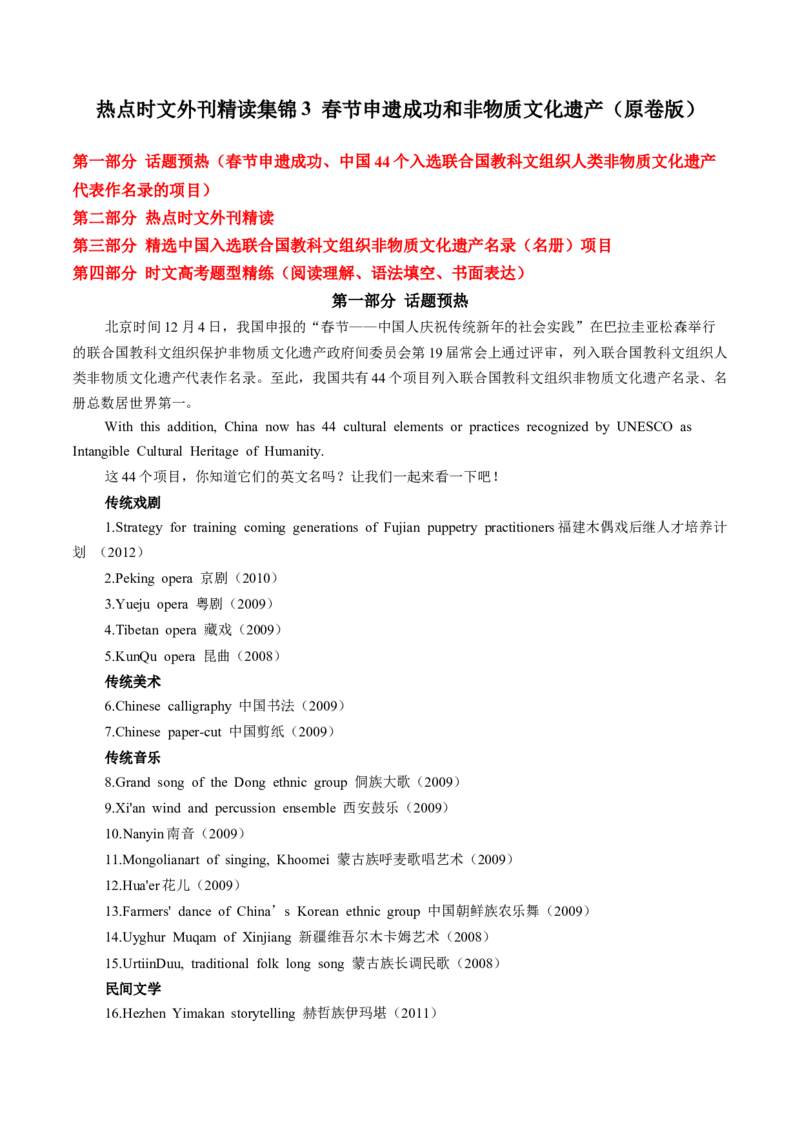
这44个项目,你知道它们的英文名吗?让我们一起来看一下吧!
传统戏剧
1.Strategy for training coming generations of Fujian puppetry practitioners福建木偶戏后继人才培养计
划 (2012)
2.Peking opera 京剧(2010)
3.Yueju opera 粤剧(2009)
4.Tibetan opera 藏戏(2009)
5.KunQu opera 昆曲(2008)
传统美术
6.Chinese calligraphy 中国书法(2009)
7.Chinese paper-cut 中国剪纸(2009)
传统音乐
8.Grand song of the Dong ethnic group 侗族大歌(2009)
9.Xi'an wind and percussion ensemble 西安鼓乐(2009)
10.Nanyin南音(2009)
11.Mongolianart of singing, Khoomei 蒙古族呼麦歌唱艺术(2009)
12.Hua'er花儿(2009)
13.Farmers' dance of China’s Korean ethnic group 中国朝鲜族农乐舞(2009)
14.Uyghur Muqam of Xinjiang 新疆维吾尔木卡姆艺术(2008)
15.UrtiinDuu, traditional folk long song 蒙古族长调民歌(2008)
民间文学
16.Hezhen Yimakan storytelling 赫哲族伊玛堪(2011)17.Gesar epic tradition 格萨(斯)尔(2009)
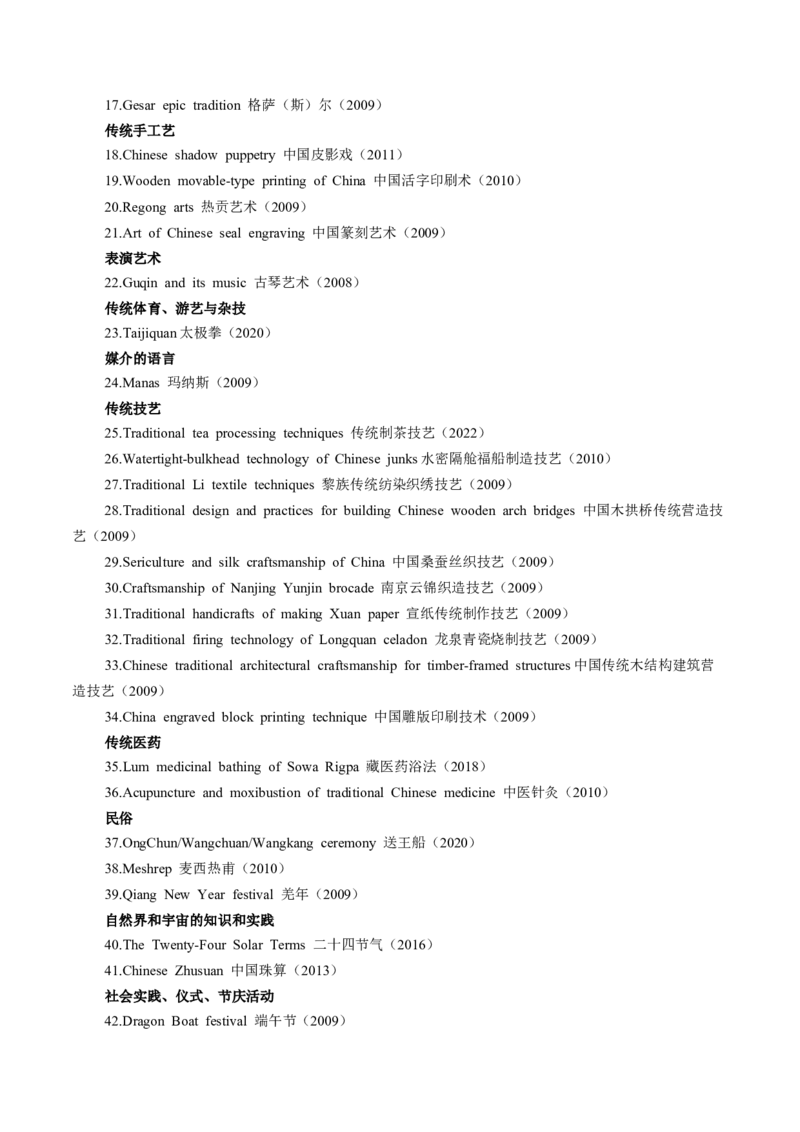
传统手工艺
18.Chinese shadow puppetry 中国皮影戏(2011)
19.Wooden movable-type printing of China 中国活字印刷术(2010)
20.Regong arts 热贡艺术(2009)
21.Art of Chinese seal engraving 中国篆刻艺术(2009)
表演艺术
22.Guqin and its music 古琴艺术(2008)
传统体育、游艺与杂技
23.Taijiquan太极拳(2020)
媒介的语言
24.Manas 玛纳斯(2009)
传统技艺
25.Traditional tea processing techniques 传统制茶技艺(2022)
26.Watertight-bulkhead technology of Chinese junks水密隔舱福船制造技艺(2010)
27.Traditional Li textile techniques 黎族传统纺染织绣技艺(2009)
28.Traditional design and practices for building Chinese wooden arch bridges 中国木拱桥传统营造技
艺(2009)
29.Sericulture and silk craftsmanship of China 中国桑蚕丝织技艺(2009)
30.Craftsmanship of Nanjing Yunjin brocade 南京云锦织造技艺(2009)
31.Traditional handicrafts of making Xuan paper 宣纸传统制作技艺(2009)
32.Traditional firing technology of Longquan celadon 龙泉青瓷烧制技艺(2009)
33.Chinese traditional architectural craftsmanship for timber-framed structures中国传统木结构建筑营
造技艺(2009)
34.China engraved block printing technique 中国雕版印刷技术(2009)
传统医药
35.Lum medicinal bathing of Sowa Rigpa 藏医药浴法(2018)
36.Acupuncture and moxibustion of traditional Chinese medicine 中医针灸(2010)
民俗
37.OngChun/Wangchuan/Wangkang ceremony 送王船(2020)
38.Meshrep 麦西热甫(2010)
39.Qiang New Year festival 羌年(2009)
自然界和宇宙的知识和实践
40.The Twenty-Four Solar Terms 二十四节气(2016)
41.Chinese Zhusuan 中国珠算(2013)
社会实践、仪式、节庆活动
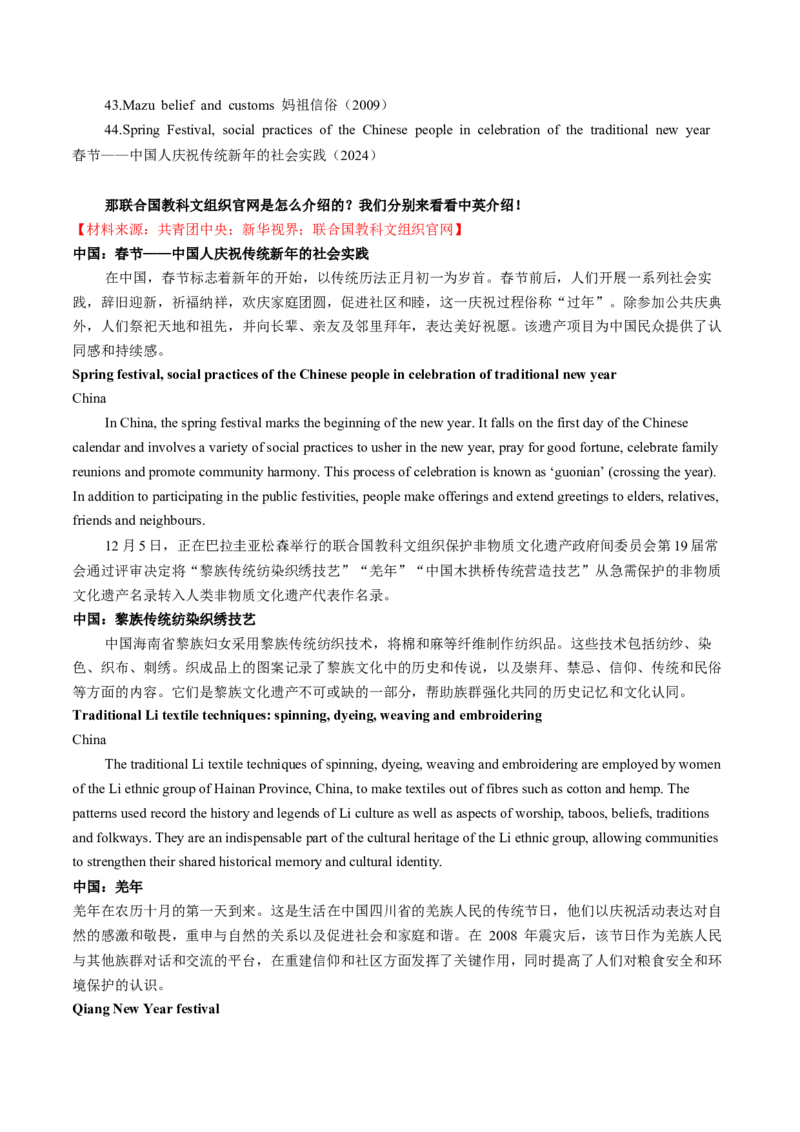
42.Dragon Boat festival 端午节(2009)43.Mazu belief and customs 妈祖信俗(2009)
44.Spring Festival, social practices of the Chinese people in celebration of the traditional new year
春节——中国人庆祝传统新年的社会实践(2024)
那联合国教科文组织官网是怎么介绍的?我们分别来看看中英介绍!
【材料来源:共青团中央;新华视界;联合国教科文组织官网】
中国:春节——中国人庆祝传统新年的社会实践
在中国,春节标志着新年的开始,以传统历法正月初一为岁首。春节前后,人们开展一系列社会实
践,辞旧迎新,祈福纳祥,欢庆家庭团圆,促进社区和睦,这一庆祝过程俗称“过年”。除参加公共庆典
外,人们祭祀天地和祖先,并向长辈、亲友及邻里拜年,表达美好祝愿。该遗产项目为中国民众提供了认
同感和持续感。
Spring festival, social practices of the Chinese people in celebration of traditional new year
China
In China, the spring festival marks the beginning of the new year. It falls on the first day of the Chinese
calendar and involves a variety of social practices to usher in the new year, pray for good fortune, celebrate family
reunions and promote community harmony. This process of celebration is known as ‘guonian’ (crossing the year).
In addition to participating in the public festivities, people make offerings and extend greetings to elders, relatives,
friends and neighbours.
12月5日,正在巴拉圭亚松森举行的联合国教科文组织保护非物质文化遗产政府间委员会第19届常
会通过评审决定将“黎族传统纺染织绣技艺”“羌年”“中国木拱桥传统营造技艺”从急需保护的非物质
文化遗产名录转入人类非物质文化遗产代表作名录。
中国:黎族传统纺染织绣技艺
中国海南省黎族妇女采用黎族传统纺织技术,将棉和麻等纤维制作纺织品。这些技术包括纺纱、染
色、织布、刺绣。织成品上的图案记录了黎族文化中的历史和传说,以及崇拜、禁忌、信仰、传统和民俗
等方面的内容。它们是黎族文化遗产不可或缺的一部分,帮助族群强化共同的历史记忆和文化认同。
Traditional Li textile techniques: spinning, dyeing, weaving and embroidering
China
The traditional Li textile techniques of spinning, dyeing, weaving and embroidering are employed by women
of the Li ethnic group of Hainan Province, China, to make textiles out of fibres such as cotton and hemp. The
patterns used record the history and legends of Li culture as well as aspects of worship, taboos, beliefs, traditions
and folkways. They are an indispensable part of the cultural heritage of the Li ethnic group, allowing communities
to strengthen their shared historical memory and cultural identity.
中国:羌年
羌年在农历十月的第一天到来。这是生活在中国四川省的羌族人民的传统节日,他们以庆祝活动表达对自
然的感激和敬畏,重申与自然的关系以及促进社会和家庭和谐。在 2008 年震灾后,该节日作为羌族人民
与其他族群对话和交流的平台,在重建信仰和社区方面发挥了关键作用,同时提高了人们对粮食安全和环
境保护的认识。
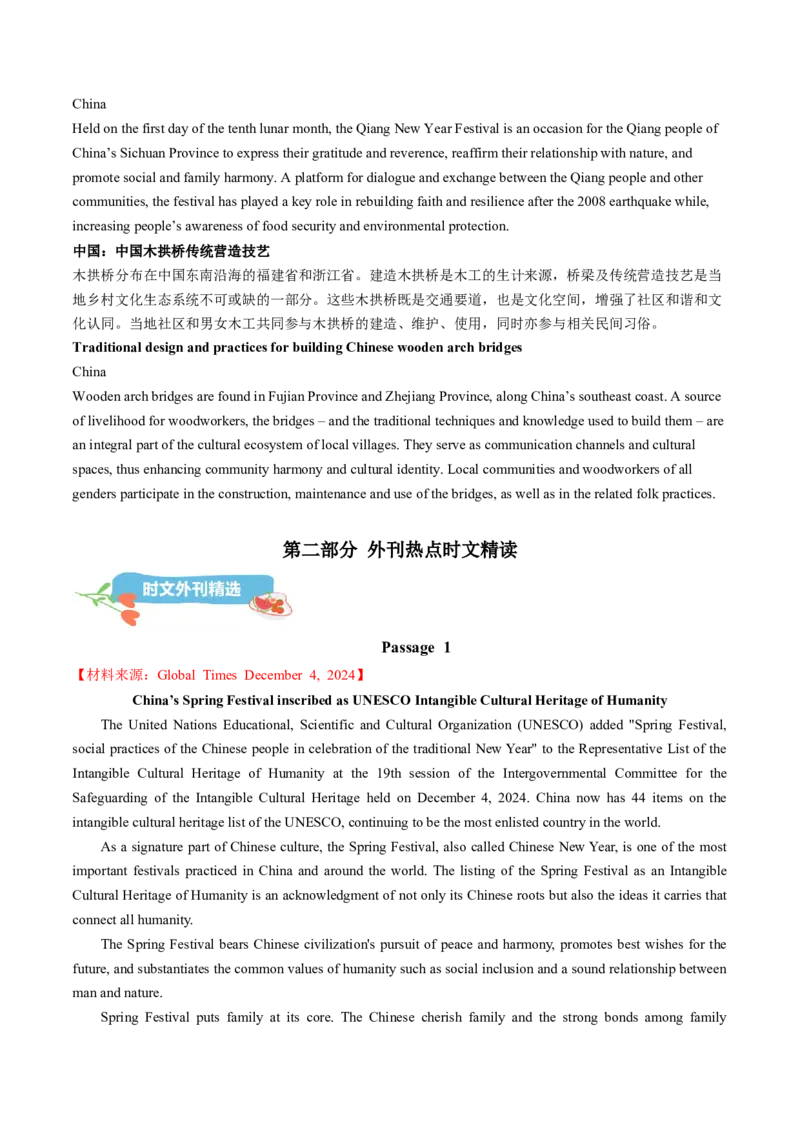
Qiang New Year festivalChina
Held on the first day of the tenth lunar month, the Qiang New Year Festival is an occasion for the Qiang people of
China’s Sichuan Province to express their gratitude and reverence, reaffirm their relationship with nature, and
promote social and family harmony. A platform for dialogue and exchange between the Qiang people and other
communities, the festival has played a key role in rebuilding faith and resilience after the 2008 earthquake while,
increasing people’s awareness of food security and environmental protection.
中国:中国木拱桥传统营造技艺
木拱桥分布在中国东南沿海的福建省和浙江省。建造木拱桥是木工的生计来源,桥梁及传统营造技艺是当
地乡村文化生态系统不可或缺的一部分。这些木拱桥既是交通要道,也是文化空间,增强了社区和谐和文
化认同。当地社区和男女木工共同参与木拱桥的建造、维护、使用,同时亦参与相关民间习俗。
Traditional design and practices for building Chinese wooden arch bridges
China
Wooden arch bridges are found in Fujian Province and Zhejiang Province, along China’s southeast coast. A source
of livelihood for woodworkers, the bridges – and the traditional techniques and knowledge used to build them – are
an integral part of the cultural ecosystem of local villages. They serve as communication channels and cultural
spaces, thus enhancing community harmony and cultural identity. Local communities and woodworkers of all
genders participate in the construction, maintenance and use of the bridges, as well as in the related folk practices.
第二部分 外刊热点时文精读
Passage 1
【材料来源:Global Times December 4, 2024】
China’s Spring Festival inscribed as UNESCO Intangible Cultural Heritage of Humanity
The United Nations Educational, Scientific and Cultural Organization (UNESCO) added "Spring Festival,
social practices of the Chinese people in celebration of the traditional New Year" to the Representative List of the
Intangible Cultural Heritage of Humanity at the 19th session of the Intergovernmental Committee for the
Safeguarding of the Intangible Cultural Heritage held on December 4, 2024. China now has 44 items on the
intangible cultural heritage list of the UNESCO, continuing to be the most enlisted country in the world.
As a signature part of Chinese culture, the Spring Festival, also called Chinese New Year, is one of the most
important festivals practiced in China and around the world. The listing of the Spring Festival as an Intangible
Cultural Heritage of Humanity is an acknowledgment of not only its Chinese roots but also the ideas it carries that
connect all humanity.
The Spring Festival bears Chinese civilization's pursuit of peace and harmony, promotes best wishes for the
future, and substantiates the common values of humanity such as social inclusion and a sound relationship between
man and nature.
Spring Festival puts family at its core. The Chinese cherish family and the strong bonds among familymembers, and extend this affection to the community and the nation and beyond. That's why each Spring Festival,
millions of people from across the country embark on the journey home, making the phenomenon the greatest
human migration on Earth.
Celebrations for the Spring Festival last for 15 days, ending with the Lantern Festival, to give full play to
family gatherings, feasts, and various cultural activities.
It starts at the dining table in every household. Spring Festival food traditions contribute a great deal to the
culture of Chinese cuisine. From dumplings to sticky rice cakes, from fried meatballs to braised fish, and
geographically from north to the south, all dishes carry the best blessings for people's loved ones during the Spring
Festival.
The Spring Festival incorporates a comprehensive range of intangible cultural heritages at various levels. It is
a festival filled with folk tales and the traditions based on them.
The fireworks and the red decorations in front of many homes and businesses were originally intended to scare
away the beast called nian (year), a mythical beast thought to have preyed on people and livestock at the turn of the
year. The monster, however, was afraid of loud bangs and the color red.
Today, during the Spring Festival, people carry on the tradition of hanging red lanterns, setting off fireworks
and fixing red scrolls with rhyming phrases on their doors in the hopes these can ward off evil spirits and attract
good luck.
In addition to the customs on specific days, there are also other interesting cultural symbols and events related
to the festival. Many of these celebrations and events that have been passed down from generation to generation are
practiced in China, Asia and beyond. They include paper-cuts, the dragon dance and lantern festival events,
together forming the happiest of days for those who celebrate this event.
【译文欣赏】
中国春节被列入联合国教科文组织人类非物质文化遗产代表作名录
联合国教科文组织(UNESCO)在 2024 年 12 月 4 日举行的保护非物质文化遗产政府间委员会第
19 届会议上,把 “春节,中国人庆祝传统新年的社会习俗” 添加到了人类非物质文化遗产代表作名录
之中。当下,中国已有 44 个项目登上了联合国教科文组织的非物质文化遗产名录,持续成为世界上入选
项目数量最多的国家。
作为中华文化极具标志性的一部分,春节,也被称作中国新年,是在中国以及全球范围内都备受重视
的最重要节日之一。春节被列入人类非物质文化遗产代表作名录,这不仅是对其源自中国这一根源的认可,
更是对它所承载的、能够连接全人类的理念的一种肯定。
春节蕴含着中华文明对和平与和谐的追求,传递着对未来的美好祝愿,同时也切实体现了像社会包容
以及人与自然和谐相处这样的人类共同价值。
春节将家庭置于核心地位。中国人珍视家庭以及家庭成员间紧密的亲情纽带,并且把这种情感延伸到
社区、国家乃至更广泛的范围之外。这就是为什么每到春节的时候,来自全国各地数以百万计的人们会踏
上归乡的旅程,从而造就了地球上规模最为庞大的人类迁徙现象。
春节的庆祝活动会持续 15 天,一直到元宵节才结束,以便充分开展家庭团聚、举办盛宴以及各类文
化活动。春节起始于家家户户的餐桌之上。春节的饮食传统为中华饮食文化增添了诸多光彩。从饺子到年糕,
从炸丸子到红烧鱼,从北方到南方,所有的菜肴都承载着人们在春节期间对自己所爱之人的美好祝福。
春节融合了各个层面丰富多样的非物质文化遗产。它是一个充满民间故事以及基于这些故事所形成传统的
节日。
许多家庭和商户门前燃放的烟花以及张贴的红色装饰,原本是为了吓跑一种叫做 “年” 的怪兽。
“年” 是一种存在于神话传说中的野兽,据说它会在新旧年交替之际捕食人和牲畜。不过,这头怪兽很
害怕巨大的声响以及红色。
如今,在春节期间,人们延续着挂红灯笼、燃放烟花以及在门上张贴写有对仗语句的红色春联的传统,
寄希望于这些做法能够驱走邪魔、招来好运。
除此之外,除了那些在特定日子里的习俗之外,还有其他许多与这个节日相关的有趣文化符号和活动。
许多代代相传的庆祝活动在中国、亚洲乃至世界其他地方都一直在延续开展,其中包括剪纸、舞龙以及各
类元宵节活动等,它们共同为庆祝这个节日的人们营造出了最为欢乐的时光。
【词汇积累】
1. inscribe英音 /ɪnˈskraɪb/ 美音/ɪnˈskraɪb/
[N] To write words in a book or carve (= cut) them on an object. 题写;刻,雕
2. intangible 英音/ɪnˈtæn.dʒə.bəl/ 美音/ɪnˈtæn.dʒə.bəl/
[N] Impossible to touch, to describe exactly, or to give an exact value. (感觉或性质)难以捉摸的,无
法形容的,难以确定的
3. signature 英音/ˈsɪɡ.nə.tʃər/ 美音/ˈsɪɡ.nə.tʃɚ/
[N] A particular quality that makes sth different from other similar things and makes it easy to recognize.
明显特征;鲜明特色;识别标志
4. substantiates 英音/səbˈstæn.ʃi.eɪt/ 美音/səbˈstæn.ʃi.eɪt/
[N] To show something to be true, or to support a claim with facts. 证明…属实;证实
5. braise英音/breɪz/ 美音/breɪz/
[N] To cook food slowly in a covered dish in a little fat and liquid. (用文火)炖,焖
6. prey英音/preɪ/ 美音/preɪ/
[N] An animal that is hunted and killed for food by another animal. 被捕食的动物,猎物
重难点解析:
1. China now has 44 items on the intangible cultural heritage list of the UNESCO, continuing to be the
most enlisted country in the world.
译文:目前,中国已有44项列入联合国科教文组织非物质文化遗产名录,继续成为世界上列入非物质文化
遗产名录最多的国家。
解析:这个句子是一个简单句,前面是主谓宾状,后面是现在分词作伴随状语,进行补充和说明。其中
intangible原意为“无形的,难以捉摸的,难以理解的”,在这里表示无形的文化,也是一个固定词组
intangible cultural heritage意为“非物质文化遗产”。enlist原意为“使入伍或者争取帮助”,在这里作过
去分词形式,表示“入选”。the UNESCO指“联合国科教文组织(United Nations Educational, Scientific
and Cultural Organization)”。2. As a signature part of Chinese culture, the Spring Festival, also called Chinese New Year, is one of
the most important festivals practiced in China and around the world.
译文:作为中国文化的标志性组成部分,春节,也称为中国新年,是中国和世界各地最重要的节日之一。
解析:“As a signature part of Chinese culture”是介词短语作状语,“also called Chinese New Year”
是过去分词短语作后置定语,对“the Spring Festival”进行进一步的解释说明。“practiced in China and
around the world”同样是过去分词短语作后置定语,修饰“festivals”。signature原意为“签名”,在这
里引申为“标志性的;典型的;特有的”,强调春节是中国文化中很有代表性的部分。practice有“实行;
实践”的意思,在这里是熟词僻义,表示“庆祝节日”的意思,用过去分词表示节日被人们所庆祝。
“also called...”是过去分词短语作后置定语的常用结构,用于对前面的名词进行补充说明,相当于一个非
限定性定语从句“which is also called...”。
3. Today, during the Spring Festival, people carry on the tradition of hanging red lanterns, setting off
fireworks and fixing red scrolls with rhyming phrases on their doors in the hopes these can ward off evil
spirits and attract good luck.
译文:如今,每逢春节,人们仍保持着挂大红灯笼、放烟花和贴对联的传统。希望这些能辟邪且能吸引好
运。
解析:主句部分是“people carry on...on their doors”,其中主语是“people”, 谓语动词是“carry
on”。“hanging red lanterns”, “setting off fireworks”和“fixing red scrolls with rhyming phrases on
their doors” 这三个动名词短语并列,共同构成“the tradition of...”后的内容,进一步阐述传统所涉及的
具体活动。而在从句部分,省略了that,引导同位语从句。carry on意为“继续;延续;开展”,强调对
某种行为、传统等的持续进行。ward off意为“避开;防止不好的事物”,如疾病、灾祸、邪恶力量等。
set off意为“出发,启程”,这里指“使……爆炸”,表示放烟花。
Passage 2
【材料来源:China Daily】
The United Nations Educational, Scientific and Cultural Organization (UNESCO) on Wednesday inscribed
Spring Festival, social practices of the Chinese people in celebration of the traditional new year, on the
Representative List of the Intangible Cultural Heritage of Humanity.
The decision was made during the 19th session of the Intergovernmental Committee for the Safeguarding of
the Intangible Cultural Heritage, taking place in Paraguay from Dec 2 to 7.The committee recognized the festival
for its wide array of rituals and unique cultural elements that engage all of Chinese society.
UNESCO highlighted that the Spring Festival, marking the start of the traditional Chinese Lunar New Year,
involves various social practices, including prayers for good fortune and family reunions.It also features activities
planned by elders and festive public events organized by communities.
According to UNESCO's documentation, the traditional knowledge and customs associated with the Spring
Festival are passed down informally within families and communities, as well as formally through the education
system.Craftsmanship and artistic skills related to the festival are transmitted through apprenticeships, promoting
family values, social cohesion, and peace, while providing a sense of cultural identity.
The committee also emphasized that the festival embodies the harmony between humans and nature and
contributes to sustainable development in areas such as food security and education.It also plays a key role inraising environmental awareness.
China's vice minister of Culture and Tourism, Rao Quan, who led the Chinese delegation at the UNESCO
session, expressed gratitude for the recognition.He stressed that the Spring Festival is China's most important
traditional holiday, symbolizing the Chinese people's hopes for a better life, strong ties to family and country, and
the values of harmony between humans and nature.
Rao further explained that the festival, passed down through generations, has provided lasting spiritual
strength to the Chinese people.It has played a significant role in promoting family and social harmony, driving
economic development, protecting the environment, and fostering global cultural exchange.
He added that the inclusion of the Spring Festival on the UNESCO list will help promote universal values of
peace and harmony and highlight the important role of intangible cultural heritage in sustainable development.
With this addition, China now has 44 cultural elements or practices recognized by UNESCO as Intangible
Cultural Heritage of Humanity.
【译文欣赏】
12月4日,联合国教科文组织决定将“春节——中国人庆祝传统新年的社会实践”列入人类非物质文
化遗产代表作名录。
这一决定是在12月2日至7日于巴拉圭举行的联合国教科文组织保护非物质文化遗产政府间委员会第
19届常会上做出的。委员会认为,春节具有广泛的仪式和独特的文化元素,吸引了中国全社会的参与。
联合国教科文组织强调,春节标志着中国传统农历新年的开始,涉及祈福纳祥、家庭团聚等各种社会
习俗。此外,春节还包括由长辈策划的活动和由社区组织的节日公共活动。
根据联合国教科文组织记录,与春节有关的传统知识和习俗既在家庭和社区内非正式地传承,又通过
教育系统正式传承。与春节有关的手工艺和艺术技能通过学徒制传承,增进了家庭观念、社会凝聚力与和
平,同时提供了一种文化认同感。
委员会还强调,春节体现了人与自然和谐共生的价值理念,有助于粮食安全和教育等领域的可持续发
展。它在提高环保意识方面也发挥了关键作用。
率领中国代表团出席联合国教科文组织会议的中国文化和旅游部副部长饶权对这一决定表示感谢。他
强调,春节是中国最重要的传统节日,象征着中国人民对美好生活的憧憬、深厚的家国情怀以及人与自然
和谐共生的价值理念。
饶权进一步解释,世代相传的中国传统节日为中国人民提供了持久的精神力量。它在促进家庭和睦、
社会和谐、经济发展、环境保护、全球文化交流等方面发挥着重要作用。
饶权补充,将春节列入人类非物质文化遗产代表作名录,有助于促进和平与和谐的价值观,并突出非
物质文化遗产在可持续发展中的重要作用。
至此,中国共有44个项目列入联合国教科文组织非物质文化遗产名录、名册。
词汇积累
UNESCO 联合国教科文组织
Intangible Cultural Heritage 非物质文化遗产
pass down 传承
Craftsmanship n.手艺,工艺;精工细作;手工艺品
apprenticeships n.学徒(apprenticeship 的复数);学徒制sustainable development 可持续发展
第三部分 精选中国入选联合国教科文组织非物质文化遗产名录(名册)项目
Qiang New Year Festival 羌年
The Qiang New Year Festival, held on the first day of the tenth lunar month, is an occasion for the
Qiang people of China's Sichuan Province to offer thanks and worship to heaven for prosperity, reaffirm
their harmonious and respectful relationship with nature, and promote social and family harmony.
农历十月初一为羌族新年,是四川的羌族人民向上天道谢、祈福、重申与自然和谐相处、促进社会和家庭
和谐的节日。
Mazu belief and customs 妈祖信俗
Mazu is the most influential goddess of the sea in China. She is celebrated twice each year in formal
temple fairs, when Meizhou residents, farmers and fisherfolk temporarily suspend their work to sacrifice
marine animals, venerate statues of Mazu and enjoy a variety of dances and other performances.
妈祖是中国最有影响力的海上女神。在每年两次的祭祀大典上庆祝妈祖,届时湄洲的居民、农民和渔民会
暂停工作,祭海洋生灵、拜妈祖雕像,欣赏各种舞蹈和其他表演。
Chinese paper-cut 剪纸
Present throughout China including various ethnic groups, paper-cut is a popular art integral to everyday
lives. It is transmitted from mother to daughter over a long period of time. Paper-cut continues to provide
an outlet for emotion and is experiencing an unprecedented revival.
剪纸是一种流行的艺术,在中国各地与各民族中广泛存在。这种艺术形式经历长时间的传承,通常由母亲
传给女儿。人们通过剪纸,倾泻情感。剪纸也正在经历前所未有的复兴。
Chinese calligraphy 书法
Five different styles of script: seal, official, cursive, running and regular. Calligraphy offers an important
channel for the appreciation of traditional culture and for arts education. It is also a source of pride and
pleasure for the Chinese people.
五种不同的字体:篆书、隶书、草书、行书、楷书。书法是传统文化欣赏和艺术教育的重要渠道,也是中
国人民自豪和快乐的来源。
Regong arts 热贡艺术
Characterized by a distinctively Tibetan Buddhist religion style and unique regional features, the Regong
arts embody the spiritual history and traditional culture of the region and remain an integral part of the
artistic life of people there today.
热贡艺术具有鲜明的藏传佛教宗教风格和独特地域特色。它体现着该地区的精神历史和传统文化,至今仍
是当地人民艺术生活的重要组成部分。
Beijing opera 京剧
Beijing opera is a performance art incorporating singing, reciting, acting, martial arts. Costumes are
flamboyant and the exaggerated facial make-up uses concise symbols, colours and patterns to portray
characters' personalities and social identities. It is regarded as an expression of the aesthetic ideal of operain traditional Chinese society.
京剧是一门集唱歌、朗诵、表演、武术于一体的表演艺术。服装艳丽,夸张的面部妆容用简洁的符号、颜
色和图案来描绘人物的个性和社会身份。京剧被认为是中国传统社会戏曲审美的一种理想表现。
Chinese shadow puppetry 皮影戏
It is a form of theatre acted by colourful silhouette figures made from leather or paper, accompanied by
music and singing.
皮影戏是一种戏剧形式,用皮革或纸张制成的彩色剪影进行人物表演,配以音乐和歌声。
Kunqu opera 昆曲
Kunqu opera is one of the oldest forms of Chinese opera still performed today. Renowned for the
virtuosity of its rhythmic patterns (changqiang), Kunqu opera has had a considerable influence on more
recent forms of Chinese opera, such as the Sichuan or Beijing opera.
昆曲是至今仍在上演的,中国最古老的戏曲形式之一。它以其优美的韵律模式(长腔)而闻名,对中国戏
曲的新形式,如川剧及京剧,产生很大影响。
Traditional tea processing techniques 传统制茶技艺
Based on natural conditions and local customs, tea producers have developed six categories of tea: green,
yellow, dark, white, oolong and black teas. The practice of greeting guests and building relationships
within families and among neighbours through tea-related activities is common to multiple ethnic groups.
茶叶生产者根据自然条件和当地习俗,发展出绿茶、黄茶、黑茶、白茶、乌龙茶和红茶六大品类。各民族
都会用与茶有关的活动来问候客人,沟通家庭和邻居之间的关系。
China engraved block printing technique 中国雕版印刷技术
Block engraving may be used to print books in a variety of traditional styles, to create modern books
with conventional binding, or to reproduce ancient Chinese books.
雕版可用于印刷各种传统风格的书籍,制作具有传统装订的现代书籍,或复制中国古代书籍。
第二部分 高考题型精练
一、阅读理解
A
The Panamanian government announced that the Chinese New Year, or Spring Festival, will be listed as a
national holiday in Panama from 2022.The decision will boost the country's tourism economy, meanwhile
acknowledge the contributions of Chinese-Panamanian to the country's "ethnic diversity and multiculturalism,"
noted Ivan Eskildsen, minister of Panama's National Tourism.
"The country is working together with the Chinese Embassy in Panama to plan 2022 Spring Festival
celebrations, which are expected to generate over $100 million in economic output," Eskildsen said. In addition,
"by holding nationwide events, Chinese in Latin America can gather in Panama and celebrate the traditional
Chinese festival," said Panama Minister of Culture Carlos Aguilar.
Some Chinese netizens have questioned whether the decision was made out of "real concern for the Chinese
living and working in the country" or merely an attempt to boost the country's economy. But many others looked at
this decision on the brighter side, saying they believe that a "national celebration will cheer up the Chinese living inPanama, even if it is just an attempt to boost international tourism.""I hope it can enhance a sense of belonging
among local Chinese toward the traditional culture during Spring Festival and attract Chinese from some
neighboring countries to participate," posted one netizen.
There has been a more than 100-year history of Chinese living in this Central American nation, where "the
arrival of Chinese in Panama can be traced back to the mid-19th century. On June 12, 2017, China and
Panamaestablished diplomatic(外交的) relations. Since then bilateral relations have developed rapidly. When it
comes to the news that the Panamanian government prepares to celebrate the Chinese New Year in 2022 as an
official national holiday, Chinese citizens have applauded the country's plan.
1.Which of the following is a suitable title for the text?
A. The diplomatic relationship between China and Panama
B. Panama’s move to list Chinese New Year as national holiday
C. The Chinese contributions to boost the Panama’s tourism economy
D. The celebration of Chinese New Year in Panama’s Chinese community
2.What does Eskildsen think of the announcement of the government?
A. It speeds the rapid development of the bilateral relations
B. It has increased over $100 million in economic output.
C. It contributes to the country's ethnic diversity and multiculturalism.
D. It helps Chinese in Latin America gather in Panama and celebrate the traditional Chinese festival.
3.Which is not the reason why the government announced the Spring Festival as a national holiday in Panama?
A. To boost international tourism.
B. To develop Panama’s tourism economy.
C. To provide the convenience for Chinese in Panama .
D. To establish the relations between China and Panama .
4.What is the attitude of many Chinese netizens towards the decision of the Panamanian government?
A. Opposed. B. Positive C. Doubtful. D. Cautious
B
Adaptation and innovation (创新) of traditional opera has been an important trend in Chinese opera circle in
recent years. In order to attract young audience of new generation and catch up with the time, traditional opera
circle makes efforts to create new works. In recent years, traditional opera has come across the change of time and
society. It gradually lost the main elderly audience and was not attractive for the young.
In order to find new opportunities, using modern sound, light and digital stage effects, China’s traditional
Peking Opera, also known as jingju, is appealing to young people in a fashionable and innovative way, as the
classic art faces an aging audience.
The centuries-old Tianleyuan Theater in Beijing has introduced fashionable performances of Peking Opera.
The opera combines instrumental music, vocal performance, mime (哑剧表演 ), dance and acrobatics (杂技).
Tianleyuan has a jingju art experience section and fashionable performances. It has attracted more than 2,000
audience members, mostly young people, according to theater staff.“Good art should keep pace with the times, so does jingju,” said Zhang Zishang, a 22-year-old performer of
The Drunken Beauty, one of the classic jingju plays performed in the theater. “I feel today’s performance is very
special,” Zhang added. She was born into a family of jingju performers and has had 10 years of stage experience.
“Innovation is good, but we must also carry on the basic elements of jingju,” another young performer Deng said.
According to Deng, innovation is perhaps the best way for jingju to deal with the problem of an aging audience. It
has made successful attempts to combine jingju with local opera forms such as ballet when organizing
performances abroad. “Innovation can help traditional arts go further. We are happy to see many young faces, and
some of them even come twice to experience the ‘new’ art,” she added.
1.Why is adaptation and innovation of traditional opera important?
A.To change the traditional opera circle. B.To improve digital stage effect.
C.To attract the young audience. D.To run after fashion.
2.Which of the following can best describe Tianleyuan Theater?
A.A destroyer of Peking Opera. B.A pioneer of innovative opera.
C.An objector of modern opera. D.A defender of traditional opera.
3.How does Deng feel about the innovation of jingju?
A.Useless. B.Curious. C.Confident. D.Negative.
4.What is the main idea of the text?
A.Traditional Opera Circle Is Innovating to Attract Young Audience.
B.The Future of the Traditional Opera Is Promising.
C.The Performers of the Traditional Opera Are Supporting Jingju.
D.The Traditional Opera Is Dying Out.
二、语法填空
Passage 1
The United Nations Educational, Scientific and Cultural Organization (UNESCO) on December 4th,
2024 inscribed Spring Festival, social practices of the Chinese people in celebration of the traditional new year, on
the Representative List of the Intangible Cultural Heritage of Humanity.
The decision was made during the 19th session of the Intergovernmental Committee for the Safeguarding of
the Intangible Cultural Heritage, 1.______(take) place in Paraguay from Dec 2 to 7. With this addition, China now
has 44 cultural elements or practices recognized by UNESCO 2. _______Intangible Cultural Heritage of
Humanity, continuing to be the most enlisted country in the world.
According to UNESCO's documentation, the traditional knowledge and customs 3._________(associate) with
the Spring Festival are passed down informally within families and communities, as well as formally through the
education system. Craftsmanship and artistic skills related to the festival 4. ______ (transmit) through
apprenticeships, promoting family values, social cohesion, and peace, while providing 5. ______ sense of cultural
identity.
The committee also emphasized that the festival embodies the harmony between humans and nature
and 6.________ (contribute) to sustainable development in areas such as food security and education. It also plays akey role in raising environmental awareness.
China's vice minister of Culture and Tourism, Rao Quan, who led the Chinese delegation at the UNESCO
session, expressed 7. ___________(grateful) for the recognition. He stressed that the Spring Festival is China's
most important traditional holiday, symbolizing the Chinese people's hopes for a better life, strong8.
_________(tie) to family and country, and the values of harmony between humans and nature.
Rao 9. _________(far) explained that the festival, passed down through generations, has provided lasting
spiritual strength to the Chinese people. It has played a significant role in promoting family and social harmony,
driving economic development, protecting the environment, 10.______fostering global cultural exchange.
He added that the inclusion of the Spring Festival on the UNESCO list will help promote universal values of
peace and harmony and highlight the important role of intangible cultural heritage in sustainable development.
Passage 2
The term Xuan paper first appeared in On Famous Paintings through the Ages, a book written by Tang
Dynasty scholar Zhang Yanyuan, 1 he described Xuan paper as an ideal carrier for calligraphy and painting.
Handmade Xuan paper from Jingxian county, East China’s Anhui province, 2 (list) as a gift to the imperial
court then for its supreme quality.
During the Tang and Song Dynasties Xuan paper reached its peak of 3 (popular) and quality. The
traditional craft of making Xuan paper is extremely 4 (demand). Sandalwood bark, a plant native to
southern China, 5 (go) through 108 procedures over the course of three years before it can transform into
fine Xuan paper.
The flow of ink determines the output of Chinese art, and Xuan paper outshines others with its excellent
ability 6 (give) full play to ink. Different proportions of bark to straw during the paper-making process can
create different canvases (画布) best suited for artistic expression in freehand ink paintings or calligraphy. The
unique quality of Xuan paper is 7 (high) valued in the world of Chinese calligraphy and painting.
Xuan paper is very resistant 8 damage brought by time. It is this durability 9 has made the
preservation of many valuable works from ancient China possible. The long history, unique craftsmanship, and high
quality of Xuan paper have made it a 1 0 (treasure) cultural heritage of China.
Passage 3
阅读下面短文,在空白处填入1个适当的单词或括号内单词的正确形式。
Chinese calligraphy art, also known as traditional Chinese calligraphy, includes a wide range of techniques
and styles. The use of Chinese brushwork, which 1 (feature) by fluent and expressive strokes (笔划),
creates a harmonious balance 2 precision and artistic freedom.
Chinese calligraphy art offers 3 look into the rich cultural heritage (遗产) and artistic traditions of
China. It provides a platform for exploration and experimentation, 4 (enable) calligraphers to push the
boundaries of their skills and create innovative works. The complexity and vast number of Chinese characters
present endless 5 (opportunıty) for artistic expressions, with each stroke and character showing a
different emotion and meaning.
“Chinese calligraphy is not just about writing; it is about artistic creation. Through calligraphy, I can express6 (I), my emotions, and my thoughts. It is a deeply personal and meditative (沉思的) process that allows me
to connect with my inner self and communicate with the world,” said Li Mei, a Chinese calligrapher.
The permanent beauty of Chinese calligraphy art lies in its ability 7 (communicate) both visual
and emotional depth. With a rich history lasting thousands of years, this art form 8 (continue) to inspire
and appeal to art enthusiasts around the world. Its 9 (elegant) and excellence surpass time and cultural
boundaries, making it a valued form of artistic expression 10 impresses people from all walks of life.
三、书面表达
1.假定你是李华,你的外国朋友Peter对中国传统文化非常感兴趣。得知春节申遗成功,特意写信向你询问
相关情况。请你给他写一封电子邮件,内容包括:
1. 表达你的兴奋之情;
2. 阐述春节的独特魅力(如传统习俗、文化内涵等);
3. 邀请他来你家乡过春节。
注意:
1. 词数80词左右;
2. 可适当增加细节,以使行文连贯。
Dear Peter,
____________________________________________________________________________________________
____________________________________________________________________________________________
____________________________________________________________________________________________
____________________________________________________________________________________________
Best regards,
Li Hua
2.上周你校组织了“非遗进校园”的活动,请你写一篇短文向校报投稿题目已给出,不计入总词数。
Tips: The Intangible Cultural heritage
(Wood-carving, Traditional Chinese painting, Calligraphy, Tea-culture, Sugar-figure blowing, etc)
内容包括:
1.活动目的
2.活动过程
3.你的感想和收获
注意:1.写作词数应为80词左右;
2.可适当增加细节,使行文完整。
A campaign on campus themed “The Intangible Cultural Heritage”
____________________________________________________________________________________________
________________________________________________________________________________________________________________________________________________________________________________________
____________________________________________________________________________________________
____________________________________________________________________________________________