热点话题05  国际太极拳日——中国传统文化走
向世界
目录
时文精读------------------------------------------------------------精选外刊原创语法填空
  【原创·语法填空】
【课标词汇积累】
【课标词汇训练】
【参考译文】
好题精练----------------------------------------------------------精选名校及联考话题专练
【阅读理解】
【阅读7 选5】
【完形填空】
【语法填空】
【话题·导语】
UNESCO affirms International Taijiquan Day worldwide 联合国教科文组织在全世界范围内确认国际太极拳
日。
【原文·时文阅读】
文章来源:https://www.globaltimes.cn/page/202511/1347571.shtml
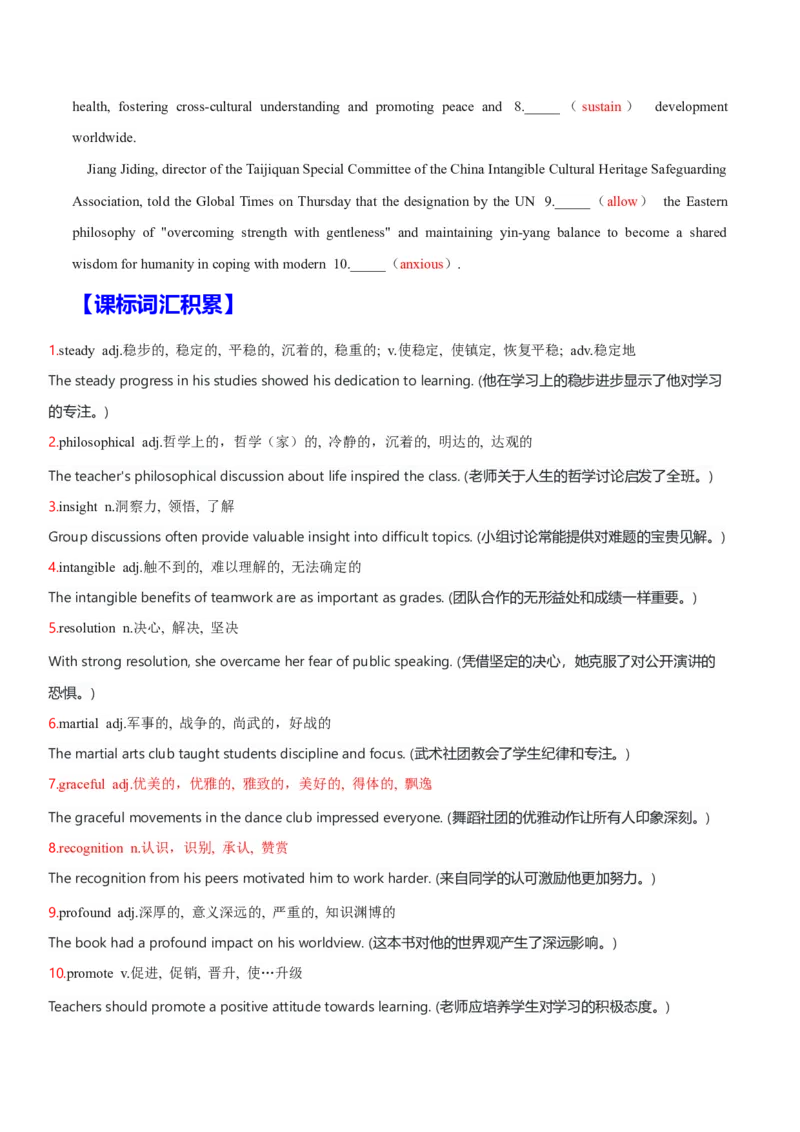
With a gentle lift of the hands, a slow rise of the body and a steady bend of the knees, Taijiquan has been
practiced for centuries by people of all ages and backgrounds. More than an exercise, it's a way of life - one that
blends physical health with deep philosophical insight.
读时文精读
  Recognized by the United Nations Educational, Scientific and Cultural Organization (UNESCO) as an intangible
cultural heritage of humanity in 2020, Taijiquan has reached more than 180 countries and regions.
  Now, Taijiquan takes another graceful step onto the global stage. With UNESCO's approval of a resolution on
November 5 designating March 21 as International , this centuries-old art form has a day of its own to be celebrated
around the world.
  The decision, made at the 43rd session of the UNESCO General Conference in Samarkand, Uzbekistan, marks
the first time an international day has been named after a martial art within the UN system.
  The move signifies the widespread global recognition of the important value of Taijiquan, a treasured traditional
Chinese sport, and is a vivid example of the Global Civilization Initiative in action, Xinhua reported. Delegates said
the establishment of International  carries profound significance for improving human health, fostering cross-
cultural understanding and promoting peace and sustainable development worldwide.
  Jiang Jiding, director of the Taijiquan Special Committee of the China Intangible Cultural Heritage Safeguarding
Association, told the Global Times on Thursday that the designation by the UN allows the Eastern philosophy of
"overcoming strength with gentleness" and maintaining yin-yang balance to become a shared wisdom for humanity
in coping with modern anxiety.
【原创·语法填空】(263words)
With a gentle lift of the hands, a slow rise of the body and a steady bend of the knees, Taijiquan 1._____
(practice) for centuries by people of all ages and backgrounds. More than an exercise, it's a way of life - one
2._____  blends physical health with deep philosophical insight.
  3._____(recognize) by the United Nations Educational, Scientific and Cultural Organization (UNESCO) as
an intangible cultural heritage of humanity in 2020, Taijiquan has reached more than 180 countries and regions.
  Now, Taijiquan takes another graceful step onto the global stage. With UNESCO's approval of a resolution on
November 5 4._____(designate)March 21 as International , this centuries-old art form has a day of its own
5._____(celebrate)around the world.
  The decision, made at the 43rd session of the UNESCO General Conference in Samarkand, Uzbekistan, marks
the first time an international day has been named 6._____ a martial art within the UN system.
  The move signifies the widespread global recognition of the important value of Taijiquan, a treasured
traditional Chinese sport, and is 7._____ vivid example of the Global Civilization Initiative in action, Xinhua
reported. Delegates said the establishment of International  carries profound significance for improving human
health, fostering cross-cultural understanding and promoting peace and 8._____ (sustain ) development
worldwide.
  Jiang Jiding, director of the Taijiquan Special Committee of the China Intangible Cultural Heritage Safeguarding
Association, told the Global Times on Thursday that the designation by the UN 9._____(allow) the Eastern
philosophy of "overcoming strength with gentleness" and maintaining yin-yang balance to become a shared
wisdom for humanity in coping with modern 10._____(anxious).
【课标词汇积累】
1.steady adj.稳步的, 稳定的, 平稳的, 沉着的, 稳重的; v.使稳定, 使镇定, 恢复平稳; adv.稳定地
The steady progress in his studies showed his dedication to learning. (他在学习上的稳步进步显示了他对学习
的专注。)
2.philosophical adj.哲学上的,哲学(家)的, 冷静的,沉着的, 明达的, 达观的
The teacher's philosophical discussion about life inspired the class. (老师关于人生的哲学讨论启发了全班。)
3.insight n.洞察力, 领悟, 了解
Group discussions often provide valuable insight into difficult topics. (小组讨论常能提供对难题的宝贵见解。)
4.intangible adj.触不到的, 难以理解的, 无法确定的
The intangible benefits of teamwork are as important as grades. (团队合作的无形益处和成绩一样重要。)
5.resolution n.决心, 解决, 坚决
With strong resolution, she overcame her fear of public speaking. (凭借坚定的决心,她克服了对公开演讲的
恐惧。)
6.martial adj.军事的, 战争的, 尚武的,好战的
The martial arts club taught students discipline and focus. (武术社团教会了学生纪律和专注。)
7.graceful adj.优美的,优雅的, 雅致的,美好的, 得体的, 飘逸
The graceful movements in the dance club impressed everyone. (舞蹈社团的优雅动作让所有人印象深刻。)
8.recognition n.认识,识别, 承认, 赞赏
The recognition from his peers motivated him to work harder. (来自同学的认可激励他更加努力。)
9.profound adj.深厚的, 意义深远的, 严重的, 知识渊博的
The book had a profound impact on his worldview. (这本书对他的世界观产生了深远影响。)
10.promote v.促进, 促销, 晋升, 使…升级
Teachers should promote a positive attitude towards learning. (老师应培养学生对学习的积极态度。)
【课标词汇训练】
根据语境,从上面的“课标词汇”中选用合适的单词及其正确形式将句子补充完整。
1.She maintained a _____________ routine of reviewing notes every evening. (她保持着每天晚上复习笔记的稳
定习惯。)
2.His _____________ approach to failure helped him grow stronger. (他对失败的哲学态度帮助他变得更坚强。)
3.He applied _____________ principles to stay calm during exams. (他运用武术原则在考试中保持冷静。)
4.Her _____________ into the problem surprised even the teacher. (她对问题的洞察力甚至让老师感到惊讶。)
5.Kindness is an _____________ quality that makes school life better. (善良是让校园生活更美好的无形品质。)
6.His New Year's _____________ was to improve his math skills. (他的新年决心是提高数学能力。)
7.Academic _____________ should not be the only goal of learning. (学术认可不应该是学习的唯一目标。)
8.She handled the criticism with _____________ composure. (她以优雅的沉着应对批评。)
9.Their friendship was based on _____________ mutual understanding. (他们的友谊建立在深刻的相互理解上。)
10.The school _____________ creativity through various activities. (学校通过各种活动促进创造力。)
【参考译文】
太极拳以轻柔的手法、缓慢的身姿与稳重的屈膝动作,历经数百年传承,成为各年龄层与文化背景人
群的日常修习。它不仅是锻炼体魄的技艺,更是一种将强健体魄与深刻哲学洞见完美融合的生活方式。
太极拳于2020 年被联合国教科文组织(UNESCO)认定为人类非物质文化遗产,目前已传播至180 多
个国家和地区。
如今,太极拳又迈出了优雅的步伐登上世界舞台。随着联合国教科文组织于11 月5 日通过决议,将3
月21 日定为国际太极拳日,这项拥有数百年历史的艺术形式终于拥有了属于自己的全球庆祝日。
在乌兹别克斯坦撒马尔罕举行的联合国教科文组织大会第四十三届会议上作出的这一决定,标志着联
合国系统首次以武术命名国际日。
新华社报道,此举标志着太极拳这一珍贵中国传统体育项目的重要价值获得全球广泛认可,是全球文
明倡议行动的生动例证。代表们表示,国际组织的建立对改善人类健康、促进跨文化交流以及推动全球和
平与可持续发展具有深远意义。
中国非物质文化遗产保护协会太极拳专项委员会主任蒋继定周四向《环球时报》表示,联合国的认定
使东方哲学‘以柔克刚’与‘阴阳平衡’的理念,成为人类应对现代焦虑的共同智慧。
Passage1 阅读理解
“Taijiquan is a traditional physical practice in China characterized by relaxed, circular movements that work
with breath regulation.” thus reads the introduction of Taijiquan by the United Nations Educational, Scientific and
Cultural Organization(UNESCO) on its website. Also referred to as T'ai Chi or Chinese boxing, Taijiquan has been
a well-known physical practice worldwide. For a long time, different stories regarding the birthplace of Taijiquan
have made the rounds, focusing mainly on two places-Wudang Mountain in Hubei Province, central China, and
Wenxian County.
A tale tells how a man named Zhang Shanfeng created Taijiquan about 1,000 years ago after witnessing a
fight between a sparrow and a snake, drawing inspiration from the animals' movements. The Wudang Mountain is
known as one of China's major Taoist land-marks. This oldest philosophy of China has had a great impact on
Taijiquan.
The story about its Chenjiagou origin has some more hard proof. In the mid-17th century, a retired general
and village head named Chen Wangting combined his kungfu training with elements of Chinese philosophy to
create Chen style Tai Chi. Popular belief holds that many modern styles of Taijiquan have been derived from the
Chen style. Wenxian is listed as Taijiquan's birthplace on the UNESCO website.
Different from Shaolin Kungfu's powerful approach, Taijiquan looks softer and slower. This soft yet
powerful spirit runs through the style of Chenjiagou, which has about 300 years of Taijiquan history.
The Chen style Taijiquan was passed down the generations. Chen Ziqiang is a direct offspring of Chen
Wangting. His uncle Chen Xiaowang is now a world-renowned T'ai Chi master and his father Chen Xiaoxing, a
leading actor in the video that China submitted to the UNESCO when applying for the honor, also has gained
international fame.
1.What can we know from paragraph 1?
A.Taijiquan benefits our body.
B.Taijiquan is for competition.
C.Taijiquan is in a stressful movement.
D.Taijiquan features quick movements.
2.What does the underlined word “derived” in paragraph 3 mean?
A.Declined.
B.Developed.
C.Obtained.
D.Differed.
3.What can we know about Chen style T'ai Chi from the text?
A.The Chen style is softer and slower than modern styles of T'ai Chi
练好题精练
B.The Chen style has a great impact on philosophy of China.
C.It has about 300 years of history.
D.It was created by animals' fight.
4.In which section of newspaper can you read the text?
A.Music.
B.Science.
C.Advertisement.
D.Culture.
【长难句分析】
【文章原句】His uncle Chen Xiaowang is now a world-renowned T'ai Chi master and his father Chen Xiaoxing, a
leading actor in the video that China submitted to the UNESCO when applying for the honor, also has gained
international fame.
【句式分析】 这个句子是一个并列复合句。And 前后是两个并列分句,后面的分句中的 a leading actor 是
Chen Xiaoxing 的同位语,that China submitted to the UNESCO when applying for the honor 是定语从句修饰先行
词the video,when applying for the honor 是状语从句的省略。
【翻译】他的叔叔陈小旺如今已是享誉全球的太极大师,而其父陈小星——这位中国申报联合国教科文组织
奖项时提交的视频中领衔出演的演员——同样享誉国际。
Passage2 阅读理解
Tai chi, a centuries-old Chinese martial art and an internationally popular form of exercise, has been added to
the cultural heritage list of the UNESCO (United Nations Educational, Scientific and Cultural Organization).
As its initial (最初) application was turned down in 2008, for more than 10 years, China has been trying to
have Tai chi — also known as taijiquan — recognised officially by the United Nations Educational, Scientific and
Cultural Organisation on the Representative List of the Intangible Cultural Heritage of Humanity (联合国教科文组
织人类非物质文化遗产代表). At the time, judges told China it had applied for too many listings for Tai chi to be
considered for a place. China was told to reduce its applications from listings, which included tai chi, Shaolin kung
fu, Peking opera and acupuncture (针灸).
According to the Mayo Clinic in the United States, doing Tai chi can reduce stress, anxiety and depression,
improve energy and stamina (耐力), strengthen the immune system (免疫)and reduce joint pain. “It is not just a
sport to make people fit, but also contains Chinese culture and philosophy,” researcher Yan Shuangjun also told
Xinhua News Agency. The application started in 2008 and now we made a victory, which will help this sport to
reach more places.
Tai chi has a massive, devoted global following. Millions of elderly Chinese people practise it every day in
city parks. Each year, tens of thousands of people from other counties come to China to learn it. Gisele Bundchen,
one of the highest-paid models in the world, makes Tai chi into her daily life. Others who have been attracted by its
use in their lives include actors Terence Stamp and Paul Adrian, Bollywood star Kunal Kapoor, and musician RZA
of the Wu Tang Clan — to say nothing of its importance to martial artists such as Jackie Chan, Bruce Lee and Jet
Li.
5.What can we learn about the applications in 2008?
A.The first application of tai chi was accepted.
B.Tai chi is a Chinese martial art with a short time.
C.China applied for acupuncture and Peking opera.
D.China thought itself had applied for too many listings.
6.How did Mayo Clinic say about Tai chi?
A.Help people think more quickly.
B.Reduce headache and promote sleep.
C.Lead to some depression and severe joint pain.
D.Help people build up energy and reduce stress.
7.How can we describe Tai chi from the last paragraph ?
A.Healthy.
B.Hard to learn.
C.Welcomed.
D.Time-taking.
8.In which section of a newspaper may this passage appear?
A.Culture.
B.Life style.
C.Education.
D.Custom.
【词汇积累】
1.popular adj.受喜爱的, 讨人喜欢的2.cultural adj.与文化/艺术有关的 3.application n.申请, 请求, 申请书,
运用, 生效 4.anxiety n.忧虑,焦虑,担心, 渴望 5.depression n.抑郁(症), 消沉 6.strengthen v.巩固, 支持,
壮大, 加强, 使坚定, 增强 7.improve v.改进, 提高, 康复, 超过
Passage 3 阅读七选五
阅读下面短文,在空白处填入1 个适当的单词或括号内单词的正确形式。
Tai Chi, or Taijiquan in Chinese, is an outstanding part of traditional Chinese culture that is valuable in
promoting health, developing self-defence skills, and improving concentration and overall well-being. Here are five
reasons for you to try Tai Chi.
● Tai Chi is good for both body and mind.
Tai Chi is a gentle martial art that originated in China. It’s called “meditation (冥想) in motion”, because it
involves slow movements with a focus on breathing and on what your body is doing in that moment.

 1
● It’s easy on the body.
Tai Chi is suitable for all ages and levels of fitness. It is low-impact, meaning there is little risk of damage to
your joints (关节).

 2

  It’s an exercise that can be easily adapted for less able people, including those in
wheelchairs.
● It may promote brain power.


 3

  Studies have found that regular Tai Chi can improve cognitive functioning in older people with
dementia (痴呆) and without. Given that it’s considered safe and suitable for the elderly, this is a definite win.
● You can do it at home.
Classes are useful not just for teaching the movements but also for meeting like-minded people.

 4
You’re bound to find one that matches your fitness level and exercise preferences.
● It has the feel-good factor.
Practising Tai Chi can reduce one’s stress and anxiety.

 5

  There are other mental health benefits of Tai
Chi, according to a research, though further research is needed.
A.Benefits aren’t just physical.
B.You can go at your own pace.
C.It can also increase one s confidence.
D.But there are videos available online too.
E.Many people think Tai Chi is similar to yoga.
F.Muscles are relaxed and there is little chance of injury.
G.Tai Chi has in recent years seen an increased popularity throughout the world.
Passage 4 完形填空
The CPC International Image Innovation Forum took place on July 6, 2023. As one of the keynote speakers
1

  to the forum, Rose Oliver, a British cultural exchange specialist, shared her firm

 2

  in the importance
of communication and understanding in this everchanging world.
“

 3

  enough, when I first came to China, I didn't even have any culture shock. I didn't feel out of
4

  ,” Oliver remembered. Her interest in Chinese culture

 5

  to her childhood. “When I was little, the
heroes in The Water Margin left a deep

 6

  on me. They would fight against evil and injustice, which

 7
me of Robin Hood. That's how I first started to get interested in Chinese culture,” Oliver recalled.
Later, Oliver fell in love with taijiquan. She decided to turn her newfound

 8

  into a professional
pursuit and opened a taijiquan school in the United Kingdom.
“I've

 9

  that all elements of Chinese culture are underpinned by the same philosophical

 10

of yin and yang and the idea of balance and harmony. I feel at home here because that

 11


  my own life
philosophy,” she explained.
She believes taijiquan has helped her better

 12


  with her students. “★Taijiquan requires us to feel
connected to the greater environment around us so that we can

 13


  to reach into every area of the
classroom, to make everybody feel

 14


  ,” she explained. For Oliver, teaching is more than a job; it is
about the strong

 15


  she has formed with her students.
1.A.attracted
B.invited
C.requested
D.demanded
2.A.value
B.belief
C.focus
D.interest
3.A.Strangely
B.Naturally
C.Obviously
D.Normally
4.A.order
B.time
C.place
D.space
5.A.turns out
B.looks over
C.sets down
D.traces back
6.A.impression
B.memory
C.experience
D.emotion
7.A.reminded
B.informed
C.exposed
D.proposed
8.A.method
B.dream
C.passion
D.faith
9.A.identified
B.realized
C.convinced
D.stressed
10.A.problems
B.themes
C.targets
D.concepts
11.A.predicts
B.indicates
C.matches
D.confirms
12.A.evolve
B.combine
C.connect
D.reflect
13.A.manage
B.attempt
C.intend
D.expect
14.A.included
B.engaged
C.relaxed
D.entertained
15.A.base
B.team
C.firm
D.bond
Passage 5 语法填空
阅读下面短文,在空白处填入1 个适当的单词或括号内单词的正确形式。(2026·安徽省天一大联考检测)
Over 100 expats (侨民) from 40 countries gathered in Beijing’ s Chaoyang District to explore traditional
Chinese culture through the practice of tai chi, also known

 1

  taijiquan.
Wang Shiting, Secretary of the Party Committee at China Foreign Affairs University (CFAU), noted that tai
chi,

 2

  form of intangible cultural heritage (非物质文化遗产), has become a cultural bridge

 3
connects people from different countries. “We are delighted to see tai chi lovers worldwide

 4
(enthusiastic) practicing in communities, parks, sporting venues and other places, with tai chi gaining increasing
5

  (admire) from people across the globe,” Wang added.
Her remarks

 6

  (deliver) at the Taijiquan Salon for Diplomats in China. The event, held in Beijing,
was co-hosted by CFAU, the Wushu Administration Center of the General Administration of Sport of China
(GASC), Asia Pacific Daily, and the Foreign Affairs Office of Chaoyang District.
Zhang Yuping, Director of the Wushu Sports Management Center, expressed hopes for collaboration with
countries around the world

 7

  (advance) wushu culture and realize the vision of “building friendship
through martial arts and achieving shared harmony”,

 8

  (declare) that tai chi may appear simple but is
actually highly challenging

 9

  requires profound inner focus and discipline. She also expressed her hope
that such events encourage friendly cooperation and help to

 10


  (deep) mutual (相互的) understanding.
During the event, participants moved outdoors to practice tai chi together. Many said they had learned a lot
from the experience.