热点话题05 中国传统文化的现代表达
一、主题解析
 “中国传统文化的现代表达”这一主题在英语课程标准中是关于 “文化传承与创新” 及 “跨文
化沟通” 的核心子话题。新课标明确要求通过此类主题培养学生的文化意识与自信,考查学生对传统与
现代融合的理解能力 —— 既包括非遗技艺、传统节日等文化载体的当代呈现,也涵盖科技赋能、年轻
化传播等创新路径。高考选材常围绕故宫文创、非遗直播、传统艺术与 AI 结合等真实情境,考查信息
提取、逻辑分析及文化内涵解读能力,本质是引导学生 “用英语讲好中国故事”。
二、句子积累
1. 阅读必备词块
(1)传统文化核心载体
intangible cultural heritage (ICH) 非物质文化遗产
traditional handicraft 传统手工艺
Chinese calligraphy 中国书法
Beijing Opera 京剧
Spring Festival couplets 春联
Dragon Boat Festival 龙舟节(端午节)
Mid-Autumn Festival 中秋节
rice dumpling (zongzi) 粽子
mooncake 月饼
Chinese seal 中国印章
classical garden 古典园林
Four Treasures of the Study 文房四宝
Confucian philosophy 儒家思想
Taoist wisdom 道家智慧
Chinese kung fu 中国功夫
(2)现代表达创新路径
cultural and creative products 文创产品
digital preservation 数字化保护
VR-enabled experience 虚拟现实体验
AI-generated traditional paintings 人工智能生成传
统绘画
cultural live-streaming 文化直播
youth-oriented adaptation 年轻化改编
innovative design 创新设计
tech-empowered inheritance 科技赋能传承
cross-border integration 跨界融合
online cultural exhibition 线上文化展
creative transformation 创造性转化
modern interpretation 现代诠释
cultural IP development 文化 IP 开发
heritage-themed apps 非遗主题应用程序
话题分析
interactive cultural workshop 互动文化工作坊
traditional elements reimagined 传统元素再创作
smart museum 智慧博物馆
e-lucky money 电子压岁钱
traditional music remix 传统音乐混音
paper-cutting art installation 剪纸艺术装置
(3)文化价值与传播
cultural confidence 文化自信
living museum of history 活态历史博物馆
cross-cultural communication 跨文化交流
cultural identity 文化认同
heritage passing-down 遗产传承
symbolic meaning 象征意义
humanistic value 人文价值
aesthetic charm 审美魅力
cultural soft power 文化软实力
global recognition 国际认可
emotional connection 情感联结
cultural roots 文化根基
tradition-meets-modernity 传统与现代交融
storytelling through culture 以文化叙事
sustainable inheritance 可持续传承
2. 常见句式
(1)文化现象描述句
The Forbidden City, which has launched over 10,000 cultural and creative products, has become a hit among
young people.(推出超 1 万件文创产品的故宫,已成为年轻人追捧的热点。)
Paper-cutting art, once a folk craft, now appears in modern art exhibitions worldwide.(曾是民间工艺的剪纸艺
术,如今亮相于全球现代艺术展。)
During the Spring Festival, sending e-lucky money via apps has become a new custom alongside traditional red
envelopes.(春节期间,通过应用发电子压岁钱已成为与传统红包并存的新习俗。)
The Dragon Boat Festival is now celebrated not only with races but also with creative zongzi flavors like matcha
and chocolate.(如今端午节不仅有龙舟赛,还有抹茶、巧克力等创意粽子口味。)
A tea-making art live-stream attracted over 500,000 viewers, making this ancient skill popular online.(一场茶艺
直播吸引超 50 万观众,让这项古老技艺在网上走红。)
Beijing Opera performers now collaborate with pop singers to create works that appeal to teenagers.(京剧演员
如今与流行歌手合作,打造受青少年喜爱的作品。)
The classical garden’s design concepts have inspired many modern architectural projects in China.(古典园林的
设计理念已启发中国诸多现代建筑项目。)
An AI program has learned to mimic Chinese calligraphy styles, producing works indistinguishable from human
creations.(一款人工智能程序已学会模仿中国书法风格,创作的作品与人类作品难辨真伪。)
Tomb-Sweeping Day has evolved into a time for both honoring ancestors and enjoying spring outings.(清明节
已演变为既祭祖又踏青的节日。)
Chinese seal art has been integrated into modern logo design for many international brands.(中国印章艺术已融
入诸多国际品牌的现代标志设计中。)
(2)创新逻辑阐释句
While modern technology brings convenience, traditional handicrafts remind us of the beauty of human touch.
(尽管现代科技带来便利,传统手工艺却让我们忆起人文温度之美。)
By combining VR technology with ancient architecture tours, visitors can “walk through” historical palaces
virtually.(通过将虚拟现实技术与古建筑游览结合,游客可 “虚拟漫步” 历史宫殿。)
Cultural and creative products succeed because they turn intangible heritage into tangible, usable items.(文创产
品成功之处在于,它们将非物质文化遗产转化为可触摸、可用的物品。)
To attract young audiences, traditional operas have simplified their plots and added modern music elements.(为
吸引年轻观众,传统戏曲简化了剧情并加入现代音乐元素。)
The digital preservation of paper-cutting ensures that this skill won’t be lost even as fewer craftsmen remain.(剪
纸的数字化保护确保即便工匠减少,这项技艺也不会失传。)
Live-streaming platforms provide a low-cost way for folk artists to showcase their skills to a global audience.(直
播平台为民间艺人提供了低成本渠道,向全球观众展示技艺。)
Traditional festivals gain new vitality by integrating modern activities like charity runs and film screenings.(传
统节日通过融入慈善跑、电影放映等现代活动焕发新活力。)
Confucian ideas of “harmony” have been reinterpreted to guide contemporary social development. (儒家
“和” 的思想经重新诠释,指导当代社会发展。)
This app uses games to teach users about Chinese idioms, making learning 传统文化 more engaging.(这款应
用通过游戏教用户汉语成语,让传统文化学习更具吸引力。)
Cross-border collaborations between Chinese designers and Western brands help spread traditional elements
globally.(中国设计师与西方品牌的跨界合作助力传统元素走向世界。)
(3)价值意义升华句
Preserving traditional culture while embracing innovation helps maintain our cultural identity in a globalized
world.(在拥抱创新的同时保护传统文化,有助于在全球化时代坚守文化认同。)
Sharing stories of cultural heritage builds a bridge of understanding between China and other countries.(分享文
化遗产故事,搭建起中国与世界的理解桥梁。)
Traditional culture’s modern expressions show that our heritage is not static but constantly evolving.(传统文化
的现代表达表明,我们的遗产并非静止,而是不断发展的。)
The popularity of cultural IPs proves that ancient wisdom still has great value in contemporary society.(文化 IP
的走红证明,古老智慧在当代社会仍有巨大价值。)
By passing down traditional skills to younger generations, we ensure the continuity of our cultural roots.(通过向
年轻一代传授传统技艺,我们确保文化根基的延续。)
Traditional art forms adapted for modern times allow people to connect with history in a relevant way.(适应现
代的传统艺术形式,让人们以贴合当下的方式与历史联结。)
The success of cultural innovations demonstrates the charm and adaptability of Chinese civilization.(文化创新
的成功彰显了中华文明的魅力与适应性。)
Experiencing traditional culture through modern tech makes heritage more accessible to the younger generation.
(通过现代科技体验传统文化,让遗产更易被年轻一代接受。)
Traditional festivals serve as a reminder of our shared history and the values we hold dear.(传统节日提醒我们
共同的历史与珍视的价值观。)
When traditional elements meet modern design, they create works that are both culturally meaningful and
aesthetically pleasing.(当传统元素遇上现代设计,便造就出既有文化内涵又具美感的作品。)
1
For many, Chinese characters seem like complex symbols. However, Lena, a 20-year-old American college
student, views them in a unique way. To her, each character has its own story. She pictures “ren” (person) as a
cat’s face, and “ceng” (once) as an angry robot.
Lena gained popularity when she spent only 30 minutes drawing “ceng” and posted it on Xiaohongshu.
Amazingly, this simple drawing got 40,000 likes overnight. Now, her creative artworks raise discussions about
language, art, and cultural exchange.
Growing up in a diverse community with many Asians, Lena was surrounded by different languages and
cultures. “As a child, I had Chinese friends. I was fascinated by seeing their names on lunch boxes. This language
was so new to me, completely different from Western languages,” Lena remembered. This early curiosity
remained with her and reappeared in college during a US-China relations course, which deepened her interest in
modern Chinese culture.
Deep in Xiaohongshu, Lena noticed more characters that looked like various objects. She describes herself
as imaginative and highly perceptive, often spotting details others miss.
Besides drawing, Lena translates all her posts into Chinese to show respect to her followers. Her efforts
突破演练
have helped her make Chinese friends online, chatting about daily life and food. Some followers said Lena
understands the beauty of Chinese characters better than many Chinese. “It’s because you’re used to them,” Lena
replied, adding the opposite is also true. For example, she learned from Chinese friends that “orz” looks like a
person bowing in apology, but it means nothing in English. “It’s something I never thought of. That’s the result of
a non-native looking at unfamiliar characters,” she said.
As Lena plans to share more character-inspired art on Xiaohongshu, her story shows a truth: language is
more than words; it’s about connection and understanding the world from others’ perspectives.
1.How did Lena become popular on Xiaohongshu?
A.By sharing her daily life in China.
B.By translating English articles into Chinese.
C.By having online chats with Chinese netizens.
D.By posting creative drawings of Chinese characters.
2.What deepened Lena’s interest in modern Chinese culture?
A.Her Chinese friends.
B.A US-China relations course.
C.Using Xiaohongshu.
D.Drawing Chinese characters.
3.Why did Lena mention the example “orz”?
A.To explain learning difficulty.
B.To prove followers’ over-praise.
C.To show non-natives’ unique views.
D.To analyze grammar differences.
4.What is the main idea of the passage?
A.Lena gains popularity on Xiaohongshu.
B.Diverse background fuels Lena’s interest.
C.Chinese characters: more than simple symbols.
D.Creative characters bridge language and culture.
【答案】1.D    2.B    3.C    4.D
【解析】本文是一篇记叙文。主要讲述了20 岁的美国大学生Lena 用独特的方式看待汉字,她将汉字想象
成各种有趣的形象并创作成画作发布在小红书上,获得了大量关注和喜爱,她的故事体现了语言不仅是
文字,更是连接不同文化、促进相互理解的桥梁。
1.细节理解题。根据第二段中“Lena gained popularity when she spent only 30 minutes drawing “ceng” and
posted it on Xiaohongshu. Amazingly, this simple drawing got 40,000 likes overnight. (Lena 在小红书上只花了
30 分钟画了“曾”字就受到了欢迎。令人惊讶的是,这幅简单的画作一夜之间就获得了4 万个赞)”可知,
Lena 通过发布汉字创意画作在小红书上受到了欢迎和关注。故选D 项。
2.细节理解题。根据第三段中“This early curiosity remained with her and reappeared in college during a US-
China relations course, which deepened her interest in modern Chinese culture. (这种早期的好奇心一直伴随着
她,并在大学学习美中关系课程时再次显现,这加深了她对现代中国文化的兴趣。)”可知,中美关系课程
加深了Lena 对现代中国文化的兴趣。故选B 项
3.推理判断题。根据倒数第二段中“For example, she learned from Chinese friends that “orz” looks like a
person bowing in apology, but it means nothing in English. “It’s something I never thought of. That’s the result of
a non-native looking at unfamiliar characters,” she said. (例如,她从中国朋友那里了解到,“orz”看起来像一
个人在鞠躬道歉,但在英语中它没有任何意义。“这是我从未想过的。这是非母语者看待不熟悉字符的
结果,”她说)”可知,Lena 提到“orz”这个例子是为了说明非母语者看待不熟悉字符时会有独特的视角。
故选C 项。
4.主旨大意题。通读全文,结合最后一段“As Lena plans to share more character-inspired art on
Xiaohongshu, her story shows a truth: language is more than words; it’s about connection and understanding the
world from others’ perspectives. (随着Lena 计划在小红书上分享更多以汉字为灵感的艺术作品,她的故事
揭示了一个真理:语言不仅仅是文字,它关乎建立联系,以及从他人的视角理解世界)”可知,文章主要讲
述了Lena 通过创意汉字画作连接语言和文化的故事,体现了创意汉字在语言和文化交流中的桥梁作用,
D 项“Creative characters bridge language and culture. (创意汉字连接语言与文化)”准确概括了文章主旨。故
选D 项。
2
Foreigners have been more aware that traditional Chinese medicine (TCM) has scientific basis and the
global growing interest in turning to TCM to solve wellness problems is helping remove its “mysterious” label
and earn it trust as an effective medical practice. The latest striking example of this shift happened when US
influencer IShowSpeed streamed his recent experience with acupuncture and bone setting in Chengdu, Sichuan
Province.
The YouTube sensation, who boasts over 37 million followers on the platform, streamed his trip to
Chengdu on Monday. During the livestream, IShowSpeed visițed a local traditional Chinese medicine store, where
he explored various practices such as pulse diagnosis, bone setting, and acupuncture. Initially worried about the
pain from the acupuncture needles, the influencer expressed his fear at first. However, after some persuasion, he
decided to experience the treatment and was so pleasantly surprised to find that his headache had disappeared.
The livestream video has been viewed more than 7.6 million times so far and has gained popularity on
social media platforms within China and abroad. For many foreigners, TCM was initially perceived as a
mysterious practice rooted in cultural tradition rather than science.This live broadcast served as an entry point into
the world of TCM, highlighting its practical effectiveness. In Han Shiming’s acupuncture store in Hunchun, Jilin
Province, there have been more Russians crossing the border specifically to do acupuncture recently. Sun Zhijia,
professor of the Third Affiliated Hospital of Guangzhou University of Chinese Medicine in Guangdong Province,
also uses his TCM skills to relieve the troubles of more foreign patients.
Sun Haishu, associate professor with the China Academy of Chinese Medical Sciences in Beijing, told the
Global Times, “In ancient times, TCM’s effectiveness was evident everywhere and was well-documented in
historical texts. Yet it is not outdated. Even in modern-day efforts to treat disease, TCM still has a role to play.
Hopefully, it can be further developed and fully applied.”
1.What do we know about IShowSpeed?
A.He set up an online platform for TCM.
B.He experienced various treatments across China.
C.His first experience of TCM in Chengdu was unpleasant.
D.His video helped reshape many foreigners’ views on TCM.
2.Which is closest in meaning to “sensation” in paragraph 2?
A.Lecturer.
B.Actor.
C.Celebrity.
D.Academic.
3.Why does the author mention the store and the hospital in paragraph 3?
A.To advertise their services globally.
B.To express the author’s preference for TCM.
C.To promote their development in medical industry.
D.To demonstrate the live broadcast’s positive impact on foreigners.
4.What does Sun Haishu think of the future of TCM?
A.Promising.
B.Uncertain.
C.Satisfactory.
D.Conservative.
【答案】1.D    2.C    3.D    4.A
【解析】本文是一篇说明文。文章主要讲述了外国人对中医认知的转变及中医的积极影响。
1.细节理解题。根据第一段中“The latest striking example of this shift happened when US influencer
IShowSpeed streamed his recent experience with acupuncture and bone setting in Chengdu, Sichuan Province. (这
种转变的最新显著例子是美国网红IShowSpeed 在四川省成都市直播了他最近接受针灸和正骨治疗的经
历。)”以及第三段中“The livestream video has been viewed more than 7.6 million times so far and has gained
popularity on social media platforms within China and abroad. For many foreigners, TCM was initially perceived
as a mysterious practice rooted in cultural tradition rather than science. This live broadcast served as an entry
point into the world of TCM, highlighting its practical effectiveness. (到目前为止,这段直播视频的观看量已
超过760 万次,并在国内外社交媒体平台上广受欢迎。对于许多外国人来说,中医最初被认为是一种植
根于文化传统而非科学的神秘实践。这次直播成为了进入中医世界的一个切入点,突出了中医的实际疗
效。)”可知,IShowSpeed 的视频帮助重塑了许多外国人对中医的看法。故选D。
2.词句猜测题。根据第二段中“who boasts over 37 million followers on the platform (在该平台上拥有超过
3700 万粉丝)”可知,此处指这位网红在YouTube 平台上很受欢迎,是一个名人。sensation 意为“名人”,
与Celebrity 意思相近。故选C。
3.推理判断题。根据第三段“The livestream video has been viewed more than 3.6 million times so far and
has gained popularity on social media platforms within China and abroad. For many foreigners, TCMwas initially
perceived as a mysterious practice rooted in cultural tradition rather than science.This live broadcast served as an
entry point into the world of TCM, highlighting its practical effectiveness. In Han Shiming’s acupuncture store in
Hunchun, Jilin Province, there have been more Russians crossing the border specifically to do acupuncture
recently. Sun Zhijia,professor of the Third Affiliated Hospital of Guangzhou University of Chinese Medicine
inGuangdong Province, also uses his TCM skills to relieve the troubles of more foreign patients. (到目前为止,
该直播视频的观看次数已超过 360 万次,并在国内外社交媒体平台上走红。对许多外国人来说,中医最
初被视为一种植根于文化传统而非科学的神秘疗法。这次直播成为人们了解中医世界的切入点,突显了
其实际疗效。在吉林省珲春市韩世明的针灸店里,最近有更多俄罗斯人跨境专程来做针灸。广东省广州
中医药大学第三附属医院的孙志佳教授,也用他的中医技能为更多外国患者解除病痛。)”可知,作者在第
三段中提到这家商店和医院是为了展示直播对外国人的积极影响。故选D。
4.推理判断题。根据最后一段中“Sun Haishu, associate professor with the China Academy of Chinese
Medical Sciences in Beijing, told the Global Times, “In ancient times, TCM’s effectiveness was evident
everywhere and was well-documented in historical texts. Yet it is not outdated. Even in modern-day efforts to treat
disease, TCM still has a role to play. Hopefully, it can be further developed and fully applied.” (北京中国中医科
学院副教授Sun Haishu 在接受《环球时报》采访时表示:“在古代,中医的疗效随处可见,并在历史文
献中有详细记载。然而,它并没有过时。即使在当今治疗疾病的努力中,中医仍然可以发挥作用。希望
它能得到进一步的发展和充分的应用。”)”可推知,Sun Haishu 认为中医的未来是有前途的。故选A。
3
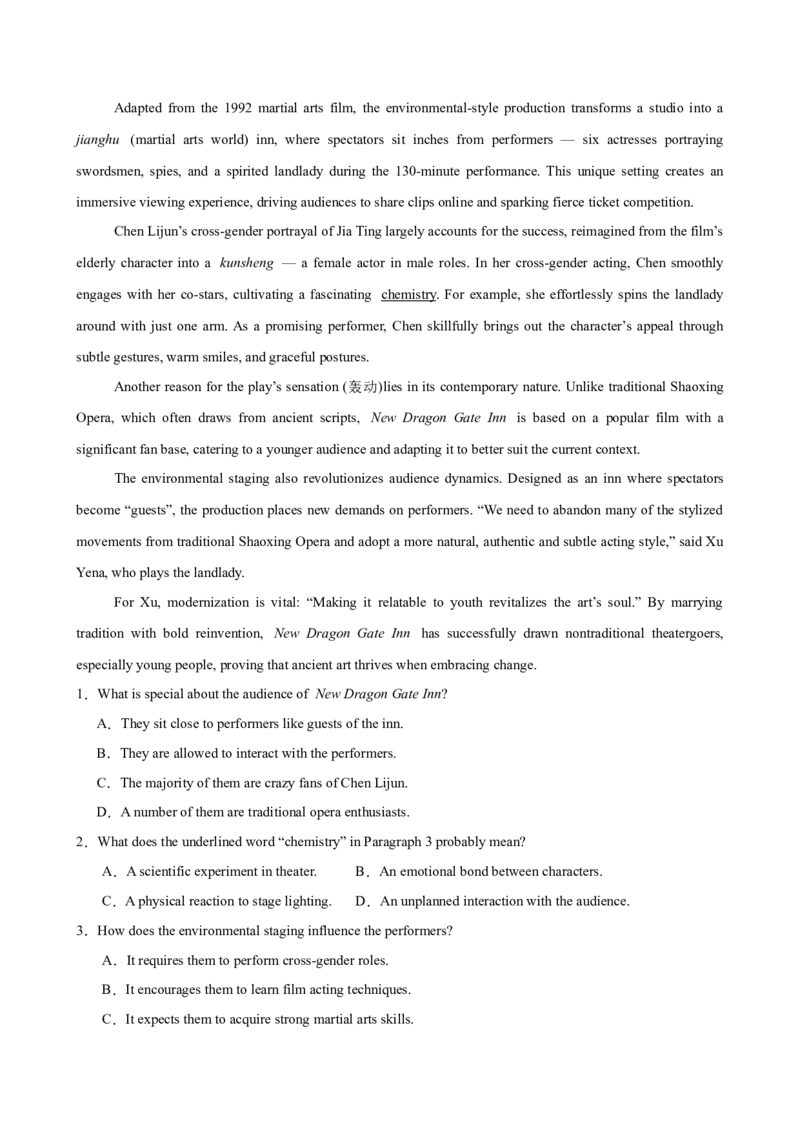
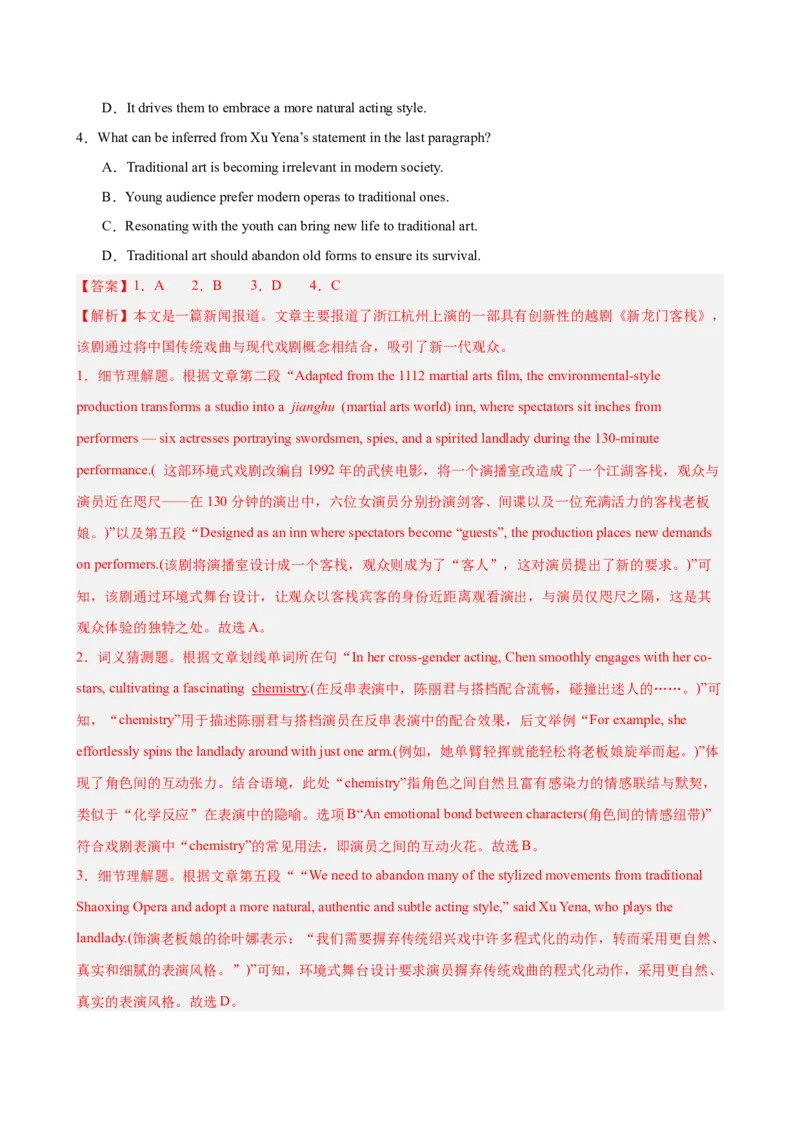
In Hangzhou, Zhejiang province, a groundbreaking Shaoxing Opera adaptation titled New Dragon Gate
Inn is captivating a new generation by blending traditional Chinese opera with modern theater concepts.
Adapted from the 1992 martial arts film, the environmental-style production transforms a studio into a
jianghu (martial arts world) inn, where spectators sit inches from performers — six actresses portraying
swordsmen, spies, and a spirited landlady during the 130-minute performance. This unique setting creates an
immersive viewing experience, driving audiences to share clips online and sparking fierce ticket competition.
Chen Lijun’s cross-gender portrayal of Jia Ting largely accounts for the success, reimagined from the film’s
elderly character into a kunsheng — a female actor in male roles. In her cross-gender acting, Chen smoothly
engages with her co-stars, cultivating a fascinating chemistry. For example, she effortlessly spins the landlady
around with just one arm. As a promising performer, Chen skillfully brings out the character’s appeal through
subtle gestures, warm smiles, and graceful postures.
Another reason for the play’s sensation (轰动)lies in its contemporary nature. Unlike traditional Shaoxing
Opera, which often draws from ancient scripts, New Dragon Gate Inn is based on a popular film with a
significant fan base, catering to a younger audience and adapting it to better suit the current context.
The environmental staging also revolutionizes audience dynamics. Designed as an inn where spectators
become “guests”, the production places new demands on performers. “We need to abandon many of the stylized
movements from traditional Shaoxing Opera and adopt a more natural, authentic and subtle acting style,” said Xu
Yena, who plays the landlady.
For Xu, modernization is vital: “Making it relatable to youth revitalizes the art’s soul.” By marrying
tradition with bold reinvention, New Dragon Gate Inn has successfully drawn nontraditional theatergoers,
especially young people, proving that ancient art thrives when embracing change.
1.What is special about the audience of New Dragon Gate Inn?
A.They sit close to performers like guests of the inn.
B.They are allowed to interact with the performers.
C.The majority of them are crazy fans of Chen Lijun.
D.A number of them are traditional opera enthusiasts.
2.What does the underlined word “chemistry” in Paragraph 3 probably mean?
A.A scientific experiment in theater.
B.An emotional bond between characters.
C.A physical reaction to stage lighting.
D.An unplanned interaction with the audience.
3.How does the environmental staging influence the performers?
A.It requires them to perform cross-gender roles.
B.It encourages them to learn film acting techniques.
C.It expects them to acquire strong martial arts skills.
D.It drives them to embrace a more natural acting style.
4.What can be inferred from Xu Yena’s statement in the last paragraph?
A.Traditional art is becoming irrelevant in modern society.
B.Young audience prefer modern operas to traditional ones.
C.Resonating with the youth can bring new life to traditional art.
D.Traditional art should abandon old forms to ensure its survival.
【答案】1.A    2.B    3.D    4.C
【解析】本文是一篇新闻报道。文章主要报道了浙江杭州上演的一部具有创新性的越剧《新龙门客栈》,
该剧通过将中国传统戏曲与现代戏剧概念相结合,吸引了新一代观众。
1.细节理解题。根据文章第二段“Adapted from the 1112 martial arts film, the environmental-style
production transforms a studio into a jianghu (martial arts world) inn, where spectators sit inches from
performers — six actresses portraying swordsmen, spies, and a spirited landlady during the 130-minute
performance.( 这部环境式戏剧改编自1992 年的武侠电影,将一个演播室改造成了一个江湖客栈,观众与
演员近在咫尺——在130 分钟的演出中,六位女演员分别扮演剑客、间谍以及一位充满活力的客栈老板
娘。)”以及第五段“Designed as an inn where spectators become “guests”, the production places new demands
on performers.(该剧将演播室设计成一个客栈,观众则成为了“客人”,这对演员提出了新的要求。)”可
知,该剧通过环境式舞台设计,让观众以客栈宾客的身份近距离观看演出,与演员仅咫尺之隔,这是其
观众体验的独特之处。故选A。
2.词义猜测题。根据文章划线单词所在句“In her cross-gender acting, Chen smoothly engages with her co-
stars, cultivating a fascinating chemistry.(在反串表演中,陈丽君与搭档配合流畅,碰撞出迷人的……。)”可
知,“chemistry”用于描述陈丽君与搭档演员在反串表演中的配合效果,后文举例“For example, she
effortlessly spins the landlady around with just one arm.(例如,她单臂轻挥就能轻松将老板娘旋举而起。)”体
现了角色间的互动张力。结合语境,此处“chemistry”指角色之间自然且富有感染力的情感联结与默契,
类似于“化学反应”在表演中的隐喻。选项B“An emotional bond between characters(角色间的情感纽带)”
符合戏剧表演中“chemistry”的常见用法,即演员之间的互动火花。故选B。
3.细节理解题。根据文章第五段““We need to abandon many of the stylized movements from traditional
Shaoxing Opera and adopt a more natural, authentic and subtle acting style,” said Xu Yena, who plays the
landlady.(饰演老板娘的徐叶娜表示:“我们需要摒弃传统绍兴戏中许多程式化的动作,转而采用更自然、
真实和细腻的表演风格。”)”可知,环境式舞台设计要求演员摒弃传统戏曲的程式化动作,采用更自然、
真实的表演风格。故选D。
4.推理判断题。根据文章最后一段“For Xu, modernization is vital: “Making it relatable to youth revitalizes
the art’s soul.” By marrying tradition with bold reinvention, New Dragon Gate Inn has successfully drawn
nontraditional theatergoers, especially young people, proving that ancient art thrives when embracing change.(在
徐叶娜看来,现代化至关重要:“让年轻人产生共鸣,才能让这门艺术的灵魂得以焕新。”通过将传统
与大胆创新相结合,《新龙门客栈》成功吸引了非传统剧场观众,尤其是年轻群体,证明了古老艺术在
拥抱变革时方能焕发新生。)”可知,她明确指出让传统艺术与年轻人产生共鸣能焕新其灵魂。故选C。
4
On Dec 4, 2024, Chunjie was included in UNESCO’s Representative List of the Intangible Cultural
Heritage of Humanity. While this recognition marks a significant milestone for Chinese culture, it also brings up
again an ongoing debate: What is the most appropriate English translation of Chunjie?
For decades, Chunjie has been widely translated as “Spring Festival” in English, a term now adopted by
UNESCO in its lowercase form. Beyond this, two other English translations are currently in use: Chinese New
Year and Lunar New Year. All the three terms are documented in major Chinese-English dictionaries,with “Spring
Festival” being the most favored, followed by “Chinese New Year”. Despite its widespread use,some people
believe that calling it “Lunar New Year” might not fully reflect its deep cultural roots in China, as the Chinese
calendar is a lunisolar calendar (阴阳历), which combines elements of both the lunar and solar cycles. This means
it’s not purely based on the lunar phases, making the term “Lunar New Year” scientifically inaccurate.
Language changes quickly, and dictionaries may not always be up-to-date. However, large language
databases like the NOW (News on the Web) Corpus can track real-time language use. As of January 2025, the
Corpus shows that “Chinese New Year” is the most frequently used term in the English-speaking world, followed
by “Lunar New Year,” with “Spring Festival” being used less often.This reflects the differences in translation
preferences between China and the West.
Now that the Spring Festival is recognized by UNESCO, it is time to reconsider its English translation. It is
suggested that Chunjie be used as the primary term to emphasize its cultural uniqueness,supported by “Spring
Festival” for familiarity and “Chinese New Year” when necessary for international understanding. This approach
respects Chinese cultural identity while meeting the needs of global communication. After all, language is not just
a tool for communication; it also carries culture,history, and identity.
1.What’s the reason for the inaccuracy of the form “Lunar New Year”?
A.It’s not recognized by UNESCO.
B.It misses the festival’s historical importance.
C.It ignores the solar elements in the Chinese calendar.
D.It’s doesn’t reflect the festival’s connection to spring.
2.What does the NOW Corpus show according to paragraph 3?
A.The term “Spring Festival” is the least used in English.
B.The term “Chunjie” is preferred only by Chinese speakers.
C.The term “Lunar New Year” is increasingly popular in English.
D.The term “Chinese New Year” is most widely used internationally.
3.Why is it suggested that “Chunjie” be used as the primary term for the festival in English?
A.To simplify translation.
B.To promote Chinese globally.
C.To highlight its unique culture.
D.To update dictionary definitions.
4.What does the passage mainly focus on?
A.The history of Chinese culture.
B.The milestone of Chinese culture.
C.The cultural significance of Chunjie.
D.The different translations of Chunjie.
【答案】1.C    2.A    3.C    4.D
【解析】本文是一篇新闻报道。文章通过分析春节的现有英文翻译及其优缺点,强调了语言在文化传播
中的重要性,并提出了一个综合性的建议,旨在平衡文化独特性和国际理解的需要。
1.细节理解题。根据第二段中的“Despite its widespread use,some people believe that calling it “Lunar New
Year” might not fully reflect its deep cultural roots in China, as the Chinese calendar is a lunisolar calendar (阴阳
历), which combines elements of both the lunar and solar cycles. This means it’s not purely based on the lunar
phases, making the term “Lunar New Year” scientifically inaccurate.(尽管它被广泛使用,一些人认为称它为
“农历新年”可能并不能完全反映其在中国的深厚文化根源,因为中国的日历是阴阳历,结合了月球和
太阳周期的元素。这意味着它不完全是基于月相,使得“农历新年”一词在科学上不准确)”可知,“农历
新年”这一术语不准确是因为它忽略了中国农历中的太阳元素。故选C 项。
2.细节理解题。根据第三段中的“As of January 2025, the Corpus shows that ‘Chinese New Year’ is the most
frequently used term in the English-speaking world, followed by ‘Lunar New Year,’ with ‘Spring Festival’ being
used less often.(截至2025 年1 月,语料库显示,“Chinese New Year”在英语世界中使用最频繁,其次是
“Lunar New Year”,而“Spring Festival”使用较少)”可知,NOW 语料库显示“Chinese New Year”在国际上
使用最广泛。故选A 项。
3.细节理解题。根据最后一段中的“It is suggested that Chunjie be used as the primary term to emphasize its
cultural uniqueness, supported by ‘Spring Festival’ for familiarity and ‘Chinese New Year’ when necessary for
international understanding.(建议使用“Chunjie”作为主要术语,以强调其文化独特性,同时在需要时辅以
“Spring Festival”和“Chinese New Year”以增强熟悉度和国际理解)”可知,使用“Chunjie”是为了突出其独
特的文化。故选C 项。
4.主旨大意题。根据文章内容,特别是第一段“On Dec 4, 2024, Chunjie was included in UNESCO’s
Representative List of the Intangible Cultural Heritage of Humanity. While this recognition marks a significant
milestone for Chinese culture, it also brings up again an ongoing debate: What is the most appropriate English
translation of Chunjie?(2024 年12 月4 日,“春节”被列入联合国教科文组织《人类非物质文化遗产代表
作名录》。虽然这一认可标志着中国文化的一个重要里程碑,但它也再次引发了一场正在进行的辩论:
什么是“春节”最合适的英文翻译?)”可知,文章主要讨论了“春节”被联合国教科文组织列入人类非物
质文化遗产代表作名录后,关于其英文翻译的不同选择及其适当性问题。由此可知,文章的主旨是关于
“春节”的不同翻译。故选D 项。
5
Jingmai Mountain, located in southwestern Yunnan Province, is a remarkable site with a long-standing tea-
growing history. For more than one thousand years, the Blang and Dai people have carefully maintained the
ancient tea forest. This particular tea variety gives rise to the highly-regarded Pu’er tea. Considered “drinkable
gold” by tea experts, Pu’er tea undergoes fermentation (发酵) for at least 10 years, which creates a deeper flavor.
It softens and becomes more complex with age, thus increasing its worth.
The local tea-related culture is deeply rooted. The Blang people believe that everything has a soul and
should leave nature undisturbed, preserving sustainable tea-farming practices. They have been avoiding the use of
weed killers. Jingmai’s closely managed lands may seem wild compared to other tea plantations worldwide. A
vibrant vegetation (植被) carpets the forest floor, creating a rich habitat for animals and helping the soil keep
essential moisture. The areas are separated to prevent the spread of diseases and pests.
In the early 2000s, the Chinese government’s investment in rural infrastructure, like new roads and
electricity, brought new opportunities to Jingmai Mountain. However, as the area developed, some problems
emerged, such as deforestation by some villagers. In response, local leaders took action quickly. They called for
the protection of the forests and traditional tea-growing methods.
Around 2010, the local community and the government united to apply for World Heritage status.
Eventually, UNESCO formally recognized Jingmai Mountain as a World Heritage site, an honor reserved for
places that provide idiosyncratic cultural value. It is the only site related to tea cultivation. To protect this
precious area, the government built a stone-paved road to prevent destruction of the tea’ s aroma (香气).
Today, tea is the backbone of the region’s economy, contributing 90% of the local income. The younger
generation promotes Jingmai tea through modern means like livestreaming. The conservation and development of
Jingmai Mountain’s tea heritage not only safeguard its unique natural and cultural features but also ensure its
long-term prosperity.
1.Why does Pu’er tea undergo fermentation?
A.To deepen its color.
B.To enrich its taste.
C.To meet market demand.
D.To sell it at a better price.
2.Which of the following statements best matches Jingmai’s tea-growing culture?
A.Respect is the best policy.
B.All’s well that ends well.
C.Every cloud has a silver lining.
D.Rome was not built in a day.
3.What does the underlined word “idiosyncratic” in Paragraph 4 probably mean?
A.Unique.
B.Educational.
C.Social.
D.Historical.
4.What is the writing purpose of the text?
A.To highlight the role of sustainable farming.
B.To prove the popularity of Chinese tea culture.
C.To make Jingmai tea culture known to the world.
D.To report the news of world tea heritage recognition.
【答案】1.B    2.A    3.A    4.C
【解析】这是一篇说明文。本文主要介绍了云南景迈山的茶文化,包括其悠久的种茶历史、独特的种植
方式、蕴含的文化理念以及成为世界遗产后的发展等情况。
1.细节理解题。根据第一段中“Considered ‘drinkable gold’ by tea experts, Pu’er tea undergoes fermentation
(发酵) for at least 10 years, which creates a deeper flavor. It softens and becomes more complex with age, thus
increasing its worth.(普洱茶被茶叶专家视为‘可饮用的黄金’,它至少要经过 10 年的发酵,这会使其风
味更加醇厚。随着年份增长,普洱茶口感变得更加柔和,风味也更加丰富多样,其价值也因此不断提升)”
可知,普洱茶经过发酵是为了丰富它的味道。故选B。
2.推理判断题。根据第二段中“The Blang people believe that everything has a soul and should leave nature
undisturbed, preserving sustainable tea-farming practices.(布朗族人认为万物皆有灵魂,应该不去打扰自然,
保持可持续的茶叶种植方式)”可知,景迈的种茶文化充分体现出对自然的尊重,所以选项A“尊重为上
策”最符合景迈的种茶文化。B 选项“All’s well that ends well(结果好就一切都好)”,强调最终结果的重要
性;C 选项“Every cloud has a silver lining(黑暗中总有一线光明)”,表达在困境中总会有希望或积极的一
面;D 选项“Rome was not built in a day(罗马不是一天建成的)”,强调做事情需要时间和耐心,不能急于
求成。故选A。
3.词句猜测题。根据第四段中“Eventually, UNESCO formally recognized Jingmai Mountain as a World
Heritage site, an honor reserved for places that provide idiosyncratic cultural value. It is the only site related to tea
cultivation.(最终,联合国教科文组织正式将景迈山认定为世界遗产地。这一殊荣通常只授予那些具有
idiosyncratic 文化价值的地方。景迈山是唯一一处与茶叶种植相关的世界遗产地)”可知,景迈山因其独特
的茶文化价值而被联合国教科文组织列为唯一一处与茶叶种植相关的世界遗产地,所以可推测出
“idiosyncratic”的意思是“独特的”。故选A。
4.推理判断题。文章详细讲述了云南景迈山的茶文化,包括其长达一千多年的种茶历史,布朗族独特的
尊重自然、可持续的种茶方式,当地丰富的茶相关文化,发展过程中遇到的诸如村民砍伐森林等问题以
及采取的保护措施,还提及景迈山成为世界遗产以及茶叶对当地经济的重要支撑作用。由此可知,文章
主要是在全方位地向世界展示景迈山茶文化的丰富内涵与独特魅力,让世界了解景迈山茶文化。故选C。
6
Jake Lee Pinnick is busy preparing food, clothing and house decorations, putting up couplets and visiting
friends with his family to celebrate the Spring Festival, or the Chinese Lunar NewYear.
In 2010, the 32-year-old American traveled to the Wudang Mountains, a UNESCO World Cultural Heritage
site in central China’s Hubei Province, to learn martial arts. Pinnick said he was very interested in Chinese Kung
Fu from a young age.
When Pinnick first arrived in the Wudang Mountains, he had no earlier training or martial arts experience,
so he began with a five-year training program, learning the basics and all aboutTaoist culture. Pinnick said the first
six months were the hardest, because he had to train for eight or nine hours, six days a week, whatever the
temperature outside.
After over a decade of hard training, he has mastered various forms of Chinese Kung Fu, including Tai Chi
and Qigong, and become a guider with about 200 apprentices ( 学徒) in China. This year is the 13th Spring
Festival that Pinnick has spent in China. He likes the Spring Festival and the traditions here. He also teaches his
daughter Selina Lee Pinnick these traditions.
As the new year begins, people are starting new chapters in their lives and making resolutions. Pinnick also
has many plans and wishes — he plans on making more efforts to learn the Chinese language this year. In addition
to learning Chinese, Pinnick will continue to learn about traditional Chinese culture and how to play Chinese
musical instruments in his leisure time, and he will share his experience on social media.
“I think that the experience I’ve had, being a foreigner coming to China and learning the culture from
outside, is unique. I hope to introduce Chinese Kung Fu and traditions to more westerners,” he said.
1.What was Pinnick’s main reason for traveling to the Wudang Mountains?
A.To learn Chinese Kung Fu.
B.To know about Taoist culture.
C.To visit some places of interest.
D.To celebrate the Spring Festival.
2.Which of the following best describes Pinnick?
A.Well-rounded. B.Generous.
C.Hardworking.
D.Selfless.
3.What can we infer about Pinnick according to the article?
A.He planned to open a Chinese Kung Fu school.
B.He became skillful at different kinds of Kung Fu.
C.He asked his daughter to learn Chinese musical instruments.
D.He practised Kung Fu before coming to the Wudang Mountains.
4.Why does Pinnick hope to share his experience on social media?
A.To become famous online.
B.To take in more apprentices.
C.To show off his unique experience.
D.To act as a bridge between cultures.
【答案】1.A    2.C    3.B    4.D
【解析】本文是一篇记叙文。文章主要讲述了Jake Lee Pinnick 来中国武当山学习武术,并爱上中国传统
文化,希望成为中外文化沟通桥梁的故事。
1.细节理解题。由第二段中“In 2010, the 32-year-old American traveled to the Wudang Mountains, a
UNESCO World Cultural Heritage site in central China’s Hubei Province, to learn martial arts. (2010 年,这位
32 岁的美国人前往位于中国中部湖北省的联合国教科文组织世界文化遗产武当山学习武术)”可知,
Pinnick 前往武当山的主要原因是学习中国功夫。故选A 项。
2.推理判断题。由第三段中“Pinnick said the first six months were the hardest, because he had to train for
eight or nine hours, six days a week, whatever the temperature outside. (Pinnick 说,前六个月是最艰难的,因
为无论外面的温度如何,他都必须每周六天训练八到九个小时)”和第四段中“After over a decade of hard
training, he has mastered various forms of Chinese Kung Fu, including Tai Chi and Qigong (经过十多年的艰苦
训练,他掌握了各种形式的中国功夫,包括太极和气功)”可知,Pinnick 在最初的六个月里,每周六天,
不论外面的温度如何,都要训练八到九个小时,且苦练十多年去掌握各种形式的中国功夫,由此可见他
是一个勤奋的人。故选C 项。
3.推理判断题。由第四段中“After over a decade of hard training, he has mastered various forms of Chinese
Kung Fu, including Tai Chi and Qigong (经过十多年的艰苦训练,他掌握了各种形式的中国功夫,包括太极
和气功)”可推知,苦练十多年,Pinnick 精通各种功夫。故选B 项。
4.推理判断题。由最后一段中Pinnick 说的话“I think that the experience I’ve had, being a foreigner coming
to China and learning the culture from outside, is unique. I hope to introduce Chinese Kung Fu and traditions to
more westerners (我认为我作为一名外国人来到中国学习外国文化的经历是独一无二的。我希望向更多的
西方人介绍中国功夫和传统)”可推知,Pinnick 希望通过社交媒体分享他的经验,是为了向更多的西方人
介绍中国功夫和传统文化,充当文化之间的桥梁。故选D 项。
7
At 93, Doreen Hynd effortlessly keeps busy with cooking, dancing, and teaching her students across
different places. Active in life, she credits her energy to her lifelong practice of Tai Chi. Hynd praises Tai Chi for
developing awareness of peacefulness, inviting the body, mind and inner consciousness to work together, and
offering an experience of lightness and strength.
Born in Australia, Doreen Hynd started her Tai Chi training at the University of Sydney in the 1980s. After
moving to the United States in 1984, she sought out Sophia Delza, who had studied under Ma Yueh Liang, a
respected Tai Chi master in China for many years. After Delza passed away, Hynd, who had become Delza’s
teaching assistant, continued to promote Tai Chi culture. Reflecting on her mission, she states, “I have always
wanted to bring it to the whole world. Tai Chi has stood the test of time for centuries in Chinese culture.”
“A lot of the classes I teach are for retired people, which has been one of the most inspiring aspects of my
life,” Hynd shared. Over her 24 years of teaching Tai Chi, she has witnessed miracles (奇迹), such as a student
with serious brain damage recovering memories after a year of practice, despite doctors considering it impossible.
“Some students in poor health learned about me through the college I worked at in Canada, and they’ve stayed
with me since,” she added, smiling broadly.
When asked about using Tai Chi for self-defense, Hynd expressed a preference for connecting with
someone approaching aggressively, even if it meant risking her life. She prioritizes forming connections over
fighting. According to Cao Guozhong, a great Tai Chi master, Hynd has absorbed the essence of Chinese culture
through Tai Chi. “Hynd loves to listen carefully to others, approach them with understanding, and transform
enemies into friends,” Cao Guozhong explained. “She reflects the philosophy found in the ancient Chinese text, I
Ching, which discusses change in the world.”
1.What does Doreen Hynd think of Tai Chi?
A.Active and effortless.
B.Demanding and powerful.
C.Energetic and practical.
D.Calming and integrative.
2.Why did Hynd decide to promote Tai Chi culture?
A.She wanted to follow Delza.
B.She valued its timeless quality.
C.She considered it part of her study.
D.She benefited considerably from it.
3.Which aspect of Tai Chi is mainly talked about in paragraph 3?
A.Its target group.
B.Its health advantage.
C.Its growing popularity.
D.Its underlying principle.
4.Why did Cao Guozhong mention I Ching?
A.To support his point.
B.To praise Hynd’s efforts.
C.To spread his philosophy.
D.To highlight Hynd’s change.
【答案】1.D    2.B    3.B    4.A
【解析】本文是一篇记叙文。文章主要讲述了93 岁的Doreen Hynd 通过太极保持活力,并积极推广中国
太极文化的故事。
1.推理判断题。根据第一段“Hynd praises Tai Chi for developing awareness of peacefulness, inviting the
body, mind and inner consciousness to work together, and offering an experience of lightness and strength.(Hynd
赞扬太极培养了平静意识,邀请身体、心灵和内在意识共同努力,并提供了一种轻盈和力量的体验)”可知,
Hynd 认为太极有助于培养平静的意识,使身体、心灵和内在意识协同工作。由此可知,她认为太极是使
人平静且整合的。故选D。
2.细节理解题。根据第二段“Reflecting on her mission, she states, “I have always wanted to bring it to the
whole world. Tai Chi has stood the test of time for centuries in Chinese culture.”(回顾她的使命,她说:“我一
直想把它带到全世界。太极拳在中国文化中经受住了几个世纪的时间考验。”)”可知,Hynd 决定推广太
极文化的原因是她认为太极文化在中国文化中经受住了时间的考验,具有永不过时的品质。故选B。
3.主旨大意题。根据第三段““A lot of the classes I teach are for retired people, which has been one of the
most inspiring aspects of my life,” Hynd shared. Over her 24 years of teaching Tai Chi, she has witnessed miracles
(奇迹), such as a student with serious brain damage recovering memories after a year of practice, despite doctors
considering it impossible. “Some students in poor health learned about me through the college I worked at in
Canada, and they’ve stayed with me since,” she added, smiling broadly.(“我教的很多课程都是为退休人员开设
的,这是我生活中最鼓舞人心的方面之一,”Hynd 分享道。在她24 年的太极拳教学中,她目睹了奇迹,
例如,一名患有严重脑损伤的学生在经过一年的练习后恢复了记忆,尽管医生认为这是不可能的。“一
些健康状况不佳的学生通过我在加拿大工作的大学了解了我,从那以后他们一直和我在一起,”她补充
道,笑容满面)”可知,本段举例说明太极让一个脑部受伤的学生恢复了记忆、改善了一些学生的健康状况。
由此可知,本段主要讨论的是太极对健康的好处。故选B。
4.推理判断题。根据最后一段“According to Cao Guozhong, a great Tai Chi master, Hynd has absorbed the
essence of Chinese culture through Tai Chi. “Hynd loves to listen carefully to others, approach them with
understanding, and transform enemies into friends,” Cao Guozhong explained. “She reflects the philosophy found
in the ancient Chinese text, I Ching, which discusses change in the world.”(据伟大的太极大师曹国忠介绍,
Hynd 通过太极吸收了中国文化的精髓。曹国忠解释说:“Hynd 喜欢认真倾听他人,以理解的态度接近他
们,把敌人变成朋友。”。她反映了中国古代《易经》中关于世界变化的哲学思想)”可知,曹国忠认为
Hynd 通过太极吸收了中国文化的精髓,接着作者直接引用曹国忠的话来加以印证。由此可知,曹国忠提
到《易经》是为了支持、证明他前面提到的观点。故选A。
8
First constructed in the 10th century as a part of a villa, the garden of Keyuan in Suzhou, Jiangsu Province,
was rebuilt and decorated on numerous occasions throughout history until it became a Confucian academy in
1805. The landscape, rockeries and flourishing willows may have greeted students to step into a “painting” where
earthly beauty and dynamics of a real world can be felt.
However, in recent history, the shine of the past seems to have been forgotten by the passing of time. The
pond was muddy. Rocks were unstable. Plants were withering (枯萎). Termites also damaged the buildings, the
structure of which had been damaged through decades of neglect.
Keyuan was handed to an experienced garden renovation ( 翻新) designer in 2012. The work of making
“the pearl” shine again was challenging. “Every step in the restoring and decorating process has to follow
historical recordings,” says the designer. “It took just more than one year for us to actually renovate this garden,
but much longer time was spent in evaluating every detail in the plan and making sure of its historical accuracy,”
the designer adds.
Now a bright and elegant garden is accessible to visitors and jointly portrays ( 描绘) a culturally rich
neighborhood with the Great Wave Pavilion. And to keep “healthy”, it also needs regular maintenance, in which
modern science plays a key role. For example, with support of big data analysis and scientific evaluation of
impact brought by tourism, specific caps of visitor numbers — within a day or even an hour — is set for every
key site to create a comfortable experience for both tourists and the gardens.
1.What do the underlined words “the pearl” in paragraph 3 refer to?
A.Renovation.
B.The UNESCO World Heritage.
C.Keyuan.
D.The Great Wave Pavilion.
2.What does the designer say about renovating Keyuan?
A.It’s impractical.
B.It’s significant.
C.It’s urgently needed.
D.It’s time-consuming.
3.What does the author want to tell us by the example in the last paragraph?
A.The need to limit the number of visitors.
B.The negative impact tourism has on gardens.
C.The role modern science plays in protecting gardens.
D.The comfortable experience the garden brings to visitors.
4.What message does the author seem to convey in the text?
A.Introduce the change of Keyuan.
B.Encourage people to visit Keyuan.
C.Introduce the renovation of Keyuan.
D.Encourage people to rebuild Keyuan.
【答案】1.C    2.D    3.C    4.A
【解析】本文是一篇说明文。文章主要介绍了始建于10 世纪,位于江苏苏州的可园。其在近代历史上被
人遗忘,近乎破败,经过改造后再次绽放光芒。文章旨在引导学生保护中国传统建筑,欣赏传统建筑之
美,提升学生审美能力。
1.词句猜测题。根据第三段中“Keyuan was handed to an experienced garden renovation (翻新) designer in
2012. (2012 年,可园被交由一位经验丰富的园林翻新设计师打理)”,该段围绕“可园的翻新工作”展开;
结合“the pearl”后的“shine again (再次焕发光彩)”,可推断其指代前文核心对象“Keyuan(可园)”。故选
C。
2.细节理解题。根据第三段设计师的表述中““It took just more than one year for us to actually renovate
this garden, but much longer time was spent in evaluating every detail in the plan and making sure of its historical
accuracy,” the designer adds. (“我们实际翻新这座园林只用了一年多一点的时间,但在评估方案中的每一个
细节、确保其历史准确性方面,却花费了长得多的时间,”设计师补充道)”可知,实际翻新仅用一年多,
但评估细节、确保历史准确性花费了更长时间,说明翻新可园很耗时。故选D。
3.推理判断题。根据最后一段中“And to keep “healthy”, it also needs regular maintenance, in which modern
science plays a key role.(而为了保持“健康状态”,它还需要定期维护,在这一过程中,现代科学发挥着
关键作用)”可知,该段核心是现代科技在园林保护中的关键作用;结合后文给出的例子“For example,
with support of big data analysis and scientific evaluation of impact brought by tourism, specific caps of visitor
numbers — within a day or even an hour — is set for every key site to create a comfortable experience for both
tourists and the gardens. (例如,在大数据分析以及对旅游业带来的影响进行科学评估的支持下,每个重要
景点都设定了具体的游客数量上限——包括每日甚至每小时的上限——以给游客和园林都带来舒适的体
验)”可知,在大数据的支持下,园内可以控制每日的游客上限,从而使游客和可园都拥有一个舒适的环境。
由此可以推断,作者举例子的目的是传达现代科技在保护园林方面的重要作用这一理念。故选C。
4.主旨大意题。文章第一段介绍可园的历史背景,第二段描述其近代衰败状况,第三段讲述其2012 年
的翻新过程,第四段说明其如今的状态及保护措施,整体围绕可园从历史到现在的变化展开。由此可知,
作者在这篇文章中主要想传达的信息是可园的变化历程。故选A。
9
A series of books in Chinese and English covering eight classic works of Peking Opera recently released,
with the aim of revealing details about the art form in a direct way.
The bilingual ( 双语的) books are from the Translation Series of a Hundred Jingju Classics, a project
originated from 2011, which is part of the effort by the central government to promote Chinese culture overseas.
Peking Opera, with its complex and colorful costumes and make-up, as well as the unique performance
combining singing, dialogue, acting and acrobatics (杂技), has become a symbol of traditional Chinese culture.
Over the last 200 years, more than 1, 000 Peking Opera shows have been produced telling the most classic
historical stories in China, as well as giving glimpses of society, according to Wang. The art form was listed as an
Intangible Cultural Heritage of Humanity (非物质文化遗产) by UNESCO in 2010. Famous performers such as
Mei Lanfang and Cheng Yanqiu have also taken Peking Opera abroad. And though foreign fans are impressed by
it, few understand the stories told on stage.
To help foreigners understand the art form better, Sun Ping, dean, School of Art, Beijing Foreign Studies
University, and her team have edited the new books. Different from previous English translations of books that
mostly covered the scripts (剧本) of Peking Opera plays, the new series introduces nearly all aspects of the art
form, including the script, actors and actresses, performance skills, musical instruments and costumes, according
to Sun, who is herself a highly regarded Peking Opera artist.
“It fills the blank in overseas promotions of Peking Opera,” says Liu Jian, a professor at the National
Academy of Chinese Theater Arts. “The inheritance and promotion of Peking Opera are very important. In a
sense, promotion is even more important. The project sets a good example.”
Scott Ian Rainen, an expert from the United States, who works at China Foreign Languages Publishing
Administration, says he was happy to read the new books. Foreigners often don’t understand the plot in a Peking
Opera play, but the books introduce the cultural and historical background, its character modeling, costumes and
props, artistic theories and so on.
1.Why are the set of bilingual books released?
A.To stress the importance of Peking Opera.
B.To attract foreigners to learn Peking Opera.
C.To promote the diversity of Peking Opera.
D.To present Peking Opera more effectively.
2.What is the third paragraph mainly about?
A.The advantage of learning Peking Opera.
B.The brief introduction of Peking Opera.
C.The benefits of releasing these bilingual books.
D.The reason for people’s attachment to Peking Opera.
3.What’s special about these translations of books?
A.They cover stories about Peking Opera.
B.They share a more significant art value.
C.They are better in covering the scripts of Peking Opera.
D.They are overall in showing the features of Peking Opera.
4.What is Scott Ian Rainen’s attitude towards the new project?
A.Negative.
B.Sceptical.
C.Positive.
D.Tolerant.
【答案】1.D    2.B    3.D    4.C
【解析】本文是一篇说明文。文章主要介绍中英双语京剧书籍的出版及意义。
1.细节理解题。根据第一段“A series of books in Chinese and English covering eight classic works of Peking
Opera recently released, with the aim of revealing details about the art form in a direct way.(最近出版了一系列
中英文书籍,涵盖了八部京剧经典作品,目的是直接揭示这种艺术形式的细节。)”可知,这套双语书籍揭
示了京剧这种艺术形式的细节,是为了更有效地向人们展示京剧。故选D。
2.主旨大意题。根据第三段“Peking Opera, with its complex and colorful costumes and make-up, as well as
the unique performance combining singing, dialogue, acting and acrobatics (杂技), has become a symbol of
traditional Chinese culture. Over the last 200 years, more than 1, 000 Peking Opera shows have been produced
telling the most classic historical stories in China, as well as giving glimpses of society, according to Wang. The
art form was listed as an Intangible Cultural Heritage of Humanity ( 非物质文化遗产 ) by UNESCO in 2010.
Famous performers such as Mei Lanfang and Cheng Yanqiu have also taken Peking Opera abroad. And though
foreign fans are impressed by it, few understand the stories told on stage.(京剧以其绚丽复杂的戏装脸谱、唱念
做打相结合的独特表演形式,已成为中国传统文化的标志性符号。据学者王珏介绍,过去二百余年间,
京剧创作了逾千部剧目,既演绎着最经典的历史故事,也映照出社会百态。2010 年,联合国教科文组织
将京剧列入人类非物质文化遗产名录。梅兰芳、程砚秋等京剧表演艺术家曾多次赴海外交流,虽令外国
观众惊叹于这门艺术的魅力,但能理解台上剧情者仍寥寥无几。)”可知,第三段主要是对京剧这一艺术形
式的简要介绍。故选B。
3.细节理解题。根据第四段中“Different from previous English translations of books that mostly covered the
scripts (剧本) of Peking Opera plays, the new series introduces nearly all aspects of the art form, including the
script, actors and actresses, performance skills, musical instruments and costumes, according to Sun, who is
herself a highly regarded Peking Opera artist.(据京剧艺术家孙女士介绍,与以往主要涵盖京剧剧本的英文译
本不同,新系列介绍了这种艺术形式的几乎所有方面,包括剧本、演员、表演技巧、乐器和服装。)”可知,
这些书籍译本的特别之处在于它们介绍了这种艺术形式的几乎所有方面,全面展示了京剧的特点。故选
D。
4.推理判断题。根据最后一段中“Scott Ian Rainen, an expert from the United States, who works at China
Foreign Languages Publishing Administration, says he was happy to read the new books.(来自美国的专家Scott
Ian Rainen 在中国外文出版发行事业局工作,他说他很高兴能读到这些新书。)”可知,Scott Ian Rainen 对
新项目持积极态度。故选C。
10
The guzheng (古筝) is a traditional Chinese stringed instrument. This instrument, with its 21-27 strings
and distinctive resonant tone, holds a revered place in Chinese music and continues to enchant listeners around the
world. The guzheng’s origins can be traced back over 2,500 years to ancient China, where it was initially known
as the “zheng”.
Throughout its long history, the guzheng has been an integral (不可或缺的) part of traditional Chinese
music, featured prominently in court performances, folk music, and various regional styles. Typically, the
guzheng is made from high-quality wood, such as rosewood. The instrument’s resonant box is adorned with
intricate artwork and often features delicate carvings. The original 21 strings, traditionally made from silk, are
now commonly crafted from nylon or metal for durability and consistency. The unique tuning pegs allow for
precise adjustments, enabling the player to achieve the desired pitch and tonal quality.
Mastering the guzheng requires dedication and skill, as the instrument offers a wide range of expressive
possibilities. The player employs a combination of plucking (弹奏), sliding (滑音), string-pressing (按音), and
vibrato ( 颤音) techniques to produce a rich variety of sounds. The instrument’s versatility allows for solo
performances, ensemble playing, and collaborations with other traditional and modern instruments, making it a
dynamic and adaptable presence in diverse musical contexts.
While deeply grounded in Chinese tradition, the guzheng has transcended cultural boundaries and gained
popularity on the global stage. Its engaging melodies and evocative timbre have found their way into diverse
musical genres, including world music, contemporary western classical compositions, and cross-cultural
collaborations. ★Modern innovations such as the electric guzheng have expanded the instrument’s capabilities,
which further enhance its appeal to musicians and audiences worldwide.
The guzheng is often used to perform traditional folk music, particularly repertoire from Southern Chinese
folk styles such as Guangdong Music (广东音乐), Chaozhou Guzheng Music (潮州筝曲), and Hakka Guzheng
School (客家筝派). Meanwhile, other players have ventured into non-traditional styles, including rock, jazz, free
improvised music, and innovative contemporary compositions. Notable musicians have incorporated the guzheng
into non-traditional contexts, expanding its sonic possibilities and contributing to cross-genre collaborations.
1.What is the main focus of the second paragraph?
A.The origin and evolution of guzheng.
B.The beautiful sound guzheng makes.
C.The traditional guzheng music works.
D.The historical significance and construction features of guzheng.
2.What does a player need to do to make the best of the guzheng?
A.He should know how to make adjustments with the tuning pegs.
B.He should use a guzheng with nylon strings rather than silk ones.
C.He should master various techniques through dedicated practice.
D.He should be proficient in collaborations with modern instruments.
3.What can we infer from guzheng’s popularity in the world nowadays?
A.The guzheng has a deep root in Chinese tradition.
B.Technological inventions add to guzheng’s attraction.
C.World-famous melodies can be played on the guzheng.
D.The guzheng has an important place in world music.
4.What is mainly talked about in the last paragraph?
A.Famous repertoire of Chinese traditional folk music.
B.Divisions of Southern Chinese folk music styles.
C.Celebrated musicians who try popular music on the guzheng.
D.Inheritance and breakthroughs of the guzheng performance.
【答案】1.D    2.C    3.B    4.D
【解析】本文是一篇说明文。文章介绍了中国非物质文化遗产——古筝。
1.细节理解题。根据第二段“Throughout its long history, the guzheng has been an integral (不可或缺的)
part of traditional Chinese music, featured prominently in court performances, folk music, and various regional
styles.(在其悠久的历史中,古筝一直是中国传统音乐不可分割的一部分,在宫廷表演、民间音乐和各种地
方风格中都占有重要地位。)”可知,这里讲述古筝的历史意义。本段还介绍了古筝的构造特点,包括制作
材料、琴弦材质、共鸣箱上的装饰等内容,所以第二段的主要焦点是古筝的历史意义和构造特征。故选
D。
2.细节理解题。根据第三段第一句“Mastering the guzheng requires dedication and skill, as the instrument
offers a wide range of expressive possibilities.(掌握古筝需要奉献精神和技巧,因为乐器提供了广泛的表达可
能性。)”可知,掌握古筝需要专注的练习和技巧。也就是说,演奏者需要长时间的练习,掌握熟练的技巧,
才能弹出美妙的乐曲,充分展示古筝的音色。故选C。
3.推理判断题。根据第四段最后一句“Modern innovations such as the electric guzheng have expanded the
instrument’s capabilities, which further enhance its appeal to musicians and audiences worldwide.(电子古筝等现
代创新扩大了乐器的功能,进一步增强了它对全球音乐家和观众的吸引力。)”可知,像电古筝这样的现代
创新增强了古筝在全球的吸引力。由此可推知,现代科技发明的加持增加了古筝的魅力。故选B。
4.主旨大意题。文章最后一段“The guzheng is often used to perform traditional folk music, particularly
repertoire from Southern Chinese folk styles such as Guangdong Music (广东音乐), Chaozhou Guzheng Music
(潮州筝曲), and Hakka Guzheng School (客家筝派). Meanwhile, other players have ventured into non-traditional
styles, including rock, jazz, free improvised music, and innovative contemporary compositions. Notable musicians
have incorporated the guzheng into non-traditional contexts, expanding its sonic possibilities and contributing to
cross-genre collaborations.(古筝通常用于演奏传统的民间音乐,特别是来自中国南方民间风格的曲目,如
广东音乐,潮州古筝音乐和客家古筝学派。与此同时,其他演奏者也尝试非传统风格,包括摇滚、爵士、
自由即兴音乐和创新的当代作品。著名的音乐家将古筝融入非传统的背景中,扩大了它的声音可能性,
并为跨流派的合作做出了贡献。)”可知,最后一段主要讲的是古筝演奏的传承与创新突破。故选D。
11
Yang Huazhen, 67, a national-level inheritor of Tibetan weaving and cross-stitch embroidery techniques,
vividly recalls how she created her first embroidery piece.
“When I was 8, my father took me to visit a friend whose daughter had a lovely doll from Chengdu. I
dreamed of that doll smiling at me,” she recalls. She used fabric meant for new clothes to sew her own doll. “My
mother was angry, so that Chinese New Year, I had no new clothes. However, looking at my doll, whose smile
was crooked and eyes were mismatched, I felt very happy.”
“Unlike the four famous Chinese embroidery styles, which are known for their ornamental value, Tibetan
and Qiang embroideries are meant to be worn,” she says. Yang gained a reputation in the village for her
exceptional needlework skills.
A major turning point for Yang came in May 2008, when a devastating earthquake hit Wenchuan County.
She decided to use her embroidery skills to help her village. In August, she led 18 women with an average age of
60, half from Qiang and half from Tibetan ethnic groups, to Chengdu to start a business. They struggled
financially, living in a rented apartment and making no profit for months.
“I cried quietly at night and wanted to give up, but the others refused,” Yang says. The local government
provided a free 100-square-meter space. A businessman offered to donate 600,000 yuan to their business. “Despite
desperately needing money, we turned the donation down, hoping to replace it with orders,” says Yang. The
businessman then commissioned them to design hotel bedding and decorations, which became a hit, paving their
way to success.
In 2014, Yang’s unique embroidery products gained global attention. Her first collaboration was with a
renowned Japanese cosmetics company, designing packaging for two make-up removers in three days, earning
200,000 yuan. Over the past decade, she has worked with the Van Gogh Museum and over a dozen brands across
various industries including cars, fashion, dining, and express services. Her work blends Tibetan and Qiang
legacies, creating innovative patterns that draw widespread interest. Yang credits her success to the charm of
Chinese ethnic culture and China’s large market.
“What is traditional can become fashionable. The key is that we must learn to innovate because that is the
best form of inheritance,” she says.
1.What can be inferred from Yang’s first embroidery experience?
A.She was creative.
B.She was disobedient.
C.She was careless.
D.She was destructive.
2.What differs Tibetan and Qiang embroideries from the four famous embroideries?
A.They are of ornamental value.
B.They focus on abstract patterns.
C.They’re more practical in clothing.
D.They need more complex techniques.
3.Why did Yang’s team turn down the donation?
A.They intended to avoid tax obligation.
B.They wanted to seek market approval.
C.They planned to quit their business.
D.They expected to maintain independence.
4.What can be inferred from Yang’s cooperation with brands?
A.The ethnic culture shines.
B.The brands lack creativity.
C.The government support is urgent.
D.The media coverage is important.
【答案】1.A    2.C    3.B    4.A
【解析】本文是一篇新闻报道。文章主要报道了国家级非遗传承人杨华珍如何通过创新将藏羌刺绣从传
统手工艺发展为国际时尚品牌合作对象的故事。
1.推理判断题。根据第二段中“She used fabric meant for new clothes to sew her own doll. “My mother was
angry, so that Chinese New Year, I had no new clothes. However, looking at my doll, whose smile was crooked
and eyes were mismatched, I felt very happy.”(她用本要做新衣服的布料缝制了自己的玩偶。“妈妈很生气,
所以那个春节我没有新衣服穿。但看着我的玩偶歪歪扭扭的笑容和不对称的眼睛,我感到非常开心。”)”
可知,杨华珍在8 岁时没有按照常规用途使用布料,而是发挥创意自制玩偶,尽管母亲因此生气,她仍
为自己的创作感到快乐。这一经历体现了她从小就具备的创造性思维。故选A 项。
2.细节理解题。根据第三段中“Unlike the four famous Chinese embroidery styles, which are known for their
ornamental value, Tibetan and Qiang embroideries are meant to be worn(与中国四大名绣以观赏价值著称不同,
藏绣和羌绣是用来穿的)”可知,藏羌刺绣与四大名绣的核心区别在于其实用性。四大名绣侧重装饰功能,
藏羌刺绣专为服饰设计,更实用。故选C 项。
3.推理判断题。根据第五段中“Despite desperately needing money, we turned the donation down, hoping to
replace it with orders(尽管极度缺钱,我们还是拒绝了捐赠,希望用订单代替)”可知,杨华珍团队拒绝捐赠
的核心原因是希望通过市场订单验证自身产品的商业价值,而非依赖慈善资助。这种选择反映了他们追
求市场认可的坚定信念。故选B 项。
4.推理判断题。根据倒数第二段中“Her work blends Tibetan and Qiang legacies, creating innovative patterns
that draw widespread interest. Yang credits her success to the charm of Chinese ethnic culture and China’s large
market.(她的作品融合了藏羌文化传统,创造出引发广泛关注的新颖图案。杨将成功归因于中国民族文化
的魅力与中国市场的巨大潜力)”可推知,杨华珍与多个国际品牌的合作案例表明,藏羌刺绣通过创新设计
将传统文化元素转化为现代时尚语言,其文化价值正是吸引品牌合作的关键。故选A 项。
12
To better understand how animals like spiders communicate with pattern and color, Jenny Yi-Ti Sung, a
biology doctoral student at the University of Cincinnati, is turning to ancient dramatic art. Sung is studying how
Beijing operas convey details about characters to their audiences through the performers’ colorful masks (脸谱).
Like jumping spiders, Beijing opera masks have unique patterns and colors that convey information to their
intended audience. For spiders, the unique characteristics broadcast species, sex or even romantic intentions to
possible mates. Similarly, in Beijing opera, the masks give the audience clues about a character’s motives,
character or virtue.
“I’m interested in understanding how male spiders might use their patterns and colors to tell a female spider
they’re the same species and are a good mate,” Sung said. “I saw a parallel in Beijing opera masks. How do these
visual patterns evolve to tell a specific identity?”
Sung is investigating whether Beijing opera masks within a particular opera are more similar or different
compared with masks in unrelated operas. Her computerized analysis involves scanning and resizing 76 masks for
uniformity, employing the Eigenfaces ( 特征脸) method to identify common or unique facial features. This
investigation aims to reveal the importance of differentiation among characters within the same story in the
Beijing opera.
Nathan Morehouse, Sung’s advisor, thought highly of Sung’s creative approach, describing it as a delightful
marriage of cultural and scientific interests in evolutionary biology. “I think it enriches science and opens up new
ways of thinking about things,” he said.
Facial patterns, as observed in jumping spiders and various animal species, hold biological significance in
conveying information about species, sex and mate suitability. Besides spiders, facial pattern recognition is found
in many other animals. “When they live in mixed-species communities, their facial patterns evolve to be distinct
so they can distinguish members of the same species at a distance,” Morehouse said.
Sung hopes that her study will shed light on evolutionary divergence (差异), exploring the point at which
members of the same species take different genetic paths. “Of course, there’s no punishment to the audience if
they don’t recognize the Beijing opera faces properly. But in the wild, you’d get eaten,” she said.
1.What does the underlined part “a parallel” in paragraph 3 mean?
A.Similarity.
B.An answer.
C.The origin.
D.Significance.
2.What is the aim of Sung’s investigation of Beijing opera masks?
A.To identify the colors used in different masks.
B.To find similarities among masks in unrelated operas.
C.To understand the features of Eigenfaces in opera masks.
D.To uncover the significance of distinguishing characters in operas.
3.According to Morehouse, what is special about Sung’s study?
A.It applies to many animals.
B.It involves biological sciences.
C.It combines science with culture.
D.It involves wildlife conservation.
4.What is one way that facial patterns help animals, according to the text?
A.They confuse their enemies.
B.They promote species harmony.
C.They enable species recognition.
D.They facilitate cross-species interaction.
【答案】1.A    2.D    3.C    4.C
【解析】这是一篇说明文。主要介绍了生物学博士生Jenny Yi-Ti Sung 如何通过研究京剧脸谱来理解蜘蛛
等动物如何通过图案和颜色进行交流,以及这种研究在进化生物学中的意义。
1.词句猜测题。根据第二段中“Like jumping spiders, Beijing opera masks have unique patterns and colors
that convey information to their intended audience.(和跳蛛一样,京剧脸谱有着独特的图案和色彩,向其目标
观众传递信息)”,结合第三段中“I saw a parallel in Beijing opera masks. How do these visual patterns evolve
to tell a specific identity?(我在京剧脸谱中看到了a parallel。这些视觉模式是如何进化来传达特定身份
的?)”可知,跳蛛和京剧脸谱都通过独特图案和颜色传递信息,存在相似性,由此可知,“a parallel”指
的是两者之间的相似性。故选A 项。
2.细节理解题。根据第四段中“This investigation aims to reveal the importance of differentiation among
characters within the same story in the Beijing opera.(这项调查旨在揭示京剧中同一故事中角色之间区分的重
要性)”可知,Sung 研究京剧脸谱的目的是揭示京剧中区分角色的重要性。故选D 项。
3.细节理解题。根据第五段中“Nathan Morehouse, Sung’s advisor, thought highly of Sung’s creative
approach, describing it as a delightful marriage of cultural and scientific interests in evolutionary biology.(Sung 的
导师Nathan Morehouse 高度评价了Sung 的创造性方法,将其描述为进化生物学中文化与科学兴趣的愉快
结合)”可知,Morehouse 认为Sung 的研究特别之处在于它将科学与文化结合起来。故选C 项。
4.细节理解题。根据第六段中“Facial patterns, as observed in jumping spiders and various animal species,
hold biological significance in conveying information about species, sex and mate suitability.(正如在跳蛛和各种
动物物种中观察到的那样,面部图案在传达关于物种、性别和配偶适宜性的信息方面具有生物学意义)”和
““When they live in mixed-species communities, their facial patterns evolve to be distinct so they can
distinguish members of the same species at a distance,” Morehouse said.(Morehouse 说:“当它们生活在多物
种群落中时,它们的面部花纹会进化得各不相同,这样它们就能在远处辨别出同类成员。”)”可知,可知,
面部图案可以帮助动物区分同类成员,即面部图案使动物能够识别物种。故选C 项。