热点话题02   动物研究——奇怪的海鸥之旅
目录
时文精读------------------------------------------------------------精选外刊原创阅读理解
  【原创·阅读理解】
【课标词汇积累】
【课标词汇训练】
【参考译文】
好题精练----------------------------------------------------------精选名校及联考话题专练
【阅读理解】
【7 选5】
【完形填空】
【语法填空】
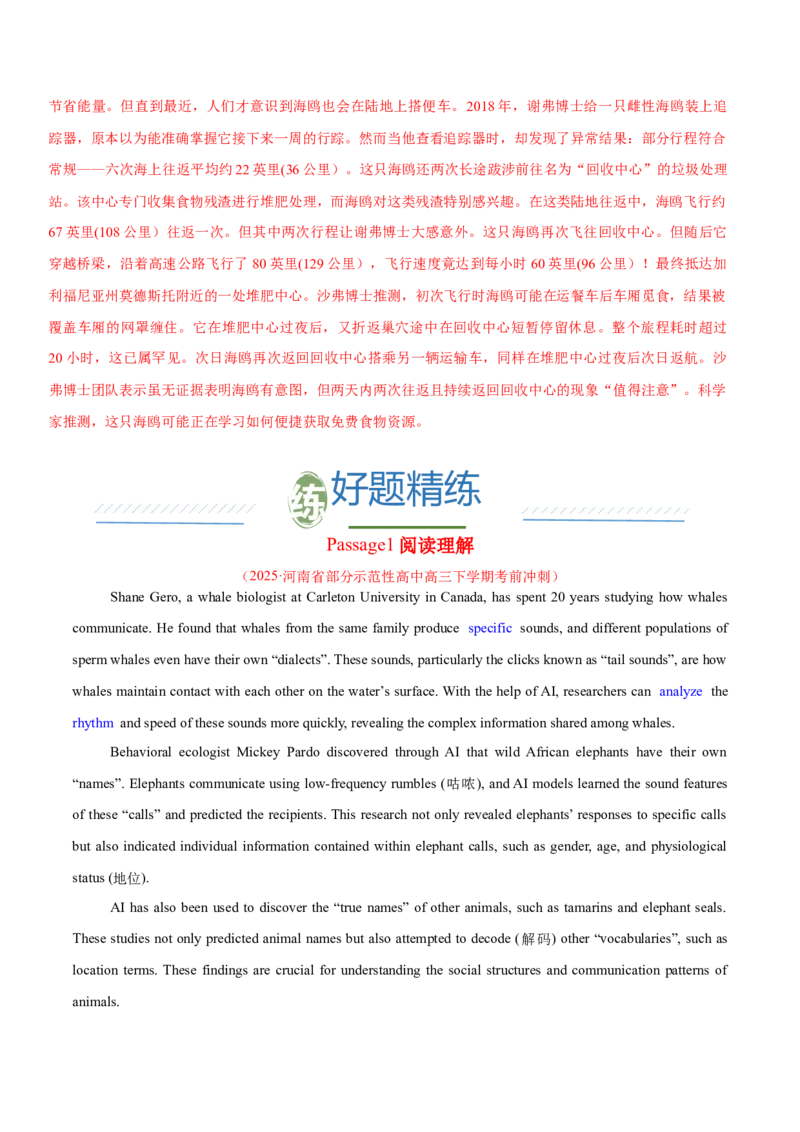
【话题·导语】
Scott Shaffer 是一名研究鸟类的生物学家。他正在研究自己放在一只海鸥身上的追踪设备的数据。他
惊讶地发现,这只鸟在一辆载着食物残渣的卡车上行驶了80 英里。
【原文·时文阅读】
(文章来源:https://newsforkids.net/articles/2025/07/24/seagull-hitches-80-mile-ride-on-a-garbage-truck/)
读时文精读
Scott Shaffer is a biologist who studies birds. In 2018, he was studying data from a tracking device he had
placed on a gull. He was surprised to find that the bird had gone for an 80-mile (129-kilometer) ride on a truck
carrying food scraps. And the bird had done it twice in just one week.
On the ocean, gulls often eat near whales, feasting off the small sea creatures the whales bring to the surface.
But when there’s not much food at sea, they spend more time looking for food on land. The clever birds are famous
at beaches for eating almost anything – whether they’ve been invited or not.
The food is important, since flying is hard work. Research has shown that gulls will take short rides on boats
to save energy. But until recently, there wasn’t much to suggest that gulls also catch rides on land.
In 2018, Dr. Shaffer placed a tracking device on a female gull. He expected the device to give him a good
idea of where the gull went over the next week. But when he checked the tracker, he found some very unusual
results.
Some results were normal: the gull’s six trips over the sea were shorter; they covered an average of about 22
miles (36 kilometers). The bird also made two longer trips over land to a recycling center called Recology.
Recology collects food scraps for composting – and gulls are very interested in food scraps. On these trips, the gull
flew about 67 miles (108 kilometers) to get to the center and back home again.
But two of the gull’s trips really took Dr. Shaffer by surprise. Again, the bird had flown to the Recology
center. But from there, the gull traveled across a bridge and along major highways for 80 miles (129 kilometers).
And the bird seemed to be traveling at a speed of about 60 mph (96 kph)! The journey ended at a compost center
near Modesto, California.
Dr. Shaffer believes that on the first trip, the gull had been eating food in the back of a truck carrying food
scraps. She probably got caught under a net covering the back of the truck. The bird spent the night at the compost
center, then flew all the way back to her nest, stopping off for a break at the Recology center. The entire trip took
over 20 hours.
That was unusual enough. But the next day, the gull went back to the Recology center and took a second ride
on another truck. Again, the bird spent the night at the compost center and flew back the next day.
Dr. Shaffer and his team say they don’t have any reason to believe the gull took the trips on purpose. But they
say it’s “notable” that the bird made the trip twice in two days, and kept returning to the Recology center afterward.
The scientists say it’s possible that the bird was beginning to learn about an easy way to reach a great source
of free food.
【原创·阅读理解】
1.What do the gulls often live on?
A.They only eat the small sea creatures.
B.They only eat the food scraps.
C.They eat almost anything at beaches.
D.They eat when invited
2.What did Dr. Shaffer find special on tracking the gull?
A.The gull’s six trips over the sea were shorter.
B.The gull made two longer trips over land to a recycling center.
C.The gull always made trips to a recycling center.
D.The gull is very interested in food scraps.
3.What do we know about Dr. Shaffer and his team’s research?
A.They think the gull took the trips intentionally.
B.They think the gull possibly learned about an easy way to get food.
C.They think the gull liked to spend the night at the compost center.
D.They think the gull were not interested in the small sea creatures.
4.Which is the suitable title for the passage?
A.Seagull Hitches 80-Mile Ride on a Garbage Truck.
B.Seagull Finds New Kind Food on Land.
C.Seagull Prefers the Recology Center.
D.Seagull Flies as Long as 80 miles.
【课标词汇积累】
1.biologist n.生物学家
 ● The biology teacher invited a famous biologist to give us a lecture about DNA.
(生物老师邀请了一位著名生物学家来给我们做关于DNA 的讲座。)
2.device n.装置,器具, 技巧, 诡计
  ●Many students use a digital device like a tablet to take notes in class.
(许多学生使用平板电脑等电子设备在课堂上记笔记。)
3.feast n.宴会, 盛宴, 宗教节日; v.尽情享用, 赴宴
●The school organized a feast to celebrate the end of the semester.
(学校组织了一场盛宴来庆祝学期结束。)
4.normal adj.正常的, 身体健康的; n.常态
   ●It’s normal for students to feel nervous before exams.
(学生在考试前感到紧张是正常的。)
5.scrap n.废料, 残余物, 小片, 吵架; vt.废弃, 取消, 抛弃
 ●We collected scrap paper to recycle for our art project.
(我们收集了废纸用于艺术项目的回收利用。)
6.notable adj.值得注意的, 显著的, 著名的; n.名人, 显要人物
  ●The school’s debate team has achieved notable success this year.
(学校的辩论队今年取得了显著的成功。)
7.on purpose 并非偶然地, 故意地, 特地, 特有的目的
 ● He spilled his drink on purpose to avoid taking the test.
(他故意打翻饮料,以逃避考试。)
8.unusual adj.特别的,不寻常的, 独特的,别致的
 ●It’s unusual for our teacher to cancel homework on a Friday.
(我们老师在周五取消作业是很不寻常的。)
9.recycling n.再循环; v.回收利用, 再利用, 再次应用, 重新使用
 ●Our school promotes recycling by placing bins in every classroom.
(我们学校通过在每个教室放置回收箱来推广回收利用。)
【课标词汇训练】
根据语境,从上面的“课标词汇”中选用合适的单词及其正确形式将句子补充完整。
1.Our school’s science club is run by a  _____________ who encourages students to explore nature.
2.The physics lab has a new _____________  for measuring electric currents.
3.During the cultural festival, students enjoyed a _____________  of different cuisines.
4.Wearing uniforms is _____________ in our high school.
5.The old textbooks were turned into _____________  for recycling.
6.A _____________  scientist visited our school to talk about climate change.
7.She sat alone _____________  because she wanted to focus on her book.
8.We had an _____________  guest speaker—a former astronaut!
9.The environmental club organized a _____________  campaign to reduce waste.
【参考译文】
斯科特·谢弗是一位研究鸟类的生物学家。2018 年,他在分析一只海鸥佩戴的追踪器数据时,惊讶地发现
这只鸟竟两次搭乘载有食物残渣的卡车完成了长达80 英里(129 公里)的旅程。更令人称奇的是,这只海鸥仅
用一周时间就完成了两次这样的壮举。在海洋中,海鸥通常会靠近鲸鱼觅食,享用鲸鱼将浮游生物带到水面的
残渣。但当海域食物匮乏时,它们会更多地在陆地上寻找食物。这些聪明的鸟类在海滩上以几乎什么都吃而闻
名——无论是否被邀请。食物至关重要,因为飞行需要耗费大量体力。研究表明,海鸥会搭乘船只短途旅行以
节省能量。但直到最近,人们才意识到海鸥也会在陆地上搭便车。2018 年,谢弗博士给一只雌性海鸥装上追
踪器,原本以为能准确掌握它接下来一周的行踪。然而当他查看追踪器时,却发现了异常结果:部分行程符合
常规——六次海上往返平均约22 英里(36 公里)。这只海鸥还两次长途跋涉前往名为“回收中心”的垃圾处理
站。该中心专门收集食物残渣进行堆肥处理,而海鸥对这类残渣特别感兴趣。在这类陆地往返中,海鸥飞行约
67 英里(108 公里)往返一次。但其中两次行程让谢弗博士大感意外。这只海鸥再次飞往回收中心。但随后它
穿越桥梁,沿着高速公路飞行了80 英里(129 公里),飞行速度竟达到每小时60 英里(96 公里)!最终抵达加
利福尼亚州莫德斯托附近的一处堆肥中心。沙弗博士推测,初次飞行时海鸥可能在运餐车后车厢觅食,结果被
覆盖车厢的网罩缠住。它在堆肥中心过夜后,又折返巢穴途中在回收中心短暂停留休息。整个旅程耗时超过
20 小时,这已属罕见。次日海鸥再次返回回收中心搭乘另一辆运输车,同样在堆肥中心过夜后次日返航。沙
弗博士团队表示虽无证据表明海鸥有意图,但两天内两次往返且持续返回回收中心的现象“值得注意”。科学
家推测,这只海鸥可能正在学习如何便捷获取免费食物资源。
Passage1 阅读理解
(2025·河南省部分示范性高中高三下学期考前冲刺)
Shane Gero, a whale biologist at Carleton University in Canada, has spent 20 years studying how whales
communicate. He found that whales from the same family produce specific sounds, and different populations of
sperm whales even have their own “dialects”. These sounds, particularly the clicks known as “tail sounds”, are how
whales maintain contact with each other on the water’s surface. With the help of AI, researchers can analyze the
rhythm and speed of these sounds more quickly, revealing the complex information shared among whales.
Behavioral ecologist Mickey Pardo discovered through AI that wild African elephants have their own
“names”. Elephants communicate using low-frequency rumbles (咕哝), and AI models learned the sound features
of these “calls” and predicted the recipients. This research not only revealed elephants’ responses to specific calls
but also indicated individual information contained within elephant calls, such as gender, age, and physiological
status (地位).
AI has also been used to discover the “true names” of other animals, such as tamarins and elephant seals.
These studies not only predicted animal names but also attempted to decode (解码) other “vocabularies”, such as
location terms. These findings are crucial for understanding the social structures and communication patterns of
animals.
练好题精练
Although AI has made progress in decoding animal languages, creating an animal version of “Google
Translate” is still far from realization. There is no accepted definition of whether animals can communicate beyond
basic levels. That is, whether they possess language structures. Researchers aim not only to converse with wildlife
and pets but also to gain a deeper understanding of their thoughts and how they perceive themselves and the world.
Through AI technology, scientists are gaining deeper insights into animal communication patterns, which not
only aids in the conservation of endangered species but may also reveal new aspects of animal intelligence and
consciousness. As technology advances, we may come closer to understanding animal languages, therefore
improving our coexistence with them.
1.Why do sperm whales make “tail sounds”?
A.To communicate with family members.
B.To warn other animals of danger.
C.To drive away other species of whales.
D.To find their way across the ocean.
2.What has Mickey achieved through AI in his research on elephants?
A.Learning about their social status.
B.Discovering their original habitats.
C.Anticipating the targets of their calls.
D.Analyzing the rhythm of their footsteps.
3.Which of the following divides researchers about animal languages?
A.The “vocabulary” size of the animals.
B.The individual “names” of the animals.
C.The thoughts of animals about the world. D.The existence of animals’ language structures.
4.What may be a suitable title for the text?
A.Scientists Use AI to Track Sperm Whales
B.Sound Provides Ways to Talk with Wild Animals
C.Biologist Protects Sperm Whales Through AI
D.AI Helps to Know About Animal Languages
【词汇积累】
1.specific adj.明确的, 独特的 2.analyze v. 分析, 分解, 化验
3.rhythm n.[诗]节奏,韵律, [医]节律,规律, [乐]节拍 4.behavioral adj.行为(研究)的
5.predict v.预言, 预测  6. technology n.科技, 技术性机器 7.coexistence n.共处, 共存
Passage2 阅读理解
(2025·重庆市高三下学期5 月第九次质量检测)
In male-on-male mouse fights, the victims of aggression often hide behind a female mouse to shift their
attackers’ attention. Think back to a time when you were confronted by a bully or found yourself in another
challenging situation — you either confronted the issue directly or looked for ways to escape it, says Joshua
Neunuebel at the University of Delaware. Animals often deal with similar struggles.
Fights between male mice can be ferocious, often involving biting, wrestling or rolling over each other if
their encounter becomes intense. Neunuebel and his colleagues recorded more than 3,000 aggressive fights between
male mice in the lab and then processed the interactions with machine learning. This tool learned to recognize
certain behaviors automatically based on video examples that the researchers had manually labeled, such as footage
(片段) of one male mouse aggressor closely chasing a second male.
The analysis revealed an attention-shifting strategy in which a male mouse ran away from an aggressor male
to approach a female mouse. That often drove the aggressor to interact with the same female mouse, taking the heat
off the victim of aggression, which then moved away. This series of events played out more than half the time
following aggressive encounters between males. “I believe one reason we were able to discover this bait-and-switch
strategy was that we studied group behavior by recording multiple mice together, which is much less common than
studying pairs of mice,” says Neunuebel.
But Markus Meister at the California Institute of Technology described the effects of the aggressive behavior
on mouse social interactions as “small and barely significant”. “Before investigating any underlying mechanisms,
one would really like to see a more consistent behaviour first,” he says.
5.What is the focus of the study?
A.Aggressive behavior of male mice.
B.Defensive strategies of male mice.
C.Differences between human and mice conflicts.
D.Communication between male and female mice.
6.What does the underlined word“ferocious” mean in Paragraph 2?
A.Violent.
B.Skillful.
C.Endless.
D.Decisive.
7.How did Neunuebel’s team discover the bait-and-switch strategy?
A.By studying individual mice.
B.By using high-tech tracking.
C.By changing outdoor settings.
D.By observing group interactions.
8.What did Markus Meister think of the finding?
A.Extensive.
B.Innovative.
C.Unconvincing.
D.Puzzling.
【长难句分析】
【文章原句】I believe one reason we were able to discover this bait-and-switch strategy was that we
studied group behavior by recording multiple mice together, which is much less common than studying
pairs of mice.
【句式分析】 这个句子是一个复合句。we were able to discover this bait-and-switch strategy 是定语从句,
that we studied group behavior by 是表语从句,which is much less common than studying pairs of mice
是表语从句中的定语从句。
【翻译】我相信我们能够发现这种诱饵和转换策略的原因之一是:我们通过记录多只老鼠在一起的行为来研
究群体行为,这比研究两只老鼠要少得多。
Passage 3  7 选5
(2025·江苏省南通市海安市高三期中)
I’m Jes Lefcourt, the director of conservation technology at the Allen Institute for AI in Seattle, Washington.
I am interested in the environment and everything related to it.

 1

  I make use of software to help to protect
elephants. My first entry into conservation work was at National Geographic. I learnt how technology can help with
practical problems there, such as tracking elephant migration.
In 2018, I joined EarthRanger, a technology platform. EarthRanger collects and displays data and combines
them with field reports on everything from animal traps to big floods.

 2

  People can see a map with a real-
time look at relevant data, from positions of wildlife to observations from researchers. Before EarthRanger, these
data were recorded on paper or spread across databases.


 3

  I spend a lot of time in the field with our partners, which include more than 400 organizations. I
work with teams that track animals, study ecosystems and promote human-wildlife coexistence.
One of our partners is Save the Elephants, based in Samburu, Kenya. It reminds you of the importance and
urgency of the elephant problem we’re facing. It tracks hundreds of elephants across Africa.

 4
In a picture taken last month, I’m at the Save the Elephants headquarters. I’m surrounded by the bones and
jaws of elephants that have died from both natural and unnatural causes. It’s a remarkable place to reflect. One
elephant dying is a tragedy.

 5

  Tens of thousands dying is an existential risk. Reducing that risk requires
joint actions across many communities, organizations and governments.
A.Elephants are in danger.
B.It also monitors elephant locations.
C.The number of elephants is increasing.
D.Measures are needed to prevent more deaths.
E.My career path has included software development.
F.I am in charge of the platform and cooperate with others.
G.The platform has nearly 100 hardware and software data sources.
Passage 4 完形填空
(2025·湖南省长沙市麓山国际实验学校高三下学期模拟考试(二))
For two months, a California couple was heartbroken, worrying about the whereabouts of their

 1
cat after losing him in Yellowstone national park. But as summer came to a close, so did their

 2

  story.
Benny and Susan

 3

  their lost cat Rayne last month after an animal welfare group called to let them know
their cat had been found in Roseville, California, about 800 miles from Yellowstone.
In June, the couple went camping in the national park, where their cat was

 4

  by something in the
wilderness. Rayne ran into the trees, and they didn’t see him again for 60 days. During the trip, they searched every
day,

 5

  treats and toys in hopes he’d return, but without

 6

 . “We had to leave without him,”
Susan told one of the group workers. “That was the

 7

  day because I felt like I was

 8

  him.”
In early August, Rayne’s microchip, which they had previously implanted,

 9

 . The couple received
a

 10


  from Pet Watch, a pet-tracking service, indicating that their cat had been found in a shelter in
Roseville. A woman had discovered Rayne alone in the street and brought him to the shelter. “He was really
11


 ,” said Susan. “He probably didn’ t have much energy left to go any farther.”


 12


  how Rayne travelled the 800 miles from Yellowstone to Roseville remains a(an)

 13

. Susan shared their

 14


  story on Facebook, hoping their story might encourage someone to come forward
with any details. In their later interview, the couple also urged other pet owners to attach

 15


  to avoid
losing their pets for good.
1.A.beloved
B.pitiful
C.playful
D.naughty
2.A.unique
B.tragic
C.happy
D.funny
3.A.located
B.recovered
C.reunited
D.connected
4.A.amazed
B.confused
C.scared
D.delighted
5.A.setting up
B.putting aside
C.giving away
D.laying out
6.A.success
B.progress
C.outcome
D.exception
7.A.longest
B.toughest
C.wildest
D.busiest
8.A.abusing
B.leaving
C.forgetting
D.abandoning
9.A.came into use
B.came in effect
C.came in handy
D.came into power
10.A.message
B.note
C.proposal
D.comment
11.A.settled down
B.broken down
C.worn out
D.stressed out
12.A.Initially
B.Exactly
C.Particularly
D.Generally
13.A.concern
B.secret
C.challenge
D.mystery
14.A.hair-raising
B.fairytale
C.time-consuming
D.rollercoaster
15.A.trackers
B.lockers
C.cameras
D.chasers
Passage 5 语法填空
(2025·山东省威海市高三下学期模拟)
阅读下面短文,在空白处填入1 个适当的单词或括号内单词的正确形式。
Thanks to advances in animal tracking technology, one can match with a wild animal and track its
movements through Chinalife’s bracelet by scanning the accompanying QR code.
In addition to tracking the movements of wild animals, digital adoption programs provide

 1
unique opportunity to form a virtual bond with them.

 2

  just a few clicks, anyone can adopt a wolf, koala,
or red panda, even if he or she is miles away. These virtual “mamas” are also offered a chance

 3

  (see)
their babies offline.
Since 2022, Nanjing Hongshan Forest Zoo has launched a “virtual adoption” program

 4
individuals, families, and even companies can adopt animals through a mini-program. Participants can interact with
their

 5

  (choose) animals, learn about their habits, and support their protection — all from home.
Currently, these innovative digital programs, ranging from tracking the

 6

  (journey) of wildlife to
virtual adoption,

 7

  (bridge) the gap between humans and animals. Through these

 8

  (create)
initiatives, individuals are not only gaining insights into animal behaviors, but are also actively participating in
conservation efforts

 9

  advancing research in the field.
Meanwhile, the collected animal tracking data serves as a valuable resource and foundation for scientific
research. All wildlife conservation ultimately comes down to habitat protection. In this process, animals’ data can
act as bioindicators,

 10


  (assist) governments and organizations in developing more reasonable
environmental protection policies.