10. Racial Issues美国种族问题
Once a man had a dream. He dreamed of a land of peace and harmony. He dreamed of a place where
people were not judged by their skin color. He dreamed of a country where children of different races could play
together. He dreamed of a nation where all people were equal. Some people didn't like his dream. They said it
would never happen. Some people applauded his dream. They wanted to make it happen. This noble vision has
come true for some. For others, it’s still just a fantasy.
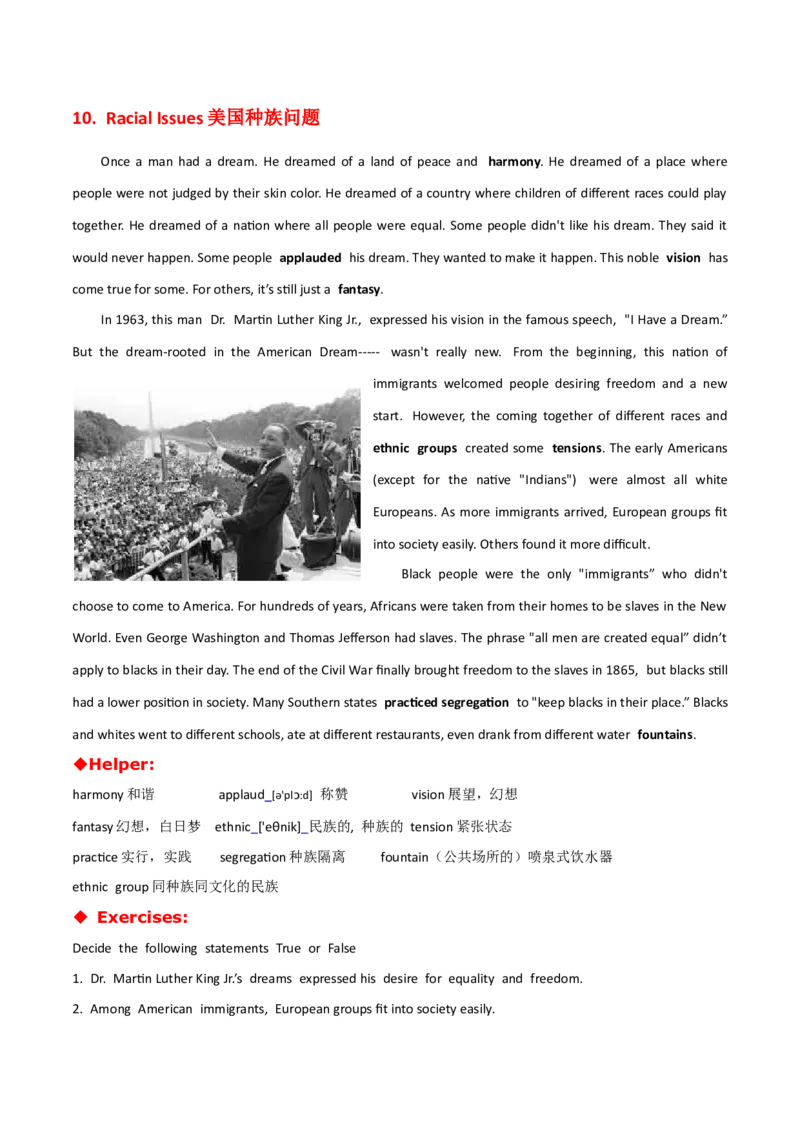
In 1963, this man Dr. Martin Luther King Jr., expressed his vision in the famous speech, "I Have a Dream.”
But the dream-rooted in the American Dream----- wasn't really new. From the beginning, this nation of
immigrants welcomed people desiring freedom and a new
start. However, the coming together of different races and
ethnic groups created some tensions. The early Americans
(except for the native "Indians") were almost all white
Europeans. As more immigrants arrived, European groups fit
into society easily. Others found it more difficult.
Black people were the only "immigrants” who didn't
choose to come to America. For hundreds of years, Africans were taken from their homes to be slaves in the New
World. Even George Washington and Thomas Jefferson had slaves. The phrase "all men are created equal” didn’t
apply to blacks in their day. The end of the Civil War finally brought freedom to the slaves in 1865, but blacks still
had a lower position in society. Many Southern states practiced segregation to "keep blacks in their place.” Blacks
and whites went to different schools, ate at different restaurants, even drank from different water fountains.
◆Helper:
harmony和谐 applaud [ə'plɔ:d] 称赞 vision展望,幻想
fantasy幻想,白日梦 ethnic ['eθnik] 民族的, 种族的 tension紧张状态
practice实行,实践 segregation种族隔离 fountain(公共场所的)喷泉式饮水器
ethnic group同种族同文化的民族
◆ Exercises:
Decide the following statements True or False
1. Dr. Martin Luther King Jr.’s dreams expressed his desire for equality and freedom.
2. Among American immigrants, European groups fit into society easily.3. George Washington was strongly against slavery.
4. The phrase "all men are created equal” was put forward by black people to fight against slavery.
5. “Keep blacks in their place” means black people should have equal rights.
◆Brief Introduction:
从前有一个人,他有一个梦。他梦到一块和平与和谐的土地。他梦到一个人们不因肤色而被论断的地
方。他梦到一个国家不同肤色的小子们玩在一起。他梦到一个国家,在其中所有的人都是平等的。有些人不
喜欢他的梦。他们说这个梦永远不会实现。有些人则对他的梦喝采。他们想实现这个梦。这个崇高的理想
对某些人而言,它还只是一个幻想。
这个人就是马丁·路德·金恩博士,在一九六三年的一篇有名的演讲"我有一个梦"当中表达了他的理想。
其实这个根植于"美国梦"的理想,并不是个完全新潮的主意。从一开始,这个由移民所组成的国家,便欢迎渴
望自由和新开始的人到来。但是,不同种族的到来亦带来了紧张的气氛。早期的美国人(除了印地安原住民
之外)几乎全是来自欧洲的白人。当更多的移民抵达时,欧洲团体较容易适应这个社会,其它团体则较感困
难。
黑人是唯一非出于自愿而到美国来的"移民"。几百年以来,非洲人自其家园被迫带到新世界为奴.即使乔
治。华盛顿和托马斯.杰弗逊也曾蓄奴。那句"人类生而平等"的话,在他们的时代并不适用于黑人。一八六五
年,南北战争的结束终于为黑奴带来自由,但是黑人的社会地位仍然较低。许多南方的州实行种族隔离政策
以使"黑人不会跨越界限"。黑人和白人上不同的学校,在不同的餐馆吃饭,甚至连喝水都用不同的饮水机。
◆Keys and Explanations:
1. True 可以从第一段梦想的具体内容知道,马丁路德.金的梦想就是渴望自由与平等。
2. True 可以从倒数第二段As more immigrants arrived, European groups fit into society easily. Others found it
more difficult.判断本题的讲法是正确的。
3. False 可以根据最后一段的Even George Washington and Thomas Jefferson had slaves.“即使乔治.华盛顿和
托马斯.杰弗逊也曾蓄奴。”可知,那个时代还没有反对奴隶制。
4. False 虽然在人权宣言中提出了人人平等的口号,但从 The phrase "all men are created equal” didn’t apply
to blacks in their day.可知,"人类生而平等"的话,在他们的时代并不适用于黑人。
5. False本句是种族隔离制度时期的规定,是限制黑人自由的措施。11. Who is Uncle Sam?
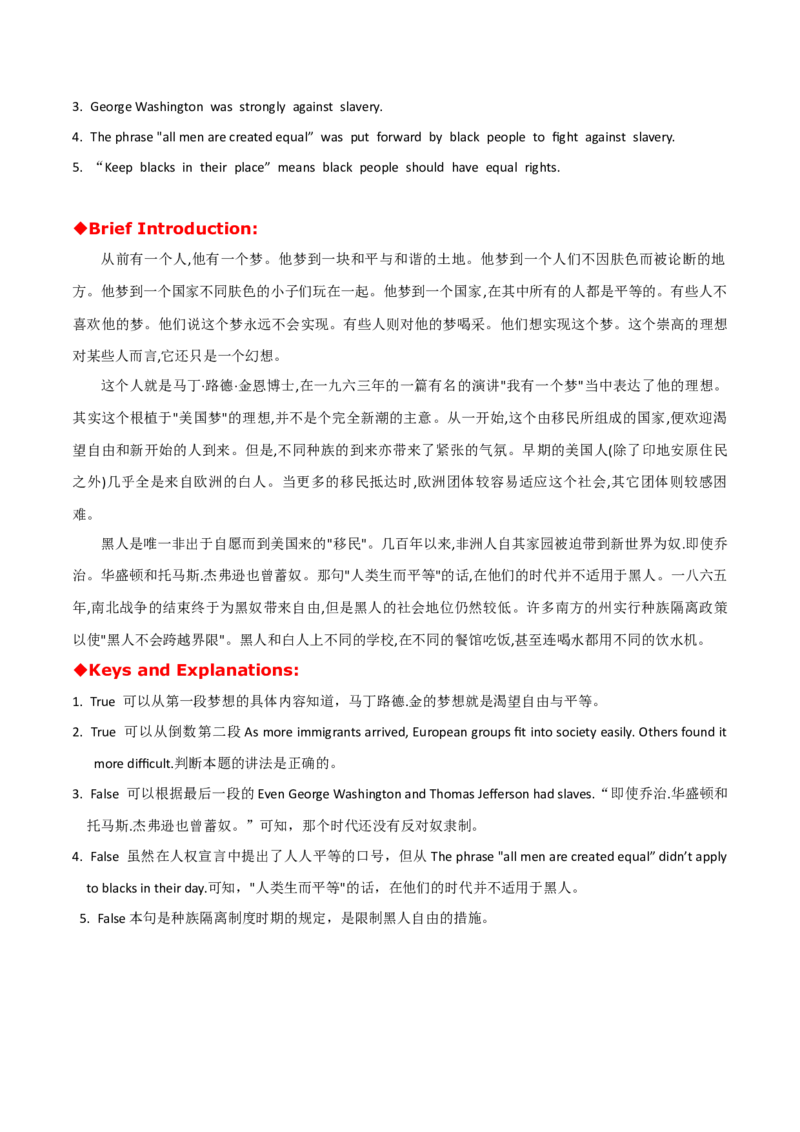
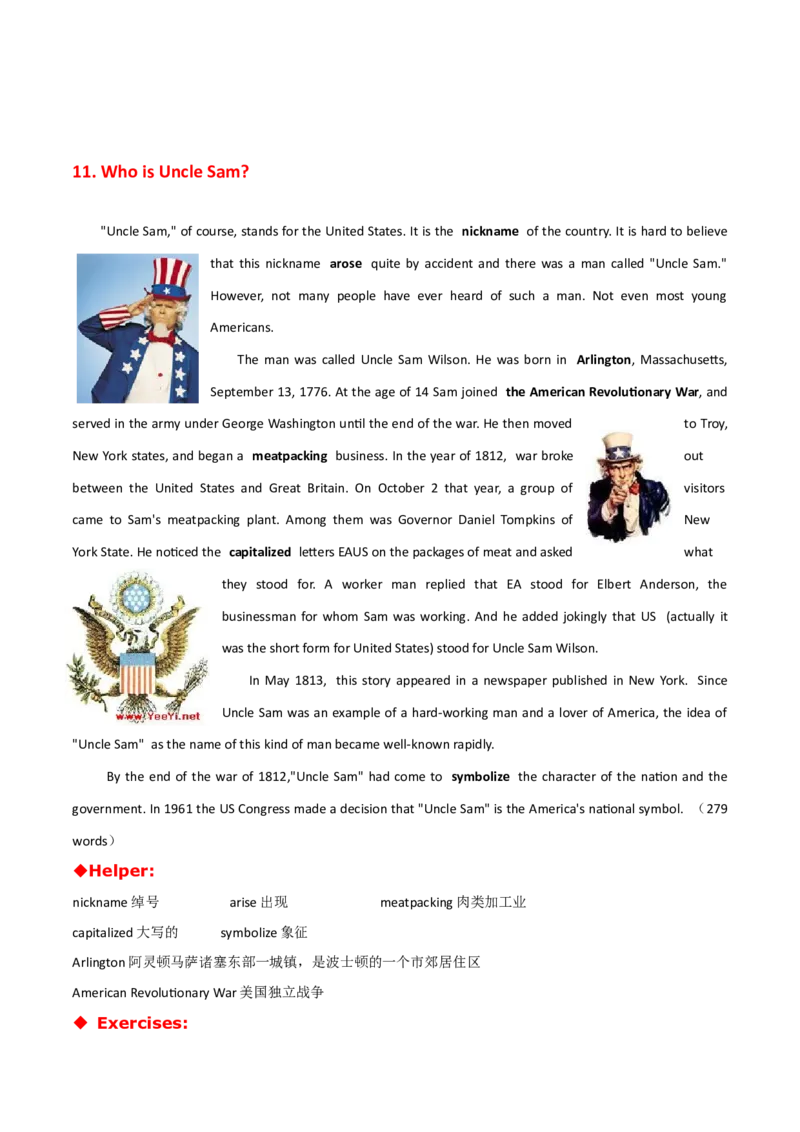
"Uncle Sam," of course, stands for the United States. It is the nickname of the country. It is hard to believe
that this nickname arose quite by accident and there was a man called "Uncle Sam."
However, not many people have ever heard of such a man. Not even most young
Americans.
The man was called Uncle Sam Wilson. He was born in Arlington, Massachusetts,
September 13, 1776. At the age of 14 Sam joined the American Revolutionary War, and
served in the army under George Washington until the end of the war. He then moved to Troy,
New York states, and began a meatpacking business. In the year of 1812, war broke out
between the United States and Great Britain. On October 2 that year, a group of visitors
came to Sam's meatpacking plant. Among them was Governor Daniel Tompkins of New
York State. He noticed the capitalized letters EAUS on the packages of meat and asked what
they stood for. A worker man replied that EA stood for Elbert Anderson, the
businessman for whom Sam was working. And he added jokingly that US (actually it
was the short form for United States) stood for Uncle Sam Wilson.
In May 1813, this story appeared in a newspaper published in New York. Since
Uncle Sam was an example of a hard-working man and a lover of America, the idea of
"Uncle Sam" as the name of this kind of man became well-known rapidly.
By the end of the war of 1812,"Uncle Sam" had come to symbolize the character of the nation and the
government. In 1961 the US Congress made a decision that "Uncle Sam" is the America's national symbol. (279
words)
◆Helper:
nickname绰号 arise出现 meatpacking肉类加工业
capitalized大写的 symbolize象征
Arlington阿灵顿马萨诸塞东部一城镇,是波士顿的一个市郊居住区
American Revolutionary War美国独立战争
◆ Exercises:Decide the following statements True or False
1. "Uncle Sam" is the America's national symbol.
2. All Americans know that "Uncle Sam" stands for the United States.
3. The nickname came from a real man called Sam.
4. "Uncle Sam" dates back to the American Revolutionary War.
5. "Uncle Sam" became well-known rapidly because Uncle Sam was an example of a hard-working man and a
lover of America.
◆Brief Introduction:
"Uncle Sam"是美国人的绰号。它源自1812-1814年间美英战争时期的一个历史传说。相传在纽约州的
特洛伊城(Troy)有位年长的肉类加工商,名叫山缪尔•威尔逊(Samuel Wilson)。他勤劳、诚实、能干,很有
威信,人们亲切地叫他"山姆大叔(Uncle Sam)"(注:Sam为Samuel的昵称)。这位山姆大叔也是一位爱国
者,他与父兄曾参加过美国独立战争。在1812年的美英战争中,他的工厂与政府签了一份为军队生产桶装
牛肉的合同,美国政府每当收到他交来的经其亲自检验合格的牛肉,就将肉装入特制的木桶,并在桶上盖
上US的记号。由于Uncle Sam的首字母是US,而美国(The United States)的缩写也是U.S.,于是人们便把这
两个名称合二为一了,意即那些经"山姆大叔"之手的牛肉,成了"美国"的财产。于是当地的人们就把"山姆
大叔"当成美国的绰号,并逐渐流传开来。1961年美国国会正式把"山姆大叔"作为美国的象征。
◆Keys and Explanations:
1. True 从文章最后一段可知。
2. False 从第一段最后一句Not even most young Americans. 可知。
3. True 从第二段的描述可知。
4. False 不是美国的革命战争而是美英战争所发生的事。
5. True从第三段内容可以知道。
12. Cowboys西部牛仔Cowboys were a main part of the American West for only a brief period. Spanish settlers in California and
Mexico established the first ranches in the Southwest during the early 19th century and employed vaqueros
to handle their cattle herds. In the middle of that century, a large free
African- American slaves from the eastern part of the US immigrated to
the Midwest and Southwest in search of free or inexpensive land. At that
time, the great cattle ranches of the West were established and the
American cowboys increased.
By the early 20th century, modern technology had made most of the
cowboys’ work obsolete. There were still many people in the American
West who rode horses and herded cows, but the great days of the
Cowboys’ lasted only 40 years, from the 1860s to 1900s.
At that time, there were open grasslands stretching from Texas to Canada. Cattle were herded there and
then driven in great herds by cowboys to the railroad stations.
Cowboys did not lead an exciting life. They drove cattle on trails to sell them on the market. They also
drove cattle from Texas because there were too many cattle eating up all of the grass there.
A cowboy’s life was simple and hard. Out on the grasslands, he was his own boss. He often stayed in the
wild for many months. There was usually no one to help him except other cowboys, so each cowboy had to
know how to do many things.
Because of the roaming life they led, cowboys travelled light. Usually they owned nothing more than
their horses, bedrolls and the clothes they wore. Although many cowboys had guns, they rarely carried guns
when they worked. The guns were too heavy and got in the way. (293 words)
◆Helper:
ranch大牧场 vaquero[væ'kɛərəu]牧童 immigrate['imigreit]移来
obsolete['ɔbsəli:t]过时的 herd[hə:d]放牧 bedroll 铺盖卷
◆Brief Introduction:
西部牛仔套捕野马之精湛的技术扣人心弦。他们印证了美国历史,书写了美国好莱坞电影史上许多可
歌可泣的故事。然而西部牛仔的现实生活又是怎样的呢?
“Cowboy”这个词实际上来源于西班牙语。最早的的牛仔原本是19世纪早期加利福尼亚和墨西哥的西
班牙定居者雇佣的骑在马背上的农场工人。事实上,牛仔们并不像电影中反映的那样带有强烈的英雄主义
色彩,他们只是负责看管奶牛,在户外的时间一天长达12到14个小时,工作既沉重又危险,报酬又低。1865年到1895年是牛仔的鼎盛时代,新的肉类保鲜办法的出现、市场对牛肉的需求急剧增长,同时铁路
延伸到大多数村落,使得牧场经营业在美国西南部非常兴盛。放牧业、牧场经营业主们用较低的成本在西
部饲养大批的牛群,然后通过铁路把它们运到东部的市场。而牛仔们就在户外放养牛群,然后把他们运到
最近的铁路上。
牛仔们的生活艰辛而又简朴。由于很少会得到别人的帮助,他们不得不学会自己做很多的事情。另
外,因为总是过着漂泊不定的生活,他们常常轻装简从,身边所携物品不过就是些马匹、铺盖以及衣物而
已。
◆ Exercises:
从所给的A、B、C、D四个选项中选出最佳答案。
1. The great cattle ranches of the West were established_________________.
A. in the early 19th century B. in the middle of 19th century
C. in the late 19th century D. in the early 20th century
2. The great days of the cowboys’ last____________.
A. 20 years B. 35 years C. 40 years D. 80 years
3. Cowboys ever led a __________________ life.
A. hard and simple B. hard but exciting
C. colorful and rich D. adventurous and meaningful
4. Which of the following statements is true according to the passage?
A. Cowboys have a main part of the American West since they appeared.
B. There were few people in the American West who rode horses and herded(放牧) cows in the early
20th century.
C. Cowboys had to learn to do many things because they seldom got help from others.
D. In order to protect themselves, cowboys used to carry guns when they worked.
5. The underlined word “roaming” means ___________________.
A. without any pay B. without anything added
C. requiring great efforts D. traveling without any definite aim
◆Keys and Explanations:
1-5 BCACD
1. 选B。细节推断题。由第一段二、三两句可推出美国西部大型养牛农场建立于19世纪中叶。
2. 选C。事实信息题。根据第二段中的“the great days of the Cowboys’ lasted only 40 years”可以得出答
案。3. 选 A。细节理解题。倒数第二段的第一句话即可告诉我们此题答案。
4. 选C。细节理解题。C项与倒数第二段最后一句的描述相吻合,因而是正确答案,其余各项均与短文内
容不一致。
5. 选 D。词义猜测题。依据最后一段第一句后半部分的“travelled light”以及这一段的第二句中对牛仔生
活的描述可推出“roaming” 的意思应是“动荡的、漂泊的”,所以答案是D。