《2024年1月“九省联考”英语真题解读与考后变式训练》
专题04 阅读理解B篇 (解析+词汇+变式+技巧+模拟) 原卷版
原题呈现
注意B篇位置是说明文不是传统记叙文
阅读理解关键词:说明文,人与自然,动物习性,动物保护,濒危动物人,与动物和谐相处
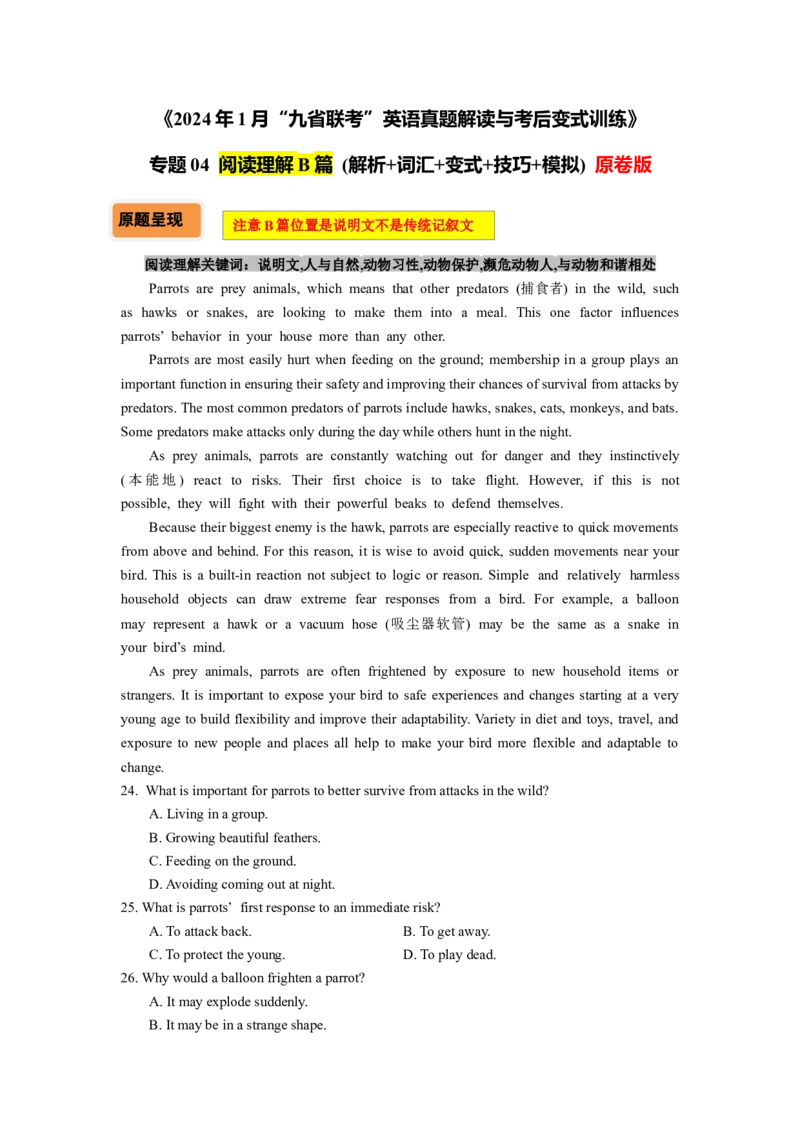
Parrots are prey animals, which means that other predators (捕食者) in the wild, such
as hawks or snakes, are looking to make them into a meal. This one factor influences
parrots’ behavior in your house more than any other.
Parrots are most easily hurt when feeding on the ground; membership in a group plays an
important function in ensuring their safety and improving their chances of survival from attacks by
predators. The most common predators of parrots include hawks, snakes, cats, monkeys, and bats.
Some predators make attacks only during the day while others hunt in the night.
As prey animals, parrots are constantly watching out for danger and they instinctively
(本能地) react to risks. Their first choice is to take flight. However, if this is not
possible, they will fight with their powerful beaks to defend themselves.
Because their biggest enemy is the hawk, parrots are especially reactive to quick movements
from above and behind. For this reason, it is wise to avoid quick, sudden movements near your
bird. This is a built-in reaction not subject to logic or reason. Simple and relatively harmless
household objects can draw extreme fear responses from a bird. For example, a balloon
may represent a hawk or a vacuum hose (吸尘器软管) may be the same as a snake in
your bird’s mind.
As prey animals, parrots are often frightened by exposure to new household items or
strangers. It is important to expose your bird to safe experiences and changes starting at a very
young age to build flexibility and improve their adaptability. Variety in diet and toys, travel, and
exposure to new people and places all help to make your bird more flexible and adaptable to
change.
24. What is important for parrots to better survive from attacks in the wild?
A. Living in a group.
B. Growing beautiful feathers.
C. Feeding on the ground.
D. Avoiding coming out at night.
25. What is parrots’ first response to an immediate risk?
A. To attack back. B. To get away.
C. To protect the young. D. To play dead.
26. Why would a balloon frighten a parrot?
A. It may explode suddenly.
B. It may be in a strange shape.C. It may have a strong color.
D. It may move around quickly.
27. What is the author’s purpose of writing the text?
A. To explain wild parrots' behavior.
B. To give advice on raising a parrot.
C. To call for action to protect animals.
D. To introduce a study on bird ecology.
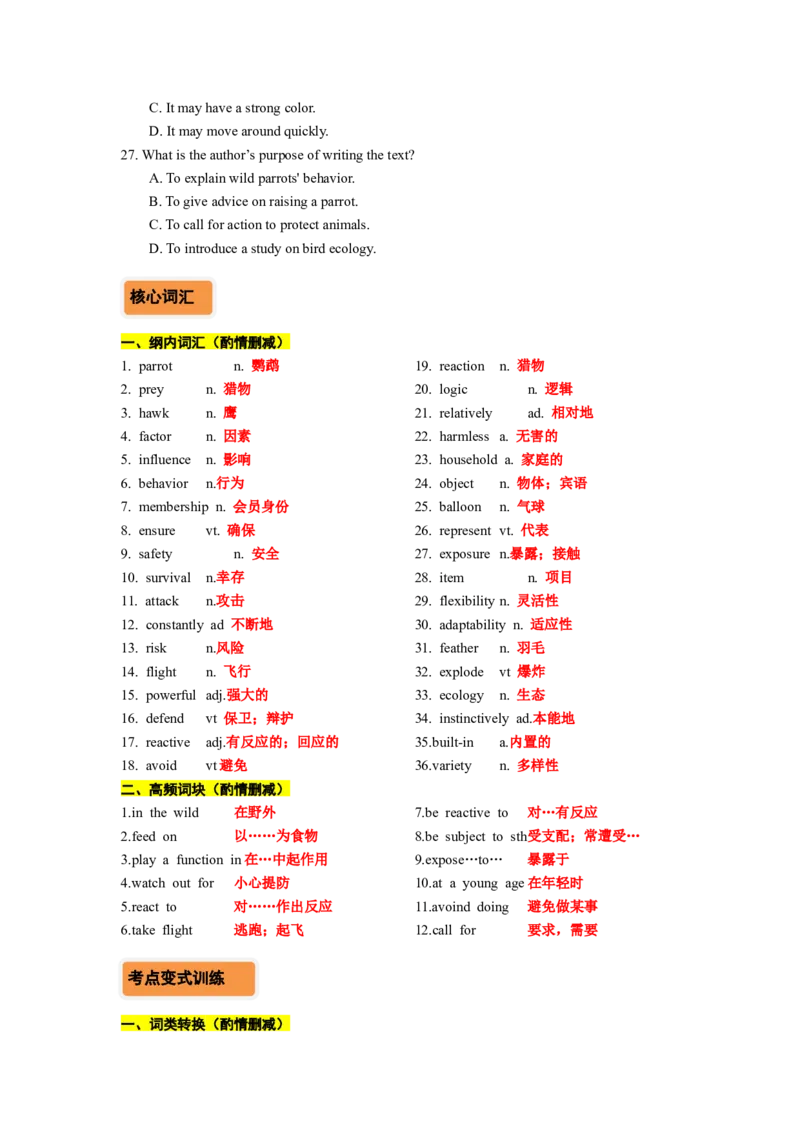
核心词汇
一、纲内词汇(酌情删减)
1. parrot n. 鹦鹉 19. reaction n. 猎物
2. prey n. 猎物 20. logic n. 逻辑
3. hawk n. 鹰 21. relatively ad. 相对地
4. factor n. 因素 22. harmless a. 无害的
5. influence n. 影响 23. household a. 家庭的
6. behavior n.行为 24. object n. 物体;宾语
7. membership n. 会员身份 25. balloon n. 气球
8. ensure vt. 确保 26. represent vt. 代表
9. safety n. 安全 27. exposure n.暴露;接触
10. survival n.幸存 28. item n. 项目
11. attack n.攻击 29. flexibility n. 灵活性
12. constantly ad 不断地 30. adaptability n. 适应性
13. risk n.风险 31. feather n. 羽毛
14. flight n. 飞行 32. explode vt 爆炸
15. powerful adj.强大的 33. ecology n. 生态
16. defend vt 保卫;辩护 34. instinctively ad.本能地
17. reactive adj.有反应的;回应的 35.built-in a.内置的
18. avoid vt避免 36.variety n. 多样性
二、高频词块(酌情删减)
1.in the wild 在野外 7.be reactive to 对…有反应
2.feed on 以……为食物 8.be subject to sth受支配;常遭受…
3.play a function in在…中起作用 9.expose…to… 暴露于
4.watch out for 小心提防 10.at a young age在年轻时
5.react to 对……作出反应 11.avoind doing 避免做某事
6.take flight 逃跑;起飞 12.call for 要求,需要
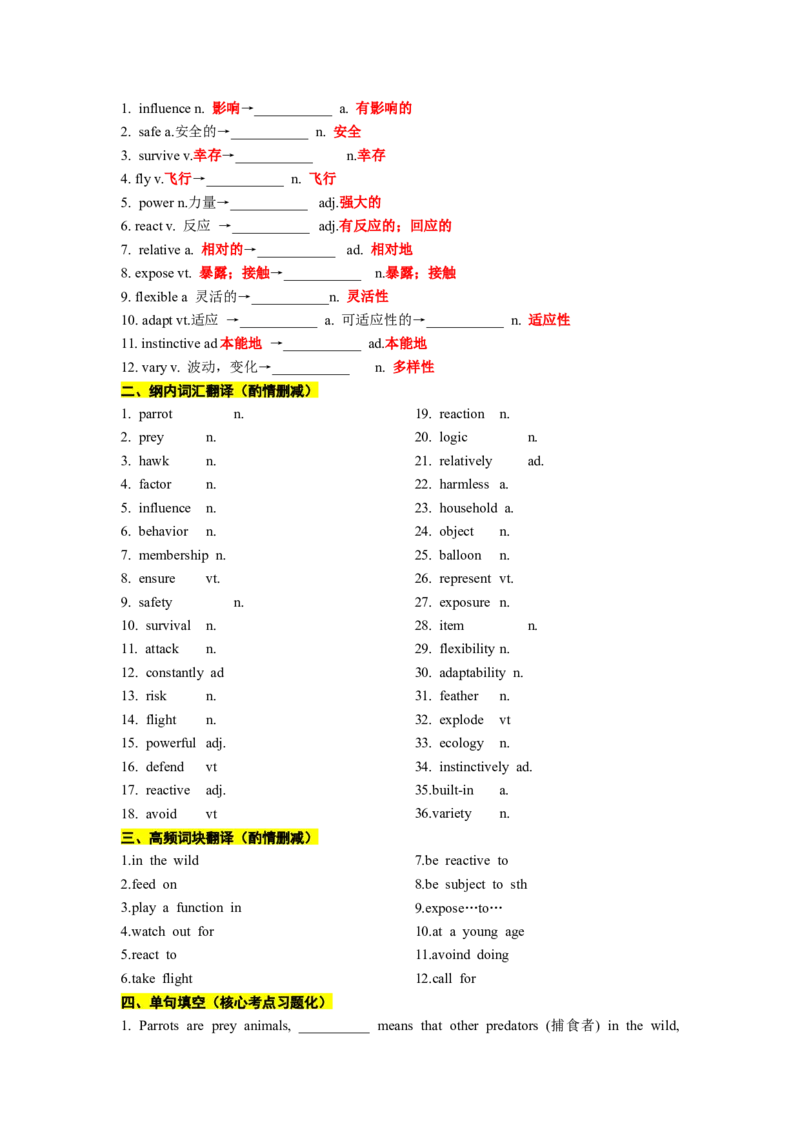
考点变式训练
一、词类转换(酌情删减)1. influence n. 影响→___________ a. 有影响的
2. safe a.安全的→___________ n. 安全
3. survive v.幸存→___________ n.幸存
4. fly v.飞行→___________ n. 飞行
5. power n.力量→___________ adj.强大的
6. react v. 反应 →___________ adj.有反应的;回应的
7. relative a. 相对的→___________ ad. 相对地
8. expose vt. 暴露;接触→___________ n.暴露;接触
9. flexible a 灵活的→___________n. 灵活性
10. adapt vt.适应 →___________ a. 可适应性的→___________ n. 适应性
11. instinctive ad本能地 →___________ ad.本能地
12. vary v. 波动,变化→___________ n. 多样性
二、纲内词汇翻译(酌情删减)
1. parrot n. 19. reaction n.
2. prey n. 20. logic n.
3. hawk n. 21. relatively ad.
4. factor n. 22. harmless a.
5. influence n. 23. household a.
6. behavior n. 24. object n.
7. membership n. 25. balloon n.
8. ensure vt. 26. represent vt.
9. safety n. 27. exposure n.
10. survival n. 28. item n.
11. attack n. 29. flexibility n.
12. constantly ad 30. adaptability n.
13. risk n. 31. feather n.
14. flight n. 32. explode vt
15. powerful adj. 33. ecology n.
16. defend vt 34. instinctively ad.
17. reactive adj. 35.built-in a.
18. avoid vt 36.variety n.
三、高频词块翻译(酌情删减)
1.in the wild 7.be reactive to
2.feed on 8.be subject to sth
3.play a function in 9.expose…to…
4.watch out for 10.at a young age
5.react to 11.avoind doing
6.take flight 12.call for
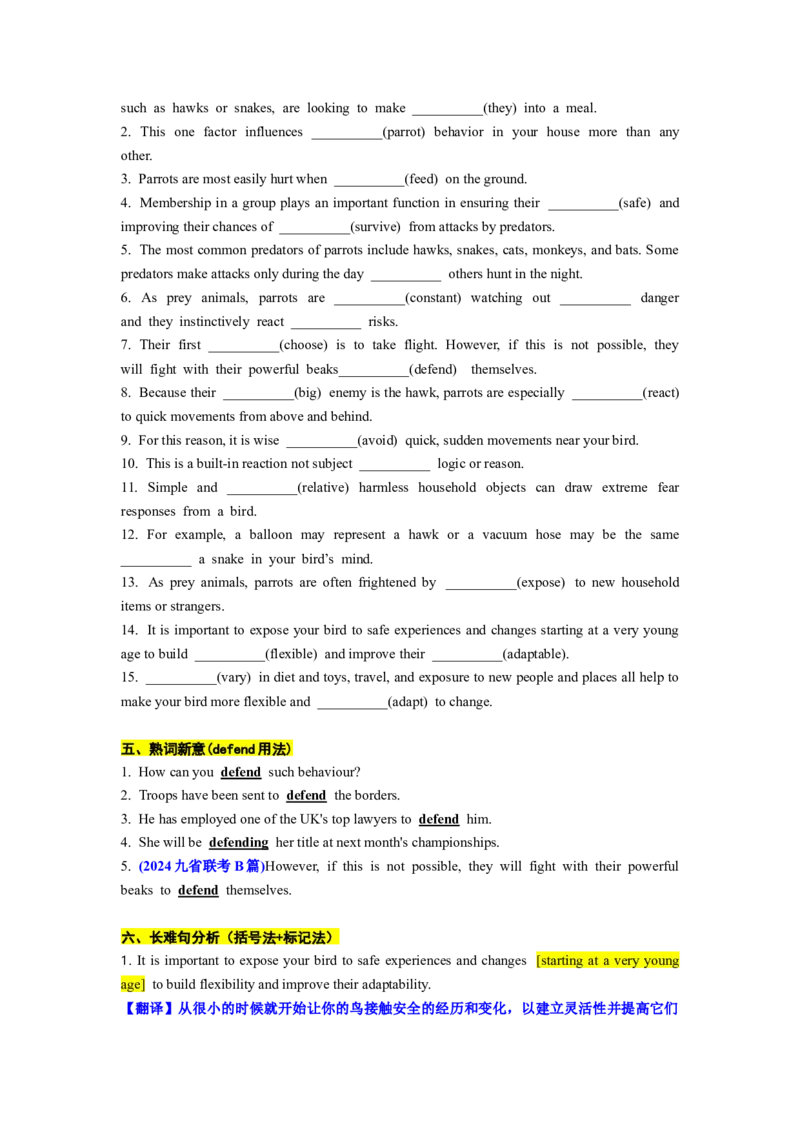
四、单句填空(核心考点习题化)
1. Parrots are prey animals, __________ means that other predators (捕食者) in the wild,such as hawks or snakes, are looking to make __________(they) into a meal.
2. This one factor influences __________(parrot) behavior in your house more than any
other.
3. Parrots are most easily hurt when __________(feed) on the ground.
4. Membership in a group plays an important function in ensuring their __________(safe) and
improving their chances of __________(survive) from attacks by predators.
5. The most common predators of parrots include hawks, snakes, cats, monkeys, and bats. Some
predators make attacks only during the day __________ others hunt in the night.
6. As prey animals, parrots are __________(constant) watching out __________ danger
and they instinctively react __________ risks.
7. Their first __________(choose) is to take flight. However, if this is not possible, they
will fight with their powerful beaks__________(defend) themselves.
8. Because their __________(big) enemy is the hawk, parrots are especially __________(react)
to quick movements from above and behind.
9. For this reason, it is wise __________(avoid) quick, sudden movements near your bird.
10. This is a built-in reaction not subject __________ logic or reason.
11. Simple and __________(relative) harmless household objects can draw extreme fear
responses from a bird.
12. For example, a balloon may represent a hawk or a vacuum hose may be the same
__________ a snake in your bird’s mind.
13. As prey animals, parrots are often frightened by __________(expose) to new household
items or strangers.
14. It is important to expose your bird to safe experiences and changes starting at a very young
age to build __________(flexible) and improve their __________(adaptable).
15. __________(vary) in diet and toys, travel, and exposure to new people and places all help to
make your bird more flexible and __________(adapt) to change.
五、熟词新意(defend用法)
1. How can you defend such behaviour?
2. Troops have been sent to defend the borders.
3. He has employed one of the UK's top lawyers to defend him.
4. She will be defending her title at next month's championships.
5. (2024九省联考B篇)However, if this is not possible, they will fight with their powerful
beaks to defend themselves.
六、长难句分析(括号法+标记法)
1. It is important to expose your bird to safe experiences and changes [starting at a very young
age] to build flexibility and improve their adaptability.
【翻译】从很小的时候就开始让你的鸟接触安全的经历和变化,以建立灵活性并提高它们的适应性,这一点很重要。
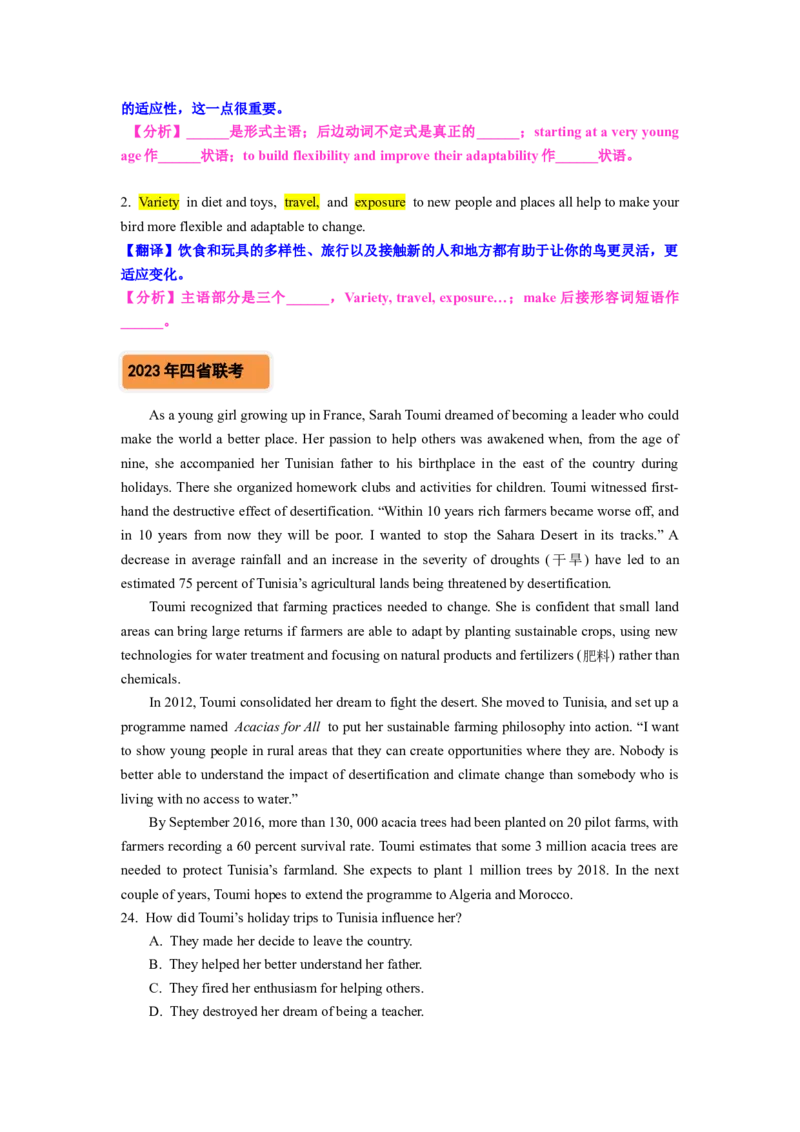
【分析】______是形式主语;后边动词不定式是真正的______;starting at a very young
age作______状语;to build flexibility and improve their adaptability作______状语。
2. Variety in diet and toys, travel, and exposure to new people and places all help to make your
bird more flexible and adaptable to change.
【翻译】饮食和玩具的多样性、旅行以及接触新的人和地方都有助于让你的鸟更灵活,更
适应变化。
【分析】主语部分是三个______,Variety, travel, exposure…;make后接形容词短语作
______。
2023年四省联考
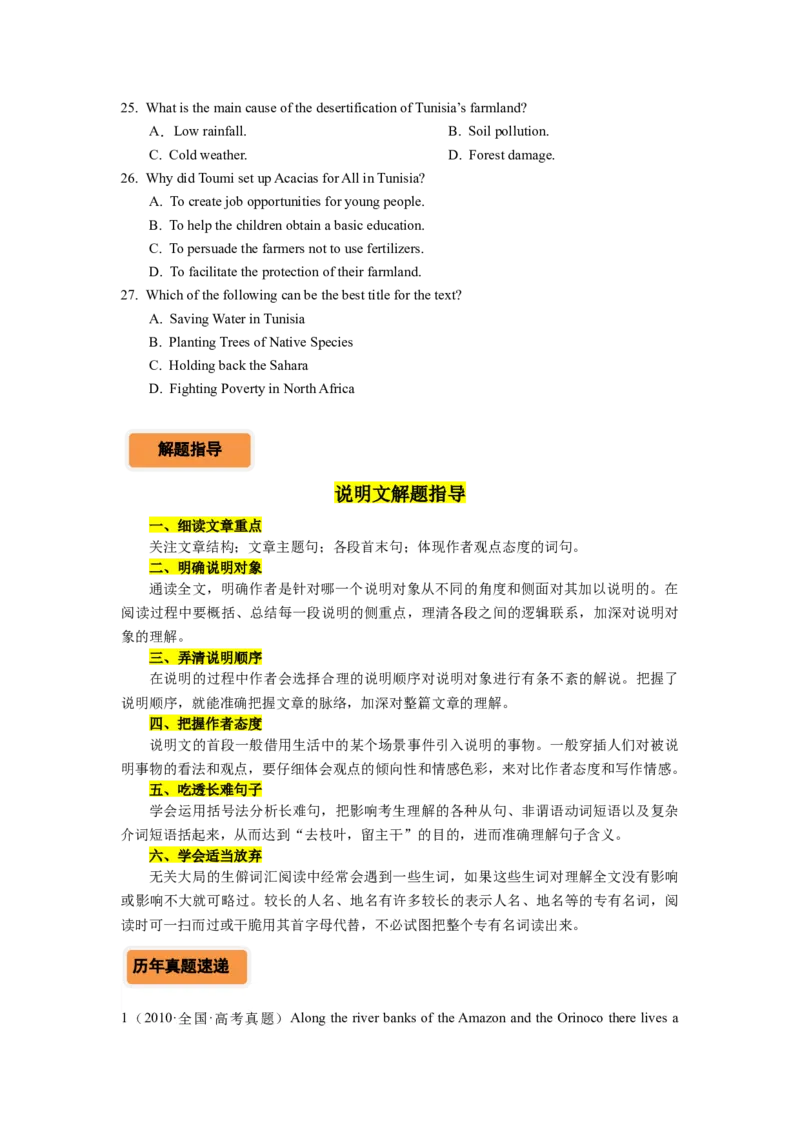
As a young girl growing up in France, Sarah Toumi dreamed of becoming a leader who could
make the world a better place. Her passion to help others was awakened when, from the age of
nine, she accompanied her Tunisian father to his birthplace in the east of the country during
holidays. There she organized homework clubs and activities for children. Toumi witnessed first-
hand the destructive effect of desertification. “Within 10 years rich farmers became worse off, and
in 10 years from now they will be poor. I wanted to stop the Sahara Desert in its tracks.” A
decrease in average rainfall and an increase in the severity of droughts (干旱) have led to an
estimated 75 percent of Tunisia’s agricultural lands being threatened by desertification.
Toumi recognized that farming practices needed to change. She is confident that small land
areas can bring large returns if farmers are able to adapt by planting sustainable crops, using new
technologies for water treatment and focusing on natural products and fertilizers (肥料) rather than
chemicals.
In 2012, Toumi consolidated her dream to fight the desert. She moved to Tunisia, and set up a
programme named Acacias for All to put her sustainable farming philosophy into action. “I want
to show young people in rural areas that they can create opportunities where they are. Nobody is
better able to understand the impact of desertification and climate change than somebody who is
living with no access to water.”
By September 2016, more than 130, 000 acacia trees had been planted on 20 pilot farms, with
farmers recording a 60 percent survival rate. Toumi estimates that some 3 million acacia trees are
needed to protect Tunisia’s farmland. She expects to plant 1 million trees by 2018. In the next
couple of years, Toumi hopes to extend the programme to Algeria and Morocco.
24. How did Toumi’s holiday trips to Tunisia influence her?
A. They made her decide to leave the country.
B. They helped her better understand her father.
C. They fired her enthusiasm for helping others.
D. They destroyed her dream of being a teacher.25. What is the main cause of the desertification of Tunisia’s farmland?
A.Low rainfall. B. Soil pollution.
C. Cold weather. D. Forest damage.
26. Why did Toumi set up Acacias for All in Tunisia?
A. To create job opportunities for young people.
B. To help the children obtain a basic education.
C. To persuade the farmers not to use fertilizers.
D. To facilitate the protection of their farmland.
27. Which of the following can be the best title for the text?
A. Saving Water in Tunisia
B. Planting Trees of Native Species
C. Holding back the Sahara
D. Fighting Poverty in North Africa
解题指导
说明文解题指导
一、细读文章重点
关注文章结构;文章主题句;各段首末句;体现作者观点态度的词句。
二、明确说明对象
通读全文,明确作者是针对哪一个说明对象从不同的角度和侧面对其加以说明的。在
阅读过程中要概括、总结每一段说明的侧重点,理清各段之间的逻辑联系,加深对说明对
象的理解。
三、弄清说明顺序
在说明的过程中作者会选择合理的说明顺序对说明对象进行有条不紊的解说。把握了
说明顺序,就能准确把握文章的脉络,加深对整篇文章的理解。
四、把握作者态度
说明文的首段一般借用生活中的某个场景事件引入说明的事物。一般穿插人们对被说
明事物的看法和观点,要仔细体会观点的倾向性和情感色彩,来对比作者态度和写作情感。
五、吃透长难句子
学会运用括号法分析长难句,把影响考生理解的各种从句、非谓语动词短语以及复杂
介词短语括起来,从而达到“去枝叶,留主干”的目的,进而准确理解句子含义。
六、学会适当放弃
无关大局的生僻词汇阅读中经常会遇到一些生词,如果这些生词对理解全文没有影响
或影响不大就可略过。较长的人名、地名有许多较长的表示人名、地名等的专有名词,阅
读时可一扫而过或干脆用其首字母代替,不必试图把整个专有名词读出来。
历年真题速递
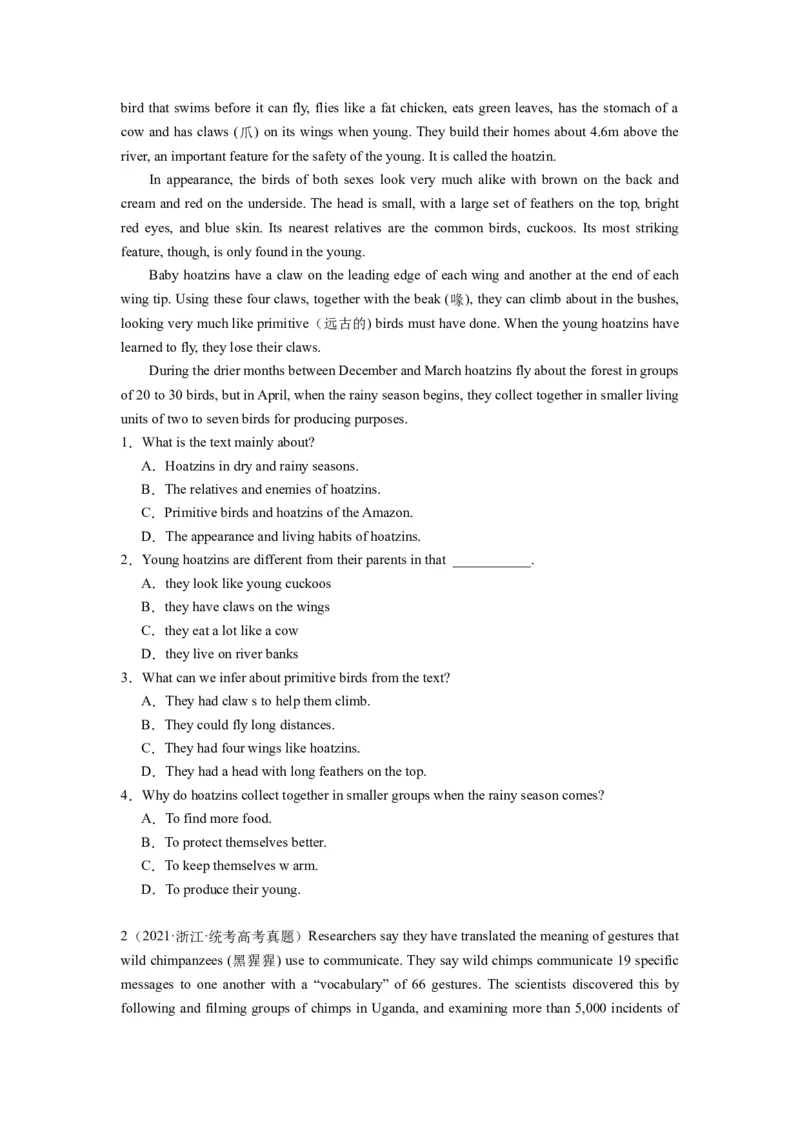
1(2010·全国·高考真题)Along the river banks of the Amazon and the Orinoco there lives abird that swims before it can fly, flies like a fat chicken, eats green leaves, has the stomach of a
cow and has claws (爪) on its wings when young. They build their homes about 4.6m above the
river, an important feature for the safety of the young. It is called the hoatzin.
In appearance, the birds of both sexes look very much alike with brown on the back and
cream and red on the underside. The head is small, with a large set of feathers on the top, bright
red eyes, and blue skin. Its nearest relatives are the common birds, cuckoos. Its most striking
feature, though, is only found in the young.
Baby hoatzins have a claw on the leading edge of each wing and another at the end of each
wing tip. Using these four claws, together with the beak (喙), they can climb about in the bushes,
looking very much like primitive(远古的) birds must have done. When the young hoatzins have
learned to fly, they lose their claws.
During the drier months between December and March hoatzins fly about the forest in groups
of 20 to 30 birds, but in April, when the rainy season begins, they collect together in smaller living
units of two to seven birds for producing purposes.
1.What is the text mainly about?
A.Hoatzins in dry and rainy seasons.
B.The relatives and enemies of hoatzins.
C.Primitive birds and hoatzins of the Amazon.
D.The appearance and living habits of hoatzins.
2.Young hoatzins are different from their parents in that ___________.
A.they look like young cuckoos
B.they have claws on the wings
C.they eat a lot like a cow
D.they live on river banks
3.What can we infer about primitive birds from the text?
A.They had claw s to help them climb.
B.They could fly long distances.
C.They had four wings like hoatzins.
D.They had a head with long feathers on the top.
4.Why do hoatzins collect together in smaller groups when the rainy season comes?
A.To find more food.
B.To protect themselves better.
C.To keep themselves w arm.
D.To produce their young.
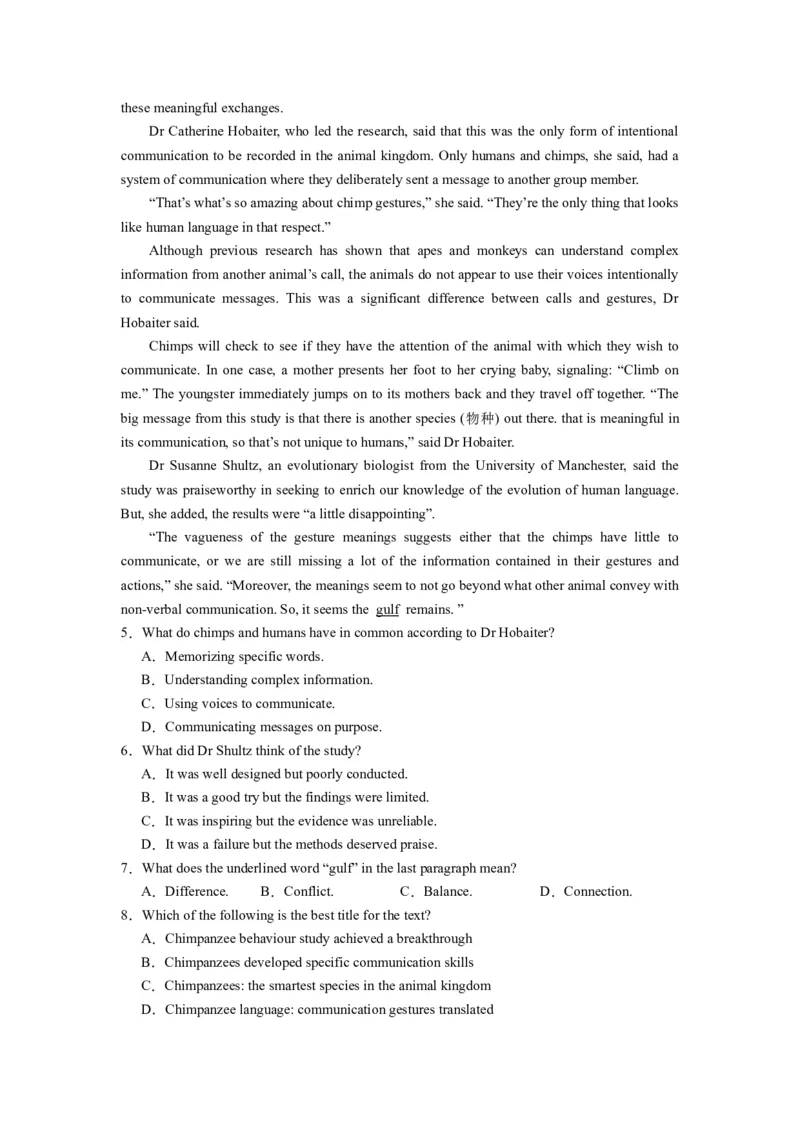
2(2021·浙江·统考高考真题)Researchers say they have translated the meaning of gestures that
wild chimpanzees (黑猩猩) use to communicate. They say wild chimps communicate 19 specific
messages to one another with a “vocabulary” of 66 gestures. The scientists discovered this by
following and filming groups of chimps in Uganda, and examining more than 5,000 incidents ofthese meaningful exchanges.
Dr Catherine Hobaiter, who led the research, said that this was the only form of intentional
communication to be recorded in the animal kingdom. Only humans and chimps, she said, had a
system of communication where they deliberately sent a message to another group member.
“That’s what’s so amazing about chimp gestures,” she said. “They’re the only thing that looks
like human language in that respect.”
Although previous research has shown that apes and monkeys can understand complex
information from another animal’s call, the animals do not appear to use their voices intentionally
to communicate messages. This was a significant difference between calls and gestures, Dr
Hobaiter said.
Chimps will check to see if they have the attention of the animal with which they wish to
communicate. In one case, a mother presents her foot to her crying baby, signaling: “Climb on
me.” The youngster immediately jumps on to its mothers back and they travel off together. “The
big message from this study is that there is another species (物种) out there. that is meaningful in
its communication, so that’s not unique to humans,” said Dr Hobaiter.
Dr Susanne Shultz, an evolutionary biologist from the University of Manchester, said the
study was praiseworthy in seeking to enrich our knowledge of the evolution of human language.
But, she added, the results were “a little disappointing”.
“The vagueness of the gesture meanings suggests either that the chimps have little to
communicate, or we are still missing a lot of the information contained in their gestures and
actions,” she said. “Moreover, the meanings seem to not go beyond what other animal convey with
non-verbal communication. So, it seems the gulf remains. ”
5.What do chimps and humans have in common according to Dr Hobaiter?
A.Memorizing specific words.
B.Understanding complex information.
C.Using voices to communicate.
D.Communicating messages on purpose.
6.What did Dr Shultz think of the study?
A.It was well designed but poorly conducted.
B.It was a good try but the findings were limited.
C.It was inspiring but the evidence was unreliable.
D.It was a failure but the methods deserved praise.
7.What does the underlined word “gulf” in the last paragraph mean?
A.Difference. B.Conflict. C.Balance. D.Connection.
8.Which of the following is the best title for the text?
A.Chimpanzee behaviour study achieved a breakthrough
B.Chimpanzees developed specific communication skills
C.Chimpanzees: the smartest species in the animal kingdom
D.Chimpanzee language: communication gestures translated3(2024上·湖北十堰·高三统考期末)Bringing species like beavers (河狸) back to England is
no longer a priority, the government said on Friday to criticism from wildlife groups.
A recent report shows that one in six UK species are at risk of extinction. In September more
than 60 conservation organisations reported a significant decline in species due to expansions in
farming and the effects of climate change. In recent years, animals and plants have been
reintroduced by charities as part of efforts to restore the country’s reduced biodiversity.
Despite the government allowing this, the Environment, Food and Rural Affairs Committee
concluded in July that there was an absence of long-term plans on how to manage this. In
response, the government has now said that the ”reintroduction of species is not a priority“.
The government said it was focused on increasing biodiversity through habitat restoration.
The government’s environment department has come under scrutiny(详细审查) for not doing
more to prevent sewage dumping and other forms of pollution in England’s waterways.
Sir Robert Goodwill, chair of the Committee, said he was disappointed with the government
response. Bringing back extinct species is a controversial issue-although farmers and landowners
appear broadly supportive, there are risks of reintroducing new species, and without clear
guidance, problems could arise.
A recent study showed that river barriers similar to those built by beavers can protect
communities at risk of flooding. But there have also been cases documented in Europe where
beavers have built their dams in places that have damaged crops and changed rivers.
Joan Edwards, director of Policy & Public Affairs at The Wildlife Trusts said,
”Reintroducing wildlife must be part of the UK government’s arsenal (武器) for tackling nature
loss and climate change-it is astonishing there is no strategy for doing so.
“The return of wild beavers can help to recreate lost wetlands, with a knock-on effect that
benefits other wildlife including insects, invertebrates and birds. Beavers also slow the flow of
water, which can reduce flood risks to towns and villages, ”she said.
9.Where is the text probably taken from?
A.A study. B.A diary. C.A guide. D.A report.
10.How did the UK government plan to increase biodiversity?
A.By expanding farming. B.By offering guidance.
C.By restoring habitat. D.By developing strategy.
11.What did Joan Edwards think of reintroduction of wildlife?
A.It was beneficial. B.It was controversial.
C.It was messy. D.It was costly.
12.What is the text mainly about?
A.The advantages of reintroducing wildlife.
B.The responses to a government statement.
C.The effects of climate change on farming.
D.The approaches to increasing biodiversity.4(2023·全国·统考高考真题)Grizzly bears, which may grow to about 2.5 m long and weigh
over 400 kg, occupy a conflicted corner of the American psyche — we revere (敬畏) them even as
they give us frightening dreams. Ask the tourists from around the world that flood into
Yellowstone National Park what they most hope to see, and their answer is often the same: a
grizzly bear.
“Grizzly bears are re-occupying large areas of their former range,” says bear biologist Chris
Servheen. As grizzly bears expand their range into places where they haven’t been seen in a
century or more, they’re increasingly being sighted by humans.
The western half of the US was full of grizzlies when Europeans came, with a rough number
of 50,000 or more living alongside Native Americans. By the early 1970s, after centuries of cruel
and continuous hunting by settlers, 600 to 800 grizzlies remained on a mere 2 percent of their
former range in the Northern Rockies. In 1975, grizzlies were listed under the Endangered Species
Act.
Today, there are about 2,000 or more grizzly bears in the US. Their recovery has been so
successful that the US Fish and Wildlife Service has twice attempted to delist grizzlies, which
would loosen legal protections and allow them to be hunted. Both efforts were overturned due to
lawsuits from conservation groups. For now, grizzlies remain listed.
Obviously, if precautions (预防) aren’t taken, grizzlies can become troublesome, sometimes
killing farm animals or walking through yards in search of food. If people remove food and
attractants from their yards and campsites, grizzlies will typically pass by without trouble. Putting
electric fencing around chicken houses and other farm animal quarters is also highly effective at
getting grizzlies away. “Our hope is to have a clean, attractant-free place where bears can pass
through without learning bad habits,” says James Jonkel, longtime biologist who manages bears in
and around Missoula.
13.How do Americans look at grizzlies?
A.They cause mixed feelings in people.
B.They should be kept in national parks.
C.They are of high scientific value.
D.They are a symbol of American culture.
14.What has helped the increase of the grizzly population?
A.The European settlers’ behavior.
B.The expansion of bears’ range.
C.The protection by law since 1975.
D.The support of Native Americans.
15.What has stopped the U. S. Fish and Wildlife Service from delisting grizzlies?
A.The opposition of conservation groups.
B.The successful comeback of grizzlies.
C.The voice of the biologists.D.The local farmers’ advocates.
16.What can be inferred from the last paragraph?
A.Food should be provided for grizzlies.
B.People can live in harmony with grizzlies.
C.A special path should be built for grizzlies.
D.Technology can be introduced to protect grizzlies.
5(2023上·广西南宁·高三南宁三中校考阶段练习)The average bear, it seems, is getting over
smarter. First, it turned out that at least one can use a comb. Now it appears that some can count
too.
Jennifer Vonk, of Oakland University, in Michigan, and Michael Beran, from Georgia State
University, set three American black bears the task of distinguishing between numerically larger
and smaller groups of dots (点) on a computer screen. In return for a food reward one bear, Brutus,
would touch the more heavily dotted pattern with his nose. The others, Bella and Dusty, would
touch the screen with their claws (爪子).
As the researchers report in Animal Behavior, the bears did best with patterns where the
coloured dots did not move and where more of them also took up a larger coloured area. This
could be explained by the bears’ distinguishing the different areas of colour rather than truly
counting the dots. However, the three bears managed to pick out the bigger number of dots even in
pairs of patterns where fewer dots took up a larger area.
Moving patterns, where each dot followed its own path around the screen, were more of a
challenge. But Brutus, at least, was not defeated. He seemed to be counting mobile dots even
when the scientists tried to mislead him by moving the total coloured area of the dots at the same
time.
It is not entirely surprising that bears should have a high degree of intelligence. They face a
lot of challenges when trying to get food. They are, however, always alone, and so do not have the
complex social systems that contribute to animal smarts. Perhaps, then, their maths skill developed
because they cannot count on their friends for help.
17.What task did the scientists set for the three bears?
A.Distinguishing different dot patterns.
B.Figuring out different colours of dots.
C.Putting the dots into differently coloured groups.
D.Picking out the group with a larger number of acts.
18.For the bears, the task was easier when ______.
A.the coloured dots were moving slowly
B.the dot patterns were regular in shape
C.the dots followed a path on the screen
D.more dots covered a larger coloured area
19.Why do the bears have high degree or intelligence?A.They have to survive by themselves.
B.They learn skills from other friends.
C.They feed on a diverse range of food.
D.They have complex social networks.
20.What can be a suitable title for the text?
A.Bears Taught to Distinguish Colours
B.Three Bears Learned How to Count
C.New Evidence of Bear Intelligence Found
D.The Smartest American Black Bear Brutus
6(2021·全国·高考真题)Port Lympne Reserve, which runs a breeding (繁育) programme, has
welcomed the arrival of a rare black rhino calf (犀牛幼崽). When the tiny creature arrived on
January 31, she became the 40th black rhino to be born at the reserve. And officials at Port
Lympne were delighted with the new arrival, especially as black rhinos are known for being
difficult to breed in captivity (圈养).
Paul Beer, head of rhino section at Port Lympne, said: “Obviously we’re all absolutely
delighted to welcome another calf to our black rhino family. She’s healthy, strong and already
eager to play and explore. Her mother, Solio, is a first-time mum and she is doing a fantastic job.
It’s still a little too cold for them to go out into the open, but as soon as the weather warms up, I
have no doubt that the little one will be out and about exploring and playing every day.”
The adorable female calf is the second black rhino born this year at the reserve, but it is too
early to tell if the calves will make good candidates to be returned to protected areas of the wild.
The first rhino to be born at Port Lympne arrived on January 5 to first-time mother Kisima and
weighed about 32kg. His mother, grandmother and great grandmother were all born at the reserve
and still live there.
According to the World Wildlife Fund, the global black rhino population has dropped as low
as 5500, giving the rhinos a “critically endangered” status.
21.Which of the following best describes the breeding programme?
A.Costly. B.Controversial.
C.Ambitious. D.Successful.
22.What does Paul Beer say about the new-born rhino?
A.She loves staying with her mother.
B.She dislikes outdoor activities.
C.She is in good condition
D.She is sensitive to heat.
23.What similar experience do Solio and Kisima have?
A.They had their first born in January.
B.They enjoyed exploring new places
C.They lived with their grandmothers.D.They were brought to the reserve young
24.What can be inferred about Porn Lympne Reserve?
A.The rhino section will be open to the public.
B.It aims to control the number of the animals.
C.It will continue to work with the World Wildlife Fund.
D.Some of its rhinos may be sent to the protected wild areas.
6(2021·全国·高考真题)When the explorers first set foot upon the continent of North America,
the skies and lands were alive with an astonishing variety of wildlife. Native Americans had taken
care of these precious natural resources wisely. Unfortunately, it took the explorers and the settlers
who followed only a few decades to decimate a large part of these resources. Millions of
waterfowl (水禽) were killed at the hands of market hunters and a handful of overly ambitious
sportsmen. Millions of acres of wetlands were dried to feed and house the ever-increasing
populations, greatly reducing waterfowl habitat.
In 1934, with the passage of the Migratory Bird Hunting Stamp Act (Act), an increasingly
concerned nation took firm action to stop the destruction of migratory (迁徙的) waterfowl and the
wetlands so vital to their survival. Under this Act, all waterfowl hunters 16 years of age and over
must annually purchase and carry a Federal Duck Stamp. The very first Federal Duck Stamp was
designed by J.N. “Ding” Darling, a political cartoonist from Des Moines, lowa, who at that time
was appointed by President Franklin Roosevelt as Director of the Bureau of Biological Survey.
Hunters willingly pay the stamp price to ensure the survival of our natural resources.
About 98 cents of every duck stamp dollar goes directly into the Migratory Bird
Conservation Fund to purchase wetlands and wildlife habitat for inclusion into the National
Wildlife Refuge System — a fact that ensures this land will be protected and available for all
generations to come. Since 1934, better than half a billion dollars has gone into that Fund to
purchase more than 5 million acres of habitat. Little wonder the Federal Duck Stamp Program has
been called one of the most successful conservation programs ever initiated.
25.What was a cause of the waterfowl population decline in North America?
A.Loss of wetlands.
B.Popularity of water sports.
C.Pollution of rivers.
D.Arrival of other wild animals.
26.What does the underlined word “decimate” mean in the first paragraph?
A.Acquire. B.Export.
C.Destroy. D.Distribute.
27.What is a direct result of the Act passed in 1934?
A.The stamp price has gone down.
B.The migratory birds have flown away.
C.The hunters have stopped hunting.D.The government has collected money.
28.Which of the following is a suitable title for the text?
A.The Federal Duck Stamp Story
B.The National Wildlife Refuge System
C.The Benefits of Saving Waterfowl
D.The History of Migratory Bird Hunting
名校好题速递
8(2024 上·重庆·高二重庆南开中学校考期末)Many guests have had the pleasure of
observing the magnificent cheetahs (猎豹) that find shelter on the Tswalu Private Reserve, but
they might not be aware of the work to make these wild cats feel comfortable in the presence of
humans. As a conservation photographer, I spent a day with conservator Clement Motau to
understand what it takes to habituate cheetahs.
Habituating wildlife is an on-going process —slowly getting wild animals used to the
presence of vehicles and people. Animals like cheetahs receive regular visits from the wildlife
conservation team. That way they learn that in this privately protected area, humans pose no threat
to.
Clement, now 29 years old, spent his early childhood in Middelburg, but he would go to the
rural area every chance he got, including most school holidays. “I enjoyed climbing mountains
and being outdoors. I always knew I wanted to work with wild animals.” He decided to study
nature conservation rather than become a tour guide because “dealing with people all the time is
not my strongest point.” After three years of studies, he came to Tswalu in 2016 and was offered a
position on the conservation team. Though one day rarely looks the same as another, with tasks
ranging from collaring wild dogs to mending fences, the chance to spend time with cheetahs is an
experience he particularly enjoys.
An hour after we first spotted Artemis, Clement's favorite cheetah, she is still on the move,
clearly looking for a meal. She is a beautiful animal, and I am in no hurry to leave. Though she
seems unbothered by our presence, we don't want to negatively impact her chances of feeding.
Wildlife tourism is an essential conservation tool, both to raise awareness and to pay for all the
costs. But the wellbeing of the animals always comes first. “She is very obliging with us today,”
he says. “So relaxed. The guides and our guests will love her. She'll be a future star.”
29.What do we know about habituating wild animals?
A.It's a process to get wild animals used to humans.
B.It's done by paying random visits to wild animals.
C.Wild animals will benefit from this practice.
D.Such practice is limited to private reserves.
30.Why did Clement choose to become a nature conservator?
A.Because he liked a job with various tasks...B.Because being a tour guide was not his dream.
C.Because he enjoyed spending time with wild animals.
D.Because working with animals was his strongest point.
31.What does the underlined sentence in the last paragraph probably mean?
A.Artemis is responding to our request.
B.Artemis is warning us to keep a distance.
C.Artemis is inviting us to enter her territory.
D.Artemis is feeling comfortable with our presence.
32.What is the text mainly about?
A.A remarkable cheetah conservator.
B.A reserve for cheetahs.
C.A cheetah conservation program.
D.A tour with a cheetah conservator.
9(2024 上·山东德州·高三统考期末)A sleeping animal cannot look for food or flee from
danger. But the fact that sleep is widespread among animals shows its restorative powers are
essential. Some animals, though, try to have their cake and eat it. Dolphins and ducks sleep with
half their brains, leaving the other half on guard. A paper in Science by Dr Le reports another
innovative workaround. Chinstrap penguins take their sleep in thousands of naps, tiny micro-
sleeps-or at least when they are nesting.
Chinstraps sleep with either their whole brain or just one half. Data confirmed they sleep in
the ocean or on land. Ducks sleep in long periods, while the penguins nod of for several seconds at
a time, hundreds of times an hour. The naps average 4 seconds in length; 72% lasted less than 10
seconds. Micro-sleeps aren’t unknown. Exhausted humans, like jet-lagged (倒时差) tourists and
parents of newborn babies, can experience them. Totaling the duration, the researchers concluded
Chinstraps get around 12 hours of sleep daily.
Two explanations are given for Chinstraps’ sleep pattern. The first is to do with external
threats. Penguins hatch eggs alone while their partners are away seeking for food. Colonies (领地)
are threatened by big birds that’ll steal unattended eggs. Broken sleep is a clever strategy of
getting some shut-eye during long egg-guarding periods.
Penguins with nests near the edge of the colony are at greater risk than those in the centre, but
enjoy more extended naps. The second is threats from within, as penguin colonies are noisy,
crowded places. They steal nesting materials from careless neighbors, so penguins in the crime-
ridden centre find it harder to sleep than those in the safer suburbs.
Choosing between those theories requires more research. Dr Lee said, “Nor can we measure
how restorative such naps are. Chinstraps are evidently able to hatch their young under such
conditions, which suggests they’re getting something from their constant nodding-off. So, humans
nurturing their newborns should take heart.”
33.Why do dolphins and ducks sleep with only one side of their brains?A.To enjoy their cake.
B.To establish a nice nest.
C.To be watchful during naps.
D.To obtain high-quality sleep.
34.What does Chinstraps’ sleep pattern feature?
A.Engaging in numerous naps a day.
B.Sleeping nowhere beyond the ocean.
C.Ranging from 4 seconds to 12 hours.
D.Always sleeping with the entire brain.
35.What can be inferred from the explanations in paragraph 3?
A.Penguins live safely in natural colonies.
B.Penguins encounter a variety of challenges.
C.Penguins hatch their eggs away from colony.
D.Penguins at the core of the colony sleep longer.
36.What does Dr Lee think of Chinstraps’ micro-naps?
A.Their duration is hard to detect.
B.They distract the restorative effects.
C.Adopting them aids human newborns.
D.Taking this sleep mode favors penguins.
10(2024 上·四川达州·高二统考期末)“THEY’RE ALL IN TROUBLE,” says Kenyan
ecologist Paula Kahumbu. “All elephants are in major, major trouble.”
Populations of the three species have declined: savanna ( 热带草原) elephants forest
elephants and the smaller-eared Asian elephants. And we’re to blame. We’ve expanded (扩张) into
elephant territory, building homes and roads, cutting down forests and planting crops. Besides,
with the rise of poaching (偷猎), the number of elephants has decreased and became dangerously
low in the past five decades.
“Poaching doesn’t just destroy animals,” says Kahumbu, “it gradually weakens society.”
That’s why her organization monitored poaching cases in Kenyan courts, launched a campaign
called Hands Off Our Elephants and educated children on the value of wildlife. Kahumbu’s goal
is noble and urgent: to change “the whole national awareness about conservation.”
Now, she’s taking her message to an international stage with Secrets of the Elephants, a four-
part series on National Geographic. It explores the hidden lives of elephants in four habitats —
Asia, plus African forests, deserts, and savannas — as well as the people who are racing to save
the animals.
“We kind of know what they need, but we aren’t always generous enough.” Secrets of the
Elephants, she hopes, will familiarize people with the wildlife that lives among them.
While making the series, the difficult situation of some elephants shocked her. “You look at
their faces and they look so sad,” she says. She particularly noticed this in Asia, where Asianelephants and people live in increasingly close distance.
“Despite decades of research into African elephants, much research into Asian elephants has
fallen behind — which is why our programme in the following pages will focus on this species,”
she adds.
37.What does paragraph 2 focus on?
A.The features of three species of elephants.
B.The different situations of the elephants.
C.The causes for the decrease of the elephants.
D.The impact of Human behaviors on elephants.
38.What did Kahumbu do?
A.She monitored poachers hunting elephants.
B.She filmed a feature about elephants.
C.She started a national wildlife protection movement.
D.She changed people’s awareness of wildlife protection.
39.What can be inferred about the Asian elephants?
A.They like to get close to humans.
B.They are almost ignored by experts.
C.They remain mysterious to humans.
D.They are gradually losing their habitat.
40.What can be a suitable title for the text?
A.Take action: Stop Poaching
B.Film series: Secrets of the Elephants
C.Kahumbu: A Brave Kenyan Ecologist
D.Endangered: Three Species of Elephants
11(2024 上·四川成都·高二统考期末)There are some fascinating data about the world’s
forests! About 30 percent of the earth’s land is covered in forests, and 300 million people call
forests home. A further 1.6billion people rely on forests to survive.
Now, keeping these numbers in mind, consider this fact: the world loses over 32million acres
of forest each year. When forests disappear, we not only miss out on all the ways they make us
healthier, we also lose an essential resource. This is why preserving forests, and nature, is more
important than ever. The key is to connect with nature, for example, forest bathing.
In the way that forest bathing requires, we start to experience and appreciate all its beauty and
benefits, through involvement with nature by using all our senses. Many governments, businesses,
and institutions have realized the importance of this and have created plans to deepen mutually
beneficial relationships between people and nature. It’s not just wild forests that need attention,
urban parks and forests are equally important. Despite losing trees to real estate ( 房地产)
developments and road construction, many cities have found creative ways to introduce more trees
and forests. In Paris, for example, a nineteenth century railway was turned into a park thatstretches nearly three miles. There’s one more thing that’s essential to the protection of forests-
helping children connect with nature. Not only is this good for their overall well-being, but
studies show that children who spend time in nature become adults who understand the
importance of protection. Around the world, many schools have started using parks and green
spaces as classrooms. Measures like these will help ensure that future generations can also enjoy
the benefits of forests.
41.Why does the author list the data of the world’s forests in Paragraph 1?
A.To highlight their significance.
B.To illustrate their economic value.
C.To present their unique features.
D.To introduce their basic information.
42.What does the underlined word “this” in Paragraph 3 refer to?
A.Close contact with nature.
B.Great loss of forest.
C.Harmonious relationship with nature.
D.Creative plans for development.
43.What influence does interacting with nature have on children?
A.It benefits their future career.
B.It improves their academic performances.
C.It provides chances for having fun in forests.
D.It raises their life-long environment awareness.
44.Which column of a newspaper is this text probably taken from?
A.Sports. B.Tourism.
C.Environment. D.Agriculture.
12(2024上·山东济南·高三统考期末)In the animal world, speed is king. Fast animals have a
leg up in outrunning other animals, which puts them high on the food chain. It would seem that all
animals would go for speed, but then there’s the sloth (树懒). While a lion can go from 0 to 60
miles an hour in only five seconds, it takes a sloth all day to cover no more than 50 meters.
Sloths live entirely in trees on a diet of leaves. And for this, they are extremely rare. While
most of the land world is covered in trees, there are very few vertebrates (脊椎动物) that call the
tree home. The aim of a 2016 study, says Jonathan Pauli, a University of Alabama professor of
forest and wildlife ecology, was to help uncover why sloths are indeed so unique. “Among
vertebrates, this is the rarest of lifestyles”, says Pauli. “When you picture animals that live off
plant leaves, they are almost all big-things like deer. What’s super interesting about sloths is that
they can’t be big.”
For their research, Pauli and his Wisconsin team studied wild sloths at a field site. When the
researchers measured the energy use of sloths, they found a wildly low burning of as little as 110
calories of energy a day. And for this, they take the cake: it is the lowest measured energeticoutput for any mammal (哺乳动物).
“The measurement was intended to find out what it cost sloths to live over a day,”says Pauli,
who adds that a diet of little but leaves lacks nutritional value and the animal’s small size doesn’t
allow for overeating-so sloths need to find ways to make the most of their diets, which means
using tiny amounts of energy, dramatic control of body temperature and living at an extremely
slow pace.
Their reward? A wonderfully widespread ecological system to call their own, one slow inch
at a time.
45.Why is a lion mentioned in Paragraph 1?
A.To admire lions’ speed.
B.To state sloths’ weakness.
C.To confirm lions’ lead position.
D.To highlight sloths’ uniqueness.
46.What is the 2016 study mainly about?
A.The lifestyle of sloths.
B.The diet of vertebrates.
C.The species of rare animals.
D.The energy use of creatures.
47.What does the underlined part “take the cake” in Paragraph 3 probably mean?
A.Break down. B.Keep on. C.Stand out. D.Grow up.
48.What can be inferred about sloths from Pauli’s words?
A.Their slow pace is a balanced choice.
B.They are in face of possible extinction.
C.Their slow pace decides a tiny appetite.
D.They suffer a lot against natural enemies.
14(2024上·陕西榆林·高一统考期末)Wood stork, which was on the brink of extinction in
1984, has recovered enough in Florida and other Southern states. The American wildlife officials
proposed removing the waterfowl (水禽) from the endangered species list.
This symbolic species, which is the only stork native to North America, has rebounded (反
弹) because dedicated partners in the southeast have worked tirelessly to restore ecosystems that
support it. In addition, the wood stork has increased its range in coastal areas. The birds have
adapted to new nesting areas, tripling the number of colonies across their range from 29 to 99 in
recent years.
Credit goes mainly to the wildlife protections provided by the Endangered Species Act(ESA),
which can impose restrictions on a variety of activities in areas where such species are, located,
such as development, mining and oil drilling. The act saved the wood stork and it helped; preserve
and rebuild vital habitats throughout the southeast, which has improved water quality and
benefited countless other species who call the area home. The Endangered Species Act has saved99% of the species that have been on the list since 1973, with 100 types of plants and animals
delisted because they have recovered or are at least stable.
The U.S. Fish and Wildlife Service said that restoration of the wood stork’s habitat, especially
in the Florida Everglades and adjacent Big Cypress National Preserve, led to a, sharp increase in
breeding pairs. Those numbers had shrunk to just 5,000 pairs in 1984, whereas there are more than
10,000 pairs today.
“The proposed delisting of the wood stork is a significant milestone and a remarkable,
achievement of the hard work by federal agencies, state and local governments, tribes,
conservation organizations, and private citizens in protecting and restoring our most at-risk
species,” Interior Secretary Deb Haaland said.
If the wood stork is delisted, officials said it would remain protected by other laws including
the Migratory Bird Treaty Act and the Clean Water Act. A monitoring plan, would be put in place
for at least five years to ensure the stork population remains stable.
49.What can be inferred about the wood stork from the text?
A.Its population is increasing.
B.It has already died out.
C.It is widely distributed worldwide.
D.It is the most endangered species.
50.What contribute mostly to recovering the population of the wood stork?
A.Charity organizations.
B.Federal agencies.
C.Protections of the ESA.
D.Local companies.
51.What is Deb Haaland’s attitude to the delisting of the wood stork?
A.Negative. B.Doubtful.
C.Indifferent. D.Positive.
52.What is the best title of the text?
A.Effect of the Big Cypress National Preserve Counts
B.Saving of the Endangered Wood Stork Progresses
C.Efforts to Restore the Wildlife Habitat Pay Off
D.Protection of American Native Species Works
14(2024上·重庆·高一重庆十八中校联考期末)Pocket gophers (囊鼠) spend most of their
lifetime alone, digging underground. Although they’re common across North and Central
American grasslands, you’re unlikely to see one—their presence is usually only noticeable thanks
to the piles of sandy soil they leave behind reaching more than 500 feet, usually about 50 inches
below the ground.
Gophers were thought to feed themselves mainly by eating the roots (根) they meet while
building new tunnel systems. Yet, digging tunnels is energetically costly and researchers show thatonly eating the roots just doesn’t make up for the energy spent.
To understand how else these animals get enough roots to survive, Francis Putz, a professor
at the University of Florida, and the student researcher Veronica Selden looked at the behavior of
gophers in northern Florida. They observed that, in the dark and wet tunnels the gophers had dug,
new and soft roots grew fast.
The gophers seem to be actively looking after the roots like farmers, the scientists say. They
create the perfect wet environment for roots and causing soil aeration (透气) by loosening the
ground in which plants grow in the first place. Importantly, the gophers spread waste throughout
the tunnels, which makes the roots grow more successfully. This is rather unlike other gopher
species, which tend to have fixed waste areas.
The study found that the gophers’ daily harvest of root crops can supply from 21 to 62
percent of their calorie needs. “They have these long tunnels that cannot be explained,” Putz says.
So why do it? If it’s not to “farm food”, he says, “I can’t think of any other reason.”
But some researchers wonder if “farming” is a right term for the gophers’ activities. “To
describe the activity as farming seems to be overstated,” says scientist Kimberly Asmus Hersey. “I
don’t see this as all that different from many other plant and plant-eating animal relationships.”
53.What can be learned about the species of gophers?
A.They exist all across America.
B.They are highly social animals.
C.They mainly live underground.
D.They dig tunnels 500 feet deep.
54.What do the researchers say about the roots gophers meet while digging?
A.They are as hard as rocks for gophers to eat.
B.They make digging work more effort-taking.
C.They are perfect home locations for gophers.
D.They cannot meet gophers’ needs for energy.
55.What did the researchers find out about the gophers in Florida?
A.They prefer building tunnels in dry conditions.
B.They try to make their tunnels as deep as possible.
C.They create a perfect environment for roots to grow.
D.They usually have fixed waste areas in their tunnels
56.What is Hersey’s attitude to Putz’s conclusion on gophers’ behavior?
A.She disagrees with it.
B.She is curious about it.
C.She thinks highly of it.
D.She is unconcerned about it.
15(2024上·河南南阳·高二南阳市第五中学校校联考期末)A new study discussed the high
probability that no chicks had survived from four of the five monitored (监测) emperor penguingroups in Antarctic. The satellite images showed the loss of sea ice at breeding (繁殖) sites, well
before chicks would have developed waterproof feathers.
Emperor penguins are dependent on stable sea ice where they lay eggs in Antarctic winter
from May to June. Eggs hatch after 65 days, but chicks do not grow feathers until summer,
between December and January. So emperor penguins are highly sensitive in a warming climate.
Since 2016, Antarctica has seen the four years with the lowest sea ice extents in the 45-year
satellite record, with the two lowest years in 2021/22 and 2022/23. Between 2018 and 2022, 30%
of the 62 known emperor penguin groups in Antarctica were affected by part or total sea ice loss.
Although it is difficult to immediately link specific extreme seasons to climate change, a longer-
term decline (减少) in sea ice extent is expected from the current generation of climate models. At
the beginning of December 2022, the Antarctic sea ice extent matched the previous all-time low
set in 2021. The most extreme loss was seen in the central and eastern Bellingshausen Sea region,
west of the Antarctic Peninsula where there was a 100% loss of sea ice in November 2022.
Current scientific evidence suggests that extreme sea ice loss events like this will become more
frequent and widespread.
Emperor penguin populations have never been subject to extensive hunting, home loss,
overfishing or other local anthropogenic (人为的) interactions in the modern era. Unusually for a
vertebrate (脊椎的) species, climate change is considered the only major factor influencing their
long-term population change. Recent efforts to predict emperor penguin population trends from
forecasts of sea ice loss have painted a dark picture, showing that if present rates of warming
persist, over 90% of the groups will be extinct by the end of this century.
It is another warning sign for humanity that we cannot continue down this path, and that
politicians must act to minimise the effect of climate change. There is no time left.
57.When do emperor penguins usually hatch?
A.From May to June. B.From July to August.
C.In the months of summer. D.In the months of autumn.
58.What does paragraph 3 mainly talk about?
A.Antarctic sea ice loss is becoming more and more serious.
B.Antarctic sea ice loss is obviously affected by climate change.
C.Antarctic sea ice loss reached 100% in November 2022.
D.Antarctic sea ice loss makes emperor penguins in danger.
59.Which has the main effect on Emperor penguin populations?
A.Hunting. B.Home loss.
C.Overfishing. D.Climate change.
60.What is the best title for the text?
A.Sea Ice Loss and Ecosystem Destruction
B.Understanding Emperor Penguin Groups
C.The Effect of Loss of Sea Ice on Penguins
D.The Importance of Stopping Climate Change