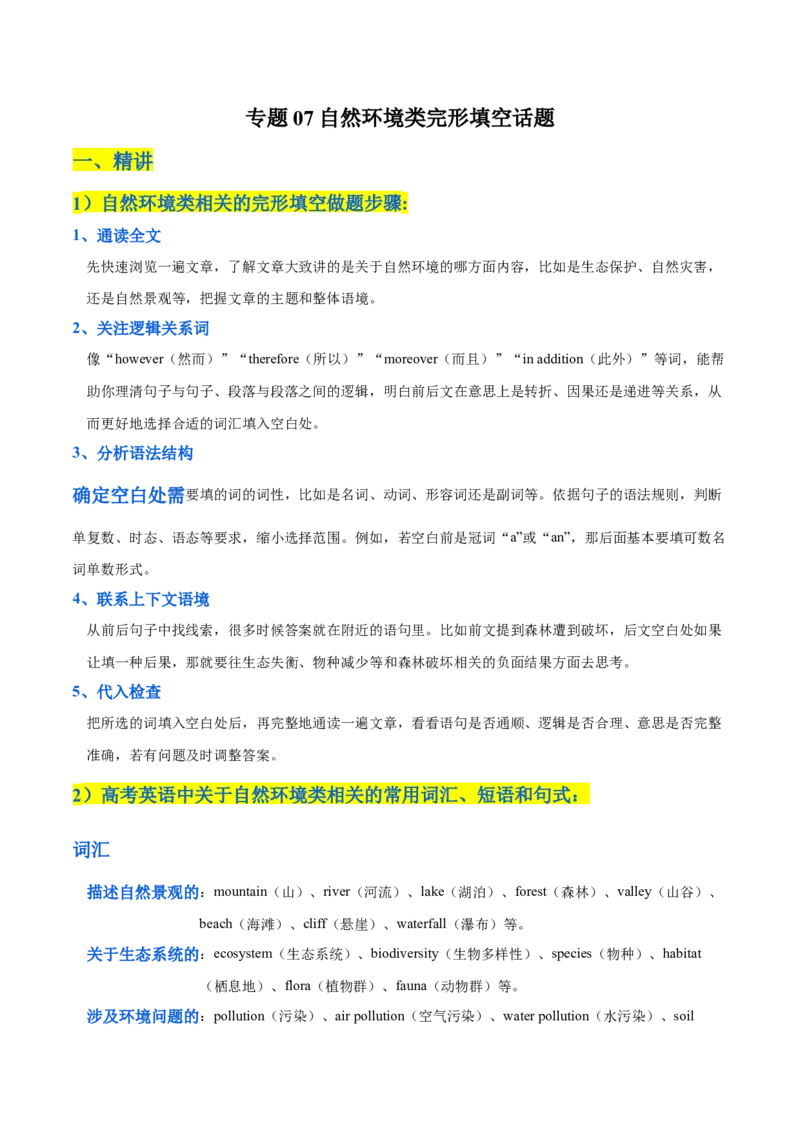
专题 07 自然环境类完形填空话题
一、精讲
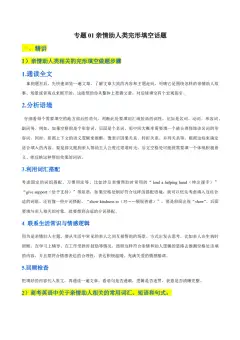
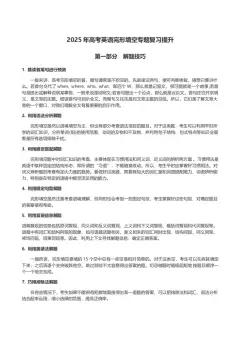
1)自然环境类相关的完形填空做题步骤:
1、通读全文
先快速浏览一遍文章,了解文章大致讲的是关于自然环境的哪方面内容,比如是生态保护、自然灾害,
还是自然景观等,把握文章的主题和整体语境。
2、关注逻辑关系词
像“however(然而)”“therefore(所以)”“moreover(而且)”“in addition(此外)”等词,能帮
助你理清句子与句子、段落与段落之间的逻辑,明白前后文在意思上是转折、因果还是递进等关系,从
而更好地选择合适的词汇填入空白处。
3、分析语法结构
确定空白处需要填的词的词性,比如是名词、动词、形容词还是副词等。依据句子的语法规则,判断
单复数、时态、语态等要求,缩小选择范围。例如,若空白前是冠词“a”或“an”,那后面基本要填可数名
词单数形式。
4、联系上下文语境
从前后句子中找线索,很多时候答案就在附近的语句里。比如前文提到森林遭到破坏,后文空白处如果
让填一种后果,那就要往生态失衡、物种减少等和森林破坏相关的负面结果方面去思考。
5、代入检查
把所选的词填入空白处后,再完整地通读一遍文章,看看语句是否通顺、逻辑是否合理、意思是否完整
准确,若有问题及时调整答案。
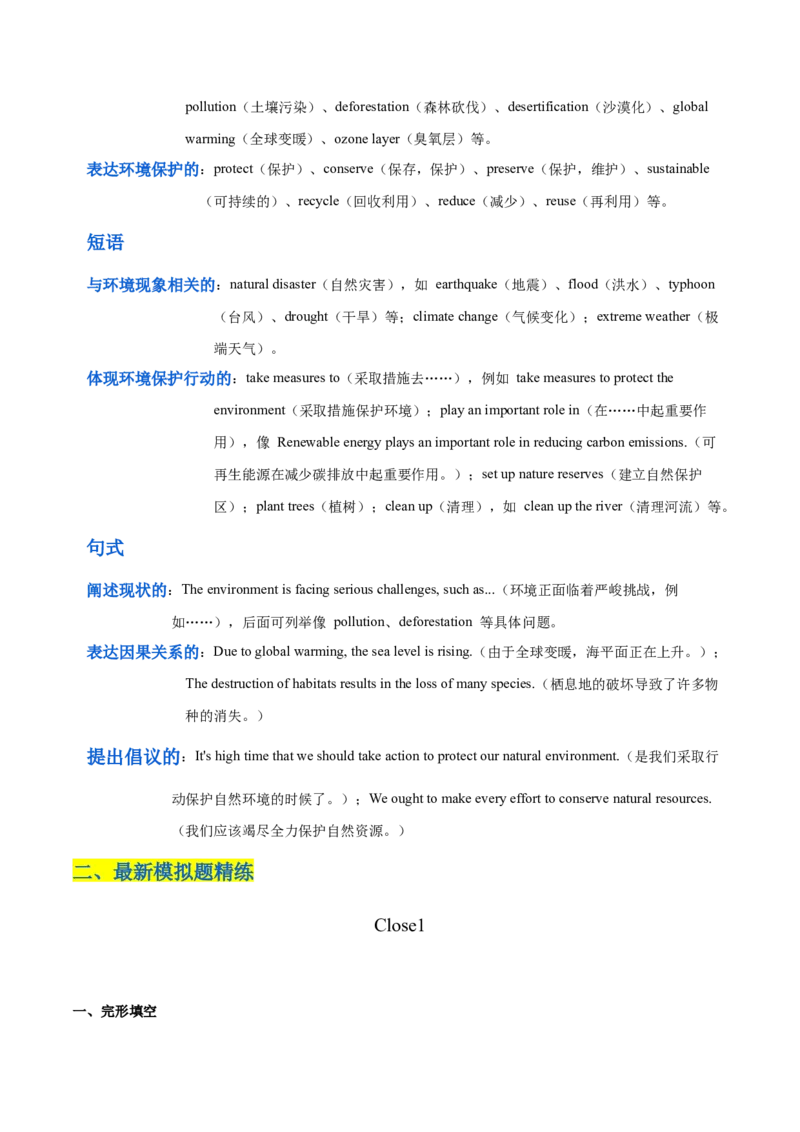
2)高考英语中关于自然环境类相关的常用词汇、短语和句式:
词汇
描述自然景观的:mountain(山)、river(河流)、lake(湖泊)、forest(森林)、valley(山谷)、
beach(海滩)、cliff(悬崖)、waterfall(瀑布)等。
关于生态系统的:ecosystem(生态系统)、biodiversity(生物多样性)、species(物种)、habitat
(栖息地)、flora(植物群)、fauna(动物群)等。
涉及环境问题的:pollution(污染)、air pollution(空气污染)、water pollution(水污染)、soilpollution(土壤污染)、deforestation(森林砍伐)、desertification(沙漠化)、global
warming(全球变暖)、ozone layer(臭氧层)等。
表达环境保护的:protect(保护)、conserve(保存,保护)、preserve(保护,维护)、sustainable
(可持续的)、recycle(回收利用)、reduce(减少)、reuse(再利用)等。
短语
与环境现象相关的:natural disaster(自然灾害),如 earthquake(地震)、flood(洪水)、typhoon
(台风)、drought(干旱)等;climate change(气候变化);extreme weather(极
端天气)。
体现环境保护行动的:take measures to(采取措施去……),例如 take measures to protect the
environment(采取措施保护环境);play an important role in(在……中起重要作
用),像 Renewable energy plays an important role in reducing carbon emissions.(可
再生能源在减少碳排放中起重要作用。);set up nature reserves(建立自然保护
区);plant trees(植树);clean up(清理),如 clean up the river(清理河流)等。
句式
阐述现状的:The environment is facing serious challenges, such as...(环境正面临着严峻挑战,例
如……),后面可列举像 pollution、deforestation 等具体问题。
表达因果关系的:Due to global warming, the sea level is rising.(由于全球变暖,海平面正在上升。);
The destruction of habitats results in the loss of many species.(栖息地的破坏导致了许多物
种的消失。)
提出倡议的:It's high time that we should take action to protect our natural environment.(是我们采取行
动保护自然环境的时候了。);We ought to make every effort to conserve natural resources.
(我们应该竭尽全力保护自然资源。)
二、最新模拟题精练
Close1
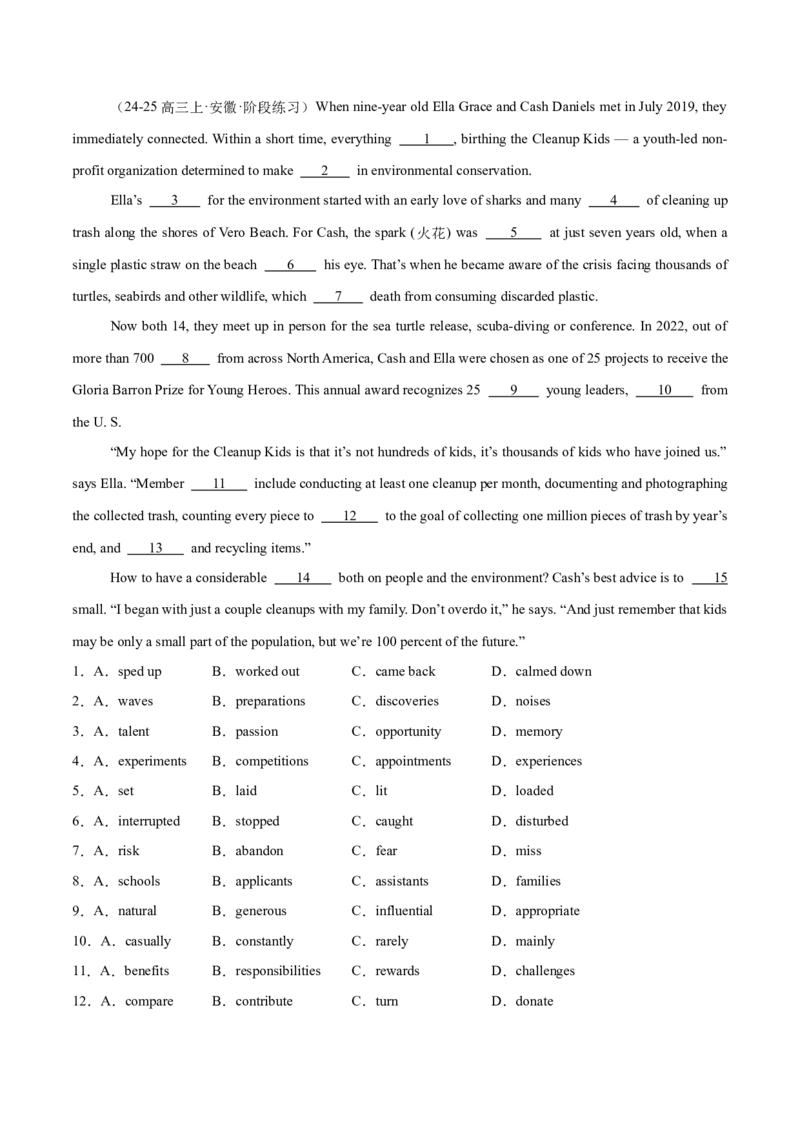
一、完形填空(24-25高三上·安徽·阶段练习)When nine-year old Ella Grace and Cash Daniels met in July 2019, they
immediately connected. Within a short time, everything 1 , birthing the Cleanup Kids — a youth-led non-
profit organization determined to make 2 in environmental conservation.
Ella’s 3 for the environment started with an early love of sharks and many 4 of cleaning up
trash along the shores of Vero Beach. For Cash, the spark (火花) was 5 at just seven years old, when a
single plastic straw on the beach 6 his eye. That’s when he became aware of the crisis facing thousands of
turtles, seabirds and other wildlife, which 7 death from consuming discarded plastic.
Now both 14, they meet up in person for the sea turtle release, scuba-diving or conference. In 2022, out of
more than 700 8 from across North America, Cash and Ella were chosen as one of 25 projects to receive the
Gloria Barron Prize for Young Heroes. This annual award recognizes 25 9 young leaders, 10 from
the U. S.
“My hope for the Cleanup Kids is that it’s not hundreds of kids, it’s thousands of kids who have joined us.”
says Ella. “Member 11 include conducting at least one cleanup per month, documenting and photographing
the collected trash, counting every piece to 12 to the goal of collecting one million pieces of trash by year’s
end, and 13 and recycling items.”
How to have a considerable 14 both on people and the environment? Cash’s best advice is to 15
small. “I began with just a couple cleanups with my family. Don’t overdo it,” he says. “And just remember that kids
may be only a small part of the population, but we’re 100 percent of the future.”
1.A.sped up B.worked out C.came back D.calmed down
2.A.waves B.preparations C.discoveries D.noises
3.A.talent B.passion C.opportunity D.memory
4.A.experiments B.competitions C.appointments D.experiences
5.A.set B.laid C.lit D.loaded
6.A.interrupted B.stopped C.caught D.disturbed
7.A.risk B.abandon C.fear D.miss
8.A.schools B.applicants C.assistants D.families
9.A.natural B.generous C.influential D.appropriate
10.A.casually B.constantly C.rarely D.mainly
11.A.benefits B.responsibilities C.rewards D.challenges
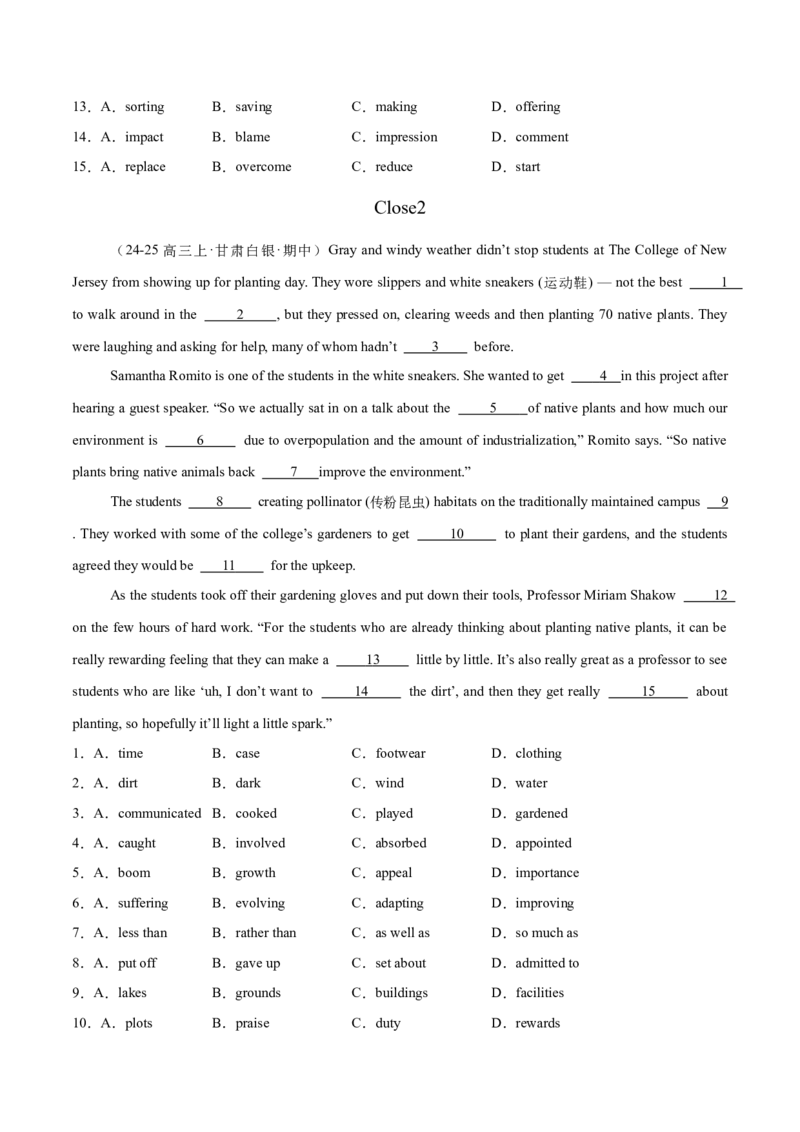
12.A.compare B.contribute C.turn D.donate13.A.sorting B.saving C.making D.offering
14.A.impact B.blame C.impression D.comment
15.A.replace B.overcome C.reduce D.start
Close2
(24-25 高三上·甘肃白银·期中)Gray and windy weather didn’t stop students at The College of New
Jersey from showing up for planting day. They wore slippers and white sneakers (运动鞋) — not the best 1
to walk around in the 2 , but they pressed on, clearing weeds and then planting 70 native plants. They
were laughing and asking for help, many of whom hadn’t 3 before.
Samantha Romito is one of the students in the white sneakers. She wanted to get 4 in this project after
hearing a guest speaker. “So we actually sat in on a talk about the 5 of native plants and how much our
environment is 6 due to overpopulation and the amount of industrialization,” Romito says. “So native
plants bring native animals back 7 improve the environment.”
The students 8 creating pollinator (传粉昆虫) habitats on the traditionally maintained campus 9
. They worked with some of the college’s gardeners to get 1 0 to plant their gardens, and the students
agreed they would be 1 1 for the upkeep.
As the students took off their gardening gloves and put down their tools, Professor Miriam Shakow 1 2
on the few hours of hard work. “For the students who are already thinking about planting native plants, it can be
really rewarding feeling that they can make a 1 3 little by little. It’s also really great as a professor to see
students who are like ‘uh, I don’t want to 1 4 the dirt’, and then they get really 1 5 about
planting, so hopefully it’ll light a little spark.”
1.A.time B.case C.footwear D.clothing
2.A.dirt B.dark C.wind D.water
3.A.communicated B.cooked C.played D.gardened
4.A.caught B.involved C.absorbed D.appointed
5.A.boom B.growth C.appeal D.importance
6.A.suffering B.evolving C.adapting D.improving
7.A.less than B.rather than C.as well as D.so much as
8.A.put off B.gave up C.set about D.admitted to
9.A.lakes B.grounds C.buildings D.facilities
10.A.plots B.praise C.duty D.rewards11.A.suitable B.thankful C.beneficial D.responsible
12.A.focused B.insisted C.reflected D.depended
13.A.choice B.change C.comment D.concept
14.A.wash B.touch C.cover D.place
15.A.excited B.careful C.worried D.nervous
Close3
(24-25高三上·广东·阶段练习)I’d been exploring the 40-hectare woods around our cottage my whole
life and I knew the way well. So it was a 1 when I found myself lost there.
One dull cold February afternoon, I had a sudden 2 to hike the hill with my two daughters. Putting
on our snowshoes, we immediately 3 northwestward. While making our way up the hill, my daughters
stopped occasionally to investigate unknown plants and to look at the abandoned deer beds... These really made
their 4 .
As the shadows started to 5 , we moved further up. Soon, weariness (疲劳) began to 6
enthusiasm. We decided to return. Instead of backtracking over our 7 route, I chose to walk down the steep
side of the hill, 8 my general sense that ahead of us lay the stream that would guide us to the road. But as
the terrain (地形) leveled out, I had my first major moment of 9 : Where was the stream? Were we off
course?
I instinctively pulled out my phone to get my location, but it 1 0 in my hand in the cold air.
1 1 , I started feeling a bit panicky. However, I quickly 1 2 myself, reassuring my daughters to
continue walking. Focusing on the landmarks, I spotted a familiar tree and eventually 1 3 the road.
That winter’s day taught me a valuable lesson about habitual reliance on technology. If my phone had
1 4 then, I might have directly followed the GPS, ignoring the old 1 5 of depending on surroundings
and life skills.
1.A.challenge B.shock C.reward D.reminder
2.A.discovery B.response C.worry D.urge
3.A.escaped B.drove C.headed D.looked
4.A.reputation B.dream C.day D.way
5.A.lengthen B.swing C.emerge D.fade
6.A.fuel B.witness C.overlook D.outpace
7.A.original B.rough C.offbeat D.roundabout8.A.appreciating B.trusting C.visualizing D.assessing
9.A.curiosity B.comparison C.doubt D.anticipation
10.A.died B.slipped C.flashed D.rang
11.A.Reportedly B.Admittedly C.Seemingly D.Surprisingly
12.A.exposed B.gathered C.defended D.behaved
13.A.got off B.laid down C.came across D.made out
14.A.worked B.remained C.changed D.overheated
15.A.theory B.standard C.practice D.routine
Close4
(24-25高三上·山西忻州·阶段练习)Children are not often invited to address the United Nations General
Assembly (联合国大会). But there stood Felix Finkbeiner, with a(n) 1 question about climate change.
“We children know that adults are 2 the climate challenges and that they have the solutions,” he
said. “But we don’t understand why there is so little 3 .”
Before his speech, Finkbeiner had been 4 a remarkable environmental campaign for four years and
it has since 5 into a global network of children working to 6 the earth’s warming by
reforesting the planet. Most of them are between the ages 9 and 12.
The reforesting effort could be traced to a fourth grade school 7 in Finkbeiner’s hometown. The
topic was climate change.
In his report, Finkbeiner 8 to plant one million trees in Germany. Finkbeiner’s teacher was
deeply impressed with the idea and asked him to 9 his report to other students and the headmaster.
Of course, no one 1 0 anything to come out of it. But two months later, he planted his first
tree, an unimpressive apple tree, near the entrance to his school. His campaign was a 1 1 and had a
dramatic close. By the time he delivered his 1 2 at the UN in New York in 2011, at the age of 13,
Germany had planted its millionth tree.
“If I had known then how much international media coverage that apple tree would 1 3 ,” he
says now, a little 1 4 , “I would have insisted my mother buy a more 1 5 one.”
1.A.easy B.political C.serious D.awkward
2.A.aware of B.addicted to C.afraid of D.curious about
3.A.profit B.action C.water D.luck
4.A.avoiding B.planning C.advertising D.leading5.A.expanded B.broken C.run D.looked
6.A.record B.know C.slow D.measure
7.A.play B.assignment C.accident D.object
8.A.declined B.pretended C.started D.promised
9.A.mail B.donate C.present D.sell
10.A.wanted B.expected C.asked D.needed
11.A.disaster B.joke C.show D.hit
12.A.speech B.tree C.evidence D.package
13.A.receive B.miss C.know D.grow
14.A.forgetfully B.unwillingly C.apologetically D.regretfully
15.A.typical B.impressive C.genuine D.important
Close5
(24-25高三上·河北邯郸·阶段练习)Every morning at 4:30 a.m., Yang He, a 64-year-old photographer,
wakes up in the 1 hours and drives to the banks of the Yangtze River in Yichang, Hubei province. Upon
arrival, he patiently waits there for finless porpoises (江豚) to come out from the water, hoping to 2 their
beauty.
As a devoted 3 of finless porpoises, Yang has taken more than 100,000 vivid photos of the 4
species in the past six years. “I know this group of finless porpoises very 5 . They are just like my
children,” he says.
Yangtze finless porpoises are so connected to the Yangtze River that any change in the health of it can
support or threaten their 6 . “I first 7 a finless porpoise as a teenager when there were far fewer
boats on the River. I would 8 see them pursuing boats as they made their way down the river,” Yang says,
adding that as human activity increased, they become rare.
Over the past few decades, however, significant measures have been 9 to change the fate of this
species. In 2017, Yang was fortunate enough to spot a finless porpoise after a long 1 0 . Over the last five
years alone, the population of Yangtze finless porpoises has increased to 1,249, marking a 1 1 of 23.4
percent. Today, groups of these creatures can once again be 1 2 leaping above the water’s surface.
“I will continue to take more beautiful photos of them as long as I am able to 1 3 a camera and
keep a(n) 1 4 on them,” Yang says, adding that he will make it his life’s mission to 1 5 these
remarkable creatures.1.A.office B.small C.big D.rush
2.A.reflect B.inquire C.photograph D.justify
3.A.admirer B.specialist C.keeper D.subscriber
4.A.motivated B.endangered C.occupied D.caged
5.A.further B.slightly C.little D.well
6.A.comprehension B.weight C.survival D.vision
7.A.pictured B.trained C.reserved D.encountered
8.A.frequently B.rarely C.occasionally D.never
9.A.called off B.carried out C.put aside D.got across
10.A.reference B.inquiry C.gap D.inference
11.A.decline B.tendency C.share D.rise
12.A.justified B.expected C.observed D.dominated
13.A.hold B.abandon C.deserve D.polish
14.A.pace B.ear C.secret D.eye
15.A.advocate B.document C.transform D.donate
Close6
(24-25 高三上·内蒙古锡林郭勒盟·期中)Botanical illustrator Zeng Xiaolian has dedicated over six
decades of his life to painting biodiversity, 1 the rich ness and beauty of nature.
“Imagino Nature Before and After Photography”, an exhibition held at the Shanghai Center of Photography,
2 some of Zeng’s, illustrations of flowers and birds. Most of the paintings were 3 after 2020. “I do
hope people from Shanghai can feel the breath of nature from Yunnan,” says Zeng, a Yunnan native.
“I was really 4 when I saw his works. They are an expression of truth, full of details, and are more
experimental than many contemporary artists’ works, though completed recently,” says the Center director, Karen
Smith.
Before the invention of photography in 1839, botanical illustrators documented the shapes and habitats of
plants based on their own observations, memories and quick sketches. The paintings of birds featured in this 5
are all created from photos authorized by Zeng’s friends. For each piece, he had to 6 ornithologists (鸟
类学家) to figure out its category, Chinese and scientific name, as well as its 7 and living habits.
Accordingly, he sketches the backgrounds.
“Biological illustration is an art of function. It’s not just fine art. People need to identify the species from thepaintings,” Zeng said. Zeng began his career by studying 8 botanical pictures in Curtis’s Botanical
Magazine. He later developed his own style. He 9 traditional Qtinese ink-wash painting techniques with
oils, watercolor and colored pencils.
“Some artists would call it a doodle,” Zeng jokes. But he warns beginners not to copy him. “It’s my way of
being 10 . I don’t care about rules,” says Zeng. “After years of practice, you learn there are no fixed
methods, which is 11 the way of life.”
Time is ticking away, but there is so much to paint. Zeng works eight to nine hours a day and 12
to complete his pet project in the next three years:100 ecological landscapes. This series will be much larger in
scale, each of the paintings 13 1.6 meters in height and characterized by different ecosystems. Instead
of the usual oil, he is 14 traditional Chinese painting. “I will 15 painting till the day I
die,” says Zeng.
1.A.guessing B.visiting C.appointing D.conveying
2.A.explains B.minds C.misses D.features
3.A.read B.accomplished C.preserved D.abandoned
4.A.touched B.depressed C.ashamed D.amused
5.A.house B.museum C.show D.stadium
6.A.instruct B.consult C.guide D.respect
7.A.wings B.hobbies C.advantages D.habitats
8.A.familiar B.conventional C.courageous D.imaginary
9.A.compared B.swapped C.combined D.replaced
10.A.efficient B.relaxed C.absent D.random
11.A.rarely B.hardly C.exactly D.carefully
12.A.hesitates B.signals C.evaluates D.hopes
13.A.measuring B.weighing C.lengthening D.deepening
14.A.loaning B.scattering C.purchasing D.employing
15.A.take on B.keep on C.catch on D.reflect on