Lesson 8 Chinese idioms汉语习语
There exist in both spoken and written Chinese a great number of idioms also called chengyu, literally “set
language” or “set expressions”, which are translated in English as “idiom”.
These may be general in nature or they may reflect famous events or stories from Chinese history, or they may
be direct quotations from famous works of Chinese literature. The great majority of Chinese idioms are composed
of four characters, which usually –though not always- can be parsed in groups of two.
Chinese idioms are usually composed in Classical Chinese and thus typically have a different grammatical
structure from that of Modern Chinese. In their speech and writing, Chinese people make frequent use of idioms,
since these often sum up briefly a meaning which it would otherwise take many words to express.
Contextually appropriate use of idioms tends to impress hearers as to
the educational level and eloquence of the speaker. Since idioms are
frequently used in formal speech and higher-level written materials, such as
newspaper editorials and commentaries, they serve as a useful medium for
helping learners move up on the proficiency ladder.
Familiarity with idioms can also be helpful for the non-native in
gaining credibility in Chinese society. Indeed, almost nothing impresses a Chinese person more than a properly
used idiom coming from the mouth of a foreigner.
There are a great number of idioms in Chinese, with certain dictionaries of idioms including well over 20,000
entries. All Chinese people know idioms, even though the total number known by any one individual will depend
on her or his education, linguistic talent, general intelligence, etc…
Idioms are such an important part of Chinese popular culture that there even exists a game called chengyu
jielong that involves someone calling out an idiom, with someone else then being supposed to think of another
idiom to link up with the first one, so that the last character of the first idiom is the same as the first character of the
second idiom, and so forth.
According to the Chinese search engine Baidu, the longest idiom chain ever created was all of 1,788 idioms
long!
For the learner of Chinese as a second/foreign language, idioms are not so easy to understand, since the
functional meaning of idioms is often different from the surface meaning and may, to quote an English idiom, be
“greater than the sum of its parts”.This is because Chinese idioms frequently involve literary allusions, extended meanings, and metaphors.
For example, consider the following idiom: 雪中送炭 xuě zhōng sòng tàn
This could be translated literally as “in the snow to deliver charcoal”; however, the actual meaning usually has
nothing at all to do with “snow” or “charcoal”, but rather involves the rendering of aid to someone at time of need.
Idioms have a long history in Chinese, with some having existed for well over 2,000 years. Indeed, the
grammatical structure of most Chinese idioms is that of Classical Chinese.
There are three common origins of idioms: ancient fables and historical tales; Buddhist and Confucian classics
as well as other works of ancient Chinese literature; and habitual collocations of terms that gradually came to be
stable and used in a certain way, even though their exact origin is not known today. To use a Chinese idiom, we
could say there are in the Chinese language as many idioms “as there are hairs on an ox”.(598 words)
◆Helper:
quotation [kwəuˈteiʃən] 引用,引证 compose [kəmˈpəuz] 组成,构成 contextually [kən'tekstʃʊəl] 文脉上的,前后关系的
eloquence [ˈeləkwəns] 口才,辩才 proficiency [prəˈfiʃənsi] 熟练,精通 familiarity [fəˌmɪlɪ'ærətɪ] 熟悉, 通晓 credibility
[ˌkredəˈbɪləti] 可靠性,可信性 allusion [əˈlu:ʒn] 影射, 典故 metaphor [ˈmetəfə(r)] 隐喻,暗喻 habitual [həˈbɪtʃu:əl] 习惯
的
◆Chinese Brief Introduction:
成语(chengyu, idioms, set phrase)是我国汉字语言词汇中一部分定型的词组或短句。成语有固定的结
构形式和固定的说法,表示一定的意义,在语句中是作为一个整体来应用的。成语有很大一部分是从古代
相承沿用下来的,在用词方面往往不同于现代汉语它代表了一个故事或者典故。 成语又是一种现成的
话,跟习用语、谚语相近,但是也略有区别。成语大多出自书面,属于文语性质的,意思精辟,往往隐含
于字面意义之中,不是其构成成分意义的简单相加,。其次在语言形式上,成语几乎都是约定俗成的四字
结构,字面不能随意更换;成语在语言表达中有生动简洁、 形象鲜明的作用。
◆Exercise:
I. Questions:
1. What is the main character of Chengyu?
2. What does it depend on whether you can use Chengyu properly or not?
3. Why does the writer say idioms work as a useful medium for helping learners move up on the proficiency
ladder?
4. What is chengyu jielong? Give an example please.
5. List three common origins of idioms.6. Explain the follow Cehnyu in English.
衣食住行 yī shí zhù xíng
II. Written work
1. 假如你的美国朋友正在学习汉语,他写来电子邮件,向你了解中国成语"掩耳盗铃"的故 事,请你根据以
下的写作内容,用英语写出这个故事。
写作内容:
(1) 盗铃的念头:深夜里偷窃邻居家挂在屋外的大铃铛;
(2)钟鸣, 掩耳; (3)盗铃:被捉; (4)寓意.
写作要求:只能使用 5 个句子表达全部的内容.
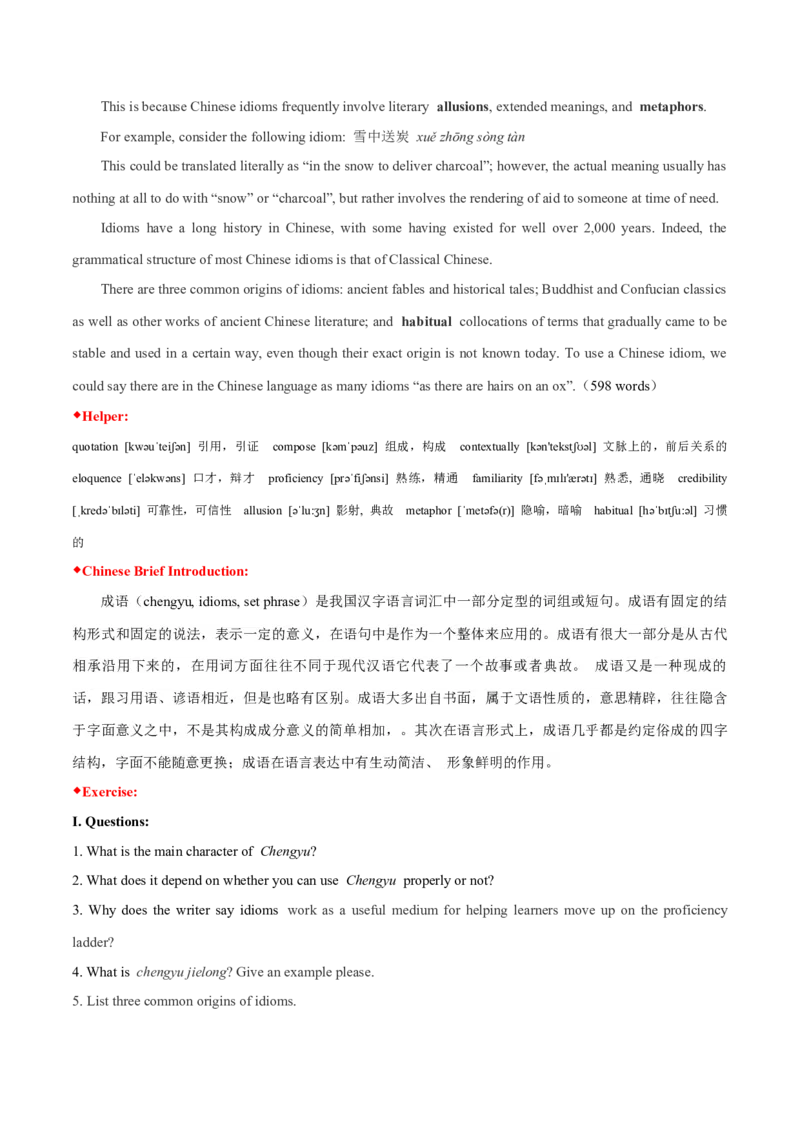
2. 根据图画和所给单词,将成语“郑人买履”译为英文小故事。词数在60—80之间。
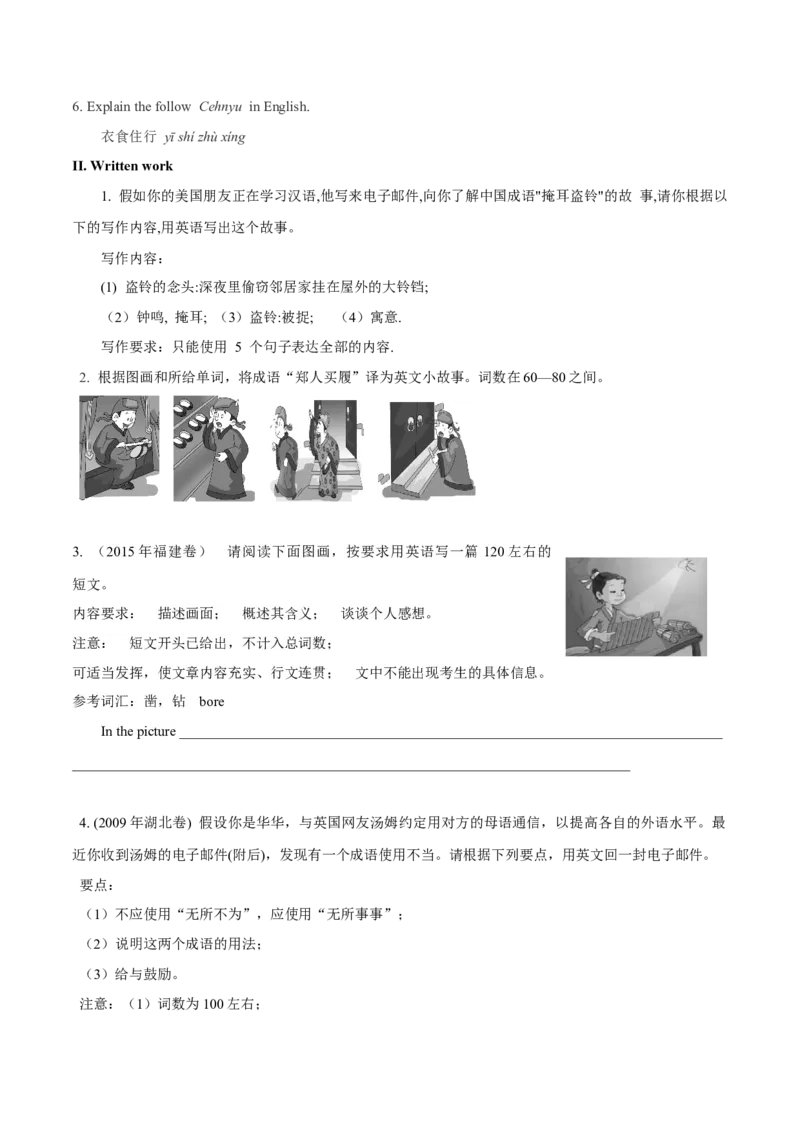
3. (2015年福建卷) 请阅读下面图画,按要求用英语写一篇 120左右的
短文。
内容要求: 描述画面; 概述其含义; 谈谈个人感想。
注意: 短文开头已给出,不计入总词数;
可适当发挥,使文章内容充实、行文连贯; 文中不能出现考生的具体信息。
参考词汇:凿,钻 bore
In the picture _____________________________________________________________________________
_______________________________________________________________________________
4. (2009年湖北卷) 假设你是华华,与英国网友汤姆约定用对方的母语通信,以提高各自的外语水平。最
近你收到汤姆的电子邮件(附后),发现有一个成语使用不当。请根据下列要点,用英文回一封电子邮件。
要点:
(1)不应使用“无所不为”,应使用“无所事事”;
(2)说明这两个成语的用法;
(3)给与鼓励。
注意:(1)词数为100左右;(2)参考释义:
无所不为 — do all kinds of bad things
无所事事 — have nothing to do;
(3)除以上两个成语外,邮件中不得使用其它汉字或拼音;
(4)电子邮件的开头和结尾已为你写好(不计入你所写词数)。
附(汤姆的邮件):
华华,你好!
近几天在忙什么事?有什么有意思的事吗?我们的学校放假了,所以这几天在家无所不
为,饱食终日,只好上网发伊妹儿。没意思。我决定找份工作,做个自食其力的人。祝好!
汤姆
Hi Tom,
Nice to read your e-mail today. I notice you’ve begun to use Chinese idioms and used most of them correctly.
…
Hope you’ll find a job soon.
Huahua
5. (2017年3月天津卷) 假设你是晨光中学的学生李津。你的美国笔友Chris正在学习汉语,他得知“中国
诗词大会”在CCTV 播出,非常感兴趣,便写信给你,希望你介绍相关情况及更多了解中国文化的途径。
请根据以下提示给他写一封回信。
(1) 简单介绍“中国诗词大会”引起的反响;
(2) 介绍了解中国文化的途径 (如阅读相关书籍、利用媒体资源等);
(3) 表达对Chris 学习中国文化的祝愿。
注意:
(1) 词数不少于100;
(2) 可适当加入细节,使内容充实、行文连贯;
(3) 开头和结尾已给出,不计入总词数。
参考词汇:
中国诗词大会Chinese Poetry Competition
Dear Chris,
......
Yours,Li Jin
◆More idioms:
1. 小菜一碟 a piece of cake
2. 见异思迁Grass is always greener on the other side of the fence.
3. 适者生存survival of the fittest
4. 物以类聚 Birds of a feather flock together.
5. 英雄所见略同Great minds think alike.
6. 为虎作伥 to act as guide to a tiger
7. 孤注一掷 to put all one's egg in one basket
8. 勇者不惧 A brave man will not shrink from dangers.
9. 洗心革面 to turn over a new leaf
10. 活到老学到老 It's never too late to learn./ Live and learn.
11. 按部就班Learn to walk before you run.
12. 以毒攻毒to set a thief to catch a thief
13. 以逸待劳 To wait at ease till the enemy is exhausted.
14. 金科玉律the gold rule
15. 雨后春笋 like bamboo shoots after a spring shower
16. 事实胜于雄辩 Facts are most convincing.
17. 有志者事竟成Where there is a will, there is a way.
18. 有钱能使鬼推磨Money makes the world go around. /Money talks.
19. 有其父必有其子Like father, like son.
20. 江山易改本性难移 a fox may grow gray, but never good(The leopard cannot change his spots;you cannot
make a crab walk straight)
21. 眼见为实To see is to believe. (Seeing is believing.)
22. 同甘共苦to share one's joys and sorrows
23. 未雨绸缪Keep something for a rainy day.
24. 本末倒置Don't put the cart before the horse.
25. 爱屋及乌 Love me, love my dog.
26. 不遗余力 spare no effort; go all out; do one's best
27. 拆东墙补西墙 rob Peter to pay Paul28. 好事不出门恶事传千里 Good news never goes beyond the gate, while bad news spread far and wide.
29. 活到老学到老 One is never too old to learn.
30. 金无足赤人无完人 Gold can't be pure and man can't be perfect.
31. 留得青山在不怕没柴烧 Where there is life, there is hope.
32. 名利双收 gain in both fame and wealth
33. 欲速则不达Haste does not bring success.
34. 巧妇难为无米之炊 If you have no hand you can't make a fist. One can't make bricks without straw.
35. 瑞雪兆丰年 A timely snow promises a good harvest.
36. 世上无难事只要肯攀登 Where there is a will, there is a way.
37. 说曹操,曹操到Talk of the devil and he comes.
38. 物以类聚,人以群分Birds of a feather flock together.
39. 望子成龙hold high hopes for one's child
40. 无风不起浪There are no waves without wind. There's no smoke without fire.
41. 心想事成May all your wish come true
42. 先下手为强catch the ball before the bound
43. 一言既出,驷马难追A real man never goes back on his words.
44. 英雄所见略同Great minds think alike.
45. 左右为难between the devil and the deep blue sea
46. 同舟共济 A common danger causes common action.
47. 知足常乐 A contented mind is a continual / perpetual feast..
48. 吃一堑,长一智A fall into the pit, a gain in your wit.
49. 客随主便 A guest should suit the convenience of the host.
50. 家书抵万金A letter from home is a priceless treasure.
51. 殊途同归All rivers run into the sea.
32. 机不可失,时不再来All time is no time when it is past..
53. 兔子不吃窝边草 The fox preys farthest from his hole.
54. 若要人不知除非己莫为 If you would not be known to do anything, never do it.
55. 前事不忘后事之师 Remember the past and it will guide your future.
56. 以毒攻毒to set a thief to catch a thief
57. 忠言逆耳 Honest advice is unpleasant to the ear
58. 塞翁失马,安知非福Bad luck often brings good luck.59. 班门弄斧 teach fish to swim. 。
60. 亡羊补牢,犹未为晚 It is never too late to mend.
61. 未雨绸缪Keep something for a rainy day.
62. 将计就计Meet plot with plot.
63. 切莫以貌取人Never judge a book by its cover.
64. 不要落井下石Never hit a man when he is down.
65. 无风不起浪No fire without smoke.
66. 教养胜过天性Nurture passes nature.
67. 活到老,学到老One is never too old to learn.
68. 一燕不成夏(一花独放不是春)One swallow does not make a summer.
69. 曾经沧海难为水One who has seen the ocean thinks nothing of mere rivers.
70. 眼不见,心不烦Out of sight, out of mind.
71. 熟能生巧Practice makes perfect.
72. 老马识途Sense comes with age.
73. 趁热打铁Strike while the iron is hot.
74. 人老智多(姜还是老的辣)The older the wiser.
75. 蜡烛不可两头燃(鱼和熊掌不可兼得)You cannot burn the candle at both ends.
76. 有得就有失(事难两全其美)You cannot have your cake and eat it.
77. 事实胜于雄辩Actions speak louder than words.
78. 三思而后行Look before you leap. First think, then act.
79. 时间就是金钱Time is money.
80. 患难见真交A friend in need is a friend indeed.
81. 前车之鉴It is good to learn at another man‘s cost.
82. 岁月不等人Time and tide waits for no man.
83. 良药苦口,忠言逆耳A good medicine tastes bitter.
84. 精诚所至,金石为开Faith will move mountain.
85. 良好的开端是成功的一半A good beginning is half done.
86. 善始者善终A good beginning makes a good ending.
87. 不做亏心事,不怕鬼叫门A good conscience is a soft pillow.
88. 小心驶得万年船Caution is the parent of safety.
89. 水滴石穿,绳锯木断Constant dripping wears away a stone.90. 知足者常乐Content is better than riches.
91. 强中自有强中手Diamond cuts diamond.
92. 入乡随俗Do as the Romans do.
93. 孤芳自赏Each bird love to hear himself sing.
94 说得容易,做得难Easier said than done.
95. 来也匆匆,去也匆匆Easy come, easy go.
96. 金无足赤,人无完人Every man has his faults.
97. 萝卜青菜,各有所爱Every man has his hobby horse.
98. 王婆卖瓜,自卖自夸Every potter praises hit pot.
99. 事实胜于雄辩Fact speak louder than words.
100. 失败是成功之母Failure is the mother of success.
101. 明枪易躲,暗箭难防False friends are worse than bitter enemies.
102. 英雄所见略同Great minds think alike.
103. 蜡烛不可两头燃(鱼和熊掌不可兼得)You cannot burn the candle at both ends.
104. 自助者天助God helps those who help themselves.
105. 风水轮流转The worse luck now, the better another time.
106. 不入虎穴,焉得虎子If you venture nothing, you will have nothing.
107. 杀鸡取卵If you sell the cow, you sell her milk too.
108. 宁为玉碎,不为瓦全It is better to die when life is a disgrace.
109. 事后诸葛亮好当It is easy to be wise after the event.
110. 良药苦口利于病Good medicine for health tastes bitter to the mouth.
111. 众口铄金,积毁销骨Give a dog a bad name and hang him.
112. 水滴石穿,绳锯木断Constant dripping wears away a stone.
SUGGESTED ANSWERS
8. Chinese idioms
I. Questions:
6. The literal meaning of this idiom is “food, clothing, shelter, and transportation”, that is, “the basic necessities oflife”.
II. Written work
1. Once upon a time there was a stupid man who went to steal his neighbor’s big bell hung outside the door
one night. He tried to get the bell off, but it rang the moment he touched it. He was afraid that someone would hear
it, so he covered his ears and got the bell down. Hearing the sound of the bell, a lot of people came to the gate and
caught him. The story tells us that we can never fool ourselves by ignoring the facts.
2. Once there was a man came from Zheng State. One day, he
wanted to buy a pair of shoes. So he took out a ruler and measured the size of his shoes. Then he went to the market
. When he came into a
shoe shop and wanted to buy shoes, he suddenly shouted, “Oh, I forgot to take my ruler. I have to go back to get my
ruler.”
Then he ran away. The shopkeeper shouted, “Wait, please! You
can try them on yourself.”
“No!”The man kept on running. When he got the ruler and went
back to the shoe shop again, the shop was already closed.
3. In the picture,we can see a boy in worn clothes, sitting at a shabby
wooden table with a pile of books on it. A weak ray of light came in
through a small hole in the wall and he was absorbed in his reading.
This is a well-known story from ancient Chinese idiom. The boy, being poor, couldn’t afford even a candle, so
he bored a hole in the
wall to “steal” light from his neighbor’s house to read at night. The
moral of the story is to spare no effort to acquire knowledge and
never get discouraged easily no matter how difficult the situation may be.
Of course, things are totally different today. It is not the story
itself but what is reflected in the story that counts. Hard work pays off. We should take pains to improve ourselves t
hrough learning and get
prepared for the future.
4. Hi! Tom,
Nice to read your e-mail today. I notice you’ve begun to use Chinese idioms and used most of them correctly.
However, I’m afraid there is one mistake I’d like to point out. It is “无所不为”. This idiom means “do all
kinds of bad things”. Are you dong all kinds of bad things at home? I guess what you were really trying to say isthat you’ve got nothing to do these days. In that case, you should use “无所事事”. We usually use “无所事事”
to express the idea that people dare to do anything bad, and “无所事事” to describe the situation in which people
have got nothing meaningful to do. Have I made myself clear?
Anyway, I’m amazed at the progress you’ve made.
Hope you’ll find a job soon .
Huahua
5. Dear Chris,
I’m glad to reply to your letter. Chinese Poetry Competition, which aims to encourage people to
know more about traditional Chinese poetry culture, has been successfully held on CCTV and has
attracted almost all the people who are interested in Chinese poetry.
In your letter, you mentioned that you were eager to know about Chinese culture. I think the best
way to learn about it is to read some relevant books. I’d like to recommend a book to you. The book.
entitled Read Poetry and Learn History by Wang Chunshui, is suitable for the foreigners to learn classical
Chinese poetry. The poems of the book can reflect the Chinese history and culture, many of which can
give readers vivid pictures of the life of the ancient Chinese. And they can also improve your
appreciation of Chinese poetry.
I think the book is a good choice for you. I believe you will understand the poems easily and
efficiently. Wish you to enjoy the book and know more about China.
Yours,
LiJin