学习目标
概况
基础积累
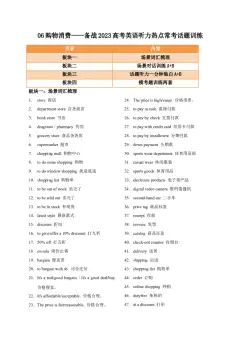
09 日常生活微场景:购物消费与公共服务
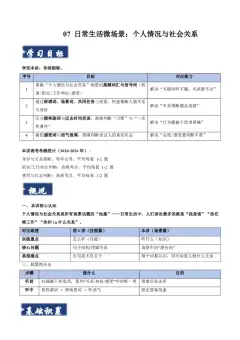
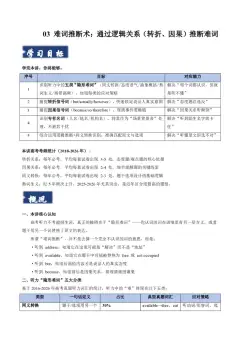
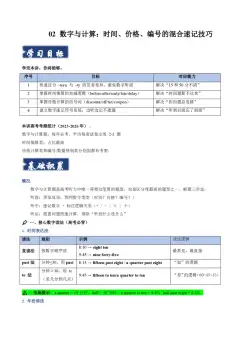
学完本讲,你将能够:
序号
目标
对应能力
1
掌握“购物消费与公共服务”场景的高频词汇与表达(商品/
价格/服务/投诉)
解决“场景词听不懂,场景推不出”
2
识别购物消费场景的典型对话流程(询问→试用→议价→交
易/退换)
解决“对话走到哪一步了不清楚”
3
捕捉公共服务场景的服务用语和指路表达,快速锁定服务类
型与地点
解决“服务场景题总选错”
4
运用数字速记与计算处理价格、时间、数量等关键信息
解决“价格/时间算不对”
本讲高考考频统计(2020-2026 年) :
购物消费类:每年必考,平均每套 1-2 题
公共服务类:每年必考,平均每套 1-2 题
合计占比:约占全卷听力总题量的 15%-20%
一、本讲核心认知
“购物消费与公共服务”是最“生活化”的场景——每一句话都在解决一个实际需求:买什么、在
哪买、多少钱、怎么去、怎么用。
二、解题两步走
步骤
做什么
目的
听前
扫描选项,预判是“商品题”“价格题”还是“地点题”
带着目标去听
听中
抓物品名词 + 辨数字/价格 + 听场景词
锁定答案
📌 一、购物消费场景关键词库
1. 商品与购物场所
类别
常见表达
听音要点
商品
jacket / dress / shirt / skirt / shoes / camera / video camera /
book / desk / flowers / beans / cake / pizza
听到即锁定“买什么”
购物场所
clothing shop / bookstore / flower shop / supermarket / grocery
store / bakery / restaurant / department store / shopping center /
market
听到即锁定“在哪买”
支付/价格
price / cost / pay / charge / discount / change / bill / receipt /
refund / exchange / checkout / credit card / cash
听到即锁定“价格/支付类题
目”
购物行为
buy / purchase / order / deliver / try on / fit / size / select /
choose / pick out / return / exchange
听到即锁定“在做什么”
尺码/颜色
size 8/10/12 / large / small / medium / color / blue / red / green /
black / white
听到即锁定“商品描述类题目”
2. 购物对话流程(高频信号词)
步骤
典型表达
功能
需求表达
I’d like to... / I’m looking for... / I want to buy...
说出想买什么
询问/介绍
Can I help you? / How about this one? / What size do you wear?
店员推荐/询问
试用/试穿
Can I try it on? / try this jacket on / the changing rooms are over there
试穿试用
价格询问/
议价
How much is it? / It costs... / That’s a bit expensive / Do you have any
discount?
价格协商
交易
I’ll take it. / I’d like to buy it. / I’ll pay by credit card. / Here’s your
change.
付款成交
🎯 真题示例1(2020 全国卷I Text 1——购物场所判断)
考题:Where are the speakers?
A. At a swimming pool.
B. In a clothing shop.
C. At a school lab.
【答案】B
【原文】 W: Can I help you?
M: Yes. I’d like to try this jacket on, please.
W: Okay, the changing rooms are over there..
【解析】 try this jacket on(试穿夹克)+ changing rooms(试衣间)是服装店的典型信号。即
使没有直接说出“shop”,这两个词已足够锁定场景。
🎯 真题示例2(2021 年全国乙卷 Text 2——尺码数字捕捉)
考题:What dress size does the woman want?
A. 8.   B. 10.   C. 12.
【答案】C
【原文】M: Can I help you?
W: I’m looking for a size twelve dress.
M: Oh, let me see. An eight, a ten. Ah, you’re lucky. I have the prettiest dress here in a twelve.
Why don’t you try it on?
【解析】 女士明确说“size twelve”。男士重复了8、10、12 三个数字,需要准确对应女士
的需求——size 12。
📌 二、公共服务场景关键词库
1. 常见公共服务类型
类别
常见表达
听音要点
交通出行
flight / train / bus / taxi / airport / station / platform / ticket / passport /
boarding pass / check-in / departure / delay
听到即锁定“交通场景”
邮政/快递
post office / mail / gift / package / letter / stamp / postcard
听到即锁定“邮政场景”
银行/金融
bank / account / savings account / credit card / cash / withdraw /
deposit / loan / interest
听到即锁定“银行场景”
图书馆
library / borrow / return / renew / overdue / fine / card / book /
magazine
听到即锁定“图书馆场景”
酒店/住宿
hotel / reservation / book a room / check in / check out / room key /
single room / double room / rate
听到即锁定“酒店场景”
餐厅/饮食
menu / order / bill / tip / waiter / chef / signature dish / reserve a table
/ dessert / steak / coffee
听到即锁定“餐厅场景”
咨询/问路
excuse me / could you tell me / where is / how can I get to / turn
left/right / go past / on your left/right
听到即锁定“问路场景”
2. 指路常用表达
表达
含义
示例
go past...
经过……
Go past the post office.
turn left/right
左转/右转
Turn left at the next corner.
on your left/right
在你左手边/右手边
It’s on your left.
across the street
在街对面
It’s across the street.
next to...
在……旁边
Next to the bakery.
It’s two blocks
away.
两个街区远
📌 三、价格计算高频句式
在购物消费场景中,价格计算是高频考点。以下句式需要快速识别:
句式
含义
示例
It costs + 数字 + 货币单位
价格是多少
It costs 650 euros.
考点分析
... dollars off
减……美元
six dollars off its original
price
...% off
……折(减价)
20% off
I paid + 数字 + for...
花了多少钱买……
I paid twenty-five.
... dollars per person
每人……美元
thirty pounds per person
The total budget is...
总预算是……
*20 × 30 = £600*
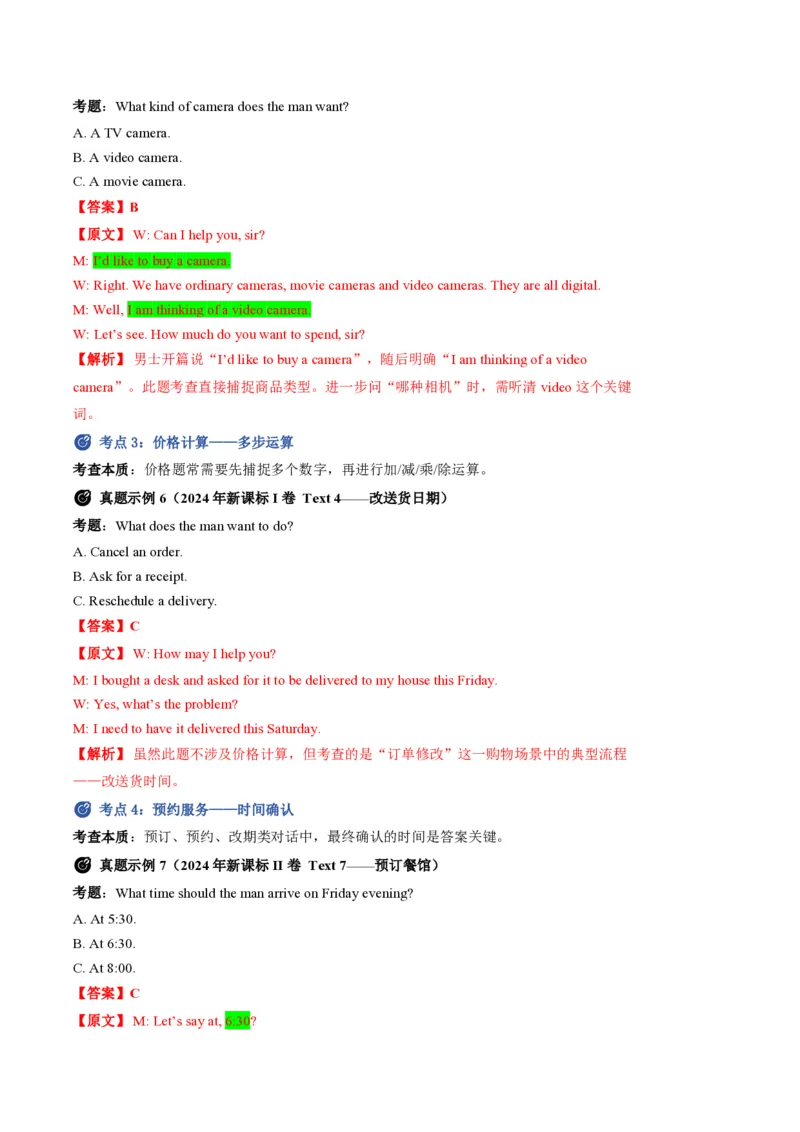
🎯 真题示例3(2026 年新课标I 卷 Text 7——价格计算)
考题:What is the total budget for the dinner?
A. £200.
B. £300.
C. £600.
【答案】C
【原文】 M: Yes, we’re expecting twenty people. And we’re aiming for thirty pounds per person.
W: Understood. Is this for a special occasion?
M: Yes. It’s to honor a staff member who is retiring next month.
【解析】 20 人 × 每人30 英镑 = 600 英镑。此题为两步信息整合:①捕捉人数 ②捕捉单价
→ 相乘得出总预算。
🎯 考点1:商品/服务获取——开头句直接锁定
考查本质:购物与服务场景的开篇句往往直接点明说话人的核心需求。
🎯 真题示例4(2026 年1 月浙江/贵州卷 Text 1——开头句定需求)
考题:What does the man probably want to buy?
A. A cake.
B. An umbrella.
C. Some flowers.
【答案】C
【原文】 M: Excuse me, is there a flower shop nearby?
W: Yes, do you see the bakery over there? Next to it, you’ll see a red umbrella. That’s where the
flower shop is.
【解析】 开头句直接点明目的——“flower shop”。说话人询问花店位置,核心需求是买花。
选项中“cake”是后面指路信息中出现的干扰项。
🎯 考点2:场景推断——通过关键词锁定地点
考查本质:对话中没有直接说出地点名称,需要通过关键词(物品/服务/设施)推断地点。
🎯 真题示例5(2020 全国卷II Text 8——购买相机场景)
考题:What kind of camera does the man want?
A. A TV camera.
B. A video camera.
C. A movie camera.
【答案】B
【原文】 W: Can I help you, sir?
M: I’d like to buy a camera.
W: Right. We have ordinary cameras, movie cameras and video cameras. They are all digital.
M: Well, I am thinking of a video camera.
W: Let’s see. How much do you want to spend, sir?
【解析】 男士开篇说“I’d like to buy a camera”,随后明确“I am thinking of a video
camera”。此题考查直接捕捉商品类型。进一步问“哪种相机”时,需听清video 这个关键
词。
🎯 考点3:价格计算——多步运算
考查本质:价格题常需要先捕捉多个数字,再进行加/减/乘/除运算。
🎯 真题示例6(2024 年新课标I 卷 Text 4——改送货日期)
考题:What does the man want to do?
A. Cancel an order.
B. Ask for a receipt.
C. Reschedule a delivery.
【答案】C
【原文】 W: How may I help you?
M: I bought a desk and asked for it to be delivered to my house this Friday.
W: Yes, what’s the problem?
M: I need to have it delivered this Saturday.
【解析】 虽然此题不涉及价格计算,但考查的是“订单修改”这一购物场景中的典型流程
——改送货时间。
🎯 考点4:预约服务——时间确认
考查本质:预订、预约、改期类对话中,最终确认的时间是答案关键。
🎯 真题示例7(2024 年新课标II 卷 Text 7——预订餐馆)
考题:What time should the man arrive on Friday evening?
A. At 5:30.
B. At 6:30.
C. At 8:00.
【答案】C
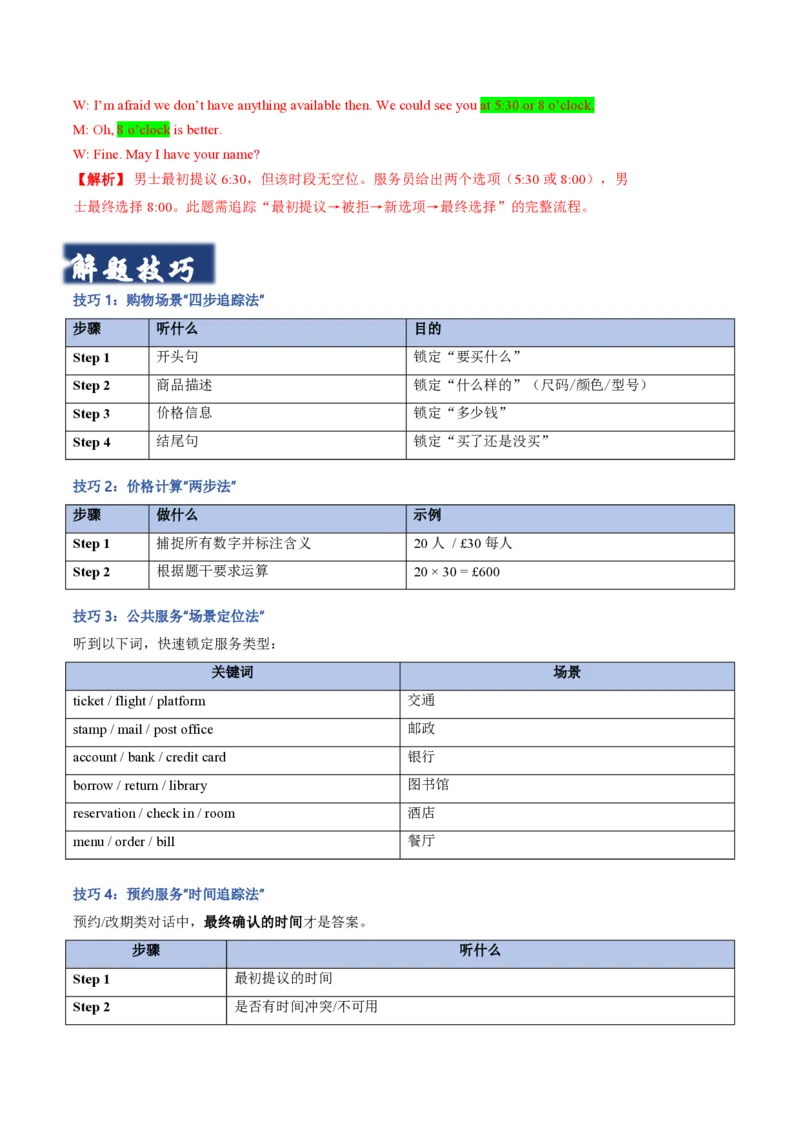
【原文】 M: Let’s say at, 6:30?
解题技巧
W: I’m afraid we don’t have anything available then. We could see you at 5:30 or 8 o’clock.
M: Oh, 8 o’clock is better.
W: Fine. May I have your name?
【解析】 男士最初提议6:30,但该时段无空位。服务员给出两个选项(5:30 或8:00),男
士最终选择8:00。此题需追踪“最初提议→被拒→新选项→最终选择”的完整流程。
技巧1:购物场景“四步追踪法”
步骤
听什么
目的
Step 1
开头句
锁定“要买什么”
Step 2
商品描述
锁定“什么样的”(尺码/颜色/型号)
Step 3
价格信息
锁定“多少钱”
Step 4
结尾句
锁定“买了还是没买”
技巧2:价格计算“两步法”
步骤
做什么
示例
Step 1
捕捉所有数字并标注含义
20 人 / £30 每人
Step 2
根据题干要求运算
20 × 30 = £600
技巧3:公共服务“场景定位法”
听到以下词,快速锁定服务类型:
关键词
场景
ticket / flight / platform
交通
stamp / mail / post office
邮政
account / bank / credit card
银行
borrow / return / library
图书馆
reservation / check in / room
酒店
menu / order / bill
餐厅
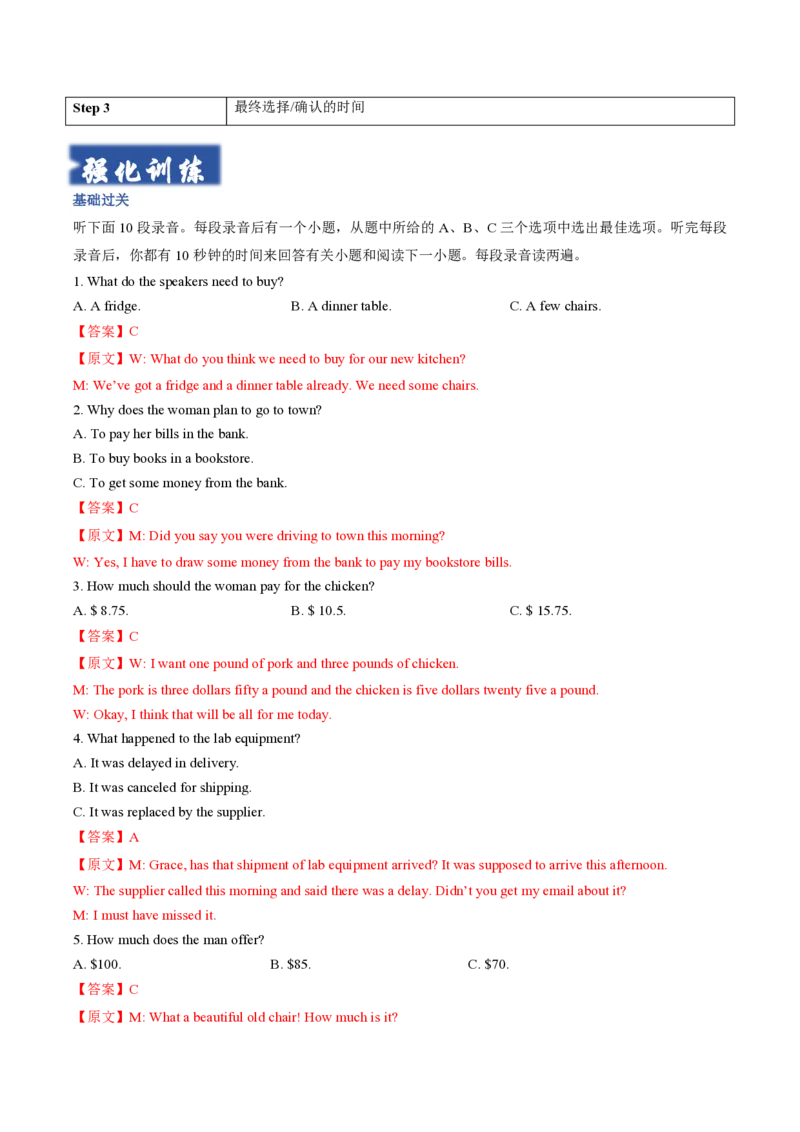
技巧4:预约服务“时间追踪法”
预约/改期类对话中,最终确认的时间才是答案。
步骤
听什么
Step 1
最初提议的时间
Step 2
是否有时间冲突/不可用
强化训练
Step 3
最终选择/确认的时间
基础过关
听下面10 段录音。每段录音后有一个小题,从题中所给的A、B、C 三个选项中选出最佳选项。听完每段
录音后,你都有10 秒钟的时间来回答有关小题和阅读下一小题。每段录音读两遍。
1. What do the speakers need to buy?
A. A fridge.
B. A dinner table.
C. A few chairs.
【答案】C
【原文】W: What do you think we need to buy for our new kitchen?
M: We’ve got a fridge and a dinner table already. We need some chairs.
2. Why does the woman plan to go to town?
A. To pay her bills in the bank.
B. To buy books in a bookstore.
C. To get some money from the bank.
【答案】C
【原文】M: Did you say you were driving to town this morning?
W: Yes, I have to draw some money from the bank to pay my bookstore bills.
3. How much should the woman pay for the chicken?
A. $ 8.75.
B. $ 10.5.
C. $ 15.75.
【答案】C
【原文】W: I want one pound of pork and three pounds of chicken.
M: The pork is three dollars fifty a pound and the chicken is five dollars twenty five a pound.
W: Okay, I think that will be all for me today.
4. What happened to the lab equipment?
A. It was delayed in delivery.
B. It was canceled for shipping.
C. It was replaced by the supplier.
【答案】A
【原文】M: Grace, has that shipment of lab equipment arrived? It was supposed to arrive this afternoon.
W: The supplier called this morning and said there was a delay. Didn’t you get my email about it?
M: I must have missed it.
5. How much does the man offer?
A. $100.
B. $85.
C. $70.
【答案】C
【原文】M: What a beautiful old chair! How much is it?
W: I’m asking for one hundred dollars for it.
M: Would you take seventy dollars for it?
W: Well, it’s worth at least two hundred. How about eighty-five dollars?
6. Where does the conversation most probably take place?
A. In a hotel.
B. In a bank.

C. In a police station.
【答案】B
【原文】W: Excuse me, but I want to open an account. Shall I fill in this form?
M: Yes, you need to fill in a form, but not this one. Go over to that desk and the man there will help you.
7. How much do the speakers have to pay for the tickets in total?
A. $20.
B. $40.
C. $60.
【答案】B
【原文】M: Look! The ticket price for adults is forty dollars.
W: Wow! As students and retired people, we both can have fifty percent off.
8. What are the speakers talking about?
A. Things to buy.
B. People to meet.
C. Places to visit.
【答案】A
【原文】M: I’m heading out. Do you want something from the market?
W: Yes, there are no fruit and milk in the fridge. Can you help get some?
M: Certainly. I’ll get them after I pick up Lily.
W: OK. By the way, cooking oil has also been used up.
9. What table does the man finally book?
A. Four-seat corner table.
B. Six-seat window table.
C. Seven-seat center table.
【答案】B
【原文】M: Hello, I’d like to book a table for five at 6 p. m. this Tuesday evening. Is there any window seat?
W: Let me check. We only got a four-seat one in the corner at six, or a six-seat window table at seven o’clock.
M: Alright, I’ll take the one at seven.
10. What will the man probably buy?
A. Chips.
B. Popcorn.
C. Chocolate.
【答案】C
【原文】M: The movie’s about to start, but I still can’t decide —chips, popcorn, or chocolate?
W: Well, it’s an action film. You’ll probably drop half the chips or popcorn during the fight scenes.
M: Good point. I’ve got it.
能力提升
听下面5 段录音。每段录音后有几个小题,从题中所给的A、B、C 三个选项中选出最佳选项,并标在试卷
的相应位置。听每段对话前,你将有时间阅读各个小题,每小题5 秒钟;听完后,各小题将给出5 秒钟的
作答时间。每段录音读两遍。
Dialogue 1
听下面的录音,回答第6、7 题。
6. Why does the woman call James?
A. To pay her bill.
B. To request some service.
C. To inquire about the charge.
7. How much does the woman have to pay as a late fee?
A. $20.
B. $65.
C. $85.
【答案】6. C
7. A
【原文】M: Hi, this is James in customer service. What can I do for you?
W: Hi, James. I want to talk about my bill. The bill I received yesterday for my home TV service is wrong.
M: What’s your account number?
W: 200508.
M: Okay. The regular monthly charge should be $65.
W: But yesterday I got a bill for $85.
M: It is because of your late payment for the last two months.
W: Oh, I see.

Dialogue 2
听下面的录音, 回答第11 至13 小题。
听下面一段对话,回答以下小题。
11. Why does the woman express thanks to the man?
A. He’ll shop with her.
B. He’ll drive her home.
C. He’ll entertain her friends.
12. What’s the advantage of a convenience store for the man?
A. The lower prices.
B. Much more selection.
C. Longer business hours.
13. What will the woman do next?
A. Stay at the counter.
B. Compare different brands. C. Help the man pick items.
【答案】11. B
12. C
13. A
【原文】W: Thanks for picking me up this evening, Eric.
M: Not at all. I’m happy to do it. By the way, I have some friends coming over tonight, and I should prepare for
that. Shall we stop at a supermarket on the way home?
W: I think it’s closed by now. We can stop at a convenience store.
M: Convenience store? They say the prices there are higher and there isn’t much selection.
W: I’m afraid so.
M: Well, it doesn’t matter. It may make choosing much easier.
W: Actually, I enjoy comparing different brands. Of course, this time there will be no choice.
M: Yeah. Here we are. Well, it is the only place open at this time of the night.
W: I guess so. Go ahead and get what you need. I’ll wait at the counter.
M: All right.

Dialogue 3
听下面的录音,回答第8 至10 小题。
8. How many books does Sarah have at home?
A. 3.
B. 7.
C. 8.
9. What’s the reason Sarah leaves?
A. She doesn’t want the books.
B. She might be late for her bus.
C. She needs to return more books.
10. Where are the speakers probably?
A. In a library.
B. At a bus stop.
C. In a bookstore.
【答案】8. A
9. B
10. A
【原文】M: Sorry Sarah, you’re not allowed to borrow more than 10 books at a time.
W: I know, but these are only seven books.
M: That’s strange. The system is not letting me process this request. You don’t have any others out?
W: I have three at home, so I’m within the limit.
M: It says here there are eight on your account.
W: That’s so strange. I just returned five of them in the morning, so it should only say three.
M: OK, no problem. Let me just check those that you returned. The system has been acting up since the afternoon.
I’ll be back in five minutes.
W: I think I’ll leave these here and come back tomorrow. I really have to get going or I’ll miss the last bus.
Dialogue 4
听下面的录音,回答第8 至10 小题。
8. What is the man doing?
A. Looking at job postings.
B. Interviewing a candidate.
C. Selecting local specialties.
9. What is the “Great Invention” mentioned by the man?
A. A delicate lighter.
B. A fine matchstick.
C. A scented (芳香的) thin stick.
10. What do we know about the man?
A. He has visited India.
B. He was born in India.
C. He has worked in India.
【答案】8. A
9. C
10. A
【原文】M: Excuse me, but are you looking at this help wanted notice, too? I’m sorry if I was in your way.
W: You’re not in my way. I thought this would be an interesting place to work, but I’m not sure.
M: Why not? It’s an Indian store I bet it’s an exciting place to work at least you learn a lot about India it looks like
they sell all kinds of interesting things here like incense and traditional Indian clothes.
W: What’s incense?
M: It’s a great invention. Somehow they make thin sticks that smell really nice you burn one end of the stick with a
match or a lighter then you blow out the flame. The stick burns very slowly after that and the smoke fills the room
with a wonderful smell.
W: How do you know so much about Indian things?
M: Oh, I traveled there a few years ago. I wanted to visit a place that was very different from where I grew up.

Dialogue 5
听下面的录音,回答第13 至16 小题。
听下面一段对话,回答以下小题。
13. What does the woman do before starting the survey?
A. She asks about the man’s employer.
B. She comments on some companies.
C. She shares her shopping preferences.
14. What is the purpose of the man’s survey?
A. To sell food for children.
B. To promote eco-friendly shopping.
C. To reduce the cost of some products.
15. What kind of product packaging does the woman support?
A. Luxurious.
B. Bright.
C. Simple.
16. What is the woman’s opinion on buying eco-friendly products?
A. It’s troublesome.
B. It’s necessary.
C. It’s common.
【答案】13. A
14. B
15. C
16. B
【原文】M: Good morning, Madam. My name is Bob Smith. I’m doing a survey of people’s shopping preferences.
Could you spare a few minutes?
W: Sure, but who are you doing this for? I don’t want to go out giving information that will help those big
companies sell more junk food to children.
M: Don’t worry. It’s the opposite. I work for the Green Market Research company. We help eco-friendly
companies tell consumers why they should buy their products.
W: So, what kind of questions are you asking?
M: Well, do you like to buy organic food and look for products with simple packaging?
W: I do try to buy organic whenever I can, and I definitely avoid products with over-packaging even if they’re
bright and luxurious. It’s just so wasteful.
M: Great! Do you think the price difference affects your decision? Sometimes eco-friendly products can be more
expensive.
W: Yes, it does. But I’m willing to support sustainable practices. I think it’s necessary in the long run.
M: That’s a fantastic point. We’ve found that many consumers share your views.

培优冲刺
Passage 1
听下面一段录音,回答第18 至20 小题。
18. What discount can students get for one book?
A. 30%.
B. 20%.
C. 10%.
19. What can all students do on the spot?
A. Get small prizes.
B. Grab a free coffee.
C. Have a lucky draw.
20. What’s the purpose of this announcement?
A. To advertise a bookstore.
B. To introduce a book fair.
C. To promote new books.
【答案】18. C
19. B
20. A
【原文】W: Attention, Everybody. Our campus bookstore is back and better than ever. To celebrate our reopening,
we’re holding a special one-day sale tomorrow, from 8 a.m. to 6 p.m., all students can enjoy a 20% discount when
buying two or more textbooks or supplies, and a 10% discount for a single item. It’s the perfect chance to get ready
for the new term. To make your experience even more enjoyable, we’ve prepared a variety of special activities.
You can meet and talk with local authors and professors who will be signing their books on site. We also have
lucky draws and mystery boxes for those who spend over a certain amount. Don’t forget to check out our photo
spots and join our social media challenges by sharing your visit. And you could even win small prizes, shop or not.
Take a break at our newly opened basement cafe and enjoy a free cup of coffee. Come and join us tomorrow. We
can’t wait to welcome you.

Passage 2
听下面一段录音,回答第17 至20 小题。
17. What’s the main topic of the text?
A. Young Americans’ way of consumption.
B. Americans’ way of consumption.
C. American’s marketing history.
18. What can we learn about the “fast-fashion”?
A. It is supported by all the Americans.
B. It is popular among the young Americans.
C. It just appears before long.
19. What do the elderly Americans care more about the products than their children?
A. The price.
B. The color.
C. The social influence.
20. What’s the most probable way for a company to win the market?
A. Selling luxury brands.
B. Making discounts.
C. Selling online and offline.
【答案】17.A  18. B
19. C
20. C
【原文】W: It’s true that the days of marketing chiefly through television, newspapers, and magazines are long
gone. Yet social media has not just changed the ways in which people discover brands; it has weakened the power
of marketing as a whole. Online, talk is cheap and prices are easily searched. Surveys suggest that young
Americans are among the most price-sensitive food shoppers. Four fifths of young Americans consider a
brand’s social impact before checkout, but they care less about the social influence than their parents. Chiefly,
it is youngsters who prefer to buy cheap “fast-fashion” outfits to wear once and then throw them away —
although “fast-fashion” has been criticized all along. There is a temptation to think that physical shops no longer
matter. Young consumers love their online shop deliveries. It makes sense for the company to make sales via social
media and ship directly to customers’ homes. But what works best is the perfect combination of the digital and
physical worlds. If they want to succeed, they need to offer the best of both physical and virtual worlds.
Passage 3
听下面一段录音,回答第18 至20 小题。
18. What is the speaker doing?
A. Giving advice.
B. Sharing an experience.
C. Making an advertisement.
19. What did the speaker use to do before bed?
A. She visited shopping websites.
B. She calculated her daily spending.
C. She sorted out her clothes.
20. How much does the speaker earn each month?
A. About $1,000.
B. About $2,000.
C. About $3,000.
【答案】18. B
19. A
20. C
【原文】W:I decided to stop shopping online for two months to see how it would affect my personal spending. In
the first week, I found it really hard to refuse the temptation from emails and online photos of new products from
some of my favorite shops. Every time I saw something I wanted, I said to myself: "Is this something you
absolutely need in life?" And without a doubt, the answer was always no. Once I broke my habit of spending 30
minutes or an hour each night before bed seeing what was for sale online, I was able to focus on activities that were
meaningful and didn't cost me a penny. And once I stopped shopping online, I realized way too much money was
going towards clothing and shoes. For example, last month I spent nearly $1,000 on clothing and shoes, and that's
almost one third of my monthly salary! I feel better knowing not only where my money is going, but also that I'm
not filling my home with items I don't need.
Passage 4
听下面一段录音,回答第17 至20 小题。
17.What is the speaker in charge of?
A.A small supermarket.
B.A large supermarket.
C.A small branch of a large supermarket.
18.What does the speaker mainly talk about?
A. The prevention of shoplifting.
B. The causes of shoplifting.
C. The purpose of shoplifting.
19.Who form the great part of shoplifters?
A. People in their early thirties.
B. People in their twenties.
C. Teenagers.
20.Which measure is NOT taken to prevent shoplifting?
A. Putting chains or alarms on goods.
B. Hiring store detectives.
C. Using closed-circuit television.
【答案】17.C  18. A
19. C
20. A
【原文】M: Well, I manage a small branch of a large supermarket, and we lose a lot of money through shoplifting.
I have to try to prevent it, or else I’ll lose all my profits. A lot of shopliftings are done by teenagers in groups. They
do it for fun. They’re not frightened so we have to make it difficult for them. Obviously a supermarket can’t have
chains or alarms on the goods. So we have store detectives, who walk around the shop like ordinary shoppers,
otherwise they’ll be recognized. We have big signs up, saying, “Shoplifters will be punished”, but that doesn’t help
much. We’ve started putting cash desks at all the exits to prevent the shoplifters walking straight out with things.
Of course, that worries the ordinary shopper who hasn’t found what he wanted. We also use closed-circuit
television, but that’s expensive. In fact, all good methods of prevention are quite expensive, and naturally, they
make our prices more expensive. But it has to be done. otherwise shoplifting itself will make all the prices much
higher, and the public doesn’t want that!