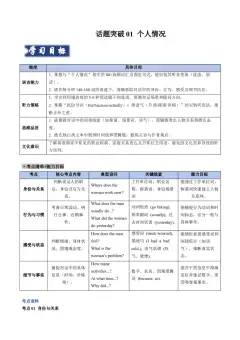
学习目标
概况
基础积累
07 日常生活微场景:个人情况与社会关系
学完本讲,你将能够:
序号
目标
对应能力
1
掌握“个人情况与社会关系”场景的高频词汇与信号词(称
谓/职业/工作单位/感受)
解决“关键词听不懂,关系推不出”
2
通过称谓词、场景词、共同任务三线索,快速推断人物关系
与身份
解决“关系推断题总选错”
3
区分频率副词与过去时间状语,准确判断“习惯”与“一次
性事件”
解决“行为题被干扰项带偏”
4
捕捉感受词与语气语调,准确判断说话人的真实状态
解决“态度/感受题判断不准”
本讲高考考频统计(2020-2026 年) :
身份与关系推断:每年必考,平均每套 1-2 题
职业/工作单位判断:高频考点,平均每套 1-2 题
感受与状态判断:高频考点,平均每套 1-2 题
一、本讲核心认知
个人情况与社会关系是所有场景话题的“地基”——日常生活中,人们谈论最多的就是“我是谁”“你在
哪工作”“你和ta 什么关系”。
对比维度
前6 讲(技能篇)
本讲(场景篇)
训练重点
怎么听(技能)
听什么(知识)
核心问题
句子结构/逻辑关系
场景中的“潜台词”
典型痛点
长句抓不住主干
每个词都认识,但不知道人物什么关系
三、解题两步走
步骤
做什么
目的
听前
扫描题干和选项,预判“关系/身份/感受”中的哪一类
带着目标去听
听中
抓称谓词 + 辨场景词 + 听语气
锁定答案线索
📌 一、三大线索——人物关系推断的核心工具
在“个人情况与社会关系”场景中,推断人物关系的答案通常藏在以下三类线索中:
线索类型
具体表现
可靠性
真题示例
线索一:称谓词/称呼
sweetheart/honey/my sister/my cousin/Mr./Mrs.
最高
夫妻、兄妹、师生
线索二:场景词/工作单位
office/company/supermarket/hospital/school/bank
中等
同事、医生与病人
线索三:共同任务/经历
us/our group/class project/we need to...
中等
同事、同学
原则:单一线索(尤其是弱证据)不足以确定关系,需要综合多个线索判断。
📌 二、考点语料库
考点01 身份与关系——关键词库
类别
常见表达
听音要点
称谓关系
cousin / uncle / aunt / colleague / classmate / roommate /
husband / wife / boss / manager / professor / doctor / Mr. /
Mrs.
听到即锁定“关系类题目”,答案
就在称呼中
职业名称
accountant / nurse / vet / doctor / teacher / lawyer / manager /
engineer / editor / photographer / host / writer / farmer
直接对应职业身份类题目
工作单位
company / firm / bank / hospital / school / university / store /
supermarket / restaurant / factory / office
听到即锁定“职业场所”,预判问
题与工作相关
身份暗示
student pass / major / exchange program / graduation / degree /
license / certificate
判断学生/毕业生/专业人士身份
🎯 真题示例1(2026 年新课标I 卷 Text 1——身份暗示)
考题:Who is the man?
A. A business client.
B. A job applicant.
C. A new staff member.
【答案】 C
【原文】 M: Do I need a card to enter the building?
W: Yes. You’ll get your card this afternoon. Now let me show you around and say hello to everyone. And then we’ll
talk about your job duties.
【解析】 “You’ll get your card this afternoon” + “show you around” + “talk about your job duties” → 新员工入职
的典型流程。
🎯 真题示例2(2026 年1 月浙江卷 Text 4——共同任务推断同事)
考题:What is the probable relationship between the speakers?
A. Classmates.   B. Fellow workers.    C. Salesman and customer.
【答案】 B
【原文】 W: Jack, Mrs. Palmer wants us in her office.
M: Right now? For what?
W: She wants us to meet the new sales manager.
【解析】 “Mrs. Palmer wants us” + “new sales manager” → 二人被共同召唤去见新销售经理,职场场景明确,
是同事关系。关键词“us”表明二人是被共同召唤的,而非单独的上下级或顾客关系。
🎯 真题示例3(2022 年全国甲卷 Text 6——夫妻关系推断)
考题:What is the probable relationship between the speakers?
A. Boss and secretary.   B. Hostess and guest.   C. Husband and wife.
【答案】 C
【原文】 W: Dave, don’t forget we are invited out to dinner tonight! ...
M: It’s informal, isn’t it?
W: Yeah, you can wear your new sports jacket, the one I got you as an anniversary gift.
【解析】 “anniversary gift”(周年纪念礼物)是夫妻关系的直接证据,无需推理即可锁定。
考点02 行为与习惯——关键词库
类别
常见表达
听音要点
频率副词
always / usually / often / sometimes / never / rarely /
once a week / every day
锁定习惯性行为的关键信号
时间状语(习惯)
on weekdays / on weekends / in the morning / after
dinner
与频率副词搭配,构成习惯行为的
时间框架
时间状语(过去)
yesterday / last night / last weekend / the other day /
just now
听到即锁定“一次性事件”
🎯 真题示例4(2020 全国卷II Text 6——频率副词→习惯性行为)
考题:What does Bill (the man) often do on Friday night?
A. Visit his parents.
B. Go to the movies.
C. Walk along Broadway.
【答案】 B
【原文】 W: So, Bill, what do you usually do on the weekend?
M: I often go to the movies with friends on Friday night. How about you, Sarah?
【解析】 “often”是频率副词,直接锁定习惯性行为——周五晚上去看电影。
考点03 感受与状态——关键词库
类别
常见表达
听音要点
积极情绪
excited / proud / happy / delighted / pleased / satisfied /
grateful
语调上扬、语速加快
消极情绪
upset / depressed / guilty / disappointed / angry / annoyed /
语调下降、叹气或停顿
考点分析
worried / anxious / nervous / frightened / scared
身体状况
tired / exhausted / sick / ill / have a cold / not feel well /
injured
常出现在解释缺席、请假的语境中
🎯 真题示例5(2022 年浙江省1 月高考 Text 8——虚拟语气→身份判断)
考题:What is the relationship between the speakers?
A. Brother and sister.
B. Fellow teachers.
C. Schoolmates.
【答案】 C
【原文】 M: That’s very nice of you. I wish it were our graduation day too.
W: Another three years and we’ll be done too.
【解析】 “I wish it were our graduation day too”(我希望今天也是我们的毕业日)使用虚拟语气,说明他
们还没毕业,还有三年才毕业,是同学关系。
🎯 考点1:身份与关系推断——三大线索综合判断
考查本质:通过称谓词、场景词、共同任务等间接线索推断人物关系和身份。
🎯 真题示例6(2024 年新课标II 卷 Text 8——课堂规则定身份)
考题:What is the relationship between the speakers?
A. Classmates.
B. Fellow workers.
C. Teacher and student.
【答案】 A
【原文】 M: So? We can’t be a group of five?
W: Well, Professor North said there should be no more than four people in each group. It’s not about you or your
work or anything like that.
【解析】对话发生在明确的校园语境下:双方在讨论课堂小组分组(“group”),并且提到了教授的规定
——“每组不能超过四个人”(“Professor North said there should be no more than four people in each
group.”)。关键词“group”+“Professor North”直接指向课堂场景,表明说话人是同学关系。
🎯 考点2:行为与习惯——频率副词+时间状语定位
考查本质:区分“习惯”与“一次性事件”,避免被日常习惯描述干扰。
🎯 真题示例7(2021 年新课标I&II 卷 Text 9——通过句式功能推断说话人意图或态度)
考题:14. Why did Sarah (the woman) make the phone call?
A. To ask a favor.
解题技巧
B. To pass on a message.
C. To make an appointment.
【答案】 A
【原文】 M: Do you know what’s wrong with the car?
W: I’m not exactly sure. I think there’s a problem with the engine. Uh, I wonder if you could give me a ride to the
hotel tomorrow morning.
【解析】 “I wonder if you could... ”是请求帮助的经典句式,表示“不知道你是否能……”,语气礼貌、委婉。
听到这个句式,预判说话人接下来要提出请求,答案往往在“I wonder if”后面的内容中。
🎯 考点3:感受与状态——语气语调+间接暗示推断
考查本质:通过语气语调、比喻性表达、生理反应描述等间接线索推断说话人的真实感受。
🎯 真题示例8(2026 年新课标II 卷 Text 7——生理反应推断紧张)
考题:How did Alex (the man) feel before climbing?
A. Deeply regretful.
B. Quite embarrassed.
C. Fairly nervous.
【答案】 C
【原文】 W: Tell us about your state of mind before you started.
M: Well, my heart was racing for a few moments. I mean, it’s a huge wall above you, with a glass-smooth surface
and no handholds.
【解析】 Alex 描述“my heart was racing”(心跳加速),并强调岩壁的巨大与光滑(“huge wall... glass-smooth
surface, no handholds”)。heart racing 是紧张的典型生理反应,对岩壁险峻的描述进一步强化了紧张情绪。
即使没有直接说nervous,也能推断出他非常紧张。
技巧1:关系推断“三线索法”
步骤
做什么
示例
Step 1
找称谓词/称呼
sweetheart → 夫妻;my sister → 兄妹
Step 2
找场景词/工作单位
office + manager → 职场;school + class → 校园
Step 3
找共同任务
us / our group / we need to → 同事/同学
技巧2:习惯 vs 事实判断法
信号词
判断
示例
usually / always / often / normally
习惯(常为干扰项)
He’s usually at the supermarket.
yesterday / last night / the other day
事实(常为答案)
I saw him in the park yesterday.
强化训练
技巧3:感受推断“两线索法”
线索
示例
推断
直接感受词
I feel nervous. / I’m excited.
直接锁定
比喻性表达/他人评价
heart in my throat. / You’re braver than me.
通过比喻或对比推断
基础过关
听下面10 段录音。每段录音后有一个小题,从题中所给的A、B、C 三个选项中选出最佳选项。听完每段
录音后,你都有10 秒钟的时间来回答有关小题和阅读下一小题。每段录音读两遍。
1. Where did Harry see Jane's brother yesterday?
A. At the supermarket.
B. In the park.
C. On a plane.
【答案】B
【原文】M: Hi Jane. I saw your brother in the park yesterday. Isn’t he usually at work at the supermarket during the
week?
W: Normally, Mike’d be there, Harry. But he’s on holiday this week. Oh, I think he’ll board a plane in just several
minutes.
2. What does the man think of his office?
A. It’s bright.
B. It’s beautiful.
C. It’s smelly.
【答案】C
【原文】W: So this is your office? Wow, it’s really beautiful! I hope to move in such a bright new place.
M: Um, but there’s always a terrible smell around here because of the decoration.
3. What does the woman say about Peter?
A. He’s always on time.
B. He’s forgetful.
C. He’s usually late.
【答案】A
【原文】M: Will Peter be late this time?
W: No. He is a man who is never late. There is still ten minutes left.
4. What does the man advise Mary to do?
A. Go out to work.
B. Listen carefully to Henry.
C. Be calm and patient.
【答案】C
【原文】W: I’m really angry at Henry. He never listens to me.
M: Take it easy, Mary. Things will work out.
5. Why is Emily tired?
A. She has a hard job.
B. She opens a restaurant.
C. She does lots of overtime.
【答案】A
【原文】M: Emily, you look very tired these days. What’s wrong?
W: It's my new job in that newly opened restaurant. It needs much effort, and the working hours are long.
6. How did the woman probably feel before walking over the glass bridge?
A. Calm.
B. Proud.
C. Frightened.
【答案】C
【原文】W: I walked over the Zhangjiajie glass bridge on my holiday.
M: You’re braver than me! I know it’s supposed to be safe, but I’m frightened of heights.
W: No one will ignore this, but once you have done it, you will feel proud. Just like me.
7. How does the man feel?
A. Excited.
B. Nervous.
C. Disappointed.
【答案】B
【原文】M: When I think about my upcoming interviews, I feel my heart in my throat.
W: That’s not like you. You’re always so cool, calm and collected.
M: I know, but this is different. What if I say the wrong thing?
8. What does the man mean?
A. Jessica will finish the paper soon.
B. Jessica is not going to write the paper.
C. Jessica seldom completes her work early.
【答案】C
【原文】W: Do you know if Jessica has finished her research paper on computers?
M: I don’t think so. She always seems to put things off until the last minute.
9. Why didn’t David show up?
A. He forgot the date.
B. It was raining.
C. He was ill.
【答案】C
【原文】W: Hi, David. What happened yesterday? I waited for you in the rain for an hour. You forgot our date,
didn’t you?
M: No, I remembered. But I had a bad cold, so I decided to stay home. I’m terribly sorry.
10. Where does the woman work now?
A. In a college.
B. In a company.
C. In the City Bank.
【答案】B
【原文】M: Hi, Linda. I haven’t seen you for ages. I miss you very much. Have you graduated from college?
W: Yes. I graduated last year and got a job in a publishing company. How about you, Henry?
M: Well, I’m now working in the City Bank.
能力提升
听下面5 段录音。每段录音后有几个小题,从题中所给的A、B、C 三个选项中选出最佳选项,并标在试卷
的相应位置。听每段对话前,你将有时间阅读各个小题,每小题5 秒钟;听完后,各小题将给出5 秒钟的
作答时间。每段录音读两遍。
Dialogue 1
听下面一段录音,回答第8 至10 小题。
8. Why was Nancy away from school yesterday?
A. Because she was busy.
B. Because she was ill.
C. Because she was at home.
9. What is she going to do?
A. Go home.
B. Go to clinic.
C. Go to her friend’s.
10. Why will they stop on the way?
A. To buy some medicine.
B. To see a doctor.
C. To buy some food.
【答案】8. B
9. A
10. A
【原文】M: Hi! Nice to meet you, Nancy! Where were you yesterday?
W: I didn’t come because I was sick.
M: You still look a little sick. You ought to go back to bed.
W: I am going home now.
M: Did you drive today?
W: Oh, no, I don’t have a car.
M: I can take you home. Would you like a ride?
W: Yes. Thanks a lot. Could you stop at the chemist’s on the way? I need to buy some medicine.

Dialogue 2
听下面一段录音, 回答第8 至10 小题。
8.Why is the man unhappy?
A. He made a serious mistake at work.
B. He quarreled with Mr. Scott.
C. He missed a hiking trip.
9. What does the woman think of the man?
A. Mean.
B. Careless.
C. Impolite.
10. What will the man do next?
A. Call Mr. Scott.
B. Make a complaint.
C. Contact his customer.
【答案】8. A
9. B
10. A
【原文】W: You look really upset. You told me that you went hiking this morning, didn’t you? Are you too tired?
M: No. Actually I made a big mistake. And my boss Mr. Scott was really angry with me.
W: What’s that?
M: I had sent the wrong goods to a customer so that we lost a lot of money.
W: How come?
M: I made a mistake in putting the address on the parcel. I didn’t do it on purpose.
W: Take your job seriously. Always be careful in doing things.
M: Alright. I promise I will. I feel really guilty about my mistake.
W: It’s useless to regret the thing that has been done.
M: I have apologized to Mr. Scott.
W: That’s not enough. Give a phone call to Mr. Scott and ask him if we can do something to make up for him.
M: I’ll do it at once.

Dialogue 3
听下面一段录音,回答6、7 小题。
6. How does the woman feel?
A. Worried.
B. Depressed.
C. Disappointed.
7. What does the man suggest doing?
A. Cheering George up.
B. Leaving George alone.
C. Paying more attention to George.
【答案】6. A
7. B
【原文】W: Jake, I want to talk to you about George.
M: What did he do now?
W: We must do something because he’s been depressed for months.
M: ⑦Oh, you know, he’s changeable like the weather. He could be laughing next week.
W: But I think we should pay more attention to him.
M: ⑦But you know how independent he is. We can’t help him if he doesn’t want it, can we?
Dialogue 4
听下面一段录音,回答第14 至17 小题。
14. Where does the conversation probably take place?
A. In a classroom.
B. In a library.
C. In a bookstore.
15. Why did the man need a new student pass?
A. His old photo looked different.
B. His pass was for a different building.
C. His teacher asked him to change it.
16. What does the man hope to do in his second year?
A. Study abroad.
B. Learn English Literature.
C. Change his major.
17. What will the woman do next?
A. Go back home.
B. Leave for school.
C. Work on her research.
【答案】14. B
15. A
16. A
17. C
【原文】M: Hey, Lucy. Fancy meeting you here! Are you here to borrow books, too?
W: Hi, Tom. No, I come here to make sure I can enter it.
M: That is a wise decision! I couldn’t enter it at first. It had something to do with my student pass. I had to go to the
teachers’ office to get a new one. Thankfully, they let me change my photo. The old one was out-of-date and
looked strange.
W: So have you signed up for your first term?
M: Yes, I’ve selected all the courses that meet my requirements.
W: I know you chose English Literature as a major, but what optional courses did you pick?
M: History and Italian. I’m hoping to take part in the exchange program in my second year and go to Italy to study
for six months.
W: That would be amazing. Good luck with that. Anyway, I should get back to my research.
M: See you later.
W: Bye.

Dialogue 5
听下面一段录音,回答第14 至17 小题。
14. What does the woman mainly sell in the morning?
A. Sweets.
B. Cigarettes.
C. Sandwiches.
15. Who often comes to the shop in the daytime?
A. Housewives.
B. Restaurant workers.
C. School teachers.
16. How long is the shop open every day?
A. 6 hours.
B. 11 hours.
C. 12 hours.
17. How does the woman feel about running the shop?
A. Excited.
B. Tired.
C. Bored.
【答案】14. B   15. A
16. C
17. A
【原文】M: How did you think of opening this shop?
W: Well, I knew the shop because I passed it every day on the way to my office. The owner got ill and had to sell
it, so I bought the business.
M: Have you made any changes to it?
W: Yes. It only provided fruits and vegetables before, but now I sell all kinds of things. And the shop stays open
for longer. I open at 6:30 every morning, when local factory workers come in for cigarettes. During the day, I
sell all kinds of things to housewives: fresh milk, cooked meat, and so on.
M: Do you close it for lunch?
W: Oh, no. That’s a very good time for business. During the lunch rush, I make sandwiches to order.
M: Are you busy after lunch?
W: Yes. I sell a lot of sweets to school children on the way home. Some customers want something for supper. I
close the shop at 6:30 and go home for my supper.
M: That’s a long day. Don’t you get tired?
W: No. I’m never bored. I find it really exciting. I love meeting people all the time.

培优冲刺
Passage 1
听下面一段录音,回答第17 至20 小题。
17. Who inspired Ann to be a nurse?
A. Her father.
B. Her teachers.
C. Her cousin.
18. What did Ann’s teachers advise her to do?
A. Improve her math.
B. Practice her English.
C. Focus on her biology.
19. What does Ann think of learning nursing?
A. Effortless.
B. Challenging.
C. Enjoyable.
20. What does Ann value most about her job?
A. The high pay.
B. The career prospects.
C. The sense of fulfillment.
【答案】17. C
18. A
19. B
20. C
【原文】Hello, everybody. My name’s Ann. Thanks for turning up to listen to me talk about my career. I hope that
some of you will decide to take up nursing in the future because it is a fantastic job. First of all, I’ll tell you a little
bit about how I got started. I had no idea what I wanted to do until I was about 14, when I was listening to a family
conversation. My cousin was talking to my dad and telling him all about how much she enjoyed her work. She was
a nurse in a busy hospital. And I thought, yeah, that’s exactly what I’d like to do. When I told my teachers that’s
what I decided, they were very encouraging. But they did say that although I had always got good marks in English
and biology, I’d have to get a little better at math, or I wouldn’t be able to do the job. Well, I must say, it wasn’t
easy being a student nurse. It involved lots of late nights staying up to do my coursework. But I’d known it would
be like that. Anyway, I think I have one of the best jobs in the world. My sister is an accountant, and although she
earns far more than I do, I think my job is much more rewarding.

Passage 2
听下面一段录音,回答第17 至20 小题。
17. Why does the speaker love San Diego?
A. Because it is almost sunny every day.
B. Because it is near the Pacific Ocean.
C. Because it is sometimes windy.
18. What does the speaker love to do in the summer?
A. To go to the seashore.
B To go to the zoo.
C. To sit in the sun.
19. What’s the speaker’s favourite thing about San Diego?
A. The sunny weather.
B. The animals in the zoo.
C. The restaurants of many types.
20. What will the speaker be after college?
A. A vet.
B. A teacher.
C. A businessman.
【答案】17. A
18. B
19. C
20. A
【原文】W: Hello, I’m a university student. I have been to many cities in the world. In fact, I like San Diego best. I
love living in San Diego. The weather here is perfect. Sunny nearly every day. But sometimes there is a cold wind
that comes off the Pacific ocean. There’s also a famous zoo here in San Diego, and I like to go in the summer to see
all the animals. My favorite thing about San Diego is the many types of restaurants that are here. I love Chinese,
Thai and Indian food. And in San Diego I can eat them all. I go to college near the zoo. I am studying to become a
vet, so one day I want to work inside the zoo. San Diego is not an old city, but there are parts more than 100 years
old, and there are interesting museums here.

Passage 3
听下面一段录音,回答第17 至20 小题。
17. Where was the woman last month?
A. In Australia.
B. In America.
C. In France.
18. What was the woman’s job in France?
A. A teacher.

B. A doctor.

C. An actress.
19. How old is the woman?
A. 35.
B. 40.

C. 50.
20. What is the main point of the speech?
A. A report of a research.

B. A movie about deserts.
C. An introduction to a guest.
【答案】17. A
18. A
19. B
20. C
【原文】It is my great pleasure to introduce our next guest! She was born here in America, but has spent her life
traveling all over the world. I was actually able to interview her in Australia last month. (17) It was a very long
conversation. She also lived and worked in France for a long time. While in France, she has taught at one of the
best universities until the age of 35. (18) Her parents had wanted her to be a doctor, which is what she first
studied. However, she soon found that was not for her. She became a scientist instead, and has seen many deserts
around the world during her research. She is now back in America, after being given an offer to act in a movie for
the first time! Of course, she celebrated her 40th birthday yesterday, and we wish her the very best! (19) Ten
years from now, I’m sure we will be talking about how wonderful she is in her movies! Her sisters, Georgia and
Layla, are both here today as well. Please welcome, Isabella White!

Passage 4
听下面一段录音,回答第17 至20 小题。
17. What is Wang Dewen famous for?
A. His woodworking skill.
B. His parenting experience.
C. His easy life.
18. What did Wang first make with wood?
A. A door.
B. A bridge.
C. A pot cover.
19. Why did Wang make wooden toys?
A. To support his family.
B. For his grandson.
C. Due to his son.
20. What is the wish of Wang’s son?
A. Publicizing the ancient Chinese skills.
B. Making his father well-known.
C. Enjoying more farm produce.
【答案】17. A
18. C
19. B
20. A
【原文】M: A Chinese man has caught millions of viewers’ eyes online for his amazing woodworking skill. He is
Wang Dewen, who is known as “Grandpa Amu” on YouTube. His most popular video, which shows him making a
fantastic wooden bridge, gained more than 42 million views. Wang’s family lived a hard life in Shandong Province.
There were four kids and his mother didn’t have enough food for them, so he began to learn the skill to support his
family. Wang’s first piece was a cooking pot cover. He made it for his mother. For the next fifty years, Wang
worked as a farmer. When he was free, he made furniture as well as doors for local building projects. Two years
ago, Wang left Shandong Province to live with his son in Guangxi Province. He made kinds of wooden toys for his
grandson. His son made the processes into videos and shared them online. He wanted more people to know these
ancient Chinese skills and hoped to use their influence to help the local villagers to sell their farm produce.