文档文本内容
学习目标
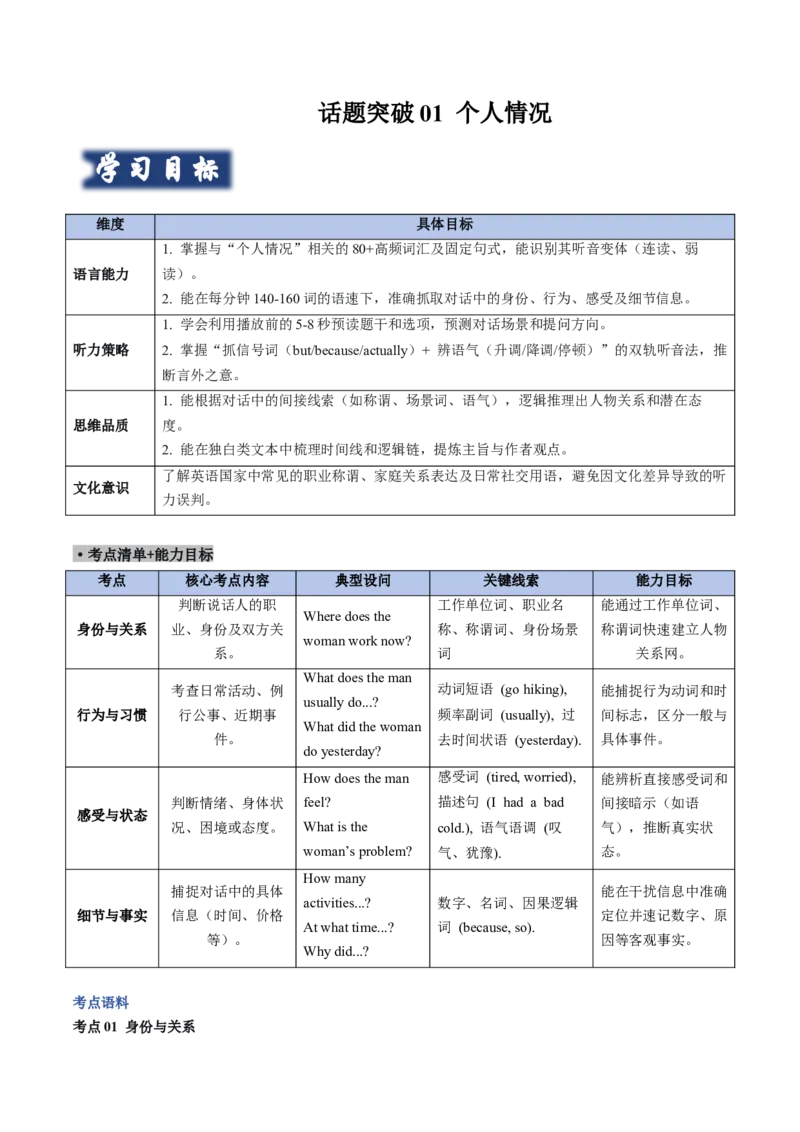
话题突破01 个人情况

维度
具体目标
语言能力
1. 掌握与“个人情况”相关的80+高频词汇及固定句式,能识别其听音变体(连读、弱
读)。
2. 能在每分钟140-160 词的语速下,准确抓取对话中的身份、行为、感受及细节信息。
听力策略
1. 学会利用播放前的5-8 秒预读题干和选项,预测对话场景和提问方向。
2. 掌握“抓信号词(but/because/actually)+ 辨语气(升调/降调/停顿)”的双轨听音法,推
断言外之意。
思维品质
1. 能根据对话中的间接线索(如称谓、场景词、语气),逻辑推理出人物关系和潜在态
度。
2. 能在独白类文本中梳理时间线和逻辑链,提炼主旨与作者观点。
文化意识
了解英语国家中常见的职业称谓、家庭关系表达及日常社交用语,避免因文化差异导致的听
力误判。
·考点清单+能力目标
考点
核心考点内容
典型设问
关键线索
能力目标
身份与关系
判断说话人的职
业、身份及双方关
系。
Where does the
woman work now?
工作单位词、职业名
称、称谓词、身份场景
词
能通过工作单位词、
称谓词快速建立人物
关系网。
行为与习惯
考查日常活动、例
行公事、近期事
件。
What does the man
usually do...?
What did the woman
do yesterday?
动词短语 (go hiking),
频率副词 (usually), 过
去时间状语 (yesterday).
能捕捉行为动词和时
间标志,区分一般与
具体事件。
感受与状态
判断情绪、身体状
况、困境或态度。
How does the man
feel?
What is the
woman’s problem?
感受词 (tired, worried),
描述句 (I had a bad
cold.), 语气语调 (叹
气、犹豫).
能辨析直接感受词和
间接暗示(如语
气),推断真实状
态。
细节与事实
捕捉对话中的具体
信息(时间、价格
等)。
How many
activities...?
At what time...?
Why did...?
数字、名词、因果逻辑
词 (because, so).
能在干扰信息中准确
定位并速记数字、原
因等客观事实。
考点语料
考点01 身份与关系
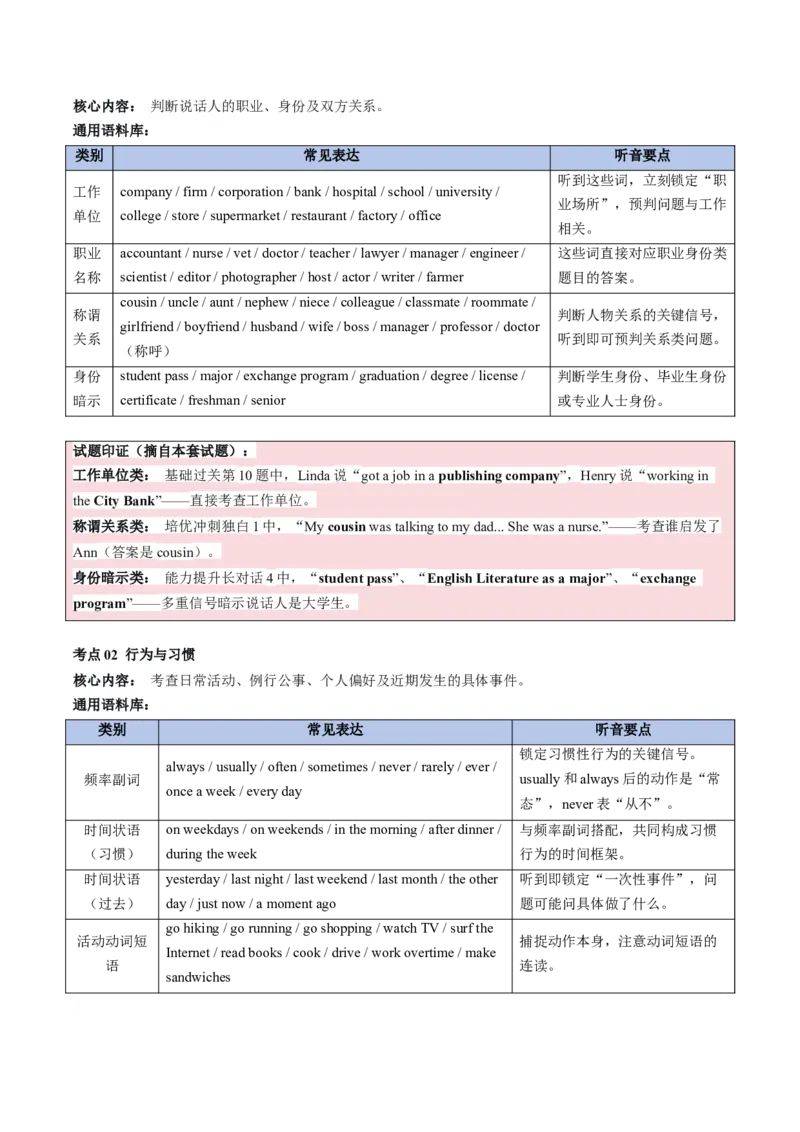
核心内容: 判断说话人的职业、身份及双方关系。
通用语料库:
类别
常见表达
听音要点
工作
单位
company / firm / corporation / bank / hospital / school / university /
college / store / supermarket / restaurant / factory / office
听到这些词,立刻锁定“职
业场所”,预判问题与工作
相关。
职业
名称
accountant / nurse / vet / doctor / teacher / lawyer / manager / engineer /
scientist / editor / photographer / host / actor / writer / farmer
这些词直接对应职业身份类
题目的答案。
称谓
关系
cousin / uncle / aunt / nephew / niece / colleague / classmate / roommate /
girlfriend / boyfriend / husband / wife / boss / manager / professor / doctor
(称呼)
判断人物关系的关键信号,
听到即可预判关系类问题。
身份
暗示
student pass / major / exchange program / graduation / degree / license /
certificate / freshman / senior
判断学生身份、毕业生身份
或专业人士身份。
试题印证(摘自本套试题):
工作单位类: 基础过关第10 题中,Linda 说“got a job in a publishing company”,Henry 说“working in
the City Bank”——直接考查工作单位。
称谓关系类: 培优冲刺独白1 中,“My cousin was talking to my dad... She was a nurse.”——考查谁启发了
Ann(答案是cousin)。
身份暗示类: 能力提升长对话4 中,“student pass”、“English Literature as a major”、“exchange
program”——多重信号暗示说话人是大学生。
考点02 行为与习惯
核心内容: 考查日常活动、例行公事、个人偏好及近期发生的具体事件。
通用语料库:
类别
常见表达
听音要点
频率副词
always / usually / often / sometimes / never / rarely / ever /
once a week / every day
锁定习惯性行为的关键信号。
usually 和always 后的动作是“常
态”,never 表“从不”。
时间状语
(习惯)
on weekdays / on weekends / in the morning / after dinner /
during the week
与频率副词搭配,共同构成习惯
行为的时间框架。
时间状语
(过去)
yesterday / last night / last weekend / last month / the other
day / just now / a moment ago
听到即锁定“一次性事件”,问
题可能问具体做了什么。
活动动词短
语
go hiking / go running / go shopping / watch TV / surf the
Internet / read books / cook / drive / work overtime / make
sandwiches
捕捉动作本身,注意动词短语的
连读。
试题印证:
频率副词+习惯: 基础过关第8 题中,“She always seems to put things off until the last minute.”——always
seems to 表明Jessica 的拖延是一贯习惯。
过去时间状语: 基础过关第1 题中,“I saw your brother in the park yesterday.”——yesterday 锁定过去事
实,干扰项supermarket 来自usually at the supermarket(日常习惯),属于“习惯 vs. 事实”的经典陷阱。
考点03 感受与状态
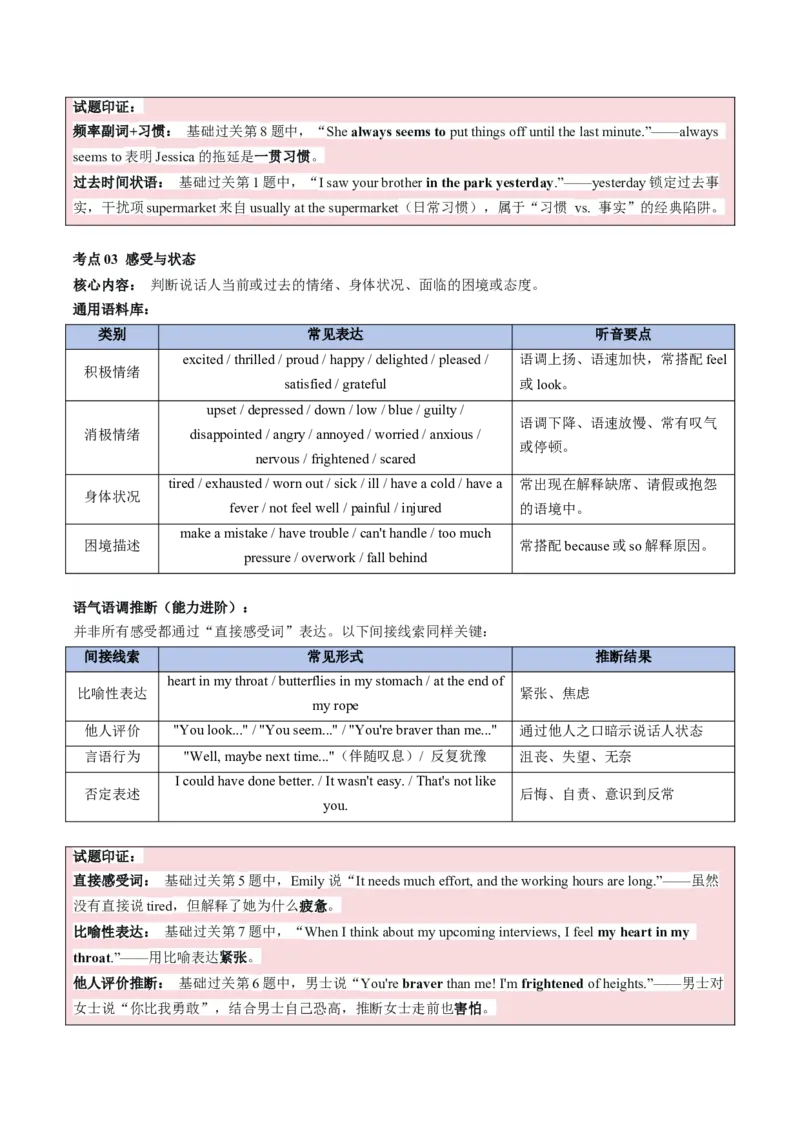
核心内容: 判断说话人当前或过去的情绪、身体状况、面临的困境或态度。
通用语料库:
类别
常见表达
听音要点
积极情绪
excited / thrilled / proud / happy / delighted / pleased /
satisfied / grateful
语调上扬、语速加快,常搭配feel
或look。
消极情绪
upset / depressed / down / low / blue / guilty /
disappointed / angry / annoyed / worried / anxious /
nervous / frightened / scared
语调下降、语速放慢、常有叹气
或停顿。
身体状况
tired / exhausted / worn out / sick / ill / have a cold / have a
fever / not feel well / painful / injured
常出现在解释缺席、请假或抱怨
的语境中。
困境描述
make a mistake / have trouble / can't handle / too much
pressure / overwork / fall behind
常搭配because 或so 解释原因。
语气语调推断(能力进阶):
并非所有感受都通过“直接感受词”表达。以下间接线索同样关键:
间接线索
常见形式
推断结果
比喻性表达
heart in my throat / butterflies in my stomach / at the end of
my rope
紧张、焦虑
他人评价
"You look..." / "You seem..." / "You're braver than me..."
通过他人之口暗示说话人状态
言语行为
"Well, maybe next time..."(伴随叹息)/ 反复犹豫
沮丧、失望、无奈
否定表述
I could have done better. / It wasn't easy. / That's not like
you.
后悔、自责、意识到反常
试题印证:
直接感受词: 基础过关第5 题中,Emily 说“It needs much effort, and the working hours are long.”——虽然
没有直接说tired,但解释了她为什么疲惫。
比喻性表达: 基础过关第7 题中,“When I think about my upcoming interviews, I feel my heart in my
throat.”——用比喻表达紧张。
他人评价推断: 基础过关第6 题中,男士说“You're braver than me! I'm frightened of heights.”——男士对
女士说“你比我勇敢”,结合男士自己恐高,推断女士走前也害怕。
基础积累
考点04 细节与事实
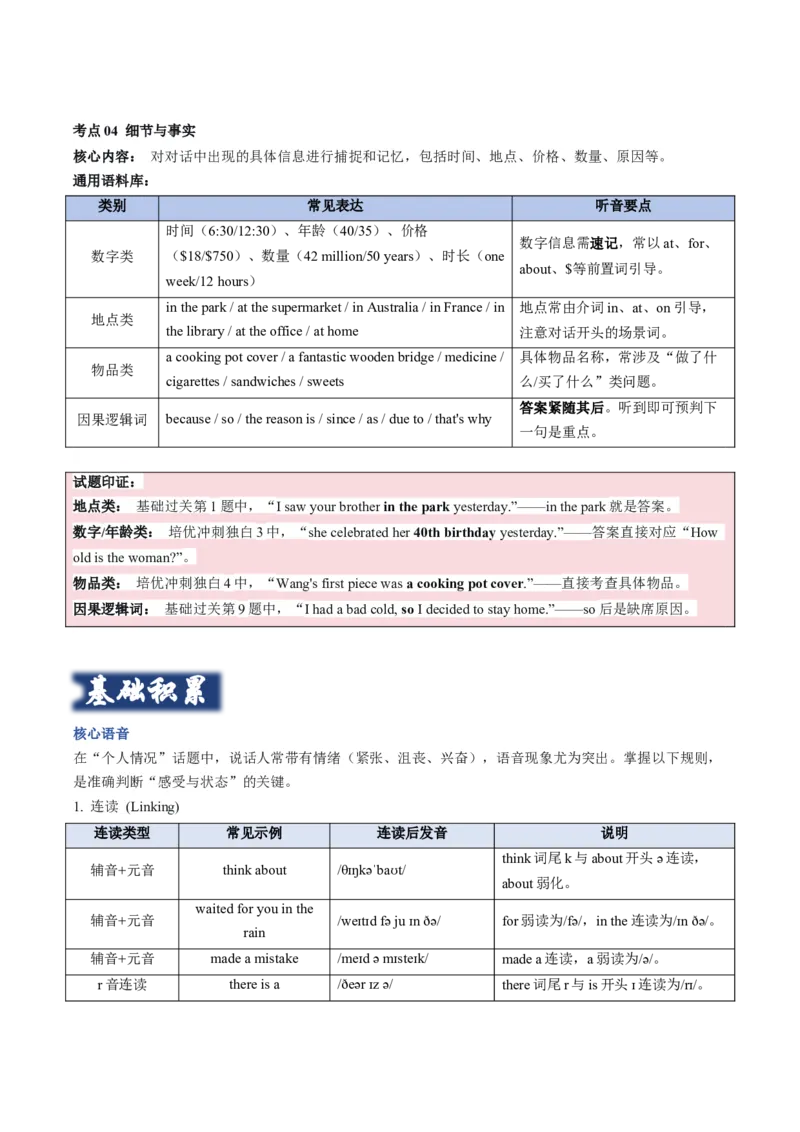
核心内容: 对对话中出现的具体信息进行捕捉和记忆,包括时间、地点、价格、数量、原因等。
通用语料库:
类别
常见表达
听音要点
数字类
时间(6:30/12:30)、年龄(40/35)、价格
($18/$750)、数量(42 million/50 years)、时长(one
week/12 hours)
数字信息需速记,常以at、for、
about、$等前置词引导。
地点类
in the park / at the supermarket / in Australia / in France / in
the library / at the office / at home
地点常由介词in、at、on 引导,
注意对话开头的场景词。
物品类
a cooking pot cover / a fantastic wooden bridge / medicine /
cigarettes / sandwiches / sweets
具体物品名称,常涉及“做了什
么/买了什么”类问题。
因果逻辑词
because / so / the reason is / since / as / due to / that's why
答案紧随其后。听到即可预判下
一句是重点。
试题印证:
地点类: 基础过关第1 题中,“I saw your brother in the park yesterday.”——in the park 就是答案。
数字/年龄类: 培优冲刺独白3 中,“she celebrated her 40th birthday yesterday.”——答案直接对应“How
old is the woman?”。
物品类: 培优冲刺独白4 中,“Wang's first piece was a cooking pot cover.”——直接考查具体物品。
因果逻辑词: 基础过关第9 题中,“I had a bad cold, so I decided to stay home.”——so 后是缺席原因。
核心语音
在“个人情况”话题中,说话人常带有情绪(紧张、沮丧、兴奋),语音现象尤为突出。掌握以下规则,
是准确判断“感受与状态”的关键。
1. 连读 (Linking)
连读类型
常见示例
连读后发音
说明
辅音+元音
think about
/θɪŋkəˈbaʊt/
think 词尾k 与about 开头ə 连读,
about 弱化。
辅音+元音
waited for you in the
rain
/weɪtɪd fə ju ɪn ðə/
for 弱读为/fə/,in the 连读为/ɪn ðə/。
辅音+元音
made a mistake
/meɪd ə mɪsteɪk/
made a 连读,a 弱读为/ə/。
r 音连读
there is a
/ðeər ɪz ə/
there 词尾r 与is 开头ɪ 连读为/rɪ/。
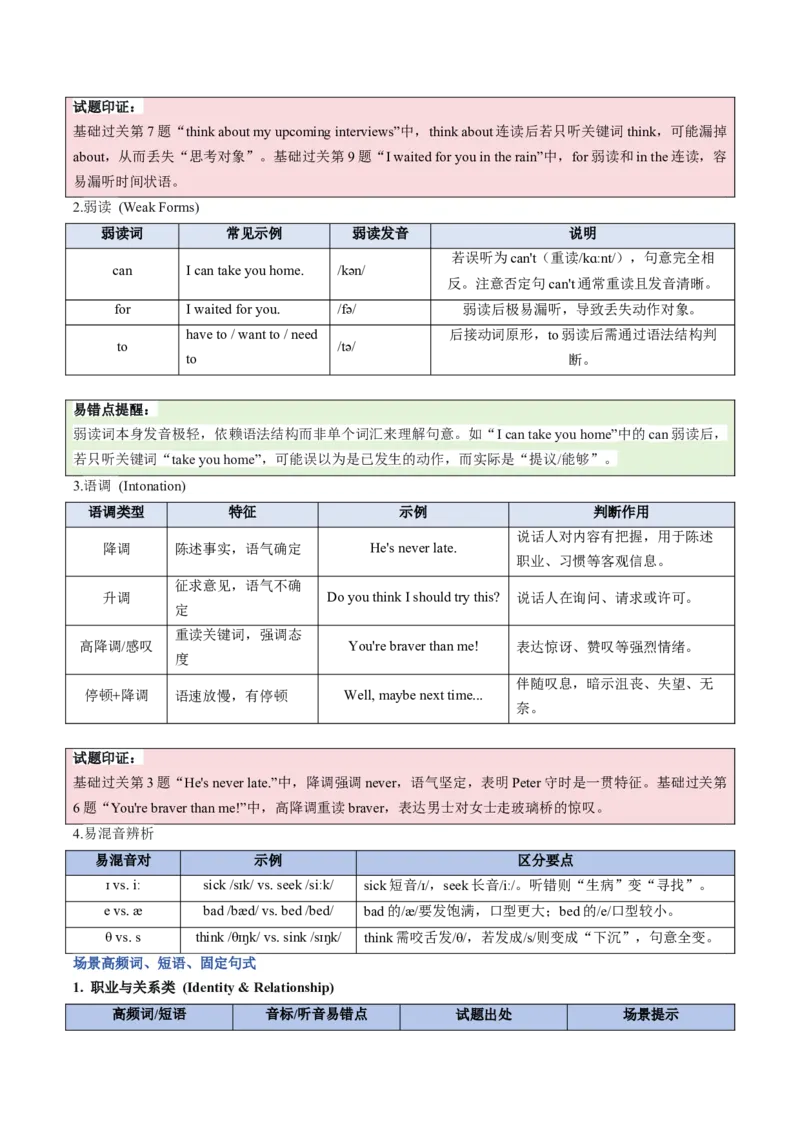
试题印证:
基础过关第7 题“think about my upcoming interviews”中,think about 连读后若只听关键词think,可能漏掉
about,从而丢失“思考对象”。基础过关第9 题“I waited for you in the rain”中,for 弱读和in the 连读,容
易漏听时间状语。
2.弱读 (Weak Forms)
弱读词
常见示例
弱读发音
说明
can
I can take you home.
/kən/
若误听为can't(重读/kɑːnt/),句意完全相
反。注意否定句can't 通常重读且发音清晰。
for
I waited for you.
/fə/
弱读后极易漏听,导致丢失动作对象。
to
have to / want to / need
to
/tə/
后接动词原形,to 弱读后需通过语法结构判
断。
易错点提醒:
弱读词本身发音极轻,依赖语法结构而非单个词汇来理解句意。如“I can take you home”中的can 弱读后,
若只听关键词“take you home”,可能误以为是已发生的动作,而实际是“提议/能够”。
3.语调 (Intonation)
语调类型
特征
示例
判断作用
降调
陈述事实,语气确定
He's never late.
说话人对内容有把握,用于陈述
职业、习惯等客观信息。
升调
征求意见,语气不确
定
Do you think I should try this?
说话人在询问、请求或许可。
高降调/感叹
重读关键词,强调态
度
You're braver than me!
表达惊讶、赞叹等强烈情绪。
停顿+降调
语速放慢,有停顿
Well, maybe next time...
伴随叹息,暗示沮丧、失望、无
奈。
试题印证:
基础过关第3 题“He's never late.”中,降调强调never,语气坚定,表明Peter 守时是一贯特征。基础过关第
6 题“You're braver than me!”中,高降调重读braver,表达男士对女士走玻璃桥的惊叹。
4.易混音辨析
易混音对
示例
区分要点
ɪ vs. iː
sick /sɪk/ vs. seek /siːk/
sick 短音/ɪ/,seek 长音/iː/。听错则“生病”变“寻找”。
e vs. æ
bad /bæd/ vs. bed /bed/
bad 的/æ/要发饱满,口型更大;bed 的/e/口型较小。
θ vs. s
think /θɪŋk/ vs. sink /sɪŋk/
think 需咬舌发/θ/,若发成/s/则变成“下沉”,句意全变。
场景高频词、短语、固定句式
1. 职业与关系类 (Identity & Relationship)
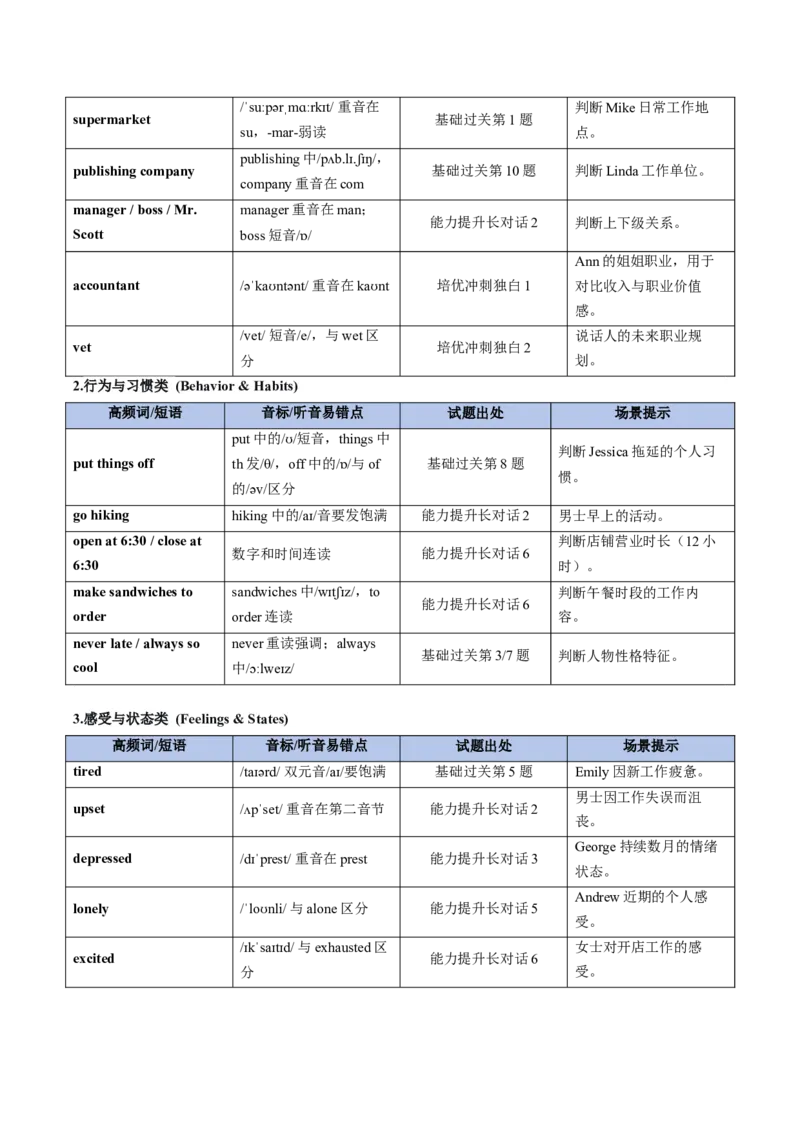
高频词/短语
音标/听音易错点
试题出处
场景提示
supermarket
/ˈsuːpərˌmɑːrkɪt/ 重音在
su,-mar-弱读
基础过关第1 题
判断Mike 日常工作地
点。
publishing company
publishing 中/pʌb.lɪ.ʃɪŋ/,
company 重音在com
基础过关第10 题
判断Linda 工作单位。
manager / boss / Mr.
Scott
manager 重音在man;
boss 短音/ɒ/
能力提升长对话2
判断上下级关系。
accountant
/əˈkaʊntənt/ 重音在kaʊnt
培优冲刺独白1
Ann 的姐姐职业,用于
对比收入与职业价值
感。
vet
/vet/ 短音/e/,与wet 区
分
培优冲刺独白2
说话人的未来职业规
划。
2.行为与习惯类 (Behavior & Habits)
高频词/短语
音标/听音易错点
试题出处
场景提示
put things off
put 中的/ʊ/短音,things 中
th 发/θ/,off 中的/ɒ/与of
的/əv/区分
基础过关第8 题
判断Jessica 拖延的个人习
惯。
go hiking
hiking 中的/aɪ/音要发饱满
能力提升长对话2
男士早上的活动。
open at 6:30 / close at
6:30
数字和时间连读
能力提升长对话6
判断店铺营业时长(12 小
时)。
make sandwiches to
order
sandwiches 中/wɪtʃɪz/,to
order 连读
能力提升长对话6
判断午餐时段的工作内
容。
never late / always so
cool
never 重读强调;always
中/ɔːlweɪz/
基础过关第3/7 题
判断人物性格特征。
3.感受与状态类 (Feelings & States)
高频词/短语
音标/听音易错点
试题出处
场景提示
tired
/taɪərd/ 双元音/aɪ/要饱满
基础过关第5 题
Emily 因新工作疲惫。
upset
/ʌpˈset/ 重音在第二音节
能力提升长对话2
男士因工作失误而沮
丧。
depressed
/dɪˈprest/ 重音在prest
能力提升长对话3
George 持续数月的情绪
状态。
lonely
/ˈloʊnli/ 与alone 区分
能力提升长对话5
Andrew 近期的个人感
受。
excited
/ɪkˈsaɪtɪd/ 与exhausted 区
分
能力提升长对话6
女士对开店工作的感
受。
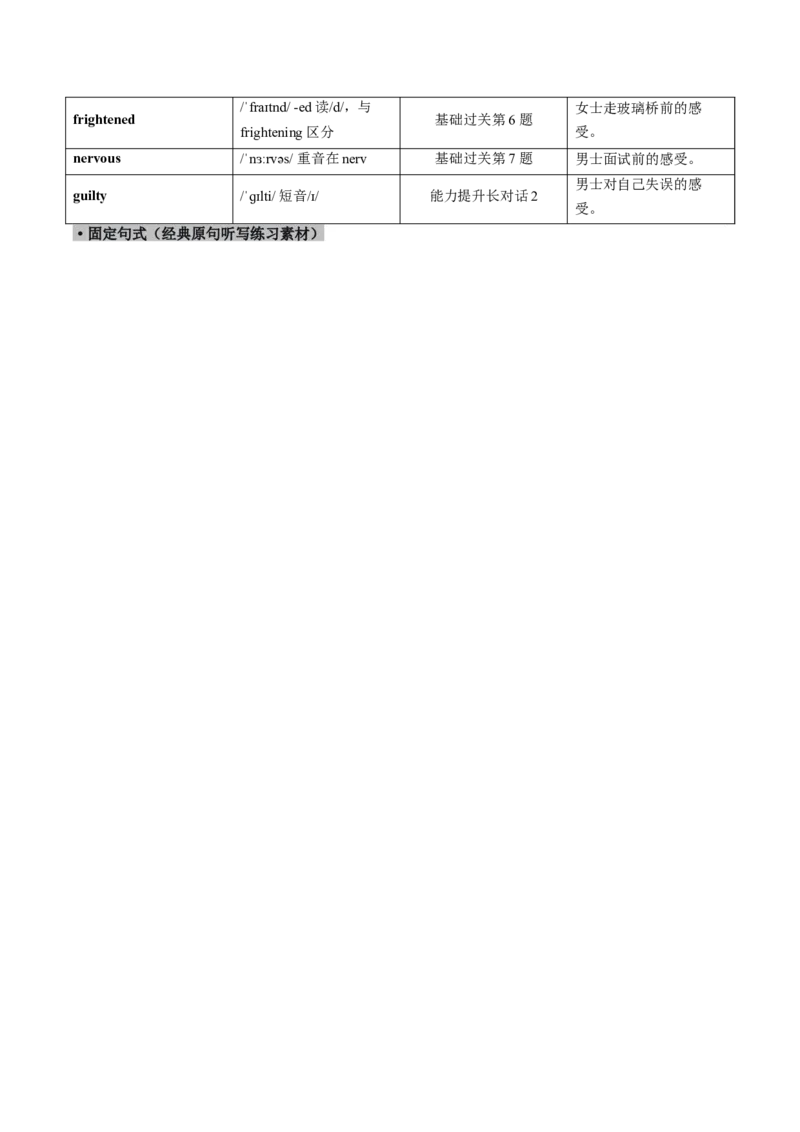
frightened
/ˈfraɪtnd/ -ed 读/d/,与
frightening 区分
基础过关第6 题
女士走玻璃桥前的感
受。
nervous
/ˈnɜːrvəs/ 重音在nerv
基础过关第7 题
男士面试前的感受。
guilty
/ˈɡɪlti/ 短音/ɪ/
能力提升长对话2
男士对自己失误的感
受。
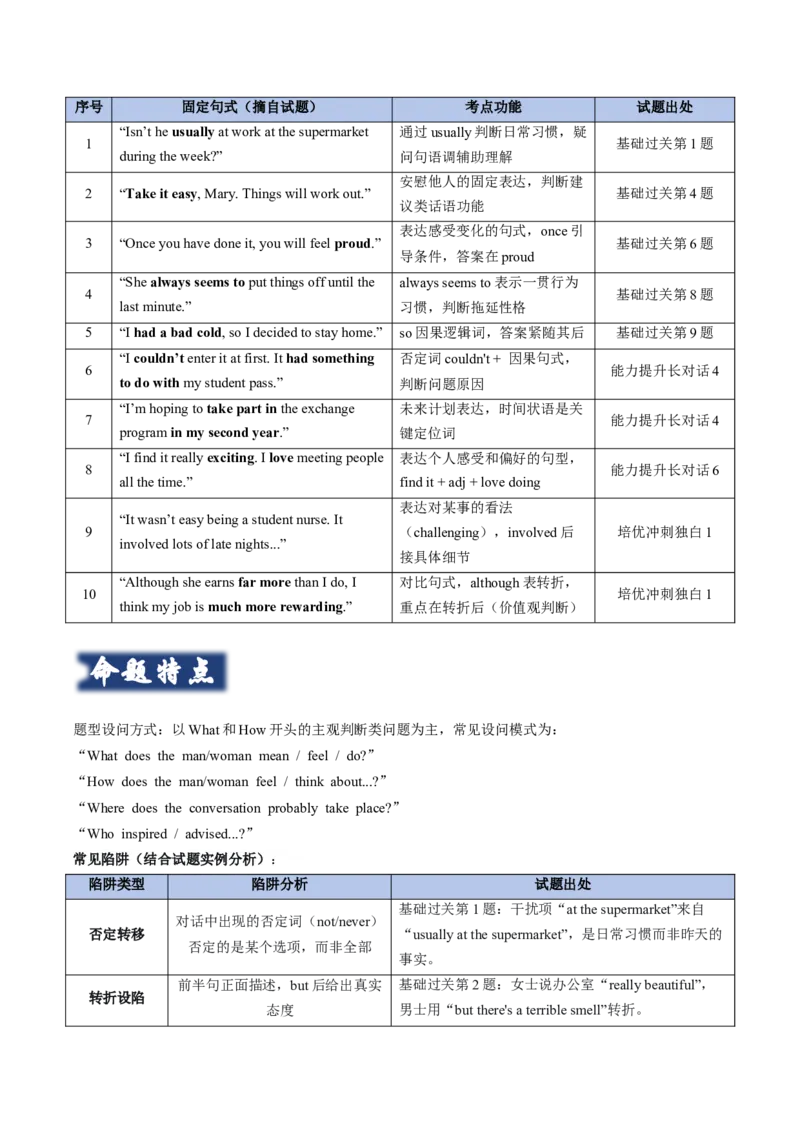
·固定句式(经典原句听写练习素材)
命题特点
序号
固定句式(摘自试题)
考点功能
试题出处
1
“Isn’t he usually at work at the supermarket
during the week?”
通过usually 判断日常习惯,疑
问句语调辅助理解
基础过关第1 题
2
“Take it easy, Mary. Things will work out.”
安慰他人的固定表达,判断建
议类话语功能
基础过关第4 题
3
“Once you have done it, you will feel proud.”
表达感受变化的句式,once 引
导条件,答案在proud
基础过关第6 题
4
“She always seems to put things off until the
last minute.”
always seems to 表示一贯行为
习惯,判断拖延性格
基础过关第8 题
5
“I had a bad cold, so I decided to stay home.”
so 因果逻辑词,答案紧随其后
基础过关第9 题
6
“I couldn’t enter it at first. It had something
to do with my student pass.”
否定词couldn't + 因果句式,
判断问题原因
能力提升长对话4
7
“I’m hoping to take part in the exchange
program in my second year.”
未来计划表达,时间状语是关
键定位词
能力提升长对话4
8
“I find it really exciting. I love meeting people
all the time.”
表达个人感受和偏好的句型,
find it + adj + love doing
能力提升长对话6
9
“It wasn’t easy being a student nurse. It
involved lots of late nights...”
表达对某事的看法
(challenging),involved 后
接具体细节
培优冲刺独白1
10
“Although she earns far more than I do, I
think my job is much more rewarding.”
对比句式,although 表转折,
重点在转折后(价值观判断)
培优冲刺独白1

题型设问方式:以What 和How 开头的主观判断类问题为主,常见设问模式为:
“What does the man/woman mean / feel / do?”
“How does the man/woman feel / think about...?”
“Where does the conversation probably take place?”
“Who inspired / advised...?”
常见陷阱(结合试题实例分析):
陷阱类型
陷阱分析
试题出处
否定转移
对话中出现的否定词(not/never)
否定的是某个选项,而非全部
基础过关第1 题:干扰项“at the supermarket”来自
“usually at the supermarket”,是日常习惯而非昨天的
事实。
转折设陷
前半句正面描述,but 后给出真实
态度
基础过关第2 题:女士说办公室“really beautiful”,
男士用“but there's a terrible smell”转折。
实战技巧
强化训练
语调误导
表面是建议,实际是安抚
基础过关第4 题:“Take it easy”表面是建议,结合语
气判断是“冷静耐心”。
张冠李戴
选项中出现对话中的人物,但张
冠李戴
培优冲刺独白1:文中出现father、teachers、cousin,
但启发Ann 的是cousin。
无中生有
利用常识设陷,文中未提及
培优冲刺独白2:选项“go to the seashore”利用圣地
亚哥靠海的常识设陷,文中只提了zoo 和
restaurants。
技巧
方法说明
试题示例
技巧1 预读问题,预测内容
扫描题干和选项,预判对话主
题
培优冲刺独白1:选项出现Her
father/Her teachers/Her cousin,预判与
“谁启发”有关。
技巧2 抓住开头,锁定基调
对话前两句交代核心事件或情
绪
能力提升长对话2 开头:“You look
really upset.”——直接定调“情绪状
态”。
技巧3 关注信号词,定位答案
because/so 后是答案,but/
however 后是真实态度
基础过关第9 题:“I had a bad
cold, so I decided to stay home.”——so
后是答案。
技巧4 辨析语气,推断言外之
意
叹气、停顿、升调重复暗示真
实态度
基础过关第4 题:男士用降调说
“Take it easy”,语气平和,意在安
抚。
技巧5 独白抓主线
按时间顺序或逻辑顺序展开
培优冲刺独白1:按14 岁受启发
告
→
诉老师
学习经历
职业感悟
→
→
时间线
展开。
技巧6 速记要点,排除干扰
用缩写/符号记录核心词
能力提升长对话4:听到English
Literature as a major→记major=Eng
Lit;exchange program in second year→
记Y2→Italy。

试题总览
 基础过关
短对话1
男士昨天见到Jane 弟弟的地点(公园),对话中提及Mike 平日工作地点(超
市)和当前状态(休假、推测即将登机)。
短对话2
男士对办公室的个人感受(有难闻气味)
短对话3
Peter 的个人性格特征(守时)
短对话4
Mary 的个人情绪(生气)及男士建议(冷静耐心)
短对话5
Emily 的个人身体状况(疲惫)及原因(新工作辛苦)
短对话6
女士走玻璃桥后的个人感受(自豪),通过男士恐高和女士说‘没人能忽视这一
点’推断她走前也害怕。
短对话7
男士面试前的个人情绪状态(紧张)
短对话8
Jessica 的个人行为习惯(拖延)
短对话9
David 未赴约的个人原因(生病)
短对话
10
女士和男士目前的职业身份与工作单位
能力提升
长对话1
Nancy 昨日缺席的个人原因(生病)、个人行程计划(回家买药)
长对话2
男士工作失误的个人经历、个人情绪感受(upset/guilty)及补救计划
长对话3
George 的个人情绪状态(depressed)与个人性格特征(changeable/independent)
长对话4
男士的专业、选课、学生证信息及第二年交换计划;女士的研究任务
长对话5
Andrew 的个人感受(lonely)、交友观念及个人交友偏好;女友是在给Andrew
提建议(以自己的经历为例)。
长对话6
女士开店的个人经历、每日工作安排、个人职业感受(excited)
培优冲刺
独白1
Ann 的职业选择动机、学习经历、对护理的看法及职业价值感
独白2
说话人对圣地亚哥的个人喜好、个人活动及未来职业规划(兽医)
独白3
Isabella White 的个人信息介绍:出生地、工作经历、职业变迁、年龄、家庭成
员
独白4
王德文的个人生平:家庭背景、学艺经历、五十年的农民生涯、为孙子做玩具及
视频走红
基础过关
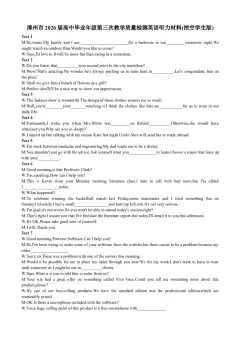
听下面10 段对话。每段对话后有一个小题,从题中所给的A、B、C 三个选项中选出最佳选项。听完每段
对话后,你都有10 秒钟的时间来回答有关小题和阅读下一小题。每段对话读两遍。
1. Where did Harry see Jane's brother yesterday?
A. At the supermarket.
B. In the park.
C. On a plane.
2. What does the man think of his office?
A. It’s bright.
B. It’s beautiful.
C. It’s smelly.
3.What does the woman say about Peter?
A. He’s always on time.
B. He’s forgetful.
C. He’s usually late.
4. What does the man advise Mary to do?
A.Go out to work.
B.Listen carefully to Henry.
C.Be calm and patient.
5. Why is Emily tired?
A. She has a hard job.
B. She opens a restaurant.
C. She does lots of overtime.
6.How did the woman probably feel before walking over the glass bridge?
A. Calm.
B. Proud.
C. Frightened.
7. How does the man feel?
A.Excited.
B.Nervous.
C.Disappointed.
8. What does the man mean?
A. Jessica will finish the paper soon.
B. Jessica is not going to write the paper.
C. Jessica seldom completes her work early.
9.Why didn’t David show up?
A. He forgot the date.
B. It was raining.
C. He was ill.
10.Where does the woman work now?
A. In a college.
B. In a company.
C. In the City Bank.
能力提升
听下面6 段对话。每段对话或独自后有几个小题,从题中所给的A、B、C 三个选项中选出最佳选项,并标
在试卷的相应位置。听每段对话前,你将有时间阅读各个小题,每小题5 秒钟;听完后,各小题将给出5
秒钟的作答时间。每段对话读两遍。
Dialogue 1
听下面一段录音,回答以下小题。
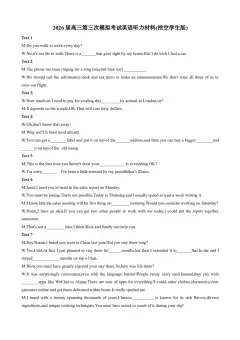
10.Why was Nancy away from school yesterday?
A.Because she was busy.
B.Because she was ill.
C.Because she was at home.
11.What is she going to do?
A.Go home.
B.Go to clinic.
C.Go to her friend’s.
12.Why will they stop on the way?
A.To buy some medicine.
B.To see a doctor.
C.To buy some food.
Dialogue 2
听下面一段录音, 回答以下小题。
10.Why is the man unhappy?
A. He made a serious mistake at work.
B. He quarreled with Mr. Scott.
C. He missed a hiking trip.
11. What does the woman think of the man?
A. Mean.
B. Careless.
C. Impolite.
12. What will the man do next?
A. Call Mr. Scott.
B. Make a complaint.
C. Contact his customer.
Dialogue 3
听下面一段录音,回答以下小题。
6. How does the woman feel?
A. Worried.
B. Depressed.
C. Disappointed.
7. What does the man suggest doing?
A. Cheering George up.
B. Leaving George alone.
C. Paying more attention to George.
Dialogue 4
听下面一段录音,回答以下小题。
14. Where does the conversation probably take place?
A. In a classroom.
B. In a library.
C. In a bookstore.
15. Why did the man need a new student pass?
A. His old photo looked different.
B. His pass was for a different building.
C. His teacher asked him to change it.
16. What does the man hope to do in his second year?
A. Study abroad.
B. Learn English Literature.
C. Change his major.
17. What will the woman do next?
A. Go back home.
B. Leave for school.
C. Work on her research.
Dialogue 5
听下面一段录音,回答以下小题。
15.How has the man been feeling lately?
A.Lonely.           B.Unhappy.     C. Depressed.
16.What does the woman advise the man to do?
A.To learn English.
B.To join a club.
C.To do exercise.
17.What can we learn from the conversation?
A.The man is the woman’s elder brother.
B.You don’t feel alone when you have a close friend.
C.The man comes from north America.
Dialogue 6
听下面一段录音,回答以下小题。
13. What does the woman mainly sell in the morning?
A. Sweets.
B. Cigarettes.
C. Sandwiches.
14. Who often comes to the shop in the daytime?
A. Housewives.
B. Restaurant workers.
C. School teachers.
15. How long is the shop open every day?
A. 6 hours.
B. 11 hours.
C. 12 hours.
16. How does the woman feel about running the shop?
A. Excited.
B. Tired.
C. Bored.
培优冲刺
Passage 1
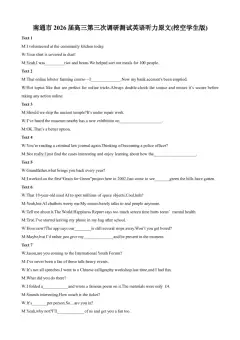
听下面一段独白,回答以下小题。
17. Who inspired Ann to be a nurse?
A. Her father.
B. Her teachers.
C. Her cousin.
18. What did Ann’s teachers advise her to do?
A. Improve her math.
B. Practice her English.
C. Focus on her biology.
19. What does Ann think of learning nursing?
A. Effortless.
B. Challenging.
C. Enjoyable.
20. What does Ann value most about her job?
A. The high pay.
B. The career prospects.
C. The sense of fulfillment.
Passage 2
听下面一段录音,回答以下小题。
17. Why does the speaker love San Diego?
A. Because it is almost sunny every day.
B. Because it is near the Pacific Ocean.
C. Because it is sometimes windy.
18. What does the speaker love to do in the summer?
A. To go to the seashore.
B To go to the zoo.
C. To sit in the sun.
19. What’s the speaker’s favourite thing about San Diego?
A. The sunny weather.
B. The animals in the zoo.
C. The restaurants of many types.
20. What will the speaker be after college?
A. A vet.
B. A teacher.
C. A businessman.
Passage 3
听下面一段录音,回答以下小题。
17. Where was the woman last month?
A. In Australia.
    B. In America.
    C. In France.
18. What was the woman’s job in France?
A. A teacher.

B. A doctor.

C. An actress.
19. How old is the woman?
A. 35.
B. 40.

C. 50.
20. What is the main point of the speech?
A. A report of a research.

B. A movie about deserts.
C. An introduction to a guest.
Passage 4
听下面一段录音,回答以下小题。
17. What is Wang Dewen famous for?
A. His woodworking skill.
B. His parenting experience.
C. His easy life.
18. What did Wang first make with wood?
A. A door.
B. A bridge.
C. A pot cover.
19. Why did Wang make wooden toys?
A. To support his family.
B. For his grandson.
C. Due to his son.
20. What is the wish of Wang’s son?
A. Publicizing the ancient Chinese skills.
B. Making his father well-known.
C. Enjoying more farm produce.