第02 讲  高考英语听力的规律与答题技巧
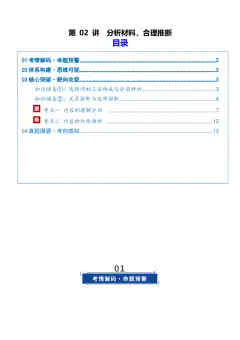
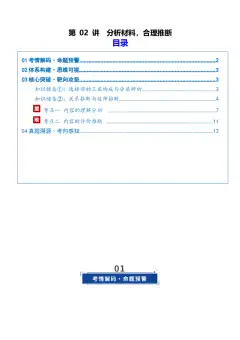
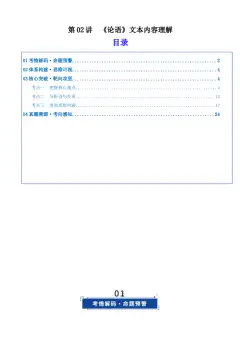
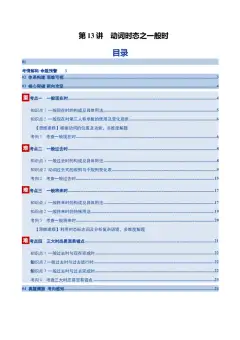
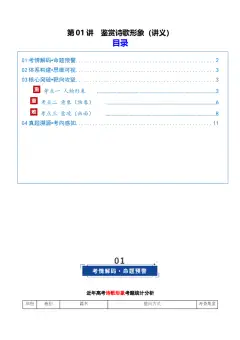
目录
01
考情解码·命题预警2
02 体系构建·思维可视.........................................................................................................................4
03 核心突破·靶向攻坚.........................................................................................................................5
考点一  听力考场上曾经的痛..................................................................................................5
考点二  听力命题热点归纳.............................................................................................................7
考点三 听力解题技巧.......................................................................................................................7
考点四 听力重点题型点拨........................................................................................................ 9
考向 听力专项演练.........................................................................................................................12
高考英语听力的规律与答题技巧
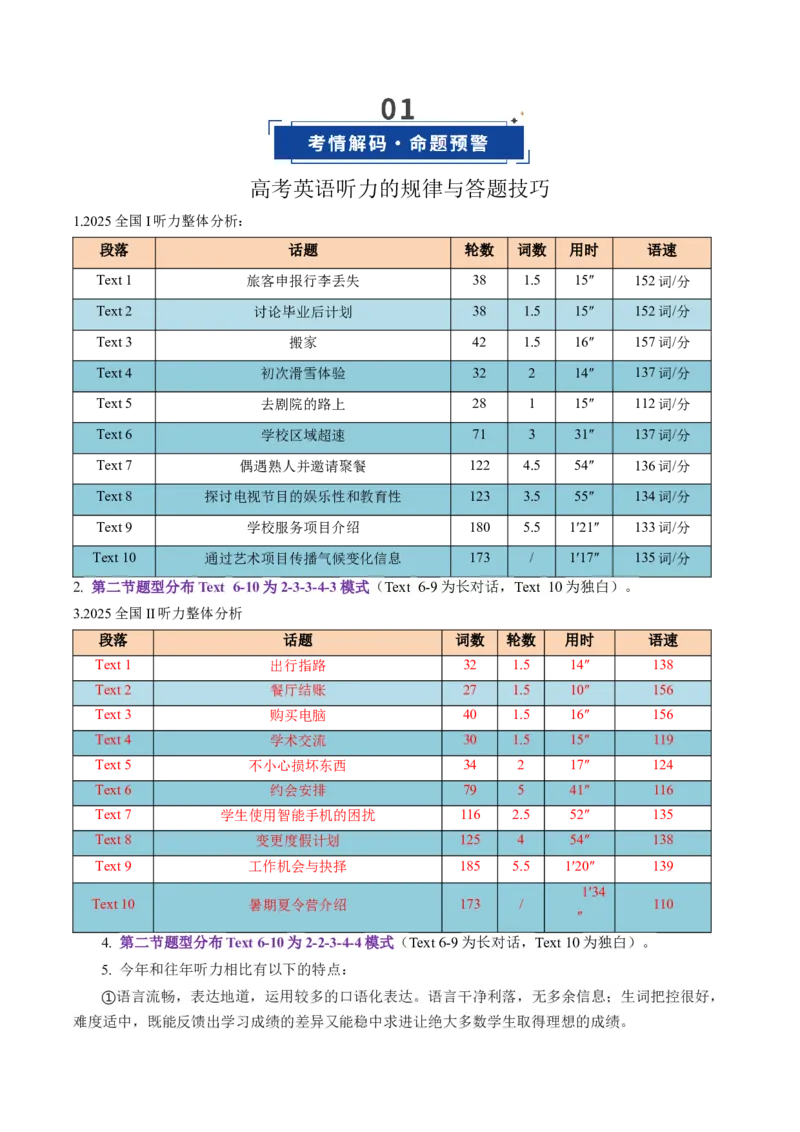
1.2025 全国I 听力整体分析:
段落
话题
轮数
词数
用时
语速
Text 1
旅客申报行李丢失
38
1.5
15″
152 词/分
Text 2
讨论毕业后计划
38
1.5
15″
152 词/分
Text 3
搬家
42
1.5
16″
157 词/分
Text 4
初次滑雪体验
32
2
14″
137 词/分
Text 5
去剧院的路上
28
1
15″
112 词/分
Text 6
学校区域超速
71
3
31″
137 词/分
Text 7
偶遇熟人并邀请聚餐
122
4.5
54″
136 词/分
Text 8
探讨电视节目的娱乐性和教育性
123
3.5
55″
134 词/分
Text 9
学校服务项目介绍
180
5.5
1′21″
133 词/分
Text 10
通过艺术项目传播气候变化信息
173
/
1′17″
135 词/分
2. 第二节题型分布Text 6-10 为2-3-3-4-3 模式(Text 6-9 为长对话,Text 10 为独白)。
3.2025 全国II 听力整体分析
段落
话题
词数
轮数
用时
语速
Text 1
出行指路
32
1.5
14″
138
Text 2
餐厅结账
27
1.5
10″
156
Text 3
购买电脑
40
1.5
16″
156
Text 4
学术交流
30
1.5
15″
119
Text 5
不小心损坏东西
34
2
17″
124
Text 6
约会安排
79
5
41″
116
Text 7
学生使用智能手机的困扰
116
2.5
52″
135
Text 8
变更度假计划
125
4
54″
138
Text 9
工作机会与抉择
185
5.5
1′20″
139
Text 10
暑期夏令营介绍
173
/
1′34
″
110
4. 第二节题型分布Text 6-10 为2-2-3-4-4 模式(Text 6-9 为长对话,Text 10 为独白)。
5. 今年和往年听力相比有以下的特点:
语言流畅,表达地道,运用较多的口语化表达。语言干净利落,无多余信息;生词把控很好,
①
难度适中,既能反馈出学习成绩的差异又能稳中求进让绝大多数学生取得理想的成绩。
话题更加贴近生活,覆盖面广,考查更全面。听力话题从学生日常生活,进阶为题材更为广泛
②
、
更为具体且新颖的话题,涉及的背景知识更多。
语速
③
正常稳定,考生有熟悉感和清晰感。
题干设置灵活度高,选项设置简短,有多个题是对原文中的句意进行了提炼,更加注重考查考
④
生对信息的推理、转换能力。
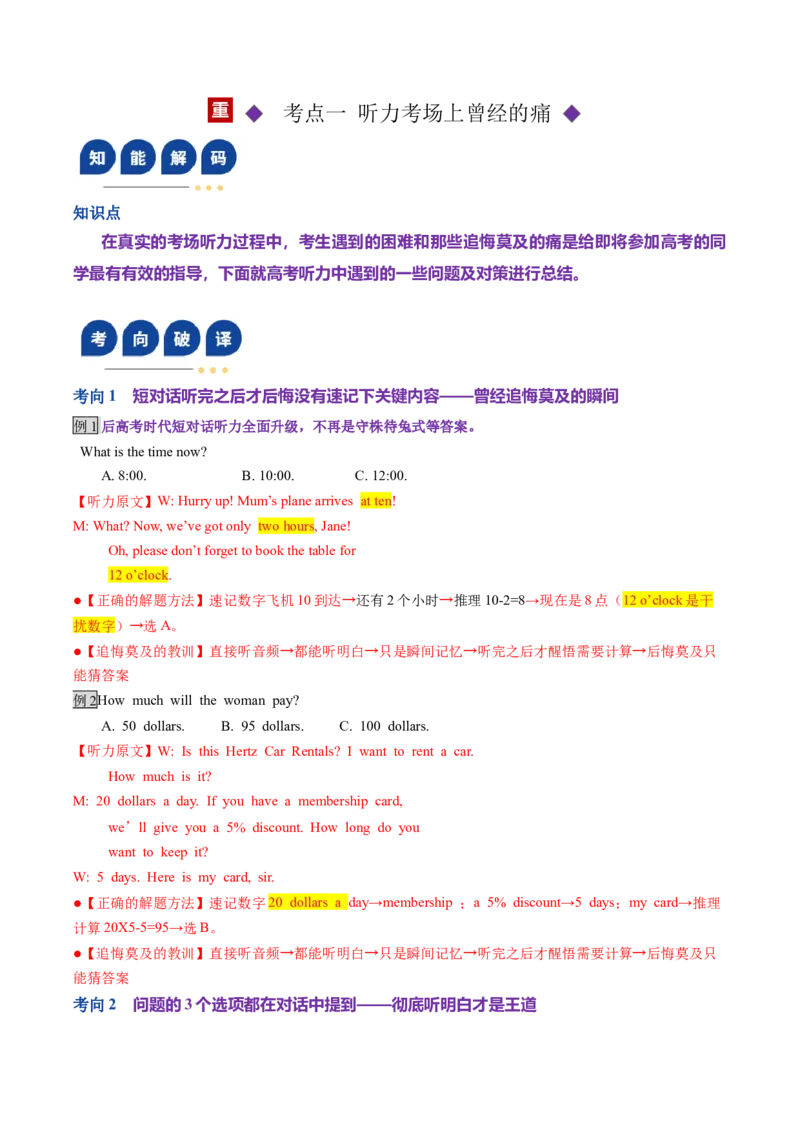
 考点一 听力考场上曾经的痛
知识点
在真实的考场听力过程中,考生遇到的困难和那些追悔莫及的痛是给即将参加高考的同
学最有有效的指导,下面就高考听力中遇到的一些问题及对策进行总结。
考向1  短对话听完之后才后悔没有速记下关键内容——曾经追悔莫及的瞬间
例1 后高考时代短对话听力全面升级,不再是守株待兔式等答案。
 What is the time now?
    A. 8:00.            B. 10:00.        C. 12:00.
【听力原文】W: Hurry up! Mum’s plane arrives at ten!
M: What? Now, we’ve got only two hours, Jane!
     Oh, please don’t forget to book the table for
     12 o’clock.
【
●
正确的解题方法】速记数字飞机10 到达→还有2 个小时→推理10-2=8→现在是8 点(12 o’clock 是干
扰数字)→选A。
●【追悔莫及的教训】直接听音频→都能听明白→只是瞬间记忆→听完之后才醒悟需要计算→后悔莫及只
能猜答案
例2How much will the woman pay?
    A. 50 dollars.     B. 95 dollars.     C. 100 dollars.
【听力原文】W: Is this Hertz Car Rentals? I want to rent a car.
     How much is it?
M: 20 dollars a day. If you have a membership card,
     we’ll give you a 5% discount. How long do you
     want to keep it?
W: 5 days. Here is my card, sir.
【
●
正确的解题方法】速记数字20 dollars a day→membership ;a 5% discount→5 days;my card→推理
计算20X5-5=95→选B。
【追悔莫及
●
的教训】直接听音频→都能听明白→只是瞬间记忆→听完之后才醒悟需要计算→后悔莫及只
能猜答案
考向2  问题的3 个选项都在对话中提到——彻底听明白才是王道
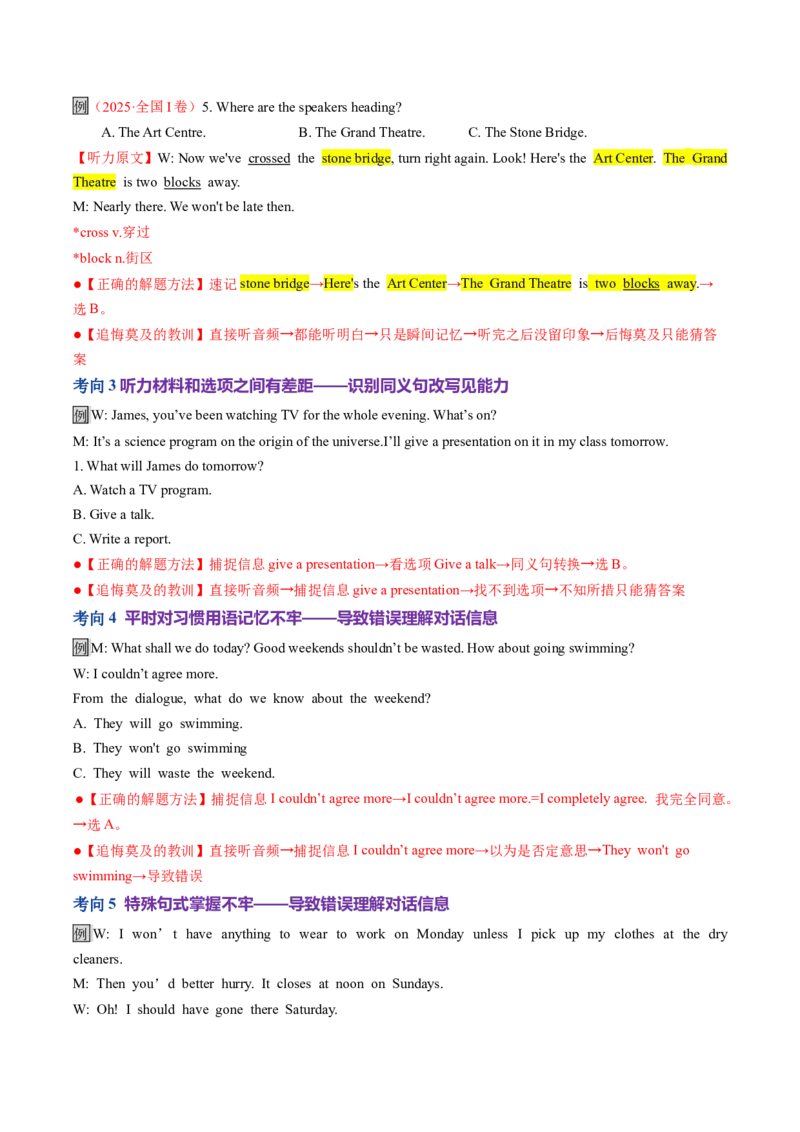
例(2025·全国I 卷)5. Where are the speakers heading?
A. The Art Centre.
B. The Grand Theatre.
C. The Stone Bridge.
【听力原文】W: Now we've crossed the stone bridge, turn right again. Look! Here's the Art Center. The Grand
Theatre is two blocks away.
M: Nearly there. We won't be late then.
*cross v.穿过
*block n.街区
【
●
正确的解题方法】速记stone bridge→Here's the Art Center→The Grand Theatre is two blocks away.→
选B。
【追悔莫及
●
的教训】直接听音频→都能听明白→只是瞬间记忆→听完之后没留印象→后悔莫及只能猜答
案
考向3 听力材料和选项之间有差距——识别同义句改写见能力
例W: James, you’ve been watching TV for the whole evening. What’s on?
M: It’s a science program on the origin of the universe.I’ll give a presentation on it in my class tomorrow.
1. What will James do tomorrow?
A. Watch a TV program.
B. Give a talk.
C. Write a report.
【
●
正确的解题方法】捕捉信息give a presentation→看选项Give a talk→同义句转换→选B。
【追悔莫及
●
的教训】直接听音频→捕捉信息give a presentation→找不到选项→不知所措只能猜答案
考向4 平时对习惯用语记忆不牢——导致错误理解对话信息
例M: What shall we do today? Good weekends shouldn’t be wasted. How about going swimming?
W: I couldn’t agree more.
From the dialogue, what do we know about the weekend?
A. They will go swimming.
B. They won't go swimming
C. They will waste the weekend.
【
●
正确的解题方法】捕捉信息I couldn’t agree more→I couldn’t agree more.=I completely agree. 我完全同意。
→选A。
【追悔莫及
●
的教训】直接听音频→捕捉信息I couldn’t agree more→以为是否定意思→They won't go
swimming→导致错误
考向5 特殊句式掌握不牢——导致错误理解对话信息
例W: I won’t have anything to wear to work on Monday unless I pick up my clothes at the dry
cleaners.
M: Then you’d better hurry. It closes at noon on Sundays.
W: Oh! I should have gone there Saturday.
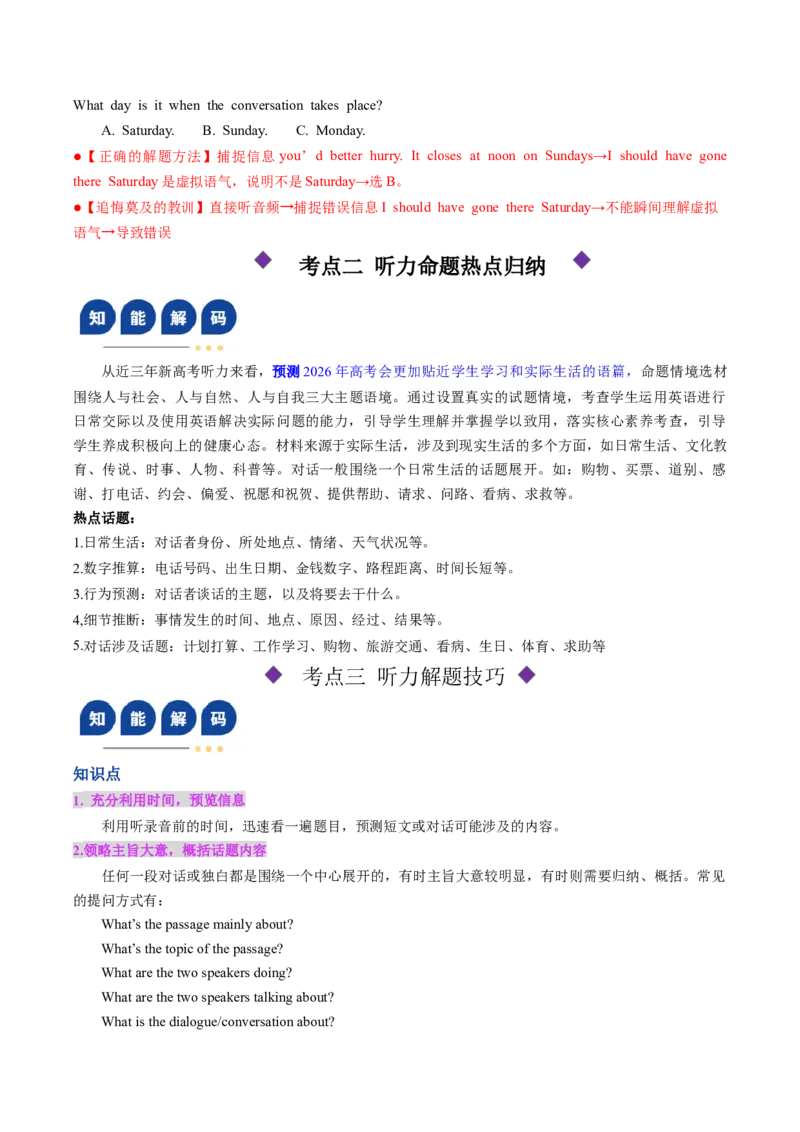
What day is it when the conversation takes place?
    A. Saturday.    B. Sunday.    C. Monday.
【
●
正确的解题方法】捕捉信息you’d better hurry. It closes at noon on Sundays→I should have gone
there Saturday 是虚拟语气,说明不是Saturday→选B。
【追悔莫及
●
的教训】直接听音频→捕捉错误信息I should have gone there Saturday→不能瞬间理解虚拟
语气→导致错误
 考点二 听力命题热点归纳

从近三年新高考听力来看,预测2026 年高考会更加贴近学生学习和实际生活的语篇,命题情境选材
围绕人与社会、人与自然、人与自我三大主题语境。通过设置真实的试题情境,考查学生运用英语进行
日常交际以及使用英语解决实际问题的能力,引导学生理解并掌握学以致用,落实核心素养考查,引导
学生养成积极向上的健康心态。材料来源于实际生活,涉及到现实生活的多个方面,如日常生活、文化教
育、传说、时事、人物、科普等。对话一般围绕一个日常生活的话题展开。如:购物、买票、道别、感
谢、打电话、约会、偏爱、祝愿和祝贺、提供帮助、请求、问路、看病、求救等。
热点话题:
1.日常生活:对话者身份、所处地点、情绪、天气状况等。
2.数字推算:电话号码、出生日期、金钱数字、路程距离、时间长短等。
3.行为预测:对话者谈话的主题,以及将要去干什么。
4,细节推断:事情发生的时间、地点、原因、经过、结果等。
5.对话涉及话题:计划打算、工作学习、购物、旅游交通、看病、生日、体育、求助等
 考点三 听力解题技巧
知识点
1. 充分利用时间,预览信息
利用听录音前的时间,迅速看一遍题目,预测短文或对话可能涉及的内容。
2.领略主旨大意,概括话题内容
任何一段对话或独白都是围绕一个中心展开的,有时主旨大意较明显,有时则需要归纳、概括。常见
的提问方式有:
What’s the passage mainly about?
What’s the topic of the passage?
What are the two speakers doing?
What are the two speakers talking about?
What is the dialogue/conversation about?
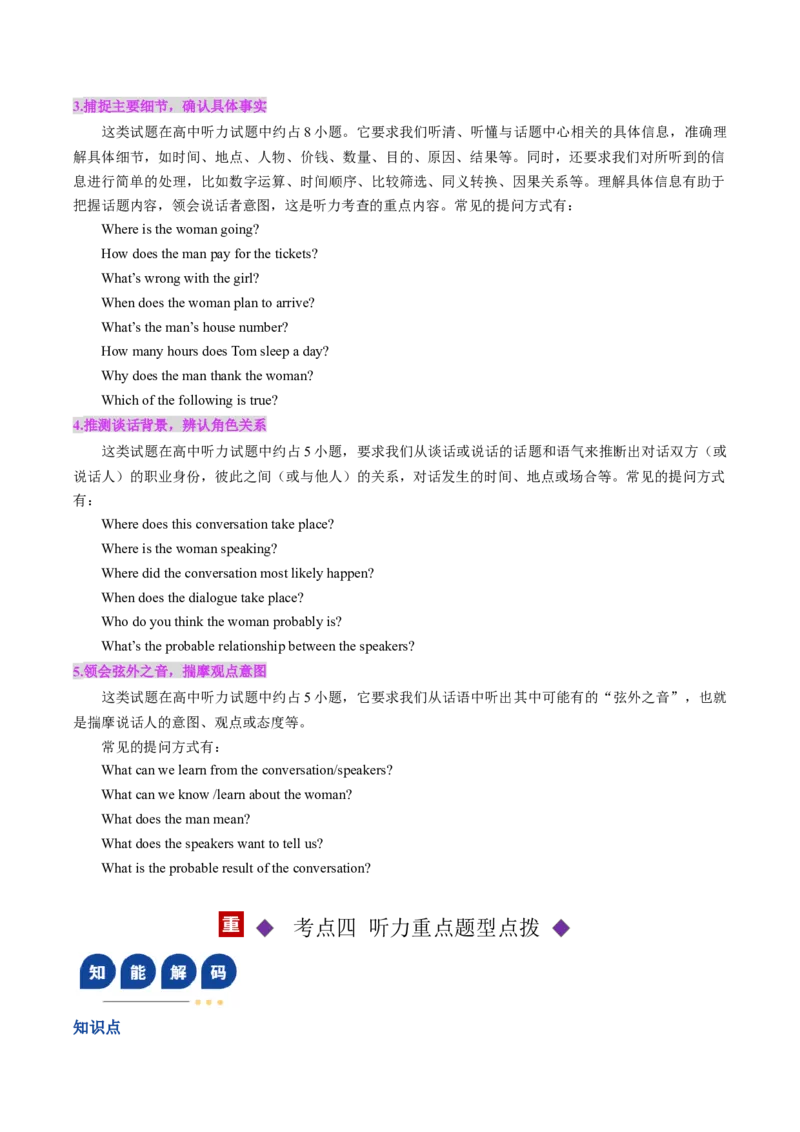
3.捕捉主要细节,确认具体事实
这类试题在高中听力试题中约占8 小题。它要求我们听清、听懂与话题中心相关的具体信息,准确理
解具体细节,如时间、地点、人物、价钱、数量、目的、原因、结果等。同时,还要求我们对所听到的信
息进行简单的处理,比如数字运算、时间顺序、比较筛选、同义转换、因果关系等。理解具体信息有助于
把握话题内容,领会说话者意图,这是听力考查的重点内容。常见的提问方式有:
Where is the woman going?
How does the man pay for the tickets?
What’s wrong with the girl?
When does the woman plan to arrive?
What’s the man’s house number?
How many hours does Tom sleep a day?
Why does the man thank the woman?
Which of the following is true?
4.推测谈话背景,辨认角色关系
这类试题在高中听力试题中约占5 小题,要求我们从谈话或说话的话题和语气来推断出对话双方(或
说话人)的职业身份,彼此之间(或与他人)的关系,对话发生的时间、地点或场合等。常见的提问方式
有:
Where does this conversation take place?
Where is the woman speaking?
Where did the conversation most likely happen?
When does the dialogue take place?
Who do you think the woman probably is?
What’s the probable relationship between the speakers?
5.领会弦外之音,揣摩观点意图
这类试题在高中听力试题中约占5 小题,它要求我们从话语中听出其中可能有的“弦外之音”,也就
是揣摩说话人的意图、观点或态度等。
常见的提问方式有:
What can we learn from the conversation/speakers?
What can we know /learn about the woman?
What does the man mean?
What does the speakers want to tell us?
What is the probable result of the conversation?
 考点四 听力重点题型点拨
知识点
1.观点与态度
此类考点主要涉及说话者对某人、某物、某事的好恶、褒贬等,主要表现为热情、冷漠、同意、反对、
同情、好奇、惊奇、悲伤、兴奋、困惑、紧张、轻松等。
题型解读:
说话者
⑴
通过语气和语调的变化表达意义和观点,反映其真实态度、情感和意图。
说话人
⑵
有时会用虚拟语气来表达自己的观点和态度。
注意说话人使用
⑶
but,however, instead , 这些词后的信息往往是考点。
熟悉口语中表示赞同或反对的
⑷
常用词。如:agree, can’t agree more, dislike, love,hate 等。
2.行为方式题
常见提问方式:
What are the speakers going to do?
①
What does the man / woman plan to do?
②
What will the man / woman most probably do?
③
What will the man / woman do first?
④
What’s the man / woman going to do?
⑤
【高分技巧】
这类对话中会出现一系列的动作,动作有先后顺序。留心选项中
⑴
和听力中每个动作及动作对应的人
和时间并做记录。
抓住对话中出现的表示动作先后顺序的连词、介词、副词,如
⑵
first, before, after, now, right now, then,
since, last 等。
注意对话中所使用的时态和重复出现的词,它们往往是答题的关键。
⑶
3.地点场景题
这类题目侧重考查谈话的地点、事件发生的地点、说话者要去的地方以及说话者来自何地等。对话或
独白中通常直接出现谈话或事件发生的地点,考生只需听清便可作答,题目相对来说比较简单。
地点题一般由
⑴
where 引出,选项一般是“介词+地点名词”构成,这类题中,有些地点会直接提
到,有些则要根据讨论的内容判断,还有些兼而有之。
此类题往往会列举一系列与时间或地点相关的细节,然后针对某一细节提问。
⑵
此类题会出现几个地点,迷惑考生,所以要一一记录。
⑶
【高分技巧】
熟悉与某特定地点或场所相关的词或短语,以此判断对话发生的地点或场所,如
⑴
boarding 一出现,
立即想到机场、码头,听见book a room 就想到旅馆等。
边听边记,善于掌握对话中的关键词。
⑵
4.意见建议题
请求与建议题的考查点一般有两种情形:甲方请求乙方帮忙或邀请乙方做某事,乙方给予肯定、否定
或考虑一下的答复;甲方遇到某种困难或麻烦,乙方给予解决的建议或措施。
常见提问方式:
What does the man / woman suggest the woman / man do?
①
What does the man / woman suggest / mean?
②
What does the man / woman want the woman / man to do?
③
What offer did the man / woman give?
④
What is the man’s / woman’s advice?
⑤
【高分技巧】
大多数情况下,第二个人谈话内容是题目重点。无论第一个人提出的是请求还是建议,第二个人的
⑴
态度和反应往往都是解题的关键。
对话中往往一方提出请求或者问题,另一方给出建议。
⑵
熟记表请求或建议的句型。
⑶
表请求:Would you please…?
Could / Would you…?
        I wonder if…
Would you like to…?
        Would you mind…?
Can / Shall I…?
表建议:Why don’t you / we…?
Why not…?
        If I were you, I’d….
You’ll have to… / get to…
You’d better…
How / What about…?
        You might as well…
5.因果关系题
这类试题大多针对事件的原因或做事的目的进行提问。在对话中,一般由第二个人说出原因或
目的
因此考生通常要把注意力放在第二个人答话的内容上;有时第一个人也会直接表明原因或目的,故考生也
不可忽视其话语中的信息。
常见提问方式:
Why?
①
What’s the reason for…?
②
What is the cause of…?
③
For what purpose did he / she…?
④
对话中出现一些表因果关系的标志性词。
⑴
大部分因果关系表达不会直接出现信号词,而是比较含蓄,往往先肯定地表明赞同的态度,然后利
⑵
用转折说出直接原因,如I’d love to…, but…; I wish I would, but…。
【高分技巧】
1.对话另一方的猜测 (回答同意与否)
W: Then what happened? Did you have a quarrel with your friends?
M: Don't worry Mom. It pours outside and I forget to take an umbrella.
2.言外之意(同义词替换,同意转化).
I was about to answer but the phone was dead. (was out of power).
3.理清易误解选项 (选择加表态)
W: You went to so early last night. Were you feeling tired or ill?
M:Neither. I couldn't stand the coldness in the living room.
4.补充隐藏信息
Why does the girl stand outside?A. Her mother isn’t at home. 没人开门
A.
She fails the exam.不敢回家  C. She loses the key.打不开门
M: Why are you standing outside again? Is your key lost or isn't Mom at home? W. The key is in my pocket and
Mommy is at home, but ...
M: Oh, I see. You failed your exam again.
W: You are really a mind reader, Dad.
5.考查重点在原因,一般由对话中的第二个人说出。
6.熟悉表因果的词:because, since, for, as, so, cause, because of, now that, due to, thanks to, owing to, as a result
of, give rise to, result in, result from, so that, be responsible for, such…that…
6.人物关系题
常考的人物关系:父子/女、母子/女、夫妻、师生、老板与秘书、同学、同事、服务员与顾客、医生
与病人、管理员与借阅者、房东与租客等。
【高分技巧】
抓住对话中与职业身份相关的关键词、术语、环境。
⑴
注意两人的语气、口吻、亲密度。
⑵
对话中往往不直接说出某人身份,要求从对话中判断
⑶
,例如对话中的称呼语。
7.数字细节题
高考听力试题中涉及的时间与数字主要包括时刻、年份、年龄、距离、速度、价格、尺寸、数量、号
码等。少数试题会在材料中直接给出时间或数字,考生只需听出问题所问的时间或数字便可轻松作答。多
数题目则需要进行简单的运算,这就要求考生不仅要听清时间或数字,还要弄清时间或数字之间的关系。
常见提问方式:
How much / many…?
①
How far…?
②
How long…?
③
What time…?
④
When…?
⑤
该类题常常涉及时间、日期、价格、年龄、距离、速度、电话号码等。
⑴
出题形式为数字辨析和计算。
⑵
对话中常出现易混淆的数字,如
⑶
fourteen 和forty。
出现与数字运算有关的词,如:
⑷
double, twice, couple, times, quarter, divide, add up to 等。
【高分技巧】
边听边记录数字。
⑴
注意数字的单位。
⑵
⑶掌握数字的读法。
8.方式与方法
方式与方法题主要涉及说话者如何做某事或者打算如何做某事、采用何种方式或方法达到某种效果或
目的。此类试题有个很明显的特征,即大多用how 进行提问。
【浙江卷】
How does the woman go to work this week?
A. By car.
B. By bike.
C. On foot.
【听力原文】
M: If I were you, I'd just walk to work. It would take you about 20 minutes. Riding a bike is a good choice, too.
W:I agree. But this week my husband is away on business, so I have to drive my kids to school before I go to work.
I'm pressed for time, you know.
【解析】
本题考查女士这周去上班的交通方式。对话中女士说本周她的丈夫出差,所以她必须在上班前开车送孩子
们去上学,意思就是她要开车上班,故A 项正确。
听力专项演练
一、听力选择题
(地点推测3 个短对话,1 个长对话,一个独白)
1.Where does the conversation most probably take place?
A.In a library.
B.At a bookstore.
C.In a museum.
2.Where does the conversation probably take place?
3.Where does the conversation probably take place?
A.At a zoo.
B.In a library.
C.In a drugstore.
听下面一段较长对话,回答以下小题。
4.Where does the conversation probably take place?
A.In a library.
B.In a classroom.
C.On a playing field
5.What subject does the man need help with?
A.History.
B.Math.
C.English.
6.Why was the man away from school for a while?
A.He took a holiday.
B.He broke his leg.
C.He went for football training.
听下面一段独白,回答以下小题。
7.What is the purpose of the talk?
A.To present a prize.
B.To introduce a lecturer.
C.To recommend a book
8.Where is Russel working now?
A.In Oxford
B.In Chicago
C.In Virginia
9.What does Russel think of sleep?
A.It’s seldom studied
B.It’s just a waste of time
C.It’s of great importance
(观点态度3 个短对话,1 个长对话,一个独白)
10.What is the man’s attitude about the suggestion?
A.He thinks that is a good idea.
B.He accepts it willingly.
C.He accepts it unwillingly.
11.What is the man’s attitude towards the news?
A.Agreeable.
B.Unconcerned.
C.Objecting.
12.What is the woman’s attitude towards the man’s plan?
A.Shocked.
B.Envious.
C.Disappointed.
听下面一段较长对话,回答以下小题。
13.Why does Cathy want to quit her job?
A.She’ll join another firm.
B.She’ll run her own business.
C.She’s fed up with it.
14.What is Mark’s attitude towards Cathy’s decision?
A.Forgiving.
B.Sympathetic.
C.Supportive.
15.What might Cathy do for the present company?
A.Apply for a project.
B.Train a new person.
C.Recommend an engineer.
听下面一段独白,回答以下小题。
16.What can we learn about Jay Chou?
A.He is very stupid.
B.He is a talented writer.
C.He is good at playing the piano.
17.What is the speaker’s attitude toward the concert?
A.Very positive.
B.Really disappointed.
C.Totally unconcerned.
18.Where did the speaker buy the CD?
A.In the stadium.
B.Outside the stadium.
C.At school.
19.What did the woman find on the CD?
A.More than 300 photos. B.More than 300 songs.
C.Nothing.
(人物关系4 个短对话,1 个长对话)
20.What is the relationship between the speakers?
A.Colleges.
B.Classmates.
C.Strangers.
21.What is the probable relationship between the speakers?
A.Classmates.
B.Teacher and student.
C.Doctor and patient.
22.What is the probable relationship between the speakers?
A.Colleagues.
B.Brother and sister.
C.Teacher and student.
23.What is the relationship between the speakers?
A.Teacher and student.
B.School friends.
C.Fellow workers.
听下面一段较长对话,回答以下小题。
24.Why did Sarah make the phone call?
A.To ask a favor.
B.To pass on a message.
C.To make an appointment.
25.Where is Sarah now?
A.In Brighton.
B.At her home.
C.At the Shelton Hotel.
26.What time is Michael leaving his place tomorrow morning?
A.At 7: 40.
B.At 8: 00.
C.At 8: 20.
27.What is the probable relationship between John and Sarah?
A.Neighbors.
B.Fellow workers.
C.Husband and wife.
(职业推测4 个短对话,1 个长对话)
28.What does the man do?
A.He’s a tailor.
B.He’s a waiter.
C.He’s a shop assistant.
29.Who is the man probably?
A.A policeman.
B.A gas station clerk.
C.A driving coach.
30.What is the woman’s daughter?
A.She is an engineer.
B.She is a musician.
C.She is a university student.
31.What does the woman want to be?
A.A bank clerk.
B.A nurse.
C.A doctor.
听下面一段较长对话,回答以下小题。
32.Why does Bill look troubled?
A.He is short of money.
B.He is facing a tough choice.
C.He has made a big mistake.
33.What is Bill now?
A.A college student.
B.An army officer.
C.A computer engineer.
34.What does the woman seem to suggest Bill do?
A.Learn to repair cars.
B.Ask his uncle for advice.
C.Refuse the job offer.
(主旨大意3 个短对话,1 个长对话,一个独白)
35.What are the speakers mainly talking about?
A.A wedding.
B.A memory.
C.Some money.
36.What are the speakers mainly talking about?
A.A game.
B.A play.
C.A movie.
37.What are the speakers mainly talking about?
A.An art museum.
B.A painting.
C.An artist.
听下面一段较长对话,回答以下小题。
38.Who are the speakers?
A.Teacher and student.
B.A couple.
C.Friends.
39.What are the speakers mainly talking about?
A.Whether kids should work for pocket money.
B.How kids can balance work and study.
C.What kids can do at home.
40.What did the man do when he was young?
A.He washed the dishes.
B.He worked on a farm.
C.He delivered newspapers.
41.What is the woman’s attitude towards sleep for young people?
A.They have too much sleep.
B.They should have enough sleep.
C.They should go to bed early.
听下面一段独白,回答以下小题。
42.What is mainly talked about in the programme?
A.How to purchase healthy goldfish.
B.How to keep goldfish scientifically.
C.How to choose goldfish containers.
43.What should we keep in mind when raising goldfish?
A.Feed them as much as possible.
B.Complete water changes are need.
C.Decorate the tank with smooth objects.
44.How many pieces of tips are given by the speakers?
A.Two.
B.Three.
C.Four.