文档文本内容
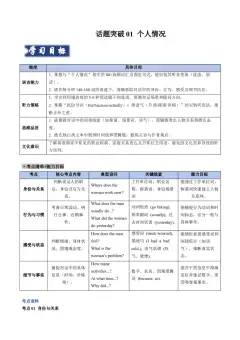
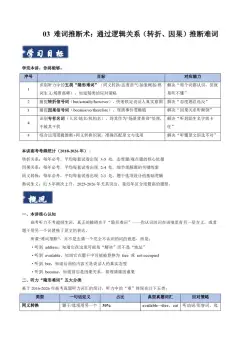
学习目标
概况
基础积累
07 日常生活微场景:个人情况与社会关系
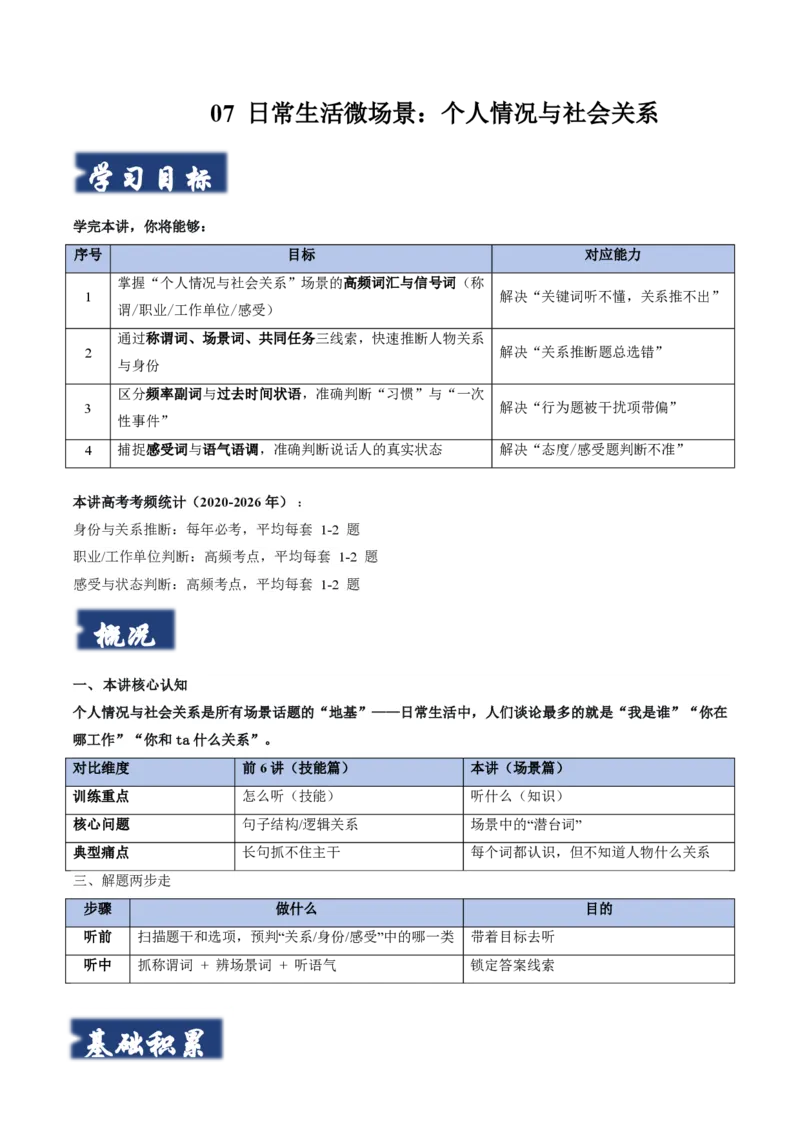
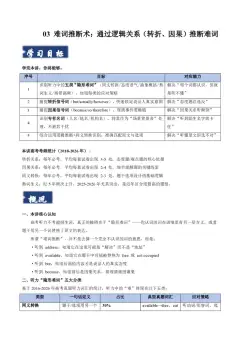
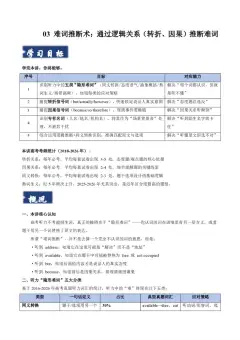
学完本讲,你将能够:
序号
目标
对应能力
1
掌握“个人情况与社会关系”场景的高频词汇与信号词(称
谓/职业/工作单位/感受)
解决“关键词听不懂,关系推不出”
2
通过称谓词、场景词、共同任务三线索,快速推断人物关系
与身份
解决“关系推断题总选错”
3
区分频率副词与过去时间状语,准确判断“习惯”与“一次
性事件”
解决“行为题被干扰项带偏”
4
捕捉感受词与语气语调,准确判断说话人的真实状态
解决“态度/感受题判断不准”
本讲高考考频统计(2020-2026 年) :
身份与关系推断:每年必考,平均每套 1-2 题
职业/工作单位判断:高频考点,平均每套 1-2 题
感受与状态判断:高频考点,平均每套 1-2 题
一、本讲核心认知
个人情况与社会关系是所有场景话题的“地基”——日常生活中,人们谈论最多的就是“我是谁”“你在
哪工作”“你和ta 什么关系”。
对比维度
前6 讲(技能篇)
本讲(场景篇)
训练重点
怎么听(技能)
听什么(知识)
核心问题
句子结构/逻辑关系
场景中的“潜台词”
典型痛点
长句抓不住主干
每个词都认识,但不知道人物什么关系
三、解题两步走
步骤
做什么
目的
听前
扫描题干和选项,预判“关系/身份/感受”中的哪一类
带着目标去听
听中
抓称谓词 + 辨场景词 + 听语气
锁定答案线索
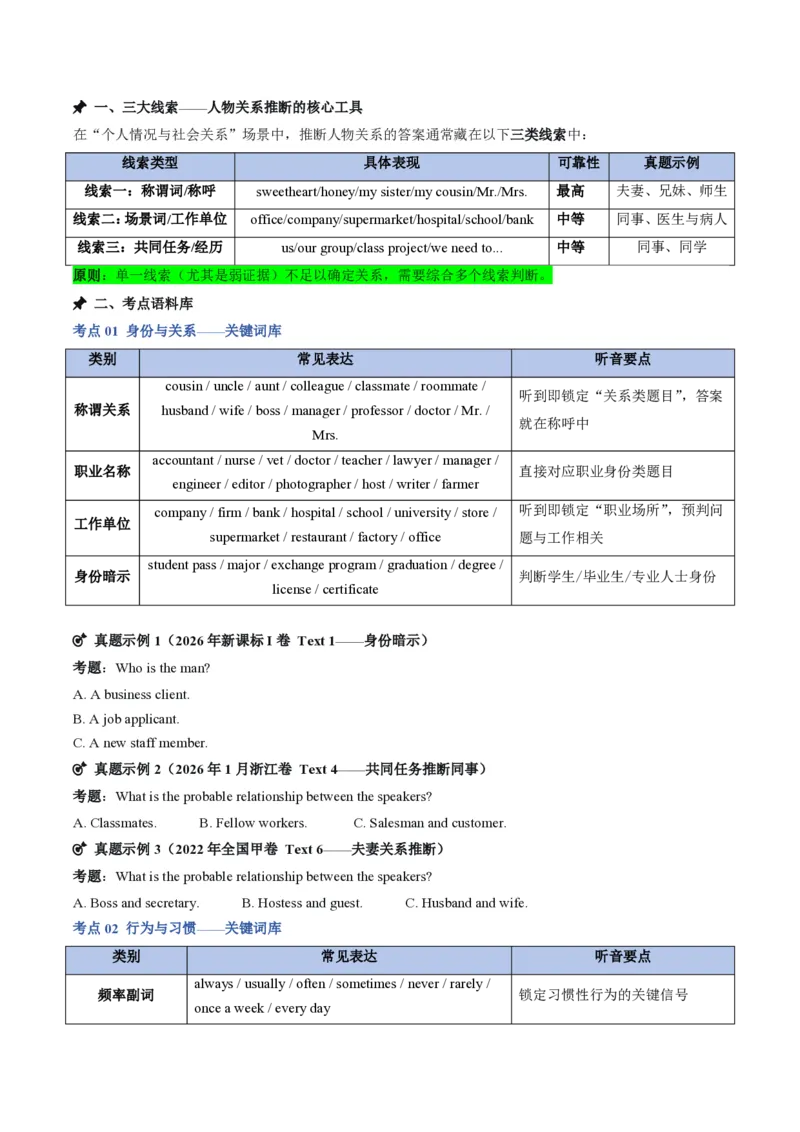
📌 一、三大线索——人物关系推断的核心工具
在“个人情况与社会关系”场景中,推断人物关系的答案通常藏在以下三类线索中:
线索类型
具体表现
可靠性
真题示例
线索一:称谓词/称呼
sweetheart/honey/my sister/my cousin/Mr./Mrs.
最高
夫妻、兄妹、师生
线索二:场景词/工作单位
office/company/supermarket/hospital/school/bank
中等
同事、医生与病人
线索三:共同任务/经历
us/our group/class project/we need to...
中等
同事、同学
原则:单一线索(尤其是弱证据)不足以确定关系,需要综合多个线索判断。
📌 二、考点语料库
考点01 身份与关系——关键词库
类别
常见表达
听音要点
称谓关系
cousin / uncle / aunt / colleague / classmate / roommate /
husband / wife / boss / manager / professor / doctor / Mr. /
Mrs.
听到即锁定“关系类题目”,答案
就在称呼中
职业名称
accountant / nurse / vet / doctor / teacher / lawyer / manager /
engineer / editor / photographer / host / writer / farmer
直接对应职业身份类题目
工作单位
company / firm / bank / hospital / school / university / store /
supermarket / restaurant / factory / office
听到即锁定“职业场所”,预判问
题与工作相关
身份暗示
student pass / major / exchange program / graduation / degree /
license / certificate
判断学生/毕业生/专业人士身份
🎯 真题示例1(2026 年新课标I 卷 Text 1——身份暗示)
考题:Who is the man?
A. A business client.
B. A job applicant.
C. A new staff member.
🎯 真题示例2(2026 年1 月浙江卷 Text 4——共同任务推断同事)
考题:What is the probable relationship between the speakers?
A. Classmates.   B. Fellow workers.    C. Salesman and customer.
🎯 真题示例3(2022 年全国甲卷 Text 6——夫妻关系推断)
考题:What is the probable relationship between the speakers?
A. Boss and secretary.   B. Hostess and guest.   C. Husband and wife.
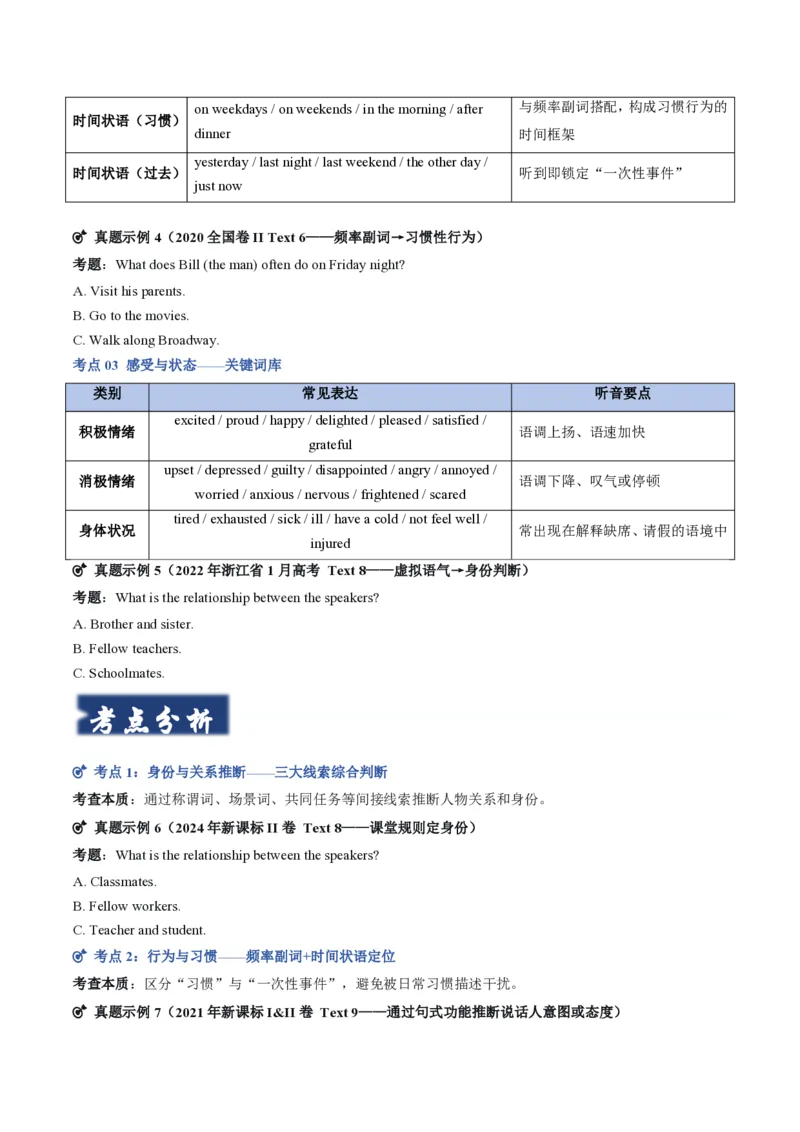
考点02 行为与习惯——关键词库
类别
常见表达
听音要点
频率副词
always / usually / often / sometimes / never / rarely /
once a week / every day
锁定习惯性行为的关键信号
考点分析
时间状语(习惯)
on weekdays / on weekends / in the morning / after
dinner
与频率副词搭配,构成习惯行为的
时间框架
时间状语(过去)
yesterday / last night / last weekend / the other day /
just now
听到即锁定“一次性事件”
🎯 真题示例4(2020 全国卷II Text 6——频率副词→习惯性行为)
考题:What does Bill (the man) often do on Friday night?
A. Visit his parents.
B. Go to the movies.
C. Walk along Broadway.
考点03 感受与状态——关键词库
类别
常见表达
听音要点
积极情绪
excited / proud / happy / delighted / pleased / satisfied /
grateful
语调上扬、语速加快
消极情绪
upset / depressed / guilty / disappointed / angry / annoyed /
worried / anxious / nervous / frightened / scared
语调下降、叹气或停顿
身体状况
tired / exhausted / sick / ill / have a cold / not feel well /
injured
常出现在解释缺席、请假的语境中
🎯 真题示例5(2022 年浙江省1 月高考 Text 8——虚拟语气→身份判断)
考题:What is the relationship between the speakers?
A. Brother and sister.
B. Fellow teachers.
C. Schoolmates.
🎯 考点1:身份与关系推断——三大线索综合判断
考查本质:通过称谓词、场景词、共同任务等间接线索推断人物关系和身份。
🎯 真题示例6(2024 年新课标II 卷 Text 8——课堂规则定身份)
考题:What is the relationship between the speakers?
A. Classmates.
B. Fellow workers.
C. Teacher and student.
🎯 考点2:行为与习惯——频率副词+时间状语定位
考查本质:区分“习惯”与“一次性事件”,避免被日常习惯描述干扰。
🎯 真题示例7(2021 年新课标I&II 卷 Text 9——通过句式功能推断说话人意图或态度)
解题技巧
强化训练
考题:14. Why did Sarah (the woman) make the phone call?
A. To ask a favor.
B. To pass on a message.
C. To make an appointment.
🎯 考点3:感受与状态——语气语调+间接暗示推断
考查本质:通过语气语调、比喻性表达、生理反应描述等间接线索推断说话人的真实感受。
🎯 真题示例8(2026 年新课标II 卷 Text 7——生理反应推断紧张)
考题:How did Alex (the man) feel before climbing?
A. Deeply regretful.
B. Quite embarrassed.
C. Fairly nervous.
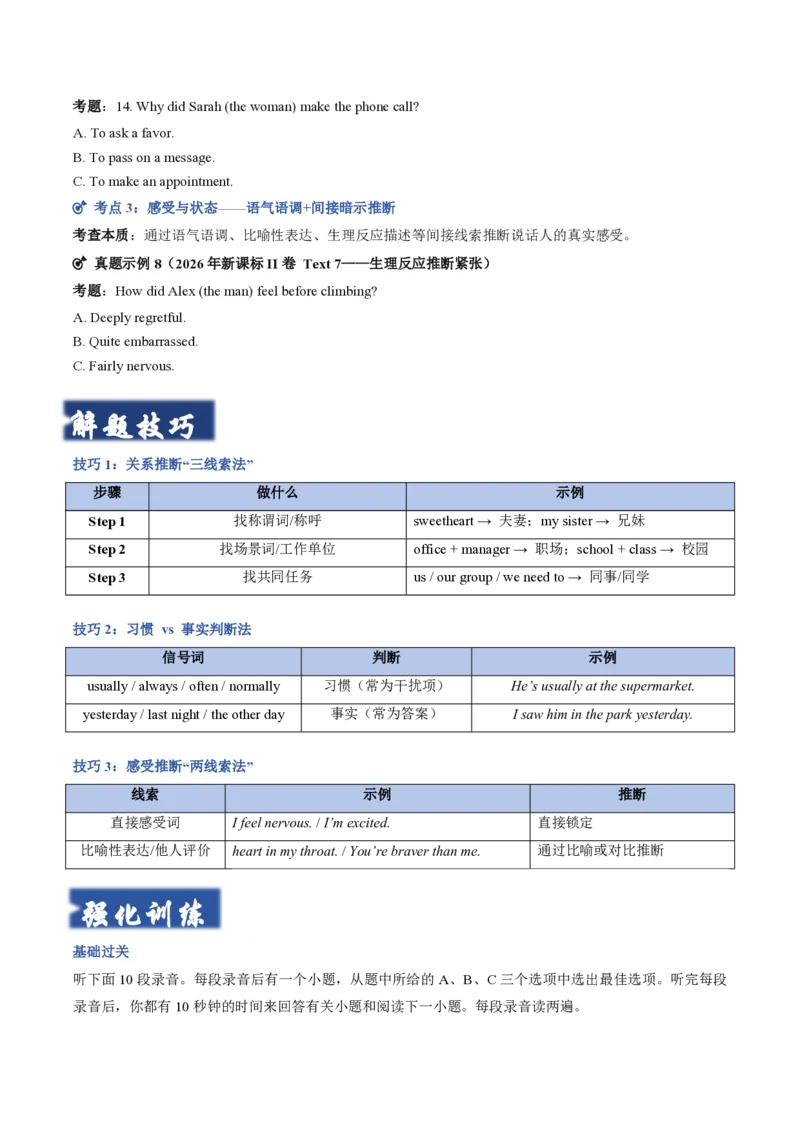
技巧1:关系推断“三线索法”
步骤
做什么
示例
Step 1
找称谓词/称呼
sweetheart → 夫妻;my sister → 兄妹
Step 2
找场景词/工作单位
office + manager → 职场;school + class → 校园
Step 3
找共同任务
us / our group / we need to → 同事/同学
技巧2:习惯 vs 事实判断法
信号词
判断
示例
usually / always / often / normally
习惯(常为干扰项)
He’s usually at the supermarket.
yesterday / last night / the other day
事实(常为答案)
I saw him in the park yesterday.
技巧3:感受推断“两线索法”
线索
示例
推断
直接感受词
I feel nervous. / I’m excited.
直接锁定
比喻性表达/他人评价
heart in my throat. / You’re braver than me.
通过比喻或对比推断
基础过关
听下面10 段录音。每段录音后有一个小题,从题中所给的A、B、C 三个选项中选出最佳选项。听完每段
录音后,你都有10 秒钟的时间来回答有关小题和阅读下一小题。每段录音读两遍。
1. Where did Harry see Jane’s brother yesterday?
A. At the supermarket.
B. In the park.
C. On a plane.
2. What does the man think of his office?
A. It’s bright.
B. It’s beautiful.
C. It’s smelly.
3.What does the woman say about Peter?
A. He’s always on time.
B. He’s forgetful.
C. He’s usually late.
4. What does the man advise Mary to do?
A. Go out to work.
B. Listen carefully to Henry.
C. Be calm and patient.
5. Why is Emily tired?
A. She has a hard job.
B. She opens a restaurant.
C. She does lots of overtime.
6.How did the woman probably feel before walking over the glass bridge?
A. Calm.
B. Proud.
C. Frightened.
7. How does the man feel?
A. Excited.
B. Nervous.
C. Disappointed.
8. What does the man mean?
A. Jessica will finish the paper soon.
B. Jessica is not going to write the paper.
C. Jessica seldom completes her work early.
9.Why didn’t David show up?
A. He forgot the date.
B. It was raining.
C. He was ill.
10.Where does the woman work now?
A. In a college.
B. In a company.
C. In the City Bank.
能力提升
听下面5 段录音。每段录音后有几个小题,从题中所给的A、B、C 三个选项中选出最佳选项,并标在试卷
的相应位置。听每段对话前,你将有时间阅读各个小题,每小题5 秒钟;听完后,各小题将给出5 秒钟的
作答时间。每段录音读两遍。
Dialogue 1
听下面一段录音,回答第8 至10 小题。
8. Why was Nancy away from school yesterday?
A. Because she was busy.
B. Because she was ill.
C. Because she was at home.
9. What is she going to do?
A. Go home.
B. Go to clinic.
C. Go to her friend’s.
10. Why will they stop on the way?
A. To buy some medicine.
B. To see a doctor.
C. To buy some food.

Dialogue 2
听下面一段录音, 回答第8 至10 小题。
8.Why is the man unhappy?
A. He made a serious mistake at work.
B. He quarreled with Mr. Scott.
C. He missed a hiking trip.
9. What does the woman think of the man?
A. Mean.
B. Careless.
C. Impolite.
10. What will the man do next?
A. Call Mr. Scott.
B. Make a complaint.
C. Contact his customer.

Dialogue 3
听下面一段录音,回答6、7 小题。
6. How does the woman feel?
A. Worried.
B. Depressed.
C. Disappointed.
7. What does the man suggest doing?
A. Cheering George up.
B. Leaving George alone.
C. Paying more attention to George.
Dialogue 4
听下面一段录音,回答第14 至17 小题。
14. Where does the conversation probably take place?
A. In a classroom.
B. In a library.
C. In a bookstore.
15. Why did the man need a new student pass?
A. His old photo looked different.
B. His pass was for a different building.
C. His teacher asked him to change it.
16. What does the man hope to do in his second year?
A. Study abroad.
B. Learn English Literature.
C. Change his major.
17. What will the woman do next?
A. Go back home.
B. Leave for school.
C. Work on her research.

Dialogue 5
听下面一段录音,回答第14 至17 小题。
14. What does the woman mainly sell in the morning?
A. Sweets.
B. Cigarettes.
C. Sandwiches.
15. Who often comes to the shop in the daytime?
A. Housewives.
B. Restaurant workers.
C. School teachers.
16. How long is the shop open every day?
A. 6 hours.
B. 11 hours.
C. 12 hours.
17. How does the woman feel about running the shop?
A. Excited.
B. Tired.
C. Bored.

培优冲刺
Passage 1
听下面一段录音,回答第17 至20 小题。
17. Who inspired Ann to be a nurse?
A. Her father.
B. Her teachers.
C. Her cousin.
18. What did Ann’s teachers advise her to do?
A. Improve her math.
B. Practice her English.
C. Focus on her biology.
19. What does Ann think of learning nursing?
A. Effortless.
B. Challenging.
C. Enjoyable.
20. What does Ann value most about her job?
A. The high pay.
B. The career prospects.
C. The sense of fulfillment.

Passage 2
听下面一段录音,回答第17 至20 小题。
17. Why does the speaker love San Diego?
A. Because it is almost sunny every day.
B. Because it is near the Pacific Ocean.
C. Because it is sometimes windy.
18. What does the speaker love to do in the summer?
A. To go to the seashore.
B To go to the zoo.
C. To sit in the sun.
19. What’s the speaker’s favourite thing about San Diego?
A. The sunny weather.
B. The animals in the zoo.
C. The restaurants of many types.
20. What will the speaker be after college?
A. A vet.
B. A teacher.
C. A businessman.

Passage 3
听下面一段录音,回答第17 至20 小题。
17. Where was the woman last month?
A. In Australia.

B. In America.
C. In France.
18. What was the woman’s job in France?
A. A teacher.
B. A doctor.

C. An actress.
19. How old is the woman?
A. 35.

B. 40.

C. 50.
20. What is the main point of the speech?
A. A report of a research.
B. A movie about deserts.
C. An introduction to a guest.

Passage 4
听下面一段录音,回答第17 至20 小题。
17. What is Wang Dewen famous for?
A. His woodworking skill.
B. His parenting experience.
C. His easy life.
18. What did Wang first make with wood?
A. A door.
B. A bridge.
C. A pot cover.
19. Why did Wang make wooden toys?
A. To support his family.
B. For his grandson.
C. Due to his son.
20. What is the wish of Wang’s son?
A. Publicizing the ancient Chinese skills.
B. Making his father well-known.
C. Enjoying more farm produce.