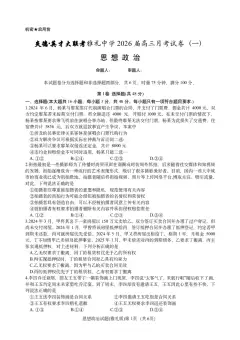
英语试题(Y2)第1页(共10 页)
绝密★启用前
姓
名________________
准考证号________________
炎德·英才名校联考联合体2027 届高三第二次联考
英
语
(考试范围:必修一至必修二Unit 3)
注意事项:
1. 答题前,考生务必将自己的姓名、考生号、考场号、座位号填写在答题卡上。
2. 回答选择题时,选出每小题答案后用铅笔把答题卡上对应题目的答案标号涂黑。如
需改动,用橡皮擦干净后,再选涂其他答案标号。回答非选择题时,将答案写在答题卡上。
写在本试卷上无效。
3. 考试结束后,将本试卷和答题卡一并交回。
第一部分听力(共两节,满分30 分)
第一节(共5 小题;每小题1.5 分,满分7.5 分)
听下面5 段对话。每段对话后有一个小题,从题中所给的A、B、C 三个选项中选出最
佳选项。听完每段对话后,你都有10 秒钟的时间来回答有关小题和阅读下一小题。每段录
音播放两遍。
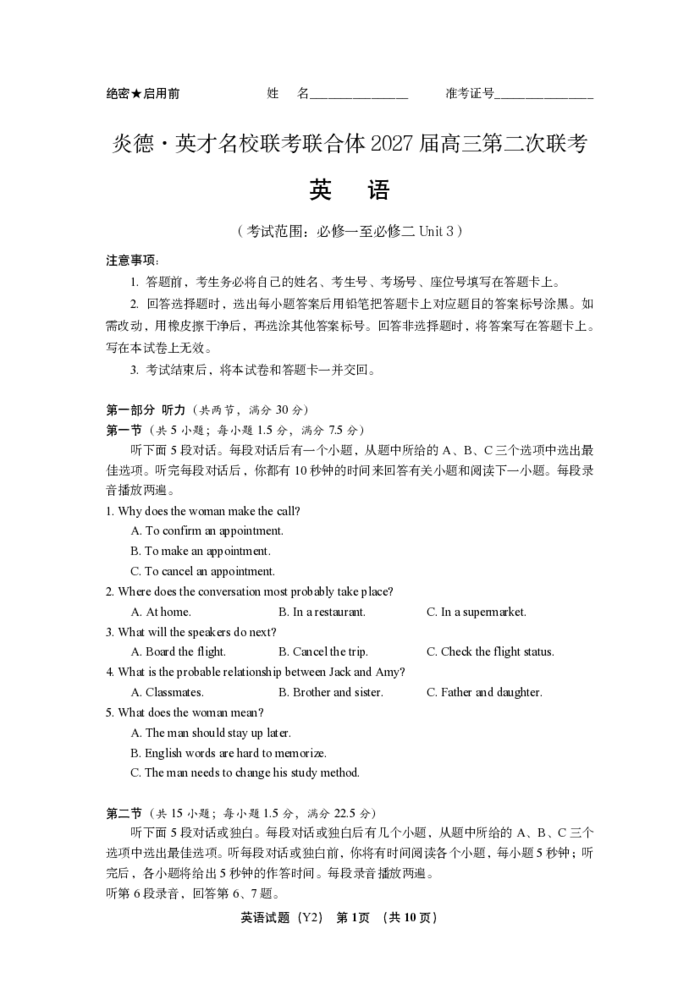
1. Why does the woman make the call?
A. To confirm an appointment.
B. To make an appointment.
C. To cancel an appointment.
2. Where does the conversation most probably take place?
A. At home.
B. In a restaurant.
C. In a supermarket.
3. What will the speakers do next?
A. Board the flight.
B. Cancel the trip.
C. Check the flight status.
4. What is the probable relationship between Jack and Amy?
A. Classmates.
B. Brother and sister.
C. Father and daughter.
5. What does the woman mean?
A. The man should stay up later.
B. English words are hard to memorize.
C. The man needs to change his study method.
第二节(共15 小题;每小题1.5 分,满分22.5 分)
听下面5 段对话或独白。每段对话或独白后有几个小题,从题中所给的A、B、C 三个
选项中选出最佳选项。听每段对话或独白前,你将有时间阅读各个小题,每小题5 秒钟;听
完后,各小题将给出5 秒钟的作答时间。每段录音播放两遍。
听第6 段录音,回答第6、7 题。
英语试题(Y2)第2页(共10 页)
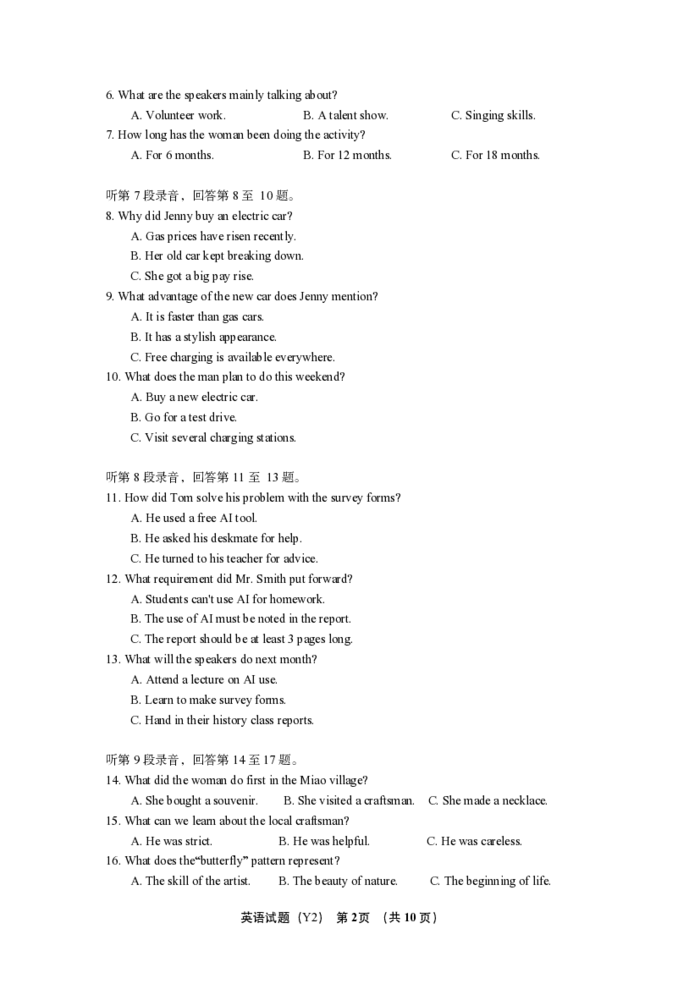
6. What are the speakers mainly talking about?
A. Volunteer work.
B. A talent show.
C. Singing skills.
7. How long has the woman been doing the activity?
A. For 6 months.
B. For 12 months.
C. For 18 months.
听第7 段录音,回答第8 至10 题。
8. Why did Jenny buy an electric car?
A. Gas prices have risen recently.
B. Her old car kept breaking down.
C. She got a big pay rise.
9. What advantage of the new car does Jenny mention?
A. It is faster than gas cars.
B. It has a stylish appearance.
C. Free charging is available everywhere.
10. What does the man plan to do this weekend?
A. Buy a new electric car.
B. Go for a test drive.
C. Visit several charging stations.
听第8 段录音,回答第11 至13 题。
11. How did Tom solve his problem with the survey forms?
A. He used a free AI tool.
B. He asked his deskmate for help.
C. He turned to his teacher for advice.
12. What requirement did Mr. Smith put forward?
A. Students can't use AI for homework.
B. The use of AI must be noted in the report.
C. The report should be at least 3 pages long.
13. What will the speakers do next month?
A. Attend a lecture on AI use.
B. Learn to make survey forms.
C. Hand in their history class reports.
听第9 段录音,回答第14 至17 题。
14. What did the woman do first in the Miao village?
A. She bought a souvenir.
B. She visited a craftsman.
C. She made a necklace.
15. What can we learn about the local craftsman?
A. He was strict.
B. He was helpful.
C. He was careless.
16. What does the“butterfly” pattern represent?
A. The skill of the artist.
B. The beauty of nature.
C. The beginning of life.
英语试题(Y2)第3页(共10 页)
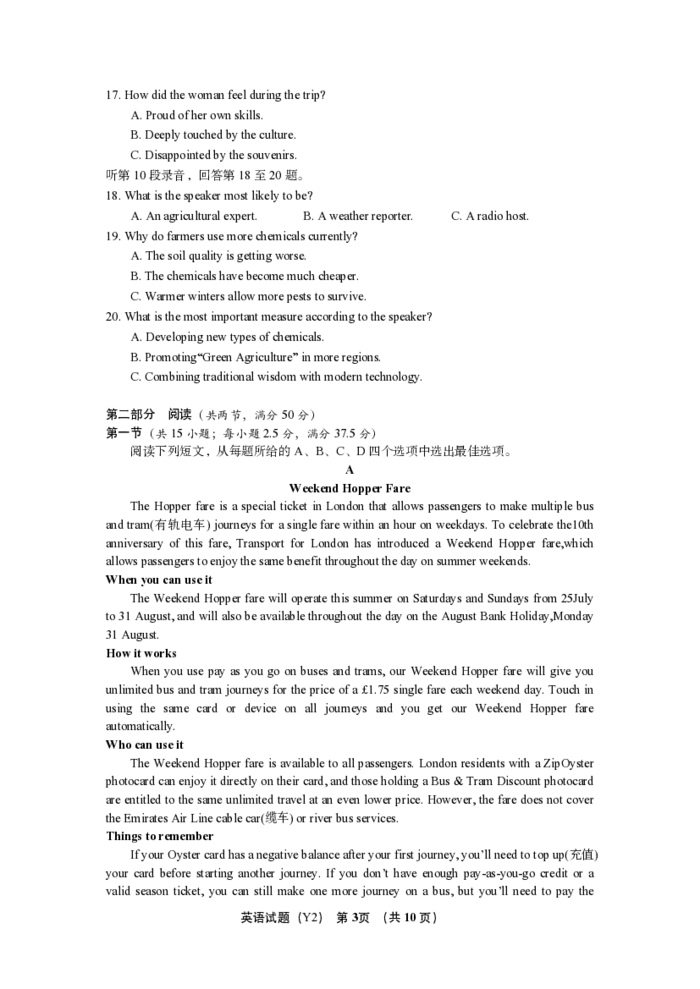
17. How did the woman feel during the trip?
A. Proud of her own skills.
B. Deeply touched by the culture.
C. Disappointed by the souvenirs.
听第10 段录音,回答第18 至20 题。
18. What is the speaker most likely to be?
A. An agricultural expert.
B. A weather reporter.
C. A radio host.
19. Why do farmers use more chemicals currently?
A. The soil quality is getting worse.
B. The chemicals have become much cheaper.
C. Warmer winters allow more pests to survive.
20. What is the most important measure according to the speaker?
A. Developing new types of chemicals.
B. Promoting“Green Agriculture” in more regions.
C. Combining traditional wisdom with modern technology.
第二部分
阅读(共两节,满分50 分)
第一节(共15 小题;每小题2.5 分,满分37.5 分)
阅读下列短文,从每题所给的A、B、C、D 四个选项中选出最佳选项。
A
Weekend Hopper Fare
The Hopper fare is a special ticket in London that allows passengers to make multiple bus
and tram(有轨电车) journeys for a single fare within an hour on weekdays. To celebrate the10th
anniversary of this fare, Transport for London has introduced a Weekend Hopper fare,which
allows passengers to enjoy the same benefit throughout the day on summer weekends.
When you can use it
The Weekend Hopper fare will operate this summer on Saturdays and Sundays from 25July
to 31 August, and will also be available throughout the day on the August Bank Holiday,Monday
31 August.
How it works
When you use pay as you go on buses and trams, our Weekend Hopper fare will give you
unlimited bus and tram journeys for the price of a £1.75 single fare each weekend day. Touch in
using the same card or device on all journeys and you get our Weekend Hopper fare
automatically.
Who can use it
The Weekend Hopper fare is available to all passengers. London residents with a ZipOyster
photocard can enjoy it directly on their card, and those holding a Bus & Tram Discount photocard
are entitled to the same unlimited travel at an even lower price. However, the fare does not cover
the Emirates Air Line cable car(缆车) or river bus services.
Things to remember
If your Oyster card has a negative balance after your first journey, you’ll need to top up(充值)
your card before starting another journey. If you don’t have enough pay-as-you-go credit or a
valid season ticket, you can still make one more journey on a bus, but you’ll need to pay the
英语试题(Y2)第4页(共10 页)
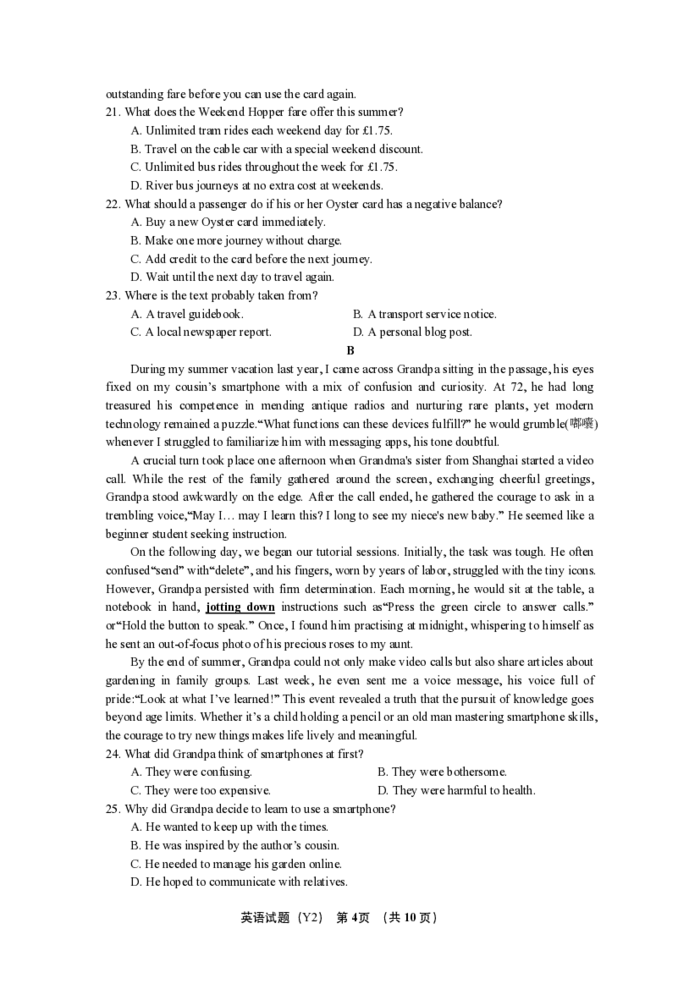
outstanding fare before you can use the card again.
21. What does the Weekend Hopper fare offer this summer?
A. Unlimited tram rides each weekend day for £1.75.
B. Travel on the cable car with a special weekend discount.
C. Unlimited bus rides throughout the week for £1.75.
D. River bus journeys at no extra cost at weekends.
22. What should a passenger do if his or her Oyster card has a negative balance?
A. Buy a new Oyster card immediately.
B. Make one more journey without charge.
C. Add credit to the card before the next journey.
D. Wait until the next day to travel again.
23. Where is the text probably taken from?
A. A travel guidebook.
B. A transport service notice.
C. A local newspaper report.
D. A personal blog post.
B
During my summer vacation last year, I came across Grandpa sitting in the passage, his eyes
fixed on my cousin’s smartphone with a mix of confusion and curiosity. At 72, he had long
treasured his competence in mending antique radios and nurturing rare plants, yet modern
technology remained a puzzle.“What functions can these devices fulfill?” he would grumble(嘟囔)
whenever I struggled to familiarize him with messaging apps, his tone doubtful.
A crucial turn took place one afternoon when Grandma's sister from Shanghai started a video
call. While the rest of the family gathered around the screen, exchanging cheerful greetings,
Grandpa stood awkwardly on the edge. After the call ended, he gathered the courage to ask in a
trembling voice,“May I… may I learn this? I long to see my niece's new baby.” He seemed like a
beginner student seeking instruction.
On the following day, we began our tutorial sessions. Initially, the task was tough. He often
confused“send” with“delete”, and his fingers, worn by years of labor, struggled with the tiny icons.
However, Grandpa persisted with firm determination. Each morning, he would sit at the table, a
notebook in hand, jotting down instructions such as“Press the green circle to answer calls.”
or“Hold the button to speak.” Once, I found him practising at midnight, whispering to himself as
he sent an out-of-focus photo of his precious roses to my aunt.
By the end of summer, Grandpa could not only make video calls but also share articles about
gardening in family groups. Last week, he even sent me a voice message, his voice full of
pride:“Look at what I’ve learned!” This event revealed a truth that the pursuit of knowledge goes
beyond age limits. Whether it’s a child holding a pencil or an old man mastering smartphone skills,
the courage to try new things makes life lively and meaningful.
24. What did Grandpa think of smartphones at first?
A. They were confusing.
B. They were bothersome.
C. They were too expensive.
D. They were harmful to health.
25. Why did Grandpa decide to learn to use a smartphone?
A. He wanted to keep up with the times.
B. He was inspired by the author’s cousin.
C. He needed to manage his garden online.
D. He hoped to communicate with relatives.
英语试题(Y2)第5页(共10 页)
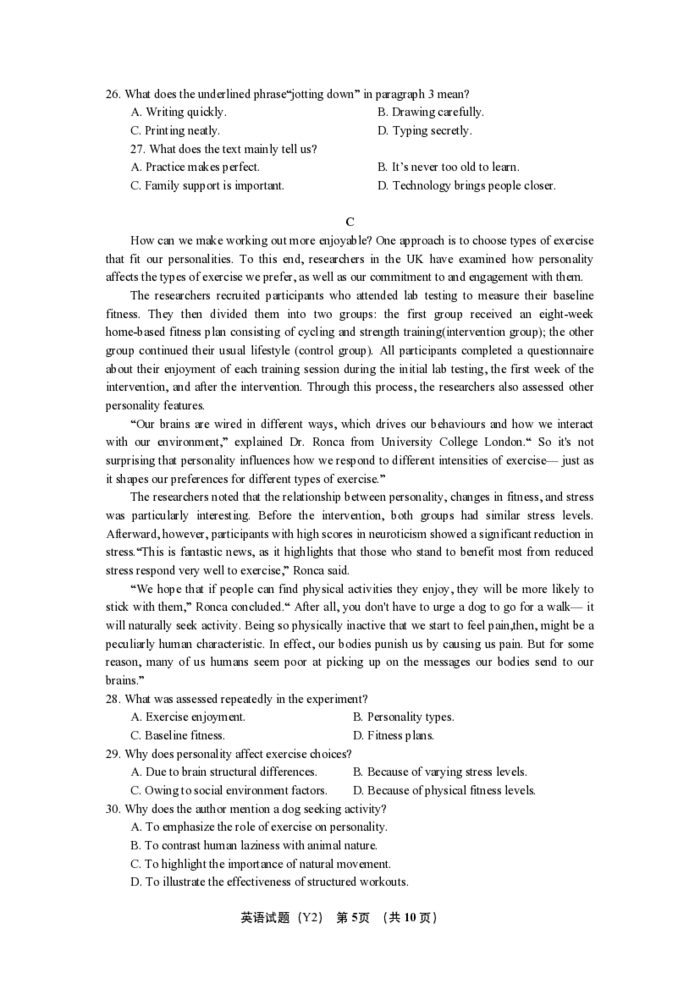
26. What does the underlined phrase“jotting down” in paragraph 3 mean?
A. Writing quickly.
B. Drawing carefully.
C. Printing neatly.
D. Typing secretly.
27. What does the text mainly tell us?
A. Practice makes perfect.
B. It’s never too old to learn.
C. Family support is important.
D. Technology brings people closer.
C
How can we make working out more enjoyable? One approach is to choose types of exercise
that fit our personalities. To this end, researchers in the UK have examined how personality
affects the types of exercise we prefer, as well as our commitment to and engagement with them.
The researchers recruited participants who attended lab testing to measure their baseline
fitness. They then divided them into two groups: the first group received an eight-week
home-based fitness plan consisting of cycling and strength training(intervention group); the other
group continued their usual lifestyle (control group). All participants completed a questionnaire
about their enjoyment of each training session during the initial lab testing, the first week of the
intervention, and after the intervention. Through this process, the researchers also assessed other
personality features.
“Our brains are wired in different ways, which drives our behaviours and how we interact
with our environment,” explained Dr. Ronca from University College London.“ So it's not
surprising that personality influences how we respond to different intensities of exercise— just as
it shapes our preferences for different types of exercise.”
The researchers noted that the relationship between personality, changes in fitness, and stress
was particularly interesting. Before the intervention, both groups had similar stress levels.
Afterward, however, participants with high scores in neuroticism showed a significant reduction in
stress.“This is fantastic news, as it highlights that those who stand to benefit most from reduced
stress respond very well to exercise,” Ronca said.
“We hope that if people can find physical activities they enjoy, they will be more likely to
stick with them,” Ronca concluded.“ After all, you don't have to urge a dog to go for a walk— it
will naturally seek activity. Being so physically inactive that we start to feel pain,then, might be a
peculiarly human characteristic. In effect, our bodies punish us by causing us pain. But for some
reason, many of us humans seem poor at picking up on the messages our bodies send to our
brains.”
28. What was assessed repeatedly in the experiment?
A. Exercise enjoyment.
B. Personality types.
C. Baseline fitness.
D. Fitness plans.
29. Why does personality affect exercise choices?
A. Due to brain structural differences.
B. Because of varying stress levels.
C. Owing to social environment factors.
D. Because of physical fitness levels.
30. Why does the author mention a dog seeking activity?
A. To emphasize the role of exercise on personality.
B. To contrast human laziness with animal nature.
C. To highlight the importance of natural movement.
D. To illustrate the effectiveness of structured workouts.
英语试题(Y2)第6页(共10 页)
31. What does Dr. Ronca suggest people do?
A. Force themselves to exercise daily.
B. Choose personality-matched exercises.
C. Ignore physical discomfort signals.
D. Adopt high-intensity workout routines.
D
For generations, homing pigeons have amazed people with their mysterious ability to
navigate vast distances to return home. While scientists have long assumed that these birds,like
many others, rely on the Earth’s magnetic field to find their way, the biological mechanism behind
this “magnetic sense” has remained frustratingly hard to find. Agroundbreaking study now
suggests the answer may lie in an unexpected organ: the liver(肝).
Researchers from the University of Bonn and the Max Planck Institute of AnimalBehavior
focused on iron-rich macrophages(巨噬细胞)— specialized white blood cells that recycle iron
from old red blood cells— found in high concentrations within the liver. These cells, the team
suspected, possess a quantum property known as superparamagnetism( 超顺磁性), potentially
allowing them to act as a biological compass needle that responds to theEarth's magnetic field.
Crucially, microscopic examination of pigeon liver tissue revealed direct nerve fibers that could
transmit directional signals from these macrophages straight to the brain.
To test this theory, scientists conducted a field experiment with 34 homing pigeons on a
cloudy day, when the sun— their usual primary navigational aid— was hidden. Half the pigeons
were injected(注射) with clodronate, a drug that temporarily eliminates macrophages,effectively
blocking the proposed line of communication between the liver's magnetic sensors and the brain.
The findings were striking. Untreated pigeons navigated the 19-kilometer journey home
within 70 minutes. In contrast, the clodronate-treated birds completely lost their sense of direction
and none managed to return that day. However, when the sun reappeared, these same birds homed
normally, indicating their general flight ability, health, and motivation were unaffected. On sunny
days, the treatment had no impact, confirming that this internal,iron-based compass is a critical
backup system for cloudy conditions rather than a primary navigation tool under clear skies.
The discovery that these white blood cells could actually be involved in sensing direction
fundamentally challenges our understanding of animal navigation. This rare blend of cellular
biology and quantum physics in a macroscopic organism opens new avenues for exploring how
other champions of migration— from sharks to nocturnal bats— perform their extraordinary feats
of orientation without a map.
32. What is paragraph 2 mainly about?
A. The role of white blood cells in an organ.
B. The process of iron recycling in the liver.
C. A possible biological compass in pigeons.
D. A link between nerve fibers and brain signals.
33. Why did the researchers treat the pigeons with clodronate?
A. To improve their homing ability on sunny days.
B. To check the iron level in their blood cells.
C. To test clodronate's effect on their flight speed.
D. To cut the link between their liver sensors and brain.
34. What do the cloudy and sunny results together show?
A. The treatment affected the pigeons on sunny days.
B. Pigeons use a primary system and a backup system.
英语试题(Y2)第7页(共10 页)
C. The sun powers pigeons’ magnetically sensitive cells.
D. Cloudy weather weakens the pigeons' ability to navigate.
35. What is the author’s purpose in writing the text?
A. To explain how pigeons deliver messages.
B. To call for action to protect homing pigeons.
C. To introduce a study on pigeon navigation.
D. To compare this study with previous research.
第二节(共5 小题;每小题2.5 分,满分12.5 分)
根据短文内容,从短文后的选项中选出能填入空白处的最佳选项。选项中有两项为多余
选项。
From Xiaohongshu to TikTok, a growing number of foreign faces are sharing their stories of
discovering C-beauty, or made-in-China beauty. In one such video, a beauty influencer holds up
products from a Chinese brand and exclaims,“This has to be one of the craziest brands I’ve ever
seen!
36
”
On Xiaohongshu, a French woman shows her shopping from Shanghai in a video before
returning home.
37
“I always knew Chinese products were good, but buying them in person
made me realize just how incredible the quality is,” she says in Mandarin.
For many, the appeal of Chinese beauty brands comes from more than just their attractive
packaging and modern design.
38
Mendes, a 28-year-old Brazilian master’s student
atShanghai Jiao Tong University, has attended almost every product expo( 博览会) in
Shanghai,testing items from both major and niche domestic brands. She is pleasantly surprised to
discover that their quality is as good as that of any renowned overseas brand.“I could see,touch,
smell and try various products. Many ingredients have been used traditionally for hundreds of
years and are embedded in Chinese culture,” says she.
39
They are listed in ancient medical classics and are now widely used in domestic
beauty products. This practice reflects the ancient philosophy of gentle and natural skin
care.Today, more and more overseas tourists and foreigners are seeking out Chinese cosmetics(化
妆品) shops.
What fuels this enthusiasm is the accelerating global expansion of Chinese brands.Overseas
consumers’ perception of Chinese beauty is shifting from“Made in China” to“Created in China”.
40
In Shanghai’s Fengxian district, the Oriental Beauty Valley is becoming the factory for
China’s cosmetics industry, with AI-powered workshops paving the way for“lights-out factories”.
A. But its fancy packaging was not enough to catch my eye.
B. This has won the trust of many foreign buyers around the world.
C. This change has been driven by years of solid domestic industry.D.
After applying the products to my face, I was completely won over.
E. The purchases include creams, perfumes, eye shadow and face masks.
F. Among these ingredients are Chinese herbs such as ginseng(人参) and green tea.
G. The thoughtful and natural integration of traditional Chinese ingredients behind them is
equally impressive.
英语试题(Y2)第8页(共10 页)
第三部分
语言运用(共两节,满分30 分)
第一节(共15 小题;每小题1 分,满分15 分)
阅读下面短文,从每题所给的A、B、C、D 四个选项中选出最佳选项。
John Burnett, a retired man from Rhode Island, lost his wife a few years ago. The loss hit him
so hard that for a year he just didn't want to do anything. He felt there was no
41
in life.
Then one day, while driving through his neighborhood, he started
42
things that people had
thrown away. Whenever he
43
discarded items on the roadside, he would pick them up and
take them home. Soon, his front lawn was
44
with bicycles, furniture, and tools he had
repaired.
What began as a hobby to keep busy
45
a way to help others. He sold the restored
goods at
46
prices because he knew many families were
47
with rising costs.“Money
is tight,” he said.“If I can help somebody else and help myself, that‘s what I do.” And sometimes,
if someone truly needed something but couldn't afford it, Burnett didn’t charge them at all.
One customer was so
48
by his story that she
49
it on Facebook after buying a
lawnmower from him. The
50
was overwhelming. Calls and messages started pouring
in.People reached out to donate items, offer
51
, or simply express their admiration. Burnett
said making money wasn’t his main goal.
52
, fixing things gave him a sense of belonging
and helped him
53
from the loss of his wife. Trash became treasure, and
54
slowly
became hope.
A simple act of fixing broken things has served as a powerful
55
that people can find
purpose again, even after life’s most difficult chapters.
41. A. purpose
B. fortune
C. balance
D. progress
42. A. counting
B. examining
C. collecting
D. removing
43. A. took over
B. came across
C. put aside
D. gave away
44. A. piled
B. equipped
C. arranged
D. decorated
45. A. resulted in
B. turned into
C. stood for
D. set about
46. A. low
B. regular
C. fixed
D. high
47. A. agreeing
B. competing
C. comparing
D. struggling
48. A. annoyed
B. confused
C. moved
D. amused
49. A. delivered
B. analyzed
C. recommended
D. shared
50. A. pressure
B. turnout
C. response
D. demand
51. A. shelter
B. encouragement
C. protection
D. approval
52. A. Instead
B. Besides
C. However
D. Therefore
53. A. escape
B. hide
C. heal
D. suffer
54. A. sorrow
B. regret
C. disappointment
D. loneliness
55. A. instruction
B. guarantee
C. reminder
D. warning
第二节(共10 小题;每小题1.5 分,满分15
英语试题(Y2)第9页(共10 页)
分)
阅读下面短文,在空白处填入1 个适当的单词或括号内单词的正确形式。
The Baoxianghua, known as the“Treasure Floral Design”, is a traditional Chinese ornamental
motif( 装饰纹样). Unlike natural flowers, it is an idealized composite floral pattern
56
(combine) the most beautiful features of various flowers, such as peonies,lotuses, and
chrysanthemums.
The term“Baoxiang” originates from Buddhism and refers to the“splendid and auspicious
appearance of the Buddha”. Over time, this concept was adapted into decorative art, leading to the
57
(create) of the Baoxianghua motif.
The
58
(early) recorded mention of the Baoxianghua can be traced back to the
TangDynasty, specifically in Zhang Yanyuan’s “Record of Famous Paintings Through the
Ages”.The text mentions the work of the artist Fan Changshou,
59
painted Baoxianghua
murals(壁画) in the temples of Chang’an. During this period, the motif reached
60
(it) artistic
peak. It was characterized by a symmetrical, radiating design, often structured around a central
point and expanding outward in layers.
As Chinese society evolved through the Song, Ming, and Qing Dynasties, the motif became
ever more widespread and was
61
(common) found on everyday objects, including textiles,
ceramics, and metalwork. Through the Silk Road, the motif
62
(introduce) to other cultures,
where it was blended into local artistic traditions.
63
(element) of it can still be seen in Persian
carpets and Indian textiles.
In modern times, the Baoxianghua remains
64
important symbol of Chinese cultural
heritage and artistic excellence. It has also found a place in popular culture, appearing on postage
stamps and fashion items, which connect traditional Chinese art with daily life
65
bring its
beauty to a global audience.
第四部分
写作(共两节,满分40 分)
第一节(满分15 分)
假定你是李华,你校英文报正在举办“科技与人文”主题征文活动。请你以“Will AI
ReplaceHuman Actors?”为题,写一篇短文投稿,内容包括:
(1)你的观点;
(2)说明理由(至少两条)。
注意:
(1)写作词数应为80 个左右;
(2)请按如下格式在答题卡的相应位置作答。
Will AI Replace Human Actors?
第二节(满分25
英语试题(Y2)第10页(共10 页)
分)
阅读下面材料,根据其内容和所给段落开头语续写两段,使之构成一篇完整的短文。
In the early 1990s, I boarded a plane at JFK Airport in New York City. I was 19 years old
and feeling excited about my plan to spend a year studying abroad in Nancy, a city in northeastern
France.
Within a few weeks of arriving in France, though, my excitement gave way to an
overwhelming sense of isolation and loneliness. Navigating day-to-day life in a new country was
much harder than I expected it to be, especially when it came to speaking French. I could
understand the language somewhat, but I was terrible at speaking it. My accent was terrible.People
could not understand me.
Constantly fighting to be understood was emotionally exhausting, and I had little hope for the
rest of my year. The only thing getting me through was the knowledge that a little piece of home
was on the way. My mom had sent me a care package, and in that package I knew she had sent
Skippy peanut butter, which, at that point, I could not find anywhere in France. So this was really
exciting for me. I had these visions of myself digging my spoon in and eating my peanut butter
right from the jar.
I had to go to the post office to pick up the package. When I arrived, I tried to tell the
attendant( 职员) why I was there. But the attendant didn't speak any English and couldn't
understand my accent when I spoke in French.
The more I repeated myself, the more frustrated I got and the more hopeless I felt. I was
about ready to break down in tears because I just really needed that package from home, when in
walked my unsung hero. The person who came to my rescue was a French woman namedChantal
Jouve. She stepped in, looked at me and said, in English,“Can I help you?”
注意:
(1)续写词数应为150 左右;
(2)请按如下格式在答题卡的相应位置作答。
Chantal Jouve spoke to the attendant after hearing my explanation.
It became a regular thing every Sunday to have dinner with her and her family.