文档文本内容
英语参考答案·第1页(共11页)
学科网(北京)股份有限公司
英语参考答案
第一部分
听力(共两节,满分30 分)
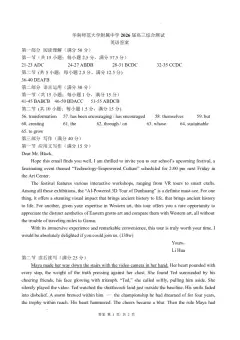
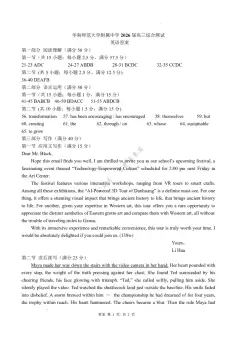
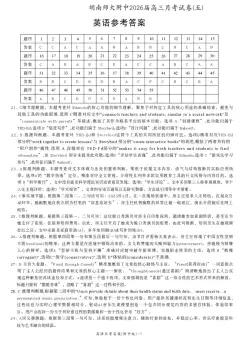
1~5 AACBC
6~10 BABCC
11~15 ABACA
16~20 BCBAC
第二部分
阅读(共两节,满分50 分)
第一节(共15 小题;每小题2.5 分,满分37.5 分)
21~25 BAABB
26~30 DCDCA
31~35 ADDBC
第二节(共5 小题;每小题2.5 分,满分12.5 分)
36~40 DFCEG
第三部分
语言运用(共两节,满分30 分)
第一节(共15 小题;每小题1 分,满分15 分)
41~45 ACBCD
46~50 BCADB
51~55 ACBDD
第二节(共10 小题;每小题1.5 分,满分15 分)
56.when
57.noticeably
58.central
59.accounting
60.are observed
61.it
62.to bring
63.what
64.phenomena
65.in
第四部分
写作(共两节,满分40 分)
第一节(满分15 分)
【参考范文】
Dear Eric,
Knowing that you are looking for a Chinese learning app,I’m writing to strongly recommend
HelloChinese,a popular app for foreign learners.
Not only does this app offer systematic courses covering Chinese pronunciation,vocabulary
and daily conversations,but it provides vivid videos and practical exercises to suit your needs.
What’s more,the cultural customs behind Chinese characters introduced by the app will offer you an
opportunity to explore Chinese culture.Besides,you can learn anytime and anywhere,which greatly
improves your learning efficiency.
I hope it will be of help to you.Looking forward to seeing your progress in Chinese learning!
Yours sincerely,
Li Hua
英语参考答案·第2页(共11页)
学科网(北京)股份有限公司
第二节(满分25 分)
【参考范文】
The monkey lay still on the deck,its wet body trembling.Moving slowly so as not to frighten it,
the fisherman slipped off his jacket and covered the poor creature with it.Crouching down,he patted
it gently.Little by little,the shivering died away and its breathing grew steady.When the fisherman
offered fresh water,the monkey drank eagerly,cupping the bowl with its small hands.Gradually
it closed its eyes,its body relaxing at last.Watching its small chest rise and fall,the fisherman made
up his mind:he would take it back to the island where it belonged.
When the monkey woke up,the Koh Siray island was already in sight.Raising its head,it
looked around,its small hands gripping the boat’s edge.It paused and cast a glance back at the
fisherman.As the boat neared the shore,it jumped onto the sand.After a few steps,it stopped and
turned back,as if saying goodbye.The fisherman waved silently,watching until the small figure
disappeared into the forest.Only then did he start the engine,knowing that the monkey belonged to
the wild and that every life deserves to be cherished.
【解析】
第二部分
阅读
第一节
A
主题语境:人与社会—志愿服务
【语篇导读】本文是应用文。介绍了伦敦Bloomsbury 艺术节的志愿者招募信息,包括
志愿者职责、培训、福利及申请方式。
21.B
细节理解题。根据What Will You Do 部分中的“Assisting box office staff with ticket
checks and crowd management”可知,活动引导员需要协助检票和人群管理,即管
理观众人流,故选B。
22.A
细节理解题。根据Training and Support 部分中的“September 23(online):Introduction
to the festival”可知,9 月23 日的培训为线上培训,即远程培训,故选A。
英语参考答案·第3页(共11页)
学科网(北京)股份有限公司
23.A
细节理解题。根据最后一段中的“You are encouraged to indicate your areas of interest,
and we will assign shifts based on your preferences.”可知,主办方会根据志愿者填报
的兴趣偏好分配班次,故选A。
B
人与社会—职业选择
【语篇导读】本文是新闻报道。讲述了Eryn Lawley 转行做书籍装订学徒的故事,揭
示了在人工智能冲击白领职业的背景下,越来越多年轻人转向传统手工艺行业,英国手
工艺学徒制重新受到关注的现象。
24.B
细节理解题。根据第一段最后一句“It’s more satisfying and far less stressful than sitting
in front of a screen all day.”可知,Lawley 认为装订工作比整天面对屏幕更令人满足、
压力更小,说明她离开数字营销工作是因为原工作压力大、满意度低,故选B。
25.B
推理判断题。根据第三段最后一句“Yet interest is rebounding:Cox London,a craft
workshop,received over 160 applications for just two apprenticeship places this year.”
可知,Cox London 今年两个学徒名额就收到160 多份申请,说明传统手工艺重新受
到欢迎,故选B。
26.D
细节理解题。根据第四段最后一句“Kath Geraghty,head of technical qualifications,
stresses the urgency of‘plugging the skill gap’in these dying crafts and building a
more representative workforce.”可知,Kath Geraghty 强调提供学徒项目是为了填补
这些濒危手工艺的技能缺口,并建立更具代表性的劳动力队伍,故选D。
27.C
推理判断题。根据最后一段“...she found something AI cannot offer...for now they
provide a rare sense of purpose and security that digital jobs fail to deliver.”可知,作者
认为手工行业目前能提供数字工作无法给予的目标感和安全感,因此对其持支持态
度,故选C。
C
主题语境:人与社会—营养认知与健康
【语篇导读】本文是说明文。介绍了威斯康星大学麦迪逊分校的一项新研究,指出超出身
体所需的过量蛋白质摄入未必有益。文章纠正了大众“蛋白质越多越健康”的误区,提醒人
们应当根据自身实际需求合理摄入蛋白质。
英语参考答案·第4页(共11页)
学科网(北京)股份有限公司
28.D
细节理解题。根据第二段最后一句“The result challenges the widespread assumption
that extra protein automatically means better health.”可知,这项研究挑战了大众普遍
看法,与以往关于蛋白质摄入的观点不同,故选D。
29.C
推理判断题。根据第四段第二句和第三句“Fitness-driven advertising floods consumers
with‘high-protein’products.Many take it for granted that more protein equals better
health.”可知,健身相关高蛋白产品广告铺天盖地,让很多消费者想当然认为蛋白
质越多越健康。由此推断,这类广告可能误导消费者对蛋白质需求的认知,故选C。
30.A
词义猜测题。根据第五段“...which means they may already consume more protein than
required”以及前文提到的“little physical exercise”可推知,sedentary 指“久坐的、
缺乏运动的”,与inactive 词义相近,故选A。
31.A
写作目的题。根据第五段最后一句和最后一段可知,作者写作目的是提醒读者依据
自身情况适量摄入蛋白质,故选A。
D
主题语境:人与社会—语言学习与认知发展
【语篇导读】本文是说明文。通过介绍母语对大脑结构的塑造作用,说明了不同语言使用
者在脑区连接上的差异,并探讨了同化理论及其争议,揭示了母语对大脑的持久影响。
32.D
细节理解题。根据第二段第三句“In contrast,native Chinese speakers,who use
logographic characters,develop stronger connections between the brain’s two hemispheres.”
可知,母语为汉语的使用者,大脑左右半球的连接更为紧密,故选D。
33.D
推理判断题。根据第三段第一句“With the foundation of the above research,the
assimilation theory(同化理论)states that the human brain tends to reuse the neural
pathways built by the mother tongue when absorbing a new language.”可推知,同化理
论认为,学习者母语形成的固有神经网络,是影响二语学习的核心因素,故选D。
34.B
推理判断题。根据第四段第二、三句“They argue that human brain flexibility has been
overestimated...early language experience only slightly adjusts current neural systems
rather than constructing brand-new pathways from scratch.”可知,学界对同化理论的
主要批评是:该理论高估了早期语言经历对大脑的改造作用,否定了大脑基因预设
的基础结构,故选B。
英语参考答案·第5页(共11页)
学科网(北京)股份有限公司
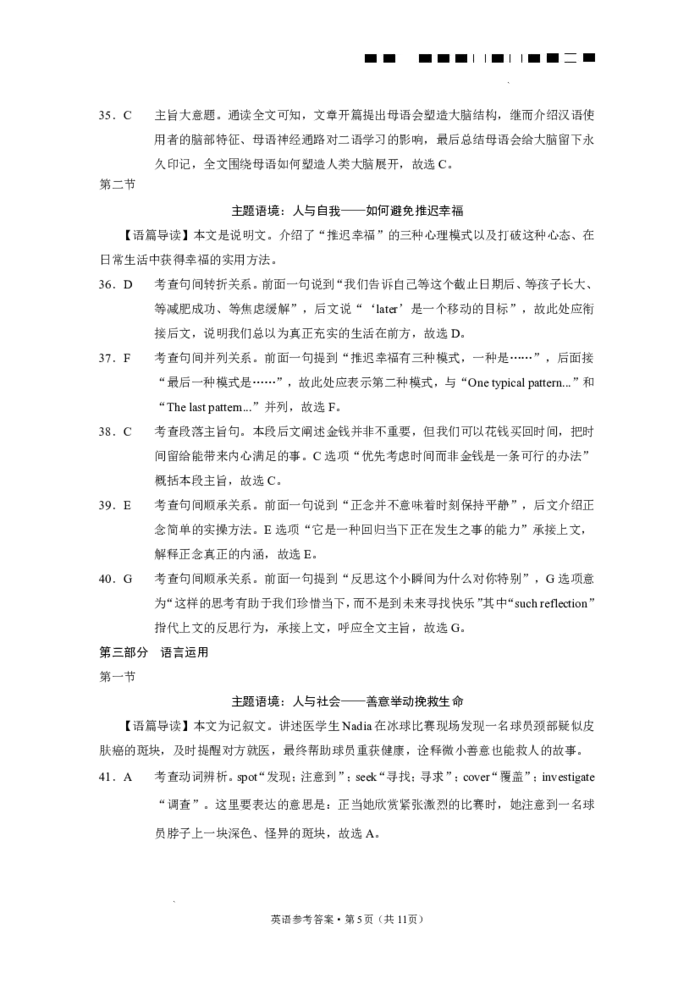
35.C
主旨大意题。通读全文可知,文章开篇提出母语会塑造大脑结构,继而介绍汉语使
用者的脑部特征、母语神经通路对二语学习的影响,最后总结母语会给大脑留下永
久印记,全文围绕母语如何塑造人类大脑展开,故选C。
第二节
主题语境:人与自我—如何避免推迟幸福
【语篇导读】本文是说明文。介绍了“推迟幸福”的三种心理模式以及打破这种心态、在
日常生活中获得幸福的实用方法。
36.D
考查句间转折关系。前面一句说到“我们告诉自己等这个截止日期后、等孩子长大、
等减肥成功、等焦虑缓解”,后文说“‘later’是一个移动的目标”,故此处应衔
接后文,说明我们总以为真正充实的生活在前方,故选D。
37.F
考查句间并列关系。前面一句提到“推迟幸福有三种模式,一种是……”,后面接
“最后一种模式是……”,故此处应表示第二种模式,与“One typical pattern...”和
“The last pattern...”并列,故选F。
38.C
考查段落主旨句。本段后文阐述金钱并非不重要,但我们可以花钱买回时间,把时
间留给能带来内心满足的事。C 选项“优先考虑时间而非金钱是一条可行的办法”
概括本段主旨,故选C。
39.E
考查句间顺承关系。前面一句说到“正念并不意味着时刻保持平静”,后文介绍正
念简单的实操方法。E 选项“它是一种回归当下正在发生之事的能力”承接上文,
解释正念真正的内涵,故选E。
40.G
考查句间顺承关系。前面一句提到“反思这个小瞬间为什么对你特别”,G 选项意
为“这样的思考有助于我们珍惜当下,而不是到未来寻找快乐”其中“such reflection”
指代上文的反思行为,承接上文,呼应全文主旨,故选G。
第三部分
语言运用
第一节
主题语境:人与社会—善意举动挽救生命
【语篇导读】本文为记叙文。讲述医学生Nadia 在冰球比赛现场发现一名球员颈部疑似皮
肤癌的斑块,及时提醒对方就医,最终帮助球员重获健康,诠释微小善意也能救人的故事。
41.A
考查动词辨析。spot“发现;注意到”;seek“寻找;寻求”;cover“覆盖”;investigate
“调查”。这里要表达的意思是:正当她欣赏紧张激烈的比赛时,她注意到一名球
员脖子上一块深色、怪异的斑块,故选A。
英语参考答案·第6页(共11页)
学科网(北京)股份有限公司
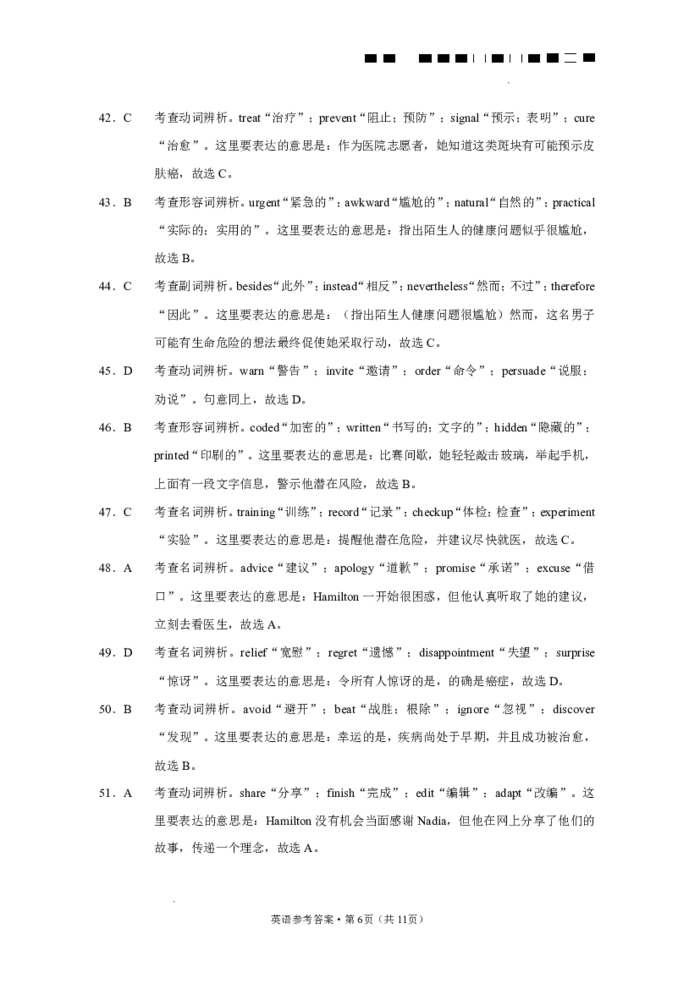
42.C
考查动词辨析。treat“治疗”;prevent“阻止;预防”;signal“预示;表明”;cure
“治愈”。这里要表达的意思是:作为医院志愿者,她知道这类斑块有可能预示皮
肤癌,故选C。
43.B
考查形容词辨析。urgent“紧急的”;awkward“尴尬的”;natural“自然的”;practical
“实际的;实用的”。这里要表达的意思是:指出陌生人的健康问题似乎很尴尬,
故选B。
44.C
考查副词辨析。besides“此外”;instead“相反”;nevertheless“然而;不过”;therefore
“因此”。这里要表达的意思是:(指出陌生人健康问题很尴尬)然而,这名男子
可能有生命危险的想法最终促使她采取行动,故选C。
45.D
考查动词辨析。warn“警告”;invite“邀请”;order“命令”;persuade“说服;
劝说”。句意同上,故选D。
46.B
考查形容词辨析。coded“加密的”;written“书写的;文字的”;hidden“隐藏的”;
printed“印刷的”。这里要表达的意思是:比赛间歇,她轻轻敲击玻璃,举起手机,
上面有一段文字信息,警示他潜在风险,故选B。
47.C
考查名词辨析。training“训练”;record“记录”;checkup“体检;检查”;experiment
“实验”。这里要表达的意思是:提醒他潜在危险,并建议尽快就医,故选C。
48.A
考查名词辨析。advice“建议”;apology“道歉”;promise“承诺”;excuse“借
口”。这里要表达的意思是:Hamilton 一开始很困惑,但他认真听取了她的建议,
立刻去看医生,故选A。
49.D
考查名词辨析。relief“宽慰”;regret“遗憾”;disappointment“失望”;surprise
“惊讶”。这里要表达的意思是:令所有人惊讶的是,的确是癌症,故选D。
50.B
考查动词辨析。avoid“避开”;beat“战胜;根除”;ignore“忽视”;discover
“发现”。这里要表达的意思是:幸运的是,疾病尚处于早期,并且成功被治愈,
故选B。
51.A
考查动词辨析。share“分享”;finish“完成”;edit“编辑”;adapt“改编”。这
里要表达的意思是:Hamilton 没有机会当面感谢Nadia,但他在网上分享了他们的
故事,传递一个理念,故选A。
英语参考答案·第7页(共11页)
学科网(北京)股份有限公司
52.C
考查动词短语辨析。give up“放弃”;laugh at“嘲笑”;pass over“忽略;不予理
会”;search for“搜寻”。这里要表达的意思是:永远不要忽略小小的警示信号,
故选C。
53.B
考查名词辨析。schedule“日程表”;conscience“良知;良心”;memory“记忆”;
imagination“想象”。这里要表达的意思是:Nadia 从来没想过博取名声与关注,她
只是遵从良知,做自己认为正确的事,故选B。
54.D
考查名词辨析。greeting“问候”;sign“标记,符号”;movement“动作,活动”;
gesture“举动;手势”。这里要表达的意思是:这个暖心故事告诉我们,有时候一
个简单的举动就能带来巨大改变、挽救生命,故选D。
55.D
考查形容词辨析。cruel“残忍的”;endless“无尽的”;apparent“明显的”;genuine
“真诚的;真正的”。这里要表达的意思是:真正的善意不需要巨大勇气或者丰厚
回报;只需要我们遇到身处困境的人时立刻行动,故选D。
第二节
主题语境:人与社会—二十四节气之寒露
【语篇导读】本文是说明文。介绍了寒露这一节气的时间、物候特征和相关民俗。阐释二
十四节气承载的人与自然和谐共生的古老智慧。
56.when
考查定语从句。该句定语从句,先行词为this time of the year,关系副词when 在
从句中作时间状语,指代at this time of the year,故填when。
57.noticeably
考查词性转换。此处需要副词修饰形容词比较级cooler,noticeable 的副词形
式为noticeably,意为“显著地;明显地”,故填noticeably。
58.central
考查词性转换。此处需要形容词修饰名词areas,center 的形容词形式central,
意为“中部的”,northern and central areas 表示“北部和中部地区”,故填central。
59.accounting
考查非谓语动词。前面整个主句内容与account for 之间是主动关系,用现在
分词作结果状语,account for 意为“是……的原因;解释”,故填accounting。
60.are observed
考查谓语动词的时态、语态和主谓一致。主语Many old customs 与observe
之间为被动关系;全文为一般现在时,主语是复数,故填are observed。
61.it
考查代词。固定结构consider it+名词+to do sth.,it 作形式宾语,真正的宾语是后面
的不定式to harvest and store crops,故填it。
英语参考答案·第8页(共11页)
学科网(北京)股份有限公司
62.to bring
考查非谓语动词。此处不定式作目的状语,表示举办户外活动的目的是为漫长
寒冬带来健康与活力,故填to bring。
63.what
考查表语从句。what 引导表语从句,在从句old people call Tie Qiu Biao 中作call
的宾语,意为“……的事物”,故填what。
64.phenomena
考查名词的复数形式。phenomenon 是可数名词,其复数形式phenomena 为
不规则变化;此处没有冠词a,故填phenomena。
65.in
考查介词。固定搭配live in harmony with…,意为“与……和谐共处”,故填in。
听力原文
Text 1
W:Do you like listening to rock music?
M:Yes.But my wife doesn’t like loud music.I usually listen to it when I drive to work in the
morning.(1)
Text 2
W:I got my driving license two months ago.I’m thinking about getting a car,but I’m short of
cash.(2)
M:Don’t worry.I can lend you some money.
Text 3
M:Welcome to Luke’s Salon,ma’am.Do you want to have your hair cut today?
W:No,I came here last week to color my hair.My hair has been falling out ever since.I guess you
must have used poor quality products.(3)
Text 4
W:What matters most to me in a friendship is having common interests.(4)
M:In my view,the most important thing is understanding and support.Although I don’t have
much in common with my friends,I can always share good news and bad moods with
them.
Text 5
M:Good morning,ma’am.Can I help you?
英语参考答案·第9页(共11页)
学科网(北京)股份有限公司
W:Yes.This is my husband’s shirt.The sleeves are a bit long.Can you make them shorter?(5)
M:Oh,let me see.I can do it for 5 euros.(5)
W:OK.
Text 6
W:How about eating out? I don’t feel like cooking today.
M:OK,darling.I’ve been so busy with work lately that I haven’t been able to accompany you.
Tomorrow is Saturday.You can have a good rest and I’ll clean the house and do the
laundry.(6)
W:All right.Let’s go to the Chinese restaurant on Budding Street.Oh,it occurs to me that there
are no new tissues and soap at home.We’d better go buy them first,or we might forget
that after dinner.(7)
M:You’re right.Let’s go.
Text 7
M:Hi,Samantha.What happened?
W:I’m in big trouble.I need to print some materials for the meeting.But there’s something
wrong with my printer.(8)(9)
M:Can I have a look? Maybe I can help you.
W:That’s very kind of you.
M:Oh,it’s no big deal.Just a paper jam.I’ll get the paper out.(9)
W:You’ve really done me a big favor,John.
M:It’s my pleasure.
W:By the way,could you please take this file to HR’s office? It’s the new interviewer
procedures for the new hiring season.(10)
M:No problem!
Text 8
W:Where is your hometown,Steve?
M:My hometown is in a coastal area in the UK.
W:So you came to the USA for university?
英语参考答案·第10页(共11页)
学科网(北京)股份有限公司
M:Yes.I was admitted in 2023 when I was 18,but I came here in 2024 because I took
a gap year.(11)
W:Do you like it here? Look at the hopeless downtown traffic! Are you used to the city life here? Is
the traffic jam a big issue in your hometown?
M:No,actually there are not many vehicles there,let alone buses.I can’t stand waiting for
a bus for about half an hour every time.(12)
W:That does sound annoying.How is the environment?
M:Well,it’s quite peaceful.And I enjoy the fresh air.
W:How about the residents there?
M:They’re friendly and hospitable.
W:Do you plan to find a job in your hometown or somewhere else after graduation?
M:Well,physical work is easy to find in my hometown,but I’m uncertain about the
white-collar jobs.(13)Maybe I will ask my teacher for advice.
W:Good idea.
Text 9
M:Hey,Carrie.Why are you dressed up? You look so pretty.
W:Thank you,Henry.I’m going to watch a talk show tonight.(14)
M:Great! Do you often go to the performances? I know you like comedies.
W:I try to go as often as I can with my friends,but the tickets for the performances are expensive.
Actually,this ticket was a Christmas gift from my father.We are going together.(15)
M:Does everyone have to dress up for the show?
W:Oh,no.Actually,people usually dress casually because it’s a relaxing occasion.But since it’
s Christmas,I’m wearing my new green dress.How does it look?
M:It looks fantastic on you.How long is the performance?
W:The one tonight starts at 7:30 and ends at 11:00.(16)
M:I hope you have a great time.See you tomorrow.
W:See you.I will share all about it with you at school tomorrow morning.(17)
Text 10
英语参考答案·第11页(共11页)
学科网(北京)股份有限公司
Welcome to our program Fun Facts About Words.Today we are going to talk about two
interesting names you may often meet in movies and news reports.I think you may have heard the
names John Doe and Jane Doe before.They do not refer to real people.Instead,they are name
replacements for someone whose real identity is unknown or needs to be kept secret.(18)The
story of John Doe dates back to 14th-century England.(19)At that time,British lawyers needed
imaginary names for land-related court cases.John Doe was created as a made-up name for one side
of a property disagreement.Later,this custom was carried over to the United States legal system.
As time went by,people needed a matching name for women.So Jane Doe appeared as the female
form of John Doe.(20)Today,the two names are widely used by police,hospitals and courts.
John Doe stands for an unknown man,while Jane Doe means an unknown woman.They work much
like the Chinese name “Zhang San”,a common way to talk about an ordinary,unnamed person.
Though they started in Britain,the names are now far more popular in North-American daily life.