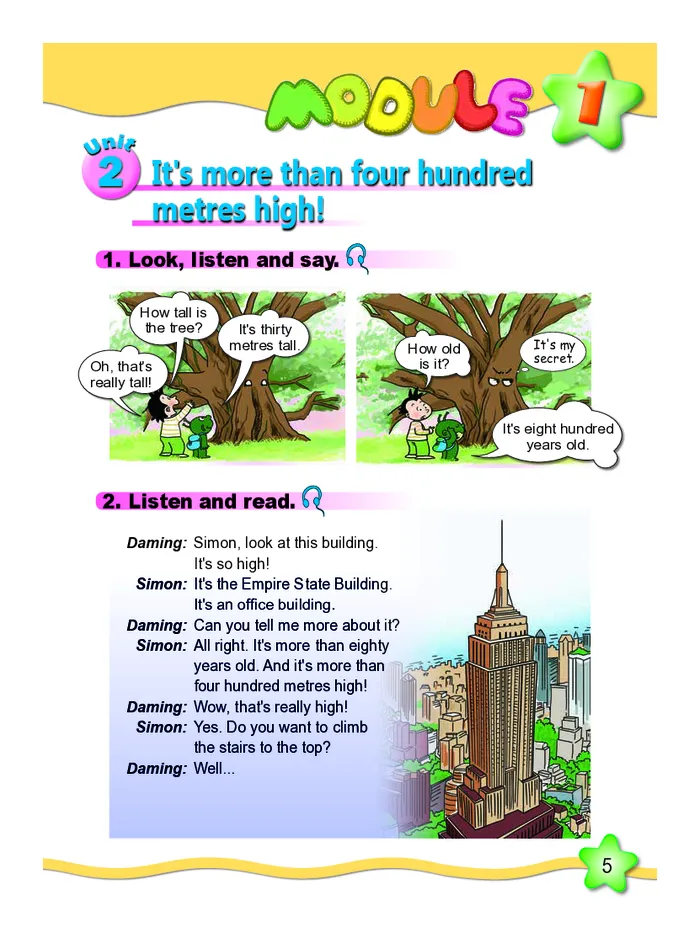
义
务
教
育
教
科
书
(一年级起点)
六年级 上册
六年级 上册
(一年级起点)
主 编:
副主编:
陈 琳 Printha Ellis (英)
鲁子问
Name ( 姓名): Class ( 班级): School ( 学校):
义
务
教
育
教
科
书
前 言
各位同学,你们好!欢迎大家学习本套英语教材!
2000年,外语教学与研究出版社与麦克米伦出版(中国)有限公司依据
国家《义务教育 英语课程标准(实验稿)》共同组织开发了本套教材;作为
我国第一套中小学“一条龙”英语教材,本套教材已出版使用十余年。2011
年,基于新颁布的国家《义务教育 英语课程标准(2011年版)》,我们对教
材进行了认真修订。
在修订后的小学教材中,我们为同学们保留了大家熟悉并喜爱的四个小
伙伴—中国学生大明和玲玲、英国学生Sam和Amy,还增加了其他一些人物
和小动物。他们会带领大家在一系列有趣的故事、对话、游戏、活动和歌曲中
学习英语。
修订后的教材每册包括10个学习模块(Module)、一个复习模块
(Review Module)、四个单词表、一个补充阅读(Reading for Pleasure)
版块以及一个综合运用实践项目(Project)。每个学习模块分两个单元
(Unit),一般情况下,第一单元呈现本模块所要学习的语言内容,第二单元
提供若干任务型(Task-based)活动,包括一首歌曲、歌谣或韵句。学习模
块的课文中呈现了一些语法内容,但不要求老师做理论的讲解,更不要求大家
孤立地、脱离语境地掌握,只希望大家初步学会在恰当的语境中运用包含这些
语法的句子。这一原则也希望老师在教学过程中以及家长在辅导孩子学习的
时候注意。复习模块对前面10个模块所学的内容进行综合和融合性复习,使
大家的语言知识和相应的语言技能得到进一步的巩固与提高。教材有四个单词
表,包括:分模块按出现顺序收录的单词,按字母顺序收录的全书单词,歌
曲、歌谣或韵句中出现的单词以及人名、地名。在歌曲、歌谣或韵句中出现的
新词,只要求理解,不要求学会运用。补充阅读为大家选用了篇幅短小、内容
丰富、形式多样的材料。教材最后设计了一个综合运用实践项目,供同学们根
据兴趣自由选择使用。
本套教材同时还配有对应的网络教材,可供同学们在线学习使用。
同学们,希望大家积极尝试,大胆实践,主动学做教材中的英语活动,
努力学唱英语歌曲、歌谣和韵句。相信你们会在参与活动、完成任务的过程中
体会到学习英语的乐趣,实现英语的灵活运用和自由交际。
…………………………………… 2
…………………… 5
……………… 8
…………………………………… 11
……………………… 14
………………………………… 17
…………………… 20
…………………………… 23
………………………………………………… 26
…………………………………… 29
…………………………… 32
…………………………… 35
……………………………………………… 38
………………………… 41
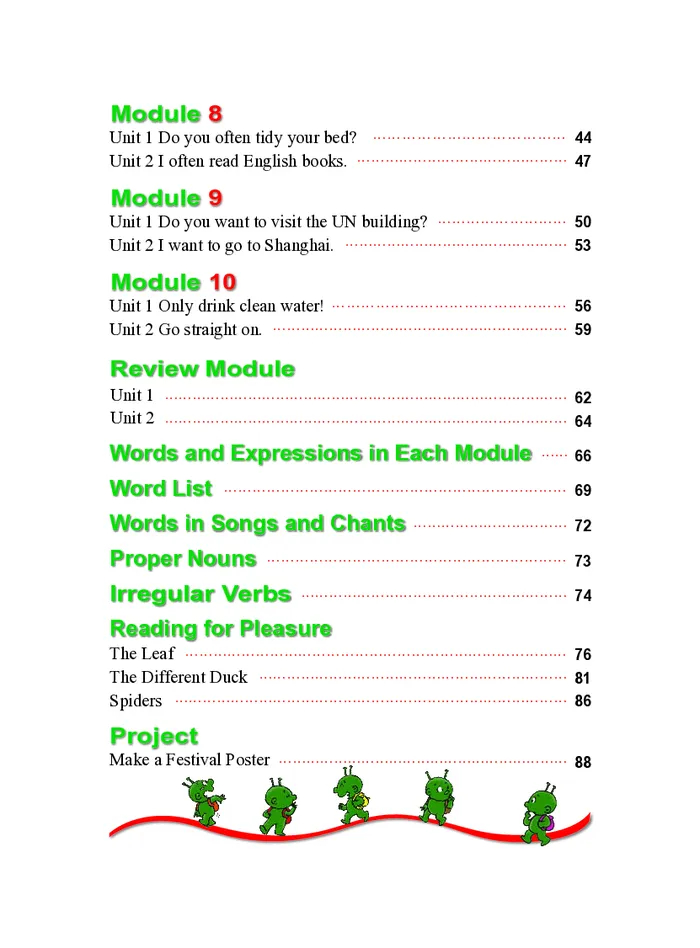
Unit 1 How long is the Great Wall?
Unit 2 It’s more than four hundred metres high!
Unit 1 I went to Chinatown in New York yesterday.
Unit 2 I went to a library yesterday.
Unit 1 Have you got any stamps from China?
Unit 2 Collecting stamps is my hobby.
Unit 1 Thanksgiving is very important in the US.
Unit 2 Can you tell me about Christmas?
Unit 1 Can I write to her?
Unit 2 I want a Chinese pen friend.
Unit 1 I’ve got some Chinese chopsticks.
Unit 2 I haven’t got a book about the US.
Unit 1 Pandas love bamboo.
Unit 2 A child sleeps for ten hours a night.
Module 1
Module 4
Module 2
Module 5
Module 3
Module 6
Module 7
N
E
W
S
TA
N
DA
RD
E
N
G
LI
S
H
Review Module
Words and Expressions in Each Module
Word List
Words in Songs and Chants
Proper Nouns
Irregular Verbs
Reading for Pleasure
Unit 1
Unit 2
………………………………… 44
……………………………………… 47
……………………… 50
………………………………………… 53
………………………………………… 56
……………………………………………………… 59
…………………………………………………………………………… 62
…………………………………………………………………………… 64
…… 66
……………………………………………………………… 69
…………………………… 72
……………………………………………………… 73
………………………………………………… 74
……………………………………………………………………… 76
………………………………………………………… 81
………………………………………………………………………… 86
……………………………………………………… 88
Module 8
Module 9
Module 10
Unit 1 Do you often tidy your bed?
Unit 2 I often read English books.
Unit 1 Do you want to visit the UN building?
Unit 2 I want to go to Shanghai.
Unit 1 Only drink clean water!
Unit 2 Go straight on.
Project
The Leaf
The Different Duck
Spiders
Make a Festival Poster
2
1
1
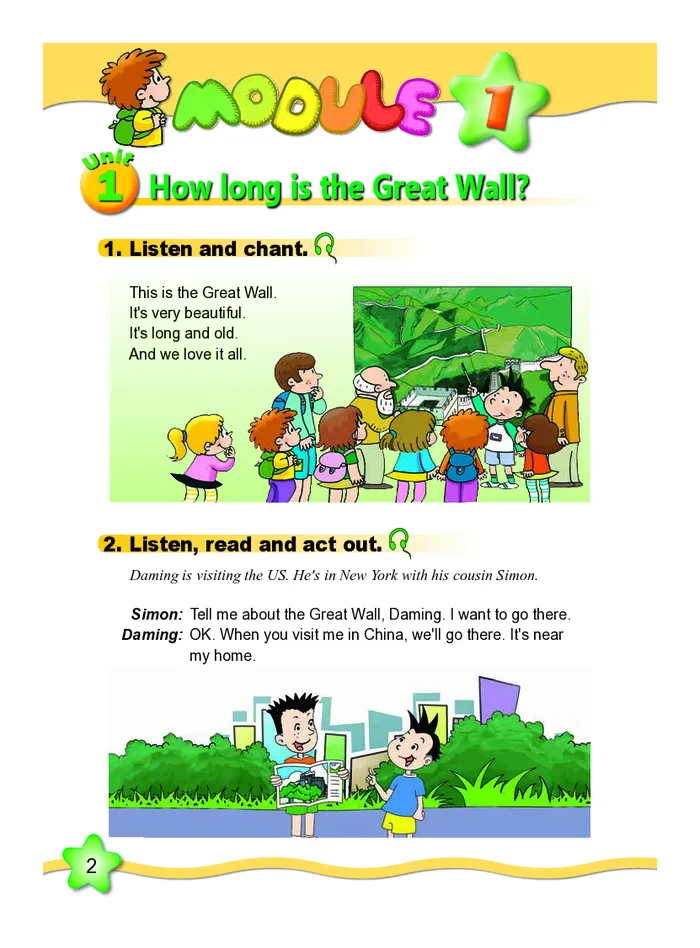
1. Listen and chant.
How long is the Great Wall?
1
t
i
n
U
This is the Great Wall.
It's very beautiful.
It's long and old.
And we love it all.
2. Listen, read and act out.
Tell me about the Great Wall, Daming. I want to go there.
OK. When you visit me in China, we'll go there. It's near
my home.
Simon:
Daming:
Daming is visiting the US. He's in New York with his cousin Simon.
3
1
t
i
n
U
1
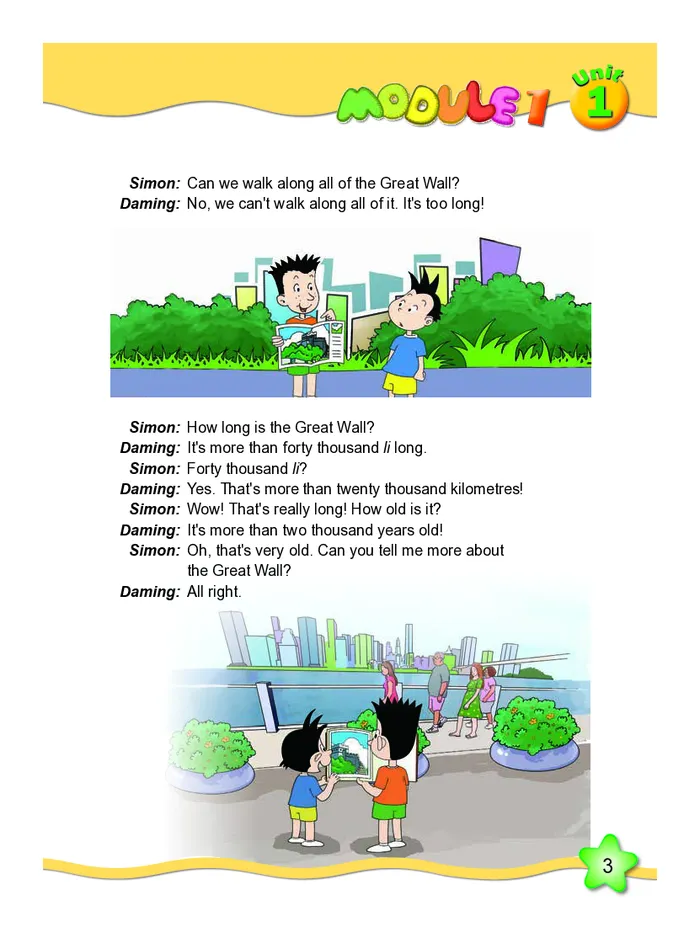
Can we walk along all of the Great Wall?
No, we can't walk along all of it. It's too long!
Simon:
Daming:
How long is the Great Wall?
It's more than forty thousand li long.
Forty thousand li?
Yes. That's more than twenty thousand kilometres!
Wow! That's really long! How old is it?
It's more than two thousand years old!
Oh, that's very old. Can you tell me more about
the Great Wall?
All right.
Simon:
Daming:
Simon:
Daming:
Simon:
Daming:
Simon:
Daming:
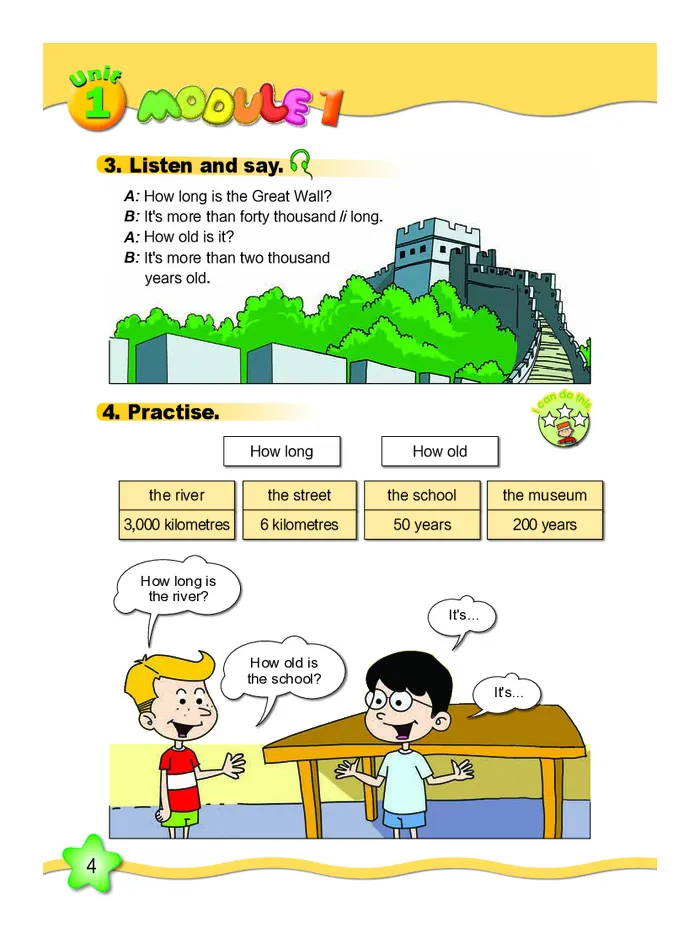
A: How long is the Great Wall?
B: It's more than forty thousand li long.
A: How old is it?
B: It's more than two thousand
years old.
How long
How old
How long is
the river?
How old is
the school?
It's...
It's...
the street
6 kilometres
the school
50 years
the museum
200 years
3,000 kilometres
the river
4
3. Listen and say.
4. Practise.
1
t
i
n
U
1
1
5
1
1
Simon, look at this building.
It's so high!
It's the Empire State Building.
It's an office building.
Can you tell me more about it?
All right. It's more than eighty
years old. And it's more than
four hundred metres high!
Wow, that's really high!
Yes. Do you want to climb
the stairs to the top?
Well...
Daming:
Simon:
Daming:
Simon:
Daming:
Simon:
Daming:
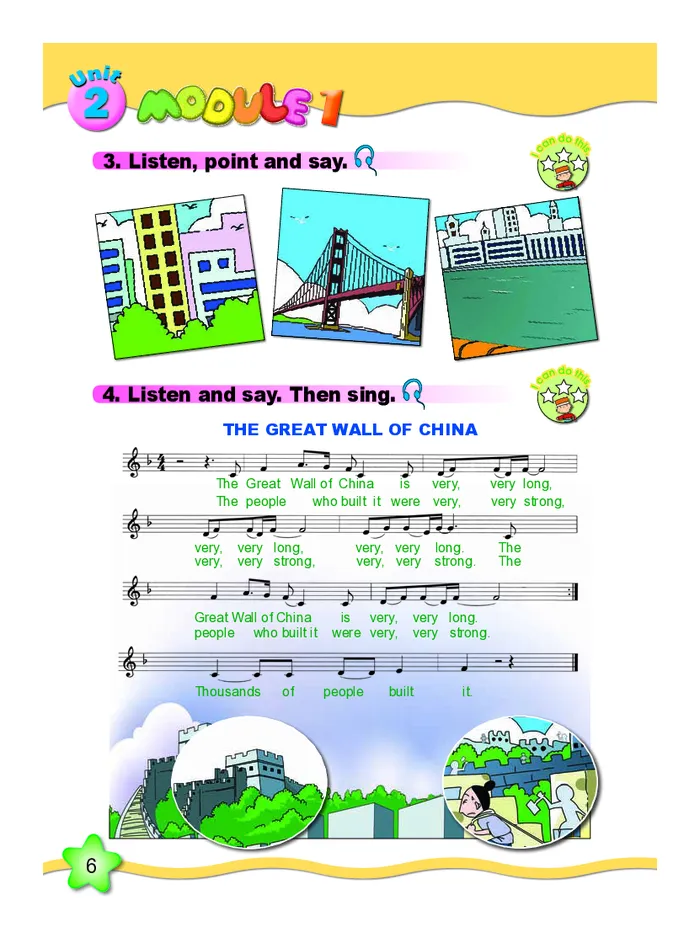
It's more than four hundred
metres high!
1. Look, listen and say.
2. Listen and read.
2
t
i
n
U
How old
is it?
It's eight hundred
years old.
It's my
secret.
Oh, that's
really tall!
How tall is
the tree?
It's thirty
metres tall.
6
2
t
i
n
U
3. Listen, point and say.
4. Listen and say. Then sing.
1
1
THE GREAT WALL OF CHINA
The Great Wall of China is very, very long,
The people who built it were very, very strong,
very, very long, very, very long. The
very, very strong, very, very strong. The
Great Wall of China is very, very long.
people who built it were very, very strong.
Thousands of people built it.
7
5. Guess and say.
Is it in our
city?
Yes,
it is.
It's about
two hundred
years old.
How old is it?
Guess the famous place.
2
t
i
n
U
6. Write and say.
1
1
Write about your favourite place and talk about it.
Yes, it is.
Is it the
museum?
A lot of old
things.
This park is my favourite
place. It is very big. It is
about 250 years old. There
is a big lake and...
This park is
my favourite place.
It is very big…
What can you
see there?
8
1
t
i
n
U
2
1. Look, listen and say.
2. Listen and read.
There's a Chinatown in New York.
Oh, that's good.
Are there any Chinatowns in China?
Oh, all towns in China are Chinatowns!
Daming:
Simon:
Daming:
Simon:
Daming:
I'm going to send an
email to Mum.
I went to Chinatown in New York
yesterday.
9
1
t
i
n
U
2
Dear Mum,
I went to Chinatown in New York yesterday. I had a
big surprise. There were Chinese people everywhere.
There were lots and lots of Chinese shops and
restaurants. The people spoke Chinese and English.
We ate in a Chinese restaurant. The food was different
from the Chinese food in China. Then we saw a lion
dance in the street. Simon really liked it. He wants to
visit China and learn Chinese. He really wants to go to
the Great Wall.
Love,
Daming
Chinatown, New York
SUBJECT:
Mum@nse.cn
TO:
10
1
t
i
n
U
3. Listen and say.
2
2
4. Practise.
I went to Chinatown in New
York yesterday.
We saw a lion dance in the
street.
Where did you go last Sunday?
What did you see?
Where did you go
last Sunday?
I went to...
What did you eat?
11
I went to a library yesterday.
1. Look, listen and say.
2
t
i
n
U
2
2
2. Listen and read.
Yesterday, I went to
Chinatown. I saw a lion
dance there. Look at this
photo. You can see it now.
Dear Max,
We went to the Ming Tombs yesterday. It was
exciting! There were lots of stone animals
and a big red gate. Did you know they found
clothes and money in the tombs...
Xiaoqiang
Dear Baobao,
I went to a library yesterday. It is very big. It
has books, CDs and computers. My favourites
are books about the US and Canada…
Dear Julie,
I wrote a story in English class yesterday.
My teacher liked it very much! I want to write
a book when I am big. I want to visit many
countries and write about them…
James
Ruby
12
3. Now read and answer.
4. Listen and say. Then chant.
2
2
Simple Simon met a farmer
when going to the fair.
Simple Simon said to the farmer,
"Let me taste a pear!"
The farmer said to Simple Simon,
"Show me first your money!"
Simple Simon said to the farmer,
"I haven't got any!"
What did Xiaoqiang do yesterday?
What did James do yesterday?
What did Ruby do yesterday?
2
t
i
n
U
1
2
3
13
5. Guess and say.
6. Think and write.
Did you see
a friend?
Did you
do sport?
Did you go
swimming?
Yes, I did.
No, I didn't.
Yes, I did.
What did you do at the weekend?
What did you do yesterday? Write an email to your friend.
Dear James,
I went to a fruit
farm yesterday...
2
2
t
i
n
U
14
3
1. Look, listen and say.
2. Listen, read and act out.
Have you got any stamps from
China?
1
t
i
n
U
What are you doing, Simon?
I'm putting my new stamps
into my stamp book. These
are stamps from Canada. And
these are stamps from the UK.
And these ones are very, very
old. They're from the US.
Daming:
Simon:
I've got some food
from China.
Have you got any
fish from China?
Sorry, I
haven't.
But I love
Chinese fish.
15
1
t
i
n
U
3
Do you collect stamps?
No, I don't. But it's a good idea!
Here are some stamps from the US and Canada for you.
Thank you.
You can make a stamp book with them.
Great!
Simon:
Daming:
Simon:
Daming:
Simon:
Daming:
Have you got any stamps
from China?
No, I haven't. You always
send me emails. You don't
send me letters, so I haven't
got any Chinese stamps!
I will send you lots of Chinese
stamps.
Thank you.
Daming:
Simon:
Daming:
Simon:
16
3. Listen and say.
4. Practise.
1
t
i
n
U
3
A: What are you doing?
B: I'm putting my new stamps
into my stamp book.
A: Have you got any stamps
from China?
B: No, I haven't.
bananas
orange juice
apples
football
toy car
jacket
doll
Have you got
a knife and
fork?
No, I
haven't.
knife and fork
kite
17
Collecting stamps is my hobby.
1. Look, listen and say.
2
t
i
n
U
3
2. Listen and read.
Collecting stamps is my hobby.
This is my favourite Chinese stamp.
It's a picture of Hainan Island, my
favourite place in China. We can
see the Five-Finger Mountain and
a coconut tree. I love it.
It's a picture of
the sun.
It's a picture of
the moon.
Oh, it's a picture
of my friend from
the moon!
18
2
t
i
n
U
3
3. Read and write.
4. Listen and say. Then chant.
You cannot feel it,
not at all!
So what is it
that I need?
It's the air
around us all.
What do I need?
What do I need?
I need something
very special indeed.
You cannot see it,
not at all!
These stamps are from Canada.
19
birds
cat
computer
kite
fish
bike
toy ship
dolls
football
toy plane
books
pencils
stamps
2
t
i
n
U
3
6. Write and talk.
5. Do and say.
A: Have you got a/any...? B: Yes, I have. / No, I haven't. Have you?
Collecting toy cars is my hobby.
These toy cars are from Canada…
Write about your hobby and talk about it.
toy cars
TV
1
2
3
4
5
6
20
4
Thanksgiving is very important
in the US.
1
t
i
n
U
2. Listen, read and act out.
1. Look, listen and say.
Simon, which festival in the US is
your favourite?
My favourite festival is Thanksgiving.
This festival is very important to us
in the US.
Daming:
Simon:
National Day is his favourite day.
Halloween is her favourite day.
Thanksgiving is their favourite day.
Children's Day is our favourite day.
21
1
t
i
n
U
4
I wrote a poem about Thanksgiving. Do you want to hear it?
Yes, please.
Thanksgiving is nearly here.
Thanksgiving comes every year.
There is one thing I should say.
Thanksgiving is my favourite day!
Oh, your poem is amazing!
Simon:
Daming:
Simon:
Daming:
What do you do on
Thanksgiving?
We always have a big,
special dinner. We say
"thank you" for our food,
family and friends. We
have a lot of fun.
Daming:
Simon:
22
1
t
i
n
U
3. Listen and say.
4. Practise.
4
A: What do you do on Thanksgiving?
B: We always have a big, special dinner.
We say "thank you" for our food, family and friends.
Which festival
in China is your
favourite?
My favourite
festival is...
When is it?
What do you do?
Talk about festivals.
What do you eat?
23
4
Can you tell me about Christmas?
1. Look, listen and say.
2. Listen and read.
2
t
i
n
U
Can you tell me about Christmas?
Sure. It's a very important festival in many countries. It is on
the 25th of December. We put Christmas trees in our homes.
There are lights in the streets and the shops. We give presents
and send cards. We love this festival!
Lili:
Sam:
At the Spring Festival,
we eat lots of food.
Oh, I love Chinese food.
Can we have the Spring
Festival now?
Ha ha... But it's
autumn now.
24
America,
America,
there are
lots and lots of things to see. It's a very big
country, from New York to Tennessee. You can
climb a high mountain. You can swim in a lake. You can
have Thanksgiving and eat lots and lots of
cakes. The flag's got three colours. It is
red and blue and white. It hangs outside the
White House all day and all night. America, A-
merica, there are lots and lots of things to see. It's a
very big country, from New York to Tennessee.
2
t
i
n
U
3. Write and say.
4
4. Listen and say. Then sing.
Christmas is a very important festival.
We give presents.
AMERICA, AMERICA
25
2
t
i
n
U
5. Guess and talk.
6. Do and say.
4
Yes, it is.
Yes, it is.
Is it in
winter?
Of course.
It's...
Is it the
Spring
Festival?
Can you tell
me about
the Spring
Festival?
Write about your favourite festival and talk about it.
Talk about festivals.
The Dragon Boat Festival
is a very important festival
for Chinese people. On this
day, we...
26
5
Can I write to her?
1
t
i
n
U
There's a panda
in the zoo now.
Can he speak
English?
Maybe. His teacher
speaks English.
1. Look, listen and say.
2. Listen, read and act out.
Hi, Laura. This is Daming. He's from China.
You're from China. Fantastic! Pleased to meet you.
Pleased to meet you, too.
Simon:
Laura:
Daming:
27
1
t
i
n
U
5
I've got a friend in China. Her name's Lingling. She can
speak some English. She wants an American pen friend.
Can I write to her?
Of course. You can write to her in English. Look, this is
her photo.
Oh, she's pretty!
Daming:
Laura:
Daming:
Laura:
Do you live here now?
Or are you visiting?
I'm visiting Simon. He's
my cousin.
I really want a Chinese
pen friend. I want to
know more about China.
Laura:
Daming:
Laura:
28
3. Listen and say.
4. Practise.
5
A: Can I write to her?
B: Of course. You can write to
her in English.
She can speak some English.
Make friends.
the US
the UK
Canada
China
Pleased to
meet you, too.
Pleased to
meet you.
Can I write
to you?
I'm from China.
Where are you
from, Peter?
Of course. You can
be my Chinese
pen friend.
I'm from
the US.
1
t
i
n
U
Hi, Maomao.
This is my new
friend, Peter.
29
5
2
t
i
n
U
1. Look, listen and say.
2. Listen and read.
I want a Chinese pen friend.
Pen Friends
Hi, I'm Carol.
I'm from the US. I
can speak some
Chinese. I want a
Chinese pen friend.
Hello, I'm Tingting.
I'm Chinese. I'm
learning English. I
want a pen friend
from the UK. We
can write in English.
Hi, I'm Brian.
I come from London. I
can't speak Chinese. But
I love China. I want new
friends from China. Do you
want to be my pen friend?
I want a pen
friend. We can
write in English
and Chinese.
I want a pen
friend, too. We can
write in French.
Tom, do you
want a pen
friend?
No. He
wants a phone
friend. Ha ha...
30
3. Write and say.
4. Listen and say. Then sing.
5
2
t
i
n
U
WHERE DO YOU COME FROM?
Where do you come from? Your face is new. I
come from America and I'm pleased to meet you.
Are you from around here? Where are you from?
No, I'm not from around here. I'm from Canada.
Are you from America? We can't tell from your face.
No, we are from England and we love this place.
Name
I'm from…
I can / I can't…
I want…
Carol
Tingting
Brian
31
5. Guess and say.
5
She can play
football.
She can speak
English.
6. Write and say.
Choose a pen friend from Activity 2 and write a letter to him/her.
2
t
i
n
U
Is it
Fangfang?
Dear Brian,
My name is... I'm from China.
I can speak some English.
I like...
Can you be my pen friend?
Best,
...
Yes, you are right.
32
6
6
1. Look, listen and say.
2. Listen and read.
1
t
i
n
U
No, I
haven't.
No, I
haven't.
What book have
you got?
I've got a
book about
the world.
Have you got
a book about
the US?
Look, Amy! A letter
from the US.
No, it isn't.
Is it from
Daming?
Have you got a
book about China?
I've got some Chinese chopsticks.
33
1
t
i
n
U
6
Dear Lingling,
My name is Laura. I met Daming here in New York. He showed
me your photo. Can you be my pen friend?
I've got long, yellow hair and blue eyes. I like Chinese food and I've
got some Chinese chopsticks. But it is very difficult for me to use
them. My brother has got a Chinese kite. It is a very big bird. He
often flies it in the park.
I'm from New York. It's a very big city. Have you got a book about
the US? Please write back and I will answer your questions about
the US.
Best,
Laura
34
3. Listen and say.
4. Practise.
1
t
i
n
U
6
6
I've got some Chinese chopsticks.
My brother has got a Chinese kite.
Have you got a book
about the US?
What have
you got in your
room?
I've got a
desk and a
chair.
I've got a
computer.
What have you got
in your room?
35
I haven't got a book about
the US.
2
t
i
n
U
6
6
1. Look, listen and say.
2. Listen and read.
Dear Laura,
Thank you for your letter. I'm happy to be your pen friend.
I haven't got a book about the US. But I have got some photos
of New York. Daming sent them to me. Miss Lin, my Art teacher,
helped me make a poster of New York with those photos.
My school starts at eight o'clock. It finishes
at half past three. What time does your
school start and finish?
Your friend,
Lingling
I've got a kite
from China.
I've got some
stamps from China.
And Bob has
got some food
from China!
36
2
t
i
n
U
3. Read and write.
4. Listen and say. Then chant.
6
6
Hello, my dear friend,
here is my letter.
What can be better
than reading a letter?
Dear Laura,
My name is Xiaoqi. My
school starts at eight
o’clock. It finishes at
four...
Letter or email,
card or phone.
We can talk together,
and we're not alone.
37
2
t
i
n
U
5. Guess and say.
6. Do and say.
6
6
These books are
for our class.
We've got four books
about the US. We've got
five books about science...
He's got short,
black hair.
At the Class Book Corner
He's got long
legs. And he plays
basketball well.
Is it Yao Ming?
Yes, you
are right.
38
Pandas love bamboo.
7
1
t
i
n
U
1. Look, listen and say.
What are you watching, Daming?
I'm watching a new DVD about animals.
Simon gave it to me.
What does it say about my
favourite animal?
Pandas?
Yes.
Pandas love bamboo.
They eat for twelve
hours a day!
I love bamboo, too.
Grandma:
Daming:
Grandma:
Daming:
Grandma:
Daming:
Grandma:
2. Listen, read and act out.
Do snakes
love music?
Well, I don't
know.
Oh, my CD!
Does your dog
love music?
39
1
t
i
n
U
7
Wow! Look at this picture! The snake can use its
body to dance.
Do snakes love music?
No, they don't. They're almost deaf! They can't
hear the music. It says the snake thinks the flute is
dangerous, so it gets frightened!
Daming:
Grandma:
Daming:
Grandma:
Daming:
Grandma:
This is a fantastic DVD!
Yes, it's fantastic!
What a great present from Simon!
40
3. Listen and say.
4. Practise.
1
t
i
n
U
7
Pandas love bamboo. They eat
for twelve hours a day!
A: Do snakes love music?
B: No, they don't. They're almost
deaf!
What food do
you love?
I love
noodles.
Do you love
hamburgers?
No, I don't.
41
2
t
i
n
U
2. Listen and read.
A child sleeps for ten hours
a night.
1. Look, listen and say.
7
7
A child sleeps for ten
hours a night.
A baby sleeps for
sixteen hours a day.
A fox sleeps in the
day and doesn't
sleep at night.
Sh!
Ah! Help!
Sh! The tiger
is sleeping.
Ho
w
ma
ny
hou
rs d
o yo
u s
lee
p a
n
ig
ht
?
Roar...
42
2
t
i
n
U
3. Read and write.
7
This old owl
lives in a tree.
He likes to look.
He likes to see.
He likes to hear,
but not to say.
We can learn a lesson
from this owl today.
4. Listen and say. Then chant.
18 hours
16 hours
4 hours
10 hours
This snake sleeps for eighteen
hours a day.
How many hours do they sleep a day?
43
Where does
it live?
How many legs
has it got?
It lives in
water.
It has got
no legs.
Yes, it is.
Is it a fish?
5. Guess and say.
6. Write and say.
7
2
t
i
n
U
Write an animal quiz and talk about it.
Where does it live?
What does it eat?
Is it big or small?
How many legs has it got?
Can it fly/swim?
What colour is it?
Is it true?
1. Pandas eat meat every day.
2. Bears sleep in winter.
3. Snakes can hear.
4. ...
44
1. Look, listen and say.
2. Listen, read and act out.
Do you often tidy your bed?
1
t
i
n
U
What are you doing, Amy?
I'm tidying Tom's bed.
Let me help you.
Thank you.
Does he ever tidy his bed?
No, he doesn't.
Lingling:
Amy:
Lingling:
Amy:
Lingling:
Amy:
I tidied my room
and I found a coin.
8
You should tidy your room
every day. Then you'll find a
coin every day!
45
1
t
i
n
U
Do you often tidy your bed?
Yes, every day. I can sleep well in a tidy bed.
I know. Do you often tidy your desk?
No, I don't. It's very messy. I can't find my books.
I will help you, Amy. I will tidy your desk.
Thank you.
Lingling:
Amy:
Lingling:
Amy:
Lingling:
Amy:
Now your desk is tidy. What do you want to do now?
Let's read!
Good idea! Do you often read stories?
Yes. I read stories every day.
Lingling:
Amy:
Lingling:
Amy:
8
46
3. Listen and say.
4. Practise.
A: Do you often tidy your bed?
B: Yes, every day.
A: Do you often read stories?
B: Yes. I read stories every
day.
tidy your room
read books
go to the library
Do you often tidy
your room?
Yes, I do.
8
1
t
i
n
U
47
I often read English books.
2
t
i
n
U
1. Listen and chant.
2. Listen and read.
I'm always here.
I never go.
You're sometimes here.
You often go.
I love English. I often
read English books.
I never play football.
I don't like it.
Maomao
Simon
Gerry
I always ride my bike to school.
I never go by bus.
8
8
I sometimes clean the
blackboard for my
teachers.
Lili
48
3. Look and write.
8
8
2
t
i
n
U
4. Listen and say. Then chant.
"Don't be so mean.
Your house will be clean,"
said the girl.
"Don't be mean!"
always
sometimes
often
never
"Hurry up! Hurry up!
And clean my house,"
said the lady.
"Clean my house."
"That is what you do.
And then clean my shoes,"
said the lady.
"Clean my shoes."
I often go swimming.
Write about yourself.
49
5. Ask and answer.
6. Read and write.
8
8
2
t
i
n
U
Do you
eat bananas?
Yes, I sometimes
eat bananas.
eat bananas
go swimming
cook dinner
clean the classroom
send emails
drink tea
play basketball
collect stamps
Always
Often
Sometimes
Never
I often go swimming...
go swimming
read books
watch TV
play basketball
go to the supermarket
cook dinner
clean my room
play computer games
do my homework
Complete the table and write about yourself.
√
never
sometimes
often
always
50
Hello, bird! Do you
want to visit China?
I want to visit
China. I want to
visit the Great Wall.
9
1
t
i
n
U
Do you want to visit the UN
building?
1. Look, listen and say.
2. Listen, read and act out.
50
Do you want to visit the
UN building?
Yes, we do!
Simon's dad:
Simon and Daming:
Tweet!
Tweet!
51
1
t
i
n
U
9
Wow! The building is beautiful. It's very big and very tall.
Haven't you got buildings like this in China?
Yes, we have. We've got lots of very tall and big buildings
in China.
Do you want to go into the building?
Yes, I do. But can we?
Daming:
Simon:
Daming:
Simon:
Daming:
51
Is this the UN building?
Yes. It's a very important building in New York. The UN
wants to make peace in the world. Many countries are
in the UN.
Is China in the UN?
Yes. China is one of the 193 member states in the UN.
Daming:
Simon:
Daming:
Simon:
52
1
t
i
n
U
9
4. Practise.
Do you want
to visit...?
Yes, I do.
3. Listen and say.
Is this the UN building?
Yes. It's a very important building in New York. The UN
wants to make peace in the world. Many countries are
in the UN.
Is China in the UN?
Yes. China is one of the 193 member states in the UN.
Daming:
Simon:
Daming:
Simon:
53
9
2
t
i
n
U
I want to go to Shanghai.
1. Look, listen and say.
2. Listen and read.
There are lots of beautiful places
to go in China.
I want to go to Shanghai.
Shanghai is very big and very
famous.
Kunming is a beautiful place.
It's in the south of China, and
it's got a beautiful lake.
And there are lots of mountains
and lakes in Guilin.
Do you want to visit the
Changjiang River? Do you want
to visit the Huangshan Mountain?
Oh, it does. It's flying
to China now.
I think we should go to all these
places.
That's a good idea.
54
2
t
i
n
U
9
3. Look and write.
4. Listen and say. Then chant.
Girl:
Boy:
Girl:
Boy:
Do you want to go
to the sea, sea, sea?
Yes, we want to go
to the sea, sea, sea.
When you want to go
to the sea, sea, sea,
come with me, me, me.
Do you want to ride
on a bus, bus, bus?
Yes, we want to ride
on a bus, bus, bus.
When you want to ride
on a bus, bus, bus,
come with us, us, us.
Do you want to drink some
juice?
Yes, I do.
Do you want to visit
the zoo, zoo, zoo?
Yes, we want to visit
the zoo, zoo, zoo.
When you want to visit
the zoo, zoo, zoo,
can we come too, too, too?
55
2
t
i
n
U
9
5. Ask and answer.
6. Do a survey and write.
Do you want
to visit the park?
Yes, I do.
Do you?
Place
Dad
Mum
Hong Kong
Harbin
My father wants to go to
Hong Kong. He wants to
go to the park there.
My mother...
56
1
t
i
n
U
Only drink clean water!
1. Listen and chant.
2. Listen, read and act out.
10
10
Daming:
Simon's mum:
This is a beautiful
park, Aunt Jane.
Yes. We often come
here.
It's sunny today.
It's fun to play.
It's raining today.
Who can take the rain away?
57
1
t
i
n
U
10
10
Mum, can we have our picnic now?
I'm hungry.
And I'm thirsty.
Yes, of course. Here are your
sandwiches.
Thank you.
Simon:
Daming:
Simon's mum:
Simon and Daming:
Oh no! I didn't bring any drinks! I forgot!
Oh no!
Don't worry, Mum. We can drink water here.
Only drink clean water!
This water is very clean.
And cool.
It's fun to drink this way!
Ha ha...
Simon's mum:
Simon and Daming:
Simon:
Simon's mum:
Simon:
Daming:
Simon:
Simon and Daming:
58
10
10
1
t
i
n
U
3. Listen and say.
4. Practise.
A: Only drink clean water!
B: This water is very clean.
It's fun to drink this way!
It's fun to...
It's fun to play
football.
It's fun to learn
English.
59
2
t
i
n
U
10
10
1. Look, listen and say.
2. Listen and read.
Go straight on.
Turn left.
Go! It's green.
Don't turn right
here!
The light is red.
Please don't cross.
Now it's green.
You can cross.
Stop!
Don't cross!
Don't ride your
bicycle here!
Go straight on.
60
2
t
i
n
U
3. Look and say.
4. Listen and say. Then chant.
10
10
A: Excuse me. How do I get to the zoo?
B: �Turn right and go to Short Road. Go straight on.
Turn left at Red Street. The zoo is on your right.
A: Thank you.
school
zoo
supermarket
toy shop
Water should be clean.
Good food should be hot.
Rice, meat and greens,
in a lovely pot!
Stop — don't cross the road!
Wait — OK, move slow!
We should only walk into the road
when we know it's safe to do so.
You are here!
61
2
t
i
n
U
6. Do and say.
10
10
5. Say "Please!"
Sit down!
Sorry,
you're out!
Please
stand up!
Write some tips for the class picnic.
1. Come to school at 8:00.
2. Bring some food.
3. Don’t forget to bring
some water.
4. ...
We're going to have a
picnic this Saturday. Please
come to school at 8:00...
62
1. Ask and answer.
2. Now say.
Questions for the Radio
On the Radio
How did you go there?
What did you do there?
What was the weather like?
Did you have fun?
Zhang Hai is ten.
He lives in...
What was the
weather like?
It was...
Hello. This is for the radio.
Where did you go
last weekend?
I went to the park.
What's your name?
How old are you?
Where do you live?
Where did you go last weekend?
1
t
i
n
U
63
3. Listen and number.
4. Write and talk.
Write your answers and then ask and answer in pairs.
What do you often do at the weekend?
________________________________________________
Where do you do it?
________________________________________________
What does your father/mother do at the weekend?
________________________________________________
Where does he/she do it?
________________________________________________
1
t
i
n
U
64
1. Listen and number.
2. Now talk about each pen friend.
About Pen Friends
This pen friend's
name is Annie.
Her parents...
2
t
i
n
U
65
3. Make sentences with these words.
bamboo
computer
library
stamp
coins
pen friend city clean surprise
difficult phone the US Canada
2
t
i
n
U
Stamp! Have you
got any stamps
from China?
Computer! My
mother bought a
computer yesterday.
hungry
thirsty picnic thousand blackboard
Module 1
how long 多长
near 在……附近
along 沿着
more than 超过
kilometre 千米,公里
metre 米
office building 办公大楼
Module 2
*Chinatown 唐人街,中国城
town 城镇,市镇
subject 主题,话题
everywhere 到处
spoke (speak的过去式)
说(某种语言)
lion dance 舞狮
tomb 坟墓
wrote (write的过去式)写
when 当……时
Module 3
stamp 邮票
book 簿,册
collect 收集
hobby 爱好
sun 太阳
island 岛屿
*coconut 椰子
66
Words and Expressions in Each Module
Module 4
*Thanksgiving 感恩节
nearly 差不多,将近
the Spring Festival 春节
sure 当然
December 十二月
light 灯
Module 5
pleased 开心的,高兴的
pretty 漂亮的
French 法语
phone 电话
Module 6
world 世界
difficult 困难的
answer 回答,答复
Miss (称呼)女士,小姐
Module 7
bamboo 竹子
gave (give的过去式)给,送
its 它的
almost 几乎,差不多
deaf 聋的
*frightened 害怕的,受惊的
sh 嘘
*roar 吼叫声
*fox 狐狸
at night 在夜晚
Module 8
coin 硬币
67
ever 曾经
tidy 整齐的,整洁的
messy 凌乱的
never 从不
blackboard 黑板
Module 9
peace 和平
make peace 维护和平
member state 成员国
famous 著名的
Module 10
aunt 姑母;姨母;舅母;
伯母;婶母
forgot (forget的过去式)
忘记
way 方式,方法
cross 穿过(马路等);
渡过(河)
68
(注:黑体词为义务教育英语课
程标准二级词汇,标有*的词为
五级词汇表外的词汇)
Aa
almost 几乎,差不多
along 沿着
answer 回答,答复
at night 在夜晚
aunt 姑母;姨母;舅母;
伯母;婶母
Bb
bamboo 竹子
blackboard 黑板
book 簿,册
Cc
*Chinatown 唐人街,中国城
*coconut 椰子
coin 硬币
collect 收集
cross 穿过(马路等);
渡过(河)
Dd
deaf 聋的
December 十二月
difficult 困难的
Word List
69
Ee
ever 曾经
everywhere 到处
Ff
famous 著名的
forgot (forget的过去式)忘记
*fox 狐狸
French 法语
*frightened 害怕的,受惊的
Gg
gave (give的过去式)给,送
Hh
hobby 爱好
how long 多长
Ii
island 岛屿
its 它的
Kk
kilometre 千米,公里
Ll
light 灯
lion dance 舞狮
Mm
member state 成员国
messy 凌乱的
metre 米
Miss (称呼)女士,小姐
more than 超过
Nn
near 在……附近
nearly 差不多,将近
never 从不
Oo
office building 办公大楼
70
71
Pp
peace 和平
make peace 维护和平
phone 电话
pleased 开心的,高兴的
pretty 漂亮的
Rr
*roar 吼叫声
Ss
sh 嘘
spoke (speak的过去式)
说(某种语言)
stamp 邮票
subject 主题,话题
sun 太阳
sure 当然
Tt
*Thanksgiving 感恩节
the Spring Festival 春节
tidy 整齐的,整洁的
tomb 坟墓
town 城镇,市镇
Ww
way 方式,方法
when 当……时
world 世界
wrote (write的过去式)写
air 空气
alone 单独的,孤独的
better 更好
built (build的过去式)建造
fair 集市
feel 触摸
first 首先
flag 旗
greens 绿色蔬菜叶子
hang 悬挂
indeed 确实,实在
lady 女士
mean 残忍的
money 钱
move 移动,走
need 需要
outside 在外面
owl 猫头鹰
pot 锅;壶
simple 头脑简单的
slow 慢慢地
something 某事物,某东西
taste 品尝
tell 识别,分辨
than 比
72
Words in Songs
and Chants
73
Names
Annie 安妮
Brian 布赖恩
Carol 卡萝尔
Gerry 格里
James 詹姆斯
Jane 简
Julie 朱莉
Kate 凯特
Laura 劳拉
Max 马克斯
Peter 彼得
Ruby 鲁比
Proper Nouns
Places
Canada 加拿大
Changjiang River 长江
Five-Finger Mountain 五指山
Huangshan Mountain 黄山
Ming Tombs 明十三陵
Tennessee (美国州名)田纳西州
the Empire State Building 帝国大厦
the White House 白宫
Others
UN 联合国
74
Infinitive
Past Tense
Infinitive
Past Tense
begin
break
bring
build
buy
catch
come
do
draw
drink
drive
eat
fall
feed
began
broke
brought
built
bought
caught
came
did
drew
drank
drove
ate
fell
fed
find
fly
forget
get
give
go
have
hear
hide
know
learn
leave
lose
make
found
flew
forgot
got
gave
went
had
heard
hid
knew
learnt/learned
left
lost
made
Irregular Verbs
Infinitive
Past Tense
Infinitive
Past Tense
meet
put
read
ride
ring
run
say
see
sell
send
met
put
read
rode
rang
ran
said
saw
sold
sent
sit
speak
spend
take
tell
think
wear
win
write
sat
spoke
spent
took
told
thought
wore
won
wrote
Irregular Verbs
75
76
The Leaf
Neighbour:
Man from Chu:
Neighbour:
Man from Chu:
Neighbour:
Hi! What are you doing?
I'm reading a book. It is about an insect called "mantis".
I know about the mantis. The mantis eats small insects!
Yes, it does. But how does it catch the small insects, do
you know?
No, I don't.
This poor man is from Chu. He is reading a book.
A neighbour is walking by.
77
Man from Chu:
Neighbour:
Man from Chu:
Neighbour:
Man from Chu:
Neighbour:
Let me tell you. The book says there's a special kind
of leaf. If the mantis holds the leaf in front of its body, it
becomes invisible! The insects can't see it!
That's really interesting.
I'm going to try it.
Really?
Of course. I'm going to find the right leaf!
Good luck! Bye!
78
At Home
Man from Chu:
Wife:
Man from Chu:
Wife:
Can you see me?
Yes, I can.
Can you see me now?
Yes, I can.
79
Man from Chu:
Wife:
Can you see me now?
What? No, I can't see you now.
100 Leaves Later...
80
Don't take my chicken!
You're stealing my rice!
But you can't see me! I'm invisible!
Of course we can see you, you silly, bad man!
Man:
Woman:
Man from Chu:
All:
In the Market
insect 昆虫
invisible 看不见的
mantis 螳螂
silly 愚蠢的
steal 偷
Word List
81
The Different Duck
A duck is sitting on five eggs. The eggs break and five baby ducks
come out. The mother duck looks at her babies. She has four beautiful
baby ducks. But one is different. It is big and grey. Its legs are very
long. The mother duck doesn't like this baby duck.
"Go away," she says to the different duck. "You are not my baby."
The different duck says goodbye and goes away. It is sad.
82
Then it sees a mother pig with her baby pigs.
"Are you my mother?" it asks.
"No," says the mother pig. "I'm not your mother. Go away."
83
So the different duck goes away. Soon it sees a fox.
"Am I your baby?" the different duck asks the fox.
"No, you're not my baby," says the fox. "But I like you. I will eat you for
dinner."
The different duck runs away. It is very sad. It wants its mother.
84
Then it hears a voice.
"You are very beautiful. I am your mother."
The different duck looks up. It is a big, white bird. It has got a long neck.
"I am a swan," says the white bird. "And you are a baby swan. You see,
here are your brothers and sisters."
"So, I'm not a different duck. I'm a swan!" says the baby swan.
85
Soon, the baby swan grows up. It becomes very beautiful.
go away 走开
grey 灰色的
grow up 长大
neck 脖子
swan 天鹅
Word List
86
There are lots of different spiders.
There are big ones and small ones,
fat ones and thin ones. Some are brown,
some are black, some are orange and
some are red. Spiders live in webs in
houses and schools. They also live in
parks and streets.
Spiders
Spiders
87
Look at the pictures. How many legs has a spider got?
Spiders eat insects. They make webs. If insects get in the webs, they
cannot get out. Then the spiders eat them. Are there any webs in your
classroom?
Some spiders can hurt you. Some cannot. Do you like spiders? Or are
you scared of them?
spider 蜘蛛
web 网
Word List
88
And we like the Dragon
Boat Festival.
OK.
Very good.
Great!
Our favourite festival
is the Spring Festival.
the Mid-Autumn Festival
the Lantern Festival
1. Work in groups. Choose different Chinese
festivals.
the Spring Festival
the Dragon Boat Festival
Make a Festival Poster
We want to find out about
the Lantern Festival.
89
2. Find information about your festival.
When is the festival?
What do people do?
What do they eat and drink?
Why do they have the festival?
90
Draw some pictures and write some sentences.
The Lantern Festival is in
spring. People put lanterns in
the streets. The lanterns are
very beautiful. In Northeast
China, people make lanterns
from ice!
3. Write about the festival.
91
4. Now talk to the class about the festival.
The Lantern Festival
is in spring.
People eat yuanxiao at
the Lantern Festival.
后 记
后 记
既名为“后记”,一般应该是本教材使用完毕后才看到的吧。
那么,同学们,你们喜欢这套教材吗?大明、玲玲以及他们的小伙
伴们是否让你们喜爱上了英语,并且帮助你们掌握了一定的英语运用能
力呢?如果是这样,那就太好啦!希望你们在以后的英语学习中继续大
胆地开口说英语——课上说、课下说;继续积极地参与各项语言活动。
一句话,你们要尽量主动使用英语来表达意思和做事情,这样才能把英
语学好。
可敬的老师们,感谢你们的辛勤劳动,以及你们为国家英语课程改
革付出的努力和做出的贡献。在修订本套教材的过程中,我们也充分考
虑了英语课程改革以及一线教学的需求。修订后的教材更加突出了英语
课程工具性和人文性的统一,优化了各册的结构设计和内容安排,以使
教学脉络更加清晰、梯度更加合理。
为了在最大程度上保证教材与课程标准的契合,便于一线教学使用,
所有参与本套教材编写的人员均付出了艰辛的努力。在此我想特别感谢
我的编写团队,没有他们的努力与付出,就没有本教材的问世。
本册教材的主要编写人员如下(中方编写人员按姓氏笔画排序):
Naomi Simmons(英)
于业宏 王馨悦 孙 泓 张 琦 樊 波
你们的
二〇一二年春日