Tiger Times 01
为什么说《乘风破浪的姐姐》是虚假的女权主
义?
讲师丨Connie     来源丨Sixth Tone   日期丨2020.07.31 Fri.
▶ 在政治正确和戏剧性之间,
《乘风破浪的姐姐》的制作人作出了什么选择?
▶   “乘风破浪“用英语怎么说?“女团”、“出道位”用英语怎么说?
▶   《乘风破浪的姐姐》本质上是个什么节目?
▶   观众爱看姐姐们的两个理由是什么?
▶   公众话语被流量明星垄断会带来什么后果?
▶   偶像选秀类节目为什么会精心设计两类人的冲突?姐姐们的节目里也有
两类姐姐吗?
扫码听课
听课笔记
'Sisters' Act: The Hollow Feminism of
China's Hottest New Show
讲解正文
Between progressive politics and drama, producers will always
choose the latter. But that doesn't mean the show isn't worth
watching.
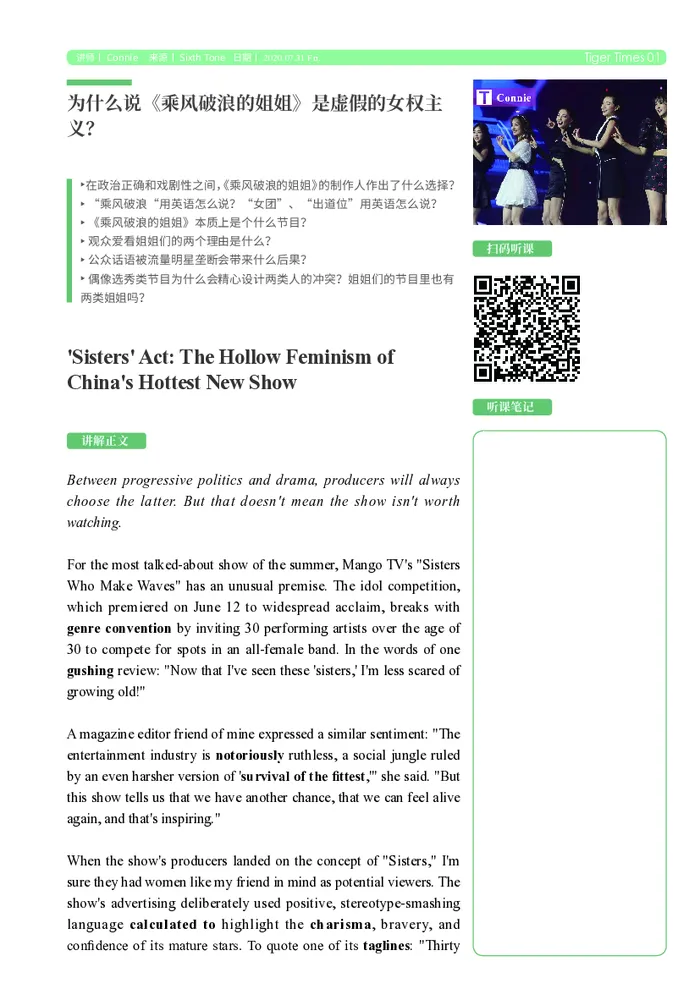
For the most talked-about show of the summer, Mango TV's "Sisters
Who Make Waves" has an unusual premise. The idol competition,
which premiered on June 12 to widespread acclaim, breaks with
genre convention by inviting 30 performing artists over the age of
30 to compete for spots in an all-female band. In the words of one
gushing review: "Now that I've seen these 'sisters,' I'm less scared of
growing old!"

A magazine editor friend of mine expressed a similar sentiment: "The
entertainment industry is notoriously ruthless, a social jungle ruled
by an even harsher version of 'survival of the fi ttest,'" she said. "But
this show tells us that we have another chance, that we can feel alive
again, and that's inspiring."

When the show's producers landed on the concept of "Sisters," I'm
sure they had women like my friend in mind as potential viewers. The
show's advertising deliberately used positive, stereotype-smashing
language calculated to highlight the charisma, bravery, and
confi dence of its mature stars. To quote one of its taglines: "Thirty
'sisters' defy age, convention, and labels to form a band."

Although certainly politically correct, that's probably going too far.
"Sisters" is ultimately just another idol show. What it delivers — and
what keeps viewers hooked — isn't empowerment, but vicarious
thrills.

At first glance, "Sisters" does seem unconventional. Most idol shows
feature contestants in their teens and 20s. "Semi-finished goods,"
these aspiring stars are more than willing to play by the rules and
ingratiate themselves to the shows' almighty judges.

The industry veterans of "Sisters," on the other hand, flout the rules,
challenge the program's crew, and push back against the judges.
When an on-camera director asked Taiwanese singer Annie Yi —
at 52, the oldest contestant on the show — to cover her knees, she
wasn't having it. "Can't we do it my way for once?" she asked. "Just
let me sit here in peace."

It's a gratifying scene for the audience, who gets to experience the
excitement of watching the show's power dynamics momentarily
flip. The show likely also benefitted from audience disgust with the
omnipresent "data economy" in which young stars with fanatical
Generation Z fan bases like Cai Xukun monopolize the public
discourse. Indeed, one of the biggest celebrity dust-ups of the past
year took place when disgruntled Generation X and Millennial
backers of mandopop star Jay Chou briefly toppled Cai from his
place atop microblogging platform Weibo's hot topic rankings.
"Sisters," too, is a reminder the world doesn't always revolve around
ingénues or their "little fresh meat" counterparts.

Yet for all the praise "Sisters" has received for its premise, the
show's primary conflict isn't between women of a certain age and
the stereotypes holding them back, but between two very different
subgroups of female celebrities. The 30 women in "Sisters" may all
be of roughly similar ages, but they come from extremely disparate
backgrounds.

The first group, which exudes self-confidence — some might say
conceit — have years of show business experience, successful
careers, and in some cases, the financial support of male benefactors.
Tiger Times
02
Kitty Zhang, for example, is known both for her still-sharp acting
skills and her tendency to put on airs. Fellow actress Eva Huang is
less acclaimed, but enjoys the backing of her producer husband. They
joined "Sisters" not because they needed the gig, but for the novelty
of being in a female band. And viewers revel in watching them break
the rules, defy the judges, and provoke the producers.

The second group has more to lose. Some were once showbiz
darlings who have since found themselves relegated to low-end
publicly funded performances; a few have been all but forgotten.
Compared with the first group, they come off as much meeker. But
that doesn't mean they're not willing to do whatever it takes to win:
"Sisters" might be their last chance to revive their careers.

This dynamic is not unique to "Sisters." At its core, the show, like
all idol shows, is a competition between those who have something
to lose and those who don't. The conflict between them is grounded
in their disparate resources and connections. The country's premier
idol competition, "Produce 101," also tends to pit girls who are born
rich and who want to be famous against those who stand to gain
everything by winning.

Despite its "girl power" trappings, "Sisters" has also come under fire
from a number of Chinese feminists. One commentator argued that,
while the show ostensibly emphasizes a diversity of female values
and female beauty, its stars are still primarily appraised, consumed,
and favored for their attractive appearances, svelte figures, dewy
skin, unrealistic pep, and extreme self-discipline.

Even though I agree "Sisters" doesn't live up to its feminist branding,
that's taking things a little too seriously. At best, "Sisters" reminds
viewers that just because a woman's turned 30 doesn't mean her life
is over, or that she can't accomplish great things. It won't — and
can't — live up to feminist ideals, for the simple reason that it wasn't
designed to do so.

Nor should it have to. I suggest everybody simply watch the program
in peace. These "sisters" have tall enough mountains to scale without
having to live up to impossible standards of political correctness. And
besides, they're putting on quite a show.
Tiger Times
03
Tiger Times
04
hollow /ˈhɒləʊ/ adj.(语言、事件或人)虚假的,无价值
的
 ○ words, events, or people that are hollow have no real worth
or value
 ○ e.g. They won, but it was a hollow victory. 他们赢了,但
那是一个没有实际意义的胜利。
genre /ˈdʒɒŋrə/ n.(音乐或文学等艺术作品的)类型
 ○ a category of artistic composition, as in music or literature,
characterized by similarities in form, style, or subject matter
 ○ e.g. a new genre of film-making 一种新的电影摄制体裁
convention /kənˈvenʃən/ n.(尤指特定地区或活动的)准则;
惯例
 ○ a way in which something is usually done, especially with-
in a particular area or activity
 ○ e.g. the pictorial conventions of mass-media imagery 大众
传媒图像的绘画准则
gushing /ˈɡʌʃɪŋ/ adj. 夸大其词的;过分吹捧的
 ○ (= gushy) expressing praise, pleasure etc. in a way that
other people think is too strong
 ○ e.g. the gushing praise of the New York critics 纽约评论
家的夸张吹捧
 ○ gush /ɡʌʃ/ v. 吹捧;夸张地表达
 ○ e.g. 'I simply loved your book, ' she gushed. “ 我真是喜欢
你的书。” 她吹捧道。
notorious /nəʊˈtɔːrɪəs/ adj. 声名狼藉的,臭名昭著的;众
所周知的
 ○ famous or well known, typically for some bad quality or
deed
 ○ e.g. Los Angeles is notorious for its smog. 洛杉矶的烟雾
是出了名的。
 ○ notoriously /nəʊˈtɔːriəsli/ 恶名昭彰地,声名狼藉地
survival of the fittest 适者生存
 ○ a situation in which only the strongest and most successful
people or things continue to exist
 ○ e.g. He described the process of how new species started
as 'natural selection', or 'the survival of the fittest'. 他将新物
种的开始称作是“ 自然选择”,或是“ 适者生存”。
be calculated to do something 旨在做某事,用意在于某
事
 ○ to be intended to have a particular effect
 ○ e.g. a question calculated to embarrass him 故意要让他难
堪的一个问题
charisma /kəˈrɪzmə/ n. 强烈的吸引力;迷人的魅力
 ○ compelling attractiveness or charm that can inspire devo-
tion in others
 ○ e.g. She enchanted guests with her charisma. 她以慑人魅
力迷倒众宾客。
tagline /tæɡlaɪn/ n.(尤指广告中的)引人注意的话,口号;
(笑话后附加的)歇后语
 ○ a catchphrase or slogan, especially as used in advertising,
or the punchline of a joke
词汇
defy /dɪˈfaɪ/ v. 公然反抗;藐视
 ○ openly resist or refuse to obey
 ○ e.g. a woman who defies convention 反传统的女子
hooked /hʊkt/ adj. 对… 上瘾的,对… 着迷的
 ○ If you are hooked on something, you enjoy it very much
and you want to do it as often as possible.
 ○ e.g. I got hooked on TV when I was sick. 我生病时看电视
上了瘾。
empower /ɪmˈpaʊə(r)/ v. 授权于
 ○ give (someone) the authority or power to do something
 ○ e.g. Nobody was empowered to sign cheques on her be-
half. 她没有授权任何人代表她签支票。
 ○ empowerment /ɪmˈpaʊəmənt/ n. 权利赋予
 ○ The empowerment of a person or group of people is the
process of giving them power and status in a particular situa-
tion.
 ○ e.g. This government believes very strongly in the empow-
erment of women. 这届政府坚信赋权于妇女。
vicarious /vɪˈkeərɪəs/ adj.(凭想像)通过他人情感(或行动)
感受的,从他人经验间接获得的
 ○ experienced in the imagination through the feelings or
actions of another person
 ○ e.g. This catalogue brings vicarious pleasure in luxury
living. 这份目录使人间接体验到奢华生活的愉悦。
ingratiate /ɪnˈgreɪʃɪeɪt/ v. 讨好,巴结,迎合
 ○ bring oneself into favour with someone by flattering or
trying to please them
 ○ e.g. a sycophantic attempt to ingratiate herself with the
local aristocracy 她谄媚讨好地方权贵的企图
flout /flaʊt/ v. 公然藐视,无视(规则,法律,惯例)
 ○ openly disregard (a rule, law or convention)
 ○ e.g. The advertising code is being flouted. 广告法规被公
然藐视。
gratifying /ˈɡrætɪfaɪɪŋ/ adj. 令人高兴的,令人满意的
 ○ pleasing and satisfying
 ○ e.g. It's gratifying to note that already much has been
achieved. 得知已经完成了很多,真令人欣慰。
 ○ gratify /ˈɡrætɪfaɪ/ v. 使高兴,使满意
dynamics /daɪˈnæmɪks/ n. 动态,(事物或人)相互作用的
方式
 ○ the way in which things or people behave, react, and affect
each other
 ○ e.g. the dynamics of the family 家庭互动
omnipresent /ˌɒmnɪˈpreznt/ adj.(任何时候都)无所不在的,
普遍存在的
 ○ present everywhere at all times
 ○ e.g. These days the media are omnipresent. 现在新闻媒体
无处不在。
monopolize /məˈnɒpəlaɪz/ v. 垄断;独占;完全控制
Tiger Times
05
 ○ (=monopolise) have complete control over something so
that other people cannot share it or take part in it
 ○ e.g. He monopolized the conversation all evening. 整个晚
上都是他一个人在说话。
dust-up /'dʌstʌp/ n. 打架,斗殴
 ○ a fight
 ○ e.g. He's now facing suspension after a dust-up with the
referee. 与裁判员发生争斗后,他现在面临着禁赛处罚。
disgruntled /dɪsˈgrʌntld/ adj. 愤怒的;不满的
 ○ angry or dissatisfied
 ○ e.g. Judges receive letters from disgruntled members of the
public. 法官收到愤怒的民众寄来的信件。
mandopop 华语流行音乐
 ○  Mandarin popular music
ingénue /ˌænʒeɪˈnjuː/ n.(尤指电影或戏剧中)涉世不深的
少女
 ○ a young girl, especially in a film or play, who has not had
much experience of life
disparate /ˈdɪspərət/ adj. 迥然不同的,不相干的
 ○ consisting of things or people that are very different and
not related to each other
 ○ e.g. the difficulties of dealing with disparate groups of
people 和不同的人群打交道的难处
exude /ɪgˈzjuːd/ v. 充分显露 (某一品质)
 ○ If you exude a particular quality, it is easy to see that you
have a lot of it.
 ○ e.g. He exuded an air of wealth and power. 他显露出一副
有钱有势的派头。
benefactor /ˈbenɪfæktə(r)/ n. 施惠者,捐助人,施主,恩
人
 ○ a person who gives money or other help to a person or
cause
 ○ e.g. We collected £478, but a very generous benefactor
made it up to £500. 我们募捐了478 英镑,一位非常慷慨
的捐款人凑足到500 英镑。
put on airs 摆架子,装腔作势
 ○ to act in a way that shows one thinks one is better than
other people
 ○ You can't put on airs and make people like you. 你要是摆
架子,人们就不喜欢你。
gig /gɪg/ n. 现场演出
 ○ a live performance by a musician or group playing popular
or jazz music
 ○ e.g. The band are doing a gig in Sheffield on Nov 12. 11 月
12 日乐队要在谢菲尔德举办演奏会。
showbiz /'ʃəʊbɪz/ n. 娱乐圈
 ○ (= show business) the entertainment industry, for example
television, film, popular theatre etc.
 ○ e.g. Phyllis always wanted to be in showbiz. 菲莉丝一直
想进入娱乐圈。
all but 几乎,差不多
 ○ almost completely
 ○ e.g. Reiner, 56, has all but conceded the race to his rival.
56 岁的赖纳差一点就向他的对手认输而使比赛结束。
meek /miːk/ adj. 温顺的,驯服的
 ○ very quiet and gentle and unwilling to argue with people
 ○ e.g. He was always so meek and mild. 他总是那么温顺。
pit sb./sth. against sb./sth. 使与… 竞争,使相斗
 ○ to test someone's strength, ability, power etc. in a competi-
tion or fight against someone or something else
 ○ e.g. We'll be pitting our team against the champions. 我们
队将和冠军队一争高下。
ostensibly /ɒˈstensɪblɪ/ adv. 表面上
 ○ apparently
 ○ e.g. The party secretary resigned, ostensibly from ill health.
该党的书记辞职了,表面上是因为健康原因。
svelte /svelt/ adj.(人)苗条高雅的
 ○ (of a person) slender and elegant
 ○ e.g. A lady wears white yarn tippet, svelte coming from a
distance. 远处还有一位身披白纱的贵妇,娉婷而来。
dewy /ˈdjuːɪ/ adj.(人的皮肤)柔软而有光泽的
 ○ (of a person's skin) appearing soft and lustrous
 ○ e.g. Your skin will begin to feel revitalized and dewy. 你会
感到你的皮肤恢复活力,柔软而有光泽。
pep /pep/ n. 精力,劲头,活力
 ○ energy and high spirits; liveliness
 ○ e.g. He was an enthusiastic player, full of pep and fight. 他
是一个充满热情的运动员,精力充沛,斗志顽强。
live up to 达到
 ○ If someone or something lives up to what they were ex-
pected to be, they are as good as they were expected to be.
 ○ e.g. Sales have not lived up to expectations this year. 销售
额今年还没有达到预期目标。
Tiger Times
06
今日习题
1. 根据英文释义写出文中出现的对应单词或词组
_________: a situation in which only the strongest and most successful people or things continue to exist
_________: angry or dissatisfied
2. 一词多义
Which of the following underlined words is closest in meaning to the one in the sentence "It's a gratifying
scene for the audience, who gets to experience the excitement of watching the show's power dynamics
momentarily flip."?  ____
A. She's dynamic and determined.
B. This software is used for modelling atmospheric dynamics.
C. She regards class conflict as a central dynamic of historical change.
D. He did research on group dynamics and leadership styles.
3. 翻译:根据给定中文回译英文
这档节目的广告宣传故意使用了积极的、粉碎刻板印象的语言,旨在突出节目里成熟女性的魅力、
勇敢以及自信。
_____________________________________________________________________________________
_________________________________________________________________
习题答案
1. survival of the fittest; disgruntled
2. D
3. The show's advertising deliberately used positive, stereotype-smashing language calculated to
highlight the charisma, bravery, and confidence of its mature stars.
编辑丨童雨欣