文档文本内容
1
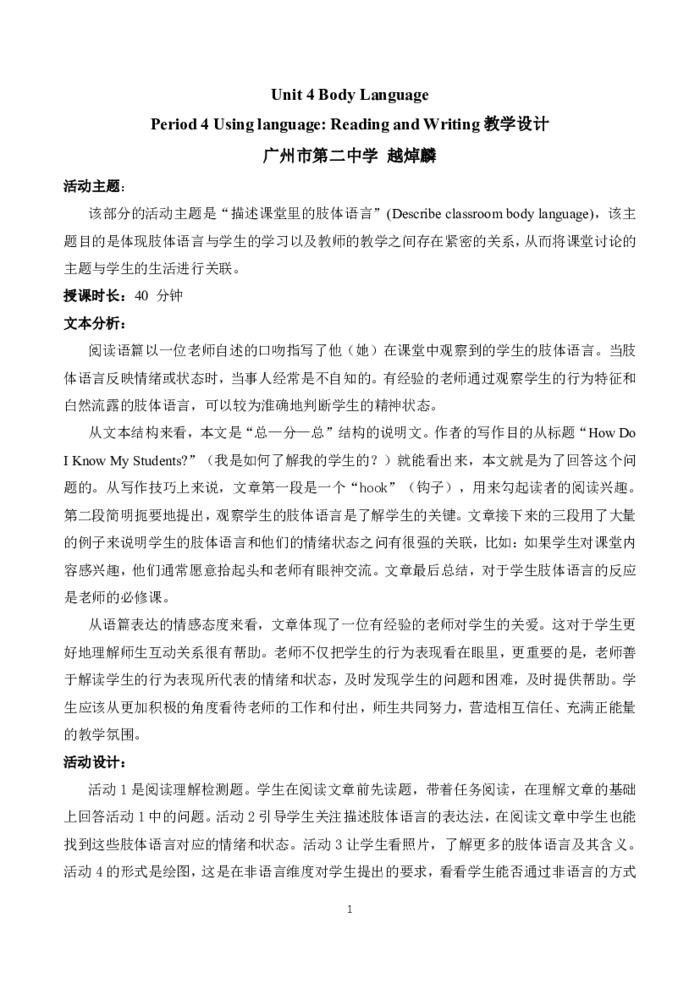
Unit 4 Body Language
Period 4 Using language: Reading and Writing 教学设计
广州市第二中学越焯麟
活动主题:
该部分的活动主题是“描述课堂里的肢体语言”(Describe classroom body language),该主
题目的是体现肢体语言与学生的学习以及教师的教学之间存在紧密的关系,从而将课堂讨论的
主题与学生的生活进行关联。
授课时长:40 分钟
文本分析:
阅读语篇以一位老师自述的口吻指写了他(她)在课堂中观察到的学生的肢体语言。当肢
体语言反映情绪或状态时,当事人经常是不自知的。有经验的老师通过观察学生的行为特征和
白然流露的肢体语言,可以较为淮确地判断学生的精神状态。
从文本结构来看,本文是“总—分—总”结构的说明文。作者的写作目的从标题“How Do
I Know My Students?”(我是如何了解我的学生的?)就能看出来,本文就是为了回答这个问
题的。从写作技巧上来说,文章第一段是一个“hook”(钩子),用来勾起读者的阅读兴趣。
第二段简明扼要地提出,观察学生的肢体语言是了解学生的关键。文章接下来的三段用了大量
的例子来说明学生的肢体语言和他们的情绪状态之问有很强的关联,比如:如果学生对课堂内
容感兴趣,他们通常愿意拾起头和老师有眼神交流。文章最后总结,对于学生肢体语言的反应
是老师的必修课。
从语篇表达的情感态度来看,文章体现了一位有经验的老师对学生的关爱。这对于学生更
好地理解师生互动关系很有帮助。老师不仅把学生的行为表现看在眼里,更重要的是,老师善
于解读学生的行为表现所代表的情绪和状态,及时发现学生的问题和困难,及时提供帮助。学
生应该从更加积极的角度看待老师的工作和付出,师生共同努力,营造相互信任、充满正能量
的教学氛围。
活动设计:
活动1 是阅读理解检测题。学生在阅读文章前先读题,带着任务阅读,在理解文章的基础
上回答活动1 中的问题。活动2 引导学生关注描述肢体语言的表达法,在阅读文章中学生也能
找到这些肢体语言对应的情绪和状态。活动3 让学生看照片,了解更多的肢体语言及其含义。
活动4 的形式是绘图,这是在非语言维度对学生提出的要求,看看学生能否通过非语言的方式
2
捕捉提肢体语言。活动5 让学生写一个文段来描述绘画表现的肢体语言并解释其含义。活动6
提供了一个写作互评的清单,学生据此互相评价作文,再各自完成修政福。
教学重点:
阅读语篇中有大量描写肢体语言的表达法,教师需要引导学生仔细阅读并模仿使用。肢体
语言也是传递人物情感态度的重要方式,学生需要仔细观察、准确捕捉、生动描写,力求到位。
教学目标:
1. To read a descriptive paragraph about reading students’ body language in the classroom.
2. To identify the details and new expressions which are used to describe body language.
3. To write a description about the body language from a person they know.
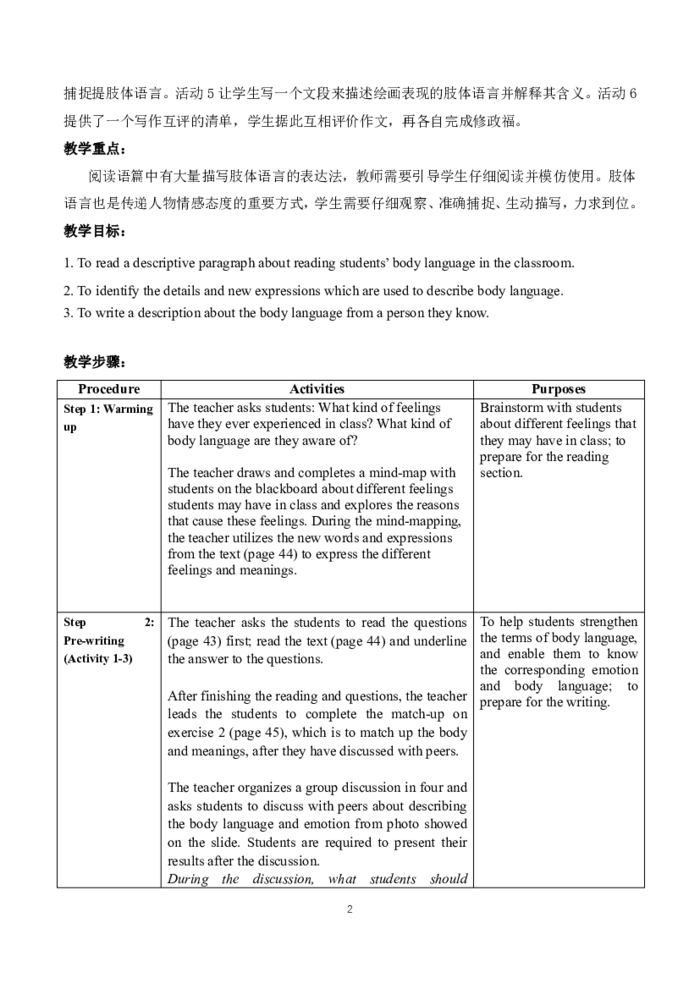
教学步骤:
Procedure
Activities
Purposes
Step 1: Warming
up
The teacher asks students: What kind of feelings
have they ever experienced in class? What kind of
body language are they aware of?
The teacher draws and completes a mind-map with
students on the blackboard about different feelings
students may have in class and explores the reasons
that cause these feelings. During the mind-mapping,
the teacher utilizes the new words and expressions
from the text (page 44) to express the different
feelings and meanings.
Brainstorm with students
about different feelings that
they may have in class; to
prepare for the reading
section.
Step
2:
Pre-writing
(Activity 1-3)
The teacher asks the students to read the questions
(page 43) first; read the text (page 44) and underline
the answer to the questions.
After finishing the reading and questions, the teacher
leads the students to complete the match-up on
exercise 2 (page 45), which is to match up the body
and meanings, after they have discussed with peers.
The teacher organizes a group discussion in four and
asks students to discuss with peers about describing
the body language and emotion from photo showed
on the slide. Students are required to present their
results after the discussion.
During
the
discussion,
what
students
should
To help students strengthen
the terms of body language,
and enable them to know
the corresponding emotion
and
body
language;
to
prepare for the writing.
3
describe are:
- what is happening from the photo;
- the person’s body language;
- the feeling or emotion the person may have based
on the body language.
Step 3:
While-writing
(Activity 4-5)
The teacher asks students to draw a person they are
familiar with and shows the body language on the
drawings. Then students discuss in their groups and
share the idea with peers.
After the drawing and sharing, the teacher provides
students with a writing task, the information is
showed on the slide:
Describe the body language and its meaning from
a person that you know
Who is he/she?
-Body language: What’s his/her typical body
language?
-Occasion: When will he/she have such kind of body
language?
-Meaning: What feelings or meanings are conveyed
by his/her body language?
-Personality: What kind of person is he/she?
-Language feature: words and expressions learned
from this unit
Then, the teacher shows the criteria of the writing
task on the slide:
-Is the description of the body language clear?
-Is the description of the feeling or meanings clearly
stated?
-Is the use of the words and expressions correct or
not?
-Spelling and coherence
Then the teacher shows the sample writing and asks
students to read the sample first before starting their
task. Then the teacher asks students to begin writing.
After listing the requirements and criteria of the
writing task and the sample writing, the teacher
provides students with expressions related to the
writing task and students to read and take note.
To enable students to have
a clear idea about the steps
and tips of describing a
person and body language.
To enable students to know
the criteria of the writing
task. To provide students
with
necessary
language
input before starting their
writing task.
4
Step 4:
Post-writing
(Activity 6)
The teacher asks students to do the review of their
peer’s task according to the writing criteria. Each
student should provide the comment on peer’s task.
The teacher makes a conclusion of the writing task
and restates the importance of reading other’s body
language while staying in a social situation.
To enable students to assess
their own works based on
the given criteria. To enable
students to have a profound
comprehension
of
body
language.
Step 5:
Homework
The teacher asks students to rewrite the task based
on the comments from peers and slides.
To
strengthen
students’
writing and skills learned
from the lesson.