文档文本内容
高一—人教版—英语—选择性必修一第五单元
华南师范大学附属中学 徐水
Using language: Reading and
writing
Learning objectives
In today’s class, you are expected to:
1. gain the information of organic farming, and chemical
farming.
2. analyze and judge the differences between chemical and
organic farming.
3. describe and state your preferences about chemical or
organic farming.
Step 1:
Reading
for
meaning
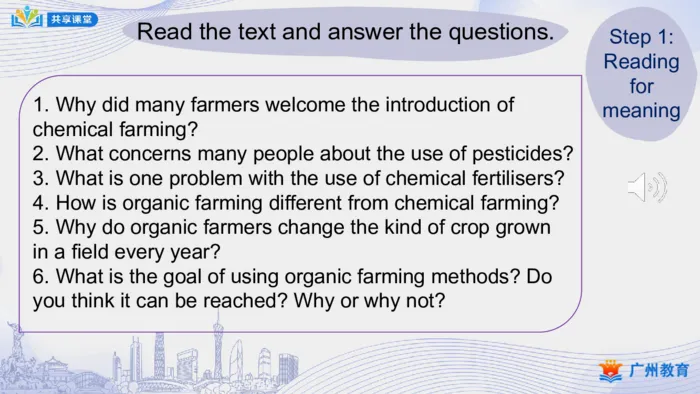
Read the text and answer the questions.
1. Why did many farmers welcome the introduction of
chemical farming?
2. What concerns many people about the use of pesticides?
3. What is one problem with the use of chemical fertilisers?
4. How is organic farming different from chemical farming?
5. Why do organic farmers change the kind of crop grown
in a field every year?
6. What is the goal of using organic farming methods? Do
you think it can be reached? Why or why not?
Step 1:
Reading
for
meaning
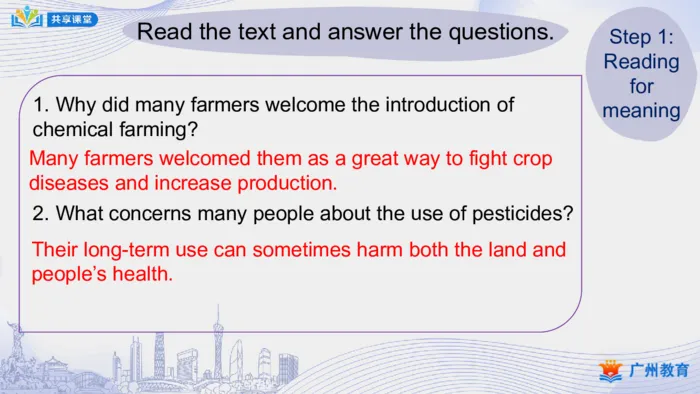
Read the text and answer the questions.
1. Why did many farmers welcome the introduction of
chemical farming?
Many farmers welcomed them as a great way to fight crop
diseases and increase production.
2. What concerns many people about the use of pesticides?
Their long-term use can sometimes harm both the land and
people’s health.
Step 1:
Reading
for
meaning
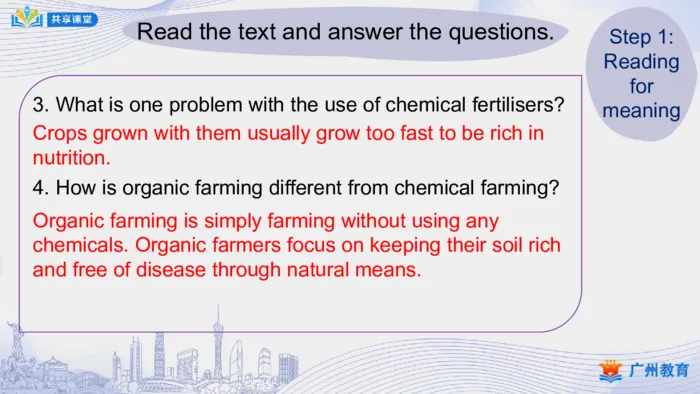
Read the text and answer the questions.
3. What is one problem with the use of chemical fertilisers?
Crops grown with them usually grow too fast to be rich in
nutrition.
4. How is organic farming different from chemical farming?
Organic farming is simply farming without using any
chemicals. Organic farmers focus on keeping their soil rich
and free of disease through natural means.
Step 1:
Reading
for
meaning
Read the text and answer the questions.
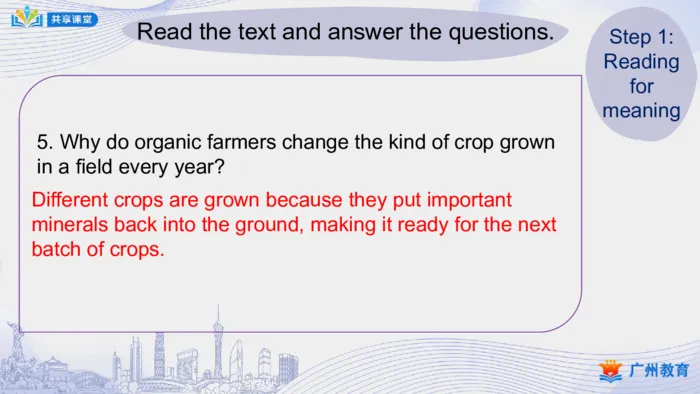
5. Why do organic farmers change the kind of crop grown
in a field every year?
Different crops are grown because they put important
minerals back into the ground, making it ready for the next
batch of crops.
Step 1:
Reading
for
meaning
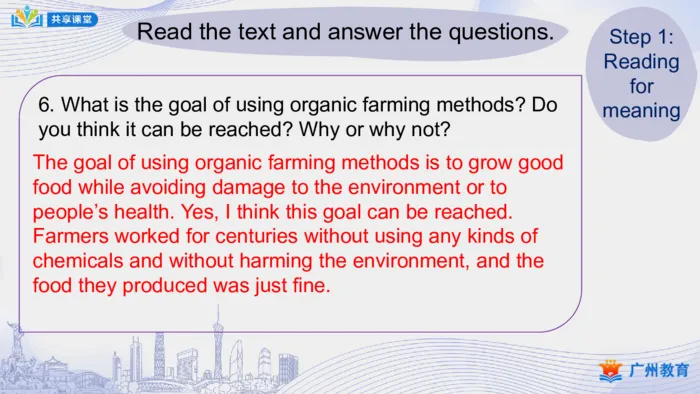
Read the text and answer the questions.
6. What is the goal of using organic farming methods? Do
you think it can be reached? Why or why not?
The goal of using organic farming methods is to grow good
food while avoiding damage to the environment or to
people’s health. Yes, I think this goal can be reached.
Farmers worked for centuries without using any kinds of
chemicals and without harming the environment, and the
food they produced was just fine.
Step 2:
Reading
for main
ideas
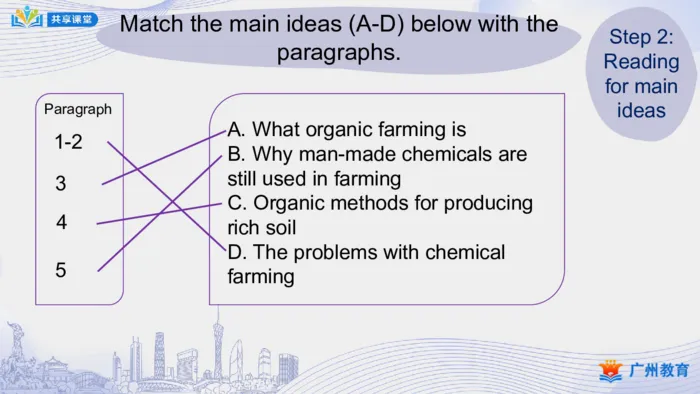
Match the main ideas (A-D) below with the
paragraphs.
Paragraph
1-2
3
4
5
A. What organic farming is
B. Why man-made chemicals are
still used in farming
C. Organic methods for producing
rich soil
D. The problems with chemical
farming
Step 3:
Reading
for details
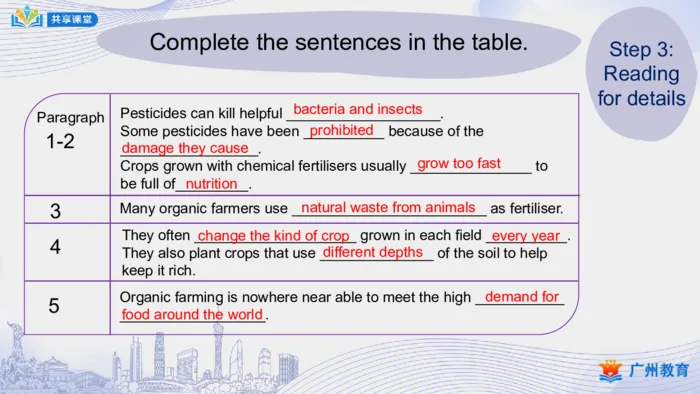
Complete the sentences in the table.
Paragraph
1-2
3
4
5
Pesticides can kill helpful ___________________.
Some pesticides have been __________ because of the
_________________.
Crops grown with chemical fertilisers usually _______________ to
be full of_________.
Many organic farmers use ________________________ as fertiliser.
They often ____________________ grown in each field __________.
They also plant crops that use ______________ of the soil to help
keep it rich.
Organic farming is nowhere near able to meet the high ___________
__________________.
bacteria and insects
prohibited
damage they cause
grow too fast
nutrition
natural waste from animals
change the kind of crop
every year
different depths
demand for
food around the world
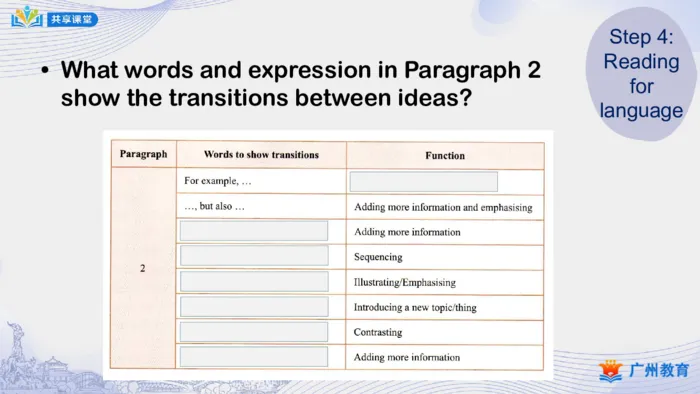
• What words and expression in Paragraph 2
show the transitions between ideas?
10
Step 4:
Reading
for
language
• What words and expression in Paragraph 2
show the transitions between ideas?
11
Step 4:
Reading
for
language
• What is the goal of using organic farming
methods? Do you think it can be reached?
Why or why not?
12
The goal of using organic farming methods is to
grow good food while avoiding damage to the
environment or to people’s health.
Step 5:
Post-
reading
Write an argumentative
essay giving your opinion
on chemical/ organic
farming
13
14
» How might the following items be problems and how
important are they for organic farming?
Disadvantages?
Advantage?
Step 6:
Pre-writing
15
» What is the reality of organic farming?
Step 6:
Pre-writing
• Organic Farming
16
• Chemical Farming
Pros
Cons
• Impact on food chain?
• Pollution?
• Process of farming (growth of weeds; fertilizers; pests;
irrigation灌溉; …)?
• Impact on the Ecosystem?
• Effect on soil fertility?
• Productivity?
Step 6:
Pre-writng
Compare organic and chemical farming.
Writing task: Support organic farming /
chemical farming?
17
Step 7:
Writing
Possible version
In my opinion, organic farming is preferable to chemical
farming because of the benefits to the environment and to people,
and because organic food is more nutritious.
To begin with, chemical farming harms the environment.
Since chemical pesticides are not found in nature, normal natural
processes cannot get rid of them. Instead, the chemicals tend to
accumulate in the soil and water, and are absorbed in the food chain,
where they poison wildlife and domestic animals.
18
Possible version
This affects us directly, because we end up eating plants,
dairy products, eggs, and meat that have high levels of pesticides.
Think about it: The purpose of the pesticides is to kill “pests”, that
is, to kill insects. Something that can kill an insect probably is not
healthy for a person to eat. While it may be true that the food we eat
does not have enough pesticides in it to kill us immediately, over the
years this pesticide may cause us health problems or give us
diseases such as cancer.
19
Finally, organic food is generally more nutritious than food grown with
man-made chemicals. If you remember a few years ago, there was the case of
watermelons literally exploding in the fields because they had been given
chemicals to make them grow faster. The reason why they exploded was that
they contained too much water, because the farmers had used too many
chemicals and the weather was unusually wet. As it turns out, such chemicals
are commonly used in farming to grow larger crops more quickly. Do you
really want to eat watered-down fruit and vegetables which have been rushed
to market? They cannot possibly taste as good as organic vegetables, nor can
they be as nutritious.
In closing, I would like to suggest buying organic food. Yes, the price is
a little higher? But the small price we pay extra will bring us huge rewards in
the end.
20
Homework
Share your compositions with your partners and help revise
theirs.
THANK YOU
高一—人教版—英语—选择性必修一第五单元
答疑课
Using language: Reading and
writing
华南师范大学附属中学 徐水
Earth University
Earth University is a special university in Costa Rica, where
students learn sustainable farming methods that can protect
the environment.
Before you watch
Complete th epassage with the words in the box.
agricultural
ecology
methods
profit
scholarships
sustainable
typical
unique
Earth University is located in Guacimo, Costa Rica. It is not a(n) ________
university. What is _______ about it is that students study both in
classrooms and in the fields. That is because Earth University is a(n)
_________ school where students learn about farming. The kind of farming
taught here is called __________ farming. The farming _______ they learn
have little or no negative impact on the environment. In class, they also
learn about _______, which is the study of how to protect the natural
balance of the environment. The students grow bananas on the farm for
_____. The  money they get from these bananas goes towards
__________ for students from poor areas.
typical
typical
unique
agricultural
sustainable
methods
ecology
profit
scholarships
While you watch: Circle the best answers.
1 Which is not a goal of Earth University?
A To teach poor students. B To teach students how to make food with bananas.
C To give students skills to protect the environment.
2 Most of the students are from _______.
A Africa
B Latin America
C Costa Rica
3 Students have to work six days a week for _______.
A half of the year
B most of the year
C the entire year
4 Earth University students also learn about _______.
A chemical farming
B leadership
C economics
After you watch: Discuss these questions in groups.
1 What do you like about Earth University?
2 Would you like to study at Earth University? Why or
why not?
THANK YOU