1
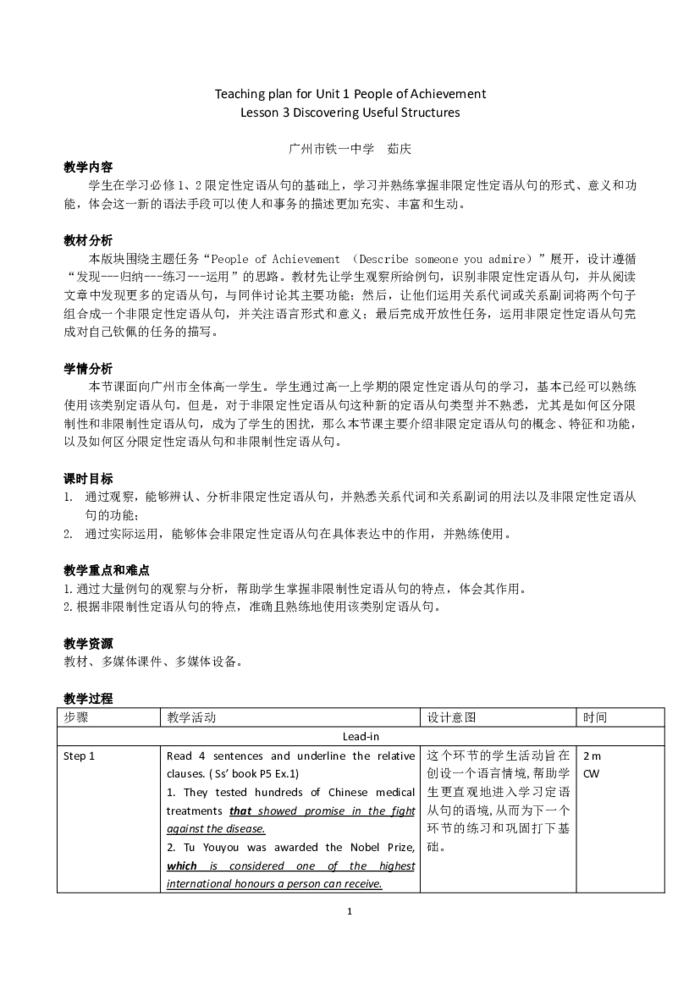
Teaching plan for Unit 1 People of Achievement
Lesson 3 Discovering Useful Structures
广州市铁一中学
茹庆
教学内容
学生在学习必修1、2 限定性定语从句的基础上,学习并熟练掌握非限定性定语从句的形式、意义和功
能,体会这一新的语法手段可以使人和事务的描述更加充实、丰富和生动。
教材分析
本版块围绕主题任务“People of Achievement (Describe someone you admire)”展开,设计遵循
“发现---归纳---练习---运用”的思路。教材先让学生观察所给例句,识别非限定性定语从句,并从阅读
文章中发现更多的定语从句,与同伴讨论其主要功能;然后,让他们运用关系代词或关系副词将两个句子
组合成一个非限定性定语从句,并关注语言形式和意义;最后完成开放性任务,运用非限定性定语从句完
成对自己钦佩的任务的描写。
学情分析
本节课面向广州市全体高一学生。学生通过高一上学期的限定性定语从句的学习,基本已经可以熟练
使用该类别定语从句。但是,对于非限定性定语从句这种新的定语从句类型并不熟悉,尤其是如何区分限
制性和非限制性定语从句,成为了学生的困扰,那么本节课主要介绍非限定定语从句的概念、特征和功能,
以及如何区分限定性定语从句和非限制性定语从句。
课时目标
1. 通过观察,能够辨认、分析非限定性定语从句,并熟悉关系代词和关系副词的用法以及非限定性定语从
句的功能;
2. 通过实际运用,能够体会非限定性定语从句在具体表达中的作用,并熟练使用。
教学重点和难点
1.通过大量例句的观察与分析,帮助学生掌握非限制性定语从句的特点,体会其作用。
2.根据非限制性定语从句的特点,准确且熟练地使用该类别定语从句。
教学资源
教材、多媒体课件、多媒体设备。
教学过程
步骤
教学活动
设计意图
时间
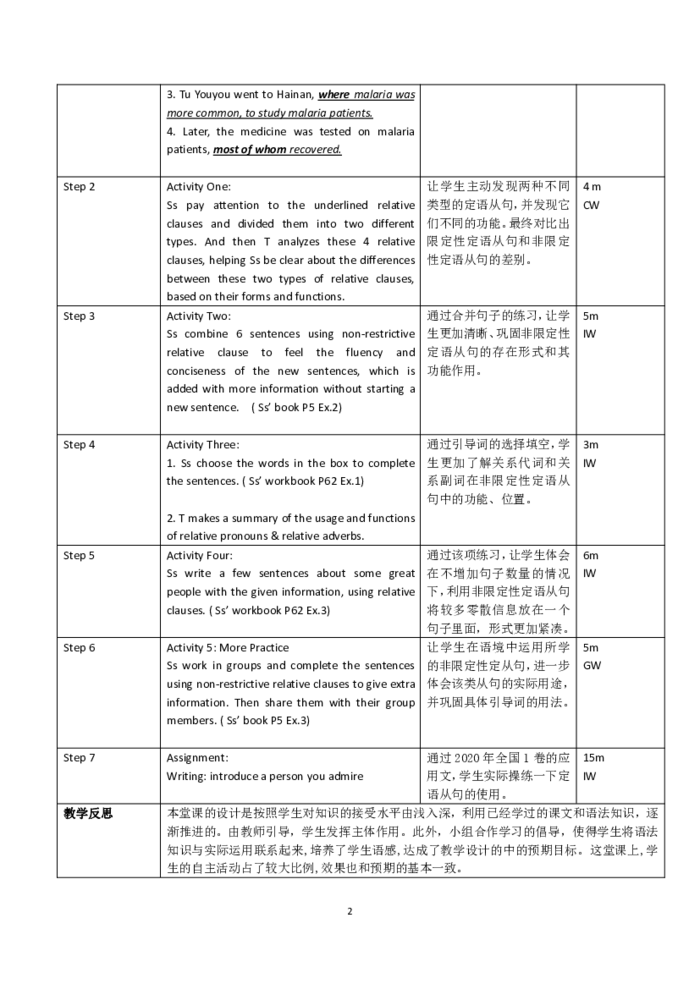
Lead-in
Step 1
Read 4 sentences and underline the relative
clauses. ( Ss’ book P5 Ex.1)
1. They tested hundreds of Chinese medical
treatments that showed promise in the fight
against the disease.
2. Tu Youyou was awarded the Nobel Prize,
which
is
considered
one
of
the
highest
international honours a person can receive.
这个环节的学生活动旨在
创设一个语言情境,帮助学
生更直观地进入学习定语
从句的语境,从而为下一个
环节的练习和巩固打下基
础。
2 m
CW
2
3. Tu Youyou went to Hainan, where malaria was
more common, to study malaria patients.
4. Later, the medicine was tested on malaria
patients, most of whom recovered.
Step 2
Activity One:
Ss pay attention to the underlined relative
clauses and divided them into two different
types. And then T analyzes these 4 relative
clauses, helping Ss be clear about the differences
between these two types of relative clauses,
based on their forms and functions.
让学生主动发现两种不同
类型的定语从句,并发现它
们不同的功能。最终对比出
限定性定语从句和非限定
性定语从句的差别。
4 m
CW
Step 3
Activity Two:
Ss combine 6 sentences using non-restrictive
relative
clause
to
feel
the
fluency
and
conciseness of the new sentences, which is
added with more information without starting a
new sentence.
( Ss’ book P5 Ex.2)
通过合并句子的练习,让学
生更加清晰、巩固非限定性
定语从句的存在形式和其
功能作用。
5m
IW
Step 4
Activity Three:
1. Ss choose the words in the box to complete
the sentences. ( Ss’ workbook P62 Ex.1)
2. T makes a summary of the usage and functions
of relative pronouns & relative adverbs.
通过引导词的选择填空,学
生更加了解关系代词和关
系副词在非限定性定语从
句中的功能、位置。
3m
IW
Step 5
Activity Four:
Ss write a few sentences about some great
people with the given information, using relative
clauses. ( Ss’ workbook P62 Ex.3)
通过该项练习,让学生体会
在不增加句子数量的情况
下,利用非限定性定语从句
将较多零散信息放在一个
句子里面,形式更加紧凑。
6m
IW
Step 6
Activity 5: More Practice
Ss work in groups and complete the sentences
using non-restrictive relative clauses to give extra
information. Then share them with their group
members. ( Ss’ book P5 Ex.3)
让学生在语境中运用所学
的非限定性定从句,进一步
体会该类从句的实际用途,
并巩固具体引导词的用法。
5m
GW
Step 7
Assignment:
Writing: introduce a person you admire
通过2020 年全国1 卷的应
用文,学生实际操练一下定
语从句的使用。
15m
IW
教学反思
本堂课的设计是按照学生对知识的接受水平由浅入深,利用已经学过的课文和语法知识,逐
渐推进的。由教师引导,学生发挥主体作用。此外,小组合作学习的倡导,使得学生将语法
知识与实际运用联系起来,培养了学生语感,达成了教学设计的中的预期目标。这堂课上,学
生的自主活动占了较大比例,效果也和预期的基本一致。
3
备注:
Ss: Students
T: Teacher
IW: Individual Work
PW: Pair Work
GW: Group Work
CW: Class Work
答疑
A model essay of Assignment:
We have a lot of respectable people around us. They may be our teachers, parents or one of
our elders. As for me, my father is the person I respect most. My father is a teacher who loves
his work and his students very much. As is often the case, he works very hard every day but he
will also spare some time to accompany me and share many funny things with me about his work.
When I come across the problems of learning in my study, my father, who is literally considerate,
will never fail to listen to me patiently and encourage me to overcome the difficulties bravely.
That is the reason why I admire him so much. I love him forever.
“as 和which 引导非限定性定语从句时候的异同”
答疑背景:在学习非限定性定语从句的时候,学生容易分不清as 和which 在非限制性定语从句中的用法
和区别,进而造成混淆使用。
一、相同点
两者引导非限制性定语从句时,可指代主句中的部分或整个句子的内容,在从句中做主语,宾语或表语,
位于主句之后有时可互换。
The meeting was put off, as/ which was exactly what we wanted.
He was a doctor, as/ which I knew from his manner.
二、不同点
1. as 可以放在主句前后,也可插入主句之中;而which 引导的非限制性从句只能位于主句之后。
As is known to all, fish can’t live without water.
Air, as we know, is gas.
2. as 常用“正如”含义,常用的结构有as we know(众所周知);as often happens(正如常发生的那样);
as is often the case (情况常常如此); as we all can see (正如我们看到的); be
announced/expected/known/imagined/mentioned/said/shown/
reported 等。这些结构常放句首,偶尔
也可以放句中或句末。
As is known to all, China is a developing country.
Kate was late for school, as is often the case.
3.“介词+关系代词(介宾代物)”中关系代词只能用which。
The Travel Agency, with which our company has been dealing for several years, has opened for new
branches.
Air is a mixture of gases, of which oxygen forms 21 percent.
4.在非限制性定语从句中,关系代词代表前面主句中的宾语从句时,常用which。
He said he had passed the exam, which was untrue.
I doubt whether he can finish this task on time, which also makes other teammates feel insecure.
5. 有时用case, point, time, situation 或reason 等抽象名词来总结主句的内容,可用“介词+ which +
抽象名词”构成从句:
Ten years of hard work changed her greatly, for which reason he could hardly recognize her at
first sight.
The machine may be out of order, in which case it will be repaired at once.