Unit 1  People of Achievement
Discovering Useful Structures
广州市铁一中学 茹庆
高一人教版英语选择性必修一第一单元
高一人教版英语选择性必修一第一单元
Unit 1  Discovering Useful Structures
Non-restrictive Attributive/ Relative Clause
非限定性定语从句

                                      Learning Objectives

1. To summarize the forms and functions of non-restrictive
relative clauses;
2. To make complex sentences using non-restrictive relative
clauses;
3. To describe people of achievement by non-restrictive relative
clauses.
Read the following sentences and underline the relative clauses.
Then name the two types of clauses and state their functions.
1. They tested hundreds of Chinese medical treatments that showed
promise in the fight against the disease.
2. Tu Youyou was awarded the Nobel Prize, which is considered one
of the highest international honours a person can receive.
3. Tu Youyou went to Hainan, where malaria was more common, to
study malaria patients.
4. Later, the medicine was tested on malaria patients, most of whom
recovered.
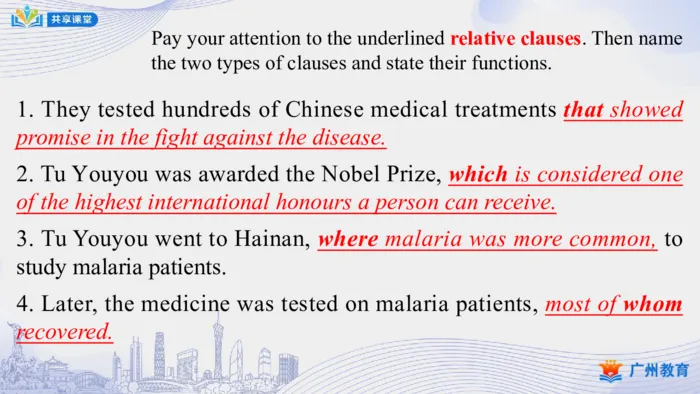
Pay your attention to the underlined relative clauses. Then name
the two types of clauses and state their functions.
1. They tested hundreds of Chinese medical treatments that showed
promise in the fight against the disease.
2. Tu Youyou was awarded the Nobel Prize, which is considered one
of the highest international honours a person can receive.
3. Tu Youyou went to Hainan, where malaria was more common, to
study malaria patients.
4. Later, the medicine was tested on malaria patients, most of whom
recovered.
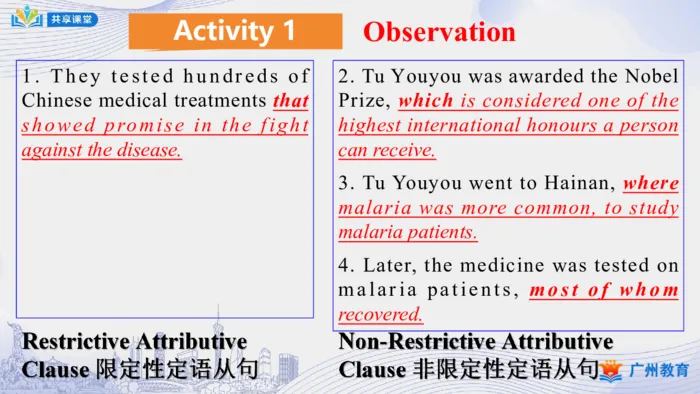
2. Tu Youyou was awarded the Nobel
Prize, which is considered one of the
highest international honours a person
can receive.
3. Tu Youyou went to Hainan, where
malaria was more common, to study
malaria patients.
4. Later, the medicine was tested on
malaria patients, most of whom
recovered.
1. They tested hundreds of
Chinese medical treatments that
showed promise in the fight
against the disease.
Observation
Activity 1
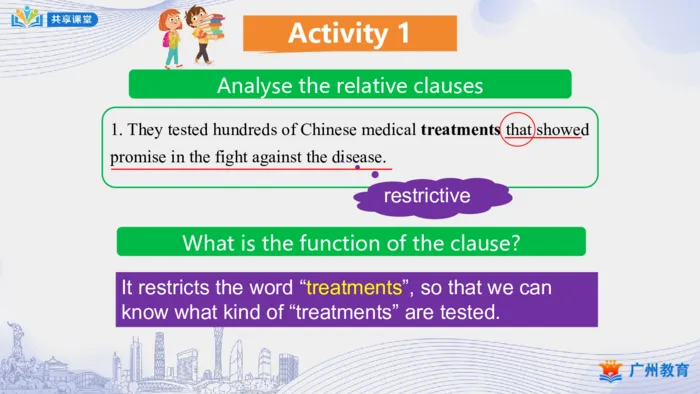
Activity 1
Analyse the relative clauses
1. They tested hundreds of Chinese medical treatments that showed
promise in the fight against the disease.
What is the function of the clause?
It restricts the word “treatments”, so that we can
know what kind of “treatments” are tested.
restrictive
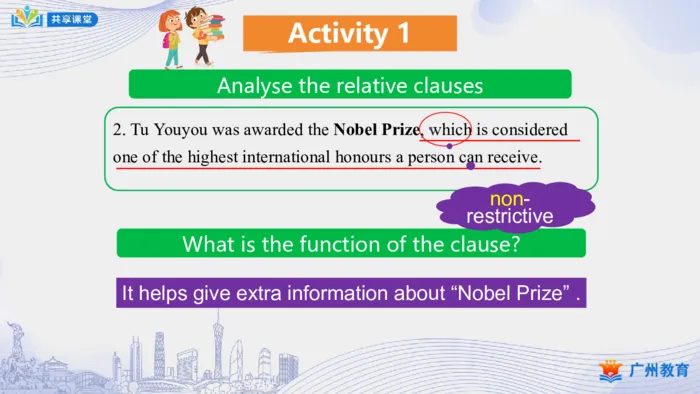
Activity 1
Analyse the relative clauses
2. Tu Youyou was awarded the Nobel Prize, which is considered
one of the highest international honours a person can receive.
What is the function of the clause?
It helps give extra information about “Nobel Prize” .
non-
restrictive
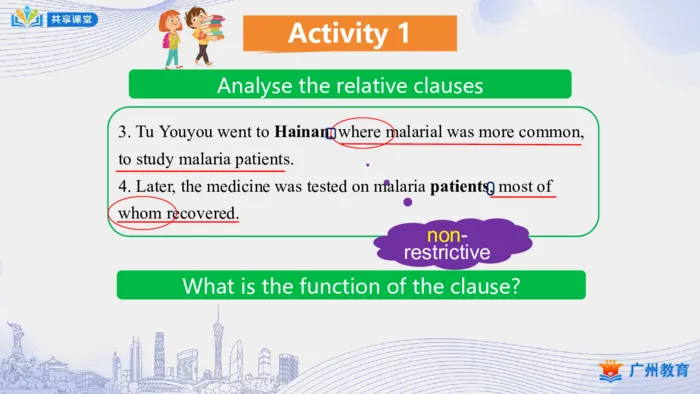
Activity 1
Analyse the relative clauses
3. Tu Youyou went to Hainan, where malarial was more common,
to study malaria patients.
4. Later, the medicine was tested on malaria patients, most of
whom recovered.
What is the function of the clause?
non-
restrictive
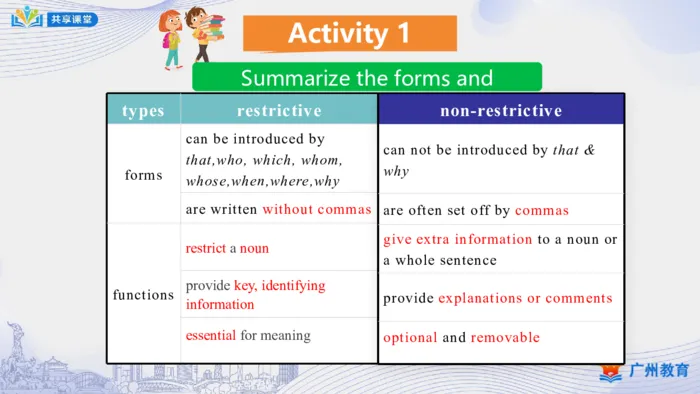
Activity 1
Summarize the forms and
functions
types
restrictive
non-restrictive
forms
can be introduced by
that,who, which, whom,
whose,when,where,why
are written without commas
functions
restrict a noun
provide key, identifying
information
essential for meaning
non-restrictive
can not be introduced by that &
why
are often set off by commas
give extra information to a noun or
a whole sentence
provide explanations or comments
optional and removable
Activity 2
Combine sentences using non-restrictive relative
clause
In this activity, you need to know some tips:
Step 1  确定主句和从句
Step 2  找到先行词
Step 3  根据先行词和关系代词或关系副词在从句
中的功能,确定使用哪个关系代词或关系副词。
Activity 2
Combine sentences using non-restrictive relative
clause
The book tells us about Alexander Fleming.
He discovered penicillin.
+
﹦
The book tells us about  Alexander Fleming,
who He discovered penicillin.
How does the sentence flow differently?
It is more fluent, and the information provided is
more closely joint together.
1. We were very impressed by the old man. He was not
willing to acknowledge defeat.
Activity 2
Combine sentences using non-restrictive relative
clause
, who was
not…
We were very impressed by the old man, who was not
willing to acknowledge defeat.
How does the sentence flow differently?
2. Afterwards, Einstein had to flee Germany. Hitler was
in power there.
Activity 2
Combine sentences using non-restrictive relative
clause
Afterwards, Einstein had to flee Germany, where Hitler
was in power.
How does the sentence flow differently?
3. There is nothing we can do to help Linda. Her
circumstances are beyond our control.
Activity 2
Combine sentences using non-restrictive relative
clause
There is nothing we can do to help Linda, whose
circumstances are beyond our control.
,
whose…
How does the sentence flow differently?
4. The teacher asked us to listen to a speech by his
favourite novelist, J. k. Rowling. It inspired us a lot.

Activity 2
Combine sentences using non-restricetive
relative clause
, which inspired us a
lot.
The teacher asked us to listen to a speech by his
favourite novelist, J. k. Rowling, which inspired us a
lot.
How does the sentence flow differently?
5. The building under construction was designed by I.M.
Pei-a famous Chinese-American architect. He was  born
in Guangzhou, China.

Activity 2
Combine sentences using non-restricetive
relative clause
, who was…
How does the sentence flow differently?
The building under construction was designed by I.M.
Pei-a famous Chinese-American architect, who was
born in Guangzhou, China.
6. I was asked to explain the project with the help of a
flow chart. It was a big challenge for me.

Activity 2
Combine sentences using non-restricetive
relative clause
, which
was…
How does the sentence flow differently?
They are more fluent and concise. We can add more
information without starting a new sentence. We can
avoid repeating certain words.
I was asked to explain the project with the help of a
flow chart, which was a big challenge for me.
Activity 3
Choose the words in the box to complete the
sentences.
who     whom     which     whose     when
where      in\ of\ for which      of whom
1. Some people always talk loudly in public, ______is  really
   annoying.
2. Mr. Smith, ___________ you spoke to, is our new professor.
3.What do you want to write about these people, ______stories I
   have just told you?
4. Her mother works in a company, _______________employees
   are all women.
5. There are 45 students in our class, out _________ only 10 are
    taking an optional art course.
which
who\ whom
whose
in which\ where
of whom
关系代词和关系副词 (relative pronouns & relative adverbs ) 在非
限定性定语从句中的用法和功能:
1.引导定语从句;
2.代替 先行词 或 整个主句 在非限定性定语从句中作句子成分,
充当 主语、宾语、表语、定语、状语。
* 非限定性定语从句中,关系代词和关系副词都不
可以省略。
Summary
Activity 4
Write a new sentence with the given information.
Song Qingling
1. Dr Sun Yat-sen's wife;
2. one of the top leaders in
modern Chinese history;
3.devoted her life to improving the
welfare of women and children.
Song Qingling, who was Dr Sun Yat-sen's wife and one of the
top leaders in modern Chinese history, devoted her life to
improving the welfare of women and children.
Activity 4
Write a new sentence with the given information.
Neil Armstrong, who was the first man
to land on the moon in July 1969, said:
“That's a small step for a man, one
giant leap for mankind.”
Norman Bethune, who came to China
in World War II, worked selflessly in
China as a doctor and saved many
Chinese people.
Activity 4
Write a new sentence with the given information.
Joan of Arc, who was dressed as a
man, went to fight for her country and
helped drive the English invaders out
of France.
Lu Xun was a leading figure of modern
Chinese literature. Lu Xun Literary
Prize, which is one of China's top four
literary prizes, is awarded every three
years.
Work in groups. Complete the sentences using non-restrictive relative
clauses to give extra information. Then share them with your group
members.
I would like to travel around…, …
What impressed me most…, …
My favourite scientist is…, …
Finally, we arrived at…, …
My grandparents like…, …
I wish to obtain…, …
My best friend…, …
Discussion
I would like to travel around…, …
Discussion
I would like to travel around Tian'an Men Square, where I can see the
amazing senery of Summer Palace.
What impressed me most…, …
What impressed me most is that they never lost heart, which really
inspired me.
I wish to obtain…, …
I wish to obtain a scholarship, which can make my parents proud of me.
 Finally, we arrived at…, …
Discussion
Finally, we arrived at a farm house, in front of which sat a small boy.
 My grandparents like…, …
My grandparents like to live in the countryside, where they can enjoy a
leisurely walk on the country road.
My favourite scientist is…, …
My favourite scientist is Marie Curie, who made outstanding
contributions in the field of physics and chemistry.
My best friend..., ...
My best friend is Jane, whose handwriting is the best in our class.
Assignment
Writing: introduce a person you admire
(2020 全国I) 你校正在组织英语作文比赛。请以身
边值得尊敬和爱戴的人为题,写一篇短文参赛,内
容包括:
1. 人物简介;
2. 尊敬和爱戴的原因。
use (non)-restrictive relative
clauses appropriately
Thank you!
Unit 1  People of Achievement
Discovering Useful Structures
答疑
高一人教版英语选择性必修一第一单元
广州市铁一中学 茹庆
Assignment
Writing: introduce a person you admire
      We have a lot of respectable people around us. They may be our
teachers, parents or one of our elders. As for me, my father is the person I
respect most. My father is a teacher who loves his work and his students
very much. As is often the case, he works very hard every day but he will
also spare some time to accompany me and share many funny things with
me about his work.
      When I come across the problems of learning in my study, my father,
who is literally(真正地)considerate(考虑周到的), will never fail to
listen to me patiently and encourage me to overcome the difficulties
bravely. That is the reason why I admire him so much.  I love him forever.
        两者引导非限制性定语从句时,均可指代主句中的
部分或整个句子的内容,在从句中做主语、宾语或表语,
位于主句之后有时可互换。
The meeting was put off, as/ which was exactly what we
wanted.
He was a doctor, as/ which I knew from his manner.
as和which引导非限定性定语从句时候的异同
1. as可以放在主句前后,也可插入主句之中;而which
引导的非限制性从句只能位于主句之后。
As is known to all, fish can’t live without water.
Air, as we know, is gas.
2. as常用“正如”含义,常用的结构有as we know(众所周
知);as often happens(正如常发生的那样);as is often the
case(情况常常如此); as we all can see(正如我们看到的);
be announced/ expected/ known/ imagined/ mentioned/ said/
shown/ reported等。这些结构常放句首,偶尔也可以放句中或
句末。
As is known to all, China is a developing country.
Kate was late for school, as is often the case.
3.“介词+关系代词(指代物)”中关系代词只能用which。
The Travel Agency, with which our company has been dealing for
several years, has opened for new branches.
Air is a mixture of gases, of which oxygen forms 21 percent.
4. 在非限制性定语从句中,关系代词代表前面主句中的宾语
从句时,常用which。
He said that he had passed the exam, which was untrue.
I doubt whether he can finish this task on time, which also makes
other teammates feel insecure.
5. 有时用case, point, time, situation或reason等抽象名词来总
结主句的内容,可用“介词+ which +抽象名词”构成从句。
Ten years of hard work changed her greatly , for which reason he
could hardly recognize her at first sight.
The machine may be out of order , in which case it will be
repaired at once.
Thank you!