ARTICLE · 1177245
小学英语知识归纳总结(三)
此份复习资料,涵盖了小学英语用语、重点句型、语法、谚语、作文等知识点。内容丰富,设计合理,望同学们按要求认真复习,争取考出优异成绩!
目录
1、肯定句改否定句的方法 :
1.在be动词后加not
如:is not, are not,am not
2.在can,should, will等后加not
如:cannot, should not,will not;
3.上述都没有的,在动词前加助动词否定形式don't/doesn't/didn't
4、 some 改成any
如:I am a girl. → I am not a girl.
You are a student. →You are not a student.
→You aren’t a student.
This is Tom’s bag, → This is not Tom’s bag.→ This isn’t Tom’s bag.
2、肯定句改一般疑问句的方法
1.把be动词放在句首,剩下的照抄
(some 改成any,I改成you,my改成your)句点改成问号。
2.把can,shall, will等放到句首,剩下的照抄
(some 改成any,I改成you,my改成your)句点改成问号。
3.上述都没有的,在句首请助动词Do/Does/Did帮忙,剩下的照抄,(some 改成any,I改成you,my改成your,)句点改成问号
注意:句首的第一个字母要大写,句尾标点应为“?”
如:I am in Class 6. →Are you in Class 6?
You are from America.
→Are you from America?
It is an orange. →Is it an orange?
4、 就一般疑问句回答
一般疑问句有两种回答,即:肯定回答和否定回答。其中,肯定回答用yes,否定回答用no。
语句顺序为:
Yes + 主语 + am /is/ are/was/were.|can.|do/does/did|;
No + 主语+ am not/ isn’t/ aren’t 如:
—Are you an English teacher?
→Yes, I am. /No, I am not.
—Is that a bird?
→Yes, it is./ No, it isn’t.
3、对划线部分提问
“就划线部分提问”是小学阶段英语学习的难点,但是一旦掌握了规律,就变得容易多了。小学英语对划线部分提问之答题口诀 :
一代:用正确的疑问词代替划线部分。
二移:把疑问词移至句首
三倒:颠倒主谓语,但对主语或其定语提问时除外(some 改成any,I改成you,my改成your),
四抄:照抄句子剩余部分。
★特殊疑问词的确定要根据划线内容而定,在小学阶段常出现的有以下几种:
1.划线部分是“事或物”,特殊疑问词用what
如: This is a book.---What is this?
I often play football on Saturdays .---What do you often do on Saturdays ?
2.划线部分是“人”,特殊疑问词用who
如:He is my brother. ---Who is he ?
3、划线部分是“地点”,特殊疑问词用where
如:The box is on the desk.---Where is the box ?
4、划线部分是“时间”,特殊疑问词用what time或when
如:It's seven twenty . ---What time is it ?
I usually get up at six . --- When do you usually get up?
5、划线部分是“年龄”,特殊疑问词用how old
如:I am twelve . ---How old are you?
My father is thirty-three . ---How old is your father ?
6、划线部分是“职业”,特殊疑问词用what
如:Mike is a worker. ---What is Mike ?
7、划线部分是“颜色”,特殊疑问词用what colour
如: My hat is blue . ---What colour is your hat?
8. 划线部分是“数量”,特殊疑问词用how many或how much
如:I can see five kites .---How many kites can you see ?
There is some milk in the glass. ---How much milk is there in the glass ?
9.划线部分是“多少钱”,特殊疑问词用how much
如:This pen is nine yuan . ---How much is this pen ?
10.划线部分是“形容词性物主代词或名词性物主代词”,特殊疑问词用whose
如:That is my book . ---Whose book is that ?
The bag is yours. ---Whose is the bag ?
以下口诀要牢记
1.问“谁”用who;
2.问“谁的”,用whose;
3.问“地点哪里”,用where;
4.问“原因”,用why;
5.问“身体状况”,用how;
6.问“方式”,用how;
7.问“年龄”,用how old;
8.问“多少”,用how many;
9.问"价钱”用how much;
10.问“哪一个”,用which ;
11.问“什么”,用what;
12.问“职业”,用what;
13.问“颜色”,用what colour;
14.问“星期”,用what day;
15.问什么学科,用what subject;
16.问“什么时候”,用when;
17.问几点用What’s the time?或 What time is it?
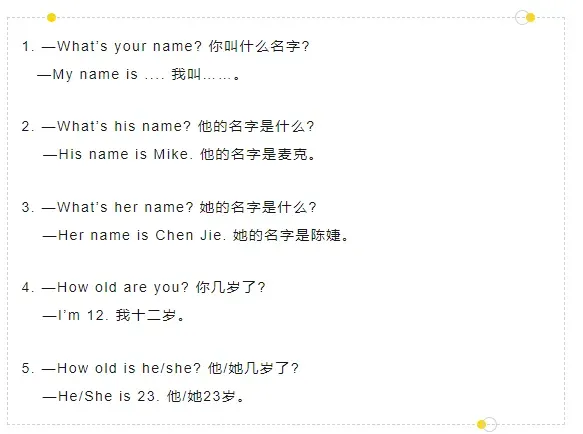
name,How old
Colour
1. —What colour is it? 它是什么颜色的?
—It’s yellow and white. 黄白相间。
2. —What colour are they? 它们是什么颜色的?
—They’re green. 绿色的。
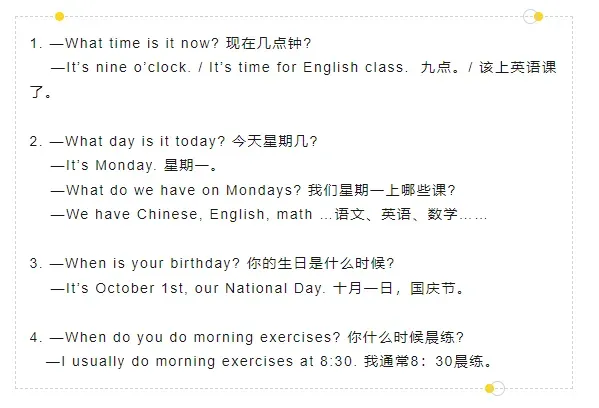
When
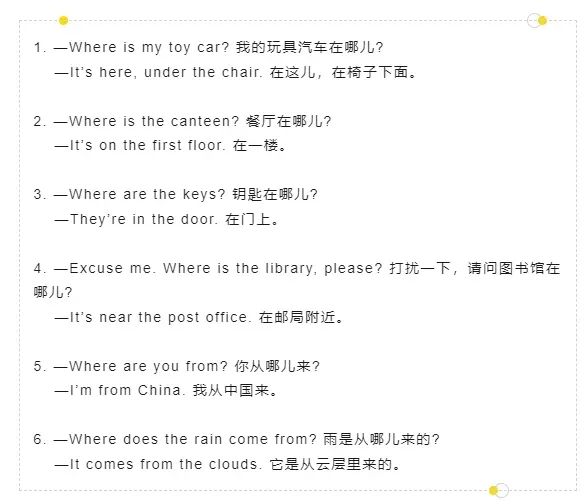
Where
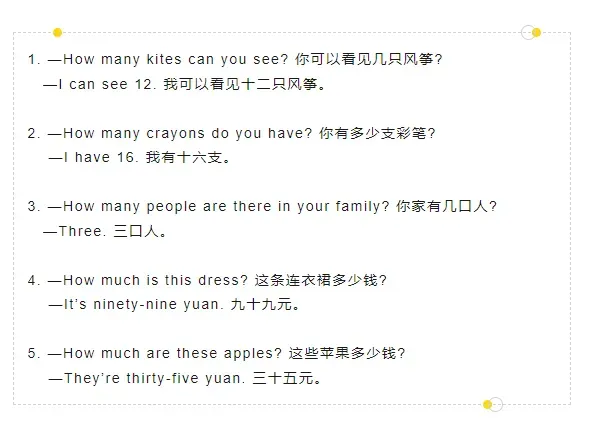
How many , How much
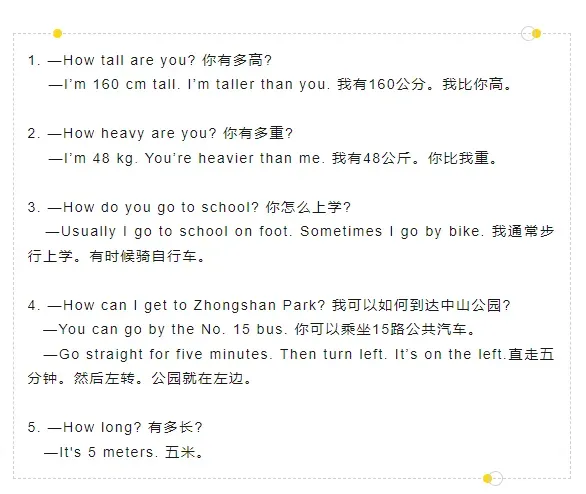
How tall,How heavy,How long
feel,matter
1. —How do you feel? 你感觉如何?
—I feel sick. 我觉得不舒服。
—How does Chen Jie feel? 陈洁感觉如何?
—She’s tired. 她很疲倦。
2. —What’s the matter? 怎么了?
—My throat is sore. / I have a sore throat. 我的喉咙疼。
3. —How are you, Sarah? You look so unhappy. 你好吗,莎拉?你看起来这么伤心。
—I failed the math test. 我的数学考试没有通过。
would like
1. —What would you like for breakfast / lunch / dinner ? 你早餐/中餐/晚餐想吃点什么?
—I’d like some bread and milk / rice and soup. 我想吃面包和牛奶/米饭和汤。
2. —What’s for breakfast / lunch / dinner? 早餐/中餐/晚餐吃什么?
—Hamburgers and orange juice. 汉堡包和橙汁。
weather
1. —What’s the weather like in Beijing? 北京的天气如何?
—It’s rainy today. How about New York? 今天是雨天。纽约呢?
—It’s sunny and hot. 今天是晴天,天气很热。
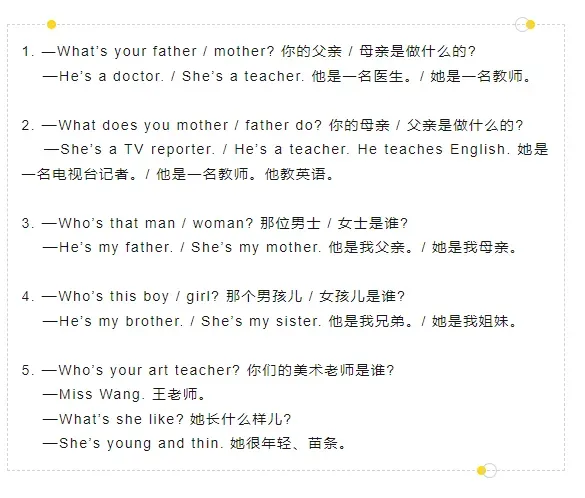
Who,What
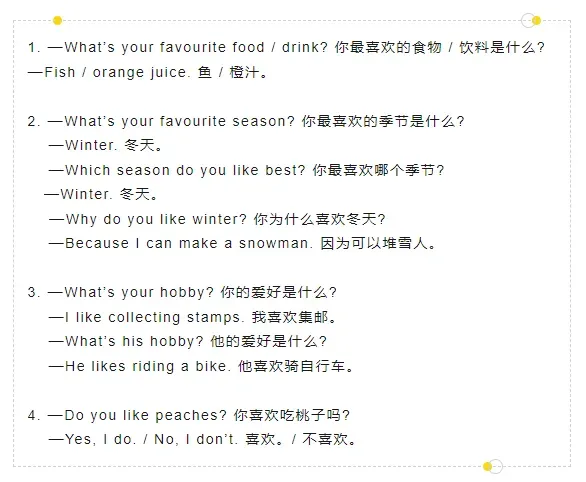
favourite
What
—What do you do on Saturdays / on the weekends? 你星期六 / 周末一般做什么?
—I usually do my homework. Sometimes I play football.我通常做作业.有时候踢足球。
What + -ing
1. —What are you doing? 你在做什么?
—I’m doing the dishes. 我在洗盘子。
2. What’s your father doing? 你父亲正在做什么?
He’s writing an e-mail.他正在写电子邮件。
3.What’s the tiger doing? 那只老虎在干什么?
It’s running. 它在奔跑。
4. What are the elephants doing? 那些大象在干什么?
They’re drinking. 它们正在喝水。
What/Where/When+going
1. —What are you going to do? 你准备做什么?
—I’m going to the cinema. 我准备去看电影。
—When are you going to do? 你准备什么时候去?
—This afternoon. 今天下午。
2. —Where are you going this afternoon? 今天下午你准备到哪儿去?
—I’m going to the bookstore. 我准备到书店去。
—What are you going to buy? 你打算买点儿什么?
—I’m going to buy a comic book. 我准备买本漫画书。
1. —Where did you go last weekend / yesterday / on your holiday?
你上周末/昨天/假期到哪儿去了?
—I went to Wuhan. 我去了武汉。
2. —How did you go there? 你怎么去的那里?
—I went by train. 我坐火车去的。
3. —What did you do there? 你在那儿做了些什么?
—I went shopping. 我去购物了。
1. —Is this your bedroom? 这是你的卧室吗?
—Yes, it is. ----是的。
—Is your sister in the living room? 你姐姐在客厅吗?
—No, she isn’t. / Yes, she is. 不在。/ 在。
2. —Is this your skirt? 这是你的短裙吗?
—Yes, it is. / No, it isn’t. 是的。/ 不是。
3. —Is your English teacher young? 你的英语老师年轻吗?
—Yes, she is. / No, she isn’t. 是的。/不.她不年轻。
4. —Are these / those / they cucumbers? 这些 / 那些是黄瓜吗?
—Yes, they are. / No, they aren’t. 是的。/ 不是的。
5. —Is there a river in the park? 公园里有一条小河吗?
—Yes, there is. / No, there isn’t. 有。/ 没有。
—Are there any bridges in your village? 你们村子里有桥吗?
—Yes, there are. / No, there aren’t. 有。/ 没有。
6. —Can I wear my new shirt today? 我今天可以穿新衬衫吗?
—Yes, you can. / No, you can’t. 可以。/ 不可以。
7. —Can you wash your clothes? 你会洗衣服吗?
—Yes, I can. / No, I can’t. 会。/ 不会。
8. —Does your pen pal live in Shanghai? 你的笔友住在上海吗?
—No, he doesn’t. He lives in Beijing. 不,他住在北京。
9. —Does she teach English? 她教英语吗?
—No, she doesn’t. She teaches math. 不,她教数学。
10. —Did you read books yesterday? 你昨天读书了吗?
—Yes, I did. / No, I didn’t. 读了。/ 没读。
1. —What’s in the classroom? 教室里有什么?
—A board, six lights, three fans, many desks and chairs.
一块黑板、六盏灯.三把电扇和许多桌椅。
2. —What / How about you? 你呢?
—I like the white sweater with the green skirt. 我喜欢这件白毛衣配这条绿短裙。
3. —Whose is it? 它是谁的?
—It’s mine / yours / his / hers. 是我的/你的/他的/她的。
4. —What can you do? 你会做什么?
—I’m helpful. I can sweep the floor and do the dishes.
我很能干。我会扫地、洗盘子。
5. —What’s your bedroom like? 你的卧室是什么样儿的?
—There is a big closet and a new mirror. There are blue curtains.
我的卧室里有一个大衣橱和一面新镜子。还有蓝色的窗帘。