ARTICLE · 1255721
2026年下半年全国大学英语四级考试(CET4)笔试全真模拟试卷(含答案解析)·考前冲刺必刷题

2026年全国大学英语四、六级考试(CET)将于2026年12月12日举行,本文为星蓝海学习网依据历年真题命题规律编写的《四级》模拟试卷,覆盖写作题、短篇新闻、长对话、听力篇章、选词填空、长篇阅读等710分核心题型。建议考生收藏并限时自测,检验备考效果。试卷答案解析请添加星蓝海学习网刘老师VX:up0005,备注CET四级试卷答案。点击阅读原文发现更多完整备考资料。
2026年下半年全国大学英语四级考试(CET4)笔试模拟试卷
卷面:写作15%+听力35%(新闻7×1+长对话8×1+篇章10×2)+阅读35%(选词10×0.5+匹配10×1+仔细10×2)+翻译15%,55客观+2主观 / 125分钟满分 710分(报道分) | 合格标准 425分及以上为通行合格线(四级425分方可报考六级) | 125分钟考试时间:2026年12月12日(四级上午 9:00—11:20 / 六级下午 15:00—17:25) | 命题依据:《全国大学英语四、六级考试大纲(2016年版)》· 教育部教育考试院(2026年下半年沿用,2026年12月12日笔试)
| 试卷说明 |
本试卷按教育部教育考试院《全国大学英语四、六级考试大纲(2016年版)》(2026年下半年沿用,2026年12月12日笔试)编制(考试日期:2026年12月12日 9:00—11:20)。
本卷为 2026 年下半年全国大学英语四级考试(CET4)笔试全真演练卷,按官方卷面结构编制:
写作 15%+听力理解 35%+阅读理解 35%+翻译(汉译英段落)15%,合计 55 道客观题+2 道主观题,
考试时间 125 分钟;总分按 710 分报道分制折算(本卷按 100 分标准化呈现),
425 分及以上方可报考大学英语六级。本卷听力部分以文字材料呈现,供精听复盘使用。
| 一、写作题(共1题,共15分) |
1.写作题(15分)
**Directions**: For this part, you are allowed 30 minutes to write an essay on the importance of developing a habit of lifelong learning. You should write at least 120 words but no more than 180 words.
中文提纲:
① 为什么当代大学生需要终身学习;
② 终身学习能带来哪些好处;
③ 你打算如何培养终身学习的习惯。
| 二、短篇新闻(共7题,每题1分,共7分) |
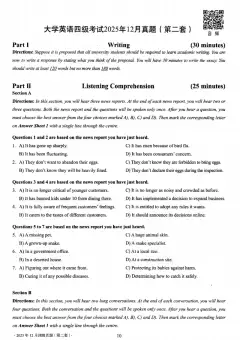
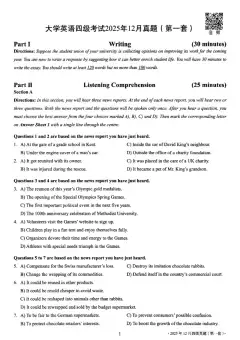
Directions: In this section, you will hear three news reports. At the end of each news report, you will hear two or three questions. Both the news report and the questions will be spoken only once. After you hear a question, you must choose the best answer from the four choices marked A, B, C and D.
News Item One
Questions 2 and 3 are based on the following news.
A university in the eastern city of Hangzhou has started a robot food-delivery service on its campus. Ten smart robots now carry meals from campus restaurants to five pick-up points near the student dormitories. Students order through a mobile app, pay online, and can follow each robot's route in real time on the screen. Since the service began in September, the robots have completed more than 30,000 deliveries. The service is free of charge during the trial period, which will last until the end of the spring term. The university says the robots help reduce queues and allow restaurant staff to focus on cooking.
2.What is the news report mainly about?
A.A new mobile app for online shopping.
B.A robot food-delivery service on a university campus.
C.A plan to replace all campus restaurants with robots.
D.A cooking competition held in student dormitories.
3.What do we learn about the service from the news?
A.Students must pay three yuan for each order.
B.It has operated for more than three years.
C.It will end when the new term begins.
D.Students can track the robots' routes in real time.
News Item Two
Questions 4 and 5 are based on the following news.
According to a new study, college students who sleep less than six hours a night are likely to perform worse in memory tests. Researchers at a medical school in Beijing followed two hundred student volunteers for a whole term. They found that the volunteers who went to bed before eleven o'clock remembered about twenty percent more words than those who stayed up late. Professor Sarah Chen, who led the study, says memory is like a muscle that needs rest. She advises students to avoid coffee after four in the afternoon and to put their phones away an hour before bedtime.
4.What did the new study find?
A.Lack of sleep may weaken students' memory.
B.Sleeping more than eight hours harms the brain.
C.Coffee helps students remember more words.
D.Memory tests are useless for most students.
5.What does Professor Chen advise students to do?
A.Exercise hard right before bedtime.
B.Drink coffee early in the morning.
C.Stay away from coffee in the late afternoon.
D.Keep their phones beside the pillow.
News Item Three
Questions 6 to 8 are based on the following news.
The southern city of Linhai has announced a five-year plan to plant fifty thousand trees along its streets and riverbanks. The project will begin next March and will cost about twenty million yuan. According to the mayor, the aim is to lower summer temperatures and improve air quality in the crowded downtown area. Local companies will pay for half of the young trees, and volunteers will help take care of them. Every primary and middle school in the city will also adopt at least ten trees and record their growth on the school website.
6.What is the city government going to do?
A.Build a large central park downtown.
B.Move factories out of the crowded area.
C.Spend twenty million yuan on city buses.
D.Plant fifty thousand trees within five years.
7.What will every school in Linhai do?
A.Donate half of the young trees.
B.Adopt at least ten trees.
C.Start a class on air quality.
D.Record temperatures near the riverbanks.
8.What does the mayor say the project aims to do?
A.Attract more tourists to the city.
B.Create jobs for local volunteers.
C.Cool the city down and clean the air.
D.Encourage companies to move downtown.
| 三、长对话(共8题,每题1分,共8分) |
Directions: In this section, you will hear two long conversations. At the end of each conversation, you will hear four questions. Both the conversation and the questions will be spoken only once. After you hear a question, you must choose the best answer from the four choices marked A, B, C and D.
Conversation One
Questions 9 to 12 are based on the following conversation.
W: Good morning. Please take a seat. You are here about the summer internship, right?M: Yes, madam. I saw your advertisement on the university job board, and I'm very interested in the marketing position.W: Great. Tell me a little about yourself first. What do you study?M: I'm a third-year student, majoring in marketing at a university in Beijing. Last term I organized a promotion campaign for our campus book festival, which attracted more than two thousand visitors.W: Impressive. The internship runs from July to August. We expect interns to work fifteen hours a week, but you can choose your own afternoons.M: That sounds perfect. I'll have two courses in the mornings, so my afternoons are completely free.W: Our interns mainly help design posters, run our social media accounts and interview customers at events. You will report to Ms. Li, the head of the design team.M: I see. May I ask whether the internship is paid?W: Yes, interns receive a monthly allowance and a transport card. Now, could you send me a short writing sample by Friday? Just one page about a product you like.M: Certainly. I'll email it to you tomorrow morning.W: Wonderful. If everything goes well, we'll invite you for a second interview next week.
9.Why does the man talk to the woman?
A.To hand in his graduation paper.
B.To invite her to the book festival.
C.To apply for a summer internship.
D.To ask for a recommendation letter.
10.What do we learn about the man?
A.He majors in marketing.
B.He is a fourth-year student.
C.He once worked for a design team.
D.He runs the university job board.
11.What does the woman say about the internship?
A.It lasts from June to September.
B.It requires full-time attendance.
C.It offers no payment at all.
D.Interns can arrange their own afternoon hours.
12.What is the man asked to do before Friday?
A.Fill in a paper application form.
B.Email a one-page writing sample.
C.Meet Ms. Li from the design team.
D.Attend a second interview.
Conversation Two
Questions 13 to 16 are based on the following conversation.
W: Hi, Mark. Are you doing anything special this Saturday?M: Not really. I was planning to review my notes, but that can wait. Why?W: The city museum is holding a special exhibition of ancient bronzes, and it closes this weekend. Several pieces have never been shown to the public before. I have two tickets. Would you like to come with me?M: Ancient bronzes? That sounds fascinating. How big is the exhibition?W: More than two hundred objects, borrowed from six museums across three provinces. There is also a short film about how ancient craftsmen made them.M: Count me in. How do we get there?W: The museum is on line two of the subway. We can get off at Culture Square Station and walk for five minutes.M: Perfect. Is there anything else worth seeing there?W: Actually, at three o'clock, a famous archaeologist will give a free lecture on the stories behind the bronzes. Seats are limited, so we'd better get there early.M: Great, let's make it a whole-day trip then. I'll bring my camera.W: Sure, but remember, no photos are allowed inside the exhibition hall itself.M: Noted. See you on Saturday morning.
13.What does the woman invite the man to do?
A.Visit a bronze exhibition.
B.Watch a film at the cinema.
C.Review notes together.
D.Take photos at Culture Square.
14.What is special about the exhibition?
A.It lasts for a whole month.
B.It is held in six different cities.
C.Admission is free for students.
D.Some objects are on public show for the first time.
15.How will the speakers go to the museum?
A.By bus.
B.By subway.
C.By taxi.
D.On foot.
16.What will the speakers do at three o'clock on Saturday?
A.Have lunch near the museum.
B.Watch a short film about craftsmen.
C.Attend a lecture by an archaeologist.
D.Meet a photographer at the station.
| 四、听力篇章(共10题,每题2分,共20分) |
Directions: In this section, you will hear three passages. At the end of each passage, you will hear three or four questions. Both the passage and the questions will be spoken only once. After you hear a question, you must choose the best answer from the four choices marked A, B, C and D.
Passage One
Questions 17 to 19 are based on the following passage.
When students listen to a lecture, many of them type every word into their laptops. However, research suggests that this habit may not be the best way to learn. In one study, two groups of students watched the same lecture. One group took notes by hand, while the other used computers. A week later, the hand-writing group answered far more questions correctly. Why does this happen? Psychologists explain that when we write by hand, we cannot copy every word, so our brains are forced to pick out the main points and put them into our own words. This deeper processing helps us understand and remember. So what makes good notes? First, don't try to write everything down. Listen for signal words such as "most important" or "in summary", and record only the key ideas. Second, leave some space between your points, so you can add examples or questions later. Finally, review your notes within twenty-four hours. According to memory research, we forget about half of new information within a day unless we go over it. Ten minutes of quick review in the evening can double the value of the time you spent in class.
17.What does the speaker say about students who take notes by hand?
A.They tend to remember more of the lecture.
B.They write down more words than others.
C.They spend less time reviewing lessons.
D.They prefer to use laptops in class.
18.What is the key to effective note-taking according to the speaker?
A.Typing as fast as the lecturer speaks.
B.Recording every example the lecturer gives.
C.Sharing notes with classmates after class.
D.Catching main points and expressing them in one's own words.
19.What does the speaker recommend students do within twenty-four hours after a lecture?
A.Rewrite their notes in a full report.
B.Go over their notes briefly.
C.Compare notes with the lecturer.
D.Test themselves on half of the material.
Passage Two
Questions 20 to 22 are based on the following passage.
Every summer, thousands of college students give up part of their holidays to work as volunteers. Some teach children in remote mountain villages; others serve at sports events or help elderly people in their neighborhoods. Why do so many young people choose to volunteer? In a recent survey of one thousand students, most said they wanted to gain practical experience while doing something meaningful for society. The survey also discovered something interesting: students who volunteered regularly managed their time better and found their first jobs more quickly than those who never volunteered. Employers believe that volunteering develops useful skills, such as teamwork, communication and problem-solving. However, not every volunteer program is right for everyone. Before signing up, students should ask themselves two questions: Does the work match my interests and skills? Can I promise enough time to do it well? A student who loves animals, for example, may find great joy in an animal protection group, while someone studying medicine might prefer to serve in a community health center. Volunteering is not just a line on your resume. When the work truly fits you, giving your time becomes a source of happiness rather than a burden.
20.Why do most students volunteer according to the survey?
A.To earn money for their studies.
B.To travel to remote mountain villages.
C.To gain experience and help society.
D.To make more friends at sports events.
21.What did the survey find about students who volunteered regularly?
A.They got higher grades in their studies.
B.They managed time better and found jobs faster.
C.They spent more time polishing their resumes.
D.They preferred to work alone after graduation.
22.What should students consider before signing up for a volunteer program?
A.Whether the work suits their interests and skills.
B.Whether the program pays a monthly allowance.
C.Whether the program is close to their hometown.
D.Whether they can get a certificate from it.
Passage Three
Questions 23 to 26 are based on the following passage.
Ten years ago, working from home was a rare privilege. Today, it has become a normal choice for millions of workers around the world. The change began with faster internet and better video tools, and it sped up after companies realized that many jobs do not require an office desk. For workers, the benefits are clear. They save hours of commuting every week, spend more time with their families, and can live in smaller cities where housing is cheaper. For companies, remote work means lower office costs and access to talent from almost anywhere. Yet working from home is not perfect. Many remote workers say they feel cut off from their colleagues. New employees, in particular, find it hard to learn from others when all communication happens through screens. Some managers also worry that it is more difficult to build team spirit online. Because of this, many companies are now trying a mixed model: employees work at home for part of the week and come to the office for meetings and teamwork. In the future, experts believe, offices will not disappear. Instead, they will be redesigned — less a row of fixed desks, more a place designed for cooperation, training and celebration.
23.What is the passage mainly about?
A.The history of the modern office building.
B.The high cost of housing in big cities.
C.The disadvantage of new video tools.
D.The spread of working from home.
24.According to the speaker, what benefit does remote work bring to companies?
A.Workers finish their tasks more slowly.
B.Employees never meet each other again.
C.Office costs fall and hiring choices widen.
D.Managers can watch workers all day long.
25.What problem may remote workers face?
A.They pay more for housing.
B.They feel isolated from colleagues.
C.They take fewer training courses.
D.They spend less time with their families.
26.What does the speaker predict about future offices?
A.They will disappear within ten years.
B.They will be full of fixed desks again.
C.They will be used only for meetings with managers.
D.They will be redesigned mainly for teamwork.
| 五、选词填空(共10题,每题0.5分,共5分) |
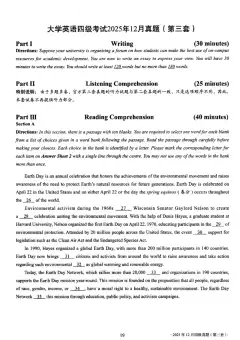
Directions: In this section, there is a passage with ten blanks. You are required to select one word for each blank from a list of choices given in a word bank. Read the passage carefully before making your choices. Each choice in the word bank is identified by a letter. You may not use any of the words in the bank more than once.
Green space in cities does far more than make streets look attractive. As more and more people move to cities, (27)______ areas keep expanding, while the land left for parks is often squeezed. Doctors report that residents who live near parks suffer less from (28)______ health problems such as stress and poor sleep. For this reason, many experts believe it is (29)______ for city planners to treat parks as a basic service, just like clean water or public transport. Yet some crowded districts have seen a clear (30)______ in the amount of green space per person in recent years. A well-designed park brings a wide (31)______ of benefits: it cools the air in summer, absorbs rainwater and gives children a safe place to play. (32)______, however, the average city still spends less than one percent of its budget on such spaces. Simple steps can help. Trees (33)______ oxygen and clean the air; community gardens let neighbors grow vegetables together; and small "pocket parks" allow busy workers to (34)______ a moment of rest near their offices. City governments can also (35)______ the use of green roofs on new buildings. On burning afternoons, a strip of shade by the roadside offers residents a (36)______ chance to cool down.
备选项:A.currently B.decline C.essential D.frequently E.generate F.goods G.mental H.precious I.regulate J.rural K.seek L.staff M.taste N.urban O.variety
27.Blank(27)
28.Blank(28)
29.Blank(29)
30.Blank(30)
31.Blank(31)
32.Blank(32)
33.Blank(33)
34.Blank(34)
35.Blank(35)
36.Blank(36)
| 六、长篇阅读(共10题,每题1分,共10分) |
Directions: In this section, you are going to read a passage with ten statements attached to it. Each statement contains information given in one of the paragraphs. Identify the paragraph from which the information is derived. Each paragraph is marked with a letter. Note that one paragraph will not be used at all, and no paragraph should be used more than once.
[A] The idea of shortening the workweek is not new. American labor unions demanded a five-day week a century ago, and the same push appeared again in the 1970s. What is new is the scale of formal experiments. Between 2015 and 2019, Iceland ran two large public trials in which about 2,500 nurses, office workers and civil servants worked fewer hours on full pay. Researchers later reported that participants felt happier and less burned out, while the quality of public services stayed the same.[B] Most trials today follow what supporters call the "100-80-100" model. Employees keep 100 percent of their pay, work 80 percent of their former hours — usually by cutting one full day — and promise to deliver 100 percent of their normal output. In other words, the company does not lower salaries; it simply removes a working day and asks teams to use the remaining time more intelligently.[C] Some famous experiments produced striking results. In the summer of 2019, Microsoft Japan closed its offices every Friday for five weeks. During the trial, the company reported that productivity per worker rose by about 40 percent, electricity use fell by a quarter, and employees took fewer days of unplanned leave. Similar results were later described by marketing agencies and software firms in Britain and New Zealand.[D] Not everyone is convinced. Critics point out that the model works best for office jobs and far less well for hospitals, factories and restaurants, where duties cannot simply be compressed into four days. They also warn that hiring extra staff to cover the missing day may push up costs, especially for small businesses with narrow profits.[E] Do companies abandon the idea after the excitement fades? Apparently not. In reviews of dozens of trials, most firms that finished a pilot chose to keep the shorter week. Managers commonly report that staff attendance improves, that sick days decrease, and that the promise of a three-day weekend helps them keep good workers.[F] There may also be an environmental dividend. When millions of employees stop commuting one day a week, traffic falls. Several studies estimate that a nationwide four-day week could cut carbon emissions from commuting by a meaningful margin, in addition to saving energy in office buildings that stay closed an extra day.[G] For employees themselves, the gains are deeply personal. In survey after survey, workers on shorter weeks say they sleep better, exercise more and spend longer evenings with their children. One nurse on a shorter rota described her new schedule as "the first time in years I could attend my son's school events."[H] Governments have begun to pay attention. In 2022, sixty-one British companies launched the world's largest formal trial of the four-day week, covering about 2,900 employees. Six months later, fifty-six of the sixty-one said they would continue with the new schedule, and eighteen made the change permanent. Other countries, including Spain and Portugal, have funded smaller pilots of their own.[I] The transition is not always smooth. A customer-service company in Canada tried the model and gave up after three months, because the rota for answering phones became a nightmare: too few staff were willing to work weekends, and managers spent hours redrawing schedules every week.[J] How do successful firms manage it? The most common step is attacking meetings: many companies cut meeting time in half, shorten the ones that remain and share written updates instead. Teams also set aside "focus hours" when nobody may interrupt, and they move routine communication to shared documents so that progress does not depend on who is present.[K] The next generation of workers may settle the debate. In recent graduate surveys, a shorter working week now ranks alongside salary as a top factor in choosing an employer. As one business professor puts it, "Companies that offer time, not just money, will win the competition for young talent."
37.Most companies that test a shorter working week decide to continue with it once the trial is over.
38.Early large-scale trials in Iceland showed that employees felt happier without any drop in the quality of their work.
39.A British trial launched in 2022 was the largest formal experiment of its kind, covering sixty-one companies.
40.In one Japanese experiment, workers produced about forty percent more per hour during the trial period.
41.To fit their tasks into fewer days, many firms reduce the number and length of meetings.
42.Cutting one day of commuting per week is an environmental benefit linked to the shorter week.
43.Under the common "100-80-100" model, employees receive their full salary while working one day less.
44.Recent surveys suggest that graduates increasingly weigh working time against salary when choosing an employer.
45.Workers on shorter weeks report sleeping better and spending more hours with their children.
46.Critics believe that industries such as healthcare cannot simply squeeze the same duties into four days.
| 七、仔细阅读(共10题,每题2分,共20分) |
Directions: There are two passages in this section. Each passage is followed by some questions or unfinished statements. For each of them there are four choices marked A, B, C and D. You should decide on the best choice.
Passage One
Questions 47 to 51 are based on the following passage.
Artificial intelligence has quietly entered classrooms. Around the world, schools are trying out "AI tutors" — software programs that chat with students, correct their exercises and design extra practice questions within seconds. Unlike traditional homework books, these programs adjust their level to each learner: when a student makes a mistake, the system analyses it, explains the rule and offers similar questions until the weakness disappears.The clearest advantage of such tools is personal attention. A single teacher facing forty students cannot give everyone instant feedback, but an AI tutor can. Studies of several programs report that shy students, who rarely raise their hands in class, often make the fastest progress because they feel free to ask the software "silly" questions again and again.Yet teachers have not given the technology a warm welcome everywhere. Many worry that students who grow used to instant answers may stop thinking deeply for themselves; some also fear that the software collects large amounts of personal data about children. A few parent groups have even asked schools to limit its use.Most education researchers take a middle position. In their view, AI tutors are powerful assistants, not replacements for human teachers. Machines are good at drilling facts and checking exercises, but they cannot encourage a discouraged teenager or discuss why a poem matters. They therefore suggest a blended model: schools should use AI tools for routine practice, while class time is reserved for discussion, group projects and the personal contact that motivates students.The debate is likely to continue as the technology improves. What seems certain, however, is that the classroom of the future will look different from today's — and that the teachers who learn to work with intelligent machines, rather than against them, will serve their students best.
47.What do we learn about AI tutoring programs from the passage?
A.They have replaced most homework books in schools.
B.They are popular with all teachers and parents.
C.They can adapt practice to each learner's level.
D.They were first designed for shy students.
48.What is mentioned as the clearest advantage of AI tutors?
A.They give students immediate and personalized feedback.
B.They reduce the amount of homework students do.
C.They help teachers collect students' personal data.
D.They make classroom discussions more lively.
49.Why do many teachers worry about students using AI tutors?
A.The software often marks correct answers as wrong.
B.Students may become too dependent and stop thinking deeply.
C.The programs cost schools a large sum of money.
D.Students refuse to do routine practice any more.
50.What do most education researchers suggest schools do?
A.Limit AI tools to language courses only.
B.Replace homework with software-based practice.
C.Ask parents to monitor children's data.
D.Combine AI practice with human-led class activities.
51.What is the author's attitude toward AI tutors?
A.Cautiously supportive.
B.Totally indifferent.
C.Strongly opposed.
D.Enthusiastically admiring.
Passage Two
Questions 52 to 56 are based on the following passage.
The Slow Food movement began in Italy in 1986, when the writer Carlo Petrini watched a new McDonald's open at the foot of Rome's Spanish Steps. Annoyed, he argued that people were losing the ability to enjoy food — and life — at a natural pace. His response was a small organization that has since grown into a worldwide network with members in more than 160 countries.Slow Food is not simply about eating slowly. The movement promotes three linked ideas: food should taste good, be produced in ways that protect the environment, and give a fair income to the people who grow it. Members are encouraged to buy local and seasonal products, to learn traditional recipes from their grandparents, and to treat meals as a time for family conversation rather than a break between appointments.To spread these values, the movement runs projects in schools. In hundreds of school gardens across the world, children plant vegetables, cook simple dishes and discover how their food travels from the field to the plate. Teachers report that students who grow a carrot are far more willing to eat one.Critics, however, note that the movement faces a real difficulty: slow food is often more expensive than fast food, and busy low-income families cannot always afford the time or money it demands. Supporters reply that the real cost appears later — in medical bills, in polluted rivers and in the disappearance of traditional foods — but this argument is hard to measure.Whatever its weaknesses, the movement has changed the way millions of people think about eating. In a world of delivery apps and ten-minute lunch breaks, Slow Food reminds us that a shared meal can be one of life's simplest pleasures.
52.What do we learn about the beginning of the Slow Food movement?
A.It was started by a group of Italian farmers.
B.It spread to more than 160 countries within a year.
C.It grew out of anger at a fast-food restaurant's opening.
D.It was first supported by the city government of Rome.
53.What does the movement encourage its members to do?
A.Buy imported food of the highest quality.
B.Create new recipes with modern technology.
C.Choose local and seasonal products.
D.Eat alone to save time for work.
54.Why does the author mention school garden projects?
A.To prove that vegetables are easy to grow.
B.To show how the movement passes its values to children.
C.To criticize schools for wasting students' time.
D.To complain that children dislike fresh food.
55.What difficulty does the Slow Food movement face according to the passage?
A.Fewer young people are joining the network.
B.Its members disagree about the three core ideas.
C.Governments refuse to support its projects.
D.Slow food often costs more than fast food.
56.Which of the following would be the best title for the passage?
A.Slow Food: A Return to the Joy of Eating
B.McDonald's: The Enemy of Italian Culture
C.School Gardens: The Future of Farming
D.Fast Food: A Problem without a Solution
| 八、翻译题(共1题,共15分) |
57.翻译题(15分)
**Directions**: For this part, you are allowed 30 minutes to translate a passage from Chinese into English.
请将下面这段话翻译成英文:
中国高铁发展迅速,已成为展示国家实力的一张亮丽名片。目前,中国高铁运营里程已超过四万公里,稳居世界第一。高铁不仅大大缩短了城市之间的旅行时间,还带动了沿线地区的经济发展。乘坐高铁出行既快捷又舒适,越来越多的人把它作为出行的首选。未来,中国将继续完善高铁网络,让更多城市纳入一小时交通圈。高铁的快速发展也促进了人才流动与区域合作。
📝 试卷答案获取方式
答案请添加星蓝海学习网刘老师VX:up0005,备注CET四级试卷答案
如需更多2026年职业资格考试备考资料(英语四级、英语六级、CET4、CET6等),欢迎关注星蓝海学习网,获取全国大学英语四、六级考试(CET)最新动态与免费题库。
#大学英语四六级 #CET #四级
星蓝海学习网 · 为考研考证学子提供12万+备考资料与真题题库xlh.100xuexi.com