《英语》三色速记手册
红色:表示重难点 /蓝色:表示易错点/绿色:表示理解点
第一部分 英语语言知识
第一章 语音知识
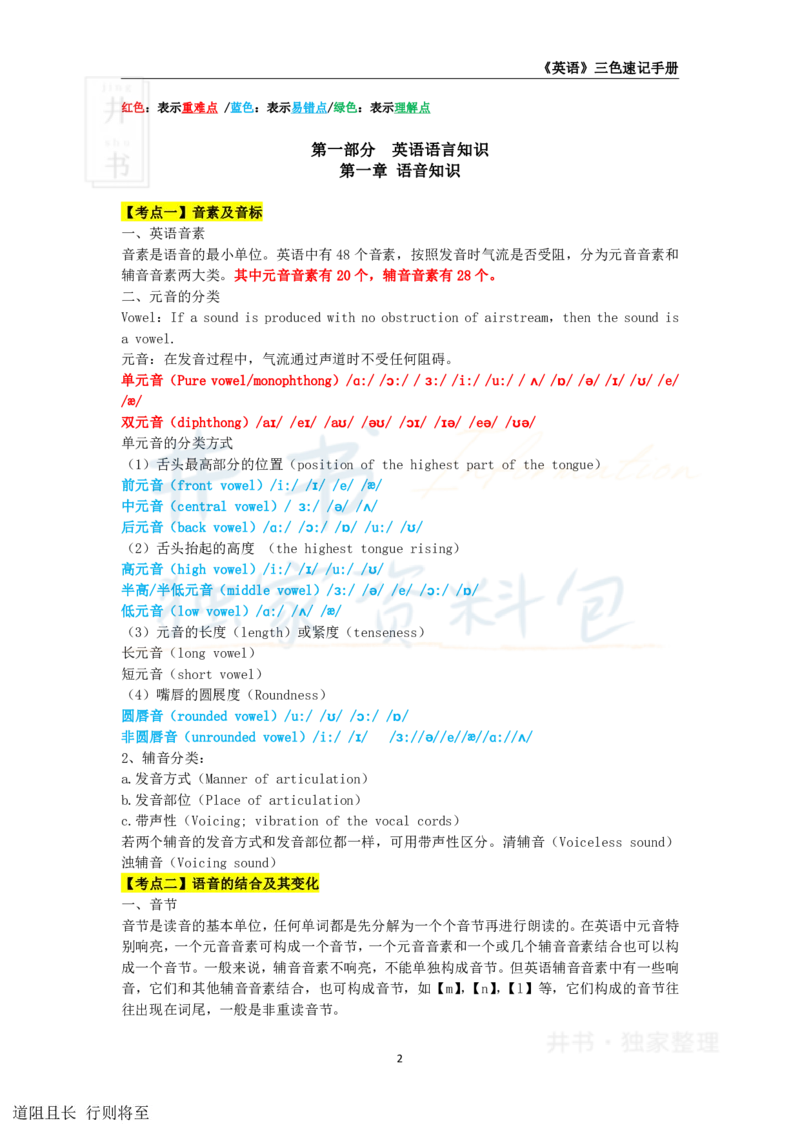
【考点一】音素及音标
一、英语音素
音素是语音的最小单位。英语中有48个音素,按照发音时气流是否受阻,分为元音音素和
辅音音素两大类。其中元音音素有20个,辅音音素有28个。
二、元音的分类
Vowel:If a sound is produced with no obstruction of airstream,then the sound is
a vowel.
元音:在发音过程中,气流通过声道时不受任何阻碍。
单元音(Pure vowel/monophthong)/ɑ:/ /ɔ:/ / ɜ:/ /i:/ /u:/ / ʌ/ /ɒ/ /ə/ /ɪ/ /ʊ/ /e/
/æ/
双元音(diphthong)/aɪ/ /eɪ/ /aʊ/ /əʊ/ /ɔɪ/ /ɪə/ /eə/ /ʊə/
单元音的分类方式
(1)舌头最高部分的位置(position of the highest part of the tongue)
前元音(front vowel)/i:/ /ɪ/ /e/ /æ/
中元音(central vowel)/ ɜ:/ /ə/ /ʌ/
后元音(back vowel)/ɑ:/ /ɔ:/ /ɒ/ /u:/ /ʊ/
(2)舌头抬起的高度 (the highest tongue rising)
高元音(high vowel)/i:/ /ɪ/ /u:/ /ʊ/
半高/半低元音(middle vowel)/ɜ:/ /ə/ /e/ /ɔ:/ /ɒ/
低元音(low vowel)/ɑ:/ /ʌ/ /æ/
(3)元音的长度(length)或紧度(tenseness)
长元音(long vowel)
短元音(short vowel)
(4)嘴唇的圆展度(Roundness)
圆唇音(rounded vowel)/u:/ /ʊ/ /ɔ:/ /ɒ/
非圆唇音(unrounded vowel)/i:/ /ɪ/ /ɜ://ə//e//æ//ɑ://ʌ/
2、辅音分类:
a.发音方式(Manner of articulation)
b.发音部位(Place of articulation)
c.带声性(Voicing; vibration of the vocal cords)
若两个辅音的发音方式和发音部位都一样,可用带声性区分。清辅音(Voiceless sound)
浊辅音(Voicing sound)
【考点二】语音的结合及其变化
一、音节
音节是读音的基本单位,任何单词都是先分解为一个个音节再进行朗读的。在英语中元音特
别响亮,一个元音音素可构成一个音节,一个元音音素和一个或几个辅音音素结合也可以构
成一个音节。一般来说,辅音音素不响亮,不能单独构成音节。但英语辅音音素中有一些响
音,它们和其他辅音音素结合,也可构成音节,如【m】,【n】,【l】等,它们构成的音节往
往出现在词尾,一般是非重读音节。
2《英语》三色速记手册
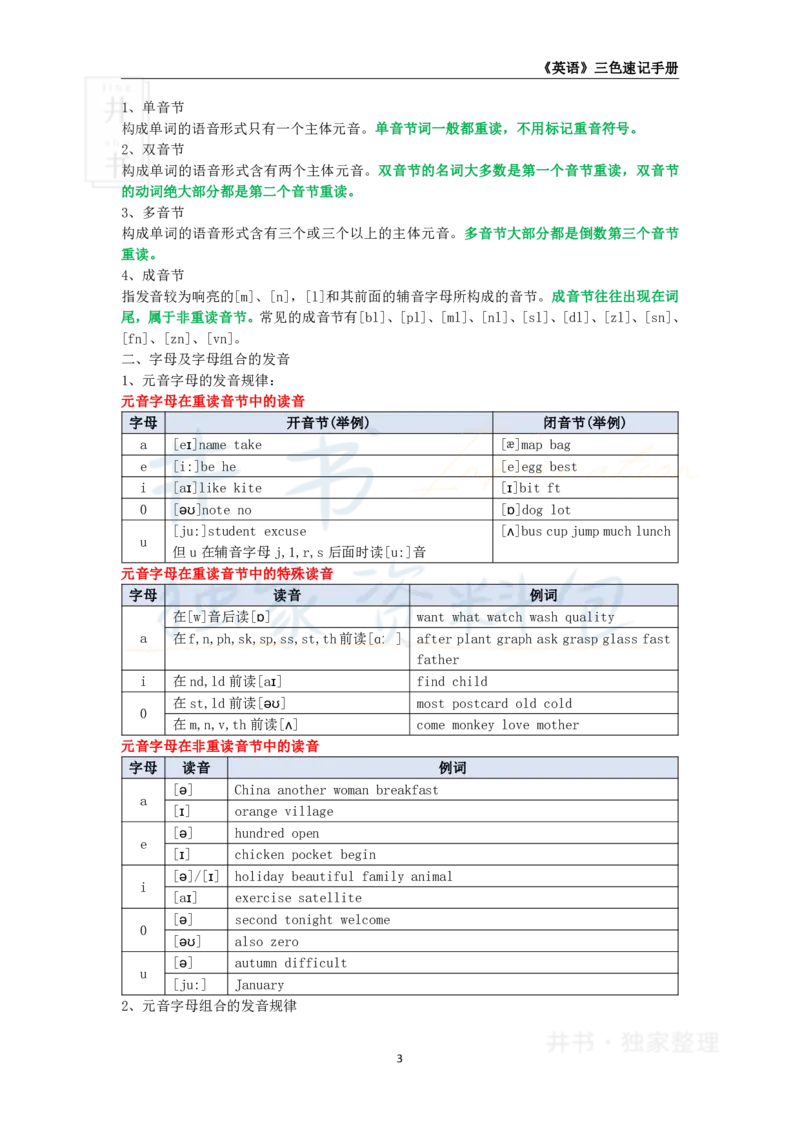
1、单音节
构成单词的语音形式只有一个主体元音。单音节词一般都重读,不用标记重音符号。
2、双音节
构成单词的语音形式含有两个主体元音。双音节的名词大多数是第一个音节重读,双音节
的动词绝大部分都是第二个音节重读。
3、多音节
构成单词的语音形式含有三个或三个以上的主体元音。多音节大部分都是倒数第三个音节
重读。
4、成音节
指发音较为响亮的[m]、[n],[l]和其前面的辅音字母所构成的音节。成音节往往出现在词
尾,属于非重读音节。常见的成音节有[bl]、[pl]、[ml]、[nl]、[sl]、[dl]、[zl]、[sn]、
[fn]、[zn]、[vn]。
二、字母及字母组合的发音
1、元音字母的发音规律:
元音字母在重读音节中的读音
字母 开音节(举例) 闭音节(举例)
a [eɪ]name take [æ]map bag
e [i:]be he [e]egg best
i [aɪ]like kite [ɪ]bit ft
0 [əʊ]note no [ɒ]dog lot
[ju:]student excuse [ʌ]buscupjumpmuchlunch
u
但u在辅音字母j,1,r,s后面时读[u:]音
元音字母在重读音节中的特殊读音
字母 读音 例词
在[w]音后读[ɒ] want what watch wash quality
a 在f,n,ph,sk,sp,ss,st,th前读[ɑː ] after plant graph ask grasp glass fast
father
i 在nd,ld前读[aɪ] find child
在st,ld前读[əʊ] most postcard old cold
0
在m,n,v,th前读[ʌ] come monkey love mother
元音字母在非重读音节中的读音
字母 读音 例词
[ə] China another woman breakfast
a
[ɪ] orange village
[ə] hundred open
e
[ɪ] chicken pocket begin
[ə]/[ɪ] holiday beautiful family animal
i
[aɪ] exercise satellite
[ə] second tonight welcome
0
[əʊ] also zero
[ə] autumn difficult
u
[ju:] January
2、元音字母组合的发音规律
3《英语》三色速记手册
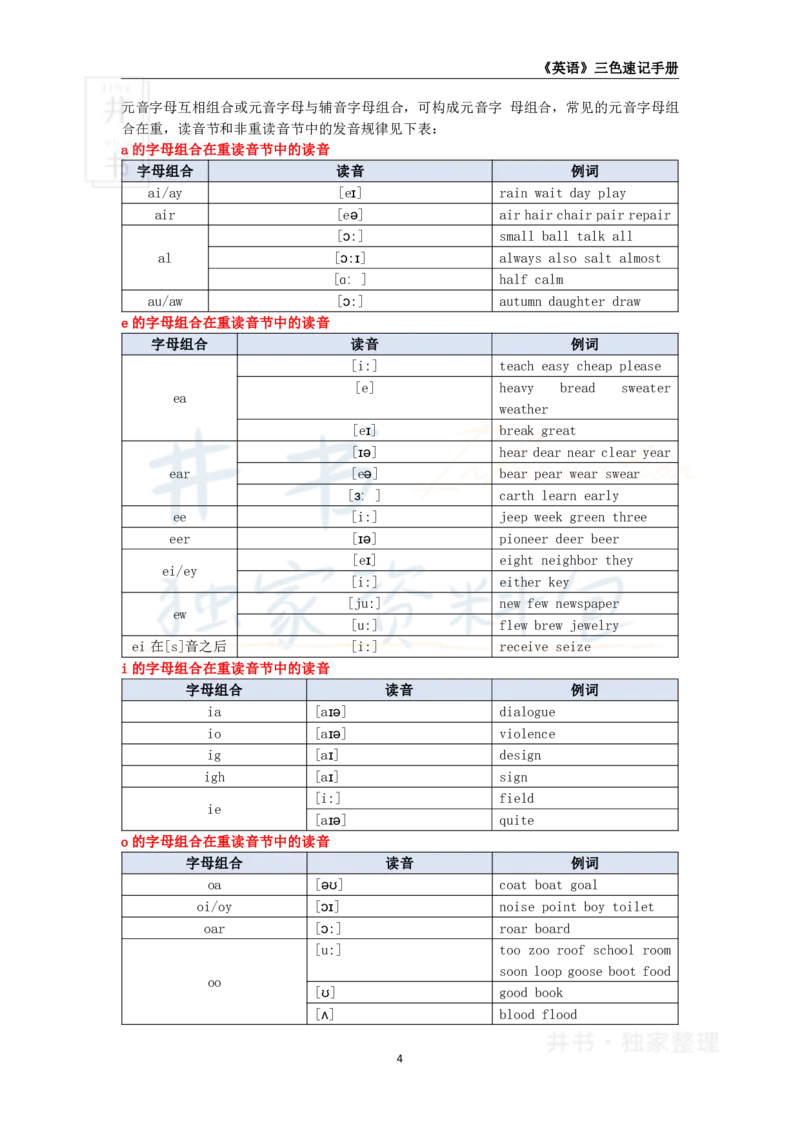
元音字母互相组合或元音字母与辅音字母组合,可构成元音字 母组合,常见的元音字母组
合在重,读音节和非重读音节中的发音规律见下表:
a的字母组合在重读音节中的读音
字母组合 读音 例词
ai/ay [eɪ] rain wait day play
air [eə] airhair chair pair repair
[ɔ:] small ball talk all
al [ɔ:ɪ] always also salt almost
[ɑː ] half calm
au/aw [ɔ:] autumn daughter draw
e的字母组合在重读音节中的读音
字母组合 读音 例词
[i:] teach easy cheap please
[e] heavy bread sweater
ea
weather
[eɪ] break great
[ɪə] hear dear near clear year
ear [eə] bear pear wear swear
[ɜː ] carth learn early
ee [i:] jeep week green three
eer [ɪə] pioneer deer beer
[eɪ] eight neighbor they
ei/ey
[i:] either key
[ju:] new few newspaper
ew
[u:] flew brew jewelry
ei在[s]音之后 [i:] receive seize
i的字母组合在重读音节中的读音
字母组合 读音 例词
ia [aɪə] dialogue
io [aɪə] violence
ig [aɪ] design
igh [aɪ] sign
[i:] field
ie
[aɪə] quite
o的字母组合在重读音节中的读音
字母组合 读音 例词
oa [əʊ] coat boat goal
oi/oy [ɔɪ] noise point boy toilet
oar [ɔ:] roar board
[u:] too zoo roof school room
soon loop goose boot food
oo
[ʊ] good book
[ʌ] blood flood
4《英语》三色速记手册
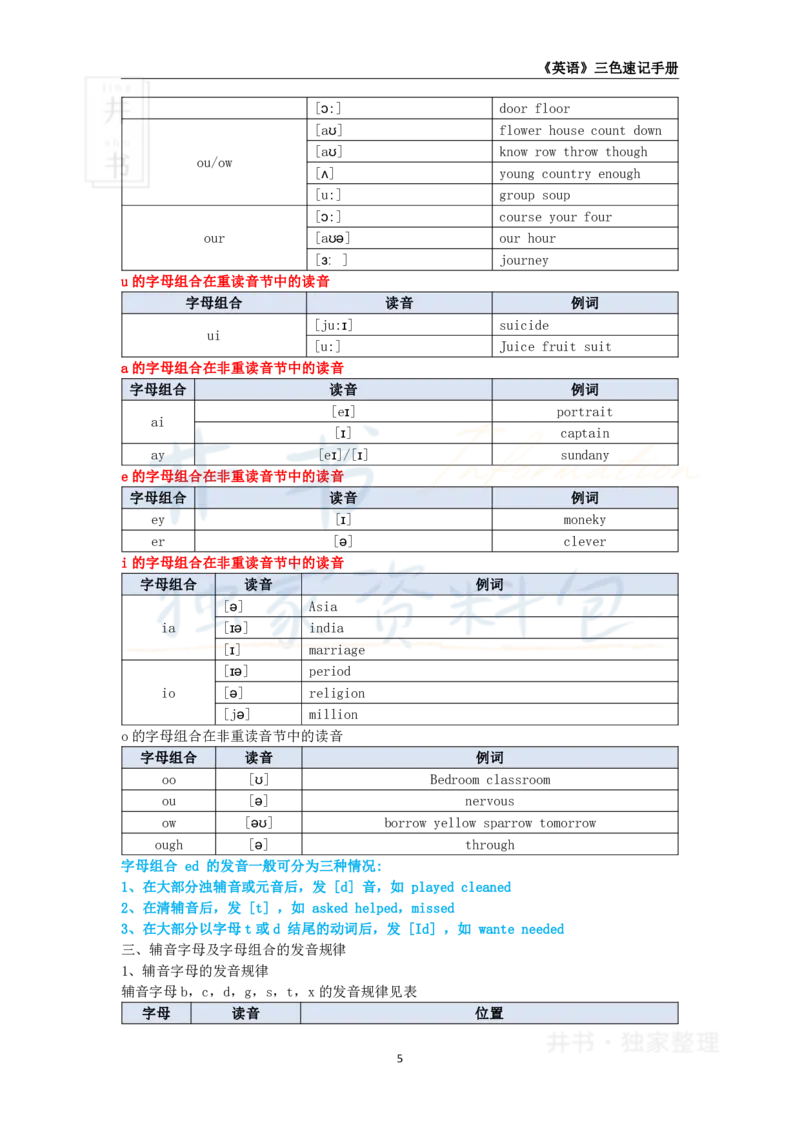
[ɔ:] door floor
[aʊ] flower house count down
[aʊ] know row throw though
ou/ow
[ʌ] young country enough
[u:] group soup
[ɔ:] course your four
our [aʊə] our hour
[ɜː ] journey
u的字母组合在重读音节中的读音
字母组合 读音 例词
[ju:ɪ] suicide
ui
[u:] Juice fruit suit
a的字母组合在非重读音节中的读音
字母组合 读音 例词
[eɪ] portrait
ai
[ɪ] captain
ay [eɪ]/[ɪ] sundany
e的字母组合在非重读音节中的读音
字母组合 读音 例词
ey [ɪ] moneky
er [ə] clever
i的字母组合在非重读音节中的读音
字母组合 读音 例词
[ə] Asia
ia [ɪə] india
[ɪ] marriage
[ɪə] period
io [ə] religion
[jə] million
o的字母组合在非重读音节中的读音
字母组合 读音 例词
oo [ʊ] Bedroom classroom
ou [ə] nervous
ow [əʊ] borrow yellow sparrow tomorrow
ough [ə] through
字母组合 ed 的发音一般可分为三种情况:
1、在大部分浊辅音或元音后,发 [d] 音,如 played cleaned
2、在清辅音后,发 [t] ,如 asked helped,missed
3、在大部分以字母t或d 结尾的动词后,发 [Id] ,如 wante needed
三、辅音字母及字母组合的发音规律
1、辅音字母的发音规律
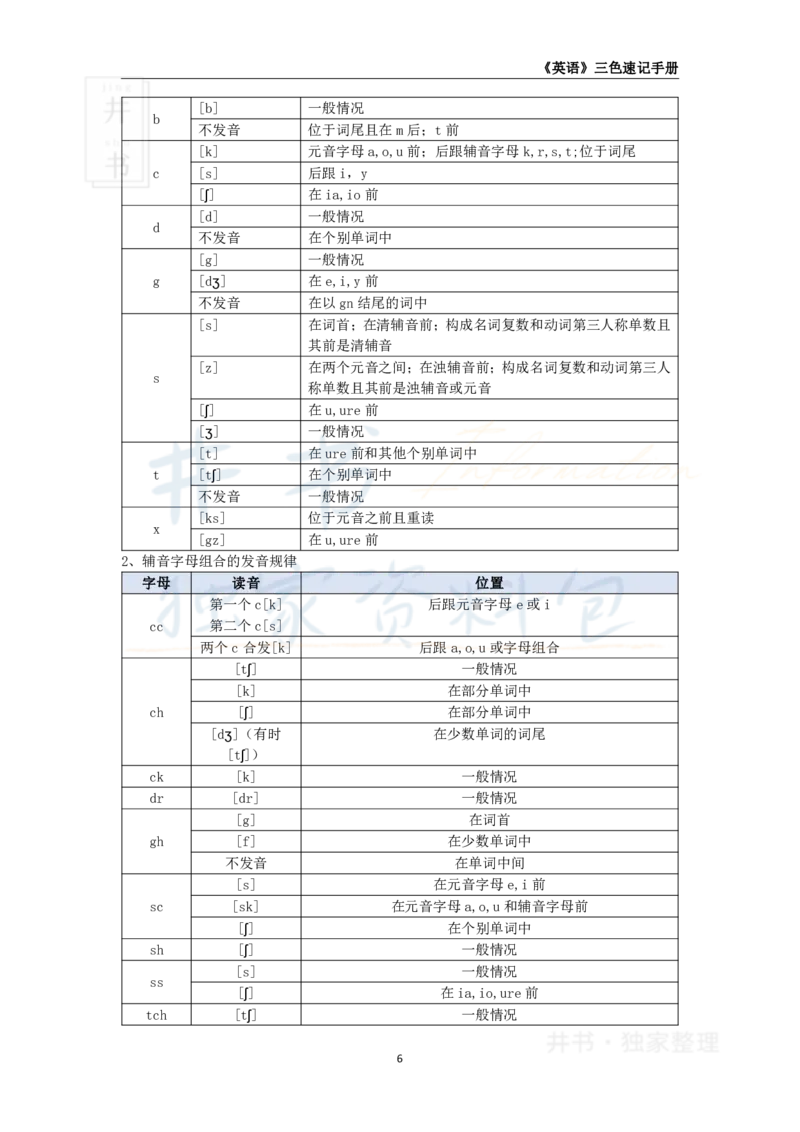
辅音字母b,c,d,g,s,t,x的发音规律见表
字母 读音 位置
5《英语》三色速记手册
[b] 一般情况
b
不发音 位于词尾且在m后;t前
[k] 元音字母a,o,u前;后跟辅音字母k,r,s,t;位于词尾
c [s] 后跟i,y
[ʃ] 在ia,io前
[d] 一般情况
d
不发音 在个别单词中
[g] 一般情况
g [dʒ] 在e,i,y前
不发音 在以gn结尾的词中
[s] 在词首;在清辅音前;构成名词复数和动词第三人称单数且
其前是清辅音
[z] 在两个元音之间;在浊辅音前;构成名词复数和动词第三人
s
称单数且其前是浊辅音或元音
[ʃ] 在u,ure前
[ʒ] 一般情况
[t] 在ure前和其他个别单词中
t [tʃ] 在个别单词中
不发音 一般情况
[ks] 位于元音之前且重读
x
[gz] 在u,ure前
2、辅音字母组合的发音规律
字母 读音 位置
第一个c[k] 后跟元音字母e或i
cc 第二个c[s]
两个c合发[k] 后跟a,o,u或字母组合
[tʃ] 一般情况
[k] 在部分单词中
ch [ʃ] 在部分单词中
[dʒ](有时 在少数单词的词尾
[tʃ])
ck [k] 一般情况
dr [dr] 一般情况
[g] 在词首
gh [f] 在少数单词中
不发音 在单词中间
[s] 在元音字母e,i前
sc [sk] 在元音字母a,o,u和辅音字母前
[ʃ] 在个别单词中
sh [ʃ] 一般情况
[s] 一般情况
ss
[ʃ] 在ia,io,ure前
tch [tʃ] 一般情况
6《英语》三色速记手册
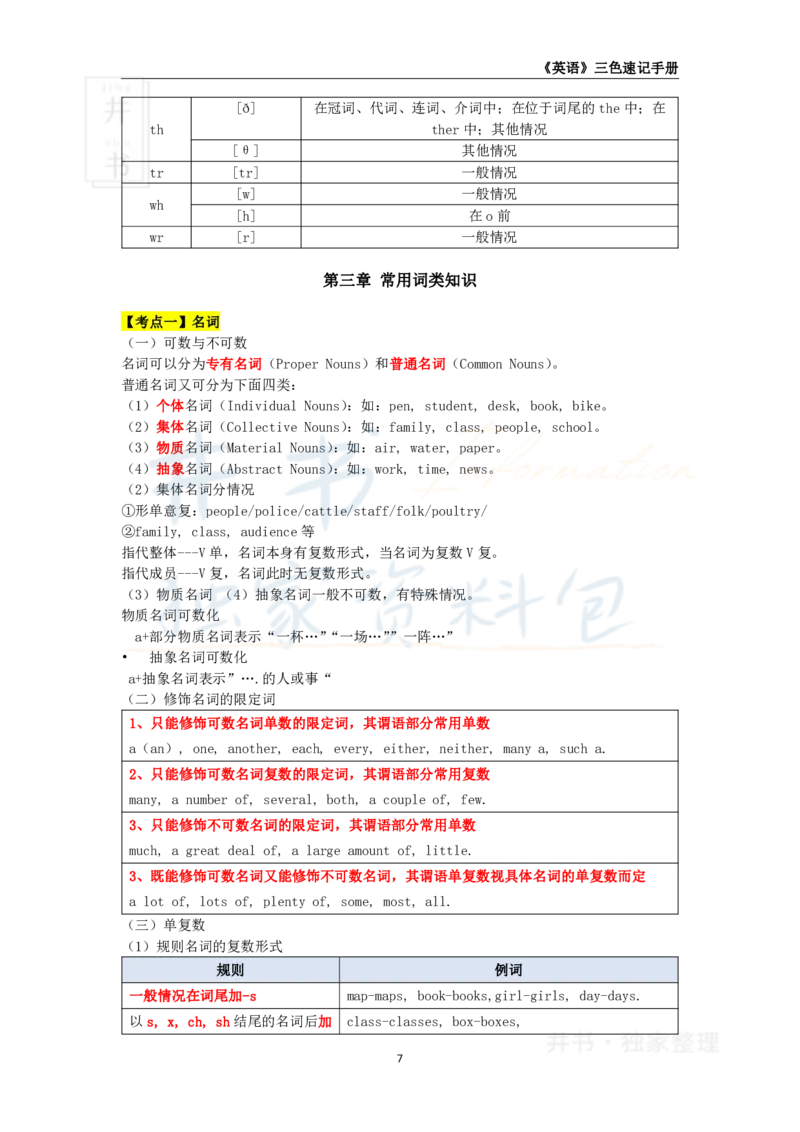
[ð] 在冠词、代词、连词、介词中;在位于词尾的the中;在
th ther中;其他情况
[θ] 其他情况
tr [tr] 一般情况
[w] 一般情况
wh
[h] 在o前
wr [r] 一般情况
第三章 常用词类知识
【考点一】名词
(一)可数与不可数
名词可以分为专有名词(Proper Nouns)和普通名词(Common Nouns)。
普通名词又可分为下面四类:
(1)个体名词(Individual Nouns):如:pen, student, desk, book, bike。
(2)集体名词(Collective Nouns):如:family, class, people, school。
(3)物质名词(Material Nouns):如:air, water, paper。
(4)抽象名词(Abstract Nouns):如:work, time, news。
(2)集体名词分情况
①形单意复:people/police/cattle/staff/folk/poultry/
②family, class, audience等
指代整体---V单,名词本身有复数形式,当名词为复数V复。
指代成员---V复,名词此时无复数形式。
(3)物质名词 (4)抽象名词一般不可数,有特殊情况。
物质名词可数化
a+部分物质名词表示“一杯…”“一场…””一阵…”
• 抽象名词可数化
a+抽象名词表示”….的人或事“
(二)修饰名词的限定词
1、只能修饰可数名词单数的限定词,其谓语部分常用单数
a(an), one, another, each, every, either, neither, many a, such a.
2、只能修饰可数名词复数的限定词,其谓语部分常用复数
many, a number of, several, both, a couple of, few.
3、只能修饰不可数名词的限定词,其谓语部分常用单数
much, a great deal of, a large amount of, little.
3、既能修饰可数名词又能修饰不可数名词,其谓语单复数视具体名词的单复数而定
a lot of, lots of, plenty of, some, most, all.
(三)单复数
(1)规则名词的复数形式
规则 例词
一般情况在词尾加-s map-maps, book-books,girl-girls, day-days.
以s, x, ch, sh结尾的名词后加 class-classes, box-boxes,
7《英语》三色速记手册
-es watch-watches, dish-dishes.
以辅音字母加y结尾的名词,变y party-parties, family-families, story-stories,
为i加-es city-cities
以元音字母加y结尾的名词,或
toy-toys, boy-boys, day-days, ray-rays,
专有名词以y结尾的,加-s
leaf-leaves thief-thieves knife-knives
变-f和-fe为v再 loaf-loaves wife-wives self-selves
加-es life-lives wolf-wolves shelf-shelves
以-f或-fe
half-halves
结尾的词
gulf-gulfs, roof-roofs, chief-chiefs,
加-s serf-serfs, belief-beliefs, proof-proofs,
handkerchief-handkerchiefs
hero-heroes, Negro-Negroes, potato-potatoes,
一般加-es
以辅音字母 tomato-tomatoes
加-o结尾的 piano-pianos, photo-photos,
不少外来词加-s
名词 auto-autos,kilo-kilos
两者皆可 zero-zeros/zeroes, volcano-volcanoes / volcanos
以元音字母加-o结尾的名词加-s radio-radios, bamboo-bamboos, zoo-zoos
以-th结尾的名词加-s truth-truths, mouth-mouths, month-months
(2)不规则名词的复数形式
规则 例词
改变名词中的元音字母 man-men, woman-women, foot-feet, goose-geese,
或其他形式 mouse-mice.
单复数相同 sheep, deer, fish, series, means, works, species.
ashes, trousers, clothes, thanks, goods, glasses,
只有复数形式
compasses.
一些集体名词总是用作
people, police, cattle, staff.
复数
部分集体名词既可以作 audience, class, family, crowd, couple, group,
单数(整体)也可以作复 committee, government, population, crew, team, public,
数(成员) enemy, party.
customs (海关),forces (军队),times(时代),spirits
(情绪), drinks (饮料), sands (沙滩), papers (文
复数形式表示特别含义
件报纸), manners (礼貌), looks(外表), brains (头
脑智力), greens (青菜), ruins (废墟)。
表 加-s Americans, Australians, Germans, Greeks,
8《英语》三色速记手册
示 Swedes,Europeans.
“ 单复数同形 Swiss, Portuguese, Chinese, Japanese. (中日瑞葡)
某 以-man或-woman
国 结尾的改为-men, Englishmen, Frenchwomen.
人” -women.
将主体名词 sons-in-law, lookers-on, passers-by, story-tellers, boy
变为复数 friends.
合
无主体名词时
成 grown-ups, good-for-nothings(饭桶), go-betweens(中
将最后一部分
名 间人).
变为复数
词
将两部分
women singers, men servants.
变为复数
【注意】在使用名词单、复数时还要注意的几个问题:
(1)有些名词通常以复数形式出现。
这些词语前不可直接加数次,但可用 a pair of/ a series of 等数量词,单复数和
pair/series保持一致。
【注意】在使用名词单、复数时还要注意的几个问题:
(2)物质名词的复数形式一般表示不同的种类。
(3)外来名词的复数形式
(四)名词的所有格
名词在句中表示所有关系的语法形式叫做名词所有格。所有格分两种:一是名词词尾加's
构成,二是由介词of加名词构成。前者多表示有生命的东西,后者多表示无生命的东西。
(1)'s所有格的构成
the boy's father, Jack's book, her
单数名词在末尾加's
son-in-law's photo.
一般在末尾加' the teachers' room, the twins' mother.
复数名词
不规则复数名词后加's the children's toys, women's rights.
Dickens'novels,Charles'sjob,theSmiths'
以s结尾的人名所有格加's或者'
house.
表示各自的所有关系时,各名词末尾均 Japan's and China's problems, Jane's and
须加's Mary's bikes.
表示共有的所有关系时在最后一词末加 Japan and America's problems, Jane and
's Mary's father.
表示“某人家”“店铺”,所有格后名 the doctor's, the barber's, the tailor's,
词省略 my uncle's.
(2)'s所有格的用法
1、表示时间 Today's newspaper, five weeks' holiday.
9《英语》三色速记手册
2、表示自然现象 the earth's atmosphere, the tree's branches.
the country's plan, the world's population,
3、表示国家城市等地方的名词
China's industry.
the ship's crew, majority's view, the team's
4、表示工作群体
victory.
a mile's journey, five dollars' worth of
5、表示度量衡及价值
apples.
6、与人类活动有特殊关系的名词 the life's time, the play's plot.
a bird's eye view, a stone's throw, at one's
7、某些固定词组
wit's end.
(3)of所有格的用法
1、用于无生命的东西 the legs of the chair , the cover of the book.
2、用于有生命的东西,尤
the classrooms of the first-year students.
其是有较长定语时
3、用于名词化的词 the struggle of the oppressed.
(4)双重所有格的用法
双重所有格 of+名词所有格 a friend of my brother's
的形式 of+名词性物主代词 a necklace of yours
1、This is a book of my father's.
1)双重所有格所修饰的名词通常
2、Have you read any books of
和不定冠词a及any, some, no,
Einstein's?
few, several等表示数量的词连
3、Some friends of my brother's
双重所有格 用,但不可以和定冠词the连用。
have arrived.
的特征
2)“of+名词所有格”中的名词一
般表示人,不能表示物,该名词必 1、a friend of the doctor's
须是特指的,不能是泛指的,不能 2、some books of my brother's.
与不定冠词连用。
(五)名词作定语
(1)当名词作定语时,几乎总是用单数形式(即使在意义上是复数)。
(2)sports, customs, arms, clothes, sales和accounts等作定语时,仍用复数形式。
(3)“man / woman+n.”变为复数时,作定语的名词和中心词都要变复数。
【考点二】代词
(一)代词分类
主格 I, you, he, she, it, we, you, they.
人称代词
宾格 me, you, him, her, it, us, you, them.
形容词性 my, your, his, her, its, our, their.
物主代词
名词性 mine, yours, his, hers, its, ours, theirs.
反身代词 myself, yourself, himself, herself, itself,
10《英语》三色速记手册
ourselves, yourselves, themselves.
指示代词 this, that, these, those, such, some.
疑问代词 who, whom, whose, which, what, whoever, whichever, whatever.
关系代词 that, which, who, whom, whose, as.
one/ some/ any, each/ every, none/ no, many/ much, few/ little/
不定代词 a few/ a little.
other/ another, all/ both, neither/ either.
some, any, every, no都能和one, body, thing一起构成复合不定代
复合不定代词
词。
(二)不定代词用法
(1)one,some与any
①one可以泛指任何人,也可特指,复数为ones。some多用于肯定句,any多用于疑问句和
否定句。
②some可用于疑问句中,表示盼望得到肯定的答复, 或者表示建议,请求等。
③some和any修饰可数名词单数时,some表示某个,any表示任何一个。
④some和数词连用表示“大约”,any可与比较级连用表示程度。
some +N复/N不;肯定句;“一些”
+N复/N不;疑问句;“一些”表示委婉语气
+N单;“某个”
+数字;“大约
any+N复/N不;否定句、疑问句;“一些”
+N单;”任何“
+比较级;”比....好一些“ 否定句、疑问句
(2)each和every
each可用作代词和形容词,强调个别,代表的数可以是两个或两个以上;
Each student has a pocket dictionary.(形容词,作定语,谓语动词对应each用单数。)
Each (of us) has a dictionary.(代词,作主语,谓语动词对应each用单数。)
We each have a dictionary.(代词,作同位语,谓语动词对应主语用复数。)
而every只能作形容词,强调整体,所指的数必须是三个或三个以上。
Every student has strong and weak points.(形容词, 作定语,谓语动词用单数。)
Every one of us has strong and weak points.(形容词,作定语,谓语动词用单数。)
但是,不定代词each, every, no所修饰的名词即使以and或逗号连接成多主语时,谓语
动词仍用单数形式。
(3) no, no one, nobody, none
①no等于not any,作定语。
②no one=nobody,两者均只能指人不指物,其后通常不接of短语,作主语时谓语用单数。
③none既可指人也可指物,作主语或宾语,代替不可数名词,谓语用单数,代替可数名词,
谓语单复数皆可以。 其后也通常接of短语。
④none有时暗示一种数量,即指数量上“一个也没有”,而no one或nobody则往往表示一
种全面否定,即指“谁都没有”,所以在回答howmany 或 howmuch的提问时,通常用none,
而在回答who的提问时,通常用 no one或 nobody。
(4)another, other, the other, others, the others
11《英语》三色速记手册
泛指:
①another指“又一个,另一个”无所指,指三者或三者以上中的任何一个,用作代词或形
容词。例如:
②other泛指“另外的,别的”,只作定语,常与复数名词或不可数名词连用;但如果前面
有the, this, that, some, any, each, every, no, one及my, your, his等时,则可与
单数名词连用。
③others泛指别的人或物,是other的复数形式,泛指别的人或物(但不是全部),不可作
定语。
特指:
④the other表示“两者中的另一个”,常与one连用,构成one…the other…“一个……
另一个……”,作定语修饰复数名词时,表示“全部其余的”。
⑤the others特指其余的人或物,是the other的复数形式。
another+N单
other+N复/N不 adj
others=other+N复 n.
the other表示“剩下的那一个”;特指
the others表示“剩下的所有“;特指
one another相互(三者及以上)from one to another从一个到另一个one after another
一个接一个
(5)both, all, either, any, neither与none的用法
都 任何 都不
两者 both Either Neither
三者(以上) all Any None
注:all表示不可数名词时,其谓语动词用单数。both和all加否定词表示部分否定,全部
否定用neither和none。
(三)that和those的用法比较
1、that用作替代词主要用于替代“the+单数名词(可数或不可数)”,表特指。
2、those用作替代词主要用于替代复数名词,表特指。
(四)it的用法
用法 举例
(1)代替上文提到的一件事物。 My book is missing.I can't find it anywhere.
(2)代替指示代词this, that. ---What' s this? ---It's a car.
(3)指代时间、季节。 It often rains in spring here.
(4)指代气候、天气、温度、自然环 In Britain it is neither too cold in winter
境等。 nor too hot in summer.
(5)指代距离。 It'sfourkilometersfrommyhometothefarm.
---Who's the baby in the photo?
(6)指代不明性别的婴儿。
---It's me.
(7)指代远处的人或者敲门者等不能
Open the door, please.It may be the police.
确定对方身份的人。
(8)作形式主语。 It's not easy to get him to change his mind.
12《英语》三色速记手册
(9)作形式宾语。 She found it difficult to get along with him.
It was he who bought a shirt at this shop
(10)用于强调结构。
yesterday.
(11)某些及物动词(like, love,
enjoy, prefer, hate, appreciate
I'd appreciate it if you could drop in
等)之后若没有出现宾语,而直接跟
tonight.
if / whether引导的状语从句,要在
从句前使用代词it。
(五)it, that, one, so的用法比较
用法
it指代上文所提事物的本身,如果所代替的事物为复数,则应该用they
it(指代同
或them表示。
名同物)
it也可以用来代替上文所提到的一件事。
see to it that=see that/make sure that/check that意思是 “确保”
“务必”,这里所提到的that从句中的将来时都要用一般现在时替代。
that表替代时是特指,可指上文谈到物或情况。(均为单数,可代替可数
that(指代
名词单数和不可数名词,有时that后面接of短语,代替可数名词复数时
同名异物)
用those,后面也可以加of )
常用来代替与上文所提到人或物相类似的不确定的另一人或物,且被替代
者为可数名词单数形式,相当于“a+名词” (泛指),其复数形式为
one(既可代
ones。
替事物,也
若下文替代者表示非特指含义,则用a/an—adj—one形式表示;若下文替
可代替人)
代者为另一特指含义,则用the one或the—adj—one形式表示;若下文
替代时为复数含义,则用the—adj—ones或the ones表示。
one作替代词用时,其前可加某些形容词或限定词,如the, this, that,
which, each, every, any,但一般不能直接在其前加物主代词。
so表示替代常用来代替上文中出现的内容,尤其是上文内容在下文中以宾
语从句形式出现时。
so
如果在下文被代替者为否定含义的宾语从句,常用动词否定形式+so或直
接用not代替。
(六)such的用法
1、表示“那样的”、“这样的”,与no,any, some, all, few,many, each, every, several,
other, another, one, two等词语连用应置于其后,但是,与不定冠词连用时,要置于其
前。
注:受no such修饰的名词无需再用冠词。
2、比较such…as与such…that
such…as中的as是关系代词,用以引导定语从句,在句中充当主语或宾语等,而such…
that中的that只起引导词的作用,用以引导结果状语。
13