2 0 2 3 下 粉 笔 教 资
主 观 专 项 教 学 设 计 2
▹
讲师:原 原
更多干货关注 粉笔教师教育 粉笔教师I. Teaching Contents 教学内容
II. Teaching Objectives 教学目标
III. Teaching Key and difficult points 教学重难点
IV. Teaching Procedures
① Teaching objectives
Step1 Warm-up and Lead-in (×mins)
② Teaching contents (Justification:...)
Step 2 Pre-/ Presentation (×mins)
③ Key and difficult points
Activity1...
④ Major steps and time allocation (Justification:...)
Step 3 While-/ Pracice (×mins) 主要教学步骤
⑤ Activities and justifications
Activity1... 设计意图
(Justification:...)
Step4 Post- / Production (×mins)
Activity1...
(Justification:...)
Step5 Summary and homework (×mins)
(Justification:...)Listening Reading
Pre-listening Pre-reading
Obstacle Obstacle
Prediction Prediction
While-listening While-reading
Extensive listening
Extensive/Global/Fast reading
Intensive listening
Intensive/Detailed/Careful reading
Listen and repeat
Read after the audio
Post-listening Post-reading
Do a survey Do a survey
Group discussion Group discussion写作课——核心教学环节P16
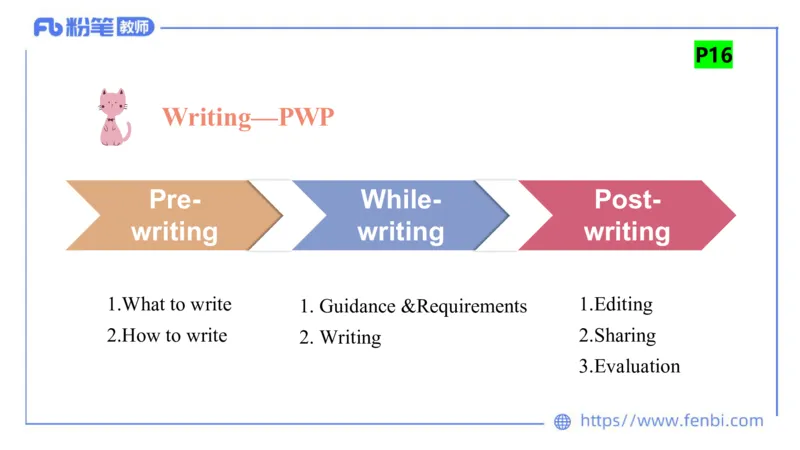
Writing—PWP
Pre- While- Post-
writing writing writing
1.What to write 1. Guidance &Requirements 1.Editing
2.How to write 2. Writing 2.Sharing
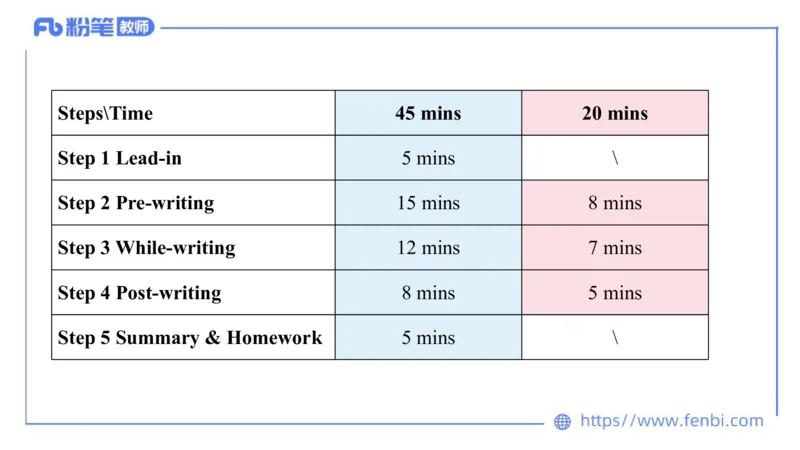
3.EvaluationSteps\Time 45 mins 20 mins
Step 1 Lead-in 5 mins \
Step 2 Pre-writing 15 mins 8 mins
Step 3 While-writing 12 mins 7 mins
Step 4 Post-writing 8 mins 5 mins
Step 5 Summary & Homework 5 mins \语言素材(有范文) 语言素材(无范文)
Writing:
Journey down the Mekong
①Think of someone famous that you admire a lot, for
Although it was autumn, the snow was already
example, an artist, a musician or a writer.
beginning to fall in Tibet. Our legs were so heavy ②Write two or three paragraphs about his or her life.
and cold that they felt like blocks of ice. Have you Below are some suggestions to help you.
③Write about:
ever seen snowmen ride bicycles? That’s what we
Where he/she was born and where he/she lived as a child.
looked like! Along the way children dressed in
His/Her family.
long wool coats stopped to look at us. In the late
How he/she became famous.
afternoon we found it was so cold that our water
His/Her songs/music/painting/novels/poems...
bottles froze.
To show he/she has seen in...
Your opinion of his/her work.
......
......P16
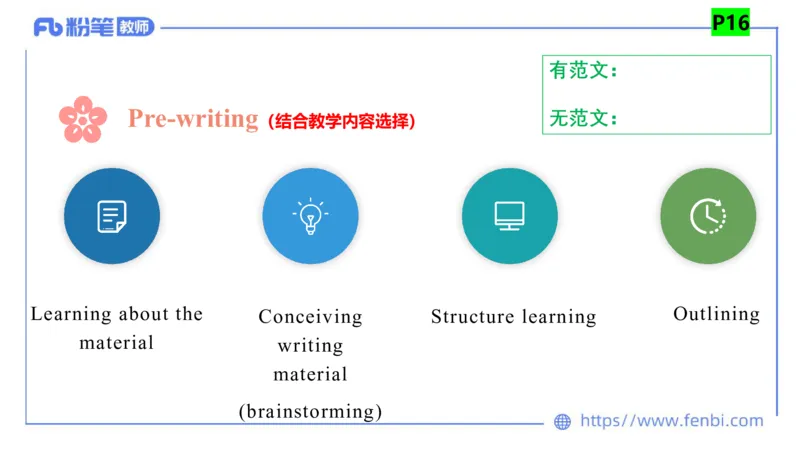
有范文:
Pre-writing 无范文:
(结合教学内容选择)
Learning about the Outlining
Conceiving Structure learning
material
writing
material
(brainstorming)• what to write
• how to write
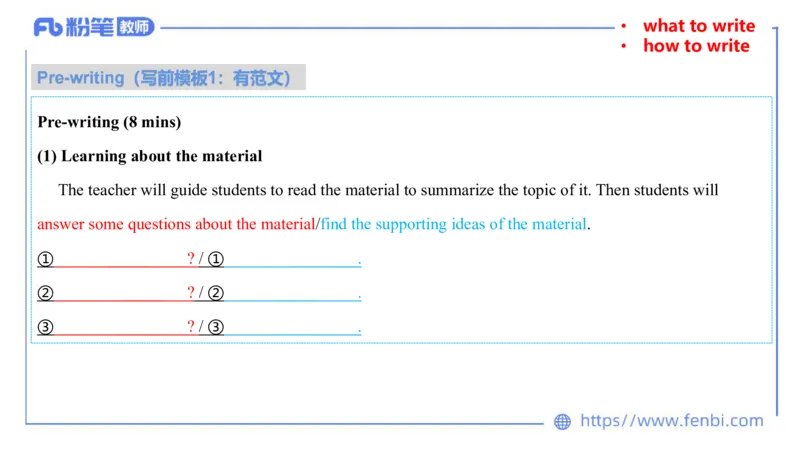
Pre-writing (8 mins)
(1) Learning about the material
The teacher will guide students to read the material to summarize the topic of it. Then students will
answer some questions about the material/find the supporting ideas of the material.
① _____ ? / ① _____ .
② _____ ? / ② _____ .
③ _____ ? / ③ _____ .• what to write
• how to write
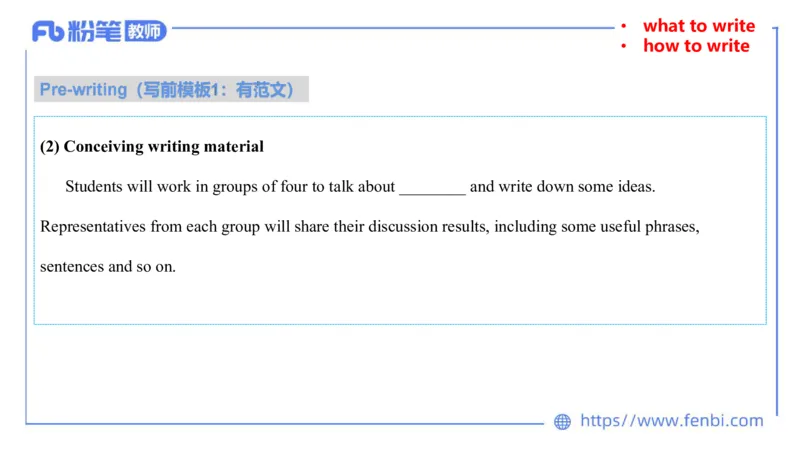
(2) Conceiving writing material
Students will work in groups of four to talk about ________ and write down some ideas.
Representatives from each group will share their discussion results, including some useful phrases,
sentences and so on.• what to write
• how to write
(3) Structure learning
The teacher will guide students to summarize the basic structure of _______, and remind them that they
should pay attention to the topic sentences, transitional words and logical relations.
(4) Outlining
Students will write an outline based on above activities
【Justification】Through the above activities, students will be prepared to write their own compositions.
They will know what to write and how to write it.语言素材:
Writing: A debate speech
When you are going to make a debate speech, it is better to write out your ideas in advance.
In this way, you can better organize your thoughts and come up with ideas as to what you
should say. While you are writing out your speech, you should keep these points in mind:
Ø Remember, your speech must be either for or against the proposition. You should not try to
give both sides of the argument.
Ø Think of at least three main points. Put these in logical order.
Ø Think of examples or stories to support each point. Personal stories are often the most
touching.• what to write
• how to write
Pre-writing(8mins)
1. Brainstorming
Let students do a brainstorming. The topic is _________. Students will be given several minutes to work
in groups to talk about it and write down some ideas. After that, representatives from each group will share
their results, including some useful phrases, sentences and so on. Each answer will get a positive feedback.
2. Structure learning
The teacher will guide students to analyse and summarize the basic structure of _______. Students should
also pay attention to the topic sentences, transitional words, logical relations and so on.
3. Outlining
Students will write an outline based on above activities.
【Justification】Through the above activities, students will be prepared to write their own compositions.
They will know what to write and how to write it.Pre-writing(8mins)
1. Brainstorming
Let students do a brainstorming. The topic is “Whether good deeds should be known”. Students will be
given several minutes to work in groups to talk about it and write down some ideas. After that,
representatives from each group will share their results, including some useful phrases, sentences and so on.
Each answer will get a positive feedback.
2. Structure learning
The teacher will stress the key points when students are going to make a debate speech and students should
also pay attention to the topic sentences, transitional words, logical relations and so on.
3. Outlining
Students will write an outline based on above activities.
【Justification】Through the above activities, students will be prepared to write their own compositions.
They will know what to write and how to write it.• Drafting
写中模板
Step 3 While-writing (7 mins)
Drafting
Students will write their own compositions, and the teacher will walk around to offer help and remind
students to pay attention to the spelling, grammar, punctuation and so on.
【Justification】Through the above activities, students will finish their writing and their writing ability will
be improved.• Editing
写后模板 • Displaying and evaluating
Step 4 Post-writing (5 mins)
(1) Editing
① Self-editing
The teacher will give students a short time to go through their compositions to correct the mistakes in
spelling and grammar.
② Peer-editing
Students will exchange their compositions with each other and correct the mistakes in spelling and
grammar. They can also make suggestions about polishing their writings.
(2) Displaying and evaluating
The teacher will invite some students to share their compositions with the whole class and guide other
students to evaluate these compositions, and then the teacher will make a conclusion.
【Justification】Through these activities, students will regulate their language and work out better ideas or
expressions, and they will improve their writing skills. Besides, they will be more willing to share their ideas
in public and learn from each other.【2016年下·高中】
根据提供的信息和语言素材设计教学方案,用英文作答。
设计任务:阅读下面的学生信息和语言素材,设计20分钟的读写教学方案。教案没有固定格式,但须
包含下列要点:
• Teaching objectives
• Teaching contents
• Key and difficult points
• Major steps and time allocation
• Activities and justifications
教学时间:20分钟
学生概况:某城镇普通高中一年级第一学期学生,班级人数40人。多数学生已经达到《义务教育英语
课程标准(实验)》五级水平。学生课堂参与积极性一般。语言素材:
In some countries in western Europe, such as France, Spain and Britain, the countryside is changing.
Life has become difficult for many villages, and some are disappearing. There are a number of reasons
for this. Firstly, young people from villages usually want to live somewhere livelier and they often move to
the towns and do not return. Secondly, people move to the cities to find work, as there are very few jobs in
the countryside. Some villages still remain because people from the cities have bought a “second home” in
the village, where they come and stay at weekends. The price of the homes goes up and people from the
area cannot afford to buy a house there. Another problem is that it is becoming more and more difficult for
farmers to make money from their farms. So they sell their land and find another job.
All these things mean that many villages in western Europe are fighting to survive. We can only hope
that they will remain. The countryside would be a sadder and uglier place without them.1. Teaching contents: This is a _______ lesson. It mainly talks about _________.
2. Teaching objectives
①Students can master the basic structure of an argumentation/this passage.
②Students can write a passage with the certain topic__________through imitation and practice.
③ Students can _________________________.
④ Students can cooperate with other group members actively and complete the tasks together.
⑤Students can foster the interest and desire of learning English and be fond of taking part in different kinds of class
activities.
⑥Students can judge various ideas correctly and have the ability to use English to think independently and creatively.1. Teaching contents: This is a reading and writing lesson. It mainly talks about the problem that some villages are
disappearing in western Europe.
2. Teaching objectives
①Students can master the basic structure of an argumentation/this passage.
②Students can write a passage with the certain topic “my hometown in the countryside” through imitation and practice.
③Students can learn to enjoy the lives in their own hometown.
④Students can foster the interest and desire of learning English and be fond of taking part in different kinds of class
activities.
⑤Students can judge various ideas correctly and have the ability to use English to think independently and creatively.3. Teaching key and difficult points
Key points:
Help students understand the content and structure of the passage.
Let students improve their writing abilities.
Difficult points:
How to talk about/describe the new topic correctly and fluently.
To improve their confidence of speaking English.Pre-writing (8 mins)
(1) Learning about the material
The teacher will guide students to read the material to summarize the topic of it. Then students will
answer some questions about the material/find the supporting ideas of the material.
① _____ ? / ① _____ .
② _____ ? / ② _____ .
③ _____ ? / ③ _____ .语言素材:
In some countries in western Europe, such as France, Spain and Britain, the countryside is changing.
Life has become difficult for many villages, and some are disappearing. There are a number of reasons
for this. Firstly, young people from villages usually want to live somewhere livelier and they often move to
the towns and do not return. Secondly, people move to the cities to find work, as there are very few jobs in
the countryside. Some villages still remain because people from the cities have bought a “second home” in
the village, where they come and stay at weekends. The price of the homes goes up and people from the
area cannot afford to buy a house there. Another problem is that it is becoming more and more difficult for
farmers to make money from their farms. So they sell their land and find another job.
All these things mean that many villages in western Europe are fighting to survive. We can only hope
that they will remain. The countryside would be a sadder and uglier place without them.Pre-writing (8 mins)
(1) Learning about the material
The teacher will guide students to read the material to summarize the topic of it. Then students will find
the reasons for disappearing villages.
① Young people often move to the towns.
② The price of the homes goes up and people from the area cannot afford to buy a house there.
③ Farmers have to sell their land and find another job.(2) Conceiving writing material
Students will work in groups of four to talk about ________ and write down some ideas.
Representatives from each group will share their discussion results, including some useful phrases,
sentences and so on.(2) Conceiving writing material
Students will work in groups of four to talk about my hometown in the countryside and write down
some ideas. Representatives from each group will share their discussion results, including some useful
phrases, sentences and so on.(3) Structure learning
The teacher will guide students to summarize the basic structure of _______, and remind them that they
should pay attention to the topic sentences, transitional words and logical relations.
(4) Outlining
Students will write an outline based on above activities
【Justification】Through the above activities, students will be prepared to write their own compositions.
They will know what to write and how to write it.语言素材:
In some countries in western Europe, such as France, Spain and Britain, the countryside is changing.
Life has become difficult for many villages, and some are disappearing. There are a number of reasons
for this. Firstly, young people from villages usually want to live somewhere livelier and they often move to
the towns and do not return. Secondly, people move to the cities to find work, as there are very few jobs in
the countryside. Some villages still remain because people from the cities have bought a “second home” in
the village, where they come and stay at weekends. The price of the homes goes up and people from the
area cannot afford to buy a house there. Another problem is that it is becoming more and more difficult for
farmers to make money from their farms. So they sell their land and find another job.
All these things mean that many villages in western Europe are fighting to survive. We can only hope
that they will remain. The countryside would be a sadder and uglier place without them.(3) Structure learning
The teacher will guide students to summarize the basic structure of argumentation, and remind them that
they should pay attention to the topic sentences, transitional words and logical relations.
(4) Outlining
Students will write an outline based on above activities
【Justification】Through the above activities, students will be prepared to write their own compositions.
They will know what to write and how to write it.While-writing (7 mins)
Drafting
Students will write their own compositions, and the teacher will walk around to offer help and remind
students to pay attention to the spelling, grammar, punctuation and so on.
(Justification: Through the activity, students will finish their writing and their writing ability will be
improved.)Post-writing (5 mins)
(1) Editing
① Self-editing
The teacher will give students a short time to go through their compositions to correct the mistakes in spelling
and grammar.
② Peer-editing
Students will exchange their compositions with each other and correct the mistakes in spelling and grammar.
They can also make suggestions about polishing their writings.
(2) Displaying and evaluating
The teacher will invite some students to share their compositions with the whole class and guide other students
to evaluate these compositions, and then the teacher will make a conclusion.
(Justification: Through these activities, students will regulate their language and work out better ideas or
expressions, and they will improve their writing skills. Besides, they will be more willing to share their ideas in
public and learn from each other.)口语课——核心教学环节Steps\Time 45 mins 20 mins
Step 1 Lead-in 5 mins \
Step 2 Pre-speaking 15 mins 8 mins
Step 3 While-speaking 12 mins 7 mins
Step 4 Post-speaking 8 mins 5 mins
Step 5 Summary & Homework 5 mins \Speaking—PWP
Pre- While- Post-
speaking speaking speaking
What to speak Displaying
Speaking Tasks
EvaluatingP20
Pre-speaking
(活动按顺序进行)
Reading/Listening: basic and Learning expressions
detailed information说前模板
Pre-speaking (8 mins)
(1) Listening to the conversation/Reading the passage
Students will listen to the conversation/read the passage to get the main idea, and then fill in the
chart/answer some questions.
_____________?
_____________? 或者
_____________?
(2) Learning expressions
The teacher will explain the meaning and usage of the new words and sentences about the situation,
including _________and invite students to do some exercises about the new knowledge.
【Justification】With those activities, students will be familiar with the situation, and accumulate many
expressions which can be used in this situation, making good preparations for the speaking activities.语言素材:
Jack: Hey, John’s birthday dinner is next week. Let’s think about the food.
Tom: Sure. How about burgers, vegetable salad, and some fruit?
Bill: Sounds good. John likes hamburgers.
Jack: Oh, I don’t like salad.
Bill: But John likes salad, and it’s his birthday.
Jack: Yes, you’re right. What about the fruit?
Tom: I think John likes strawberries and apples.
Bill: OK. Let’s have strawberries and apples then.Step 1 Pre-speaking (8 mins)
(1) Listening to the conversation
Students will listen to the conversation to get the main idea, and then answer some questions/ fill in the chart.
Does John like vegetable salad?
John Bill Jack
What doesn’t Jack like? hamburger √
What fruit does John like? salad
strawberry
(2) Learning expressions
The teacher will explain the meaning and usage of the new words such as “hamburgers” “vegetables”
“strawberries” and sentences including “John likes hamburgers.” “I don’t like salad.” and invite students to do
some exercises about the new knowledge.
(Justification: With those activities, students will be familiar with the situation, and accumulate many expressions
which can be used in this situation, making good preparations for the speaking activities.)P21
While-speaking
(活动按顺序进行)
Group acivities
Reading after the audio (discussion/ making a new dialogue/ survey)说中模板
While-speaking (7 mins)
(1) Reading after the tape
The teacher will play the tape and lead students to read after it. Students should pay attention to the
pronunciation and intonation. Then they can act out the dialogue.
(2) Group work
Ask students to work in groups of four and have a discussion/make up a conversation about . They
should try to use the words and sentence structures they have learned today.
【Justification】Students will have a deeper understanding of the topic and usage of the new knowledge,
and they can also have more opportunities to express themselves.语言素材:
Jack: Hey, John’s birthday dinner is next week. Let’s think about the food.
Tom: Sure. How about burgers, vegetable salad, and some fruit?
Bill: Sounds good. John likes hamburgers.
Jack: Oh, I don’t like salad.
Bill: But John likes salad, and it’s his birthday.
Jack: Yes, you’re right. What about the fruit?
Tom: I think John likes strawberries and apples.
Bill: OK. Let’s have strawberries and apples then.Step 2 While-speaking (7 mins)
(1) Reading after the tape
The teacher will play the tape and lead students to read after it. Students should pay attention to the
pronunciation and intonation.Then they can act out the dialogue.
(2) Group discussion
Ask students to work in groups of four and have a discussion about the food they like. They should try to
use the words and sentence structures they have learned today.
(Justification: Students will have a deeper understanding of the topic and usage of the new knowledge, and
they can also have more opportunities to express themselves.)P21
Post-speaking
(活动按顺序进行)
Displaying Evaluating说后模板
Post-speaking (5 mins)
Displaying and evaluating:
The teacher will invite some students to share their dialogue with the whole class and guide other students
to evaluate the performance, and then the teacher will make a conclusion.
【Justification】Through these activities, students will regulate their language and work out better ideas or
expressions, and they will improve their speaking skills. Besides, they will be more willing to share their
ideas in public and learn from each other.语言素材:
Ms Li: Hello, my name is Li Fang. I’m your teacher and you are my students. I’m Chinese. I’m
from Wuhan. What’s your name?
Lingling: My name is Wang Lingling.
Ms Li: Nice to meet you, Lingling. Where are you from?
Lingling: I’m from Beijing. I’m Chinese.
Ms Li: How old are you?
Lingling: I’m thirteen years old.
Ms Li: Good. Hello, what about you?
Daming: Hello, Ms Li, my name is Li Daming and I’m from Beijing, too. I’m twelve years old.
Ms Li: Thanks. Hello, are you from America?
Tony: No, I’m not. I’m from England. I’m Tony Smith.
Ms Li: Nice to meet you, Tony. Hi, are you English, too?
Betty: No, I’m not. I’m American and my name is Betty King.
Lingling: Tony and Betty are our friends.
Ms Li: Good! Welcome to Class 4, Grade 7!Pre-speaking (8 mins)
(1) Listening to the conversation/Reading the passage
Students will listen to the conversation/read the passage to get the main idea, and then fill in the
chart/answer some questions.
_____________?
_____________? 或者
_____________?
(2) Learning expressions
The teacher will explain the meaning and usage of the new words and sentences about the situation,
including _________and invite students to do some exercises about the new knowledge.
【Justification】With those activities, students will be familiar with the situation, and accumulate many
expressions which can be used in this situation, making good preparations for the speaking activities.语言素材:
Ms Li: Hello, my name is Li Fang. I’m your teacher and you are my students. I’m Chinese. I’m
from Wuhan. What’s your name?
Lingling: My name is Wang Lingling.
Ms Li: Nice to meet you, Lingling. Where are you from?
Lingling: I’m from Beijing. I’m Chinese.
Ms Li: How old are you?
Lingling: I’m thirteen years old.
Ms Li: Good. Hello, what about you?
Daming: Hello, Ms Li, my name is Li Daming and I’m from Beijing, too. I’m twelve years old.
Ms Li: Thanks. Hello, are you from America?
Tony: No, I’m not. I’m from England. I’m Tony Smith.
Ms Li: Nice to meet you, Tony. Hi, are you English, too?
Betty: No, I’m not. I’m American and my name is Betty King.
Lingling: Tony and Betty are our friends.
Ms Li: Good! Welcome to Class 4, Grade 7!4. Major steps
Step1 Pre-speaking (8 mins)
(1) Listening to the conversation
Students will listen to the conversation to get the main idea, and then answer some
questions/ fill in the chart.
Name Hometown age
Where is Lingling from?
Ms Li
Who is from America? OR
Lingling
How old is Daming?
Betty
(2) Learning expressions
...
The teacher will explain the meaning and usage of the new sentences about the situation,
including “--What is your name? --My name is...” “--Where are you from? --I’m from...” “--
How old are you? --I’m...” and invite students to do some exercises about the new knowledge.
(Justification: With those activities, students will be familiar with the situation, and
accumulate many expressions which can be used in this situation, making good preparations
for the speaking activities.)Step 2 While-speaking (7 mins)
(1) Reading after the tape
The teacher will play the tape and lead students to read after it. Students should pay attention to the
pronunciation and intonation. Then they can act out the dialogue.
(2) Group discussion/ make a conversation/ Do a survey
Ask students to work in groups of four and have a discussion/make a conversation/ do a survey
about . They should try to use the words and sentence structures they have learned today.
(Justification: Students will have a deeper understanding of the topic and usage of the new knowledge, and
they can also have more opportunities to express themselves.)Step 2 While-speaking (7 mins)
(1) Reading after the tape
The teacher will play the tape and lead students to read after it. Students should pay attention to the
pronunciation and intonation. Then they can act out the dialogue.
(2) Do a survey
Ask students to work in groups of four and do a survey about their group mates’ hometown and age.
They should try to use the words and sentence structures they have learned today.
(Justification: Students will have a deeper understanding of the topic and usage of the new knowledge,
and they can also have more opportunities to express themselves.)Step 3 Post-speaking (5 mins)
Sharing and evaluating
The teacher will invite some students to share their results with the whole class and guide other students to
evaluate the performance, and then the teacher will make a conclusion.
(Justification: Through these activities, students will regulate their language and work out better ideas or
expressions, and they will improve their speaking skills. Besides, they will be more willing to share their
ideas in public and learn from each other.)