





文档内容
2011 年 12 月英语四级考试真题
Part I Writing (30 minutes)
Directions: For this part, you are allowed 30 minutes to write a short essay entitled Nothing
Succeeds Without a Strong Will by commenting on the humorous saying, "Quitting
smoking is the easiest thing in the world. I've done it hundreds of times." You should
write at least 120 words but no more than 180 words.
Nothing Succeeds Without a Strong Will
Part II Reading Comprehension (Skimming and Scanning) (15
minutes)
Directions: In this part, you will have 15 minutes to go over the passage quickly
and answer the questions on Answer Sheet 1. For questions 1-7 choose the
best answer from the four choices marked A), B), C) and D). For questions
8-10, complete the sentence with the information given in the passage.
Why Integrity Matters
What Is Integrity?
The key to integrity is consistency- not only setting high personal standards for
oneself (honesty, responsibility, respect for others, fairness) but also living up to those
standards each and every day. One who has integrity is bound by and follows moral
and ethical (道德上的) standards even when making life's hard choices, choices
which may be clouded by stress, pressure to succeed, or temptation.
What happens if we lie, cheat, steal, or violate other ethical standards? We feel
disappointed in ourselves and ashamed. But a lapse (缺失) of integrity also affects our
relationships with others. Trust is essential in any important relationship, whetherpersonal or professional. Who can trust someone who is dishonest or unfair? Thus
integrity must be one of our most important goals.
Risky Business
We are each responsible for our own decisions, even if the decision, making
process has been undermined by stress or peer pressure. The real test of character is
whether we can learn from our mistake, by understanding why we acted as we did and
then exploring ways to avoid similar problems in the future.
Making ethical decisions is a critical part of avoiding future problems. We must
learn to recognize risks, because if we can't see the risks we're taking, we can't make
responsible choices. To identify risks, we need to know the rules and be aware of the
facts. For example, one who doesn't know the rules a about plagiarism (剽窃) may
accidentally use words or ideas without giving proper credit or one who fails to keep
careful research notes may unintentionally fail to quote and cite sources as required.
But the fact that such a violation is "unintentional" does not excuse the misconduct,
Ignorance is not a defense.
"But Everybody Does It"
Most people who get in trouble do know the rules and facts but manage to fool
themselves about the risks they're taking by using excuses: "Everyone else does it."
"I'm not hurting anyone", or "I really need this grade." Excuses can get very elaborate:
"I know I'm look at another's exam, even though I'm supposed to keep my eyes on my
own paper, but that's not cheating because I’m just checking my answers, not
copying." We must be honest about our actions and avoid excuses, if we fool
ourselves into believing we're not doing anything wrong, we can't see the real choice
we're making - and that leads to bad decisions.
To avoid fooling yourself, watch out for excuses and try this test: Ask how you
would feel if your actions were public and anyone could be watching over your
shoulder. If you'd rather hide your actions, that's an indication that you're taking a risk
and rationalizing it to yourself.
Evaluating Risks
To decide whether a risk is worth taking, you must examine the consequences, in
the future as well as right now, negative as well as positive, and to others as well as to
yourself. Those who take risks they later regret usually focus on immolate benefits
and simply haven't considered what might go wrong. The consequences of getting
caught are serious and may include a "O" on a test or assignment, an "F" in the class,
suspension (暂令停学) or dismissal from school and a ruined reputation. In fact,
when you break a role or law, you lose control over your life and give others the
power to impose punishment that you have no control over. This is an extremely
vulnerable (脆弱的) position. There may be some matters of life and death or highest
principle, which might justify such a risk, but there aren't many things that fall in this
category.
Getting Away with it - Or NotThose who don't get caught pay an even higher price. A cheater doesn't learn
from the test, which deprives (剥夺) him her of an education. Cheating undermines
confidence and independence: the cheater is a fraud, and knows that without
dishonesty, he/she would have failed. Cheating destroys self-respect and integrity,
leaving the cheater ashamed, guilty and afraid of getting caught.
Worst of all, a cheater who doesn't get caught the first time usually cheats again,
not only because he/she is farther behind, but also because it seems "easier." This
slippery slope of eroding ethics and bigger risks leads only to disaster. Eventually, the
cheater gets caught, and the later he/she gets caught, the worse the consequences.
Cheating Hurts Other, Too
Cheaters often feel invisible, as if their actions "don't count" and don't really hurt
anyone. But individual choices have an intense cumulative (累积的) effect. Cheating
can spread like a disease. Recent statistics suggest 30%or more of college students
cheat. If a class is graded on a curve, cheating hurts others' grades. Even if there is no
curve, cheating "poisons" the classroom, and others may feel pressured to join in. ("If
I don't cheat I can't compete with those who do") Cheating also has a destructive
impact on teachers. The real reward of goof teaching is seeing students learn. But a
cheater says. "I'm not interested in what you're trying to teach, all I care about is
stealing a grade, regardless of the effect on others." The end result is a destructive
attack on the quality of your education. Finally, cheating can hurt the reputation of the
university and harm those who worked hard for their degree.
Why Integrity Marten
If cheating becomes the norm, then we are in big trouble. We must rely on the
honesty and good faith of others, if not, we couldn't put money in the bank, buy food,
clothing, or medicine from others, drive across a bridge, get on a plane, go to the
dentist--the list is endless. There are many examples of the vast harm that is caused
when individuals forget or ignore the effect their dishonesty can have. The savings
and loan scandal, the stock market and junk bond swindles, and, of course, Watergate,
have undermined the faith of many Americans in the integrity of political and
economic leaders and society as a whole. Such incidents take a tremendous toll on our
nation's economy and our individual well-being. For example, but for the savings and
loan debacle, there might be funds available to reduce the national debt and pay for
education.
In sum, we all have a common stake in our school, our community, and our
society. Our actions do matter. It is essential that we act with integrity in order to
build the kind of world in which we want to live.
注意:此部分试题请在答题卡1上作答。
1. A person of integrity not only sets high moral and ethical standards but also
_______.
A) sticks to them in their daily life B) makes them known to others
C) understands their true values D) sees that others also follow
them2. What role does integrity play in personal and professional relationships?
A) It helps to create team spirit B) It facilitates communication
C) It is the basis of mutual trust D) It inspires mutual respect
3. why must we learn to identify the risks we are going to take?
A. To ensure we make responsible choices. B. To avoid being
overwhelmed by stress.
C. So that we don’t break any rules. D. So that we don’t
run into trouble.
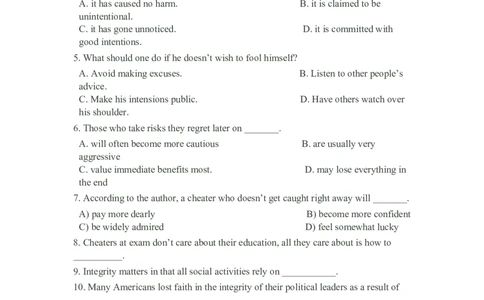
4. Violation of a rule is misconduct even if _______?
A. it has caused no harm. B. it is claimed to be
unintentional.
C. it has gone unnoticed. D. it is committed with
good intentions.
5. What should one do if he doesn’t wish to fool himself?
A. Avoid making excuses. B. Listen to other people’s
advice.
C. Make his intensions public. D. Have others watch over
his shoulder.
6. Those who take risks they regret later on _______.
A. will often become more cautious B. are usually very
aggressive
C. value immediate benefits most. D. may lose everything in
the end
7. According to the author, a cheater who doesn’t get caught right away will _______.
A) pay more dearly B) become more confident
C) be widely admired D) feel somewhat lucky
8. Cheaters at exam don’t care about their education, all they care about is how to
__________.
9. Integrity matters in that all social activities rely on ___________.
10. Many Americans lost faith in the integrity of their political leaders as a result of
__________.
Part III Listening Comprehension (35
minutes)
Section A
Directions: In this section, you will hear 8 short conversations and 2 long
conversations. At the end of each conversation, one or more questions will
be asked about what was said. Both the conversation and the questions willbe spoken only once. After each question there will be a pause. During the
pause, you must read the four choices marked A), B), C) and D), and decide
which is the best answer. Then mark the corresponding letter on Answer
Sheet 2 with a single line through the centre.
注意:此部分试题请在答题卡2上作答。
11. A) Read the notice on the window.
B) Go and ask the staff.
C) Get a new bus schedule.
D) Board the bus to Cleveland.
12. A) He was looking forward to seeing the giraffes.
B) He enjoyed watching the animal performance.
C) He got home too late to see the TV special.
D) He fell asleep in the middle of the TV program.
13. A) She wants to take the most direct way.
B) She may be late for the football game.
C) She is worried about missing her flight.
D) She is currently caught in a traffic jam.
14. A) At a restaurant. B) In a fish shop. C) At a clinic. D) On a
fishing boat.
15. A) He is an experienced sales manager.
B) He is being interviewed for a job.
C) He is a close friend of the woman.
D) He is good at answering tricky questions.
16. A) The man should consider his privacy first.
B) The man will choose a low-rent apartment.
C) The man is not certain if he can find a quieter place.
D) The man is unlikely to move out of the dormitory.
17. A) The woman is going to make her topic more focused.
B) The man and the woman are working on a joint project.
C) One should choose a broad topic for a research paper.
D) It took a lot of time to get the man on the right track.
18. A) They went camping this time last year.
B) They didn’t quite enjoy their last picnic.
C) They learned to cooperate under harsh conditions.
D) They weren’t experienced in organizing picnics.Questions 19 to 22 are based on the conversation you have just heard.
19. A) He likes Sweden better than England.
B) He prefers hot weather to cold weather.
C) He is an Englishman living in Sweden.
D) He visits London nearly every winter.
20. A) The bad weather. B) The gloomy winter. C) The cold houses. D) The
long night.
21. A) Delightful. B) Painful. C) Depressing. D)
Refreshing.
22. A) They often stay up late reading.
B) They work hard and play hard.
C) They like to go camping in summer.
D) They try to earn more and spend more.
Questions 23 to 25 are based on the conversation you have just heard.
23. A) English Literature. B) Management. C) French. D) Public
Administration.
24. A) English teaching. B) Staff training.
C) Careers guidance. D) Psychological counseling.
25. A) Its generous scholarship. B) Its worldwide fame.
C) Its well-designed courses. D) Its pleasant environment.
Section B
Directions: In this section, you will hear 3 short passages. At the end of each
passage, you will hear some questions. Both the passage and the questions
will be spoken only once. After you hear a question, you must choose the
best answer from the four choices marked A), B), C) and D). Then mark the
corresponding letter on Answer Sheet 2 with a single line through the
centre.
注意:此部分试题请在答题卡2上作答。
Passage One
Questions 26 to 28 are based on the passage you have just heard.
26. A) Characteristics of Japanese artists.
B) Some features of Japanese culture.
C) The art of Japanese brush painting.
D) The uniqueness of Japanese art.
27. A) To calm themselves down.B) To enhance concentration.
C) To show their impatience.
D) To signal lack of interest.
28. A) How listeners in different cultures show respect.
B) How speakers can win approval from the audience.
C) How speakers can misunderstand the audience.
D) How different Western and Eastern art forms are.
Passage Two
Questions 29 to 32 are based on the passage you have just heard.
29. A) Directing personnel evaluation.
B) Buying and maintaining equipment.
C) Drawing up plans for in-service training.
D) Interviewing and recruiting employees.
30. A) Some of his equipment was damaged in a fire.
B) The training program he ran was a failure.
C) Two of his workers were injured at work.
D) Two of his employees committed theft.
31. A) A better relationship with his boss.
B) Advancement to a higher position.
C) A better-paying job in another company.
D) Improvement in the company’s management.
32. A) She has more self-confidence than Chris.
B) She works with Chris in the same division.
C) She has more management experience than Chris.
D) She is competing with Chris for the new job.
Passage Three
Questions 33 to 35 are based on the passage you have just heard.
33. A) They help us see the important values of culture.
B) They guide us in handling human relationship.
C) They help us express ourselves more effectively.
D) They are an infinite source of human knowledge.
34. A) Their wording may become different.
B) The values they reflect may change.C) Their origins can no longer be traced.
D) They may be misinterpreted occasionally.
35. A) Certain values are shared by a large number of cultures.
B) Some proverbs are assuming more and more importance.
C) Old proverbs are constantly replaced by new ones.
D) Certain values have always been central to a culture.
Section C
Directions: In this section, you will hear a passage three times. When the passage
is read for the first time, you should listen carefully for its general idea.
When the passage is read for the second time, you are required to fill in the
blanks numbered from 36 to 43 with the exact words you have just heard.
For blanks numbered from 44 to 46 you are required to fill in the missing
information. For these blanks, you can either use the exact words you have
just heard or write down the main points in your own words. Finally, when
the passage is read for the third time, you should check what you have
written.
注意:此部分试题请在答题卡2上作答。
Our lives are woven together. As much as I enjoy my own (36) _c____, I no
longer imagine I can get through a (37) ___s__ day much less all my life, (38) __c___
on my own. Even if I am on (39) ___v__ in the mountains, I am eating food someone
else has grown, living in a house someone else has built, wearing clothes someone
else has (40) _s____ from cloth woven by others, using (41) __e___ someone else is
distributing to my house. (42) __e___ of interdependence is everywhere; we are on
this (43) _j____ together.
As I was growing up, (44)
_irbcttininterwe__________________________________________________. “Make
your own way”,” Stand on your own two feet” or my mother’s favorite remark when I
was face-to-face with consequences of some action: Now that you’ve made your bed,
lie on it. Total independence is a dominant thing in our culture. I imagine that (45)
__ w m p w t t t me w to t r f my a and m
c __ ________________________________________. But the teaching was shaped by
our cultural imagines. And instead, I grew up believing that I was supposed to be
totally independent and consequently became very reluctant to ask for help.
(46) __ _
________________________________________________________________.
Part Ⅳ Reading Comprehension (Reading
in Depth) (25 minutes)Section A
Directions: In this section, there is a passage with ten blanks. You are required to
select one word for each blank from a list of choices given in a word bank
following the passage. Read the passage through carefully before making
your choices. Each choice in the bank is identified by letter. Please mark
the corresponding letter for each item on Answer Sheet 2 with a single line
through the centre. You may not use any of the words in the bank more than
once.
Questions 47 to 56 are based on the following passage.
With the world's population estimated to grow from six to nine billion by 2050,
researchers. businesses and governments are already dealing with the impact this
increase will have on everything from food and water to infrastructure (基础设施)
and jobs. Underling all this 47 will be the demand for energy, which is expected to
double over the next 40 years.
Finding the resources to meet this demand in a __48__ sustainable way is the
cornerstone (基石) of our nation's energy security, and will be one of the major
__49__ of the 21st century. Alternative forms of energy- bio-fuels, wind and solar, to
name a few are __50__ being funded and developed, and will play a growing __51__
in the world's energy supply. But experts say that even when __52__, alternative
energy sources will likely meet only about 30% of the world's energy needs by 2050.
For example, even with __53__ investments, such as the $93 million for wind
energy development __54__ in the American Recovery and Reinvestment Act,
important alternative energy sources such as wind and bio-fuels __55__ only about
1% of the market today.
Energy and sustainability experts say the answer to our future energy needs will
likely come from a lot of __56__ both traditional and alternative.
注意:此部分试题请在答题卡2上作答。
A) stable I) exactly
B) solutions J)consist
C) significant K) comprise
D) role L) competitions
E) progress M) combined
F) marvelous N) challenges
G) included O) certainly
H) growth
Section B
Directions: There are 2 passages in this section. Each passage is followed by some
questions or unfinished statements. For each of them there are four chokes
marked A), B), C) and D). You should decide on the best choice and markthe corresponding letter on Answer Sheet 2 with a single line through the
centre.
Passage One
Questions 57 to 61 are based on the following passage.
Boys' schools are the perfect place to teach young men to express their emotions
and involve them in activities such as art, dance and music.
Far from the traditional image of a culture of aggressive masculinity (阳刚), the
absence of girls gives boys the chance to develop without pressure to conform to a
stereotype. a US study says.
Boys at single-sex schools were said to be more likely to get involved in cultural
and artistic activities that helped develop their emotional expressiveness, rather than
feeling they had to conform to the "boy code" of hiding their emotions to be a "real
man".
The findings of the study so against received wisdom that boys do better when
taught alongside girls.
Tony Little, headmaster of Eton, warned that boys were being faded by the
British education system because it had become too focused on girls. He criticized
teachers for failing to recognize that boys are actually more emotional than girls.
The research argued that boys often perform badly in mixed schools because they
become discouraged when their female peers do better earlier in speaking and reading
skills.
But in single-sex schools teachers can tailor lessons to boys' learning style, letting
them move around the classroom and getting them to compete in teams to prevent
boredom, wrote the study's author, Abigail James, of the University of Virginia.
Teachers could encourage boys to enjoy reading and writing with "boy-focused"
approaches such as themes and characters that appeal to them. Because boys generally
have more acute vision learn best through touch, and are physically more active, they
need to be given "hands-on" lessons where they are allowed to walk around. "Boys in
mixed schools view classical music as feminine (女性的) and prefer the modem genre
(类型) in which violence and sexism are major themes, "James wrote.
Single-sex education also made it less likely that boys would feel they had to
conform to a stereotype that men should be "masterful and in charge" in relationships.
"In mixed schools boys feel compelled to act like men before they understand
themselves well enough to know what that means, " the study reported.
注意:此部分试题请在答题卡2上作答。
57. The author believes that a single-sex school would __________.
A) force boys to hide their emotions to be "real men"
B) help to cultivate masculine aggressiveness in boys
C) encourage boys to express their emotions more freely
D) naturally reinforce in boys the traditional image of a man58. It is commonly believed that in a mixed school boys __________.
A) Perform relatively better C) behave more responsibly
B) grow up more healthily D) receive a better education
59. What does Tony Little say about the British education system?
A) It fails more boys than girls academically.
B) It focuses more on mixed school education.
C) It fails to give boys the attention they need.
D) It places more pressure on boys than on girls.
60. According to Abigail James, one of the advantages of single-sex schools is
__________.
A) teaching can be tailored to suit the characteristics of boys
B) boys can focus on their lessons without being distracted
C) boys can choose to learn whatever they are interested in
D) teaching can be designed to promote boys' team spirit
61. Which of the following is characteristic of boys according to Abigail James'
report?
A) They enjoy being in charge. C) They have sharper vision.
B) They conform to stereotypes. D) They are violent and sexist.
Passage Two
Questions 62 to 66 are based on the following passage.
It's an annual argument. Do we or do we not go on holiday? My partner says no
because the boiler could go, or the roof fall off and we have no savings to save us. I
say you only live once and we work hard and what's the point if you can't go on
holiday. The joy of a recession means no argument next year - we just won't go.
Since money is known to be one of the things most likely to bring a relationship
to its knees, we should be grateful. For many families the recession means more than
not booking a holiday A YouGov poll of 2, 000 people found 22% said they were
arguing more with their partners because of concerns about money. What's less clear
is whether divorce and separation rates rise in a recession – financial pressures mean
couples argue more but make splitting up less affordable. A recent research shows
arguments about money were especially damaging to couples. Disputes were
characterized by intense verbal (言语上的) aggression, tended to be repeated and not
resolved and made men, more than women, extremely angry.
Kim Stephenson, an occupational psychologist, believes money is such a big deal
because of what it symbolizes, which may be different things to men and women.
"People can say the same things about money but have different ideas of what it's
for." he explains. "They'll say it's to save to spend, for security, for freedom, to showsomeone you love them." He says men are more likely to see money as a way of
buying status and of showing their parents that they've achieved something.
"The biggest problem is that couples assume each other know what's going on
with their finances, but they don't. There seems to be more of a taboo (禁忌) about
talking about money than about death. But you both need to know what you're doing,
who's paying what into the joint account and how much you keep separately. In a
healthy relationship, you don't have to agree about money, but you have to talk about
it."
注意:此部分试题请在答题卡2上作答:
62. What does the author say about vacationing?
A) People enjoy it all the more during a recession.
B) Few people can afford it without working hard.
C) It makes all the hard work worthwhile.
D) It is the chief cause of family disputes.
63. What does the author mean by saying "money is known ... to bring a relationship
to its knees"(Line 1, Para. 2)?
A) Money is considered to be the root of all evils.
B) Some people sacrifice their dignity for money.
C) Few people can resist the temptation of money.
D) Disputes over money may rain a relationship.
64. The YouGov poll of 2, 000 people indicates that in a recession __________.
A) conflicts between couples tend to rise
B) it is more expensive for couples to split up
C) couples show more concern for each other
D) divorce and separation rates increase
65. What does Kim Stephenson believe?
A) Money is often a symbol of a person's status.
B) Money means a great deal to both and women.
C) Men and women spend money on different things.
D) Men and women view money in different ways.
66. The author suggests at the end of the passage that couples should __________.
A) put their money together instead of keeping it separately
B) make efforts to reach agreement on their family budgets
C) discuss money matters to maintain a healthy relationship
D) avoid arguing about money matters to remain romanticPart Ⅴ
Cloze (1
5 minutes)
Directions: There are 20 blanks in the following passage. For each bland there are
four choices marked A), B), C) and D) on the right side of the paper You
should choose the ONE that best fits into the passage. Then mark the
corresponding letter on Answer Sheet 2 with a single line through the
centre.
注意:此部分试题请在答题卡2上作答。
Employers fear they will be unable to recruit students with the skills they need as
the economic recovery kicks in, a new survey __67__.
Nearly half of the organizations told researchers they were already struggling to
find __68__ with skills in science, technology, engineering and maths (STEM).
__69__ even more companies expect to experience __70__ of employees with STEM
skills in the next three years.
The Confederation of British Industry __71__ businesses and organizations
across the public and __72__ sectors, which together employ 2.4 million people.
Half are __73__ they will not be able to fill graduate posts in the coming years,
while a third said they would not be able to __74__ enough employees with the right
A-level skills.
"__75__ we move further role recovery and businesses plan __76__ growth, the
demand for people with high-quality skills and qualifications will __77__," said
Richard Lambert, Director General, CBI. "Firms say it is already hard to find people
with the right __78__ or engineering skills. The new government must make it a top
__79__ to encourage more young people to study science-related __80__."
The survey found that young people would improve their job prospects __81__
they studied business, maths, English and physics or chemistry at A-level. The A-
levels that employers __82__ least are psychology and sociology. And while many
employers don't insist on a __83__ degree subject. A third prefer to hire those with a
STEM-related subject.
The research __84__ worries about the lack of progress in improving basic skills
in the UK __85__. Half of the employer expressed worries about employees' basic
literacy and numeracy(计算) skills, while the biggest problem is with IT
skills,86two-thirds reported concerns.
67. A) submits B) reveals C) launches D) generates
68. A) audience B) officials C) partners D) staff
69. A) while B) because C) for D) although
70. A) exits B) shortages C) absences D) departures
71. A) surveyed B) searched C) exposed D) exploited
72. A) collective B) private C) personal D) civil73. A) confronted B) conformed C) concerned D) confused
74. A) bind B) attain C) transfer D) recruit
75. A) Lest B) Unless C) Before D) As
76. A) with B) for C) on D) by
77. A) dominate B) stretch C) enforce D) intensify
78. A) creative B) technical C) narrative D) physical
79. A) priority B) option C) challenge D) judgment
80. A) procedures B) academics C) thoughts D) subjects
81. A) until B) since C) whereas D) if
82. A) rate B) discuss C) order D) observe
83. A) typical B particular C) positive D) general
84. A) highlighted B) prescribed C) focused D) touched
85. A) masses B) workforce C) faculty D) communities
86. A) what B) whom C) where D) why
Part
Ⅳ
Translation (5
minutes)
Directions: Complete the sentences by translating into English the Chinese given in
brackets Please write your translation on Answer Sheer 2.
注意:此部分试题请在答题卡2上作答,只需写出译文部分。
87. Charity groups organized various activities to _____________
___ (为地震幸存者筹款)。
88. Linda ___________ _ (不可能收到我的电子
邮件):otherwise, she would have replied.
89. It's my mother ___________ _____ (一直在鼓励我不要灰
心)when I have difficulties in my studies.
90. The publishing house has to ______________
(考虑这部小说的受欢迎程度)。
91. It is absolutely wrong to _________
______ (仅仅以金钱来定义幸福)。