Numerical Comprehension Test 1
Solutions Booklet
Instructions
This numerical comprehension test comprises 18 questions, and you will have 18 minutes in
which to correctly answer as many as you can. Calculators are permitted for this test, and it is
recommended you have some rough paper to work on.
You will have to work quickly and accurately to perform well in this test. If you don't know the
answer to a question, leave it and come back to it if you have time. Each question will have
five possible answers, one of which is correct. If the exact correct answer is not provided,
select the closest possible answer. You may click Back and Next during the test to review or
skip questions.
You can submit your test at any time. If the time limit is up before you click submit the test will
automatically be submitted with the answers you have selected. It is recommended to keep
working until the time limit is up.
Try to find a time and place where you will not be interrupted during the test. The test will
begin on the next page.
AssessmentDay
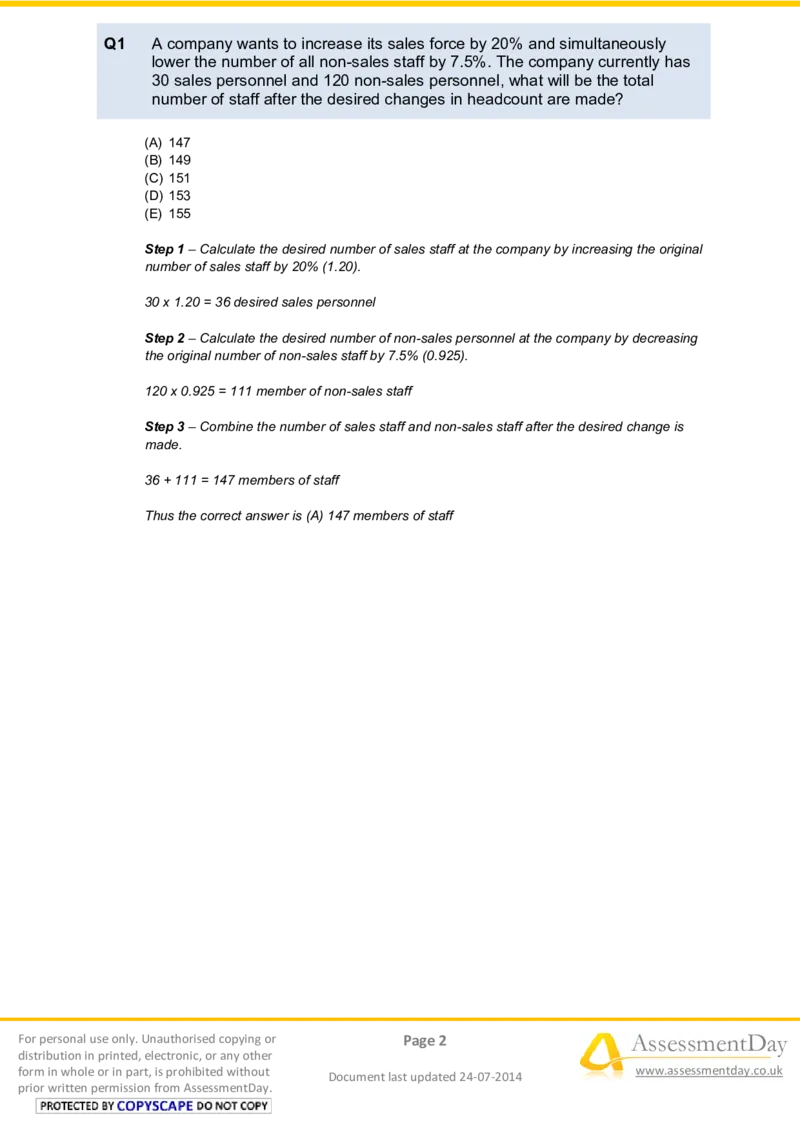
Practice Aptitude TestsQ1 A company wants to increase its sales force by 20% and simultaneously
lower the number of all non-sales staff by 7.5%. The company currently has
30 sales personnel and 120 non-sales personnel, what will be the total
number of staff after the desired changes in headcount are made?
(A) 147
(B) 149
(C) 151
(D) 153
(E) 155
Step 1 – Calculate the desired number of sales staff at the company by increasing the original
number of sales staff by 20% (1.20).
30 x 1.20 = 36 desired sales personnel
Step 2 – Calculate the desired number of non-sales personnel at the company by decreasing
the original number of non-sales staff by 7.5% (0.925).
120 x 0.925 = 111 member of non-sales staff
Step 3 – Combine the number of sales staff and non-sales staff after the desired change is
made.
36 + 111 = 147 members of staff
Thus the correct answer is (A) 147members of staff
For personal use only. Unauthorised copying or Page 2 AssessmentDay
distribution in printed, electronic, or any other
form in whole or in part, is prohibited without
Document last updated 24-07-2014
www.assessmentday.co.uk
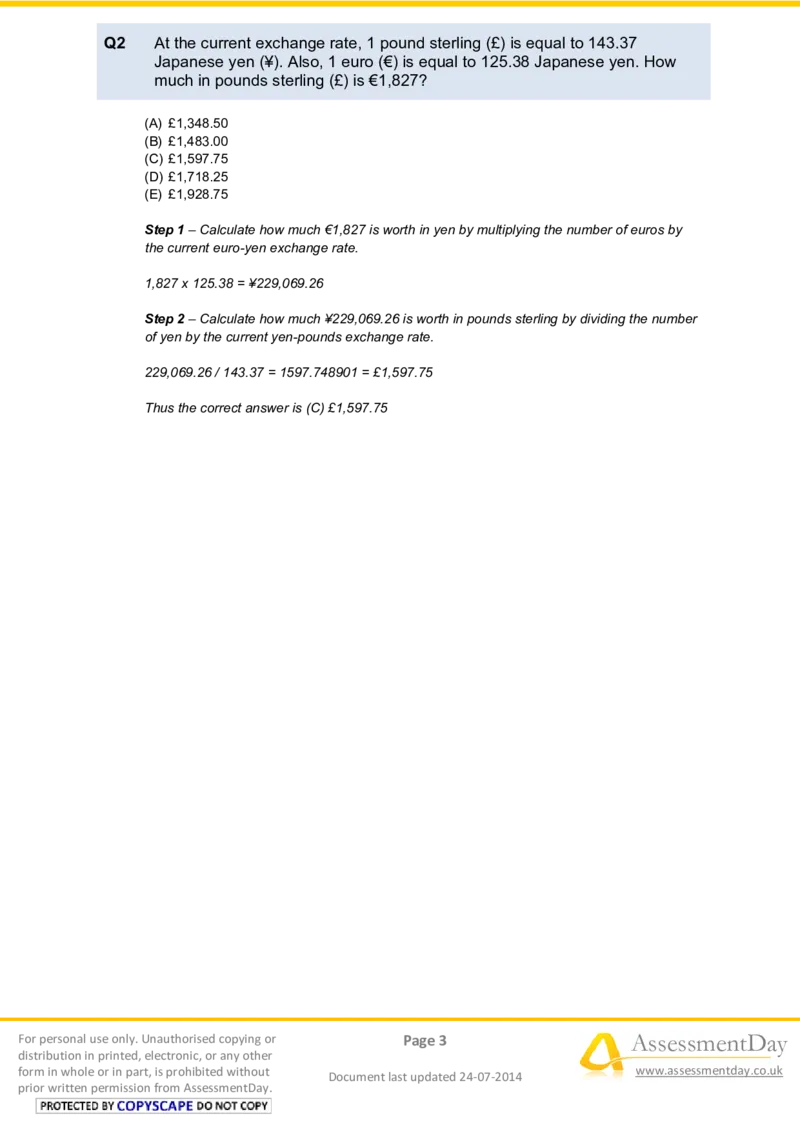
prior written permission from AssessmentDay.Q2 At the current exchange rate, 1 pound sterling (£) is equal to 143.37
Japanese yen (¥). Also, 1 euro (€) is equal to 125.38 Japanese yen. How
much in pounds sterling (£) is €1,827?
(A) £1,348.50
(B) £1,483.00
(C) £1,597.75
(D) £1,718.25
(E) £1,928.75
Step 1 – Calculate how much €1,827 is worth in yen by multiplying the number of euros by
the current euro-yen exchange rate.
1,827 x 125.38 = ¥229,069.26
Step 2 – Calculate how much ¥229,069.26 is worth in pounds sterling by dividing the number
of yen by the current yen-pounds exchange rate.
229,069.26 / 143.37 = 1597.748901 = £1,597.75
Thus the correct answer is (C) £1,597.75
For personal use only. Unauthorised copying or Page 3 AssessmentDay
distribution in printed, electronic, or any other
form in whole or in part, is prohibited without
Document last updated 24-07-2014
www.assessmentday.co.uk
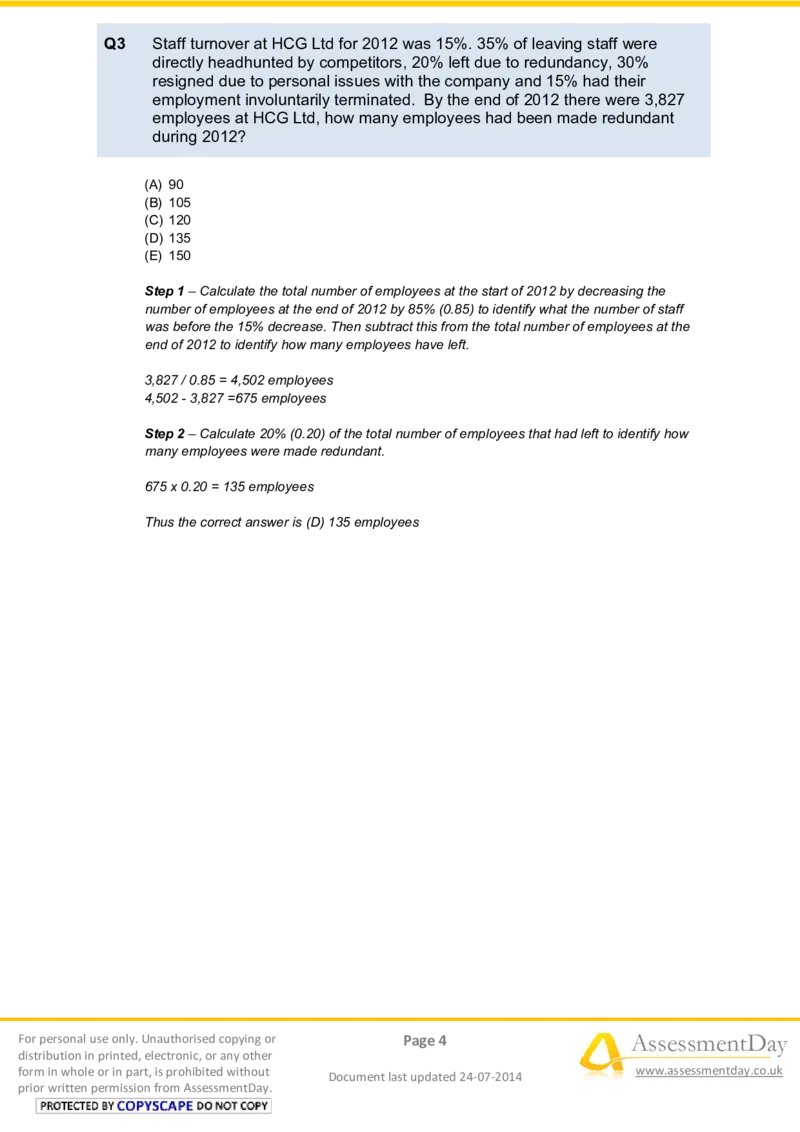
prior written permission from AssessmentDay.Q3 Staff turnover at HCG Ltd for 2012 was 15%. 35% of leaving staff were
directly headhunted by competitors, 20% left due to redundancy, 30%
resigned due to personal issues with the company and 15% had their
employment involuntarily terminated. By the end of 2012 there were 3,827
employees at HCG Ltd, how many employees had been made redundant
during 2012?
(A) 90
(B) 105
(C) 120
(D) 135
(E) 150
Step 1 – Calculate the total number of employees at the start of 2012 by decreasing the
number of employees at the end of 2012 by 85% (0.85) to identify what the number of staff
was before the 15% decrease. Then subtract this from the total number of employees at the
end of 2012 to identify how many employees have left.
3,827 / 0.85 = 4,502 employees
4,502 - 3,827 =675 employees
Step 2 – Calculate 20% (0.20) of the total number of employees that had left to identify how
many employees were made redundant.
675 x 0.20 = 135 employees
Thus the correct answer is (D) 135 employees
For personal use only. Unauthorised copying or Page 4 AssessmentDay
distribution in printed, electronic, or any other
form in whole or in part, is prohibited without
Document last updated 24-07-2014
www.assessmentday.co.uk
prior written permission from AssessmentDay.Q4 Aisha sells 3 products: product A; product B and product C. In March, Aisha
sold 3,570 units in total. The numbers of units sold for products A, B and C is
in the ratio 10:5:2 respectively. How many units of B and C combined were
sold by Aisha in march?
(A) 1,470 units
(B) 1,580 units
(C) 1,690 units
(D) 1,800 units
(E) 1,910 units
Step 1 – Calculate the number of units of product B and C sold.
3570 / (10 + 5 + 2) = 3570 / 17 = 210
Product B = 210 x 5 = 1,050 units
Product C = 210 x 2 = 420 units
Step 2 – Combine the number of product B and C units sold to identify the total number of
products sold.
1,050 + 420 = 1,470 units
Thus the correct answer is (A) 1,470 units
For personal use only. Unauthorised copying or Page 5 AssessmentDay
distribution in printed, electronic, or any other
form in whole or in part, is prohibited without
Document last updated 24-07-2014
www.assessmentday.co.uk
prior written permission from AssessmentDay.Q5 The distance between City A and City B is 178km. Ricardo’s car has a fuel
economy of 35 miles to the gallon. If a litre of petrol costs £1.32, how much
money would Ricardo spend on petrol traveling from City A to City B? (1 mile
= 1.609344 kilometres; 1 gallon = 4.54609 litres)
(A) £16.78
(B) £18.96
(C) £20.10
(D) £22.93
(E) £25.83
Step 1 – Convert the number of Kilometres from City A to City B into miles.
178 km / 1.609344 = 110.6040722 miles
Step 2 – Identify the petrol usage during the journey from City A to City B by identifying how
many gallon of petrol are used, and then converting this figure into litres.
110.6040722 / 35 = 3.160116349 gallons of petrol
3.160116349 x 4.54609 = 14.36617333 litres of petrol
Step 3 – Calculate the cost of the petrol consumed in order to reach City B from City A by
multiplying the volume of petrol used by its price per litre.
14.36617333 x £1.32 = £18.9633488 = £18.96
Thus the correct answer is (B) £18.96
For personal use only. Unauthorised copying or Page 6 AssessmentDay
distribution in printed, electronic, or any other
form in whole or in part, is prohibited without
Document last updated 24-07-2014
www.assessmentday.co.uk
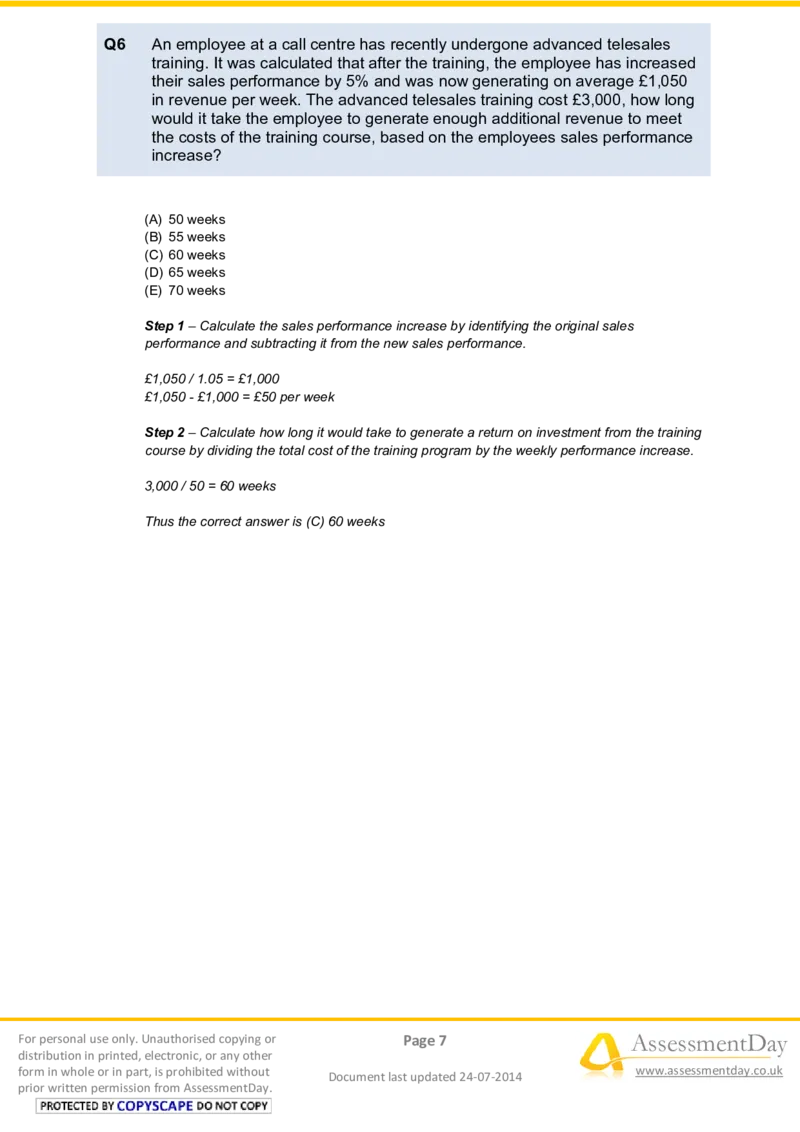
prior written permission from AssessmentDay.Q6 An employee at a call centre has recently undergone advanced telesales
training. It was calculated that after the training, the employee has increased
their sales performance by 5% and was now generating on average £1,050
in revenue per week. The advanced telesales training cost £3,000, how long
would it take the employee to generate enough additional revenue to meet
the costs of the training course, based on the employees sales performance
increase?
(A) 50 weeks
(B) 55 weeks
(C) 60 weeks
(D) 65 weeks
(E) 70 weeks
Step 1 – Calculate the sales performance increase by identifying the original sales
performance and subtracting it from the new sales performance.
£1,050 / 1.05 = £1,000
£1,050 - £1,000 = £50 per week
Step 2 – Calculate how long it would take to generate a return on investment from the training
course by dividing the total cost of the training program by the weekly performance increase.
3,000 / 50 = 60 weeks
Thus the correct answer is (C) 60 weeks
For personal use only. Unauthorised copying or Page 7 AssessmentDay
distribution in printed, electronic, or any other
form in whole or in part, is prohibited without
Document last updated 24-07-2014
www.assessmentday.co.uk
prior written permission from AssessmentDay.Q7 A river has an average rate of water flow of 59.6 m3/s. This river has three
tributaries, tributary A, B and C, which account for 36%, 47% and 17% of
water flow respectively. How much water is discharged in 30 minutes from
tributary B?
(A) 40,190.7 m3
(B) 42,837.9 m3
(C) 45,383.8 m3
(D) 47,573.2 m3
(E) 50,421.6 m3
Step 1 – Calculate the average rate of water flow of tributary B by identifying 47% (0.47) of
the total water flow of the river.
59.6 m3/s x 0.47 = 28.012 m3/s
Step 2 – Calculate the total water flow of tributary B in 30 minutes by multiplying the water
flow of tributary B by 60 (identifying water flow per minute) and then multiplying that figure by
30 (identifying water flow per 30 minutes).
28.012 m3/s x 60 x 30 = 50,421.6 m3
Thus the correct answer is (E) 50,421.6 m3
For personal use only. Unauthorised copying or Page 8 AssessmentDay
distribution in printed, electronic, or any other
form in whole or in part, is prohibited without
Document last updated 24-07-2014
www.assessmentday.co.uk
prior written permission from AssessmentDay.Q8 ¼ of all staff at Casper and John Partners Ltd are eligible for a fully funded
company car. However ½ of eligible employees have opted out of the
company car scheme and ⅛ of opted out eligible employees have stated
their reasons for doing so are due to environmental concerns. What fraction
of employees at Casper and John Partners Ltd opted out of the company car
scheme due to environmental concerns?
(A) 1/61
(B) 1/64
(C) 1/67
(D) 1/69
(E) 1/70
Step 1 – Identify the fraction of employees that have opted out of the company car scheme by
dividing the number of opted out employees by 2 (½).
¼ / 2 = ⅛
Step 2 – Identify the fraction of employees that opted out of the company car scheme due to
environmental concerns by dividing the opted out employee number by 8 (1/8).
⅛ / 8 = 1/64
Thus the correct answer is (B) 1/64
For personal use only. Unauthorised copying or Page 9 AssessmentDay
distribution in printed, electronic, or any other
form in whole or in part, is prohibited without
Document last updated 24-07-2014
www.assessmentday.co.uk
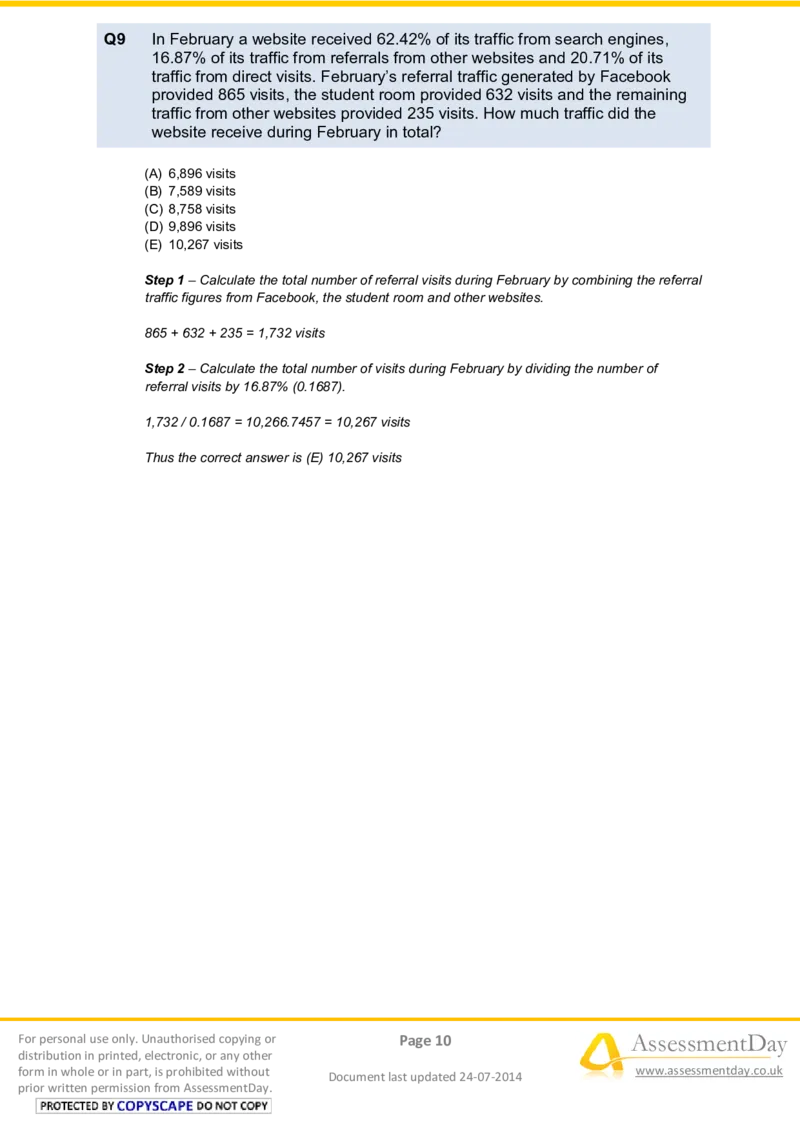
prior written permission from AssessmentDay.Q9 In February a website received 62.42% of its traffic from search engines,
16.87% of its traffic from referrals from other websites and 20.71% of its
traffic from direct visits. February’s referral traffic generated by Facebook
provided 865 visits, the student room provided 632 visits and the remaining
traffic from other websites provided 235 visits. How much traffic did the
website receive during February in total?
(A) 6,896 visits
(B) 7,589 visits
(C) 8,758 visits
(D) 9,896 visits
(E) 10,267 visits
Step 1 – Calculate the total number of referral visits during February by combining the referral
traffic figures from Facebook, the student room and other websites.
865 + 632 + 235 = 1,732 visits
Step 2 – Calculate the total number of visits during February by dividing the number of
referral visits by 16.87% (0.1687).
1,732 / 0.1687 = 10,266.7457 = 10,267 visits
Thus the correct answer is (E) 10,267 visits
For personal use only. Unauthorised copying or Page 10 AssessmentDay
distribution in printed, electronic, or any other
form in whole or in part, is prohibited without
Document last updated 24-07-2014
www.assessmentday.co.uk
prior written permission from AssessmentDay.Q10 An oil and gas field generates 5000 barrels of crude oil, and 17,000 cubic
metres of natural gas per day. The current price per barrel of crude oil is
$91.87 and the price per 1000 cubic metres of natural gas $131.10. The
profit margins per barrel of oil and per 1000 cubic metre of natural gas are
31% and 27% respectively. How much profit is generated by this oil and gas
field in 7 weeks? (Assume the price of oil and gas remains constant)
(A) $7,007,012
(B) $7,160,045
(C) $7,282,185
(D) $7,387,896
(E) $7,482,453
Step 1 – Calculate the revenue generated by the sale of oil and gas produced per day by
multiplying the volume of oil and gas produced per day by their value per barrel/1000 cubic
metres.
5000 x $91.87 = $459,350.00
17 x $131.10 = $2,228.70
Step 2 – Calculate the profit generated by the sale of oil and gas produced per day by
multiplying the revenue by the respective profit margins (0.31 and 0.27).
£459,350 x 0.31 = $142,398.50
£2,228.70 x 0.27 = $601.749
$142,398.50 + $601.749 = $143,000.249
Step 3 – Calculate the profit generated by the sale of oil and gas over 7 weeks.
7 x 7 = 49 days
49 x $143,000.249 = $7,007,012.201 = $7,007,012
Thus the correct answer is (A) $7,007,012
For personal use only. Unauthorised copying or Page 11 AssessmentDay
distribution in printed, electronic, or any other
form in whole or in part, is prohibited without
Document last updated 24-07-2014
www.assessmentday.co.uk
prior written permission from AssessmentDay.Q11 A companywide staff satisfaction survey revealed that 60% of staff provided
negative responses on one or more question items on the survey. Of this
60% of staff, ½ stated low opportunities for advancement, ¼ stated that
payment and benefits were unsatisfactory and ⅜ stated that problems with
their line manager were common. There are 3,461 members of staff at the
company and the survey had an 86% response rate. How many members of
staff stated that problems with their line manager were common?
(A) 660 members of staff
(B) 670 members of staff
(C) 680 members of staff
(D) 690 members of staff
(E) 700 members of staff
Step 1 – Calculate the number of staff that completed the staff satisfaction survey by
multiplying the total number of staff by 86% (0.86).
3,461 x 0.86 = 2,976.46 = 2,976 members of staff
Step 2 – Calculate the number of staff that answered one or more question items negatively
by multiplying the total number of respondents by 60% (0.60).
2,976 x 0.60 = 1,785.876 = 1,786 members of staff
Step 3 – Calculate the number of staff that stated that problems with their line manager were
common by multiplying the number of respondents that provided negative feedback by 3/8
(0.375).
1,786 x (3/8) = 1,786 x 0.375 =669.75 = 670 members of staff
Thus the correct answer is (B) 670 members of staff
For personal use only. Unauthorised copying or Page 12 AssessmentDay
distribution in printed, electronic, or any other
form in whole or in part, is prohibited without
Document last updated 24-07-2014
www.assessmentday.co.uk
prior written permission from AssessmentDay.Q12 Gareth’s house hold budget per week is £250. ½ of this budget is spent on
rent, 12.5% is spent on bills and 27.5% is spent on food. Every week, ¾ of
the budget not accounted for by rent, food and bills is placed in a savings
account. How long would it take Gareth to save up £900 from his left over
house hold budget?
(A) 42 weeks
(B) 44 weeks
(C) 46 weeks
(D) 48 weeks
(E) 50 weeks
Step 1 – Calculate the amount of the budget not spent on food, rent or bills per week by
subtracting these expenses from the weekly budget.
£250 / 2 = £125
£250 x 0.125 = £31.25
£250 x 0.275 = £68.75
£125 + £31.25 + £68.75 = £225
250 – 225 = £25
Step 2 – Calculate the amount of money placed in Gareth’s savings account.
£25 x 0.75 = £18.75
Step 3 – Identify how many weeks it would take to save up £900 based.
900 / 18.75 = 48 weeks
Thus the correct answer is (D) 48 weeks
For personal use only. Unauthorised copying or Page 13 AssessmentDay
distribution in printed, electronic, or any other
form in whole or in part, is prohibited without
Document last updated 24-07-2014
www.assessmentday.co.uk
prior written permission from AssessmentDay.Q13 An investor purchased 25 ounces of gold in 2007 for a total of £16,225.
When the investor sold the metal in 2012, the price of gold per gram was
£50.74. The profits gained from this transaction were used to buy silver at the
market price of £27.57 per ounce. What is the largest amount of silver that
the investor could purchase using profits generated from selling their gold? (1
gram = 0.035274 ounces).
(A) 512 ounces of silver
(B) 596 ounces of silver
(C) 678 ounces of silver
(D) 716 ounces of silver
(E) 876 ounces of silver
Step 1 – Calculate the value of the gold at the point of purchase per gram by dividing the total
value of the gold by the number of ounces purchased, then multiply the value of the gold by
the number of ounces in 1 gram (0.035274).
£16,225 / 25 = £649 per ounce of gold
£649 x 0.035274 = £22.892826 per gram of gold.
Step 2 – Calculate the profit generated by selling the gold in 2012 by calculating the profit per
gram of gold sold, and then multiplying this by the number of grams sold.
£50.74 - £22.892826 = £27.847174 profit per gram of gold
25 / 0.035274 = 708.7373136 grams of gold in total
708.7373136 x £27.847174 = £19,736.33129
Step 3 – Calculate how many ounces of silver which can be purchased with the profits of the
previous transaction by dividing the profit gained from the transaction by the value of an
ounce of silver. .
£19,736.33129 / £27.57 = 715.8625786 = 716 ounces of silver
Thus the correct answer is (D) 716 ounces of silver
For personal use only. Unauthorised copying or Page 14 AssessmentDay
distribution in printed, electronic, or any other
form in whole or in part, is prohibited without
Document last updated 24-07-2014
www.assessmentday.co.uk
prior written permission from AssessmentDay.Q14 Architectural Bronze is an alloy, typically composed of 57% copper, 3% lead
and 40% zinc. The current price of copper is £3,670 per metric ton and the
current price of zinc is £1,240 per metric ton. If a foundry has 1275 tons of
lead, how much would it cost to purchase enough copper and zinc to
produce the maximum amount of architectural bronze possible with the
existing amount of lead?
(A) £86,282,920
(B) £92,282,170
(C) £101,272,280
(D) £109,985,750
(E) £111,728,270
Step 1 – Calculate the amount of copper and zinc that would be required in order to produce
the maximum amount of Architectural bronze by dividing the total amount of lead by 3%
(0.03) to identify the total amount of architectural bronze that can be made with 1275 tons of
lead. We then multiply the total amount of architectural bronze by 57% (0.57) to identify the
total amount of copper, and 40% (0.40) to identify the total amount of zinc.
1275 / 0.03 = 42,500 metric tons of architectural bronze
42,500 x 0.57 = 24,225 metric tons of copper
42,500 x 0.4 =17,000 metric tons of zinc
Step 2 – Calculate the value of the copper and the zinc, and then combine the two figures to
identify the total value of the architectural bronze that can be made with 1275 tons of lead.
24,225 x £3,670 = £88,905,750
17,000 x £1,240 = £21,080,000
£88,905,750 + £21,080,000 = £109,985,750
Thus the correct answer is (D) £109,985,750
For personal use only. Unauthorised copying or Page 15 AssessmentDay
distribution in printed, electronic, or any other
form in whole or in part, is prohibited without
Document last updated 24-07-2014
www.assessmentday.co.uk
prior written permission from AssessmentDay.Q15 The wild population of Snow Leopards was recorded at 6,590 in 2003. At the
time 34% of wild Snow Leopards resided in China, 23% resided in Mongolia
and 12.5% resided in India, with the remaining population residing in other
Asian countries. By 2012, wild snow Leopard populations had grown by 16%
in China, 3.5% in Mongolia, decreased by 2.9% in India and remained
unchanged in other Asian countries. In 2012 an additional 600 Snow
Leopards reside in Zoos, what was the total Snow Leopard population in
2012?
(A) 7,578 Snow Leopards
(B) 7,754 Snow Leopards
(C) 7,956 Snow Leopards
(D) 8,145 Snow Leopards
(E) 8,235 Snow Leopards
Step 1 – Calculate the number of wild Snow Leopards in China, Mongolia India and other
Asian countries during 2003 by multiplying the total number of snow leopards by the
corresponding percentages. We then combine these figures and subtract them from the total
number of snow leopards to identify the number of snow leopards in other Asian countries.
China = 6,590 x 0.34 = 2,240.6 = 2,241
Mongolia = 6,590 x 0.23 =1,515.7 = 1,516
India = 6,590 x 0.125 =823.75 = 824
Other Asian = 6,590 - (2241 + 1516 + 824) = 2,009
Step 2 – Calculate the number of wild Snow Leopards in China, Mongolia and India during
2012 by multiplying their numbers in 2003 by the percentage change in 2012.
China = 2,241 x 1.16 =2599.56 = 2,600
Mongolia = 1,516 x 1.035 = 1,569.06 = 1,569
India = 824 x 0.971 = 800.104 = 800
Step 3 – Combine the 2012 wild Snow leopard populations from China, Mongolia, India, other
Asian countries and the Zoo populations.
2,600 + 1,569 + 800 + 2,009 + 600 = 7,578
Thus the correct answer is (A) 7,578 Snow Leopards
For personal use only. Unauthorised copying or Page 16 AssessmentDay
distribution in printed, electronic, or any other
form in whole or in part, is prohibited without
Document last updated 24-07-2014
www.assessmentday.co.uk
prior written permission from AssessmentDay.Q16 Claire provides freelance consulting services at £30 per hour, with a 1 hour
unpaid lunch break and paid overtime at 1.5 times the usual hourly rate. Her
latest contract requires to her to work from 8.30am till 5.45pm, for 15 billable
days, with an extra 1 and a half hours overtime per day. Assuming Claire
pays 30% in taxes on her income, how much will Claire earn from her latest
contract after tax?
(A) £2,568.75
(B) £2,863.50
(C) £3,010.00
(D) £3,205.50
(E) £3,307.50
Step 1 – Calculate the total income earned during Claire’s regular working hours by
identifying how many hours she works, and multiplying this figure by her price per hour, and
then the number of days worked.
Working from 8.30am till 5:45, minus an hour for lunch = 8.25 working hours (8 hours 15
minutes)
8.25 x £30 = £247.50
£247.5 x 15 billable days = £3,712.50
Step 2 – Calculate the total overtime income earned by Claire by calculating the number of
overtime hours worked and multiplying this figure by her price per hour.
1.5 x 15 = 22.5 hours of overtime
22.5 x (£30 x 1.5) = 22.5 x £45 = £1,012.50
Step 3 – Combine the income from Claire’s regular hours and from her overtime hours, and
then decrease that number by 30% (multiply by 0.70) in order to subtract the tax.
£3,712.50 + £1,012.50 = £4,725
£4,725 x 0.70 = £3,307.50
Thus the correct answer is (E) £3,307.50
For personal use only. Unauthorised copying or Page 17 AssessmentDay
distribution in printed, electronic, or any other
form in whole or in part, is prohibited without
Document last updated 24-07-2014
www.assessmentday.co.uk
prior written permission from AssessmentDay.Q17 An organization spends 5.5% of its annual training and development budget
on evaluating the effectiveness of training programs. 65% of the money
spent on evaluation is used to evaluate employee’s immediate reaction to the
training, using reaction sheets. ¾ of the money spent on capturing reactions
to training programs is spent on analyzing and benchmarking the data
collected. If the organizations training and development budget is £2.7 million
per year, how much is spent analyzing reaction data per month an average?
(A) £5,583.32
(B) £5,736.93
(C) £6,032.81
(D) £6,258.38
(E) £6,473.57
Step 1 – Calculate the amount of money spent on training evaluation per year by multiplying
the training and development budget by 5.5% (0.055).
2,700,000 x 0.055 = £148,500
Step 2 – Calculate the amount of money spent on measuring employee reactions to training
courses by multiplying the amount spent on training evaluation by 65% (0.65).
£148,500 x 0.65 = £96,525
Step 3 – Calculate the amount of money spent on analysing and benchmarking the reactions
data by multiplying the amount of money spent in measuring trainee relations by 75% (0.75).
£96,525b x ¾ = £96,525 x 0.75 = £72,393.75
Step 4 – Calculate the average amount of money spent on analysing and benchmarking the
reactions data per month by dividing the figure by 12.
£72,393.75 / 12 = £6,032.8125 = £6,032.81
Thus the correct answer is (C) £6,032.81
For personal use only. Unauthorised copying or Page 18 AssessmentDay
distribution in printed, electronic, or any other
form in whole or in part, is prohibited without
Document last updated 24-07-2014
www.assessmentday.co.uk
prior written permission from AssessmentDay.Q18 Daniel holds 170 shares of Company A, 80 shares of Company B and 110
shares of Company C. At the time of purchase, company A shares were
valued at £2.82 per share, company B shares were valued at £1.92 per
share and company C shares were valued at £2.78 per share. When Daniel
sold his shares, company A and B shares had risen in value by 5% and 6%
respectively, and the value of company C shares had dropped by 2%, how
much profit did Daniel generate from selling his shares?
(A) £24.89
(B) £27.07
(C) £29.64
(D) £32.45
(E) £34.89
Step 1 – Calculate the total value of Daniels shares at the time of purchase by multiplying the
previous value of the shares by the number of shares owned.
Company A = 170 x £2.82 = £479.40
Company B = 80 x £1.92 = £153.60
Company C = 110 x £2.78 = £305.80
Step 2 – Calculate the total value of Daniels shares at the point of sale by multiplying the
previous total value of Daniels shares by their respective percentage increases.
Company A = £479.40 x 1.05 = 503.37
Company B = £153.60 x 1.06 = 162.816
Company C = £305.80 x 0.98 = 299.684
Step 3 – Subtract the total value of the shares at the time of purchase from the total value of
the shares at the point of sale to identify the profit generated from this transaction, and then
combine the profit from these three transactions.
Company A = £503.370 - £479.40 = £23.97
Company B = £162.816 - £153.60 = £9.216
Company C = £299.684 - £305.80 = -£6.116
£23.97 + £9.216 + -£6.116 = £27.07
Thus the correct answer is (B) £27.07
-- End of Test --
For personal use only. Unauthorised copying or Page 19 AssessmentDay
distribution in printed, electronic, or any other
form in whole or in part, is prohibited without
Document last updated 24-07-2014
www.assessmentday.co.uk
prior written permission from AssessmentDay.