文档文本内容
关注公众号:陆陆高分冲刺 ~领取:最新版“小中高考-总复习”、最新试卷下载
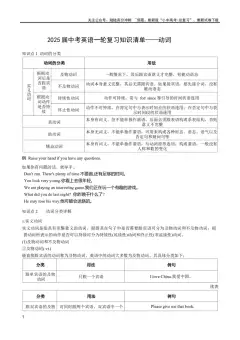
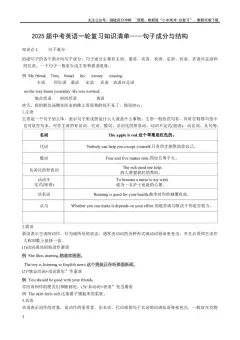
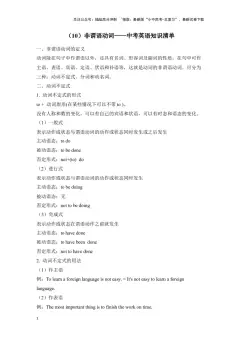
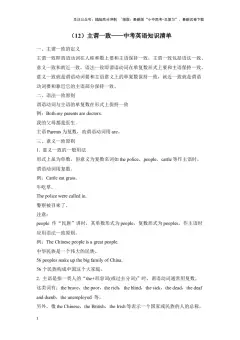
2025 届中考英语一轮复习知识清单——非谓语动词
(一)动词不定式
知识点1 动词不定式的构成及句法功能
1.动词不定式的构成
动词不定式的基本形式:to+动词原形。有时可以不用 to,这里的to是不定式符号,本身没有词义。动词
不定式没有人称和数的变化,在句子中不能作谓语,其否定形式是“not+ to+动词原形”。
2.动词不定式的句法功能
动词不定式具有名词、形容词和副词的特征。
(1)作主语
用作主语的动词不定式通常表示一种具体的、特定的行为,其谓语动词用第三人称单数形式。
例 To learn English well is not easy.学好英语不容易。
To save time is to lengthen life.节约时间就是延长生命。
当作主语的动词不定式(短语)较长时,通常用 it作形式主语,而将真正的主语置于句末,常见句型为“it+
be+ adj.(+ for/ of sb.)+ to do sth.”。
①“it be+ adj.+ for sb.+ to do sth.”句型中通常使用表示事物性质的形容词,如 easy、difficult、hard、important、
possible、interesting等,可转化为“to do sth.+ be+ adj.+ for sb.”结构。
例 It was hard for him to learn English well.
= To learn English well was hard for him.对他来说学好英语太难了。
②“it be+ adj.+ of sb.+ to do sth.”句型中一般用表示主观感情或态度的形容词,如 good、kind、nice、clever、
foolish、right、wrong、careful等,可转化为“sb.+ be+ adj.+ to do sth.”结构。
例 It's kind of you to say so.= You are kind to say so.
你能这样说真好。
③it takes/ took sb.+时间+ to do sth.某人花多长时间做某事
例 It took me three hours to repair the TV set.
我用了三个小时修理这台电视机。
(2)作宾语
①动词不定式作宾语时,其逻辑主语同时也是全句的主语。
常见的后跟动词不定式的动词
begin开始; choose 选择; continue 继续; decide决定; expect期待; fail失败; forget忘记;hate讨厌; help帮助;
hope 希望; manage设法; need 需要; offer主动提出; plan计划; prefer 更喜欢; promise 承诺; refuse 拒绝;
try 尝试,努力; wait 等待; wish 希望; afford 负担得起; agree 同意; start开始; want想要; like喜欢
例 She promised to come at nine o’ clock.她答应九点来的。
I have decided to study English.我已经决定学英语了。
②有些词后面跟动词不定式时,常用 it作形式宾语,而将真正的宾语(即动词不定式)后置,常见句型为
“主语+ consider/ think/ make/ find+ it+ adj./n.+ to do sth.”。
例 After the operation you may find it difficult to chew and swallow.
手术后你可能会感到咀嚼和吞咽困难。
We thought it better to start early.我们认为早出发好些。
(3)作定语
①动词不定式作定语时,要放在所修饰的名词或代词之后。常见的能跟动词不定式作定语的名词有
1关注公众号:陆陆高分冲刺 ~领取:最新版“小中高考-总复习”、最新试卷下载
ability、attempt、chance、decision、 effort、 need、 plan、 time 等。
例 It was a difficult decision to make.这是个很难作出的决定。
②动词不定式修饰 something、anything、nothing 等复合不定代词时,放在它们的后面,如果复合不定代词
还有形容词修饰,顺序是“something/ anything/ nothing...+形容词+动词不定式”。
例 Have you got anything important to buy?
你有什么重要的东西要买吗?
I had something cold to drink.我喝冷饮了。
③如果动词不定式中的动词为不及物动词,其后应有相应的介词。
例I want some paper to write on.我想要一些写字的纸。
④当动词不定式所修饰的名词是 time、place 或 way时,动词不定式后面习惯上要省略介词。
例 The library is a good place to study.图书馆是一个学习的好地方。
(4)作表语
动词不定式可跟在系动词后作表语,表示主语的具体内容、目的等。
例 Her ambition was to be a teacher.她的志向是当一名老师。
The first step will be to get a job.第一步就是找一份工作。
(5)作宾语补足语
常见的跟带 to的动词不定式作宾语补足语的动词
allow 允许; order 命令; teach 教; ask 要求; want 想要; invite 邀请; encourage 鼓励; tell告诉; warn 警告;
advise 建议; expect期望; wish想要; force 强迫; decide决定; would like 想要
例 My mother asks me not to play computer games before finishing my homework.我妈妈要求我在完成家庭作
业之前不要玩电脑游戏。
(6)作状语
①作目的状语,常用的结构有 to do、in order to do、so as to do,表示“为了做”。例I went to the library to
borrow some books.
我去图书馆借了一些书。
She raised her voice so as to make herself heard.
为了让别人听见,她提高了嗓门。
②作结果状语,常用的结构有 so/ such… as to do sth.(如此……以至于做某事)、… enough to do sth.(足
够……能够做某事)、too… to do sth.(太……而不能做某事)、 only to do(不料,竟然)。
例 He isn't strong enough to lift the box.
他不够强壮,提不起这个箱子。
The boy is too young to go to school.这个男孩太小不能去上学。
I rushed to the station as fast as I could, only to find the train had already gone.我尽快赶往车站,却发现火车已
经开走了。
③作原因状语,常用的结构有 be glad/ sad/ happy/ sorry/ pleased/ surprised/ disappointed/ delighted/ shocked to
do sth.。
例I'm glad to see you.见到你很高兴。
I'm sorry to trouble you.我很抱歉麻烦你。
2关注公众号:陆陆高分冲刺 ~领取:最新版“小中高考-总复习”、最新试卷下载
④作评注性状语,动词不定式还可用作独立成分,往往用于表示说话人的观点或态度。常用的动词不定式
短语有:
to be honest 老实说; to begin/ start with 首先; to tell ( you) the truth 说实话
例 To be honest, it is one of the worst books I' ve ever read.
老实说,那是我读过的最差的书之一。
To tell ( you) the truth, we don't want to go with you.
说实话,我们不想和你一起去。
知识点2“疑问词+动词不定式(短语)”结构
动词不定式(短语)可以和疑问代词 who、whom、what、which 或疑问副词 when、how、where连用,该结
构在句中充当主语、宾语、表语等成分。
例 What to do is an important question.要做什么是一个重要的问题。
I can't decide who/ whom to invite.我决定不了邀请谁。
The question is when to start.问题是什么时候开始。
知识点3 动词不定式符号 to 的省略
1.使役动词和感官动词后省略 to 的情况
在 let、make、have等使役动词和 feel、see、watch、notice、look at、 listen to、 hear等感官动词后用作
宾语补足语的动词不定式通常省略 to。
例 She always makes me laugh.她总是让我大笑。
I saw the woman enter a bank.我看见那个女人进了一家银行。2. why ( not)…后省略 to 的情况
例 Why argue with him? He’ ll never change his mind.
为什么要跟他争论? 他永远不会改变自己的主意。
Why not ask the teacher? 为什么不问问老师?
3.动词 help后省略 to的情况
在动词 help 后用作宾语或宾语补足语的动词不定式可以省略 to。
例 Can you help ( to) carry this heavy box?
你可以帮忙搬这个重箱子吗?
4. but、except之前有实义动词 do 的某种形式时, 其后通常省略动词不定式符号 to,否则要带 to。
例 His mother could do nothing but wait for the doctor to arrive.
他妈妈除了等着医生到来之外别无他法。
I have no choice but to accept the fact.
除了接受这个事实,我别无选择。
5.在并列结构中,为了避免重复,可省略后一个动词不定式符号 to。
但两个动词不定式有对照或对比的意义时,后一个 to 不能省略。
例I'd like to stay with you, ( to) help you and ( to) learn from you.
3关注公众号:陆陆高分冲刺 ~领取:最新版“小中高考-总复习”、最新试卷下载
我想要留在你身边,帮助你并向你学习。
I came not to sc old but to praise you.
我来不是责骂你,而是赞扬你。
6.主语部分含有实义动词 do时,作表语的动词不定式可省略 to。
例 What he wanted to do was ( to) become a skillful worker.
他想要做的事情是成为一名技术熟练的工人。
(二)动名词
知识点1 动名词的构成及句法功能
1.动名词的构成:动词原形+-ing
2.动名词的句法功能
(1)作主语:通常表示抽象的、习惯性的或经常性的动作。动名词作主语时,谓语动词通常用单数形式。
例 Smoking is bad for your health.
吸烟对你的健康有害。
(2)作宾语(动词宾语和介词宾语):表示一般的、习惯性的、抽象的或经常性的行为。
例 I like playing basketball very much.
我非常喜欢打篮球。
Stamps are used for sending letters.
邮票是用来寄信的。锦囊妙“记”
接动名词作宾语的词汇和结构有:
完成练习值得忙( finish、practice、be worth、be busy);
继续习惯别放弃( keep on、be used to、give up);
考虑建议不禁想( consider、suggest、can't help、feel like);
喜欢怀念要介意( enjoy、miss、mind)。
(3)作表语:主语和表语在概念上必须一致(相同或类似)。
例 His hobby is collecting stamps.他的爱好是集邮。
(4)作定语:说明它所修饰的词的用途及性质等。
例 She is in the reading room.她在阅览室里。
We should improve our learning habits.
我们应该改善我们的学习习惯。
知识点2 动词后接不定式和动名词的区别及转换
stop doing sth.停止做某事
(1)
stop to do sth.停下(正做的事情)去做另一件事
例 She stopped reading the story.她停止读那个故事了。
She stopped to read the story.她停下来去读那个故事。
forget doing sth.忘记曾做过某事
4关注公众号:陆陆高分冲刺 ~领取:最新版“小中高考-总复习”、最新试卷下载
(2) forget to do sth.忘记要做某事
例I forgot turning off the lights when I left the room.
我忘了在我离开房间时已经把灯关掉了。
I forgot to turn off the lights when I left the room.
离开房间时,我忘记关灯了。
remember doing sth.记得曾做过某事
(3)
remember to do sth.记着要去做某事
例Ⅰremember seeing this film before.我记得以前看过这部电影。
I remember to see the film this evening.我记着今天晚上要去看电影。
try doing sth.尝试着做某事
(4) try to do sth.设法去做某事,努力去做某事
例 They will try doing it in a new way.
他们将试着用一种新的办法做此事。
We are trying to learn English well.我们正在努力学好英语。
( need to do sth.需要做某事
(5)
sth. needs doing 某物需要……
例 He needs to do his homework.他需要做家庭作业了。
The flower needs watering.花需要浇水了。(6)( regeted to ) g yst.对过渡地的事后悔
例 I regret telling you the bad news.
我后悔把这个坏消息告诉了你。
I regret to say I'm not able to help you finish it.
很抱歉,我不能帮你完成此事。
mean doing sth. 意味着做某事
(7)
mean to do sth. 打算或想做某事
例 The new order will mean working overtime.
这个新订单将意味着要加班。
She means to succeed.她一意求成。
continue doing sth.继续做同一件事(未完成)
(8) continue to do sth.继续做另外一件事(已经完成一件事)
例 She looked up for a minute and then continued drawing.
她抬头看了一会儿,然后继续画。
Sara continued to work after she had her baby.
萨拉生了孩子后继续工作。
(9) prefer to do sth. rather than do sth.= prefer doing sth. to doing sth.宁愿做某件事而不愿做另一件事
5关注公众号:陆陆高分冲刺 ~领取:最新版“小中高考-总复习”、最新试卷下载
例I prefer to learn English rather than play the piano on Sundays.=I prefer learning English to playing the piano on
Sundays.
在周日,我宁愿学习英语,也不愿去弹钢琴。
知识点3动名词的常用句型
1. it+ is+n.+ doing sth.
例 It's no use complaining.抱怨没有用。
It is not much fun playing basketball.
打篮球没什么意思。
It is a waste of time trying to explain.
设法解释是浪费时间。
2. sb.+ have/ has( dtriculty+( in) doing sth.某人做某事有困难
例 A group of elephants in Yunnan Province have trouble finding a proper living place. We should help them. 云
南省的一群大象很难找到一个合适的生活场所。我们应该帮助它们。
3. sb.+ spend time(+ in)+ doing sth.某人花费时间做某事
例 He spends most of his time ( in) studying English.
他花费大多数的时间学习英语。
(三)分词
知识点1 分词的构成及句法功能
1.分词的构成
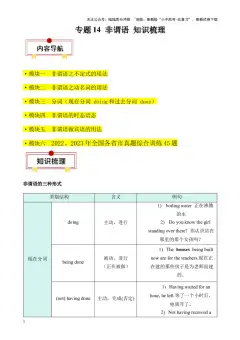
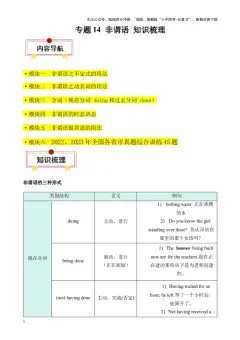
分词分为现在分词和过去分词两种。现在分词由“动词原形+-ing”构成;过去分词由“动词原形+-ed”构成,
但也有不规则的形式。
2.分词的句法功能
(1)作定语:
现在分词作定语,其逻辑主语就是它所修饰的词;过去分词作定语,其逻辑宾语就是它所修饰的词。
例 Do you know the girl standing under the tree?
你认识在树下站着的那个女孩吗?
The meeting held yesterday was very important.
昨天召开的会议很重要。
(2)作状语:分词作状语,其逻辑主语为句子的主语。
例 The students went out of the classroom, talking and laughing.
学生们谈笑着走出了教室。
Seriously injured, she was sent to hospital at once.
由于受伤严重,她被立刻送往医院了。
(3)作表语:现在分词作表语表示主语所具有的特征;过去分词作表语表示主语所处的状态。
例 The film is very moving.这部电影很感人。
The blackboard is broken.这块黑板碎了。
6关注公众号:陆陆高分冲刺 ~领取:最新版“小中高考-总复习”、最新试卷下载
(4)作补语:现在分词作补语,与被补充说明的宾语或主语之间是主动关系,现在分词可以在 see、hear、
notice、watch、feel、look at、 listen to、 observe、 have、 get、 leave、 keep、 set、 catch、 find 等
动词(短语)后面和一个名词或代词构成复合宾语,作宾语补足语;过去分词作补语,与被补充说明的宾语
或主语之间是被动关系。
例 Don't keep us waiting for a long time.不要让我们等得太久。
He’ ll have his hair cut after school.放学后他要去理发。
知识点2 现在分词和过去分词的区别
1.在语态上:现在分词表示主动意义,过去分词表示被动意义。
例Ⅰheard someone closing the door.我听见有人在关门。
I heard the door closed.我听见门被关上了。
2.在时间上:现在分词表示正在进行的动作,过去分词表示已经完成的动作。
例 the developing country 发展中国家
the developed country 发达国家3.形容词化的动词的-ing形式和动词的-ed形式
动词的-ing形式 动词的-ed形式
moving 令人感动的 moved 感动的
encouraging 鼓舞人心的 encouraged 受鼓舞的
pleasing 令人高兴/满意的 pleased 高兴的,满意的
satisfying 令人满意的 satisfied 满意的
tiring 令人困倦的 tired疲劳的
exciting 令人兴奋的 excited兴奋的
知识点3 现在分词作宾补和动词不定式作宾补的区别合合
常见的动词如 see、watch、notice、hear、feel、have等,接省略 to 的动词不定式作宾语补足语,表示已经
完成了的或经常性的动作;接现在分词作宾语补足语,表示动作正在进行。
例 I heard him singing in the classroom.
我听到他正在教室里唱歌。
I heard him sing in the classroom.
我听到他在教室里唱歌了。
have sb. do sth.、 have sb./ sth. doing sth.和 have sth. done的区别
知
识点4
1. have sb. do sth.让某人做某事
have 可以用 let、 make代替。此处省略 to 的动词不定式往往表示一次性的具体动作,且强调动作已经
完成或尚未发生。
例 The soldiers had the boy stand with his back to his father.
士兵们让这个男孩背对他的父亲站着。
7关注公众号:陆陆高分冲刺 ~领取:最新版“小中高考-总复习”、最新试卷下载
2. have sb./ sth. doing sth.让某人/物一直做某事
have 可以用 keep代替,现在分词( doing)所表示的动作往往具有持续进行的含义。
例 The two men had their lights burning all night long.
那两个人让他们的灯通宵亮着。
3. have sth. done让某事被别人做, 即 ask sb. else to do sth.
过去分词( done)所表示的动作由他人(非主语本身)来完成,含有被动意义。
例I'm having my car fixed this afternoon.
我今天下午要去修车。
知识点 5 含现在分词的几个常见结构或句式
1. find sb. doing sth.发现某人正在做某事
例 We found a boy crying under the tree.
我们发现一个男孩正在树下哭泣。2. catch sb. doing sth.当场发现某人正在做某事
例 His parents caught him playing computer games.
他父母逮住他在玩电脑游戏。
3. keep sb. doing sth.使某人一直做某事
例 He kept the students reading the whole class.
他让学生们读了一整堂课。
4. there be+n./ pron.+ doing sth.有做某事的…
例 There are already robots working in factories.
已经有在工厂里工作的机器人了。
There is someone waiting for you at the gate.
在门口有个正等你的人。
8