







文档内容
北 京 市 西 城 区 九 年 级 统 一 测 试 试 卷
英 语
2024. 4
考 生 须 知
1. 本试卷共11页,共两部分,共38题。满分60分。考试时间90分钟。 2. 在试卷和草稿纸
上准确填写姓名、准考证号、考场号和座位号。
3. 试题答案一律填涂或书写在答题卡上,在试卷上作答无效
4. 在答题卡上,选择题用2B铅笔作答,其他试题用黑色字迹签字笔作答 5. 考试结束,请将
本试卷、答题卡和草稿纸一并交回
第一 部分
本部分共33题,共40分。在每题列出的四个选项中,选出最符合题目要求的一项。
一、单项填空(每题0. 5分,共6分)
从下面各题所给的A、B、C、D四个选项中,选择可以填入空白处的最佳选项。
1. My sister likes drawing and ________ wants to be an artist in the future.
A. she B. he C. it D. they
2. I like listening to music while exercising _______ the park.
A. on B. under C. in D. to
3. —Would you like more pizza, Linda?
—No, thanks. The pizza is delicious ________ I’m full.
A. if B. but C. because D. or
,
4. —_______ you read the sign across the street Tom?
—No, I can’t.
A. Must B. Can C. May D. Might
5. Lao She is one of ________ Chinese writers of the twentieth century.
A. great B. greater C. greatest D. the greatest
6. —_________ are you late?
—Because I missed the early train.
.
A When B. What C. Why D. Where
7. — Where is Mary?
—She ________ the teachers with the poster right now.
第1页/共10页
学科网(北京)股份有限公司A. is helping B. helped C. was helping D. will help
8. The students ________ a lot for the show since last Monday.
A. have practiced B. practice
C. were practicing D. practiced
9. When my friend called last night, I ________ plans for the May Day holiday.
A. am making B. have made C. make D. was making
10. I’m on the school football team, and usually we ________ a match on Saturday.
A. had B. have C. are having D. have had
11. The community library ________ in 2023.
A. builds B. is built C. built D. was built
12. —Do you know ________?
—Next Tuesday afternoon. We are looking forward to it.
A. where we will have the school concert
B. where will we have the school concert
C. when we will have the school concert
D. when will we have the school concert
二、完形填空(每题1分,共8分)
阅读下面的短文,掌握其大意,然后从短文后各题所给的A、B、C、D 四个选项中,选择最佳选项。
“We were the cutest babies in the world!” I smiled and said to Rachel as I put up a ___13___ of me riding a
horse on the wall of the classroom.
“I know, look at this one!” Rachel pointed to the picture of us at age five. We both laughed and shook our heads.
We couldn’t believe that we would be graduating (毕业) in a week.
,
As a way of celebrating our childhoods we were asked to bring in pictures of ourselves growing up. As I
looked ___14___ from photo to photo, from preschoolers to ninth-graders, I began to look at my classmates around
me.
First I looked at Rachel, and I ___15___ the first day of school. I was a little five-year-old. When my mother
left me, I just didn’t know what to do but cry. Then I felt a hand on my shoulder. I turned around and saw Rachel.
“Why are you crying?” she asked.
“My mommy left me.”
“Would you like to play a puzzle game together?” She offered.
That got my ___16___. I loved puzzle games. I started to play, and after a few minutes, I wasn’t crying
anymore.
I looked back at the pictures and my eyes ___17___ on a picture of Tony. Tony lives right next to me, and we
第2页/共10页
学科网(北京)股份有限公司have always been close. I remember how much fun I had playing “boys’ games”, all thanks to Tony making it
possible.
“Come on, she’s a girl—she’ll make you play Barbies or something,” one of the boys on our block said to
Tony.
I turned and started to walk away. I felt tears ___18___ up in my eyes when I heard Tony say, “No, I want to
play with Sarah. We’re going to play basketball.”
The millions of memories that I ___19___ from those years suddenly came back to me. High school would be
different. I couldn’t imagine how that would feel. I looked at the pictures once more and noticed how, in every picture,
each of us was at ___20___ points of our lives, but we were always smiling. We were all okay, even through all the
changes.
I was finally ready for high school.
13.
A. drawing B. diary C. picture D. poster
14.
A. politely B. closely C. immediately D. angrily
15.
A. discovered B. remembered C. compared D. imagined
16.
A. patience B. advice C. message D. attention
17.
A. landed B. carried C. darkened D. opened
.
18
A. jump B. mix C. well D. move
19.
A. collected B. improved C. matched D. copied
20.
A. strange B. serious C. hard D. different
三、阅读理解(每题2分,共26分)
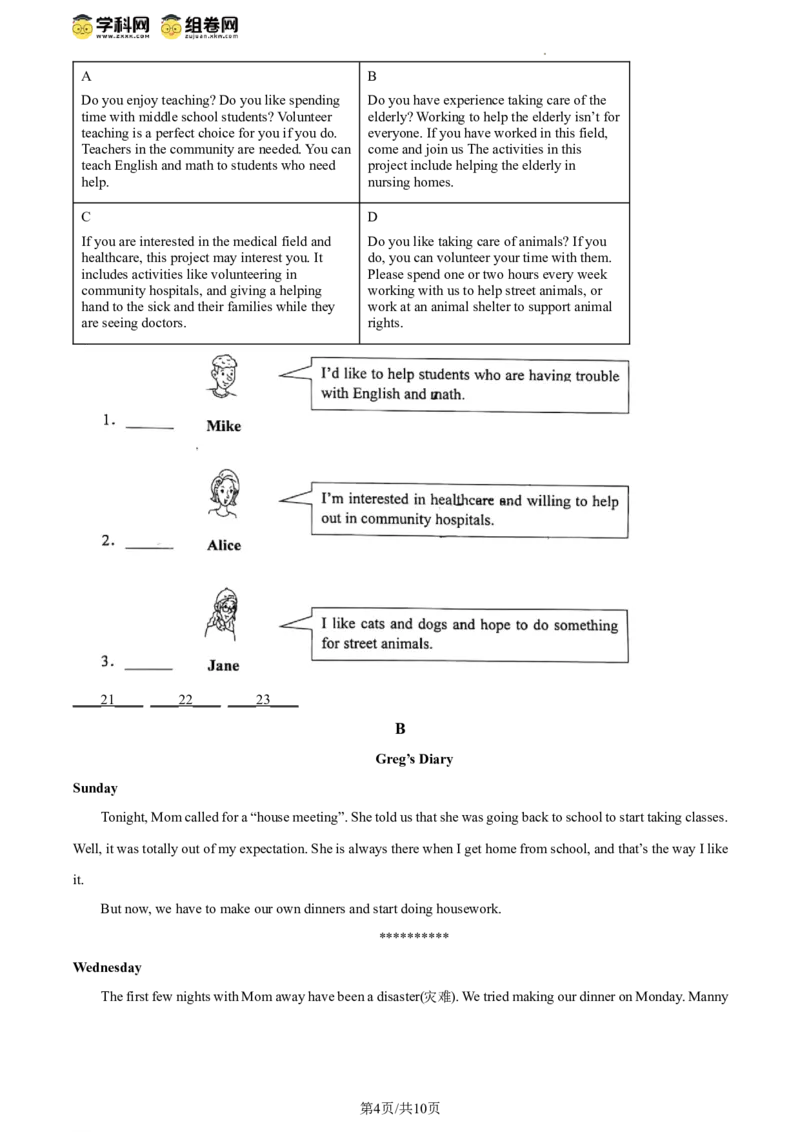
(一)
A
阅读下列志愿活动介绍,请根据人物意愿匹配最适合的活动,并将其对应的 A 、B 、C 、D 选项填在相
应的位置上。选项中有一项为多余选项。
第3页/共10页
学科网(北京)股份有限公司A B
Do you enjoy teaching? Do you like spending Do you have experience taking care of the
time with middle school students? Volunteer elderly? Working to help the elderly isn’t for
teaching is a perfect choice for you if you do. everyone. If you have worked in this field,
Teachers in the community are needed. You can come and join us The activities in this
teach English and math to students who need project include helping the elderly in
help. nursing homes.
C D
If you are interested in the medical field and Do you like taking care of animals? If you
healthcare, this project may interest you. It do, you can volunteer your time with them.
includes activities like volunteering in Please spend one or two hours every week
community hospitals, and giving a helping working with us to help street animals, or
hand to the sick and their families while they work at an animal shelter to support animal
are seeing doctors. rights.
____21____ ____22____ ____23____
B
Greg’s Diary
Sunday
Tonight, Mom called for a “house meeting”. She told us that she was going back to school to start taking classes.
Well, it was totally out of my expectation. She is always there when I get home from school, and that’s the way I like
it.
But now, we have to make our own dinners and start doing housework.
**********
Wednesday
The first few nights with Mom away have been a disaster(灾难). We tried making our dinner on Monday. Manny
第4页/共10页
学科网(北京)股份有限公司made the iced tea, but it was undrinkable. Rodric cooked the roast beef, but it was a mess. So, we bagged the
homemade meal idea and went out to eat.
**********
Tuesday
My task is taking out the rubbish. Tonight, Dad asked me why I didn’t do my job this morning. He said I
needed to start being more responsible.
I’ve heard it from Dad before. Last summer, our neighbor Ms. Grove, asked me to look after her plants while
she went on business. Well, I did it for the first few days and then I got busy with other things. Ms. Grove was pretty
mad because most of the plants didn’t make it. Then she sent me home without paying me.
**********
Thursday
Well, Dad is really serious about me taking on more responsibility. And first he wants me to start waking myself
up in the morning. That’s actually a real problem because I depend on him to wake me up.
Yesterday was the first day I tried to wake myself up, and it didn’t work out. My alarm clock (闹钟) went off,
but the sound just worked its way into my dream. And today didn’t go any better.
The problem is without an actual human being waking me up, my brain is always going to find some excuse to
keep sleeping. But I think I might have found a solution to this alarm clock situation. I found an old-style alarm clock
today and it makes a loud noise when it goes off. I tested it out to see if it still worked, and sure enough, it did. I don’t
think anyone could sleep through a noise like that.
24. When he heard his mom was going back to school, Greg felt _________.
A. proud B. surprised C. excited D. relaxed
25. From the diary, we can learn that Greg’s dad expected him to ________.
A. build up self-confidence B. become more responsible
C. make friends with the neighbors D. get along with his brothers
C
Have you ever wondered why you are good at noticing things in your environment that are possibly dangerous?
Defensive circuits, one of our brain systems, detect (察觉) signs that might suggest threats (威胁) and prepare the
body to take quick action, therefore increasing our chances of staying alive.
Our defensive circuits are always on the lookout for things that might be threats.
They look for certain features of objects (物体) that make those objects stand out from the other things around
them. Objects with these features are given priority in our brains; that is, we pay attention to them before other things.
So, how exactly does our threat detection work?
第5页/共10页
学科网(北京)股份有限公司First, the presence of a feature that could suggest a threat grabs, or catches, our attention very quickly—it is an
automatic (自动的) process. Threat detection happens so quickly because the threat information does not have to go
all the way around the cortex (大脑皮层). You can think of this as a shortcut through the brain, which gives us more
time to avoid possible threats.
Once we look at something that might be a threat, we often find looking away to be very difficult—the threatening
object holds our attention. This process is also automatic, and its advantage is that it gives us more time to collect
additional details about the possible threat. Those details are important for understanding whether we are facing a
real threat and deciding how to best deal with the situation.
After we have recognized the possible threat, our brains must often make up for the time we’ve spent examining
it-we need to avoid paying attention to the threat, and then we can look around and process the rest of the environment.
This can help us find additional threats, or find a way out.
Once we detect a threat, the defensive circuits prepare our body to take action. We make changes to our emotions
(for example, feeling fear) and body functions (such as speeding up our heartbeat). Together, these changes allow us
to act properly in threatening situations, increasing the likelihood that we will get away without being harmed.
There are differences between people on how easily the defensive system is activated. Some of us are frightened
more easily than others, and it takes less to activate the defensive circuits. This, however, can be problematic. Overly
sensitive defensive circuits might stop working as they should when overused.
26. What can we learn about the defensive circuits?
A. They watch out for possible danger.
B. They help us remember threat features.
C. They promise us a happy and healthy life.
D. They easily stand out from other brain systems.
27. What do our brains do to make up for the time spent examining possible danger?
A. Create additional details immediately.
B. Activate a shortcut through the cortex.
C. Push our body to make lasting changes.
D. Redirect our attention to the rest of the environment.
28. Which would be the best title for the passage?
A. How does your brain work in various situations?
B. What makes us different when it comes to facing threats?
C. Why are we overly sensitive to certain threatening objects?
D. What happens in your brain when you notice something frightening?
第6页/共10页
学科网(北京)股份有限公司D
On a Saturday afternoon, your best friend calls you and says he needs help moving. You gladly show up to
help. When you are done, he hands you some money, saying “Thanks for your help.” The situation suddenly feels
awkward (尴尬的).
Why doesn’t direct payment fit the situation? According to economist Dan Ariely, we live in two worlds—one
governed by social norms (规范), and the other characterized by market norms. Social norms are part of our social
nature. They include the friendly requests (请求) that people make of one another and immediate payback is not
required. In the second world, where market norms make the rules, people work for money and get what they pay
for. Market relationships are not necessarily bad or mean, but they do suggest comparable benefits and immediate
payments.
When we keep social norms and market norms on their separate paths, things move along smoothly. Moreover,
when social and market norms run into each other, the results are not satisfying.
There was an experiment involving daycare center fines. Some parents would arrive late to pick up their
children, so fines were introduced. However, this made more parents late. Before the fine was introduced, parents
were sorry for keeping the teachers waiting, and this made them feel compelled to arrive on time in the future.
But the introduction of the fine replaced this social norm with a market norm. Parents felt they were paying to be
allowed to choose whether they wanted to be late. Even after the center removed the fine, the parents didn’t return
to social norms and the number of late pick-ups didn’t drop. The result showed a fact: when a special norm runs
into a market norm, the social norm goes away and seldom returns.
However, does this necessarily mean market norms always have a bigger effect than social norms? Ariely
performed an experiment by paying people $5 (Group 1) or $0.50 (Group 2) for dragging (拖动) circles across a
computer screen for five minutes. With payment, he expected them to use market norms in that situation and act
accordingly. And to Group 3, he introduced the task as a social request, just asking them for help. The results
showed that Group 1 dragged on average 159 circles, and Group 2 dragged about 101 circles. But the ones who
were paid nothing dragged 168 circles. When people were paid, motivation (动力) and productivity rose as pay
rose, but people worked even harder under social norms than for money, Why? Because people love to feel that
they have helped others.
Money is the most expensive way to motivate people. Social norms are not only cheaper, but often more
effective as well. Money will take you only so far—social norms are the forces that can make a difference in the
long run.
29. Which of the following examples fits within social norms?
第7页/共10页
学科网(北京)股份有限公司A. Paying a friend for his voluntary help.
B. Fining a worker because of his mistakes.
C. Offering a neighbor a free ride to the airport.
D. Returning a product to get your money back.
30. The words “feel compelled to” in Paragraph 4 most probably mean ________.
A. remain unwilling to B. think it necessary to
C. be afraid to D. find it easy to
31. What can we learn about Dan Ariely’s experiment in Paragraph 5?
A. Ariely expected people to help each other to complete the task.
B. The result suggested who should receive the highest payment.
C. People in the experiment acted according to the same norms.
D. The experiment showed the effects of the two norms.
32. According to the passage, the writer probably agrees that _________.
A. social norms can play a great role in society
B. market norms aren’t effective as they used to be
C. better performance sometimes leads to lower pay
D. people should replace market norms with social norms
第二部分
本部分共5题,共20分。根据题目要求,完成相应任务。
四、阅读表达(34—36题,每题2分;37题4分。共10分)
The summer of 2023 saw record-breaking heatwaves across many parts of the world. As temperatures continue to
rise, the effect of carbon emissions (碳排放) on the environment has become a big problem. Studies show the
travel industry is responsible for about 10% of these emissions, with air travel alone causing about 2. 8% of them.
To address this problem, Intrepid—a travel company, has suggested a “carbon passport” in its recent report. The
idea behind it is that each traveler would have a yearly carbon limit, and nobody can go over that limit. Using carbon
passports means travelers will have to take fewer flights to lower their “carbon footprint”—the CO emissions from their
2
actions. At present, the carbon footprint of each person is about four tons yearly on average (平均). To limit
temperature rise to acceptable levels by 2050, our goal should be below two tons.
In line with this goal, some European countries are taking steps to reduce air travel. In France, local flights are
canceled if the same trips can be made by train in 2. 5 hours or less. In Belgium, additional charges (收费) are added to
short-distance flights to encourage other forms of travel.
Intrepid considers the idea of a “carbon passport” effective with more people involved in. Travelers will receive
第8页/共10页
学科网(北京)股份有限公司information about their carbon footprints and change their travel habits. And businesses will be pushed to use more
green practices. Alex Hawkins, one of the writers of the report, says, “These passports will make us think more about
how our trips influence the environment.”
When it comes to monitoring everyone’s carbon emission, Anna Abelson, a professor of the New York University
thinks it would be a challenge in terms of logistics (统计). Even if we work that out, there are still some worries. For
example, people might not be able to take jobs far away or visit family in other cities as often. Some even worry
about privacy and personal freedom if we start monitoring and limiting people’s air travel.
“Getting everyone on board with carbon passports won’t be easy.” Hawkins added, “It would need support from
lots of different people and groups all over the world.” However, even with the challenges, the idea of carbon passports
shows the need for us to take action together to fight climate change and make travel eco-friendlier.
33. Which industry is responsible for about 10% of the world’s carbon emissions?
__________________________________________________________
34. What is the idea behind a “carbon passport”?
__________________________________________________________
35. How does France reduce air travel?
___________________________________________________________
36. What do you think of the idea of a “carbon passport”? Why do you think so? (Please give two reasons. )
___________________________________________________________
五、文段表达(10分)
从下面两个题目中任选一题,根据所给提示,完成一篇不少于 50词的英语文段写作。文中已
给出内容不计入总词数。所给提示词语仅供选用。请不要写出你的校名和姓名。
题目①
37. 假设你是李华。你校交换生将与你们共同参加学校的外出活动。作为学生会主席,你将给他们做
行前动员。请用英文写一篇讲话稿,告知他们外出的时间、地点和活动内容,以及相关的安全建议。
提示词语:park, climb, careful, avoid
提示问题:● When and where will you take the field trip?
●What activities are you going to do during the trip?
●What safety advice would you like to give them?
Hello, everyone. I’m glad to tell you that we are going to take a field trip.
____________________________________________________________________________
____________________________________________________________________________
____________________________________________________________________________
____________________________________________________________________________
____________________________________________________________________________
____________________________________________________________________________
第9页/共10页
学科网(北京)股份有限公司____________________________________________________________________________
_____________________Hope we can have a good time.
题目②
38. 初中三年, 一定有很多课给你留下了深刻的印象。
假设你是李华。你校英文公众号正在开展以“My Most Memorable Class”为主题的征文活动,请用英
文写一篇文章投稿,介绍你最难忘的一节课,并谈谈这节课为什么令你难忘。
,
提示词语: science music, experiment, sing, interesting
提示问题: ●What was your most memorable class?
●Why was the class memorable?
My Most Memorable Class
____________________________________________________________________________________________
____________________________________________________________________________________________
____________________________________________________________________________________________
____________________________________________________________________________________________
____________________________________________________________________________________________
____________________________________________________________________________________________
________________________________________________
第10页/共10页
学科网(北京)股份有限公司