北京市西城区 2021—2022 学年度第一学期期末试卷
八年级英语
2022.1
注意事项:
1. 本试卷共 14 页,共九道大题,56 道小题。其中第一大题至第八大题为必做题,满分 90
分。第九道大题为选做题,满分 10 分,计入总分,但卷面总分不超过 90 分。考试时间
100 分钟。
2. 在试卷和答题卡上准确填写学校、班级、姓名和学号。
3. 试题答案一律填涂或书写在答题卡上,在试卷上作答无效。
4. 在答题卡上,选择题用 2B 铅笔作答,其他试题用黑色字迹签字笔作答。
5. 考试结束,请将考试材料一并交回。
听力理解(共 20 分)
一、听下面四段对话,每段对话后有两道小题,从每题所给的 A、B、C 三个选项中选出最
佳选项。每段对话你将听两遍。(共 12 分,每小题 1.5 分)
请听一段对话,完成下列小题。
1. Where does the man come from?
A. Cambridge. B. Los Angeles. C. Beijing.
2. What is the man’s hometown like?
A. It’s a quiet village with green fields. B. It’s a beautiful city with a university.C. It’s a small town with famous
beaches.
请听一段对话,完成下列小题。
3. What did the girl do last night?
A. She cleared the snow. B. She watched the snow. C. She played in the snow.
4. Why is the girl so excited about the snow?
A. Snow makes her think of her childhood. B. She likes playing in snow every year. C. It is the first time for her to
see snow.
请听一段对话,完成下列小题。
5. What’s the boy’s plan for the next holiday?
A. To take a tour in London. B. To train horses on the farm. C. To ride a bike to do exercise.
6. How will the boy get to the countryside?A. By train. B. By plane. C. By bus.
请听一段对话,完成下列小题。
7. What did the man often do when he was at school?
A. He often rode a bike. B. He often went running. C. He often played tennis.
8. What are the speakers mainly talking about?
A. Doing sports to have fun. B. Choosing a sport to get fit. C. Starting a sport club to exercise.
二、听独白,记录关键信息。本段独白你将听两遍。(共 8 分,每小题 2 分)
请根据所听到的独白内容和提示词语,将所缺的关键信息填写在答题卡的相应位置上。
How to tell a funny story
Decide your set up ♦ Center on one 9 to get the listeners’ attention
Be brief (简洁的) ♦ Get the first laugh (大笑) 10
Look at your listeners ♦ Try to relax and tell the story in a 11 way
Try to 12 on the
♦ Make listeners remember the last part or laugh line of a story
biggest laugh
Practise telling a story ♦ Practice makes perfect
知识运用(共 20 分)
三、单项填空(共 10 分,每小题 1 分)
(一)从下面各题所给的 A、B、C、D 四个选项中,选择可以填入空白处的最佳选项。
1. ________ people all over the world will watch the 2022 Winter Olympics online.
A. Million B. The million C. Millions D. Millions of
2. It’s cloudy outside. It ________ rain, so you’d better bring an umbrella with you.
A. can B. may C. should D. need
3. — Jack, what do you think of our after-school clubs?
— The AI Club is ________ than the Chess Club.
A. enjoyable B. most enjoyable C. more enjoyable D. the most enjoyable
.
4 Betty practises speaking more often ________ her Chinese.
A. improve B. to improve C. improved D. improving
,
5. Of all the children Amy listens to the story Tom Sawyer ________.
A. carefully B. so carefully C. most carefully D. more carefully
6. Peter ________ on the players at the stadium at eight o’clock yesterday evening.A. was cheering B. will cheer C. cheers D. is cheering
(二)根据短文内容,从各题所给的 A、B 两个选项中选出正确选项。
A
Travelling can be either cheap or costly. It often depends on how far you want to travel and the choice of
transport (交通工具). Riding a bicycle is ___7___ than driving a car, because it will not cost anything as you
power it by your legs. However, the use of a bicycle can be hard work and can take a lot of time to travel long
distances (距离). Cars and motorcycles are faster ways of transport, ___8___ they are more expensive to use as
they need a lot of gas (汽油) to work.
7. A. cheap B. cheaper
8. A. but B. because
B
There was another car crash (撞车事故) yesterday morning at the traffic lights in the Village of Boussada.
While Alice was driving a car across the road, another car suddenly hit ___9___ car. The driver of that car didn’t
notice the traffic lights because they were behind a large tree. As a result, both of the cars were seriously broken.
Luckily, no one got hurt badly. The drivers then went to the police station to report the accident and ___10___,
“This is the third accident that happened this month. We should remove (移开) the tree, or there will be more
accidents.”
9. A. her B. she
10. A. suggesting B. suggested
四、完形填空(共 10 分,每小题 1 分)
阅读下面的短文,掌握其大意,然后从短文后各题所给的 A、B、C、D 四个选项中,选择
最佳选项。
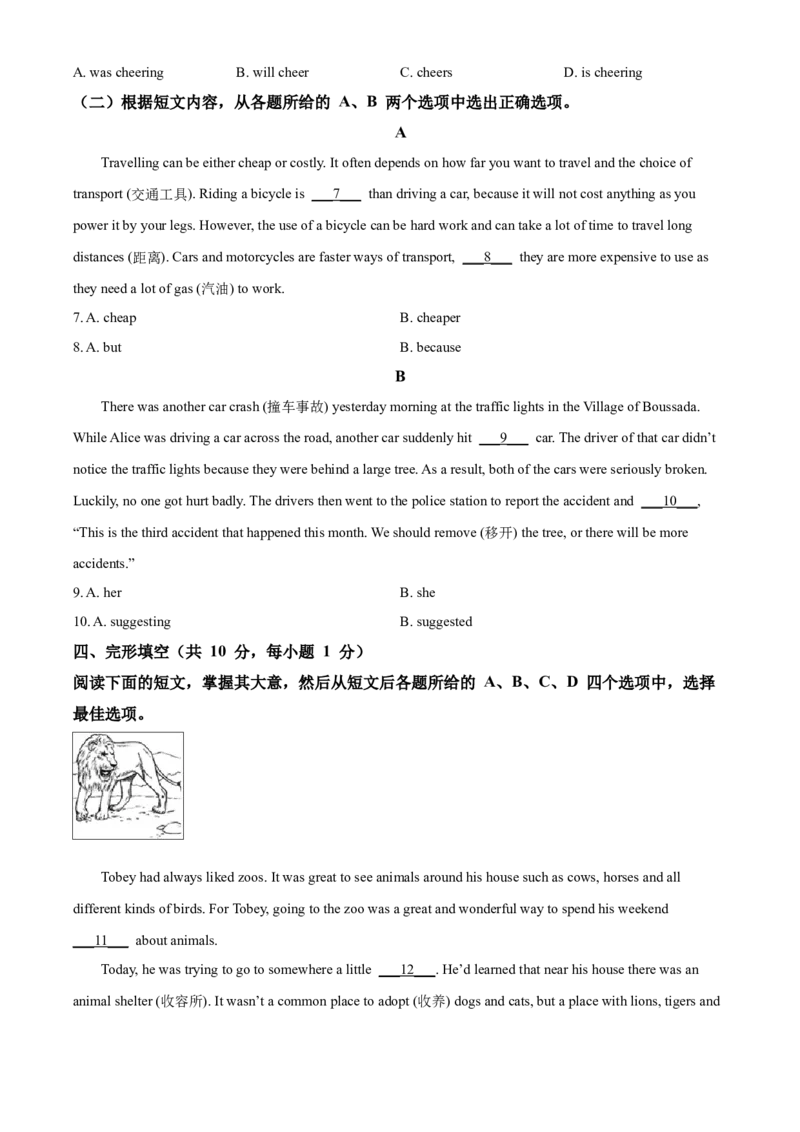
Tobey had always liked zoos. It was great to see animals around his house such as cows, horses and all
different kinds of birds. For Tobey, going to the zoo was a great and wonderful way to spend his weekend
___11___ about animals.
Today, he was trying to go to somewhere a little ___12___. He’d learned that near his house there was an
animal shelter (收容所). It wasn’t a common place to adopt (收养) dogs and cats, but a place with lions, tigers andbears.
As he arrived, he was ___13___, because he heard lions even from the parking lot. The place was small, but
clean. And the volunteers (志愿者) there were very helpful. Tobey and his family ___14___ the place at their own
pace (节奏), looking at the cages and places the animals lived in.
Tobey ___15___ understood the differences between this place and a zoo. Zoos had beautiful habitats set up
for each animal, but you could not get near the animals at all. At this shelter, he was almost ___16___ enough to
reach out and touch the animals, even if there were two fences between him and the animals. There weren’t as
many people, either, so it seemed like a more personal ___17___. The paths were covered with trees and it made
the animals feel more at home.
It was interesting to look into the eyes of a lion when you could almost reach out and touch it. It was
___18___ to watch the bears walking slowly in front of you. Then there were lions lying lazily in the midday heat
and monkeys cleaning themselves. It was a very special experience.
The best part about the place was the stories. Each animal had a story posted on the side of their cage. People
___19___ them from abuse (虐待) or took them to the shelter when they were no longer wanted. These were hard
luck stories with a happy ending.
When it was finally time to go, they all ___20___ the volunteers and made a donation. Shelters always
needed money, food for animals, and help. It made them feel good to do something they could. It was a great place,
and Tobey couldn’t wait to return.
11. A. thinking B. learning C. talking D. hearing
12. A. common B. different C. beautiful D. interesting
13. A. tired B. bored C. relaxed D. surprised
14. A. reached B. showed C. toured D. cleaned
15. A. immediately B. luckily C. especially D. hopefully
16. A. kind B. strong C. tall D. close
17. A. research B. choice C. experience D. situation
18. A. time B. fun C. trouble D. risk
19. A. fed B. found C. chose D. saved
20. A. thanked B. accepted C. paid D. missed
阅读理解(共 32 分)
五、阅读下列短文,根据短文内容,从短文后各题所给的 A、B、C、D 四个选项中选出最
佳选项。(共 22 分,每小题 2 分)
AChildren and teenagers in action
All around the world, children and teenagers (青少年) are helping to make their communities (社区) better
places.
Help an elderly neighbour
This is Gemma. She lives with her family in Michigan in the USA. Their neighbour (邻
居), Molly, is 86 years old. Gemma visits Molly every day and offers help. She sweeps her
garden and waters her plants. And she talks to Molly about her life at school.
Clean up the countryside
Nick and his friends help to clean up the countryside in the UK. They meet at the
weekend once a month. They go to rivers, beaches, parks and forests to pick up all the litter
they can find. Sometimes they have competitions (比赛) to see who can find the most litter.
Walk dogs
Leroy and his younger sister are volunteer dog walkers. Every weekend they go to a
charity (慈善机构) for homeless dogs in Dublin. They take the dogs for walks in the park or in
the countryside. They also help to train the dogs.
Visit a retirement home
,
Lisa’s favorite subject is ICT. She is good with computers. So once a week she visits a
retirement home (养老院) in Wellington. She teaches the old people how to send emails and
how to use a social network. With Lisa’s help, some of them can write blogs.
21. Who often goes to a retirement home?
A. Gemma. B. Nick. C. Lisa. D. Leroy.22. Gemma visits Molly ________.
A. once a month B. once a week C. every weekend D. every day
23. What does Nick do to make the community a better place?
A. He sweeps the garden for Molly. B. He picks up litter in the countryside.
C. He takes the dogs for walks in the park. D. He teaches the old people how to send emails.
B
Manners
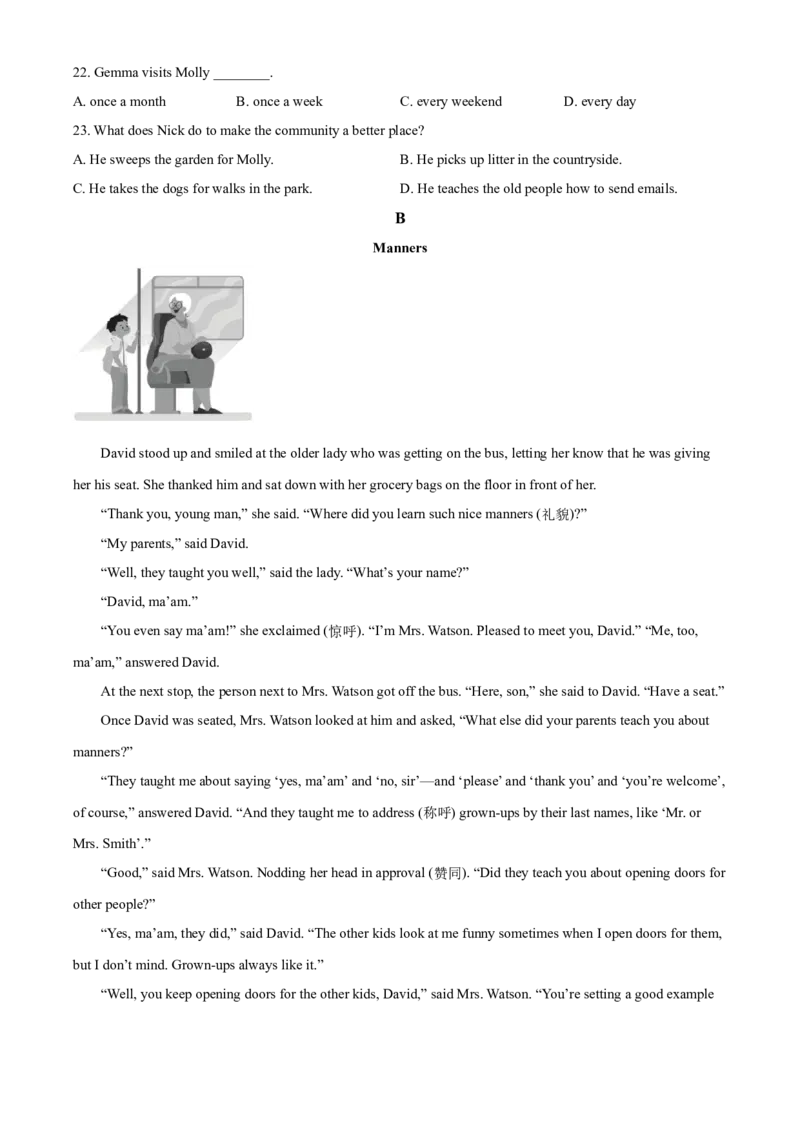
David stood up and smiled at the older lady who was getting on the bus, letting her know that he was giving
her his seat. She thanked him and sat down with her grocery bags on the floor in front of her.
“Thank you, young man,” she said. “Where did you learn such nice manners (礼貌)?”
“My parents,” said David.
“Well, they taught you well,” said the lady. “What’s your name?”
“David, ma’am.”
“You even say ma’am!” she exclaimed (惊呼). “I’m Mrs. Watson. Pleased to meet you, David.” “Me, too,
ma’am,” answered David.
At the next stop, the person next to Mrs. Watson got off the bus. “Here, son,” she said to David. “Have a seat.”
Once David was seated, Mrs. Watson looked at him and asked, “What else did your parents teach you about
manners?”
“They taught me about saying ‘yes, ma’am’ and ‘no, sir’—and ‘please’ and ‘thank you’ and ‘you’re welcome’,
of course,” answered David. “And they taught me to address (称呼) grown-ups by their last names, like ‘Mr. or
Mrs. Smith’.”
“Good,” said Mrs. Watson. Nodding her head in approval (赞同). “Did they teach you about opening doors for
other people?”
“Yes, ma’am, they did,” said David. “The other kids look at me funny sometimes when I open doors for them,
but I don’t mind. Grown-ups always like it.”
“Well, you keep opening doors for the other kids, David,” said Mrs. Watson. “You’re setting a good examplefor them.”
The next bus stop was in front of the city library. “This is where I get off,” said David, standing up. “It was
nice to meet you.” A young woman came toward the back door, and David walked aside to let her pass.
“This is my stop, too,” said Mrs. Watson. “I live near the library.”
As Mrs. Watson stood to move, she stumbled (蹒跚) a bit.
“May I hold your bags while you get off the bus?” asked David, stepping forward to help. “That would be
very nice. Thank you, David,” said Mrs. Watson.
24. When the old lady was getting on the bus, David ________.
A. said hello to her B. helped to take her bags
C. gave his seat to her D. walked aside to let her pass
25. Mrs. Watson thought David was setting a good example because ________.
A. some grown-ups always liked David B. he often read books in the city library
C. other children asked him to help them D. he always opened the door for others
26. According to the passage, David is ________.
A. funny and nice B. polite and helpful C. calm and careful D. kind and hardworking
27. The story mainly tells us ________.
A. learning good manners is too troublesome B. having good manners brings you a lot of problems
C. good manners help people get closer to one another D. good manners make children care about their parents
C
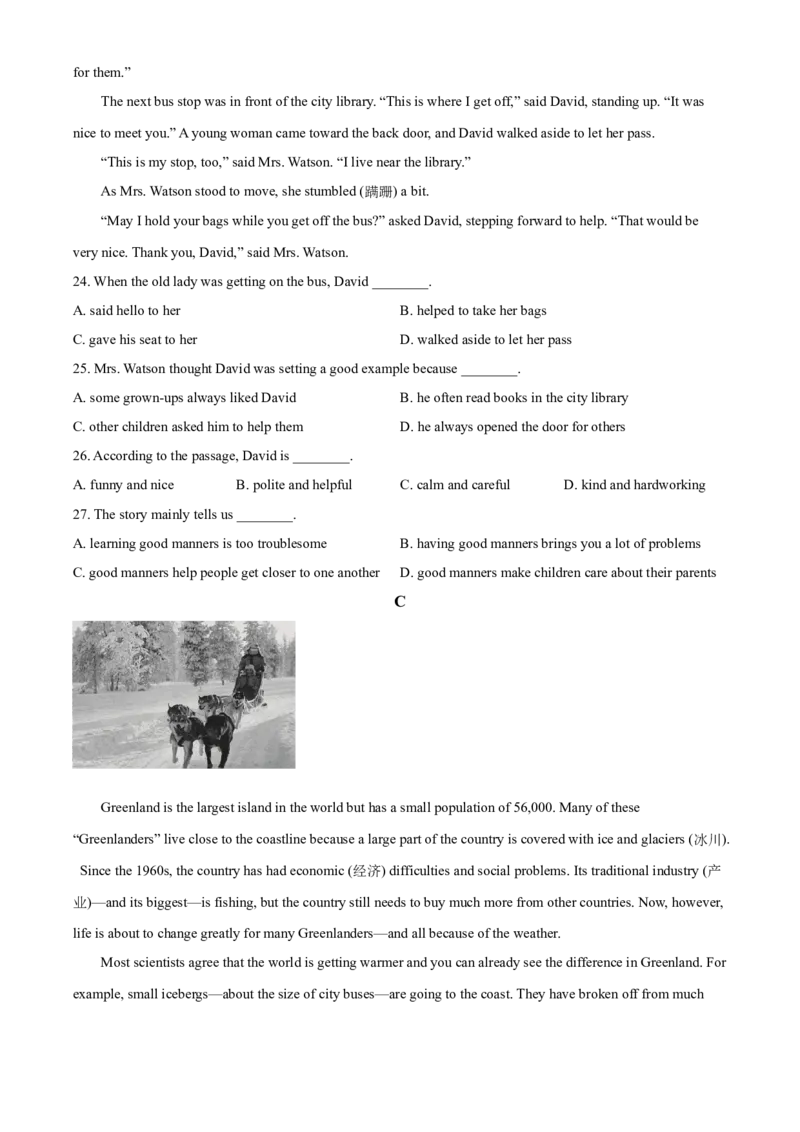
Greenland is the largest island in the world but has a small population of 56,000. Many of these
“Greenlanders” live close to the coastline because a large part of the country is covered with ice and glaciers (冰川).
Since the 1960s, the country has had economic (经济) difficulties and social problems. Its traditional industry (产
业)—and its biggest—is fishing, but the country still needs to buy much more from other countries. Now, however,
life is about to change greatly for many Greenlanders—and all because of the weather.
Most scientists agree that the world is getting warmer and you can already see the difference in Greenland. For
example, small icebergs—about the size of city buses—are going to the coast. They have broken off from muchlarger areas of ice further out in the sea because of the change in temperature. Furthermore, the huge sheet of ice
covering Greenland is getting smaller by about 75 cubic kilometres each year. If all of Greenland’s ice melted (融
化), sea levels across the world would rise by 7.5 metres.
One industry taking advantage of the melting ice is the oil industry. Nowadays, the sea around the west coast
of Greenland has no ice for six months of the year. Oil companies plan to drill for oil there in the next few years.
Greenlanders have mixed (混合的) feelings about it. The country’s prime minister, Kuupik Kleist, describes the
dilemma: “Greenlanders are the ones most exposed (受影响) to climate change, but we need a strong economy and
we have to make good use of the chance that oil could bring us …”
Farming will also change. The growing season is longer with springs arriving earlier and summers ending
,
later. On the one hand if the country produced more of its own food, it wouldn’t need to buy so much from other
countries. On the other hand, some farmers are worried that the drier summers might bring new problems.
For example, last year, it was so dry that farmers produced half the normal amount of food. Farming families
usually celebrate the beginning of summer by singing a traditional song. The song is about the importance of
summer in a place where, in the past, the winters were long and the summers were short. As nature and the weather
changes in Greenland, they might not sing this song in a hundred years’ time. Summer, summer, how wonderful!
How incredibly good!
The cold is gone,
The cold is gone…
28. What can we learn about Greenland?
A. Life will become quite different. B. The population will grow smaller.
C. People will be poorer and poorer. D. The ice and glaciers will get larger.
29. The word dilemma in Paragraph 3 probably means “________”.
A. great chances B. fast development C. difficult situation D. economic problems
30. Why did the farmers sing the traditional song in the past?
A. To show thanks to the old times. B. To say goodbye to the dry season.
C. To invite their friends to get together. D. To give a warm welcome to summer.
31. Which of the following would be the best title for the passage?
A. Rising sea levels B. The advantages of melting ice
C. Changing Greenland D. Different weather in Greenland
六、(共 10 分,每小题 2 分)
阅读短文,根据短文内容回答问题。
Diana was shopping in a busy store after work one evening. Just five minutes before closing time, she heard ashop worker saying, “Someone’s having a seizure (疾病突发)”.
Walking quickly towards the shop worker, Diana saw a shopper on the ground. She was lying on the floor,
jerking uncontrollably (控制不住地抽搐). A small group of people crowded to help the woman and a shop worker
called an ambulance.
.
Diana knew that she could use what she had learned from her first aid training to help as well
“The seizure was very different from the way people usually move,” Diana said. “The woman’s movements
were so powerful that her glasses flew off her face.”
Knowing it was important to keep the woman safe, one of the workers brought over a worker jacket and put it
under the woman’s head so she wouldn’t hurt herself.
“The seizure probably lasted only a few minutes, but it seemed much longer while it was going on,” Diana
said, “When the jerking stopped, a man helped turn the woman onto her side. I then tilted (倾斜) her head back to
help her keep breathing (呼吸). After the seizure, the woman seemed not to be able to understand what we were
saying and couldn’t speak. Luckily, I learned that this could happen after a seizure and it might take some time for
people to get back to feeling like their normal selves. It was such a relief (宽慰) when she finally answered that she
was OK.”
By this time, the ambulance was on its way, so the other shoppers who had helped left.
“As I was leaving, one of the store’s workers said, ‘Thank you for your kindness.’ I was very touched by her
words, and I told her that I’d learned first aid in case something like this ever happened, and now it had,” Diana
said, “Although the accident left me feeling very shaken, I was glad I knew what to do to help.”
32. Where did the accident happen?
____________________________________
33. What was wrong with the woman on the ground?
____________________________________
34. Why did the worker put a jacket under the woman’s head?
____________________________________35. How did Diana help the woman?
____________________________________
36. What can we learn from Diana’s experience?
____________________________________
书面表达(共 18 分)
七、根据中文意思和英文提示词语写出句子。(共 8 分,每小题 2 分)
37. 玲玲因她的小说而出名。(famous, novel)
____________________________________
38. 现在越来越多的人开始喜欢冰雪运动。(begin, ice sports)
____________________________________
39. 为了准备报告,昨天 Jack 很晚才回家。(prepare for)
____________________________________
40. 我没有听到你的电话,因为当时我正在照顾妹妹。(hear, look after)
____________________________________
八、文段表达(10 分)
41. 请根据中文和英文提示,完成一篇不少于50词的文段写作。文中已给出内容不计入总词数。所给提示
词语仅供选用。请不要写出你的校名和姓名。
学校的英文公众号正在开展主题为“我与北京传统文化 (traditional culture)” 的征文活动。请你结合自
己的经历,写一篇短文投稿,谈一谈你去了哪里,做了哪些体验北京传统文化的事情,以及你的感受。
提示词语:visit, taste, Beijing Opera, experience, great
提示问题:● Where did you go?
● What did you do there?
●How did you feel?
Beijing is the capital city with a long history and rich culture.
____________________________________________________________________________________________
____________________________________________________________________________________________
____________________________________________________________________________________________
____________________________________________________________________________________________
____________________________________________________________________________________________
____________________________________________________________________________________________
_______________
九、选做题(共 10 分,第 1、3小题各 3 分,第2小题 4 分)阅读下面短文,根据题目要求用英文回答问题。
Wild animals in the neighborhood
Sometimes people might see wild animals in unusual places. A coyote might appear on a city street, and bears
may show up on porches.
Raccoons often empty rubbish bins in human neighborhoods (人类居民区). They come to the human’s world
to find food. Usually these animals live in the trees and forests of the world, but lately, changes in these areas have
caused animals to find new ways to feed and house themselves.
The problems for animals start when the people use animal land to build human homes. As the population of
the world grows, more and more houses and buildings spring up. Developing land makes animals living in the area
move out. When an animal’s home is destroyed (遭到破坏), it has to find a new place to live.
Destroying the homes of animals causes several problems. One problem is the extinction (灭绝) of some
species. For example, eagles need a place to nest and lay eggs. If eagles do not have places to live, they will stop
laying eggs. So, people would miss the beauty of the eagle.
The destruction of animal homes causes other problems. One is the movement of animals into human areas.
Coyotes that cannot find food in the desert will search anywhere for something to eat. Coyotes are hunters and must
find food wherever it might be. When bears cannot find enough food to eat in the forest, they may look for food
from human homes. Sometimes running into a bear can be dangerous.
Many people know saving animal homes is important. Some governments understand the need to stop
destroying animal homes. One state’s laws (法律) make builders replace trees they cut down by planting about 100
million new trees every year. Trees also clean the air and help keep pollution from getting into the waterways.
Children can also make a big difference in keeping animal homes safe. One group of students in a city
borrowed a piece of land and asked the city to pass laws to protect it. The government agreed, so now it is notallowed to build on the land. The students use the land to plant trees and grow gardens.
Humans and animals share this earth. Sometimes we run into their homes, and sometimes they run into ours.
We have to learn as much as we can about the animals we share the world with. And we also should learn how to
keep the delicate balance (微妙的平衡) between the huge needs of human population and the laws of nature.
42. According to the passage, why do wild animals come to human neighborhoods?
______________________________________________
43. What do you think of wild animals in human neighborhoods? Why do you think so? (In about 40 words)
____________________________________________________________________________________________
____________________________________________________________________________________________
_____________________________________________________
44. What should we do to get on well with wild animals?
______________________________________________本试卷的题干、答案和解析均由组卷网(http://zujuan.xkw.com)专业教师团队编校出品。
登录组卷网可对本试卷进行单题组卷、细目表分析、布置作业、举一反三等操作。
试卷地址:在组卷网浏览本卷
组卷网(http://zujuan.xkw.com)是学科网旗下智能题库,拥有小初高全学科超千万精品试题。
微信关注组卷网,了解更多组卷技能
学科网长期征集全国最新统考试卷、名校试卷、原创题,赢取丰厚稿酬,欢迎合作。
钱老师 QQ:537008204 曹老师 QQ:713000635