2014 年全国硕士研究生入学统一考试
英语(一)试题
Section Ⅰ Use of English
Directions: Read the following text. Choose the best word(s) for each numbered blank and mark
A, B, C or D on the ANSWER SHEET. (10 points)
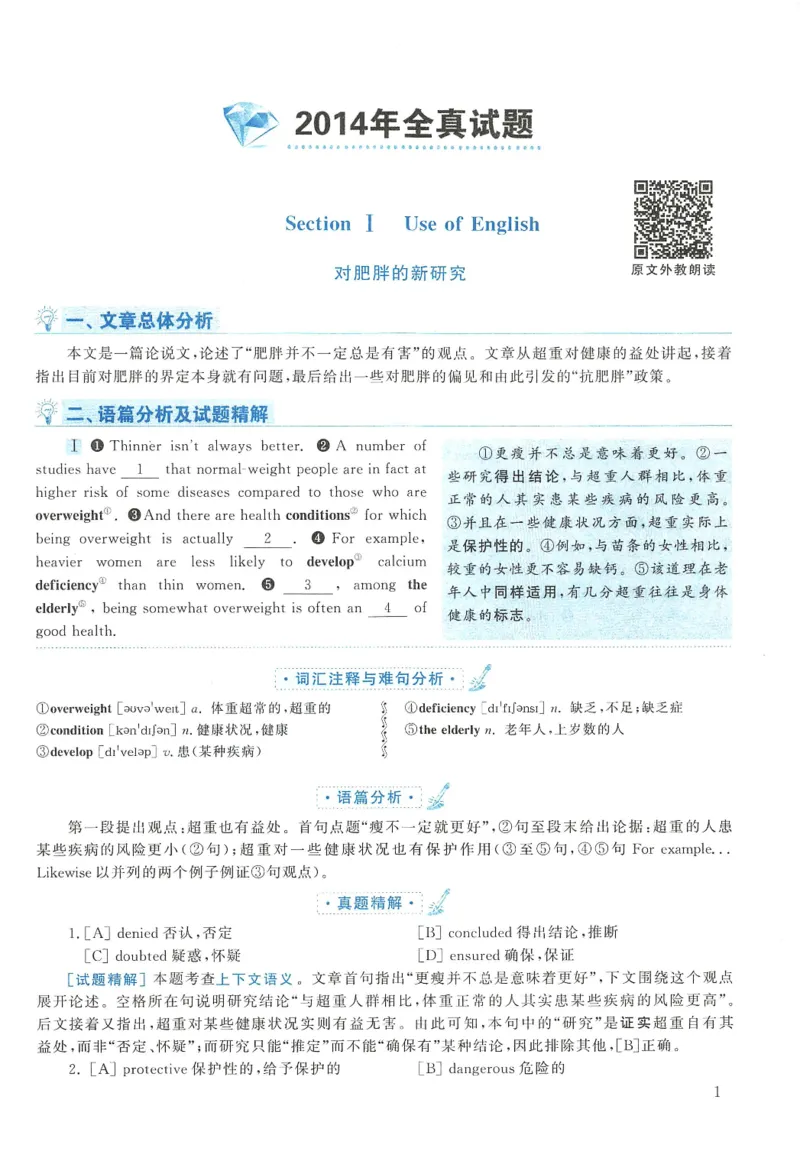
As many people hit middle age, they often start to notice that their memory and mental
clarity are not what they used to be. We suddenly can’t remember ___1___ we put the keys just a
moment ago, or an old acquaintance’s name, or the name of an old band we used to love. As the
brain___2___, we refer to these occurrences as “senior moments.”___3___seemingly innocent,
this loss of mental focus can potentially have a(n)___4___impact on our professional, social, and
personal___5___.
Neuroscientists, experts who study the nervous system, are increasingly showing that there’s
actually a lot that can be done. It___6___out that the brain needs exercise in much the same way
our muscles do, and the right mental___7___can significantly improve our basic
cognitive___8___. Thinking is essentially a___9___of making connections in the brain. To a
certain extent, our ability to___10___in making the connections that drive intelligence is
inherited.___11___, because these connections are made through effort and practice, scientists
believe that intelligence can expand and fluctuate___12___mental effort.
Now, a new Web-based company has taken it a step___13___and developed the first “brain
training program” designed to actually help people improve and regain their mental___14___.
The Web-based program___15___you to systematically improve your memory and attention
skills. The program keeps___16___of your progress and provides detailed feedback___17___your
performance and improvement. Most importantly, it___18___modifies and enhances the games
you play to___19___on the strengths you are developing—much like a(n)___20___exercise
routine requires you to increase resistance and vary your muscle use.
1.[A] where [B] when [C] that [D] why
2.[A] improves [B] fades [C] recovers [D] collapses
3.[A] If [B] Unless [C] Once [D] While
4.[A] uneven [B] limited [C] damaging [D] obscure
5.[A] wellbeing [B] environment [C] relationship [D] outlook
6.[A] turns [B] finds [C] points [D] figures
7.[A] roundabouts [B] responses [C] workouts [D] associations
8.[A] genre [B] functions [C] circumstances [D] criterion
9.[A] channel [B] condition [C] sequence [D] process
10.[A] persist [B] believe [C] excel [D] feature
11.[A] Therefore [B] Moreover [C] Otherwise [D] However
12.[A] according to [B] regardless of [C] apart from [D] instead of
13.[A] back [B] further [C] aside [D] around
14.[A] sharpness [B] stability [C] framework [D] flexibility
15.[A] forces [B] reminds [C] hurries [D] allows
16.[A] hold [B] track [C] order [D] pace
17.[A]to [B] with [C] for [D] on
18.[A] irregularly [B] habitually [C] constantly [D] unusually
119.[A] carry [B] put [C] build [D] take
20.[A] risky [B] effective [C] idle [D] familiar
Section Ⅱ Reading Comprehension
Part A
Directions:Read the following four texts. Answer the questions below each text by choosing A,
B, C or D. Mark your answers on theANSWER SHEET. (40 points)
Text 1
In order to “change lives for the better” and reduce “dependency,” George Osborne,
Chancellor of the Exchequer, introduced the “upfront work search” scheme. Only if the jobless
arrive at the jobcentre with a CV, register for online job search, and start looking for work will
they be eligible for benefit—and then they should report weekly rather than fortnightly. What
could be more reasonable?
More apparent reasonableness followed. There will now be a seven-day wait for the
jobseeker’s allowance. “Those first few days should be spent looking for work, not looking to
sign on,” he claimed. “We’re doing these things because we know they help people stay off
benefits and help those on benefits get into work faster.” Help? Really? On first hearing, this was
the socially concerned chancellor, trying to change lives for the better, complete with “reforms” to
an obviously indulgent system that demands too little effort from the newly unemployed to find
work, and subsidises laziness. What motivated him, we were to understand, was his zeal for
“fundamental fairness”—protecting the taxpayer, controlling spending and ensuring that only the
most deserving claimants received their benefits.
Losing a job is hurting: you don’t skip down to the jobcentre with a song in your heart,
delighted at the prospect of doubling your income from the generous state. It is financially
terrifying, psychologically embarrassing and you know that support is minimal and extraordinarily
hard to get. You are now not wanted; you are now excluded from the work environment that offers
purpose and structure in your life. Worse, the crucial income to feed yourself and your family and
pay the bills has disappeared. Ask anyone newly unemployed what they want and the answer is
always: a job.
But in Osborneland, your first instinct is to fall into dependency—permanent dependency if
you can get it—supported by a state only too ready to indulge your falsehood. It is as though 20
years of ever-tougher reforms of the job search and benefit administration system never happened.
The principle of British welfare is no longer that you can insure yourself against the risk of
unemployment and receive unconditional payments if the disaster happens. Even the very phrase
“jobseeker’s allowance” is about redefining the unemployed as a “jobseeker” who had no
fundamental right to a benefit he or she has earned through making national insurance
contributions. Instead, the claimant receives a time-limited “allowance,” conditional on actively
seeking a job; no entitlement and no insurance, at £71.70 a week, one of the least generous in the
EU.
21. George Osborne’s scheme was intended to
[A]provide the unemployed with easier access to benefits.
[B]encourage jobseekers’ active engagement in job seeking.
[C]motivate the unemployed to report voluntarily.
[D]guarantee jobseekers’ legitimate right to benefits.
222. The phrase “to sign on” (Line 3,Para.2) most probably means
[A]to check on the availability of jobs at the jobcentre.
[B]to accept the government’s restrictions on the allowance.
[C]to register for an allowance from the government.
[D]to attend a governmental job-training program.
23. What promoted the chancellor to develop his scheme?
[A]A desire to secure a better life for all.
[B]An eagerness to protect the unemployed.
[C]An urge to be generous to the claimants.
[D]A passion to ensure fairness for taxpayers.
24. According to Paragraph 3, being unemployed makes one feel
[A]uneasy.
[B]enraged.
[C]insulted.
[D]guilty.
25. To which of the following would the author most probably agree?
[A]The British welfare system indulges jobseekers’ laziness.
[B]Osborne’s reforms will reduce the risk of unemployment.
[C]The jobseekers’ allowance has met their actual needs.
[D]Unemployment benefits should not be made conditional.
Text 2
All around the world, lawyers generate more hostility than the members of any other
profession—with the possible exception of journalism. But there are few places where clients have
more grounds for complaint than America.
During the decade before the economic crisis, spending on legal services in America grew
twice as fast as inflation. The best lawyers made skyscrapers-full of money, tempting ever more
students to pile into law schools. But most law graduates never get a big-firm job. Many of them
instead become the kind of nuisance-lawsuit filer that makes the tort system a costly nightmare.
There are many reasons for this. One is the excessive costs of a legal education. There is just
one path for a lawyer in most American states: a four-year undergraduate degree in some
unrelated subject, then a three-year law degree at one of 200 law schools authorized by the
American Bar Association and an expensive preparation for the bar exam. This leaves today’s
average law-school graduate with $100,000 of debt on top of undergraduate debts. Law-school
debt means that they have to work fearsomely hard.
Reforming the system would help both lawyers and their customers. Sensible ideas have been
around for a long time, but the state-level bodies that govern the profession have been too
conservative to implement them. One idea is to allow people to study law as an undergraduate
degree. Another is to let students sit for the bar after only two years of law school. If the bar exam
is truly a stern enough test for a would-be lawyer, those who can sit it earlier should be allowed to
do so.Students who do not need the extra training could cut their debt mountain by a third.
The other reason why costs are so high is the restrictive guild-like ownership structure of the
business. Except in the District of Columbia, non-lawyers may not own any share of a law firm.
This keeps fees high and innovation slow. There is pressure for change from within the profession,
3but opponents of change among the regulators insist that keeping outsiders out of a law firm
isolates lawyers from the pressure to make money rather than serve clients ethically.
In fact,allowing non-lawyers to own shares in law firms would reduce costs and improve
services to customers, by encouraging law firms to use technology and to employ professional
managers to focus on improving firms’ efficiency. After all, other countries, such as Australia and
Britain, have started liberalizing their legal professions. America should follow.
26. A lot of students take up law as their profession due to
[A]the growing demand from clients.
[B]the increasing pressure of inflation.
[C]the prospect of working in big firms.
[D]the attraction of financial rewards.
27.Which of the following adds to the costs of legal education in most American states?
[A]Higher tuition fees for undergraduate studies.
[B]Admissions approval from the bar association.
[C]Pursuing a bachelor’s degree in another major.
[D]Receiving training by professional associations.
28.Hindrance to the reform of the legal system originates from
[A]lawyers’ and clients’ strong resistance
[B]the rigid bodies governing the profession
[C]the stern exam for would-be lawyers
[D]non-professionals’ sharp criticism
29.The guild-like ownership structure is considered “restrictive” partly because it
[A]bans outsiders’ involvement in the profession.
[B]keeps lawyers from holding law-firm shares.
[C]aggravates the ethical situation in the trade.
[D]prevents lawyers from gaining due profits.
30.In this text, the author mainly discusses
[A]flawed ownership of America’s law firms and its causes
[B]the factors that help make a successful lawyer in America
[C]a problem in America’s legal profession and solutions to it
[D]the role of undergraduate studies in America’s legal education
Text 3
The US$3-million Fundamental Physics Prize is indeed an interesting experiment, as
Alexander Polyakov said when he accepted this year’s award in March. And it is far from the only
one of its type. As a News Feature article in Nature discusses, a string of lucrative awards for
researchers have joined the Nobel Prizes in recent years. Many, like the Fundamental Physics
Prize, are funded from the telephone-number-sized bank accounts of Internet entrepreneurs. These
benefactors have succeeded in their chosen fields, they say, and they want to use their wealth to
draw attention to those who have succeeded in science.
What’s not to like? Quite a lot, according to a handful of scientists quoted in the News
Feature. You cannot buy class, as the old saying goes, and these upstart entrepreneurs cannot buy
their prizes the prestige of the Nobels. The new awards are an exercise in self-promotion for those
4behind them, say scientists. They could distort the achievement-based system of peer-review-led
research. They could cement the status quo of peer-reviewed research. They do not fund peer-
reviewed research. They perpetuate the myth of the lone genius.
The goals of the prize-givers seem as scattered as the criticism. Some want to shock, others to
draw people into science, or to better reward those who have made their careers in research.
As Nature has pointed out before, there are some legitimate concerns about how science
prizes—both new and old—are distributed. The Breakthrough Prize in Life Sciences, launched
this year, takes an unrepresentative view of what the life sciences include. But the Nobel
Foundation’s limit of three recipients per prize, each of whom must still be living, has long been
outgrown by the collaborative nature of modern research—as will be demonstrated by the
inevitable row over who is ignored when it comes to acknowledging the discovery of the Higgs
boson. The Nobels were, of course, themselves set up by a very rich individual who had decided
what he wanted to do with his own money. Time, rather than intention, has given them legitimacy.
As much as some scientists may complain about the new awards, two things seem clear. First,
most researchers would accept such a prize if they were offered one. Second, it is surely a good
thing that the money and attention come to science rather than go elsewhere. It is fair to criticize
and question the mechanism—that is the culture of research, after all—but it is the prize-givers’
money to do with as they please. It is wise to take such gifts with gratitude and grace.
31. The Fundamental PhysicsPrize is seen as
[A]a symbol of the entrepreneurs’ wealth.
[B]a possible replacement of the Nobel Prizes.
[C]an example of bankers’ investments.
[D]a handsome reward for researchers.
32. The critics think that the new awards will most benefit
[A]the profit-oriented scientists.
[B]the founders of the awards.
[C]the achievement-based system.
[D]peer-review-led research.
33. The discovery of the Higgs boson is a typical case which involves
[A] controversies over the recipients’ status.
[B] the joint effort of modern researchers.
[C] legitimate concerns over the new prizes.
[D] the demonstration of research findings.
34. According to Paragraph 4, which of the following is true of the Nobels?
[A] Their endurance has done justice to them.
[B] Their legitimacy has long been in dispute.
[C] They are the most representative honor.
[D] History has never cast doubt on them.
35. The author believes that the new awards are
[A]acceptable despite the criticism.
[B]harmful to the culture of research.
[C]subject to undesirable changes.
[D]unworthy of public attention.
5Text 4
“The Heart of the Matter,” the just-released report by the American Academy of Arts and
Sciences (AAAS), deserves praise for affirming the importance of the humanities and social
sciences to the prosperity and security of liberal democracy in America. Regrettably, however, the
report’s failure to address the true nature of the crisis facing liberal education may cause more
harm than good.
In 2010, leading congressional Democrats and Republicans sent letters to the AAASasking
that it identify actions that could be taken by “federal, state and local governments, universities,
foundations, educators, individual benefactors and others” to “maintain national excellence in
humanities and social scientific scholarship and education.”In response, the American Academy
formed the Commission on the Humanities and Social Sciences. Among the commission’s 51
members are top-tier-university presidents, scholars, lawyers, judges, and business executives, as
well as prominent figures from diplomacy, filmmaking, music and journalism.
The goals identified in the report are generally admirable. Because representative government
presupposes an informed citizenry, the report supports full literacy; stresses the study of history
and government, particularly American history and American government; and encourages the use
of new digital technologies.To encourage innovation and competition, the report calls for
increased investment in research, the crafting of coherent curricula that improve students’ ability
to solve problems and communicate effectively in the 21st century, increased funding for teachers
and the encouragement of scholars to bring their learning to bear on the great challenges of the
day. The report also advocates greater study of foreign languages, international affairs and the
expansion of study abroad programs.
Unfortunately, despite 2½ years in the making, “The Heart of the Matter” never gets to the
heart of the matter: the illiberal nature of liberal education at our leading colleges and
universities.The commission ignores that for several decades America’s colleges and universities
have produced graduates who don’t know the content and character of liberal education and are
thus deprived of its benefits. Sadly, the spirit of inquiry once at home on campus has been
replaced by the use of the humanities and social sciences as vehicles for publicizing
“progressive,” or left-liberal propaganda.
Today, professors routinely treat the progressive interpretation of history and progressive
public policy as the proper subject of study while portraying conservative or classical liberal ideas
—such as free markets or self-reliance —as falling outside the boundaries of routine, and
sometimes legitimate, intellectual investigation.
The AAAS displays great enthusiasm for liberal education. Yet its report may well set back
reform by obscuring the depth and breadth of the challenge that Congress asked it to illuminate.
36. According to Paragraph 1, what is the author’s attitude toward the AAAS’s report?
[A] Critical.
[B] Appreciative.
[C] Contemptuous.
[D] Tolerant.
37. Influential figures in the Congress required that the AAAS report on how to
[A] retain people’s interest in liberal education.
[B] define the government’s role in education.
[C] keep a leading position in liberal education.
6[D] safeguard individuals’ rights to education.
38. According to Paragraph 3, the report suggests
[A] an exclusive study of American history.
[B] a greater emphasis on theoretical subjects.
[C] the application of emerging technologies.
[D] funding for the study of foreign languages.
39. The author implies in Paragraph 5 that professors are
[A] supportive of free markets.
[B] cautious about intellectual investigation.
[C] conservative about public policy.
[D] biased against classical liberal ideas.
40. Which of the following would be the best title for the text?
[A] Ways to Grasp “The Heart of the Matter”
[B] Illiberal Education and “The Heart of the Matter”
[C] The AAAS’s Contribution to Liberal Education
[D] Progressive Policy vs. Liberal Education
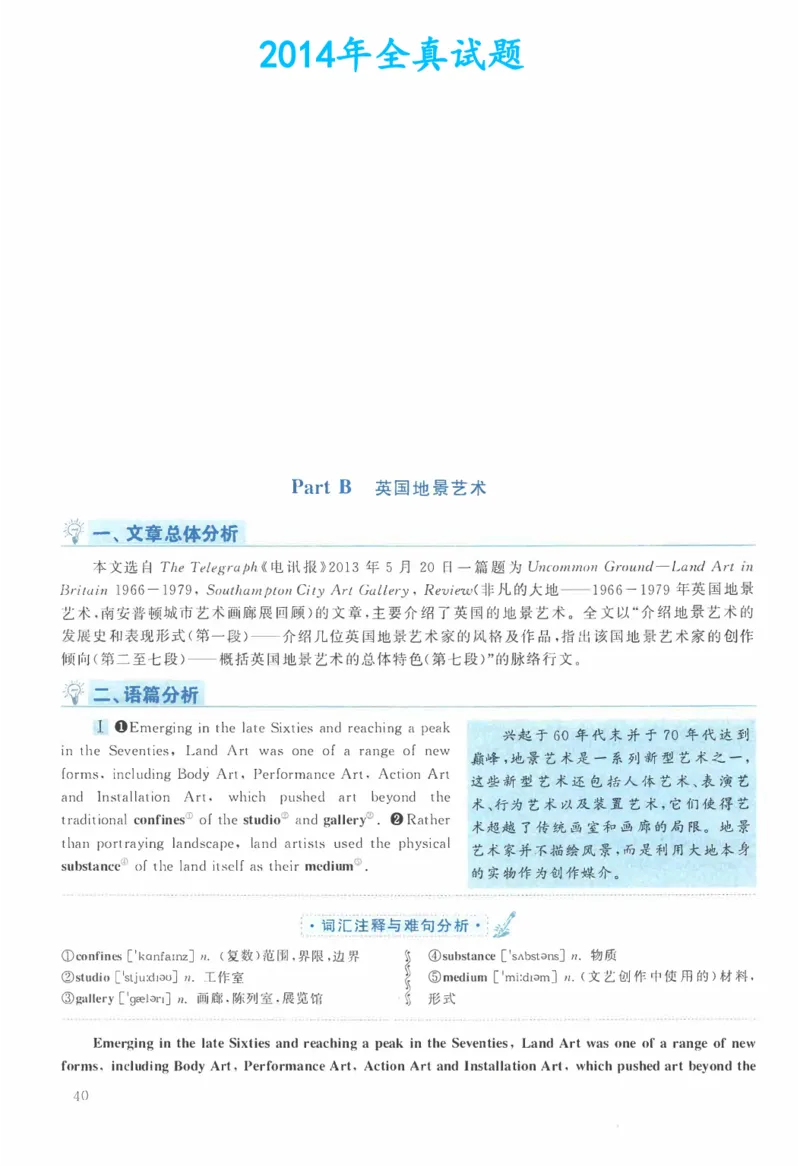
Part B
Directions:
The following paragraphs are given in a wrong order. For Questions 41-45, you are required to
reorganize these paragraphs into a coherent text by choosing from the list A-G and filling them
into the numbered boxes. Paragraphs A and E have been correctly placed. Mark your answers
on the ANSWER SHEET.(10 points)
[A] Some archaeological sites have always been easily observable—for example, the Parthenon in
Athens, Greece; the pyramids of Giza in Egypt; and the megaliths of Stonehenge in southern
England. But these sites are exceptions to the norm.Most archaeological sites have been located by
means of careful searching, while many others have been discovered by accident. Olduvai Gorge,
an early hominid site in Tanzania, was found by abutterfly hunter who literally fell into its deep
valley in 1911.Thousands of Aztec artifacts came to light during the digging of the Mexico City
subway in the 1970s.
[B] In another case, American archaeologists RenéMillion and George Cowgill spent years
systematically mapping the entire city of Teotihuacan in the Valley of Mexico near what is now
Mexico City. At its peak around AD 600, this city was one of the largest human settlements in the
world. The researchers mapped not only the city’s vast and ornate ceremonial areas, but also
hundreds of simpler apartment complexes where common people lived.
[C] How do archaeologists know where to find what they are looking for when there is nothing
visible on the surface of the ground? Typically, they survey and sample (make test excavations
on) large areas of terrain to determine where excavation will yield useful information. Surveys and
test samples have also become important for understanding the larger landscapes that contain
archaeological sites.
[D] Surveys can cover a single large settlement or entire landscapes. In one case, many researchers
working around the ancient Maya city of Copán, Honduras, have located hundreds of small rural
villages and individual dwellings by using aerial photographs and by making surveys on foot. The
7resulting settlement maps show how the distribution and density of the rural population around the
city changed dramatically between AD 500 and 850, when Copán collapsed.
[E] To find their sites, archaeologists today rely heavily on systematic survey methods and a
variety of high-technology tools and techniques. Airborne technologies, such as different types of
radar and photographic equipment carried by airplanes or spacecraft, allow archaeologists to learn
about what lies beneath the ground without digging. Aerial surveys locate general areas of interest
or larger buried features, such as ancient buildings or fields.
[F] Most archaeological sites, however, are discovered by archaeologists who have set out to look
for them. Such searches can take years. British archaeologist Howard Carter knew that the tomb of
the Egyptian pharaoh Tutankhamun existed from information found in other sites. Carter sifted
through rubble in the Valley of the Kings for seven years before he located the tomb in 1922. In
the late 1800s British archaeologist Sir Arthur Evans combed antique dealers’ stores in Athens,
Greece. He was searching for tiny engraved seals attributed to the ancient Mycenaean culture that
dominated Greece from the 1400s to 1200s BC. Evans’s interpretations of these engravings
eventually led him to find the Minoan palace at Knossos (Knossós), on the island of Crete, in
1900.
[G] Ground surveys allow archaeologists to pinpoint the places where digs will be successful.
Most ground surveys involve a lot of walking, looking for surface clues such as small fragments
of pottery. They often include a certain amounts of digging to test for buried materials at selected
points across a landscape. Archaeologists also may locate buried remains by using such
technologies as ground radar, magnetic-field recording, and metal detectors. Archaeologists
commonly use computers to map sites and the landscapes around sites. Two- and three-
dimensional maps are helpful tools in planning excavations, illustrating how sites look, and
presenting the results of archaeological research.
41.→ A → 42. → E →43.→ 44.→ 45.
Part C
Directions:
Read the following text carefully and then translate the underlined segments into Chinese. Your
translation should be written neatly on the ANSWER SHEET. (10 points)
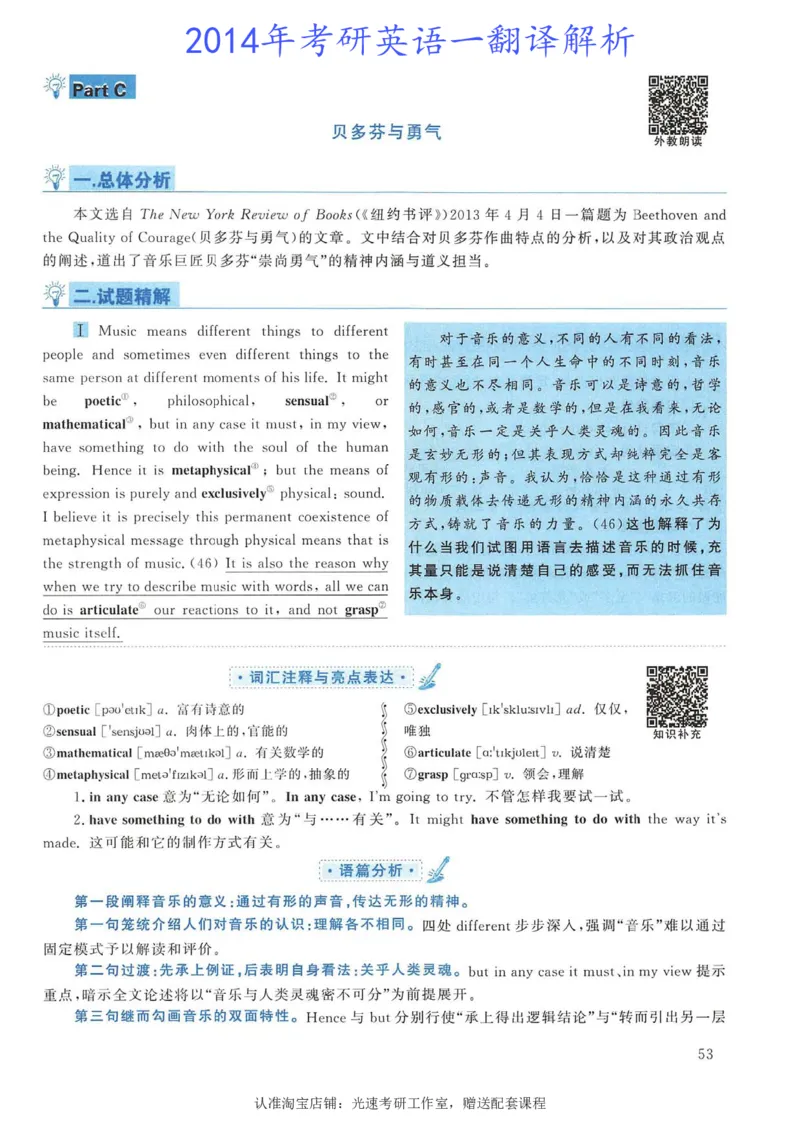
Music means different things to different people and sometimes even different things to the
same person at different moments of his life. It might be poetic, philosophical, sensual, or
mathematical, but in any case it must, in my view, have something to do with the soul of the
human being. Hence it is metaphysical; but the means of expression is purely and exclusively
physical: sound. I believe it is precisely this permanent coexistence of metaphysical message
through physical means that is the strength of music. (46) It is also the reason why when we try
to describe music with words, all we can do is articulate our reactions to it, and not grasp music
itself.
Beethoven’s importance in music has been principally defined by the revolutionary nature
of his compositions. He freed music from hitherto prevailing conventions of harmony and
structure. Sometimes I feel in his late works a will to break all signs of continuity. The music is
abrupt and seemingly disconnected, as in the last piano sonata. In musical expression, he did not
feel restrained by the weight of convention. (47) By all accounts he was a freethinking person,
and a courageous one, and I find courage an essential quality for the understanding, let alone the
8performance, of his works.
This courageous attitude in fact becomes a requirement for the performers of Beethoven’s
music. His compositions demand the performer to show courage, for example in the use of
dynamics. (48) Beethoven’s habit of increasing the volume with an extreme intensity and then
abruptly following it with a sudden soft passage was only rarely used by composers before him.
Beethoven was a deeply political man in the broadest sense of the word. He was not
interested in daily politics, but concerned with questions of moral behavior and the larger
questions of right and wrong affecting the entire society. (49) Especially significant was his view
of freedom, which, for him, was associated with the rights and responsibilities of the individual:
he advocated freedom of thought and of personal expression.
Beethoven’s music tends to move from chaos to order as if order were an imperative of
human existence. For him, order does not result from forgetting or ignoring the disorders that
plague our existence; order is a necessary development, an improvement that may lead to the
Greek ideal of spiritual elevation. It is not by chance that the Funeral March is not the last
movement of the Eroica Symphony, but the second, so that suffering does not have the last word.
(50) One could interpret much of the work of Beethoven by saying that suffering is inevitable, but
the courage to fight it renders life worth living.
Section III Writing
Part A
51.Directions:
Write a letter of about 100 words to the president of your university, suggesting how to
improve students’ physical condition.
You should include the details you think necessary.
You should write neatly on the ANSWER SHEET.
Do notsign your own name at the end of the letter. Use “Li Ming” instead.
Do notwrite the address.(10 points)
Part B
52.Directions:
Write an essay of 160-200 words based on the following drawing. In your essay, you should
1)describe the drawing briefly,
2)interpret its intended meaning, and
3)give your comments.
You should write neatly on the ANSWER SHEET. (20 points)
92014 年试题精读透析
10Section Ⅰ Use of English (10 points)
1. A 2. B 3. D 4. C 5. A 6. A 7. C 8. B 9. D 10. C
11. D 12. A 13. B 14. A 15. D 16. B 17. D 18. C 19. C 20. B
Section Ⅱ Reading Comprehension (60 points)
Part A (40 points)
21. B 22. C 23. D 24. A 25. D 26. D 27. C 28. B 29. A 30. C
31. D 32. B 33. B 34. A 35. A 36. A 37. C 38. C 39. D 40. B
Part B (10 points)
41. C 42. F 43. G 44. D 45. B
Part C (10 points)
46. 这也解释了为何当我们力图用语言描述音乐时只能说清对它的感受,而无法抓住
音乐本身。
47. 人们都认为贝多芬是个思想自由且勇敢无畏的人,我认为勇气是理解其作品的关
键,更不用说演奏其作品了。
48. 贝多芬惯于先把乐曲的音量增到极致,然后再突然跟上一段轻柔的段落,在他之
前,鲜有作曲家运用这样的手段。
49.尤为重要的是他对自由的看法,对他而言,自由与个人的权利和义务息息相关,
他提倡思想和个人言论的自由。
50. 贝多芬的大部分作品可以这样来解读:痛苦是不可避免的,但是战胜痛苦的勇气
使活着更有意义。
11