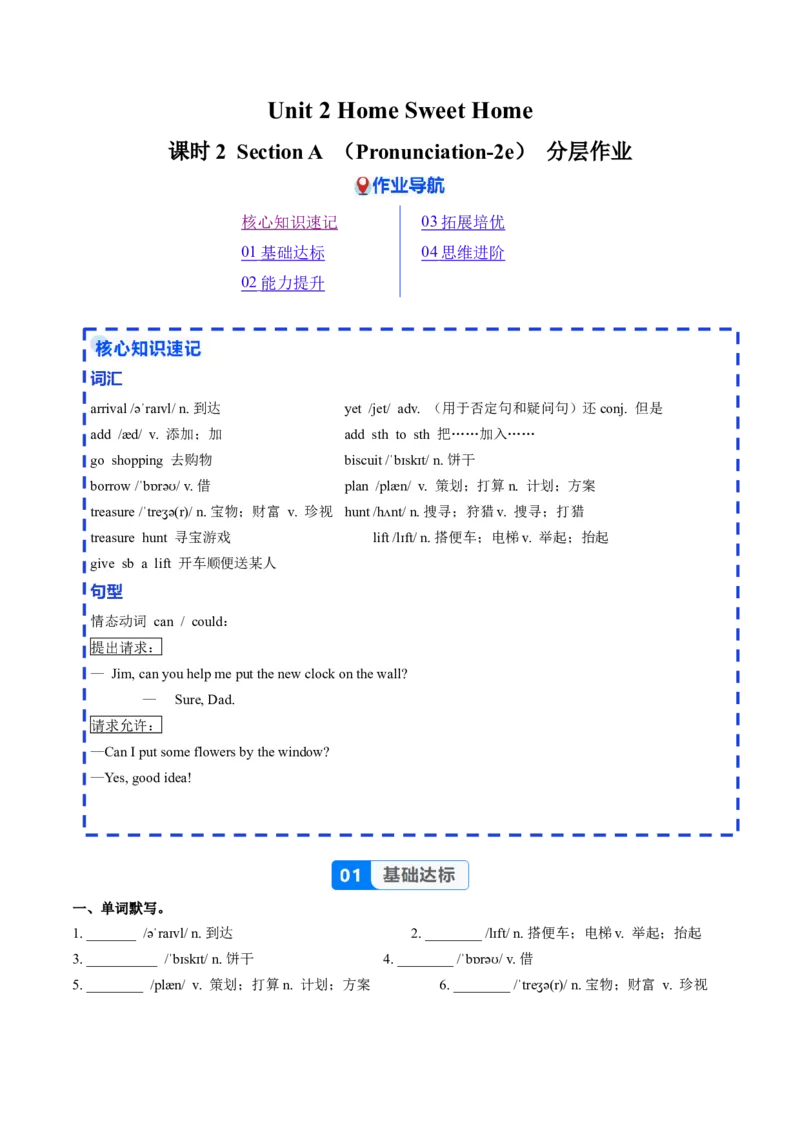
Unit 2 Home Sweet Home
课时 2 Section A (Pronunciation-2e) 分层作业
核心知识速记 03 拓展培优
01 基础达标 0 4 思维进阶
02 能力提升
词汇
arrival /əˈraɪvl/ n. 到达 yet /jet/ adv. (用于否定句和疑问句)还conj. 但是
add /æd/ v. 添加;加 add sth to sth 把……加入……
go shopping 去购物 biscuit /ˈbɪskɪt/ n. 饼干
borrow /ˈbɒrəʊ/ v. 借 plan /plæn/ v. 策划;打算n. 计划;方案
treasure /ˈtreʒə(r)/ n. 宝物;财富 v. 珍视 hunt /hʌnt/ n. 搜寻;狩猎v. 搜寻;打猎
treasure hunt 寻宝游戏 lift /lɪft/ n. 搭便车;电梯v. 举起;抬起
give sb a lift 开车顺便送某人
句型
情态动词 can / could:
提出请求:
— Jim, can you help me put the new clock on the wall?
— Sure, Dad.
请求允许:
—Can I put some flowers by the window?
—Yes, good idea!
一、单词默写。
1. _______ /əˈraɪvl/ n. 到达 2. ________ /lɪft/ n. 搭便车;电梯v. 举起;抬起
3. __________ /ˈbɪskɪt/ n. 饼干 4. ________ /ˈbɒrəʊ/ v. 借
5. ________ /plæn/ v. 策划;打算n. 计划;方案 6. ________ /ˈtreʒə(r)/ n. 宝物;财富 v. 珍视二、词组默写。
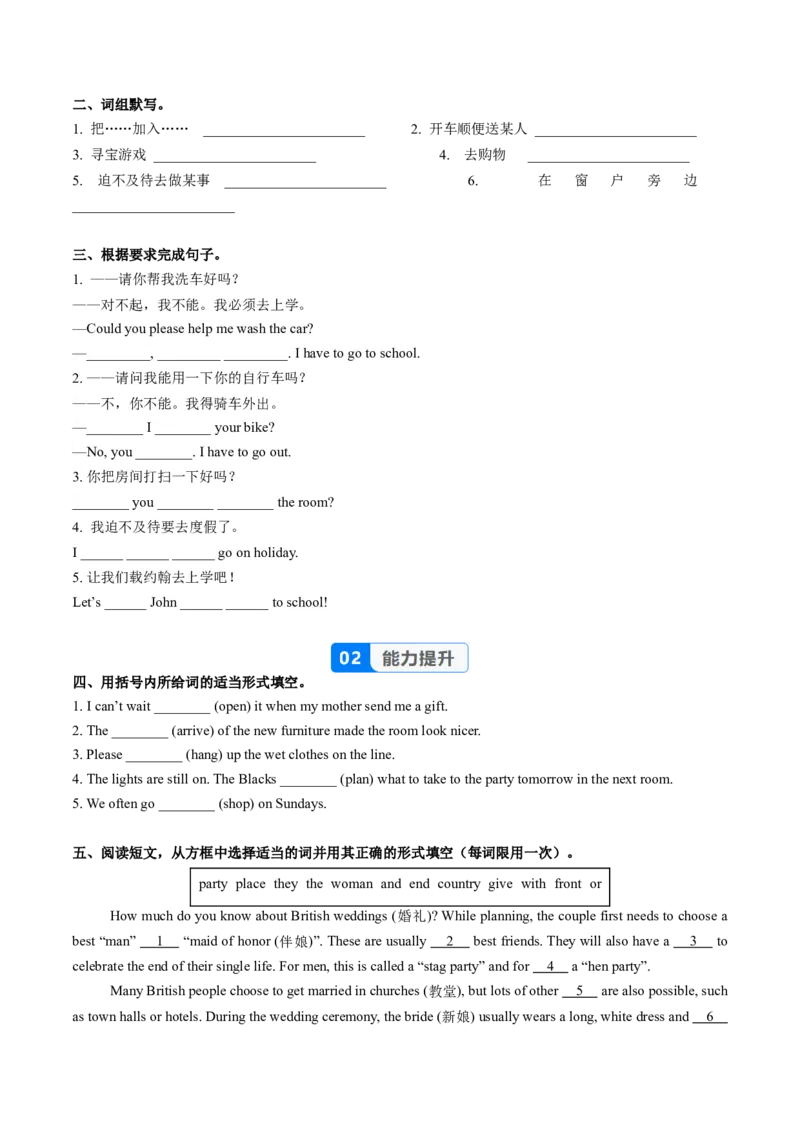
1. 把……加入…… _______________________ 2. 开车顺便送某人 _______________________
3. 寻宝游戏 _______________________ 4. 去购物 _______________________
5. 迫不及待去做某事 _______________________ 6. 在 窗 户 旁 边
_______________________
三、根据要求完成句子。
1. ——请你帮我洗车好吗?
——对不起,我不能。我必须去上学。
—Could you please help me wash the car?
—_________, _________ _________. I have to go to school.
2. ——请问我能用一下你的自行车吗?
——不,你不能。我得骑车外出。
—________ I ________ your bike?
—No, you ________. I have to go out.
3. 你把房间打扫一下好吗?
________ you ________ ________ the room?
4. 我迫不及待要去度假了。
I ______ ______ ______ go on holiday.
5. 让我们载约翰去上学吧!
Let’s ______ John ______ ______ to school!
四、用括号内所给词的适当形式填空。
1. I can’t wait ________ (open) it when my mother send me a gift.
2. The ________ (arrive) of the new furniture made the room look nicer.
3. Please ________ (hang) up the wet clothes on the line.
4. The lights are still on. The Blacks ________ (plan) what to take to the party tomorrow in the next room.
5. We often go ________ (shop) on Sundays.
五、阅读短文,从方框中选择适当的词并用其正确的形式填空(每词限用一次)。
party place they the woman and end country give with front or
How much do you know about British weddings (婚礼)? While planning, the couple first needs to choose a
best “man” 1 “maid of honor (伴娘)”. These are usually 2 best friends. They will also have a 3 to
celebrate the end of their single life. For men, this is called a “stag party” and for 4 a “hen party”.
Many British people choose to get married in churches (教堂), but lots of other 5 are also possible, such
as town halls or hotels. During the wedding ceremony, the bride (新娘) usually wears a long, white dress and 6groom (新郎) wears a dark suit. In 7 of the guests, they say they will love each other always. After 8 each
other a ring, they are then married and kiss each other!
After the ceremony there is a party 9 eating, drinking and dancing until late at night. At the 10 of
the party, the bride and g room go on their honeymoon (蜜月). They enjoy their first holiday as a married couple.
六、阅读还原。
A well-known 75-year Harvard study shows that children who regularly do chores are likely to become more
independent and successful when they grow up. In fact, chores play an important role in children’s future
development. 1
When children do chores, they can get a sense of achievement. They can easily see the results after finishing
the chores. Especially when their parents say out thanks for their help and tell them they’ve made the day easier,
they will know they are able to help their families. 2 It can also encourage children to be more active in
helping others outside of the family.
What’s more, they will form a sense of responsibility. They will learn that it is everyone’s duty to do chores.
This understanding helps to stop them from becoming spoiled (惯坏的). 3 It requires efforts to achieve our
goals.
Besides, they will learn how to manage their time effectively. Chores are part of life and doing chores from a
young age helps children to get used to them. Children ought to learn to include them in their day with all other
activities. 4 When they grow up, they need to balance different parts of their life like work and family.
5 Chores usually include washing dishes, sweeping the floor, and making the bed, etc. These are all life
skills that children need to develop before they start living on their own. And the only way to learn is by doing.
In a word, chores aren’t just about keeping the house clean. They are life lessons!
A.Life skills are very important.
B.Chores also teach important life skills.
C.Here are some benefits of doing chores.
D.Life doesn’t simply offer everything on a plate.
E.Time management is a useful skill to have in adult life, too.
F.This experience can help children see their value in the family.
七、阅读理解。
Most students do not enjoy doing housework. Some of them think that cleaning the bathroom or cooking
dinner for the family is boring. However, if you try the following ways, you will find that housework is not as
boring as you think.
◆ Learn to do small things
You should learn to do small things, for example, you can do the dishes, sweep the floor or make the bed.
Part of growing up is to be able to take care of yourself. Doing some small things around the house shows that youare becoming responsible (有责任感的).
◆Divide (划分) housework among the family
In fact, it’s too tiring for one person to do all the housework alone. It’s good to divide housework into
different parts. All the family members will do the housework together. Dividing housework among all the family
members will make everyone’s job much easier.
◆ Make it fun
Cooking is one part of housework. Cooking can be very funny if you put your heart into it. If you learn how
to cook your favorite food, you will also get a feeling of satisfaction.
根据材料内容,选择正确答案。
1.Why do most students dislike doing housework?
A.Because they think it is dirty. B.Because they think it is boring.
C.Because they think it is difficult. D.Because they think it is dangerous.
2.Doing small things around the house helps you ________.
A.become more outgoing B.grow up healthily
C.become more responsible D.improve grades
3.What’s the advantage of dividing housework among the family?
A.It makes the house cleaner. B.It makes everyone’s job easier.
C.It makes family members closer. D.It saves more time.
4.How can you make cooking fun?
A.By putting your heart into cooking. B.By cooking with friends.
C.By listening to music while cooking. D.By cooking a big meal.
5.What’s the main idea of the passage?
A.How to teach children to do housework.B.How to divide housework among family members.
C.The importance of doing housework. D.Some ways to make housework less boring.
请阅读下面语篇,根据其内容回答问题,并将答案写在答题卡相应的位置上。
Nowadays, labor (劳动) education is an important part of our school education. It is not only a way to
improve students’ ability, but also a way to teach them how to look after themselves. Housework like doing the
dishes, cleaning the room and so on becomes part of Chinese education. According to the national regulations,
students in primary and middle school will have at least one class a week to try and experience different kinds of
labor and learn different life skills and even job skills. The skills are about everyday chores and volunteer services.
●Tidy their rooms and classrooms.
Pick clothes for travel and pack a bag. Make a healthy daily eating plan. Cook three or four dishes.
●Fix some things like TVs or lights.
Take part in activities such as planting and fishing.●Take part in one or two programs like paper making or car making.
The main reason for adding labor education is that teenagers now do too little housework. According to a
survey, teenagers in China only spend 0.2 hour a day on chores. We made a chart according to our survey. Let’s
have a look.
Teenagers Take out Do Sweep Fold Make
in villages the rubbish the dishes the floor the clothes the bed
Numbers 1700 1800 1900 1500 700
Teenagers Take out Do Sweep Fold Make
in cities the rubbish the dishes the floor the clothes the bed
Numbers 1600 900 1400 1000 1100
I’m a 15-year-old boy. I live in
I’m a middle school student in
Taiyuan. My parents provide me a good
a small village. My parents go to big cities
and clean learning environment. They
to make more money. So I live with my
don’t need me to do anything because
grandparents. I have to make meals for
they think going to a good university is
myself and wash my own clothes. I can
more important than doing chores now.
look after myself well. Also, I get good
This term, our school has labor class.
grades in the school. I think doing chores
I’m so glad that through it, I learn the
makes me more independent.
spirit of working hard and being
independent.
1.According to the new standard, how often do students have labor class?
______________________________________________________________
2.According to the new standard, what skills can students learn about everyday chores? (One example is OK.)
______________________________________________________________
3.Who do more chores, the teenagers in the big cities or the teenagers in the small villages?
______________________________________________________________
4.What spirit will students learn according to the two students?
______________________________________________________________
5.What’s your opinion about doing chores? Why?
______________________________________________________________